>
MIG Bank M&A Details Public as Swissquote Reports Q3 2013 Results
Tuesday,05/11/2013|08:01GMTby
Andrew Saks McLeod
Swissquote has today announced its financial results for the first nine months of 2013, which demonstrate a steady increase in net revenue and profit despite the company's one-off cost sustained in purchasing MIG Bank.
Swissquote has today announced its financial results for the first nine months of 2013 and the third quarter of the year. The broker reported a 3.9% increase in total income and a higher pre-tax profit than the same period one year previous, demonstrating an upward movement of 4.5%.
According to the company, the increase in net income takes into account the one-off cost and subsequent business activity resulting from the firm's acquisition of MIG Bank in September this year, subsequent to an increase in profit by 19% in the first six months of 2013, with the firm having reported a 3.7% increase in overall expenses compared with the same period last year.
MIG Bank/Swissquote M&A Details
Today's report also provided financials of September's deal for the first time (see page 12, note 10 in the PDF below). The deal was structured similar to GAIN Capital's acquisition of GFT, where a small equity premium above the broker's total cash was paid. Similarly, MIG Bank owners received CHF 40.6 million in cash and CHF 23.1 million in Swissquote stock and options. Backing out MIG Bank net assets of CHF 44.7 million, premium over net assets of the deal was CHF 19 million.
MIG Bank was sold in its entirety to Swissquote, the company's rationale having been to utilize this to greatly expand its FX operations, which was an important strategic move for the firm with FX volumes of CHF 158 billion accounting for 26.2 percent of total net revenues in the first half of 2013.
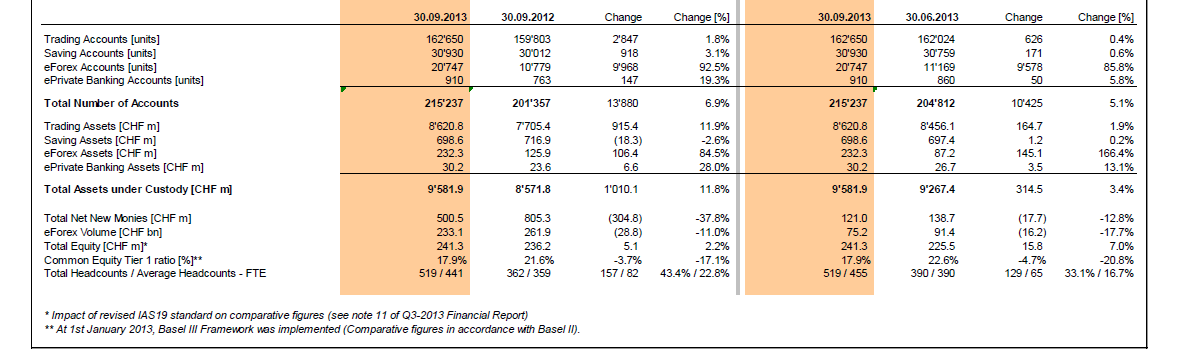
On this basis, the results for the first nine months of this year detail an increase in the number of accounts by 6.9 percent to 215,237.
The total deposit for this period weighed in at CHF 9,582 million, 11.8 percent higher than that of the same period one year previous. Furthermore, Swissquote has stated that the results for the fourth quarter show FX earnings generated by MIG Bank, which is the first time the company has included this since the acquisition, and has contributed to the positive cumulative return.
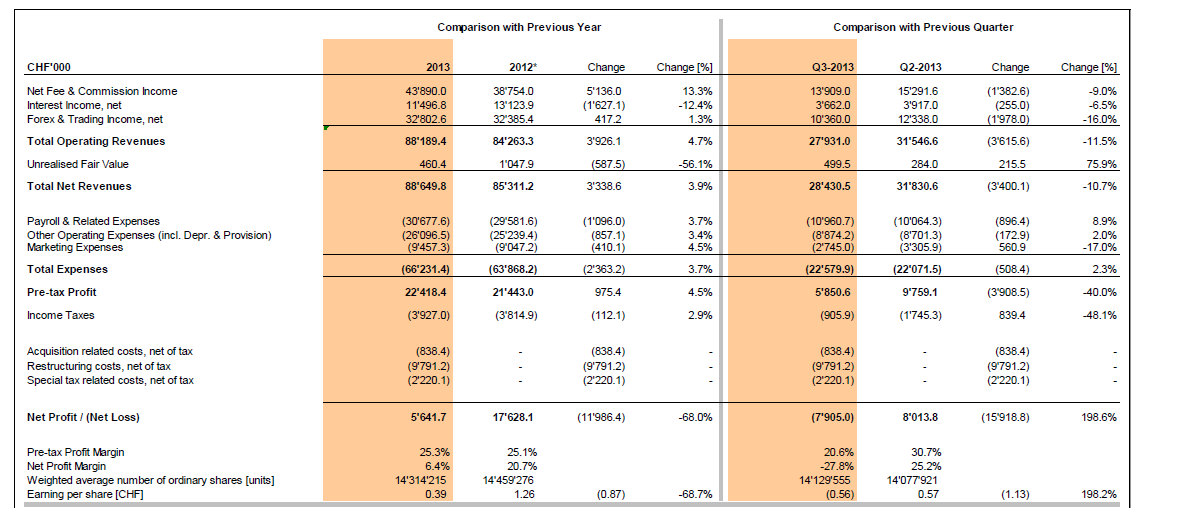
The total net revenues in the first nine months of 2013, CHF 88.6 million compared with CHF 85.3 million for the first nine months of 2012, which equates to a percentage increment of 3.9% over the prior-year period, bearing in mind an unrealized fair value of CHF 0.46 million.
Commission income increased when compared to the previous year, with net fee and commission income standing at CHF 43.9 million over last year's first nine months' CHF 38.8 million. Net interest income decreased as a result of prudent investment policy, standing at CHF 11.5 million .
Stellar Q3 of 2012 Outshines Q3 2013
Whilst comparison on a year-on-year basis paints a picture of overall revenue growth for Swissquote, the most poignant being the company's 92% increase in its number of eFX accounts over last year's first nine months, examining the figures on a quarterly basis displays a decrement.
Despite 2012's industry-wide downturn in volumes, Swissquote's results for the third quarter of 2012 outperform those of the third quarter of this year, a dynamic that is becoming somewhat omnipresent, with firms having reaped the rewards of in some cases, a record-setting start to this year with volumes tailing off as the year has progressed.
Whilst still turning a profit, the company registered a 16% decrease in FX and trading income for the third quarter of this year, standing at CHF 10.3 million compared with 12.3 million of the same quarter in 2012, despite the number of trading accounts having risen by 5.1% when compared with the same quarter a year previous.
The company holds a higher value of client assets under custody when viewed on a year-on-year and quarter-on-quarter basis, with at the end of the first nine months of 2013 a total of CHF 9.581 million under its responsibility, compared with 8.571 million at at the end of the first nine months of last year, representing an increase of 11.8% year-on-year, and 3.4% compared to quarter 3 of 2012.
Integration of MIG Bank Client Base
Swissquote has confirmed within the reporting of its results that customer relationships at MIG Bank will be open until the end of 2013, at which point they will be trasnferred to Swissquote Bank. The designation of MIG will be shelved at that time and the company's product range will be integrated into the product range of Swissquote Bank.
Swissquote has today announced its financial results for the first nine months of 2013 and the third quarter of the year. The broker reported a 3.9% increase in total income and a higher pre-tax profit than the same period one year previous, demonstrating an upward movement of 4.5%.
According to the company, the increase in net income takes into account the one-off cost and subsequent business activity resulting from the firm's acquisition of MIG Bank in September this year, subsequent to an increase in profit by 19% in the first six months of 2013, with the firm having reported a 3.7% increase in overall expenses compared with the same period last year.
MIG Bank/Swissquote M&A Details
Today's report also provided financials of September's deal for the first time (see page 12, note 10 in the PDF below). The deal was structured similar to GAIN Capital's acquisition of GFT, where a small equity premium above the broker's total cash was paid. Similarly, MIG Bank owners received CHF 40.6 million in cash and CHF 23.1 million in Swissquote stock and options. Backing out MIG Bank net assets of CHF 44.7 million, premium over net assets of the deal was CHF 19 million.
MIG Bank was sold in its entirety to Swissquote, the company's rationale having been to utilize this to greatly expand its FX operations, which was an important strategic move for the firm with FX volumes of CHF 158 billion accounting for 26.2 percent of total net revenues in the first half of 2013.
On this basis, the results for the first nine months of this year detail an increase in the number of accounts by 6.9 percent to 215,237.
The total deposit for this period weighed in at CHF 9,582 million, 11.8 percent higher than that of the same period one year previous. Furthermore, Swissquote has stated that the results for the fourth quarter show FX earnings generated by MIG Bank, which is the first time the company has included this since the acquisition, and has contributed to the positive cumulative return.
The total net revenues in the first nine months of 2013, CHF 88.6 million compared with CHF 85.3 million for the first nine months of 2012, which equates to a percentage increment of 3.9% over the prior-year period, bearing in mind an unrealized fair value of CHF 0.46 million.
Commission income increased when compared to the previous year, with net fee and commission income standing at CHF 43.9 million over last year's first nine months' CHF 38.8 million. Net interest income decreased as a result of prudent investment policy, standing at CHF 11.5 million .
Stellar Q3 of 2012 Outshines Q3 2013
Whilst comparison on a year-on-year basis paints a picture of overall revenue growth for Swissquote, the most poignant being the company's 92% increase in its number of eFX accounts over last year's first nine months, examining the figures on a quarterly basis displays a decrement.
Despite 2012's industry-wide downturn in volumes, Swissquote's results for the third quarter of 2012 outperform those of the third quarter of this year, a dynamic that is becoming somewhat omnipresent, with firms having reaped the rewards of in some cases, a record-setting start to this year with volumes tailing off as the year has progressed.
Whilst still turning a profit, the company registered a 16% decrease in FX and trading income for the third quarter of this year, standing at CHF 10.3 million compared with 12.3 million of the same quarter in 2012, despite the number of trading accounts having risen by 5.1% when compared with the same quarter a year previous.
The company holds a higher value of client assets under custody when viewed on a year-on-year and quarter-on-quarter basis, with at the end of the first nine months of 2013 a total of CHF 9.581 million under its responsibility, compared with 8.571 million at at the end of the first nine months of last year, representing an increase of 11.8% year-on-year, and 3.4% compared to quarter 3 of 2012.
Integration of MIG Bank Client Base
Swissquote has confirmed within the reporting of its results that customer relationships at MIG Bank will be open until the end of 2013, at which point they will be trasnferred to Swissquote Bank. The designation of MIG will be shelved at that time and the company's product range will be integrated into the product range of Swissquote Bank.
73% of Young Investors Say Traditional Wealth Building Is Broken – Here’s How They Trade Instead
Featured Videos
Executive Interview | Charlotte Bullock | Chief Product Officer, Bank of London | FMLS:25
In this interview, we sat down with Charlotte Bullock, Head of Product at The Bank of London, previously at SAP and now shaping product at one of the sector’s most ambitious new banking players.
Charlotte reflects on the Summit so far and talks about the culture inside fintech banks today. We look at the pressures that come with scaling, and how firms can hold onto the nimble approach that made them stand out early on.
We also cover the state of payments ahead of her appearance on the payments roundtable: the blockages financial firms face, the areas that still need fixing, and what a realistic solution looks like in 2026.
In this interview, we sat down with Charlotte Bullock, Head of Product at The Bank of London, previously at SAP and now shaping product at one of the sector’s most ambitious new banking players.
Charlotte reflects on the Summit so far and talks about the culture inside fintech banks today. We look at the pressures that come with scaling, and how firms can hold onto the nimble approach that made them stand out early on.
We also cover the state of payments ahead of her appearance on the payments roundtable: the blockages financial firms face, the areas that still need fixing, and what a realistic solution looks like in 2026.
In this interview, we sat down with Charlotte Bullock, Head of Product at The Bank of London, previously at SAP and now shaping product at one of the sector’s most ambitious new banking players.
Charlotte reflects on the Summit so far and talks about the culture inside fintech banks today. We look at the pressures that come with scaling, and how firms can hold onto the nimble approach that made them stand out early on.
We also cover the state of payments ahead of her appearance on the payments roundtable: the blockages financial firms face, the areas that still need fixing, and what a realistic solution looks like in 2026.
In this interview, we sat down with Charlotte Bullock, Head of Product at The Bank of London, previously at SAP and now shaping product at one of the sector’s most ambitious new banking players.
Charlotte reflects on the Summit so far and talks about the culture inside fintech banks today. We look at the pressures that come with scaling, and how firms can hold onto the nimble approach that made them stand out early on.
We also cover the state of payments ahead of her appearance on the payments roundtable: the blockages financial firms face, the areas that still need fixing, and what a realistic solution looks like in 2026.
In this conversation, we sit down with Drew Niv, CSO at ATFX Connect and one of the most influential figures in modern FX.
We speak about market structure, the institutional view on liquidity, and the sharp rise of prop trading, a sector Drew has been commenting on in recent months. Drew explains why he once dismissed prop trading, why his view changed, and what he now thinks the model means for brokers, clients and risk managers.
We explore subscription-fee dependency, the high reneging rate, and the long-term challenge: how brokers can build a more stable and honest version of the model. Drew also talks about the traffic advantage standalone prop firms have built and why brokers may still win in the long run if they take the right approach.
In this conversation, we sit down with Drew Niv, CSO at ATFX Connect and one of the most influential figures in modern FX.
We speak about market structure, the institutional view on liquidity, and the sharp rise of prop trading, a sector Drew has been commenting on in recent months. Drew explains why he once dismissed prop trading, why his view changed, and what he now thinks the model means for brokers, clients and risk managers.
We explore subscription-fee dependency, the high reneging rate, and the long-term challenge: how brokers can build a more stable and honest version of the model. Drew also talks about the traffic advantage standalone prop firms have built and why brokers may still win in the long run if they take the right approach.
In this conversation, we sit down with Drew Niv, CSO at ATFX Connect and one of the most influential figures in modern FX.
We speak about market structure, the institutional view on liquidity, and the sharp rise of prop trading, a sector Drew has been commenting on in recent months. Drew explains why he once dismissed prop trading, why his view changed, and what he now thinks the model means for brokers, clients and risk managers.
We explore subscription-fee dependency, the high reneging rate, and the long-term challenge: how brokers can build a more stable and honest version of the model. Drew also talks about the traffic advantage standalone prop firms have built and why brokers may still win in the long run if they take the right approach.
In this conversation, we sit down with Drew Niv, CSO at ATFX Connect and one of the most influential figures in modern FX.
We speak about market structure, the institutional view on liquidity, and the sharp rise of prop trading, a sector Drew has been commenting on in recent months. Drew explains why he once dismissed prop trading, why his view changed, and what he now thinks the model means for brokers, clients and risk managers.
We explore subscription-fee dependency, the high reneging rate, and the long-term challenge: how brokers can build a more stable and honest version of the model. Drew also talks about the traffic advantage standalone prop firms have built and why brokers may still win in the long run if they take the right approach.
In this conversation, we sit down with Drew Niv, CSO at ATFX Connect and one of the most influential figures in modern FX.
We speak about market structure, the institutional view on liquidity, and the sharp rise of prop trading, a sector Drew has been commenting on in recent months. Drew explains why he once dismissed prop trading, why his view changed, and what he now thinks the model means for brokers, clients and risk managers.
We explore subscription-fee dependency, the high reneging rate, and the long-term challenge: how brokers can build a more stable and honest version of the model. Drew also talks about the traffic advantage standalone prop firms have built and why brokers may still win in the long run if they take the right approach.
In this conversation, we sit down with Drew Niv, CSO at ATFX Connect and one of the most influential figures in modern FX.
We speak about market structure, the institutional view on liquidity, and the sharp rise of prop trading, a sector Drew has been commenting on in recent months. Drew explains why he once dismissed prop trading, why his view changed, and what he now thinks the model means for brokers, clients and risk managers.
We explore subscription-fee dependency, the high reneging rate, and the long-term challenge: how brokers can build a more stable and honest version of the model. Drew also talks about the traffic advantage standalone prop firms have built and why brokers may still win in the long run if they take the right approach.
Executive Interview | Remonda Z. Kirketerp Møller| CEO & Founder Muinmos | FMLS:25
In this interview, Remonda Z. Kirketerp Møller, founder of Muinmos, breaks down the state of AI in regtech and what responsible adoption really looks like for brokers. We talk about rising fragmentation, the pressures around compliance accuracy, and why most firms are still in the early stages of AI maturity.
Ramanda also shares insights on regulator sandboxes, shifting expectations around accountability, and the current reality of MiCA licensing and passporting in Europe.
A concise look at where compliance, onboarding, and AI-driven processes are heading next.
In this interview, Remonda Z. Kirketerp Møller, founder of Muinmos, breaks down the state of AI in regtech and what responsible adoption really looks like for brokers. We talk about rising fragmentation, the pressures around compliance accuracy, and why most firms are still in the early stages of AI maturity.
Ramanda also shares insights on regulator sandboxes, shifting expectations around accountability, and the current reality of MiCA licensing and passporting in Europe.
A concise look at where compliance, onboarding, and AI-driven processes are heading next.
In this interview, Remonda Z. Kirketerp Møller, founder of Muinmos, breaks down the state of AI in regtech and what responsible adoption really looks like for brokers. We talk about rising fragmentation, the pressures around compliance accuracy, and why most firms are still in the early stages of AI maturity.
Ramanda also shares insights on regulator sandboxes, shifting expectations around accountability, and the current reality of MiCA licensing and passporting in Europe.
A concise look at where compliance, onboarding, and AI-driven processes are heading next.
In this interview, Remonda Z. Kirketerp Møller, founder of Muinmos, breaks down the state of AI in regtech and what responsible adoption really looks like for brokers. We talk about rising fragmentation, the pressures around compliance accuracy, and why most firms are still in the early stages of AI maturity.
Ramanda also shares insights on regulator sandboxes, shifting expectations around accountability, and the current reality of MiCA licensing and passporting in Europe.
A concise look at where compliance, onboarding, and AI-driven processes are heading next.
In this interview, Remonda Z. Kirketerp Møller, founder of Muinmos, breaks down the state of AI in regtech and what responsible adoption really looks like for brokers. We talk about rising fragmentation, the pressures around compliance accuracy, and why most firms are still in the early stages of AI maturity.
Ramanda also shares insights on regulator sandboxes, shifting expectations around accountability, and the current reality of MiCA licensing and passporting in Europe.
A concise look at where compliance, onboarding, and AI-driven processes are heading next.
In this interview, Remonda Z. Kirketerp Møller, founder of Muinmos, breaks down the state of AI in regtech and what responsible adoption really looks like for brokers. We talk about rising fragmentation, the pressures around compliance accuracy, and why most firms are still in the early stages of AI maturity.
Ramanda also shares insights on regulator sandboxes, shifting expectations around accountability, and the current reality of MiCA licensing and passporting in Europe.
A concise look at where compliance, onboarding, and AI-driven processes are heading next.
In this conversation, we speak with Aydin Bonabi, CEO and co-founder of Surveill, a firm focused on fraud detection and AI-driven compliance tools for financial institutions.
We start with Aydin’s view of the Summit and the challenges brokers face as fraud tactics grow more complex. He explains how firms can stay ahead through real-time signals, data patterns, and early-stage detection.
We also talk about AI training and why compliance teams often struggle to keep models accurate, fair, and aligned with regulatory expectations. Aydin breaks down what “good” AI training looks like inside a financial environment, including the importance of clean data, domain expertise, and human oversight.
He closes with a clear message: fraud is scaling, and so must the tools that stop it.
In this conversation, we speak with Aydin Bonabi, CEO and co-founder of Surveill, a firm focused on fraud detection and AI-driven compliance tools for financial institutions.
We start with Aydin’s view of the Summit and the challenges brokers face as fraud tactics grow more complex. He explains how firms can stay ahead through real-time signals, data patterns, and early-stage detection.
We also talk about AI training and why compliance teams often struggle to keep models accurate, fair, and aligned with regulatory expectations. Aydin breaks down what “good” AI training looks like inside a financial environment, including the importance of clean data, domain expertise, and human oversight.
He closes with a clear message: fraud is scaling, and so must the tools that stop it.
In this conversation, we speak with Aydin Bonabi, CEO and co-founder of Surveill, a firm focused on fraud detection and AI-driven compliance tools for financial institutions.
We start with Aydin’s view of the Summit and the challenges brokers face as fraud tactics grow more complex. He explains how firms can stay ahead through real-time signals, data patterns, and early-stage detection.
We also talk about AI training and why compliance teams often struggle to keep models accurate, fair, and aligned with regulatory expectations. Aydin breaks down what “good” AI training looks like inside a financial environment, including the importance of clean data, domain expertise, and human oversight.
He closes with a clear message: fraud is scaling, and so must the tools that stop it.
In this conversation, we speak with Aydin Bonabi, CEO and co-founder of Surveill, a firm focused on fraud detection and AI-driven compliance tools for financial institutions.
We start with Aydin’s view of the Summit and the challenges brokers face as fraud tactics grow more complex. He explains how firms can stay ahead through real-time signals, data patterns, and early-stage detection.
We also talk about AI training and why compliance teams often struggle to keep models accurate, fair, and aligned with regulatory expectations. Aydin breaks down what “good” AI training looks like inside a financial environment, including the importance of clean data, domain expertise, and human oversight.
He closes with a clear message: fraud is scaling, and so must the tools that stop it.
In this conversation, we speak with Aydin Bonabi, CEO and co-founder of Surveill, a firm focused on fraud detection and AI-driven compliance tools for financial institutions.
We start with Aydin’s view of the Summit and the challenges brokers face as fraud tactics grow more complex. He explains how firms can stay ahead through real-time signals, data patterns, and early-stage detection.
We also talk about AI training and why compliance teams often struggle to keep models accurate, fair, and aligned with regulatory expectations. Aydin breaks down what “good” AI training looks like inside a financial environment, including the importance of clean data, domain expertise, and human oversight.
He closes with a clear message: fraud is scaling, and so must the tools that stop it.
In this conversation, we speak with Aydin Bonabi, CEO and co-founder of Surveill, a firm focused on fraud detection and AI-driven compliance tools for financial institutions.
We start with Aydin’s view of the Summit and the challenges brokers face as fraud tactics grow more complex. He explains how firms can stay ahead through real-time signals, data patterns, and early-stage detection.
We also talk about AI training and why compliance teams often struggle to keep models accurate, fair, and aligned with regulatory expectations. Aydin breaks down what “good” AI training looks like inside a financial environment, including the importance of clean data, domain expertise, and human oversight.
He closes with a clear message: fraud is scaling, and so must the tools that stop it.
Exness expands its presence in Africa: Inside our interview with Paul Margarites in Cape Town
Finance Magnates met with Paul Margarites, Exness regional commercial director for Sub-Saharan Africa, during a visit to the firm’s office opening in Cape Town. In this talk, led by Andrea Badiola Mateos, Co-CEO at Finance Magnates, Paul shares views on the South African trading space, local user behavior, mobile trends, regulation, team growth, and how Exness plans to grow in more markets across the region. @Exness
Read the article at: https://www.financemagnates.com/thought-leadership/exness-expands-its-presence-in-africa-inside-our-interview-with-paul-margarites/
#exness #financemagnates #exnesstrading #CFDtrading #tradeonline #africanews #capetown
Finance Magnates met with Paul Margarites, Exness regional commercial director for Sub-Saharan Africa, during a visit to the firm’s office opening in Cape Town. In this talk, led by Andrea Badiola Mateos, Co-CEO at Finance Magnates, Paul shares views on the South African trading space, local user behavior, mobile trends, regulation, team growth, and how Exness plans to grow in more markets across the region. @Exness
Read the article at: https://www.financemagnates.com/thought-leadership/exness-expands-its-presence-in-africa-inside-our-interview-with-paul-margarites/
#exness #financemagnates #exnesstrading #CFDtrading #tradeonline #africanews #capetown
Finance Magnates met with Paul Margarites, Exness regional commercial director for Sub-Saharan Africa, during a visit to the firm’s office opening in Cape Town. In this talk, led by Andrea Badiola Mateos, Co-CEO at Finance Magnates, Paul shares views on the South African trading space, local user behavior, mobile trends, regulation, team growth, and how Exness plans to grow in more markets across the region. @Exness
Read the article at: https://www.financemagnates.com/thought-leadership/exness-expands-its-presence-in-africa-inside-our-interview-with-paul-margarites/
#exness #financemagnates #exnesstrading #CFDtrading #tradeonline #africanews #capetown
Finance Magnates met with Paul Margarites, Exness regional commercial director for Sub-Saharan Africa, during a visit to the firm’s office opening in Cape Town. In this talk, led by Andrea Badiola Mateos, Co-CEO at Finance Magnates, Paul shares views on the South African trading space, local user behavior, mobile trends, regulation, team growth, and how Exness plans to grow in more markets across the region. @Exness
Read the article at: https://www.financemagnates.com/thought-leadership/exness-expands-its-presence-in-africa-inside-our-interview-with-paul-margarites/
#exness #financemagnates #exnesstrading #CFDtrading #tradeonline #africanews #capetown
Finance Magnates met with Paul Margarites, Exness regional commercial director for Sub-Saharan Africa, during a visit to the firm’s office opening in Cape Town. In this talk, led by Andrea Badiola Mateos, Co-CEO at Finance Magnates, Paul shares views on the South African trading space, local user behavior, mobile trends, regulation, team growth, and how Exness plans to grow in more markets across the region. @Exness
Read the article at: https://www.financemagnates.com/thought-leadership/exness-expands-its-presence-in-africa-inside-our-interview-with-paul-margarites/
#exness #financemagnates #exnesstrading #CFDtrading #tradeonline #africanews #capetown
Finance Magnates met with Paul Margarites, Exness regional commercial director for Sub-Saharan Africa, during a visit to the firm’s office opening in Cape Town. In this talk, led by Andrea Badiola Mateos, Co-CEO at Finance Magnates, Paul shares views on the South African trading space, local user behavior, mobile trends, regulation, team growth, and how Exness plans to grow in more markets across the region. @Exness
Read the article at: https://www.financemagnates.com/thought-leadership/exness-expands-its-presence-in-africa-inside-our-interview-with-paul-margarites/
#exness #financemagnates #exnesstrading #CFDtrading #tradeonline #africanews #capetown