FXCM Receives NYSE Notification as Share Price Continues to Underperform
Wednesday,09/09/2015|21:23GMTby
Andy Traveller
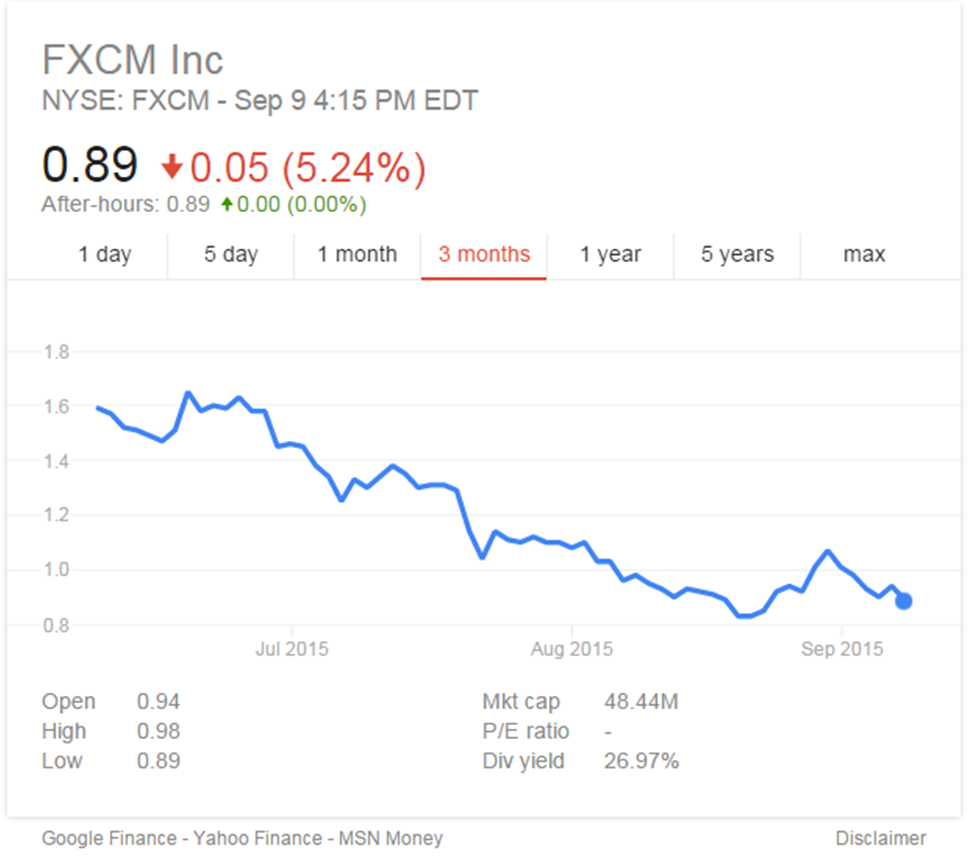
As the company's share price struggles to stay above $1.00 per share, it risks being delisted from the NYSE.
Leading online Forex and CFD broker, FXCM Inc (NYSE:FXCM), announced that it was notified on September 3, 2015, by the New York Stock Exchange (NYSE) that it was not in compliance with the continued listing standards.
Under section 802.01C of the Listed Company Manual of the NYSE, listed companies are required to maintain an average closing price of the company’s common stock above $1.00 per share.
However, FXCM’s shares have been on a downward trend since the company took a heavy hit on Black Thursday back in January, when the Swiss National Bank decided to unpeg the franc, sending the currency soaring.
Since then, its share price has continued to fall. The notification letter cited that FXCM’s share price had fallen below $1.00 per share over a period of 30 consecutive trading days, which is the minimum average share price for continued listing on the NYSE.
Without a major reversal of the company’s fortunes, the reverse stock split appears to be the only avenue to cure the price condition. Under NYSE rules, the Company has six months following receipt of the notification to regain compliance with the minimum share price requirement.
The Board ... encourages all shareholders to vote in favor for the reverse stock split as this could ensure the avoidance of a delisting.
FXCM has urged shareholders to approve the split, saying: “The Company and Board of Directors believe that effecting the reverse stock split is in the Company’s and shareholders’ best interests and encourage all shareholders of record to vote in favor for the reverse stock split as this could ensure the avoidance of a delisting.”
In a statement, FXCM was keen to point out that “the notice has no immediate impact on the listing of the Company’s common stock, which will continue to trade on the NYSE under the symbol “FXCM”. At this time, the Company believes that neither the notice nor a possible future delisting will have an impact on FXCM’s business operation or its activities as an online FX trading broker.”
Leading online Forex and CFD broker, FXCM Inc (NYSE:FXCM), announced that it was notified on September 3, 2015, by the New York Stock Exchange (NYSE) that it was not in compliance with the continued listing standards.
Under section 802.01C of the Listed Company Manual of the NYSE, listed companies are required to maintain an average closing price of the company’s common stock above $1.00 per share.
However, FXCM’s shares have been on a downward trend since the company took a heavy hit on Black Thursday back in January, when the Swiss National Bank decided to unpeg the franc, sending the currency soaring.
Since then, its share price has continued to fall. The notification letter cited that FXCM’s share price had fallen below $1.00 per share over a period of 30 consecutive trading days, which is the minimum average share price for continued listing on the NYSE.
Without a major reversal of the company’s fortunes, the reverse stock split appears to be the only avenue to cure the price condition. Under NYSE rules, the Company has six months following receipt of the notification to regain compliance with the minimum share price requirement.
The Board ... encourages all shareholders to vote in favor for the reverse stock split as this could ensure the avoidance of a delisting.
FXCM has urged shareholders to approve the split, saying: “The Company and Board of Directors believe that effecting the reverse stock split is in the Company’s and shareholders’ best interests and encourage all shareholders of record to vote in favor for the reverse stock split as this could ensure the avoidance of a delisting.”
In a statement, FXCM was keen to point out that “the notice has no immediate impact on the listing of the Company’s common stock, which will continue to trade on the NYSE under the symbol “FXCM”. At this time, the Company believes that neither the notice nor a possible future delisting will have an impact on FXCM’s business operation or its activities as an online FX trading broker.”
Italy’s Consob Tightens Net on AI-Fueled Scams With Fresh Website Bans
FP Markets Winner Spotlight 🏆 | Global Broker of the Year 2025 #Trading #Broker #Innovation #Shorts
FP Markets Winner Spotlight 🏆 | Global Broker of the Year 2025 #Trading #Broker #Innovation #Shorts
FP Markets takes the spotlight as Global Broker of the Year 2025 at the Finance Magnates Awards.
Martin Stoilov, Head of Client Experience, shares that trust, innovation, and people played a key role in the company’s success, supported by a strong foundation of integrity and client-centricity.
Following this milestone, FP Markets continues to focus on growth, technology investment, and its core values of transparency and excellence.
👉 Be part of FM Awards 2026: https://awards.financemagnates.com/#nominate
FP Markets takes the spotlight as Global Broker of the Year 2025 at the Finance Magnates Awards.
Martin Stoilov, Head of Client Experience, shares that trust, innovation, and people played a key role in the company’s success, supported by a strong foundation of integrity and client-centricity.
Following this milestone, FP Markets continues to focus on growth, technology investment, and its core values of transparency and excellence.
👉 Be part of FM Awards 2026: https://awards.financemagnates.com/#nominate
In this video, we review @HolaPrimeMarketsOfficial, a multi-asset forex and CFDs broker offering different account types, trading platforms, and flexible trading conditions.
We cover the broker’s overall offering, including account options, trading environment, platforms like MT4 and MT5, and additional services such as managed accounts and fast withdrawals.
Watch the full video to see if Hola Prime Markets fits your trading needs.
📣 Stay up to date with the latest in finance and trading. Follow Finance Magnates for industry news, insights, and global event coverage.
Connect with us:
🔗 LinkedIn: /financemagnates
👍 Facebook: /financemagnates
📸 Instagram: https://www.instagram.com/financemagnates
🐦 X: https://x.com/financemagnates
🎥 TikTok: https://www.tiktok.com/tag/financemagnates
▶️ YouTube: /@financemagnates_official
#HolaPrime #ForexBroker #CFDTrading #FinanceMagnates #Trading #Forex #BrokerReview
In this video, we review @HolaPrimeMarketsOfficial, a multi-asset forex and CFDs broker offering different account types, trading platforms, and flexible trading conditions.
We cover the broker’s overall offering, including account options, trading environment, platforms like MT4 and MT5, and additional services such as managed accounts and fast withdrawals.
Watch the full video to see if Hola Prime Markets fits your trading needs.
📣 Stay up to date with the latest in finance and trading. Follow Finance Magnates for industry news, insights, and global event coverage.
Connect with us:
🔗 LinkedIn: /financemagnates
👍 Facebook: /financemagnates
📸 Instagram: https://www.instagram.com/financemagnates
🐦 X: https://x.com/financemagnates
🎥 TikTok: https://www.tiktok.com/tag/financemagnates
▶️ YouTube: /@financemagnates_official
#HolaPrime #ForexBroker #CFDTrading #FinanceMagnates #Trading #Forex #BrokerReview
Hola Prime Review: What You Need to Know | Full Breakdown by Finance Magnates
Hola Prime Review: What You Need to Know | Full Breakdown by Finance Magnates
In this video, we review @HolaPrime_Global, a proprietary trading firm offering evaluation programs and performance-based payouts in simulated market environments.
We cover how the challenge model works, including account types, profit splits (up to 95%), trading rules, and what it takes to reach a funded account. You’ll also learn about available platforms like MT4, MT5, cTrader, and more, along with insights into payouts, support, and trading conditions.
Watch the full video to see if Hola Prime fits your trading style.
📣 Stay up to date with the latest in finance and trading. Follow Finance Magnates for industry news, insights, and global event coverage.
Connect with us:
🔗 LinkedIn: /financemagnates
👍 Facebook: /financemagnates
📸 Instagram: https://www.instagram.com/financemagnates
🐦 X: https://x.com/financemagnates
🎥 TikTok: https://www.tiktok.com/tag/financemagnates
▶️ YouTube: /@financemagnates_official
#HolaPrime #PropFirm #Trading #FinanceMagnates #Forex #FuturesTrading #TradingReview #PropFirmReview
In this video, we review @HolaPrime_Global, a proprietary trading firm offering evaluation programs and performance-based payouts in simulated market environments.
We cover how the challenge model works, including account types, profit splits (up to 95%), trading rules, and what it takes to reach a funded account. You’ll also learn about available platforms like MT4, MT5, cTrader, and more, along with insights into payouts, support, and trading conditions.
Watch the full video to see if Hola Prime fits your trading style.
📣 Stay up to date with the latest in finance and trading. Follow Finance Magnates for industry news, insights, and global event coverage.
Connect with us:
🔗 LinkedIn: /financemagnates
👍 Facebook: /financemagnates
📸 Instagram: https://www.instagram.com/financemagnates
🐦 X: https://x.com/financemagnates
🎥 TikTok: https://www.tiktok.com/tag/financemagnates
▶️ YouTube: /@financemagnates_official
#HolaPrime #PropFirm #Trading #FinanceMagnates #Forex #FuturesTrading #TradingReview #PropFirmReview
Axi Winner Spotlight 🏆 | Global Most Innovative Broker 2025 #Innovation #Trading #Fintech #Broker
Axi Winner Spotlight 🏆 | Global Most Innovative Broker 2025 #Innovation #Trading #Fintech #Broker
Axi takes the spotlight at the Finance Magnates Awards, winning Global Most Innovative Broker 2025.
Olivia Xenofontos and Ivanna Openko share how the team will feel: proud, motivated, and ready to keep delivering.
They also describe the night as well-organized, focused, and enjoyable for all.
👉 Be part of FM Awards 2026.
Axi takes the spotlight at the Finance Magnates Awards, winning Global Most Innovative Broker 2025.
Olivia Xenofontos and Ivanna Openko share how the team will feel: proud, motivated, and ready to keep delivering.
They also describe the night as well-organized, focused, and enjoyable for all.
👉 Be part of FM Awards 2026.
Recognition that matters.
Built on transparency.
Driven by the industry.
The Finance Magnates Awards 2026.
Nominations are now open.
🔗 https://awards.financemagnates.com/?utm_source=SM&utm_medium=social&utm_campaign=recognition-matters
Recognition that matters.
Built on transparency.
Driven by the industry.
The Finance Magnates Awards 2026.
Nominations are now open.
🔗 https://awards.financemagnates.com/?utm_source=SM&utm_medium=social&utm_campaign=recognition-matters