This is the full document of the class action suit filed against Bank of New York Mellon (BNY Mellon) by Southeastern Pennsylvania Transportation Authority (SEPTA). If this is indeed what happened then it's simply terrible:
As detailed in the Florida and Virginia Actions, from at least 2000, and continuing through the present day, BNY Mellon has manipulated FX transactions executed by the Company in order to maximize profits to BNY Mellon at the expense of the Company's clients, such as SEPTA.
In essence, BNY Mellon charges its clients inflated FX rates when buying foreign currency, and deflated FX rates when selling foreign currency. The rate BNY Mellon actually charges clients is set after a FX transaction is executed and after the Company has an opportunity to observe post-Execution changes in the FX currency market. The difference between the actual FX transaction price and the amount ultimately charged to BNY Mellon's clients is pocketed by the Company as profit.
BNY Mellon's practices remained unknown to Plaintiff and the Class until the Florida and Virginia Actions were unsealed because, inter alia, the account statements provided to BNY Mellon's clients failed to provide pertinent details including time stamps for each FX transaction. Without FX time stamps, clients were unable to verify that the FX rates charged by BNY Mellon were consistent with the actual FX rates at the time the FX transactions were executed. Moreover, according to the Florida Action, in order to avoid detection of its conduct the Company provided its clients account statements that showed FX rates that fell within the daily trading range. BNY Mellon also used employees located in New York and Pittsburgh to hold "reconciliation" calls to "choose foreign exchange rates, i.e., the Falsified FX Rates, of the false price to charge" the Company's clients.
BNY Mellon's actions have generated hundreds of millions of dollars annually in unwarranted profits - wrongly taken from BNY Mellon's clients -and may account for more than one-half of BNY Mellon's entire annual FX trading profits.
SEPTA relies on the action brought against BNY Mellon by FX Analytics in Virginia and Florida, which amongst other things states the following:
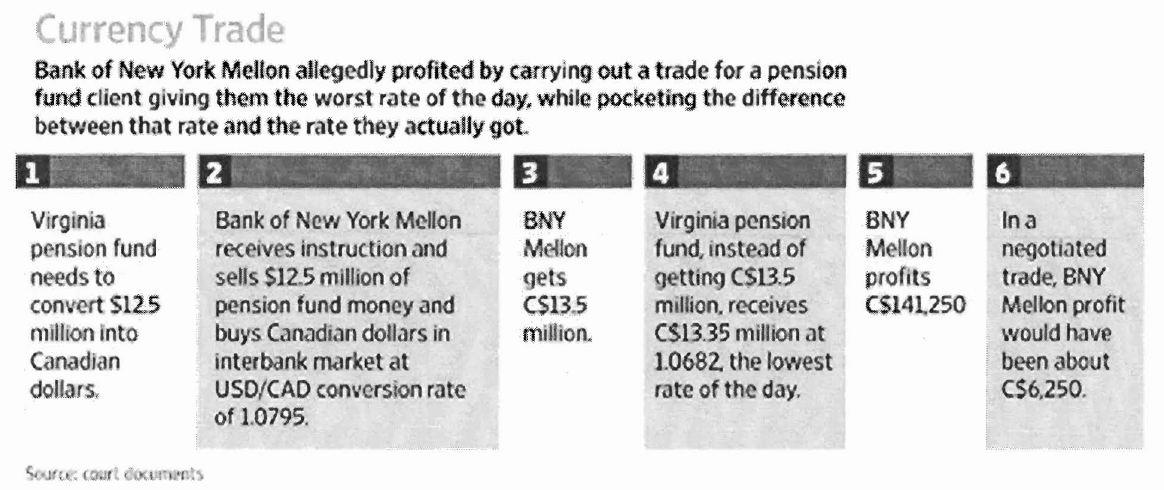
According to the complaints filed in the Virginia and Florida Actions, when BNY Mellon received instructions to execute a foreign trade, it would convert funds from USD into a foreign currency to complete the transaction. After the trade was executed, "[BNY Mellon] would note the low and high exchange rate of the day for the two currencies involved in the FX trade."
At the end of the trading day, BNY Mellon sinlply "ignored the price [it] paid for the FX [conversion]" and charged its clients for the "FX transaction as if the trade occurred at either the high or low of the day (depending on the nature of the transaction, buy or sell), in order to charge [its clients] the least favorable rate that occurred that trading day."
Example of a transaction brought in the document:
Click Read More below to see the full court document.
// <![CDATA[
var docstoc_docid="73586260";var docstoc_title="class action suit against BNY Mellon";var docstoc_urltitle="class action suit against BNY Mellon";
This is the full document of the class action suit filed against Bank of New York Mellon (BNY Mellon) by Southeastern Pennsylvania Transportation Authority (SEPTA). If this is indeed what happened then it's simply terrible:
As detailed in the Florida and Virginia Actions, from at least 2000, and continuing through the present day, BNY Mellon has manipulated FX transactions executed by the Company in order to maximize profits to BNY Mellon at the expense of the Company's clients, such as SEPTA.
In essence, BNY Mellon charges its clients inflated FX rates when buying foreign currency, and deflated FX rates when selling foreign currency. The rate BNY Mellon actually charges clients is set after a FX transaction is executed and after the Company has an opportunity to observe post-Execution changes in the FX currency market. The difference between the actual FX transaction price and the amount ultimately charged to BNY Mellon's clients is pocketed by the Company as profit.
BNY Mellon's practices remained unknown to Plaintiff and the Class until the Florida and Virginia Actions were unsealed because, inter alia, the account statements provided to BNY Mellon's clients failed to provide pertinent details including time stamps for each FX transaction. Without FX time stamps, clients were unable to verify that the FX rates charged by BNY Mellon were consistent with the actual FX rates at the time the FX transactions were executed. Moreover, according to the Florida Action, in order to avoid detection of its conduct the Company provided its clients account statements that showed FX rates that fell within the daily trading range. BNY Mellon also used employees located in New York and Pittsburgh to hold "reconciliation" calls to "choose foreign exchange rates, i.e., the Falsified FX Rates, of the false price to charge" the Company's clients.
BNY Mellon's actions have generated hundreds of millions of dollars annually in unwarranted profits - wrongly taken from BNY Mellon's clients -and may account for more than one-half of BNY Mellon's entire annual FX trading profits.
SEPTA relies on the action brought against BNY Mellon by FX Analytics in Virginia and Florida, which amongst other things states the following:
According to the complaints filed in the Virginia and Florida Actions, when BNY Mellon received instructions to execute a foreign trade, it would convert funds from USD into a foreign currency to complete the transaction. After the trade was executed, "[BNY Mellon] would note the low and high exchange rate of the day for the two currencies involved in the FX trade."
At the end of the trading day, BNY Mellon sinlply "ignored the price [it] paid for the FX [conversion]" and charged its clients for the "FX transaction as if the trade occurred at either the high or low of the day (depending on the nature of the transaction, buy or sell), in order to charge [its clients] the least favorable rate that occurred that trading day."
Example of a transaction brought in the document:
Click Read More below to see the full court document.
// <![CDATA[
var docstoc_docid="73586260";var docstoc_title="class action suit against BNY Mellon";var docstoc_urltitle="class action suit against BNY Mellon";
Retail Trading & Prop Firms in 2025: Five Defining Trends - And One Prediction for 2026
Executive Interview | Charlotte Bullock | Chief Product Officer, Bank of London | FMLS:25
In this interview, we sat down with Charlotte Bullock, Head of Product at The Bank of London, previously at SAP and now shaping product at one of the sector’s most ambitious new banking players.
Charlotte reflects on the Summit so far and talks about the culture inside fintech banks today. We look at the pressures that come with scaling, and how firms can hold onto the nimble approach that made them stand out early on.
We also cover the state of payments ahead of her appearance on the payments roundtable: the blockages financial firms face, the areas that still need fixing, and what a realistic solution looks like in 2026.
In this interview, we sat down with Charlotte Bullock, Head of Product at The Bank of London, previously at SAP and now shaping product at one of the sector’s most ambitious new banking players.
Charlotte reflects on the Summit so far and talks about the culture inside fintech banks today. We look at the pressures that come with scaling, and how firms can hold onto the nimble approach that made them stand out early on.
We also cover the state of payments ahead of her appearance on the payments roundtable: the blockages financial firms face, the areas that still need fixing, and what a realistic solution looks like in 2026.
In this conversation, we sit down with Drew Niv, CSO at ATFX Connect and one of the most influential figures in modern FX.
We speak about market structure, the institutional view on liquidity, and the sharp rise of prop trading, a sector Drew has been commenting on in recent months. Drew explains why he once dismissed prop trading, why his view changed, and what he now thinks the model means for brokers, clients and risk managers.
We explore subscription-fee dependency, the high reneging rate, and the long-term challenge: how brokers can build a more stable and honest version of the model. Drew also talks about the traffic advantage standalone prop firms have built and why brokers may still win in the long run if they take the right approach.
In this conversation, we sit down with Drew Niv, CSO at ATFX Connect and one of the most influential figures in modern FX.
We speak about market structure, the institutional view on liquidity, and the sharp rise of prop trading, a sector Drew has been commenting on in recent months. Drew explains why he once dismissed prop trading, why his view changed, and what he now thinks the model means for brokers, clients and risk managers.
We explore subscription-fee dependency, the high reneging rate, and the long-term challenge: how brokers can build a more stable and honest version of the model. Drew also talks about the traffic advantage standalone prop firms have built and why brokers may still win in the long run if they take the right approach.
Executive Interview | Remonda Z. Kirketerp Møller| CEO & Founder Muinmos | FMLS:25
In this interview, Remonda Z. Kirketerp Møller, founder of Muinmos, breaks down the state of AI in regtech and what responsible adoption really looks like for brokers. We talk about rising fragmentation, the pressures around compliance accuracy, and why most firms are still in the early stages of AI maturity.
Ramanda also shares insights on regulator sandboxes, shifting expectations around accountability, and the current reality of MiCA licensing and passporting in Europe.
A concise look at where compliance, onboarding, and AI-driven processes are heading next.
In this interview, Remonda Z. Kirketerp Møller, founder of Muinmos, breaks down the state of AI in regtech and what responsible adoption really looks like for brokers. We talk about rising fragmentation, the pressures around compliance accuracy, and why most firms are still in the early stages of AI maturity.
Ramanda also shares insights on regulator sandboxes, shifting expectations around accountability, and the current reality of MiCA licensing and passporting in Europe.
A concise look at where compliance, onboarding, and AI-driven processes are heading next.
In this conversation, we speak with Aydin Bonabi, CEO and co-founder of Surveill, a firm focused on fraud detection and AI-driven compliance tools for financial institutions.
We start with Aydin’s view of the Summit and the challenges brokers face as fraud tactics grow more complex. He explains how firms can stay ahead through real-time signals, data patterns, and early-stage detection.
We also talk about AI training and why compliance teams often struggle to keep models accurate, fair, and aligned with regulatory expectations. Aydin breaks down what “good” AI training looks like inside a financial environment, including the importance of clean data, domain expertise, and human oversight.
He closes with a clear message: fraud is scaling, and so must the tools that stop it.
In this conversation, we speak with Aydin Bonabi, CEO and co-founder of Surveill, a firm focused on fraud detection and AI-driven compliance tools for financial institutions.
We start with Aydin’s view of the Summit and the challenges brokers face as fraud tactics grow more complex. He explains how firms can stay ahead through real-time signals, data patterns, and early-stage detection.
We also talk about AI training and why compliance teams often struggle to keep models accurate, fair, and aligned with regulatory expectations. Aydin breaks down what “good” AI training looks like inside a financial environment, including the importance of clean data, domain expertise, and human oversight.
He closes with a clear message: fraud is scaling, and so must the tools that stop it.
Exness expands its presence in Africa: Inside our interview with Paul Margarites in Cape Town
Finance Magnates met with Paul Margarites, Exness regional commercial director for Sub-Saharan Africa, during a visit to the firm’s office opening in Cape Town. In this talk, led by Andrea Badiola Mateos, Co-CEO at Finance Magnates, Paul shares views on the South African trading space, local user behavior, mobile trends, regulation, team growth, and how Exness plans to grow in more markets across the region. @Exness
Read the article at: https://www.financemagnates.com/thought-leadership/exness-expands-its-presence-in-africa-inside-our-interview-with-paul-margarites/
#exness #financemagnates #exnesstrading #CFDtrading #tradeonline #africanews #capetown
Finance Magnates met with Paul Margarites, Exness regional commercial director for Sub-Saharan Africa, during a visit to the firm’s office opening in Cape Town. In this talk, led by Andrea Badiola Mateos, Co-CEO at Finance Magnates, Paul shares views on the South African trading space, local user behavior, mobile trends, regulation, team growth, and how Exness plans to grow in more markets across the region. @Exness
Read the article at: https://www.financemagnates.com/thought-leadership/exness-expands-its-presence-in-africa-inside-our-interview-with-paul-margarites/
#exness #financemagnates #exnesstrading #CFDtrading #tradeonline #africanews #capetown