Capital.com shares some data insights about its machine learning effort.
Flickr
Since its launch, Capital.com has emphasized that the company is focusing on developing an AI assistant to traders. The firm has been developing machine learning techniques to optimize the experience of its clients.
The company’s CEO, Ivan Gowan, shared with Finance Magnates some insights on trading behavior and on the demonstrated potential of AI-assisted trading. With the clear conclusion that traders aren’t perfect, becoming more aware of your own mistakes can make a difference.
Highlighting the conflicts between the cortex and the limbic system in our decision-making process, Capital.com’s CEO explains a dilemma that all traders face one time or another.
Ivan Gowan, CEO of Capital.com
“When we trade, rational and irrational parts of our brains work simultaneously: we consciously make decisions that we believe to be rational while under the influence of external – and often unrecognized – forces,” Gowan explained.
Majority of Trades Profitable
The company’s research shows that the majority of trades made by clients are profitable. This runs contrary to the popular belief that retail traders are wrong more frequently than not. It also runs contrary to the dismal profitability disclaimers that brokers had to start publishing in August.
Capital.com's CEO shares that in one particular case, a trader has been correct in predicting the EUR/USD price on 61% of occasions. With an average loss of 48 pips, however, he was doomed to fail as his average losing trade was worth 83 pips.
The company’s goal has been to be able to limit the number of its clients that lose money. The AI system of Capital.com that analyses trading behavior is capable to identify over 50 biases that commonly – and unknowingly – affect traders.
Based on psychology and user behavior within the app, the AI assistant provides personalized feedback, tips, and solutions. “Because our AI system is iterative, we are constantly making changes to the system to help it to help you to make better trading decisions,” Gowan elaborated of the company’s machine learning-based app.
Is the AI System Helping Clients?
“Since introducing our AI system in 2017, the outcome is unmistakable: more of clients are keeping their hard-earned profits than ever before,” says Gowan.
In another data collection effort, the company analyzed all clients who opened more than 10 trades between May and August. On average, unsuccessful traders held losing positions 4.7 times longer than profitable traders. This set of data confirmed that the human mind keeps playing tricks on traders.
Thousands of years of evolution have resulted in the human brain adopting an automated decision to delay losses and take profits quickly. Any experienced financial markets professional will tell you that in order to succeed you must do the opposite. The phenomenon is called disposition bias.
“In a situation like this, the use of machine learning to suggest relevant educational material and target traders who showed signs of the disposition bias in their trading activity means we are able to help our clients learn from their decisions and improve their entry and exit points in the future,” Gowan said.
Traders adopting stop losses, are faring better
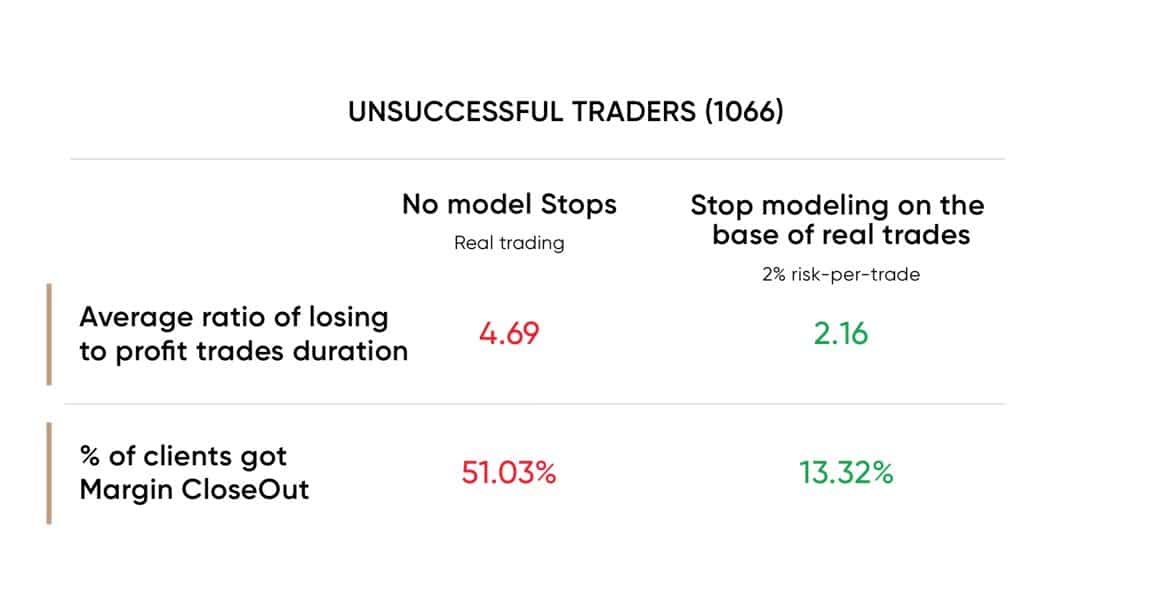
He further elaborated on a key metric valid for clients of Capital.com. Only 30 percent of the broker’s clients use stop-loss orders. Adopting a stop-loss of two percent of capital, the company modeled that time spent on losing positions would decrease 2.16 times when compared to winning ones.
In addition, the same stop-loss modeling shows that only 13.3 percent of clients would experience a margin close-out – compared to the 51 percent who saw margin close-outs occur in reality.
“By analyzing trading behavior in this way, we are helping traders in these situations by sending them personalized messages to remind them of the ability to set stops on their trades, helping them to profit,” the CEO of Capital.com explained.
Broker-Client Relationship Optimisation
Aside from assisting clients, the AI system in place at Capital.com also helps the brokerage to provide them with more relevant information. The company is aiming to deliver to traders only information which they might find interesting.
“The AI system helps us to group users based on their location and the markets they are most interested to enable collaborative filtering, which allows us to offer insights on a cluster of markets that are traded by similar uses in a particular geographical area,” Gowan shared.
While during the years, data analysts might have been able to deliver some insights on client segmentation, machine learning is taking brokerage operations to the next level.
The necessity for a differentiating product on part of brokers is key to success in the new global regulatory environment. With technology being the main differentiator in this industry, the likelihood that you might need to harness machine learning to improve your offering to clients is getting higher.
FX and CFDs broking has become a more capital-intensive business. Just like the old times, the best way to invest is still into people and technology, so be careful not to put all your eggs in one basket.
Since its launch, Capital.com has emphasized that the company is focusing on developing an AI assistant to traders. The firm has been developing machine learning techniques to optimize the experience of its clients.
The company’s CEO, Ivan Gowan, shared with Finance Magnates some insights on trading behavior and on the demonstrated potential of AI-assisted trading. With the clear conclusion that traders aren’t perfect, becoming more aware of your own mistakes can make a difference.
Highlighting the conflicts between the cortex and the limbic system in our decision-making process, Capital.com’s CEO explains a dilemma that all traders face one time or another.
Ivan Gowan, CEO of Capital.com
“When we trade, rational and irrational parts of our brains work simultaneously: we consciously make decisions that we believe to be rational while under the influence of external – and often unrecognized – forces,” Gowan explained.
Majority of Trades Profitable
The company’s research shows that the majority of trades made by clients are profitable. This runs contrary to the popular belief that retail traders are wrong more frequently than not. It also runs contrary to the dismal profitability disclaimers that brokers had to start publishing in August.
Capital.com's CEO shares that in one particular case, a trader has been correct in predicting the EUR/USD price on 61% of occasions. With an average loss of 48 pips, however, he was doomed to fail as his average losing trade was worth 83 pips.
The company’s goal has been to be able to limit the number of its clients that lose money. The AI system of Capital.com that analyses trading behavior is capable to identify over 50 biases that commonly – and unknowingly – affect traders.
Based on psychology and user behavior within the app, the AI assistant provides personalized feedback, tips, and solutions. “Because our AI system is iterative, we are constantly making changes to the system to help it to help you to make better trading decisions,” Gowan elaborated of the company’s machine learning-based app.
Is the AI System Helping Clients?
“Since introducing our AI system in 2017, the outcome is unmistakable: more of clients are keeping their hard-earned profits than ever before,” says Gowan.
In another data collection effort, the company analyzed all clients who opened more than 10 trades between May and August. On average, unsuccessful traders held losing positions 4.7 times longer than profitable traders. This set of data confirmed that the human mind keeps playing tricks on traders.
Thousands of years of evolution have resulted in the human brain adopting an automated decision to delay losses and take profits quickly. Any experienced financial markets professional will tell you that in order to succeed you must do the opposite. The phenomenon is called disposition bias.
“In a situation like this, the use of machine learning to suggest relevant educational material and target traders who showed signs of the disposition bias in their trading activity means we are able to help our clients learn from their decisions and improve their entry and exit points in the future,” Gowan said.
Traders adopting stop losses, are faring better
He further elaborated on a key metric valid for clients of Capital.com. Only 30 percent of the broker’s clients use stop-loss orders. Adopting a stop-loss of two percent of capital, the company modeled that time spent on losing positions would decrease 2.16 times when compared to winning ones.
In addition, the same stop-loss modeling shows that only 13.3 percent of clients would experience a margin close-out – compared to the 51 percent who saw margin close-outs occur in reality.
“By analyzing trading behavior in this way, we are helping traders in these situations by sending them personalized messages to remind them of the ability to set stops on their trades, helping them to profit,” the CEO of Capital.com explained.
Broker-Client Relationship Optimisation
Aside from assisting clients, the AI system in place at Capital.com also helps the brokerage to provide them with more relevant information. The company is aiming to deliver to traders only information which they might find interesting.
“The AI system helps us to group users based on their location and the markets they are most interested to enable collaborative filtering, which allows us to offer insights on a cluster of markets that are traded by similar uses in a particular geographical area,” Gowan shared.
While during the years, data analysts might have been able to deliver some insights on client segmentation, machine learning is taking brokerage operations to the next level.
The necessity for a differentiating product on part of brokers is key to success in the new global regulatory environment. With technology being the main differentiator in this industry, the likelihood that you might need to harness machine learning to improve your offering to clients is getting higher.
FX and CFDs broking has become a more capital-intensive business. Just like the old times, the best way to invest is still into people and technology, so be careful not to put all your eggs in one basket.
Italy’s Consob Tightens Net on AI-Fueled Scams With Fresh Website Bans
Featured Videos
FP Markets Winner Spotlight 🏆 | Global Broker of the Year 2025 #Trading #Broker #Innovation #Shorts
FP Markets Winner Spotlight 🏆 | Global Broker of the Year 2025 #Trading #Broker #Innovation #Shorts
FP Markets Winner Spotlight 🏆 | Global Broker of the Year 2025 #Trading #Broker #Innovation #Shorts
FP Markets Winner Spotlight 🏆 | Global Broker of the Year 2025 #Trading #Broker #Innovation #Shorts
FP Markets takes the spotlight as Global Broker of the Year 2025 at the Finance Magnates Awards.
Martin Stoilov, Head of Client Experience, shares that trust, innovation, and people played a key role in the company’s success, supported by a strong foundation of integrity and client-centricity.
Following this milestone, FP Markets continues to focus on growth, technology investment, and its core values of transparency and excellence.
👉 Be part of FM Awards 2026: https://awards.financemagnates.com/#nominate
FP Markets takes the spotlight as Global Broker of the Year 2025 at the Finance Magnates Awards.
Martin Stoilov, Head of Client Experience, shares that trust, innovation, and people played a key role in the company’s success, supported by a strong foundation of integrity and client-centricity.
Following this milestone, FP Markets continues to focus on growth, technology investment, and its core values of transparency and excellence.
👉 Be part of FM Awards 2026: https://awards.financemagnates.com/#nominate
FP Markets takes the spotlight as Global Broker of the Year 2025 at the Finance Magnates Awards.
Martin Stoilov, Head of Client Experience, shares that trust, innovation, and people played a key role in the company’s success, supported by a strong foundation of integrity and client-centricity.
Following this milestone, FP Markets continues to focus on growth, technology investment, and its core values of transparency and excellence.
👉 Be part of FM Awards 2026: https://awards.financemagnates.com/#nominate
FP Markets takes the spotlight as Global Broker of the Year 2025 at the Finance Magnates Awards.
Martin Stoilov, Head of Client Experience, shares that trust, innovation, and people played a key role in the company’s success, supported by a strong foundation of integrity and client-centricity.
Following this milestone, FP Markets continues to focus on growth, technology investment, and its core values of transparency and excellence.
👉 Be part of FM Awards 2026: https://awards.financemagnates.com/#nominate
In this video, we review @HolaPrimeMarketsOfficial, a multi-asset forex and CFDs broker offering different account types, trading platforms, and flexible trading conditions.
We cover the broker’s overall offering, including account options, trading environment, platforms like MT4 and MT5, and additional services such as managed accounts and fast withdrawals.
Watch the full video to see if Hola Prime Markets fits your trading needs.
📣 Stay up to date with the latest in finance and trading. Follow Finance Magnates for industry news, insights, and global event coverage.
Connect with us:
🔗 LinkedIn: /financemagnates
👍 Facebook: /financemagnates
📸 Instagram: https://www.instagram.com/financemagnates
🐦 X: https://x.com/financemagnates
🎥 TikTok: https://www.tiktok.com/tag/financemagnates
▶️ YouTube: /@financemagnates_official
#HolaPrime #ForexBroker #CFDTrading #FinanceMagnates #Trading #Forex #BrokerReview
In this video, we review @HolaPrimeMarketsOfficial, a multi-asset forex and CFDs broker offering different account types, trading platforms, and flexible trading conditions.
We cover the broker’s overall offering, including account options, trading environment, platforms like MT4 and MT5, and additional services such as managed accounts and fast withdrawals.
Watch the full video to see if Hola Prime Markets fits your trading needs.
📣 Stay up to date with the latest in finance and trading. Follow Finance Magnates for industry news, insights, and global event coverage.
Connect with us:
🔗 LinkedIn: /financemagnates
👍 Facebook: /financemagnates
📸 Instagram: https://www.instagram.com/financemagnates
🐦 X: https://x.com/financemagnates
🎥 TikTok: https://www.tiktok.com/tag/financemagnates
▶️ YouTube: /@financemagnates_official
#HolaPrime #ForexBroker #CFDTrading #FinanceMagnates #Trading #Forex #BrokerReview
In this video, we review @HolaPrimeMarketsOfficial, a multi-asset forex and CFDs broker offering different account types, trading platforms, and flexible trading conditions.
We cover the broker’s overall offering, including account options, trading environment, platforms like MT4 and MT5, and additional services such as managed accounts and fast withdrawals.
Watch the full video to see if Hola Prime Markets fits your trading needs.
📣 Stay up to date with the latest in finance and trading. Follow Finance Magnates for industry news, insights, and global event coverage.
Connect with us:
🔗 LinkedIn: /financemagnates
👍 Facebook: /financemagnates
📸 Instagram: https://www.instagram.com/financemagnates
🐦 X: https://x.com/financemagnates
🎥 TikTok: https://www.tiktok.com/tag/financemagnates
▶️ YouTube: /@financemagnates_official
#HolaPrime #ForexBroker #CFDTrading #FinanceMagnates #Trading #Forex #BrokerReview
In this video, we review @HolaPrimeMarketsOfficial, a multi-asset forex and CFDs broker offering different account types, trading platforms, and flexible trading conditions.
We cover the broker’s overall offering, including account options, trading environment, platforms like MT4 and MT5, and additional services such as managed accounts and fast withdrawals.
Watch the full video to see if Hola Prime Markets fits your trading needs.
📣 Stay up to date with the latest in finance and trading. Follow Finance Magnates for industry news, insights, and global event coverage.
Connect with us:
🔗 LinkedIn: /financemagnates
👍 Facebook: /financemagnates
📸 Instagram: https://www.instagram.com/financemagnates
🐦 X: https://x.com/financemagnates
🎥 TikTok: https://www.tiktok.com/tag/financemagnates
▶️ YouTube: /@financemagnates_official
#HolaPrime #ForexBroker #CFDTrading #FinanceMagnates #Trading #Forex #BrokerReview
In this video, we review @HolaPrimeMarketsOfficial, a multi-asset forex and CFDs broker offering different account types, trading platforms, and flexible trading conditions.
We cover the broker’s overall offering, including account options, trading environment, platforms like MT4 and MT5, and additional services such as managed accounts and fast withdrawals.
Watch the full video to see if Hola Prime Markets fits your trading needs.
📣 Stay up to date with the latest in finance and trading. Follow Finance Magnates for industry news, insights, and global event coverage.
Connect with us:
🔗 LinkedIn: /financemagnates
👍 Facebook: /financemagnates
📸 Instagram: https://www.instagram.com/financemagnates
🐦 X: https://x.com/financemagnates
🎥 TikTok: https://www.tiktok.com/tag/financemagnates
▶️ YouTube: /@financemagnates_official
#HolaPrime #ForexBroker #CFDTrading #FinanceMagnates #Trading #Forex #BrokerReview
In this video, we review @HolaPrimeMarketsOfficial, a multi-asset forex and CFDs broker offering different account types, trading platforms, and flexible trading conditions.
We cover the broker’s overall offering, including account options, trading environment, platforms like MT4 and MT5, and additional services such as managed accounts and fast withdrawals.
Watch the full video to see if Hola Prime Markets fits your trading needs.
📣 Stay up to date with the latest in finance and trading. Follow Finance Magnates for industry news, insights, and global event coverage.
Connect with us:
🔗 LinkedIn: /financemagnates
👍 Facebook: /financemagnates
📸 Instagram: https://www.instagram.com/financemagnates
🐦 X: https://x.com/financemagnates
🎥 TikTok: https://www.tiktok.com/tag/financemagnates
▶️ YouTube: /@financemagnates_official
#HolaPrime #ForexBroker #CFDTrading #FinanceMagnates #Trading #Forex #BrokerReview
Hola Prime Review: What You Need to Know | Full Breakdown by Finance Magnates
Hola Prime Review: What You Need to Know | Full Breakdown by Finance Magnates
Hola Prime Review: What You Need to Know | Full Breakdown by Finance Magnates
Hola Prime Review: What You Need to Know | Full Breakdown by Finance Magnates
Hola Prime Review: What You Need to Know | Full Breakdown by Finance Magnates
Hola Prime Review: What You Need to Know | Full Breakdown by Finance Magnates
In this video, we review @HolaPrime_Global, a proprietary trading firm offering evaluation programs and performance-based payouts in simulated market environments.
We cover how the challenge model works, including account types, profit splits (up to 95%), trading rules, and what it takes to reach a funded account. You’ll also learn about available platforms like MT4, MT5, cTrader, and more, along with insights into payouts, support, and trading conditions.
Watch the full video to see if Hola Prime fits your trading style.
📣 Stay up to date with the latest in finance and trading. Follow Finance Magnates for industry news, insights, and global event coverage.
Connect with us:
🔗 LinkedIn: /financemagnates
👍 Facebook: /financemagnates
📸 Instagram: https://www.instagram.com/financemagnates
🐦 X: https://x.com/financemagnates
🎥 TikTok: https://www.tiktok.com/tag/financemagnates
▶️ YouTube: /@financemagnates_official
#HolaPrime #PropFirm #Trading #FinanceMagnates #Forex #FuturesTrading #TradingReview #PropFirmReview
In this video, we review @HolaPrime_Global, a proprietary trading firm offering evaluation programs and performance-based payouts in simulated market environments.
We cover how the challenge model works, including account types, profit splits (up to 95%), trading rules, and what it takes to reach a funded account. You’ll also learn about available platforms like MT4, MT5, cTrader, and more, along with insights into payouts, support, and trading conditions.
Watch the full video to see if Hola Prime fits your trading style.
📣 Stay up to date with the latest in finance and trading. Follow Finance Magnates for industry news, insights, and global event coverage.
Connect with us:
🔗 LinkedIn: /financemagnates
👍 Facebook: /financemagnates
📸 Instagram: https://www.instagram.com/financemagnates
🐦 X: https://x.com/financemagnates
🎥 TikTok: https://www.tiktok.com/tag/financemagnates
▶️ YouTube: /@financemagnates_official
#HolaPrime #PropFirm #Trading #FinanceMagnates #Forex #FuturesTrading #TradingReview #PropFirmReview
In this video, we review @HolaPrime_Global, a proprietary trading firm offering evaluation programs and performance-based payouts in simulated market environments.
We cover how the challenge model works, including account types, profit splits (up to 95%), trading rules, and what it takes to reach a funded account. You’ll also learn about available platforms like MT4, MT5, cTrader, and more, along with insights into payouts, support, and trading conditions.
Watch the full video to see if Hola Prime fits your trading style.
📣 Stay up to date with the latest in finance and trading. Follow Finance Magnates for industry news, insights, and global event coverage.
Connect with us:
🔗 LinkedIn: /financemagnates
👍 Facebook: /financemagnates
📸 Instagram: https://www.instagram.com/financemagnates
🐦 X: https://x.com/financemagnates
🎥 TikTok: https://www.tiktok.com/tag/financemagnates
▶️ YouTube: /@financemagnates_official
#HolaPrime #PropFirm #Trading #FinanceMagnates #Forex #FuturesTrading #TradingReview #PropFirmReview
In this video, we review @HolaPrime_Global, a proprietary trading firm offering evaluation programs and performance-based payouts in simulated market environments.
We cover how the challenge model works, including account types, profit splits (up to 95%), trading rules, and what it takes to reach a funded account. You’ll also learn about available platforms like MT4, MT5, cTrader, and more, along with insights into payouts, support, and trading conditions.
Watch the full video to see if Hola Prime fits your trading style.
📣 Stay up to date with the latest in finance and trading. Follow Finance Magnates for industry news, insights, and global event coverage.
Connect with us:
🔗 LinkedIn: /financemagnates
👍 Facebook: /financemagnates
📸 Instagram: https://www.instagram.com/financemagnates
🐦 X: https://x.com/financemagnates
🎥 TikTok: https://www.tiktok.com/tag/financemagnates
▶️ YouTube: /@financemagnates_official
#HolaPrime #PropFirm #Trading #FinanceMagnates #Forex #FuturesTrading #TradingReview #PropFirmReview
In this video, we review @HolaPrime_Global, a proprietary trading firm offering evaluation programs and performance-based payouts in simulated market environments.
We cover how the challenge model works, including account types, profit splits (up to 95%), trading rules, and what it takes to reach a funded account. You’ll also learn about available platforms like MT4, MT5, cTrader, and more, along with insights into payouts, support, and trading conditions.
Watch the full video to see if Hola Prime fits your trading style.
📣 Stay up to date with the latest in finance and trading. Follow Finance Magnates for industry news, insights, and global event coverage.
Connect with us:
🔗 LinkedIn: /financemagnates
👍 Facebook: /financemagnates
📸 Instagram: https://www.instagram.com/financemagnates
🐦 X: https://x.com/financemagnates
🎥 TikTok: https://www.tiktok.com/tag/financemagnates
▶️ YouTube: /@financemagnates_official
#HolaPrime #PropFirm #Trading #FinanceMagnates #Forex #FuturesTrading #TradingReview #PropFirmReview
In this video, we review @HolaPrime_Global, a proprietary trading firm offering evaluation programs and performance-based payouts in simulated market environments.
We cover how the challenge model works, including account types, profit splits (up to 95%), trading rules, and what it takes to reach a funded account. You’ll also learn about available platforms like MT4, MT5, cTrader, and more, along with insights into payouts, support, and trading conditions.
Watch the full video to see if Hola Prime fits your trading style.
📣 Stay up to date with the latest in finance and trading. Follow Finance Magnates for industry news, insights, and global event coverage.
Connect with us:
🔗 LinkedIn: /financemagnates
👍 Facebook: /financemagnates
📸 Instagram: https://www.instagram.com/financemagnates
🐦 X: https://x.com/financemagnates
🎥 TikTok: https://www.tiktok.com/tag/financemagnates
▶️ YouTube: /@financemagnates_official
#HolaPrime #PropFirm #Trading #FinanceMagnates #Forex #FuturesTrading #TradingReview #PropFirmReview
Axi Winner Spotlight 🏆 | Global Most Innovative Broker 2025 #Innovation #Trading #Fintech #Broker
Axi Winner Spotlight 🏆 | Global Most Innovative Broker 2025 #Innovation #Trading #Fintech #Broker
Axi Winner Spotlight 🏆 | Global Most Innovative Broker 2025 #Innovation #Trading #Fintech #Broker
Axi Winner Spotlight 🏆 | Global Most Innovative Broker 2025 #Innovation #Trading #Fintech #Broker
Axi Winner Spotlight 🏆 | Global Most Innovative Broker 2025 #Innovation #Trading #Fintech #Broker
Axi Winner Spotlight 🏆 | Global Most Innovative Broker 2025 #Innovation #Trading #Fintech #Broker
Axi takes the spotlight at the Finance Magnates Awards, winning Global Most Innovative Broker 2025.
Olivia Xenofontos and Ivanna Openko share how the team will feel: proud, motivated, and ready to keep delivering.
They also describe the night as well-organized, focused, and enjoyable for all.
👉 Be part of FM Awards 2026.
Axi takes the spotlight at the Finance Magnates Awards, winning Global Most Innovative Broker 2025.
Olivia Xenofontos and Ivanna Openko share how the team will feel: proud, motivated, and ready to keep delivering.
They also describe the night as well-organized, focused, and enjoyable for all.
👉 Be part of FM Awards 2026.
Axi takes the spotlight at the Finance Magnates Awards, winning Global Most Innovative Broker 2025.
Olivia Xenofontos and Ivanna Openko share how the team will feel: proud, motivated, and ready to keep delivering.
They also describe the night as well-organized, focused, and enjoyable for all.
👉 Be part of FM Awards 2026.
Axi takes the spotlight at the Finance Magnates Awards, winning Global Most Innovative Broker 2025.
Olivia Xenofontos and Ivanna Openko share how the team will feel: proud, motivated, and ready to keep delivering.
They also describe the night as well-organized, focused, and enjoyable for all.
👉 Be part of FM Awards 2026.
Axi takes the spotlight at the Finance Magnates Awards, winning Global Most Innovative Broker 2025.
Olivia Xenofontos and Ivanna Openko share how the team will feel: proud, motivated, and ready to keep delivering.
They also describe the night as well-organized, focused, and enjoyable for all.
👉 Be part of FM Awards 2026.
Axi takes the spotlight at the Finance Magnates Awards, winning Global Most Innovative Broker 2025.
Olivia Xenofontos and Ivanna Openko share how the team will feel: proud, motivated, and ready to keep delivering.
They also describe the night as well-organized, focused, and enjoyable for all.
👉 Be part of FM Awards 2026.
Recognition that matters.
Built on transparency.
Driven by the industry.
The Finance Magnates Awards 2026.
Nominations are now open.
🔗 https://awards.financemagnates.com/?utm_source=SM&utm_medium=social&utm_campaign=recognition-matters
Recognition that matters.
Built on transparency.
Driven by the industry.
The Finance Magnates Awards 2026.
Nominations are now open.
🔗 https://awards.financemagnates.com/?utm_source=SM&utm_medium=social&utm_campaign=recognition-matters
Recognition that matters.
Built on transparency.
Driven by the industry.
The Finance Magnates Awards 2026.
Nominations are now open.
🔗 https://awards.financemagnates.com/?utm_source=SM&utm_medium=social&utm_campaign=recognition-matters
Recognition that matters.
Built on transparency.
Driven by the industry.
The Finance Magnates Awards 2026.
Nominations are now open.
🔗 https://awards.financemagnates.com/?utm_source=SM&utm_medium=social&utm_campaign=recognition-matters
Recognition that matters.
Built on transparency.
Driven by the industry.
The Finance Magnates Awards 2026.
Nominations are now open.
🔗 https://awards.financemagnates.com/?utm_source=SM&utm_medium=social&utm_campaign=recognition-matters
Recognition that matters.
Built on transparency.
Driven by the industry.
The Finance Magnates Awards 2026.
Nominations are now open.
🔗 https://awards.financemagnates.com/?utm_source=SM&utm_medium=social&utm_campaign=recognition-matters