Today's retail traders are eager to take on risk and leave the safety of EU-regulated brokers
FM
It has been almost three months since the new regulatory framework for retail clients of forex and CFDs brokers got implemented by the European Securities Markets Authority (ESMA). The immediate result from the move was a sharp decline in trading in August.
Brokerages across different spectrums of the industry shared with Finance Magnates that the decline in client activity was brisk. So brisk that it led to a series of downgrades in the outlooks of major publicly-listed brokerage companies.
Coincidence or not, several weeks into the new regulatory environment the CEO of IG Group, Peter Hetherington resigned. Industry insiders saw the move as a testament to the failure of the company to accurately anticipate the magnitude of the impact of new regulations.
Build It and They’ll Come
While some companies in the EU have been focusing on revamping their offerings and committing to compliance with the new framework, others are taking a different approach. There is a clear difference in the strategic implementation of the new regulatory framework.
Generally speaking, there are two types of companies which are regulated in the EU. The first type is those looking to house clients from all over the globe. They are using the EU license as a front end to their reputation.
Then there are those who are focused on some specific domestic markets, be that the UK, Germany, Spain, or anywhere else. This type of companies are primarily focused on providing services to EU clients.
While the first type is keen to do whatever possible to maintain high volumes, the second type will do whatever it takes to be compliant with the EU regulations.
Granted, there is also a third type of brokers which is a hybrid between the first two. They have adopted both approaches and try to gravitate towards the more favorable strategy as they go.
Most FCA-regulated brokers have instead focused on complying with the new rules. The firms are heavily exposed to the local market and are actively developing new products to remain relevant.
ESMA’s Failure
Since ESMA announced its intentions for a new regulatory framework, the institution has been resisting to consider any feedback to the proposed changes by both clients and brokers.
The news about the new regulatory framework has angered many traders as they cannot choose what risks they want to take. Of course, the brokers have been worried about the scope of the changes to their business model and their ability to continue operating in the new environment.
ESMA's failure to listen to the parties involved in the industry is underscored in a desperate message from the AMF to retail clients from a few weeks ago.
In a letter published on its website (as if retail clients read it), the regulator stated that the purpose of the new framework is investor protection. The French regulator encouraged investors to “resist certain online trading platforms’ efforts to circumvent and remove the protections put in place by the regulators.”
The AMF also underlined that it is aware that some brokers are suggesting to open an account offshore. What else could they do if they are asked by the client who is interested in trading with high leverage?
The Chairman of the Autorité des Marchés Financiers, Robert Ophèle, stressed: “The goal of the regulators was not to allow only a select few to trade CFDs and binary options but rather to better protect investors against an identified risk of loss.”
It would seem that ESMA and the French regulator greatly underestimated the risk appetite of retail investors.
Cook Islands Paradise
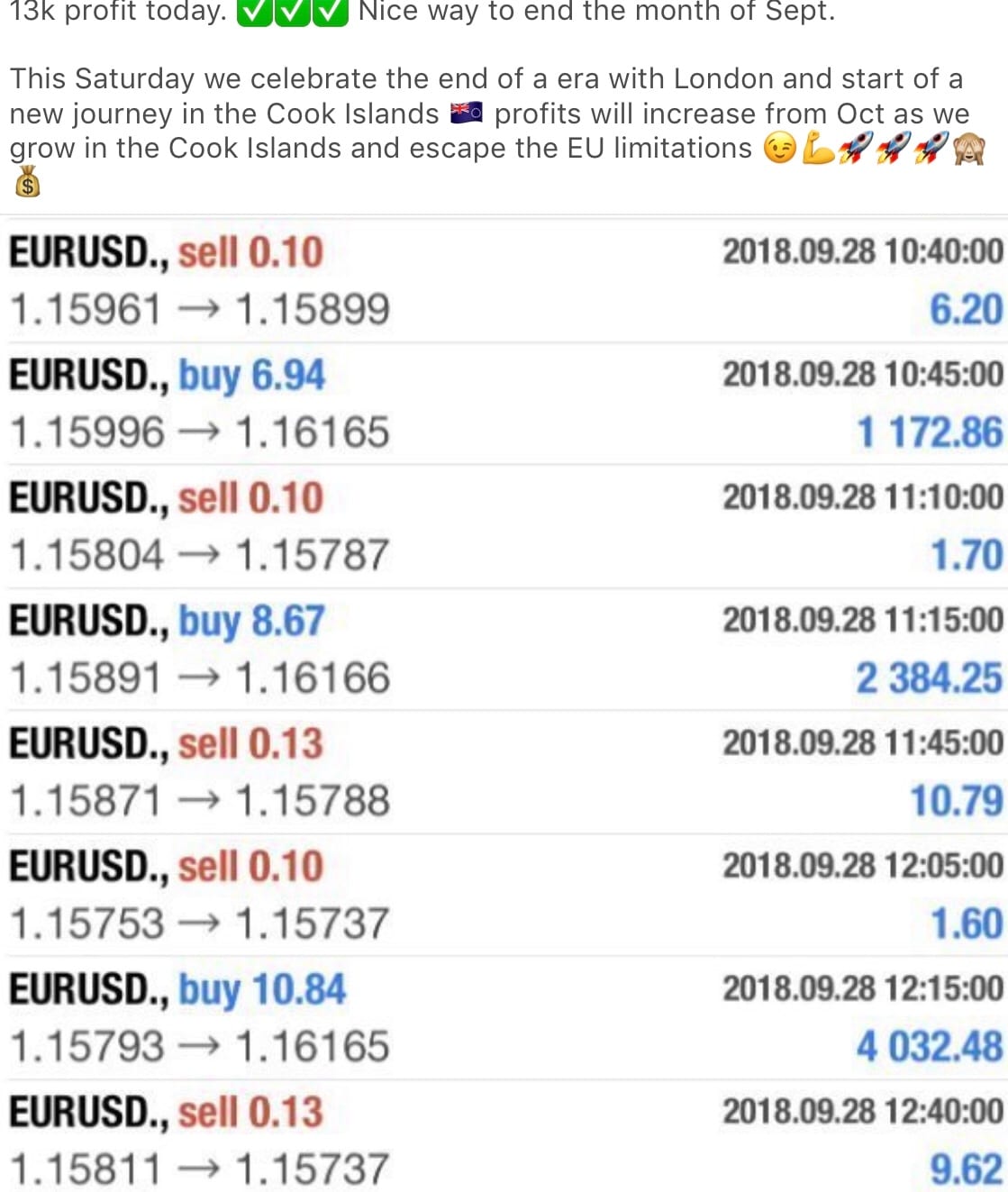
In the meantime, new, unregulated brokers have been popping up here and there. Some company owners have been boasting on social media that they have the perfect recipe for affiliates. They are attracting them with promises of high commissions, big returns for customers due to algo trading, and who knows what else.
ESMA’s failure to prevent a flight offshore is making life difficult for EU-regulated companies. In the meantime, the 'Wild West' part of the industry is just waiting around the corner with an offshore paradise proposition.
Just have a look at two examples of a trading record that makes clients rich and another one that shows affiliates how they will join the clients they bring to a new Cook Islands brokerage company.
According to the Cook Islands FSC, companies do not need a brokerage license in the country to operate one. Firms operating brokerage companies can instead get a money changer license. The legislative framework doesn't specify capital requirements. The Cook Islands doesn't have a legal framework that regulates the sale of securities.
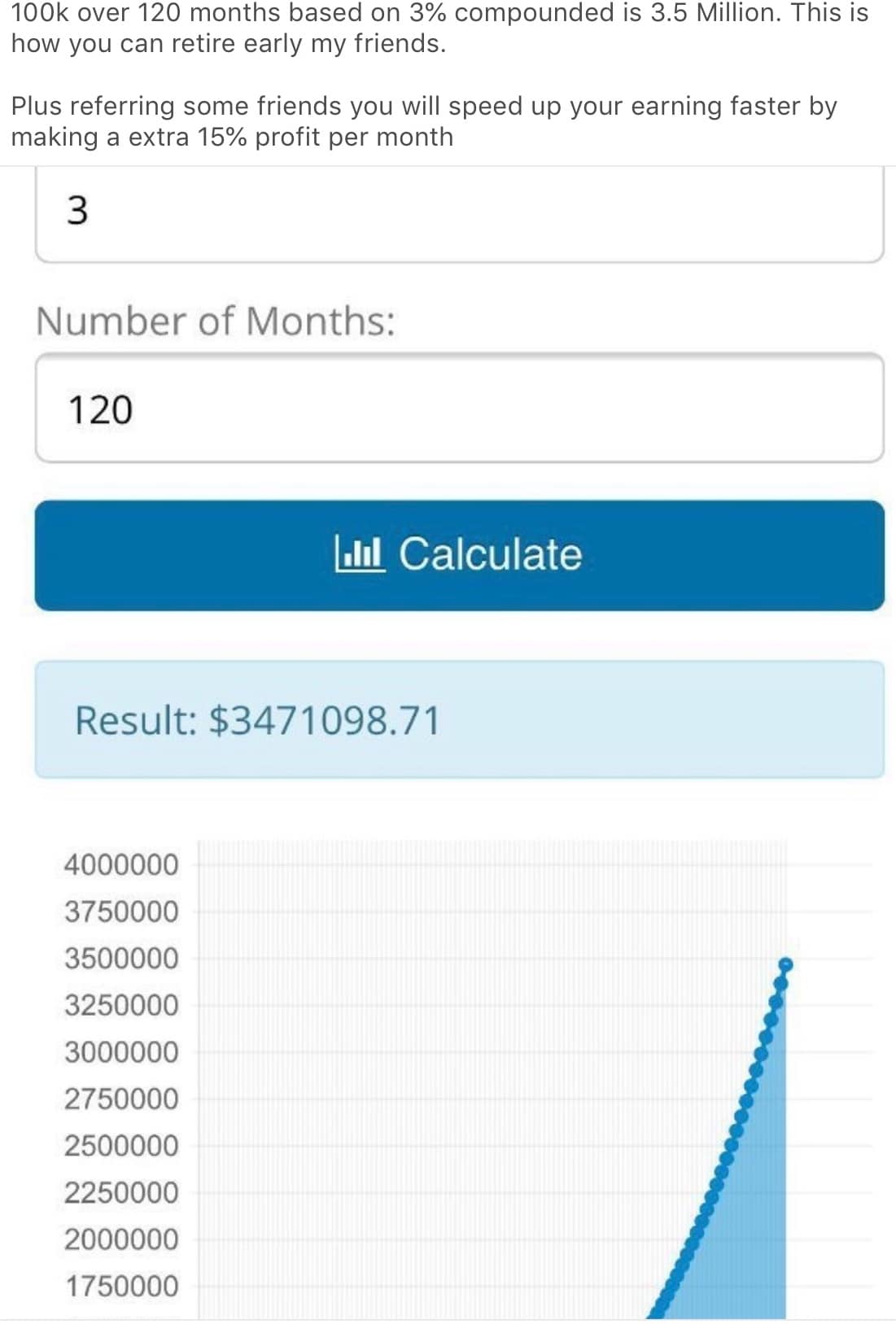
Bernie Madoff promised seven percent a year. This scheme warrants three percent a month plus another 15% if you refer friends!
If you were wondering how this is possible, the next screen shows that:
It might be easy to convince some uneducated retail investors and affiliates that they someone can make 3% per month and get 15% bonus if they refer new clients. In real life, we have media and regulators whose job is to raise awareness about such advertisements.
There has been no case in the history of the financial industry when the perpetrators of advertisements that promise extraordinary returns don't end up misappropriating client funds.
A New Era Indeed
There is rarely an opportunity for creative metaphoric articulation when writing about the forex and CFDs trading industry. At least that has been my experience until today. While curiously observing how the market reacts to the new regulations from ESMA, it suddenly hit me.
Today's EU-domiciled traders are just like migratory birds. For a while now, they have been willing to taking on risk, trading with high leverage, and have become dependent on it. Just like migratory birds depend on warm weather. Good luck trying to make them stay in Europe for the winter.
It has been almost three months since the new regulatory framework for retail clients of forex and CFDs brokers got implemented by the European Securities Markets Authority (ESMA). The immediate result from the move was a sharp decline in trading in August.
Brokerages across different spectrums of the industry shared with Finance Magnates that the decline in client activity was brisk. So brisk that it led to a series of downgrades in the outlooks of major publicly-listed brokerage companies.
Coincidence or not, several weeks into the new regulatory environment the CEO of IG Group, Peter Hetherington resigned. Industry insiders saw the move as a testament to the failure of the company to accurately anticipate the magnitude of the impact of new regulations.
Build It and They’ll Come
While some companies in the EU have been focusing on revamping their offerings and committing to compliance with the new framework, others are taking a different approach. There is a clear difference in the strategic implementation of the new regulatory framework.
Generally speaking, there are two types of companies which are regulated in the EU. The first type is those looking to house clients from all over the globe. They are using the EU license as a front end to their reputation.
Then there are those who are focused on some specific domestic markets, be that the UK, Germany, Spain, or anywhere else. This type of companies are primarily focused on providing services to EU clients.
While the first type is keen to do whatever possible to maintain high volumes, the second type will do whatever it takes to be compliant with the EU regulations.
Granted, there is also a third type of brokers which is a hybrid between the first two. They have adopted both approaches and try to gravitate towards the more favorable strategy as they go.
Most FCA-regulated brokers have instead focused on complying with the new rules. The firms are heavily exposed to the local market and are actively developing new products to remain relevant.
ESMA’s Failure
Since ESMA announced its intentions for a new regulatory framework, the institution has been resisting to consider any feedback to the proposed changes by both clients and brokers.
The news about the new regulatory framework has angered many traders as they cannot choose what risks they want to take. Of course, the brokers have been worried about the scope of the changes to their business model and their ability to continue operating in the new environment.
ESMA's failure to listen to the parties involved in the industry is underscored in a desperate message from the AMF to retail clients from a few weeks ago.
In a letter published on its website (as if retail clients read it), the regulator stated that the purpose of the new framework is investor protection. The French regulator encouraged investors to “resist certain online trading platforms’ efforts to circumvent and remove the protections put in place by the regulators.”
The AMF also underlined that it is aware that some brokers are suggesting to open an account offshore. What else could they do if they are asked by the client who is interested in trading with high leverage?
The Chairman of the Autorité des Marchés Financiers, Robert Ophèle, stressed: “The goal of the regulators was not to allow only a select few to trade CFDs and binary options but rather to better protect investors against an identified risk of loss.”
It would seem that ESMA and the French regulator greatly underestimated the risk appetite of retail investors.
Cook Islands Paradise
In the meantime, new, unregulated brokers have been popping up here and there. Some company owners have been boasting on social media that they have the perfect recipe for affiliates. They are attracting them with promises of high commissions, big returns for customers due to algo trading, and who knows what else.
ESMA’s failure to prevent a flight offshore is making life difficult for EU-regulated companies. In the meantime, the 'Wild West' part of the industry is just waiting around the corner with an offshore paradise proposition.
Just have a look at two examples of a trading record that makes clients rich and another one that shows affiliates how they will join the clients they bring to a new Cook Islands brokerage company.
According to the Cook Islands FSC, companies do not need a brokerage license in the country to operate one. Firms operating brokerage companies can instead get a money changer license. The legislative framework doesn't specify capital requirements. The Cook Islands doesn't have a legal framework that regulates the sale of securities.
Bernie Madoff promised seven percent a year. This scheme warrants three percent a month plus another 15% if you refer friends!
If you were wondering how this is possible, the next screen shows that:
It might be easy to convince some uneducated retail investors and affiliates that they someone can make 3% per month and get 15% bonus if they refer new clients. In real life, we have media and regulators whose job is to raise awareness about such advertisements.
There has been no case in the history of the financial industry when the perpetrators of advertisements that promise extraordinary returns don't end up misappropriating client funds.
A New Era Indeed
There is rarely an opportunity for creative metaphoric articulation when writing about the forex and CFDs trading industry. At least that has been my experience until today. While curiously observing how the market reacts to the new regulations from ESMA, it suddenly hit me.
Today's EU-domiciled traders are just like migratory birds. For a while now, they have been willing to taking on risk, trading with high leverage, and have become dependent on it. Just like migratory birds depend on warm weather. Good luck trying to make them stay in Europe for the winter.
Italy’s Consob Tightens Net on AI-Fueled Scams With Fresh Website Bans
Featured Videos
FP Markets Winner Spotlight 🏆 | Global Broker of the Year 2025 #Trading #Broker #Innovation #Shorts
FP Markets Winner Spotlight 🏆 | Global Broker of the Year 2025 #Trading #Broker #Innovation #Shorts
FP Markets Winner Spotlight 🏆 | Global Broker of the Year 2025 #Trading #Broker #Innovation #Shorts
FP Markets Winner Spotlight 🏆 | Global Broker of the Year 2025 #Trading #Broker #Innovation #Shorts
FP Markets takes the spotlight as Global Broker of the Year 2025 at the Finance Magnates Awards.
Martin Stoilov, Head of Client Experience, shares that trust, innovation, and people played a key role in the company’s success, supported by a strong foundation of integrity and client-centricity.
Following this milestone, FP Markets continues to focus on growth, technology investment, and its core values of transparency and excellence.
👉 Be part of FM Awards 2026: https://awards.financemagnates.com/#nominate
FP Markets takes the spotlight as Global Broker of the Year 2025 at the Finance Magnates Awards.
Martin Stoilov, Head of Client Experience, shares that trust, innovation, and people played a key role in the company’s success, supported by a strong foundation of integrity and client-centricity.
Following this milestone, FP Markets continues to focus on growth, technology investment, and its core values of transparency and excellence.
👉 Be part of FM Awards 2026: https://awards.financemagnates.com/#nominate
FP Markets takes the spotlight as Global Broker of the Year 2025 at the Finance Magnates Awards.
Martin Stoilov, Head of Client Experience, shares that trust, innovation, and people played a key role in the company’s success, supported by a strong foundation of integrity and client-centricity.
Following this milestone, FP Markets continues to focus on growth, technology investment, and its core values of transparency and excellence.
👉 Be part of FM Awards 2026: https://awards.financemagnates.com/#nominate
FP Markets takes the spotlight as Global Broker of the Year 2025 at the Finance Magnates Awards.
Martin Stoilov, Head of Client Experience, shares that trust, innovation, and people played a key role in the company’s success, supported by a strong foundation of integrity and client-centricity.
Following this milestone, FP Markets continues to focus on growth, technology investment, and its core values of transparency and excellence.
👉 Be part of FM Awards 2026: https://awards.financemagnates.com/#nominate
In this video, we review @HolaPrimeMarketsOfficial, a multi-asset forex and CFDs broker offering different account types, trading platforms, and flexible trading conditions.
We cover the broker’s overall offering, including account options, trading environment, platforms like MT4 and MT5, and additional services such as managed accounts and fast withdrawals.
Watch the full video to see if Hola Prime Markets fits your trading needs.
📣 Stay up to date with the latest in finance and trading. Follow Finance Magnates for industry news, insights, and global event coverage.
Connect with us:
🔗 LinkedIn: /financemagnates
👍 Facebook: /financemagnates
📸 Instagram: https://www.instagram.com/financemagnates
🐦 X: https://x.com/financemagnates
🎥 TikTok: https://www.tiktok.com/tag/financemagnates
▶️ YouTube: /@financemagnates_official
#HolaPrime #ForexBroker #CFDTrading #FinanceMagnates #Trading #Forex #BrokerReview
In this video, we review @HolaPrimeMarketsOfficial, a multi-asset forex and CFDs broker offering different account types, trading platforms, and flexible trading conditions.
We cover the broker’s overall offering, including account options, trading environment, platforms like MT4 and MT5, and additional services such as managed accounts and fast withdrawals.
Watch the full video to see if Hola Prime Markets fits your trading needs.
📣 Stay up to date with the latest in finance and trading. Follow Finance Magnates for industry news, insights, and global event coverage.
Connect with us:
🔗 LinkedIn: /financemagnates
👍 Facebook: /financemagnates
📸 Instagram: https://www.instagram.com/financemagnates
🐦 X: https://x.com/financemagnates
🎥 TikTok: https://www.tiktok.com/tag/financemagnates
▶️ YouTube: /@financemagnates_official
#HolaPrime #ForexBroker #CFDTrading #FinanceMagnates #Trading #Forex #BrokerReview
In this video, we review @HolaPrimeMarketsOfficial, a multi-asset forex and CFDs broker offering different account types, trading platforms, and flexible trading conditions.
We cover the broker’s overall offering, including account options, trading environment, platforms like MT4 and MT5, and additional services such as managed accounts and fast withdrawals.
Watch the full video to see if Hola Prime Markets fits your trading needs.
📣 Stay up to date with the latest in finance and trading. Follow Finance Magnates for industry news, insights, and global event coverage.
Connect with us:
🔗 LinkedIn: /financemagnates
👍 Facebook: /financemagnates
📸 Instagram: https://www.instagram.com/financemagnates
🐦 X: https://x.com/financemagnates
🎥 TikTok: https://www.tiktok.com/tag/financemagnates
▶️ YouTube: /@financemagnates_official
#HolaPrime #ForexBroker #CFDTrading #FinanceMagnates #Trading #Forex #BrokerReview
In this video, we review @HolaPrimeMarketsOfficial, a multi-asset forex and CFDs broker offering different account types, trading platforms, and flexible trading conditions.
We cover the broker’s overall offering, including account options, trading environment, platforms like MT4 and MT5, and additional services such as managed accounts and fast withdrawals.
Watch the full video to see if Hola Prime Markets fits your trading needs.
📣 Stay up to date with the latest in finance and trading. Follow Finance Magnates for industry news, insights, and global event coverage.
Connect with us:
🔗 LinkedIn: /financemagnates
👍 Facebook: /financemagnates
📸 Instagram: https://www.instagram.com/financemagnates
🐦 X: https://x.com/financemagnates
🎥 TikTok: https://www.tiktok.com/tag/financemagnates
▶️ YouTube: /@financemagnates_official
#HolaPrime #ForexBroker #CFDTrading #FinanceMagnates #Trading #Forex #BrokerReview
In this video, we review @HolaPrimeMarketsOfficial, a multi-asset forex and CFDs broker offering different account types, trading platforms, and flexible trading conditions.
We cover the broker’s overall offering, including account options, trading environment, platforms like MT4 and MT5, and additional services such as managed accounts and fast withdrawals.
Watch the full video to see if Hola Prime Markets fits your trading needs.
📣 Stay up to date with the latest in finance and trading. Follow Finance Magnates for industry news, insights, and global event coverage.
Connect with us:
🔗 LinkedIn: /financemagnates
👍 Facebook: /financemagnates
📸 Instagram: https://www.instagram.com/financemagnates
🐦 X: https://x.com/financemagnates
🎥 TikTok: https://www.tiktok.com/tag/financemagnates
▶️ YouTube: /@financemagnates_official
#HolaPrime #ForexBroker #CFDTrading #FinanceMagnates #Trading #Forex #BrokerReview
In this video, we review @HolaPrimeMarketsOfficial, a multi-asset forex and CFDs broker offering different account types, trading platforms, and flexible trading conditions.
We cover the broker’s overall offering, including account options, trading environment, platforms like MT4 and MT5, and additional services such as managed accounts and fast withdrawals.
Watch the full video to see if Hola Prime Markets fits your trading needs.
📣 Stay up to date with the latest in finance and trading. Follow Finance Magnates for industry news, insights, and global event coverage.
Connect with us:
🔗 LinkedIn: /financemagnates
👍 Facebook: /financemagnates
📸 Instagram: https://www.instagram.com/financemagnates
🐦 X: https://x.com/financemagnates
🎥 TikTok: https://www.tiktok.com/tag/financemagnates
▶️ YouTube: /@financemagnates_official
#HolaPrime #ForexBroker #CFDTrading #FinanceMagnates #Trading #Forex #BrokerReview
Hola Prime Review: What You Need to Know | Full Breakdown by Finance Magnates
Hola Prime Review: What You Need to Know | Full Breakdown by Finance Magnates
Hola Prime Review: What You Need to Know | Full Breakdown by Finance Magnates
Hola Prime Review: What You Need to Know | Full Breakdown by Finance Magnates
Hola Prime Review: What You Need to Know | Full Breakdown by Finance Magnates
Hola Prime Review: What You Need to Know | Full Breakdown by Finance Magnates
In this video, we review @HolaPrime_Global, a proprietary trading firm offering evaluation programs and performance-based payouts in simulated market environments.
We cover how the challenge model works, including account types, profit splits (up to 95%), trading rules, and what it takes to reach a funded account. You’ll also learn about available platforms like MT4, MT5, cTrader, and more, along with insights into payouts, support, and trading conditions.
Watch the full video to see if Hola Prime fits your trading style.
📣 Stay up to date with the latest in finance and trading. Follow Finance Magnates for industry news, insights, and global event coverage.
Connect with us:
🔗 LinkedIn: /financemagnates
👍 Facebook: /financemagnates
📸 Instagram: https://www.instagram.com/financemagnates
🐦 X: https://x.com/financemagnates
🎥 TikTok: https://www.tiktok.com/tag/financemagnates
▶️ YouTube: /@financemagnates_official
#HolaPrime #PropFirm #Trading #FinanceMagnates #Forex #FuturesTrading #TradingReview #PropFirmReview
In this video, we review @HolaPrime_Global, a proprietary trading firm offering evaluation programs and performance-based payouts in simulated market environments.
We cover how the challenge model works, including account types, profit splits (up to 95%), trading rules, and what it takes to reach a funded account. You’ll also learn about available platforms like MT4, MT5, cTrader, and more, along with insights into payouts, support, and trading conditions.
Watch the full video to see if Hola Prime fits your trading style.
📣 Stay up to date with the latest in finance and trading. Follow Finance Magnates for industry news, insights, and global event coverage.
Connect with us:
🔗 LinkedIn: /financemagnates
👍 Facebook: /financemagnates
📸 Instagram: https://www.instagram.com/financemagnates
🐦 X: https://x.com/financemagnates
🎥 TikTok: https://www.tiktok.com/tag/financemagnates
▶️ YouTube: /@financemagnates_official
#HolaPrime #PropFirm #Trading #FinanceMagnates #Forex #FuturesTrading #TradingReview #PropFirmReview
In this video, we review @HolaPrime_Global, a proprietary trading firm offering evaluation programs and performance-based payouts in simulated market environments.
We cover how the challenge model works, including account types, profit splits (up to 95%), trading rules, and what it takes to reach a funded account. You’ll also learn about available platforms like MT4, MT5, cTrader, and more, along with insights into payouts, support, and trading conditions.
Watch the full video to see if Hola Prime fits your trading style.
📣 Stay up to date with the latest in finance and trading. Follow Finance Magnates for industry news, insights, and global event coverage.
Connect with us:
🔗 LinkedIn: /financemagnates
👍 Facebook: /financemagnates
📸 Instagram: https://www.instagram.com/financemagnates
🐦 X: https://x.com/financemagnates
🎥 TikTok: https://www.tiktok.com/tag/financemagnates
▶️ YouTube: /@financemagnates_official
#HolaPrime #PropFirm #Trading #FinanceMagnates #Forex #FuturesTrading #TradingReview #PropFirmReview
In this video, we review @HolaPrime_Global, a proprietary trading firm offering evaluation programs and performance-based payouts in simulated market environments.
We cover how the challenge model works, including account types, profit splits (up to 95%), trading rules, and what it takes to reach a funded account. You’ll also learn about available platforms like MT4, MT5, cTrader, and more, along with insights into payouts, support, and trading conditions.
Watch the full video to see if Hola Prime fits your trading style.
📣 Stay up to date with the latest in finance and trading. Follow Finance Magnates for industry news, insights, and global event coverage.
Connect with us:
🔗 LinkedIn: /financemagnates
👍 Facebook: /financemagnates
📸 Instagram: https://www.instagram.com/financemagnates
🐦 X: https://x.com/financemagnates
🎥 TikTok: https://www.tiktok.com/tag/financemagnates
▶️ YouTube: /@financemagnates_official
#HolaPrime #PropFirm #Trading #FinanceMagnates #Forex #FuturesTrading #TradingReview #PropFirmReview
In this video, we review @HolaPrime_Global, a proprietary trading firm offering evaluation programs and performance-based payouts in simulated market environments.
We cover how the challenge model works, including account types, profit splits (up to 95%), trading rules, and what it takes to reach a funded account. You’ll also learn about available platforms like MT4, MT5, cTrader, and more, along with insights into payouts, support, and trading conditions.
Watch the full video to see if Hola Prime fits your trading style.
📣 Stay up to date with the latest in finance and trading. Follow Finance Magnates for industry news, insights, and global event coverage.
Connect with us:
🔗 LinkedIn: /financemagnates
👍 Facebook: /financemagnates
📸 Instagram: https://www.instagram.com/financemagnates
🐦 X: https://x.com/financemagnates
🎥 TikTok: https://www.tiktok.com/tag/financemagnates
▶️ YouTube: /@financemagnates_official
#HolaPrime #PropFirm #Trading #FinanceMagnates #Forex #FuturesTrading #TradingReview #PropFirmReview
In this video, we review @HolaPrime_Global, a proprietary trading firm offering evaluation programs and performance-based payouts in simulated market environments.
We cover how the challenge model works, including account types, profit splits (up to 95%), trading rules, and what it takes to reach a funded account. You’ll also learn about available platforms like MT4, MT5, cTrader, and more, along with insights into payouts, support, and trading conditions.
Watch the full video to see if Hola Prime fits your trading style.
📣 Stay up to date with the latest in finance and trading. Follow Finance Magnates for industry news, insights, and global event coverage.
Connect with us:
🔗 LinkedIn: /financemagnates
👍 Facebook: /financemagnates
📸 Instagram: https://www.instagram.com/financemagnates
🐦 X: https://x.com/financemagnates
🎥 TikTok: https://www.tiktok.com/tag/financemagnates
▶️ YouTube: /@financemagnates_official
#HolaPrime #PropFirm #Trading #FinanceMagnates #Forex #FuturesTrading #TradingReview #PropFirmReview
Axi Winner Spotlight 🏆 | Global Most Innovative Broker 2025 #Innovation #Trading #Fintech #Broker
Axi Winner Spotlight 🏆 | Global Most Innovative Broker 2025 #Innovation #Trading #Fintech #Broker
Axi Winner Spotlight 🏆 | Global Most Innovative Broker 2025 #Innovation #Trading #Fintech #Broker
Axi Winner Spotlight 🏆 | Global Most Innovative Broker 2025 #Innovation #Trading #Fintech #Broker
Axi Winner Spotlight 🏆 | Global Most Innovative Broker 2025 #Innovation #Trading #Fintech #Broker
Axi Winner Spotlight 🏆 | Global Most Innovative Broker 2025 #Innovation #Trading #Fintech #Broker
Axi takes the spotlight at the Finance Magnates Awards, winning Global Most Innovative Broker 2025.
Olivia Xenofontos and Ivanna Openko share how the team will feel: proud, motivated, and ready to keep delivering.
They also describe the night as well-organized, focused, and enjoyable for all.
👉 Be part of FM Awards 2026.
Axi takes the spotlight at the Finance Magnates Awards, winning Global Most Innovative Broker 2025.
Olivia Xenofontos and Ivanna Openko share how the team will feel: proud, motivated, and ready to keep delivering.
They also describe the night as well-organized, focused, and enjoyable for all.
👉 Be part of FM Awards 2026.
Axi takes the spotlight at the Finance Magnates Awards, winning Global Most Innovative Broker 2025.
Olivia Xenofontos and Ivanna Openko share how the team will feel: proud, motivated, and ready to keep delivering.
They also describe the night as well-organized, focused, and enjoyable for all.
👉 Be part of FM Awards 2026.
Axi takes the spotlight at the Finance Magnates Awards, winning Global Most Innovative Broker 2025.
Olivia Xenofontos and Ivanna Openko share how the team will feel: proud, motivated, and ready to keep delivering.
They also describe the night as well-organized, focused, and enjoyable for all.
👉 Be part of FM Awards 2026.
Axi takes the spotlight at the Finance Magnates Awards, winning Global Most Innovative Broker 2025.
Olivia Xenofontos and Ivanna Openko share how the team will feel: proud, motivated, and ready to keep delivering.
They also describe the night as well-organized, focused, and enjoyable for all.
👉 Be part of FM Awards 2026.
Axi takes the spotlight at the Finance Magnates Awards, winning Global Most Innovative Broker 2025.
Olivia Xenofontos and Ivanna Openko share how the team will feel: proud, motivated, and ready to keep delivering.
They also describe the night as well-organized, focused, and enjoyable for all.
👉 Be part of FM Awards 2026.
Recognition that matters.
Built on transparency.
Driven by the industry.
The Finance Magnates Awards 2026.
Nominations are now open.
🔗 https://awards.financemagnates.com/?utm_source=SM&utm_medium=social&utm_campaign=recognition-matters
Recognition that matters.
Built on transparency.
Driven by the industry.
The Finance Magnates Awards 2026.
Nominations are now open.
🔗 https://awards.financemagnates.com/?utm_source=SM&utm_medium=social&utm_campaign=recognition-matters
Recognition that matters.
Built on transparency.
Driven by the industry.
The Finance Magnates Awards 2026.
Nominations are now open.
🔗 https://awards.financemagnates.com/?utm_source=SM&utm_medium=social&utm_campaign=recognition-matters
Recognition that matters.
Built on transparency.
Driven by the industry.
The Finance Magnates Awards 2026.
Nominations are now open.
🔗 https://awards.financemagnates.com/?utm_source=SM&utm_medium=social&utm_campaign=recognition-matters
Recognition that matters.
Built on transparency.
Driven by the industry.
The Finance Magnates Awards 2026.
Nominations are now open.
🔗 https://awards.financemagnates.com/?utm_source=SM&utm_medium=social&utm_campaign=recognition-matters
Recognition that matters.
Built on transparency.
Driven by the industry.
The Finance Magnates Awards 2026.
Nominations are now open.
🔗 https://awards.financemagnates.com/?utm_source=SM&utm_medium=social&utm_campaign=recognition-matters