President Trump's intention to repeal the Dodd-Frank Act may alter the trading options of American citizens.
Bloomberg
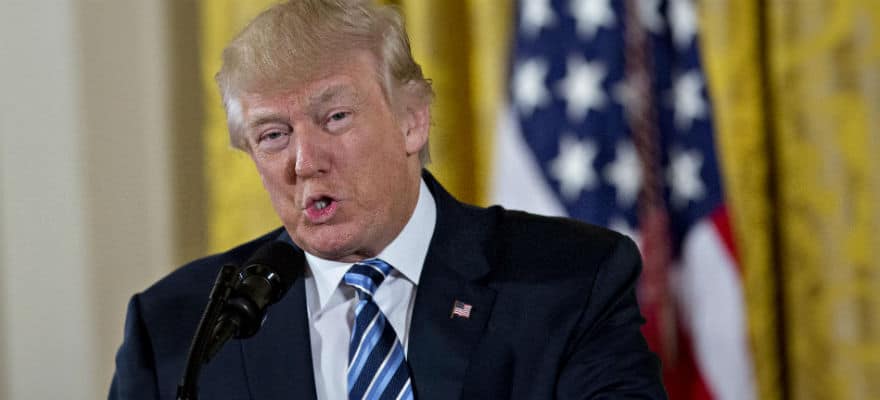
Among Donald Trump's many electoral promises was one which caught the attention of the Forex and CFD industry.
The new President of the United States announced his intention to limit or completely eliminate the 2010 law known as the Dodd-Frank Wall Street Act, which drastically changed the image of one of the largest financial markets.
Finance Magnates takes a closer look at Donald Trump's promise in the latest edition of the Quarterly Industry Report, seeking answers to the question of what the implications are for the derivatives industry, which has changed enormously in the United States since the 2008 crisis.
[gptAdvertisement]
A market where no one can survive?
Before Barack Obama signed the Dodd-Frank act, American traders could avail themselves of the services of 40 local online providers and a whole set of foreign financial firms. Currently, this number has been reduced to just 4, and brokers outside the US cannot offer their services to US citizens.
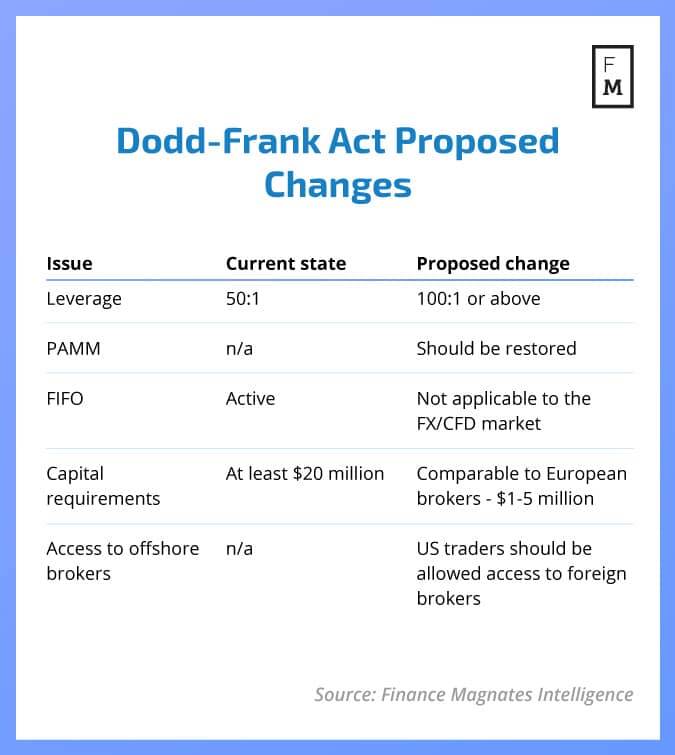
However, when analyzing the current requirements for setting up a brokerage in the US, no one should be surprised that the number is so low. According to Dodd-Frank rules enforced by the CFTC, companies wishing to offer retail trading in the forex market must maintain a minimum capital of $20 million. What’s more, this amount increases if a broker’s liabilities to retail forex traders are higher than $10 million. In such a case, the licensed company's net capital requirements are raised by 5% of that sum. For example, if financial obligations equal $15 million, the broker needs to increase its available funds by $0.75 million.
In addition to this, obtaining a license in the US can take as long as two years.
Add to the mix the maximum leverage of 1:50, the hedging ban and the need to implement the FIFO (first in first out) rule, and you get a recipe for really difficult market conditions. Brokerage operations are far more difficult than for example in Europe, where the Cyprus Securities Exchange Commission (CySEC) and the British Financial Conduct Authority (FCA) impose significantly lower requirements.
Trump's administration should adjust the rules to limit market consolidation
Using the experience of European supervision committees, there are several important issues that could change the face of the retail forex market in the United States.
First and foremost, American customers should have the choice - cutting them off from non-US brokers only limits freedom and does not provide proper protection. Profitability statistics from the first quarter of 2017 show that average trader profitability stood at 40%, which is a very good result, showing that US investors know how to multiply their funds.
It is necessary for the regulators themselves to make the market more attractive and to simplify access - the return of PAMM accounts and adjustment of capital requirements to those in Europe would undoubtedly attract new industry players. Cyprus has a license waiting period of 3 to 6 months, and in the UK it lasts a maximum of 15 months. In the US, however, it may take up to two years to obtain final authorization - simplifying the regulatory machine and reducing the complexity of the whole process also seems to be an indispensable step.
Although the first changes in Dodd-Frank have already been announced, the FX/CFD industry still has a long way to go. So far, brokers can only accept the reality as it is and prepare for future changes to make the most of their possible presence in the US market.
Among Donald Trump's many electoral promises was one which caught the attention of the Forex and CFD industry.
The new President of the United States announced his intention to limit or completely eliminate the 2010 law known as the Dodd-Frank Wall Street Act, which drastically changed the image of one of the largest financial markets.
Finance Magnates takes a closer look at Donald Trump's promise in the latest edition of the Quarterly Industry Report, seeking answers to the question of what the implications are for the derivatives industry, which has changed enormously in the United States since the 2008 crisis.
[gptAdvertisement]
A market where no one can survive?
Before Barack Obama signed the Dodd-Frank act, American traders could avail themselves of the services of 40 local online providers and a whole set of foreign financial firms. Currently, this number has been reduced to just 4, and brokers outside the US cannot offer their services to US citizens.
However, when analyzing the current requirements for setting up a brokerage in the US, no one should be surprised that the number is so low. According to Dodd-Frank rules enforced by the CFTC, companies wishing to offer retail trading in the forex market must maintain a minimum capital of $20 million. What’s more, this amount increases if a broker’s liabilities to retail forex traders are higher than $10 million. In such a case, the licensed company's net capital requirements are raised by 5% of that sum. For example, if financial obligations equal $15 million, the broker needs to increase its available funds by $0.75 million.
In addition to this, obtaining a license in the US can take as long as two years.
Add to the mix the maximum leverage of 1:50, the hedging ban and the need to implement the FIFO (first in first out) rule, and you get a recipe for really difficult market conditions. Brokerage operations are far more difficult than for example in Europe, where the Cyprus Securities Exchange Commission (CySEC) and the British Financial Conduct Authority (FCA) impose significantly lower requirements.
Trump's administration should adjust the rules to limit market consolidation
Using the experience of European supervision committees, there are several important issues that could change the face of the retail forex market in the United States.
First and foremost, American customers should have the choice - cutting them off from non-US brokers only limits freedom and does not provide proper protection. Profitability statistics from the first quarter of 2017 show that average trader profitability stood at 40%, which is a very good result, showing that US investors know how to multiply their funds.
It is necessary for the regulators themselves to make the market more attractive and to simplify access - the return of PAMM accounts and adjustment of capital requirements to those in Europe would undoubtedly attract new industry players. Cyprus has a license waiting period of 3 to 6 months, and in the UK it lasts a maximum of 15 months. In the US, however, it may take up to two years to obtain final authorization - simplifying the regulatory machine and reducing the complexity of the whole process also seems to be an indispensable step.
Although the first changes in Dodd-Frank have already been announced, the FX/CFD industry still has a long way to go. So far, brokers can only accept the reality as it is and prepare for future changes to make the most of their possible presence in the US market.
Damian Chmiel is a Senior Analyst & Editor at Finance Magnates with more than 15 years of experience in the CFD and online trading industry. Active as both a trader and journalist since 2010, he focuses on broker coverage, fintech innovation, and regulatory developments across Europe, the Middle East, and Asia.
His work includes interviews with C-level leaders at major brokerages and fintech platforms, as well as co-authoring Finance Magnates’ quarterly industry benchmarking reports. Damian’s reporting is data-driven, market-aware, and grounded in direct industry engagement. His analysis and commentary have also been cited by external media outlets, including Investing.com, Binance, The Asset, Stockhead, and Dispatch.
Education:
MA in Finance and Accounting, Cracow University of Economics
Italy’s Consob Tightens Net on AI-Fueled Scams With Fresh Website Bans
FP Markets Winner Spotlight 🏆 | Global Broker of the Year 2025 #Trading #Broker #Innovation #Shorts
FP Markets Winner Spotlight 🏆 | Global Broker of the Year 2025 #Trading #Broker #Innovation #Shorts
FP Markets takes the spotlight as Global Broker of the Year 2025 at the Finance Magnates Awards.
Martin Stoilov, Head of Client Experience, shares that trust, innovation, and people played a key role in the company’s success, supported by a strong foundation of integrity and client-centricity.
Following this milestone, FP Markets continues to focus on growth, technology investment, and its core values of transparency and excellence.
👉 Be part of FM Awards 2026: https://awards.financemagnates.com/#nominate
FP Markets takes the spotlight as Global Broker of the Year 2025 at the Finance Magnates Awards.
Martin Stoilov, Head of Client Experience, shares that trust, innovation, and people played a key role in the company’s success, supported by a strong foundation of integrity and client-centricity.
Following this milestone, FP Markets continues to focus on growth, technology investment, and its core values of transparency and excellence.
👉 Be part of FM Awards 2026: https://awards.financemagnates.com/#nominate
In this video, we review @HolaPrimeMarketsOfficial, a multi-asset forex and CFDs broker offering different account types, trading platforms, and flexible trading conditions.
We cover the broker’s overall offering, including account options, trading environment, platforms like MT4 and MT5, and additional services such as managed accounts and fast withdrawals.
Watch the full video to see if Hola Prime Markets fits your trading needs.
📣 Stay up to date with the latest in finance and trading. Follow Finance Magnates for industry news, insights, and global event coverage.
Connect with us:
🔗 LinkedIn: /financemagnates
👍 Facebook: /financemagnates
📸 Instagram: https://www.instagram.com/financemagnates
🐦 X: https://x.com/financemagnates
🎥 TikTok: https://www.tiktok.com/tag/financemagnates
▶️ YouTube: /@financemagnates_official
#HolaPrime #ForexBroker #CFDTrading #FinanceMagnates #Trading #Forex #BrokerReview
In this video, we review @HolaPrimeMarketsOfficial, a multi-asset forex and CFDs broker offering different account types, trading platforms, and flexible trading conditions.
We cover the broker’s overall offering, including account options, trading environment, platforms like MT4 and MT5, and additional services such as managed accounts and fast withdrawals.
Watch the full video to see if Hola Prime Markets fits your trading needs.
📣 Stay up to date with the latest in finance and trading. Follow Finance Magnates for industry news, insights, and global event coverage.
Connect with us:
🔗 LinkedIn: /financemagnates
👍 Facebook: /financemagnates
📸 Instagram: https://www.instagram.com/financemagnates
🐦 X: https://x.com/financemagnates
🎥 TikTok: https://www.tiktok.com/tag/financemagnates
▶️ YouTube: /@financemagnates_official
#HolaPrime #ForexBroker #CFDTrading #FinanceMagnates #Trading #Forex #BrokerReview
Hola Prime Review: What You Need to Know | Full Breakdown by Finance Magnates
Hola Prime Review: What You Need to Know | Full Breakdown by Finance Magnates
In this video, we review @HolaPrime_Global, a proprietary trading firm offering evaluation programs and performance-based payouts in simulated market environments.
We cover how the challenge model works, including account types, profit splits (up to 95%), trading rules, and what it takes to reach a funded account. You’ll also learn about available platforms like MT4, MT5, cTrader, and more, along with insights into payouts, support, and trading conditions.
Watch the full video to see if Hola Prime fits your trading style.
📣 Stay up to date with the latest in finance and trading. Follow Finance Magnates for industry news, insights, and global event coverage.
Connect with us:
🔗 LinkedIn: /financemagnates
👍 Facebook: /financemagnates
📸 Instagram: https://www.instagram.com/financemagnates
🐦 X: https://x.com/financemagnates
🎥 TikTok: https://www.tiktok.com/tag/financemagnates
▶️ YouTube: /@financemagnates_official
#HolaPrime #PropFirm #Trading #FinanceMagnates #Forex #FuturesTrading #TradingReview #PropFirmReview
In this video, we review @HolaPrime_Global, a proprietary trading firm offering evaluation programs and performance-based payouts in simulated market environments.
We cover how the challenge model works, including account types, profit splits (up to 95%), trading rules, and what it takes to reach a funded account. You’ll also learn about available platforms like MT4, MT5, cTrader, and more, along with insights into payouts, support, and trading conditions.
Watch the full video to see if Hola Prime fits your trading style.
📣 Stay up to date with the latest in finance and trading. Follow Finance Magnates for industry news, insights, and global event coverage.
Connect with us:
🔗 LinkedIn: /financemagnates
👍 Facebook: /financemagnates
📸 Instagram: https://www.instagram.com/financemagnates
🐦 X: https://x.com/financemagnates
🎥 TikTok: https://www.tiktok.com/tag/financemagnates
▶️ YouTube: /@financemagnates_official
#HolaPrime #PropFirm #Trading #FinanceMagnates #Forex #FuturesTrading #TradingReview #PropFirmReview
Axi Winner Spotlight 🏆 | Global Most Innovative Broker 2025 #Innovation #Trading #Fintech #Broker
Axi Winner Spotlight 🏆 | Global Most Innovative Broker 2025 #Innovation #Trading #Fintech #Broker
Axi takes the spotlight at the Finance Magnates Awards, winning Global Most Innovative Broker 2025.
Olivia Xenofontos and Ivanna Openko share how the team will feel: proud, motivated, and ready to keep delivering.
They also describe the night as well-organized, focused, and enjoyable for all.
👉 Be part of FM Awards 2026.
Axi takes the spotlight at the Finance Magnates Awards, winning Global Most Innovative Broker 2025.
Olivia Xenofontos and Ivanna Openko share how the team will feel: proud, motivated, and ready to keep delivering.
They also describe the night as well-organized, focused, and enjoyable for all.
👉 Be part of FM Awards 2026.
Recognition that matters.
Built on transparency.
Driven by the industry.
The Finance Magnates Awards 2026.
Nominations are now open.
🔗 https://awards.financemagnates.com/?utm_source=SM&utm_medium=social&utm_campaign=recognition-matters
Recognition that matters.
Built on transparency.
Driven by the industry.
The Finance Magnates Awards 2026.
Nominations are now open.
🔗 https://awards.financemagnates.com/?utm_source=SM&utm_medium=social&utm_campaign=recognition-matters