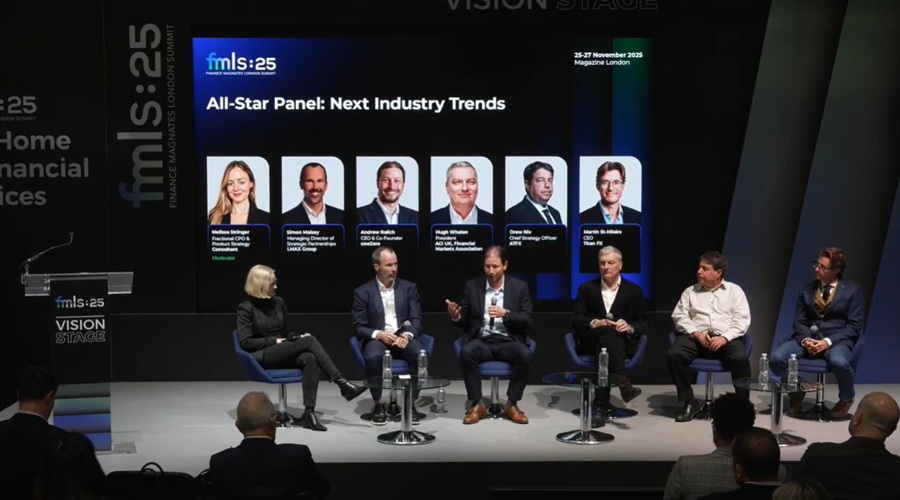
At the “All Star Panel: Next Industry Trends” the panelists agreed that retail brokers have increasingly diverged from institutional practices.
For 2026 broker priorities, brokers must become digital-ready for tokenized assets.
A sharp split is emerging in retail FX and CFDs just
as a new wave of convergence with institutional markets gathers pace, senior
executives warned during the “All-Star Panel: Next Industry Trends” at FMLS:25
in London.
Moderated by Melissa Stringer, the Fractional CPO and
Product Strategy Consultant, the discussion brought together Simon Maisey, LMAX
Group’s Managing Director of Strategic Partnerships, Andrew Ralich, oneZero CEO
and Co-Founder, Hugh Whelan, President at ACI UK, Financial Markets Association,
Drew Niv, the Chief Strategy Officer at ATFX, and Martin St‑Hilaire, the CEO of
Titan FX.
The panelists delved in a wide‑ranging debate on
market structure, risk and the impact of new entrants.
Retail–Institutional Reconvergence
Niv argued that the last decade has seen retail
and institutional FX pull apart, as retail brokers leaned harder into
internalisation and B‑book models while expanding into emerging markets.
From left: Melissa, Simon, Andrew, Hugh, Drew, and Martin
Maisey stressed that access to data and
wholesale liquidity has levelled dramatically across the spectrum from retail
brokers to banks and buy‑side firms.
“There's no longer a market that people can't see. If
you're prepared to pay, you can get that data, you can get that information.
And also like the liquidity is largely the same as well.”
Execution, Expectations and Regulation
Asked what “good execution” means in 2025, St‑Hilaire
described a clash between marketing claims and economic reality in emerging
markets.
“If the spread is really, really tiny and tight,
tight, tight, there's a good chance that you might not get the execution
actually that you deserve. If the spread is maybe a bit wider, you will get
probably more chance to be actually feel your order will be filled at the price
that was advertised to you initially.”
According to Whelan, retail expectations are often
misaligned with the demands of institutional liquidity, particularly on depth,
low latency and multi‑regional infrastructure. Moving up the ladder requires
significant investment in technology, operational resilience and regulatory
engagement that many retail firms underestimate, he warned.
In Asia, he pointed to Korea, India and Taiwan as
examples of markets opening to foreign institutions but only in return for
“multi‑year investments” in local partnerships, reporting and on‑the‑ground
presence, with Singapore’s MAS providing the template for higher standards.
He predicted that the entry of “big supermarkets” such
as large crypto platforms and app‑based brokers with tens of millions of
accounts will reset standards, especially if firms like Binance or Robinhood
were to acquire established FX brokers.
“And I think they're going to make the standards very
different. And I think there's always going to be a niche in this business, but
I think the landscape is going to shift. There's a lot of big...Super apps are
kind of a trivializing word.”
Ralich pushed back on the idea that today’s retail
conditions are inherently unrealistic, likening tight spreads to free drinks in
a casino – “it is what it is” given how the market works.
He sees the real blind spot in risk: brokers managing
ever larger, bank‑sized B‑book positions without enough hedging, particularly
beyond simple spot, leaving the industry exposed to book blow‑ups and
insolvencies reminiscent of the pre‑CFTC era in the US.
Product Shifts, Tokenisation and AI
Maisey highlighted how client demand is already
reshaping product mixes, with some brokers seeing gold volumes surpass FX in
recent months.
“And people are going to start trading things they're
interested in rather than just products they can change. We're already seeing
from our broker partners now, we're seeing like in the last month, gold was
more popular than FX.”
He also noted a shift in how retail traders are
influenced, away from linear broadcast news and toward self‑selected online
sources, which in turn shapes what they choose to trade.
Ralich argued that convergence with crypto and digital
assets may allow the OTC industry to “hopscotch” over a traditional exchange‑driven
model, pointing to perpetual futures as a crypto invention that looks, in his
words, like “just a CFD that has been given a prettier name.”
2026 Priorities: Infrastructure,
Localization and Concentration Risk
Looking ahead to what brokers will need in 2026,
Maisey listed three non‑negotiables: being “digital‑ready” for tokenized and
crypto‑style products; upgrading connectivity and prime‑broker workflows to
handle institutional flows; and securing the right regulatory jurisdictions for
institutional business.
The implementation burden for institutional
connectivity, he said, remains very different from retail plug‑and‑play
models. St‑Hilaire made the case for deep localization as the
only viable way mid‑sized brokers can compete with global “super apps.”
“And if we break out from these regulations and this
legislation and coming from emerging market where the legislation are much
lower, we could imagine like that it's quite easy to have an AI that actually
do your website. You have your front end for your trading platform.”
Niv warned that the industry is now “long gold
volatility,” with many brokers deriving more than half their exposure from gold
and facing a dangerous concentration risk if volatility dries up.
“And the biggest risk in this industry, people have to
think like January to August of 2023, there was like a gold volatility drought.
And just from my experience, I would say half the industry was probably four to
five months away from bankruptcy. And big names.”
Whelan echoed that the lesson from institutional
markets is diversification – across client segments and asset classes –
suggesting retail brokers may likewise need to look beyond FX and metals into
broader multi‑asset offerings to smooth earnings.
For all the talk of tokenization, AI and app wars, the
panelists returned to a simple conclusion: firms that thrive in the next cycle
will be those that combine institutional‑grade risk management and transparency
with sharper product design, richer client experiences and a more honest
conversation with retail traders about what “good execution” really means.
A sharp split is emerging in retail FX and CFDs just
as a new wave of convergence with institutional markets gathers pace, senior
executives warned during the “All-Star Panel: Next Industry Trends” at FMLS:25
in London.
Moderated by Melissa Stringer, the Fractional CPO and
Product Strategy Consultant, the discussion brought together Simon Maisey, LMAX
Group’s Managing Director of Strategic Partnerships, Andrew Ralich, oneZero CEO
and Co-Founder, Hugh Whelan, President at ACI UK, Financial Markets Association,
Drew Niv, the Chief Strategy Officer at ATFX, and Martin St‑Hilaire, the CEO of
Titan FX.
The panelists delved in a wide‑ranging debate on
market structure, risk and the impact of new entrants.
Retail–Institutional Reconvergence
Niv argued that the last decade has seen retail
and institutional FX pull apart, as retail brokers leaned harder into
internalisation and B‑book models while expanding into emerging markets.
From left: Melissa, Simon, Andrew, Hugh, Drew, and Martin
Maisey stressed that access to data and
wholesale liquidity has levelled dramatically across the spectrum from retail
brokers to banks and buy‑side firms.
“There's no longer a market that people can't see. If
you're prepared to pay, you can get that data, you can get that information.
And also like the liquidity is largely the same as well.”
Execution, Expectations and Regulation
Asked what “good execution” means in 2025, St‑Hilaire
described a clash between marketing claims and economic reality in emerging
markets.
“If the spread is really, really tiny and tight,
tight, tight, there's a good chance that you might not get the execution
actually that you deserve. If the spread is maybe a bit wider, you will get
probably more chance to be actually feel your order will be filled at the price
that was advertised to you initially.”
According to Whelan, retail expectations are often
misaligned with the demands of institutional liquidity, particularly on depth,
low latency and multi‑regional infrastructure. Moving up the ladder requires
significant investment in technology, operational resilience and regulatory
engagement that many retail firms underestimate, he warned.
In Asia, he pointed to Korea, India and Taiwan as
examples of markets opening to foreign institutions but only in return for
“multi‑year investments” in local partnerships, reporting and on‑the‑ground
presence, with Singapore’s MAS providing the template for higher standards.
He predicted that the entry of “big supermarkets” such
as large crypto platforms and app‑based brokers with tens of millions of
accounts will reset standards, especially if firms like Binance or Robinhood
were to acquire established FX brokers.
“And I think they're going to make the standards very
different. And I think there's always going to be a niche in this business, but
I think the landscape is going to shift. There's a lot of big...Super apps are
kind of a trivializing word.”
Ralich pushed back on the idea that today’s retail
conditions are inherently unrealistic, likening tight spreads to free drinks in
a casino – “it is what it is” given how the market works.
He sees the real blind spot in risk: brokers managing
ever larger, bank‑sized B‑book positions without enough hedging, particularly
beyond simple spot, leaving the industry exposed to book blow‑ups and
insolvencies reminiscent of the pre‑CFTC era in the US.
Product Shifts, Tokenisation and AI
Maisey highlighted how client demand is already
reshaping product mixes, with some brokers seeing gold volumes surpass FX in
recent months.
“And people are going to start trading things they're
interested in rather than just products they can change. We're already seeing
from our broker partners now, we're seeing like in the last month, gold was
more popular than FX.”
He also noted a shift in how retail traders are
influenced, away from linear broadcast news and toward self‑selected online
sources, which in turn shapes what they choose to trade.
Ralich argued that convergence with crypto and digital
assets may allow the OTC industry to “hopscotch” over a traditional exchange‑driven
model, pointing to perpetual futures as a crypto invention that looks, in his
words, like “just a CFD that has been given a prettier name.”
2026 Priorities: Infrastructure,
Localization and Concentration Risk
Looking ahead to what brokers will need in 2026,
Maisey listed three non‑negotiables: being “digital‑ready” for tokenized and
crypto‑style products; upgrading connectivity and prime‑broker workflows to
handle institutional flows; and securing the right regulatory jurisdictions for
institutional business.
The implementation burden for institutional
connectivity, he said, remains very different from retail plug‑and‑play
models. St‑Hilaire made the case for deep localization as the
only viable way mid‑sized brokers can compete with global “super apps.”
“And if we break out from these regulations and this
legislation and coming from emerging market where the legislation are much
lower, we could imagine like that it's quite easy to have an AI that actually
do your website. You have your front end for your trading platform.”
Niv warned that the industry is now “long gold
volatility,” with many brokers deriving more than half their exposure from gold
and facing a dangerous concentration risk if volatility dries up.
“And the biggest risk in this industry, people have to
think like January to August of 2023, there was like a gold volatility drought.
And just from my experience, I would say half the industry was probably four to
five months away from bankruptcy. And big names.”
Whelan echoed that the lesson from institutional
markets is diversification – across client segments and asset classes –
suggesting retail brokers may likewise need to look beyond FX and metals into
broader multi‑asset offerings to smooth earnings.
For all the talk of tokenization, AI and app wars, the
panelists returned to a simple conclusion: firms that thrive in the next cycle
will be those that combine institutional‑grade risk management and transparency
with sharper product design, richer client experiences and a more honest
conversation with retail traders about what “good execution” really means.
Jared Kirui is an Editor at Finance Magnates with more than five years of experience in financial journalism. He covers online trading, fintech, payments, and crypto industries with a focus on companies, regulation and compliance, executive moves, trading technology, and market analysis.
His work has been featured in other media outlets, including Benzinga, ZyCrypto, The Distributed, and The Daily Hodl.
Education:
Bachelor of Commerce degree (Finance option), University of Nairobi
Can Prop Trading Work Without Leverage? A Handful of Firms Are Finding Out
Featured Videos
FP Markets Winner Spotlight 🏆 | Global Broker of the Year 2025 #Trading #Broker #Innovation #Shorts
FP Markets Winner Spotlight 🏆 | Global Broker of the Year 2025 #Trading #Broker #Innovation #Shorts
FP Markets Winner Spotlight 🏆 | Global Broker of the Year 2025 #Trading #Broker #Innovation #Shorts
FP Markets Winner Spotlight 🏆 | Global Broker of the Year 2025 #Trading #Broker #Innovation #Shorts
FP Markets takes the spotlight as Global Broker of the Year 2025 at the Finance Magnates Awards.
Martin Stoilov, Head of Client Experience, shares that trust, innovation, and people played a key role in the company’s success, supported by a strong foundation of integrity and client-centricity.
Following this milestone, FP Markets continues to focus on growth, technology investment, and its core values of transparency and excellence.
👉 Be part of FM Awards 2026: https://awards.financemagnates.com/#nominate
FP Markets takes the spotlight as Global Broker of the Year 2025 at the Finance Magnates Awards.
Martin Stoilov, Head of Client Experience, shares that trust, innovation, and people played a key role in the company’s success, supported by a strong foundation of integrity and client-centricity.
Following this milestone, FP Markets continues to focus on growth, technology investment, and its core values of transparency and excellence.
👉 Be part of FM Awards 2026: https://awards.financemagnates.com/#nominate
FP Markets takes the spotlight as Global Broker of the Year 2025 at the Finance Magnates Awards.
Martin Stoilov, Head of Client Experience, shares that trust, innovation, and people played a key role in the company’s success, supported by a strong foundation of integrity and client-centricity.
Following this milestone, FP Markets continues to focus on growth, technology investment, and its core values of transparency and excellence.
👉 Be part of FM Awards 2026: https://awards.financemagnates.com/#nominate
FP Markets takes the spotlight as Global Broker of the Year 2025 at the Finance Magnates Awards.
Martin Stoilov, Head of Client Experience, shares that trust, innovation, and people played a key role in the company’s success, supported by a strong foundation of integrity and client-centricity.
Following this milestone, FP Markets continues to focus on growth, technology investment, and its core values of transparency and excellence.
👉 Be part of FM Awards 2026: https://awards.financemagnates.com/#nominate
In this video, we review @HolaPrimeMarketsOfficial, a multi-asset forex and CFDs broker offering different account types, trading platforms, and flexible trading conditions.
We cover the broker’s overall offering, including account options, trading environment, platforms like MT4 and MT5, and additional services such as managed accounts and fast withdrawals.
Watch the full video to see if Hola Prime Markets fits your trading needs.
📣 Stay up to date with the latest in finance and trading. Follow Finance Magnates for industry news, insights, and global event coverage.
Connect with us:
🔗 LinkedIn: /financemagnates
👍 Facebook: /financemagnates
📸 Instagram: https://www.instagram.com/financemagnates
🐦 X: https://x.com/financemagnates
🎥 TikTok: https://www.tiktok.com/tag/financemagnates
▶️ YouTube: /@financemagnates_official
#HolaPrime #ForexBroker #CFDTrading #FinanceMagnates #Trading #Forex #BrokerReview
In this video, we review @HolaPrimeMarketsOfficial, a multi-asset forex and CFDs broker offering different account types, trading platforms, and flexible trading conditions.
We cover the broker’s overall offering, including account options, trading environment, platforms like MT4 and MT5, and additional services such as managed accounts and fast withdrawals.
Watch the full video to see if Hola Prime Markets fits your trading needs.
📣 Stay up to date with the latest in finance and trading. Follow Finance Magnates for industry news, insights, and global event coverage.
Connect with us:
🔗 LinkedIn: /financemagnates
👍 Facebook: /financemagnates
📸 Instagram: https://www.instagram.com/financemagnates
🐦 X: https://x.com/financemagnates
🎥 TikTok: https://www.tiktok.com/tag/financemagnates
▶️ YouTube: /@financemagnates_official
#HolaPrime #ForexBroker #CFDTrading #FinanceMagnates #Trading #Forex #BrokerReview
In this video, we review @HolaPrimeMarketsOfficial, a multi-asset forex and CFDs broker offering different account types, trading platforms, and flexible trading conditions.
We cover the broker’s overall offering, including account options, trading environment, platforms like MT4 and MT5, and additional services such as managed accounts and fast withdrawals.
Watch the full video to see if Hola Prime Markets fits your trading needs.
📣 Stay up to date with the latest in finance and trading. Follow Finance Magnates for industry news, insights, and global event coverage.
Connect with us:
🔗 LinkedIn: /financemagnates
👍 Facebook: /financemagnates
📸 Instagram: https://www.instagram.com/financemagnates
🐦 X: https://x.com/financemagnates
🎥 TikTok: https://www.tiktok.com/tag/financemagnates
▶️ YouTube: /@financemagnates_official
#HolaPrime #ForexBroker #CFDTrading #FinanceMagnates #Trading #Forex #BrokerReview
In this video, we review @HolaPrimeMarketsOfficial, a multi-asset forex and CFDs broker offering different account types, trading platforms, and flexible trading conditions.
We cover the broker’s overall offering, including account options, trading environment, platforms like MT4 and MT5, and additional services such as managed accounts and fast withdrawals.
Watch the full video to see if Hola Prime Markets fits your trading needs.
📣 Stay up to date with the latest in finance and trading. Follow Finance Magnates for industry news, insights, and global event coverage.
Connect with us:
🔗 LinkedIn: /financemagnates
👍 Facebook: /financemagnates
📸 Instagram: https://www.instagram.com/financemagnates
🐦 X: https://x.com/financemagnates
🎥 TikTok: https://www.tiktok.com/tag/financemagnates
▶️ YouTube: /@financemagnates_official
#HolaPrime #ForexBroker #CFDTrading #FinanceMagnates #Trading #Forex #BrokerReview
In this video, we review @HolaPrimeMarketsOfficial, a multi-asset forex and CFDs broker offering different account types, trading platforms, and flexible trading conditions.
We cover the broker’s overall offering, including account options, trading environment, platforms like MT4 and MT5, and additional services such as managed accounts and fast withdrawals.
Watch the full video to see if Hola Prime Markets fits your trading needs.
📣 Stay up to date with the latest in finance and trading. Follow Finance Magnates for industry news, insights, and global event coverage.
Connect with us:
🔗 LinkedIn: /financemagnates
👍 Facebook: /financemagnates
📸 Instagram: https://www.instagram.com/financemagnates
🐦 X: https://x.com/financemagnates
🎥 TikTok: https://www.tiktok.com/tag/financemagnates
▶️ YouTube: /@financemagnates_official
#HolaPrime #ForexBroker #CFDTrading #FinanceMagnates #Trading #Forex #BrokerReview
In this video, we review @HolaPrimeMarketsOfficial, a multi-asset forex and CFDs broker offering different account types, trading platforms, and flexible trading conditions.
We cover the broker’s overall offering, including account options, trading environment, platforms like MT4 and MT5, and additional services such as managed accounts and fast withdrawals.
Watch the full video to see if Hola Prime Markets fits your trading needs.
📣 Stay up to date with the latest in finance and trading. Follow Finance Magnates for industry news, insights, and global event coverage.
Connect with us:
🔗 LinkedIn: /financemagnates
👍 Facebook: /financemagnates
📸 Instagram: https://www.instagram.com/financemagnates
🐦 X: https://x.com/financemagnates
🎥 TikTok: https://www.tiktok.com/tag/financemagnates
▶️ YouTube: /@financemagnates_official
#HolaPrime #ForexBroker #CFDTrading #FinanceMagnates #Trading #Forex #BrokerReview
Hola Prime Review: What You Need to Know | Full Breakdown by Finance Magnates
Hola Prime Review: What You Need to Know | Full Breakdown by Finance Magnates
Hola Prime Review: What You Need to Know | Full Breakdown by Finance Magnates
Hola Prime Review: What You Need to Know | Full Breakdown by Finance Magnates
Hola Prime Review: What You Need to Know | Full Breakdown by Finance Magnates
Hola Prime Review: What You Need to Know | Full Breakdown by Finance Magnates
In this video, we review @HolaPrime_Global, a proprietary trading firm offering evaluation programs and performance-based payouts in simulated market environments.
We cover how the challenge model works, including account types, profit splits (up to 95%), trading rules, and what it takes to reach a funded account. You’ll also learn about available platforms like MT4, MT5, cTrader, and more, along with insights into payouts, support, and trading conditions.
Watch the full video to see if Hola Prime fits your trading style.
📣 Stay up to date with the latest in finance and trading. Follow Finance Magnates for industry news, insights, and global event coverage.
Connect with us:
🔗 LinkedIn: /financemagnates
👍 Facebook: /financemagnates
📸 Instagram: https://www.instagram.com/financemagnates
🐦 X: https://x.com/financemagnates
🎥 TikTok: https://www.tiktok.com/tag/financemagnates
▶️ YouTube: /@financemagnates_official
#HolaPrime #PropFirm #Trading #FinanceMagnates #Forex #FuturesTrading #TradingReview #PropFirmReview
In this video, we review @HolaPrime_Global, a proprietary trading firm offering evaluation programs and performance-based payouts in simulated market environments.
We cover how the challenge model works, including account types, profit splits (up to 95%), trading rules, and what it takes to reach a funded account. You’ll also learn about available platforms like MT4, MT5, cTrader, and more, along with insights into payouts, support, and trading conditions.
Watch the full video to see if Hola Prime fits your trading style.
📣 Stay up to date with the latest in finance and trading. Follow Finance Magnates for industry news, insights, and global event coverage.
Connect with us:
🔗 LinkedIn: /financemagnates
👍 Facebook: /financemagnates
📸 Instagram: https://www.instagram.com/financemagnates
🐦 X: https://x.com/financemagnates
🎥 TikTok: https://www.tiktok.com/tag/financemagnates
▶️ YouTube: /@financemagnates_official
#HolaPrime #PropFirm #Trading #FinanceMagnates #Forex #FuturesTrading #TradingReview #PropFirmReview
In this video, we review @HolaPrime_Global, a proprietary trading firm offering evaluation programs and performance-based payouts in simulated market environments.
We cover how the challenge model works, including account types, profit splits (up to 95%), trading rules, and what it takes to reach a funded account. You’ll also learn about available platforms like MT4, MT5, cTrader, and more, along with insights into payouts, support, and trading conditions.
Watch the full video to see if Hola Prime fits your trading style.
📣 Stay up to date with the latest in finance and trading. Follow Finance Magnates for industry news, insights, and global event coverage.
Connect with us:
🔗 LinkedIn: /financemagnates
👍 Facebook: /financemagnates
📸 Instagram: https://www.instagram.com/financemagnates
🐦 X: https://x.com/financemagnates
🎥 TikTok: https://www.tiktok.com/tag/financemagnates
▶️ YouTube: /@financemagnates_official
#HolaPrime #PropFirm #Trading #FinanceMagnates #Forex #FuturesTrading #TradingReview #PropFirmReview
In this video, we review @HolaPrime_Global, a proprietary trading firm offering evaluation programs and performance-based payouts in simulated market environments.
We cover how the challenge model works, including account types, profit splits (up to 95%), trading rules, and what it takes to reach a funded account. You’ll also learn about available platforms like MT4, MT5, cTrader, and more, along with insights into payouts, support, and trading conditions.
Watch the full video to see if Hola Prime fits your trading style.
📣 Stay up to date with the latest in finance and trading. Follow Finance Magnates for industry news, insights, and global event coverage.
Connect with us:
🔗 LinkedIn: /financemagnates
👍 Facebook: /financemagnates
📸 Instagram: https://www.instagram.com/financemagnates
🐦 X: https://x.com/financemagnates
🎥 TikTok: https://www.tiktok.com/tag/financemagnates
▶️ YouTube: /@financemagnates_official
#HolaPrime #PropFirm #Trading #FinanceMagnates #Forex #FuturesTrading #TradingReview #PropFirmReview
In this video, we review @HolaPrime_Global, a proprietary trading firm offering evaluation programs and performance-based payouts in simulated market environments.
We cover how the challenge model works, including account types, profit splits (up to 95%), trading rules, and what it takes to reach a funded account. You’ll also learn about available platforms like MT4, MT5, cTrader, and more, along with insights into payouts, support, and trading conditions.
Watch the full video to see if Hola Prime fits your trading style.
📣 Stay up to date with the latest in finance and trading. Follow Finance Magnates for industry news, insights, and global event coverage.
Connect with us:
🔗 LinkedIn: /financemagnates
👍 Facebook: /financemagnates
📸 Instagram: https://www.instagram.com/financemagnates
🐦 X: https://x.com/financemagnates
🎥 TikTok: https://www.tiktok.com/tag/financemagnates
▶️ YouTube: /@financemagnates_official
#HolaPrime #PropFirm #Trading #FinanceMagnates #Forex #FuturesTrading #TradingReview #PropFirmReview
In this video, we review @HolaPrime_Global, a proprietary trading firm offering evaluation programs and performance-based payouts in simulated market environments.
We cover how the challenge model works, including account types, profit splits (up to 95%), trading rules, and what it takes to reach a funded account. You’ll also learn about available platforms like MT4, MT5, cTrader, and more, along with insights into payouts, support, and trading conditions.
Watch the full video to see if Hola Prime fits your trading style.
📣 Stay up to date with the latest in finance and trading. Follow Finance Magnates for industry news, insights, and global event coverage.
Connect with us:
🔗 LinkedIn: /financemagnates
👍 Facebook: /financemagnates
📸 Instagram: https://www.instagram.com/financemagnates
🐦 X: https://x.com/financemagnates
🎥 TikTok: https://www.tiktok.com/tag/financemagnates
▶️ YouTube: /@financemagnates_official
#HolaPrime #PropFirm #Trading #FinanceMagnates #Forex #FuturesTrading #TradingReview #PropFirmReview
Axi Winner Spotlight 🏆 | Global Most Innovative Broker 2025 #Innovation #Trading #Fintech #Broker
Axi Winner Spotlight 🏆 | Global Most Innovative Broker 2025 #Innovation #Trading #Fintech #Broker
Axi Winner Spotlight 🏆 | Global Most Innovative Broker 2025 #Innovation #Trading #Fintech #Broker
Axi Winner Spotlight 🏆 | Global Most Innovative Broker 2025 #Innovation #Trading #Fintech #Broker
Axi Winner Spotlight 🏆 | Global Most Innovative Broker 2025 #Innovation #Trading #Fintech #Broker
Axi Winner Spotlight 🏆 | Global Most Innovative Broker 2025 #Innovation #Trading #Fintech #Broker
Axi takes the spotlight at the Finance Magnates Awards, winning Global Most Innovative Broker 2025.
Olivia Xenofontos and Ivanna Openko share how the team will feel: proud, motivated, and ready to keep delivering.
They also describe the night as well-organized, focused, and enjoyable for all.
👉 Be part of FM Awards 2026.
Axi takes the spotlight at the Finance Magnates Awards, winning Global Most Innovative Broker 2025.
Olivia Xenofontos and Ivanna Openko share how the team will feel: proud, motivated, and ready to keep delivering.
They also describe the night as well-organized, focused, and enjoyable for all.
👉 Be part of FM Awards 2026.
Axi takes the spotlight at the Finance Magnates Awards, winning Global Most Innovative Broker 2025.
Olivia Xenofontos and Ivanna Openko share how the team will feel: proud, motivated, and ready to keep delivering.
They also describe the night as well-organized, focused, and enjoyable for all.
👉 Be part of FM Awards 2026.
Axi takes the spotlight at the Finance Magnates Awards, winning Global Most Innovative Broker 2025.
Olivia Xenofontos and Ivanna Openko share how the team will feel: proud, motivated, and ready to keep delivering.
They also describe the night as well-organized, focused, and enjoyable for all.
👉 Be part of FM Awards 2026.
Axi takes the spotlight at the Finance Magnates Awards, winning Global Most Innovative Broker 2025.
Olivia Xenofontos and Ivanna Openko share how the team will feel: proud, motivated, and ready to keep delivering.
They also describe the night as well-organized, focused, and enjoyable for all.
👉 Be part of FM Awards 2026.
Axi takes the spotlight at the Finance Magnates Awards, winning Global Most Innovative Broker 2025.
Olivia Xenofontos and Ivanna Openko share how the team will feel: proud, motivated, and ready to keep delivering.
They also describe the night as well-organized, focused, and enjoyable for all.
👉 Be part of FM Awards 2026.
Recognition that matters.
Built on transparency.
Driven by the industry.
The Finance Magnates Awards 2026.
Nominations are now open.
🔗 https://awards.financemagnates.com/?utm_source=SM&utm_medium=social&utm_campaign=recognition-matters
Recognition that matters.
Built on transparency.
Driven by the industry.
The Finance Magnates Awards 2026.
Nominations are now open.
🔗 https://awards.financemagnates.com/?utm_source=SM&utm_medium=social&utm_campaign=recognition-matters
Recognition that matters.
Built on transparency.
Driven by the industry.
The Finance Magnates Awards 2026.
Nominations are now open.
🔗 https://awards.financemagnates.com/?utm_source=SM&utm_medium=social&utm_campaign=recognition-matters
Recognition that matters.
Built on transparency.
Driven by the industry.
The Finance Magnates Awards 2026.
Nominations are now open.
🔗 https://awards.financemagnates.com/?utm_source=SM&utm_medium=social&utm_campaign=recognition-matters
Recognition that matters.
Built on transparency.
Driven by the industry.
The Finance Magnates Awards 2026.
Nominations are now open.
🔗 https://awards.financemagnates.com/?utm_source=SM&utm_medium=social&utm_campaign=recognition-matters
Recognition that matters.
Built on transparency.
Driven by the industry.
The Finance Magnates Awards 2026.
Nominations are now open.
🔗 https://awards.financemagnates.com/?utm_source=SM&utm_medium=social&utm_campaign=recognition-matters