

>
Ukraine Raises Interest Rates to 14%, Stemming Capital Outflows and Forex Devaluation
Thursday,13/11/2014|03:00GMTby
George Tchetvertakov
As the geo-political conflict between Russia and the Ukraine intensifies, both the Rouble and the Hryvnia are suffering via capital outflows. In Ukraine's case, raising interest rates is like fighting a rising tide with a bucket.
The National Bank of Ukraine (NBU), the country’s central bank, raised interest rates from 12.5% to 14.0% as of today. The move was largely unexpected and gave the Ukrainian hryvnia a solid bid in trading during the Asian session.
Ukraine is also crippled by rampant inflation with consumer prices rising an eye-watering 19.8% in October compared to 0.5% in January. This is the highest rate of inflation since 2009 and the consequential effects of the GFC which can be partly explained by the government’s decision to raise household utility tariffs in order to qualify for an international bailout from the IMF/World Bank. The confluence of war, geopolitical uncertainty, inflation and capital flight has driven the hryvnia 59% lower agains the US dollar since the start of 2014.
Conflict Is Bad for Business
Market conditions have consistently deteriorated since the Ukraine-Russia conflict began in February of this year, so much so that the NBU expects the Ukrainian economy to contract by 7% this year and the growth outlook for 2015 is equally sombre. According to the NBU, the negative GDP growth over the past year is intensifying… “the decline in real GDP in Q3 was 5.1% compared to 4.6% in Q2 and 1.1% in Q1 respectively."
To make things worse, Ukraine is now obligated to meet a slew of macroeconomic conditions and reforms as prescribed by the IMF and World Bank. When analysing IMF involvement in other countries such as Greece and Cyprus, it is likely that Ukraine will be forced to implement increasingly draconian measures to the detriment of its working population, leading to more unemployment and social unrest. Furthermore, national reserves of currency and precious metals are likely to be appropriated by the IMF, conditional for repayment conditions to being met.
According to an official statement accompanying the rate increase, the NBU said, “A worse market outlook and further hryvnia devaluation are causing additional inflation pressure, which will remain during the beginning of next year.” Adding, “Stabilizing measures taken by the central bank need to be reinforced by rate policy tools toward increasing the domestic value of the hryvnia.”
The NBU cites, “mutual restrictions in foreign trade with Russia” as a core factor for the decline in aggregate output. The two countries not only share an economic link but also a cultural bond that account for the majority of Ukraine’s net trade. Given the geopolitical conflict, many of those ties have been severed.
Pointing the finger of blame at Russia, the NBU states, “ The lack of de-escalation of military aggression against Ukraine led to the exacerbation of negative expectations, manifested in accelerating the outflow of deposits from banks and demand for foreign currency in recent months after some signs of stabilization in June 2014." In July and October, hryvnia outflows reached $16.8 billion. In terms of cash currency, the NBU estimates that approximately $1 billion left Ukraine in July-October.
And the Only Winner Is....
The Russia-Ukraine conflict undermines economic activity in both countries and continues to frighten investors from investing in the region until geopolitical conditions improve. Both countries are engaged in artificially supporting their respective currencies and both are using foreign exchange reserves to sustain value in their own currencies. Both the CBR and NBU have raised interest rates several times this year; with a low-rate environment globally, the only thing higher interest rates do is to stifle domestic business activity.
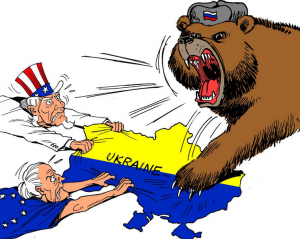
With the conflict now raging for almost a year, the prime benefactors are Russia's global competitors - the US and the EU. Chinese officials are also likely to be filled with glee as a major global player is tangled up with inflation under international sanctions.
The conflict took a turn for the worse yesterday with NATO reporting that Russian troops entered Eastern Ukraine to support the separatist movement that has only grown since its inception. It is difficult to see how the conflict will de-escalate given the impasse over territorial claims and past indiscretions by both nations.
The NBU is likely to raise rates again while the hryvnia continues to see falling demand. With IMF and World Bank involvement, a hryvnia-US dollar peg is also an option likely to be considered as a way to contain rampant inflation.
The National Bank of Ukraine (NBU), the country’s central bank, raised interest rates from 12.5% to 14.0% as of today. The move was largely unexpected and gave the Ukrainian hryvnia a solid bid in trading during the Asian session.
Ukraine is also crippled by rampant inflation with consumer prices rising an eye-watering 19.8% in October compared to 0.5% in January. This is the highest rate of inflation since 2009 and the consequential effects of the GFC which can be partly explained by the government’s decision to raise household utility tariffs in order to qualify for an international bailout from the IMF/World Bank. The confluence of war, geopolitical uncertainty, inflation and capital flight has driven the hryvnia 59% lower agains the US dollar since the start of 2014.
Conflict Is Bad for Business
Market conditions have consistently deteriorated since the Ukraine-Russia conflict began in February of this year, so much so that the NBU expects the Ukrainian economy to contract by 7% this year and the growth outlook for 2015 is equally sombre. According to the NBU, the negative GDP growth over the past year is intensifying… “the decline in real GDP in Q3 was 5.1% compared to 4.6% in Q2 and 1.1% in Q1 respectively."
To make things worse, Ukraine is now obligated to meet a slew of macroeconomic conditions and reforms as prescribed by the IMF and World Bank. When analysing IMF involvement in other countries such as Greece and Cyprus, it is likely that Ukraine will be forced to implement increasingly draconian measures to the detriment of its working population, leading to more unemployment and social unrest. Furthermore, national reserves of currency and precious metals are likely to be appropriated by the IMF, conditional for repayment conditions to being met.
According to an official statement accompanying the rate increase, the NBU said, “A worse market outlook and further hryvnia devaluation are causing additional inflation pressure, which will remain during the beginning of next year.” Adding, “Stabilizing measures taken by the central bank need to be reinforced by rate policy tools toward increasing the domestic value of the hryvnia.”
The NBU cites, “mutual restrictions in foreign trade with Russia” as a core factor for the decline in aggregate output. The two countries not only share an economic link but also a cultural bond that account for the majority of Ukraine’s net trade. Given the geopolitical conflict, many of those ties have been severed.
Pointing the finger of blame at Russia, the NBU states, “ The lack of de-escalation of military aggression against Ukraine led to the exacerbation of negative expectations, manifested in accelerating the outflow of deposits from banks and demand for foreign currency in recent months after some signs of stabilization in June 2014." In July and October, hryvnia outflows reached $16.8 billion. In terms of cash currency, the NBU estimates that approximately $1 billion left Ukraine in July-October.
And the Only Winner Is....
The Russia-Ukraine conflict undermines economic activity in both countries and continues to frighten investors from investing in the region until geopolitical conditions improve. Both countries are engaged in artificially supporting their respective currencies and both are using foreign exchange reserves to sustain value in their own currencies. Both the CBR and NBU have raised interest rates several times this year; with a low-rate environment globally, the only thing higher interest rates do is to stifle domestic business activity.
With the conflict now raging for almost a year, the prime benefactors are Russia's global competitors - the US and the EU. Chinese officials are also likely to be filled with glee as a major global player is tangled up with inflation under international sanctions.
The conflict took a turn for the worse yesterday with NATO reporting that Russian troops entered Eastern Ukraine to support the separatist movement that has only grown since its inception. It is difficult to see how the conflict will de-escalate given the impasse over territorial claims and past indiscretions by both nations.
The NBU is likely to raise rates again while the hryvnia continues to see falling demand. With IMF and World Bank involvement, a hryvnia-US dollar peg is also an option likely to be considered as a way to contain rampant inflation.
"Simply a Bad Idea": Bank of Ireland's McMunn Breaks With FCA on Regulator Growth Duty
Featured Videos
FM Daily Brief - 8 May 2026
Today's lead: Are brokers and prop firms wasting marketing budgets by confusing finfluencer reach with trust? Also ahead: an AWS outage impacting Coinbase, and Flutter reveals its real revenue strategy in prediction markets. It's Friday, the eighth of May 2026. You're listening to the Finance Magnates Daily Brief.
Today’s lead: Colombia is emerging as a key hub for global retail brokers as CFI expands its footprint in Bogotá. Also ahead: a decade review of listed CFD brokers shows sharply diverging performance, and UK retail investing debates highlight a widening gap between policy design and younger investors. It’s Thursday, the seventh of May 2026. You’re listening to the Finance Magnates Daily Brief.
FM Daily Brief - 6 May 2026
Today’s lead: brokers are doubling down on Singapore, with Saxo launching a premium tier and CMC restructuring ahead of a multi-asset push. Also ahead: the UAE licensing race heats up, and a deeper shift in broker business models. It’s Wednesday, the sixth of May 2026. You’re listening to the Finance Magnates Daily Brief.
FM Daily Brief - 5 May 2026
Today's lead: the Middle East prop trading surge in Deloitte's tech rankings. Also ahead, Plus500 says full-year performance is tracking above forecasts. It's Tuesday, the fifth of May 2026. You're listening to the Finance Magnates Daily Brief.
FM Daily Brief - 4 May 2026
Today's lead: spot FX volumes are retreating from March's war-driven peaks as the Iran ceasefire cools dollar trade. Also ahead: a Dubai-based broker sets out its gold volume targets for the rest of H1, and Australia's crypto licensing deadline moves closer with a 10% turnover penalty in play. It's Monday, the fourth of May 2026. You're listening to the Finance Magnates Daily Brief.