Tokenized Stocks Still Follow Wall Street Prices, Study by Exchange Group Finds

Tuesday, 20/10/2026 | 08:18 GMT by Damian Chmiel
  • The token led in none of 61 xStocks pairs, and the stock set over 80% of the price for the median one.
  • Its author says token buyers get regulated-market quotes without the disclosure and surveillance behind them.
info

Tokenized U.S. stocks take their prices from the exchanges where the shares trade, a World Federation of Exchanges (WFE) study published today (Tuesday) found. In none of the 61 pairs it analyzed did the token lead price discovery.

Brokers and crypto platforms sell the tokens on access to U.S. shares at any hour. Yet for the median pair, the study traced more than 80% of the lasting part of the price to the stock, and the token did most of the correcting when the two drifted apart.

London's trading industry is coming home!

The WFE, which represents stock exchanges, is not a neutral party. In August 2025 it wrote to regulators that tokenized stocks "mimic" equities without the same investor protections and asked for tighter oversight.

Tokens Do Most of the Adjusting

The working paper by Kaitao Lin, a senior financial economist at the WFE, covers xStocks, tokens issued by Backed, which Kraken agreed to buy in December 2025. It uses daily closing prices from July 2025, when xStocks launched, through May 2026.

Pedro Gurrola-Perez, head of research at the WFE

About 80% of the pairs shared a long-run price with their stock, and that relationship ran almost exactly one for one. When a token closed above its stock, the token's own price erased more than half of the gap within the next trading day, the paper found.

Pedro Gurrola-Perez, head of research at the WFE, said the fact that a tokenized market trades around the clock "does not mean that it leads price discovery."

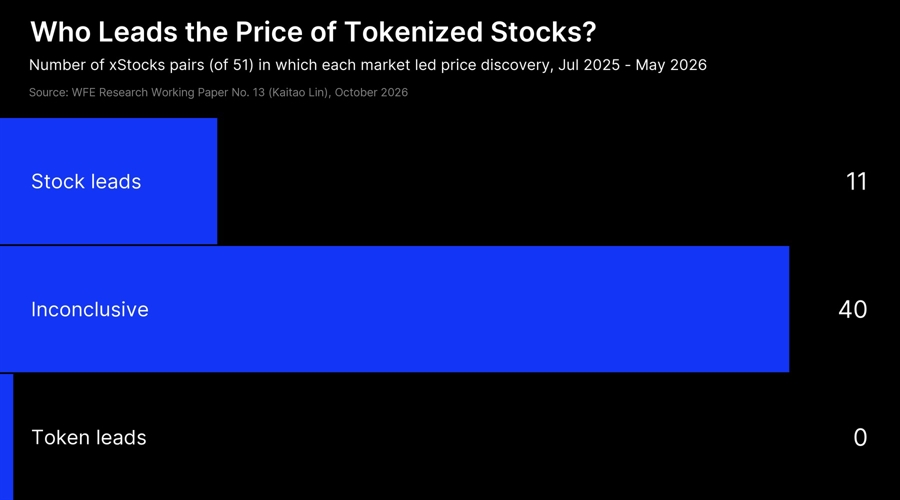
A second test, based on how much of each new price move sticks, put the stock ahead in 11 of the 51 pairs with a stable long-run link and the token ahead in none. The remaining 40 pairs were inconclusive.

A Late Close and a Thin Market

The design favored the token. Token prices were stamped at midnight UTC, several hours after the 4 p.m. New York close, so the token had more time to take in news, and the stock still led, Lin wrote.

The token market was also described in the paper as "an order of magnitude thinner" than the one it mirrors. xStocks are not offered to U.S. clients.

Holding an xStock gives no voting or other shareholder rights in the company. The European Securities and Markets Authority (ESMA ) warned in September 2025 that tokenized stocks often lack such rights.

The study uses one price a day and leaves out weekends, so it does not measure what happens between Friday's close and Monday's open.

That is where token platforms make their case. Data from Binance Research showed Binance's bStocks tokens captured a median 92% of the Monday opening move over seven weekends.

Lin cited another study that found off-hours token returns predicted the stock's next opening return. He wrote that the two findings are consistent, with the token relaying news and the stock setting the price both return to.

Exchanges Bring Tokens Inside

"The research illustrates that the true exchange remains the source of price discovery," said Nandini Sukumar, chief executive of the WFE.

The paper's warning is aimed at regulators. Token buyers get the prices of a regulated market "without its disclosure, surveillance, and investor protections," Lin wrote.

Exchanges are also building their own version. Nasdaq filed in September 2025 to let tokenized shares trade on its order book with the same rights as ordinary ones. The Securities and Exchange Commission (SEC) approved the rule in March 2026.

The SEC also approved Nasdaq's plan for 23-hour weekday trading in April, and Nasdaq is targeting a December 6 start. The paper says that change will narrow the gap in trading hours between tokens and the stocks behind them.

Tokenized U.S. stocks take their prices from the exchanges where the shares trade, a World Federation of Exchanges (WFE) study published today (Tuesday) found. In none of the 61 pairs it analyzed did the token lead price discovery.

Brokers and crypto platforms sell the tokens on access to U.S. shares at any hour. Yet for the median pair, the study traced more than 80% of the lasting part of the price to the stock, and the token did most of the correcting when the two drifted apart.

London's trading industry is coming home!

The WFE, which represents stock exchanges, is not a neutral party. In August 2025 it wrote to regulators that tokenized stocks "mimic" equities without the same investor protections and asked for tighter oversight.

Tokens Do Most of the Adjusting

The working paper by Kaitao Lin, a senior financial economist at the WFE, covers xStocks, tokens issued by Backed, which Kraken agreed to buy in December 2025. It uses daily closing prices from July 2025, when xStocks launched, through May 2026.

Pedro Gurrola-Perez, head of research at the WFE

About 80% of the pairs shared a long-run price with their stock, and that relationship ran almost exactly one for one. When a token closed above its stock, the token's own price erased more than half of the gap within the next trading day, the paper found.

Pedro Gurrola-Perez, head of research at the WFE, said the fact that a tokenized market trades around the clock "does not mean that it leads price discovery."

A second test, based on how much of each new price move sticks, put the stock ahead in 11 of the 51 pairs with a stable long-run link and the token ahead in none. The remaining 40 pairs were inconclusive.

A Late Close and a Thin Market

The design favored the token. Token prices were stamped at midnight UTC, several hours after the 4 p.m. New York close, so the token had more time to take in news, and the stock still led, Lin wrote.

The token market was also described in the paper as "an order of magnitude thinner" than the one it mirrors. xStocks are not offered to U.S. clients.

Holding an xStock gives no voting or other shareholder rights in the company. The European Securities and Markets Authority (ESMA ) warned in September 2025 that tokenized stocks often lack such rights.

The study uses one price a day and leaves out weekends, so it does not measure what happens between Friday's close and Monday's open.

That is where token platforms make their case. Data from Binance Research showed Binance's bStocks tokens captured a median 92% of the Monday opening move over seven weekends.

Lin cited another study that found off-hours token returns predicted the stock's next opening return. He wrote that the two findings are consistent, with the token relaying news and the stock setting the price both return to.

Exchanges Bring Tokens Inside

"The research illustrates that the true exchange remains the source of price discovery," said Nandini Sukumar, chief executive of the WFE.

The paper's warning is aimed at regulators. Token buyers get the prices of a regulated market "without its disclosure, surveillance, and investor protections," Lin wrote.

Exchanges are also building their own version. Nasdaq filed in September 2025 to let tokenized shares trade on its order book with the same rights as ordinary ones. The Securities and Exchange Commission (SEC) approved the rule in March 2026.

The SEC also approved Nasdaq's plan for 23-hour weekday trading in April, and Nasdaq is targeting a December 6 start. The paper says that change will narrow the gap in trading hours between tokens and the stocks behind them.

About the Author: Damian Chmiel
Damian Chmiel
  • 4073 Articles
  • 119 Followers
About the Author: Damian Chmiel
Damian Chmiel is a Senior Analyst & Editor at Finance Magnates with more than 15 years of experience in the CFD and online trading industry. Active as both a trader and journalist since 2010, he focuses on broker coverage, fintech innovation, and regulatory developments across Europe, the Middle East, and Asia. His work includes interviews with C-level leaders at major brokerages and fintech platforms, as well as co-authoring Finance Magnates’ quarterly industry benchmarking reports. Damian’s reporting is data-driven, market-aware, and grounded in direct industry engagement. His analysis and commentary have also been cited by external media outlets, including Investing.com, Binance, The Asset, Stockhead, and Dispatch. Education: MA in Finance and Accounting, Cracow University of Economics
  • 4073 Articles
  • 119 Followers

More from the Author

Retail FX

!"#$%&'()*+,-./0123456789:;<=>?@ABCDEFGHIJKLMNOPQRSTUVWXYZ[\]^_`abcdefghijklmnopqrstuvwxyz{|} !"#$%&'()*+,-./0123456789:;<=>?@ABCDEFGHIJKLMNOPQRSTUVWXYZ[\]^_`abcdefghijklmnopqrstuvwxyz{|}