A selection of our editors’ favourite stories and reading recommendations of the week.
Finance Magnates
In this week's edition, our editors once again take a brief detour away from the news desk to tell us about their favourite stories and reading recommendations.
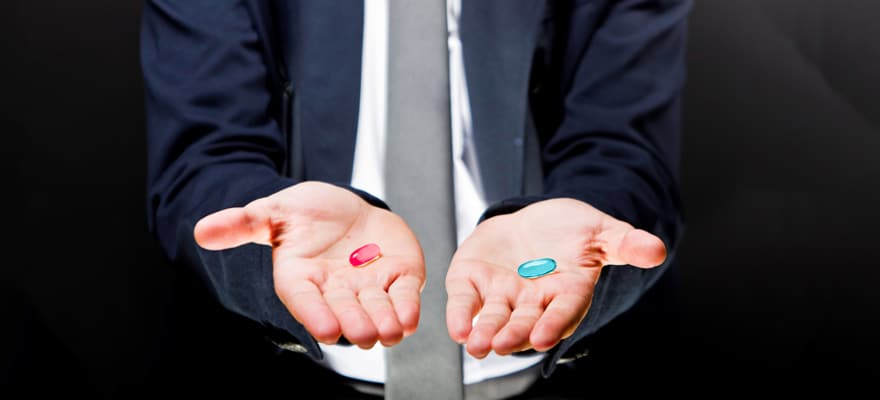
Avi Mizrahi kicks off with his contribution relating to an article that might just show you how deep the rabbit hole goes...
As someone with a great love for theoretical science and futurism, I was not at all surprised that Elon Musk, the guy who wants to back up humanity on Mars, is aware of the simulation hypothesis.
However, the fact that such a well-known business figure was willing to discuss it publicly was a surprise.
Now, thanks to Musk, more people whose job it is to think about our world have become aware of the theory - and this story proves it.
If you are really interested you have to search for Nick Bostrom's work, but this just might be the first step that will send you down the rabbit hole.
Wearable Computers and Tron Movies
Somewhere between articles on Forex and other markets, I like to see what’s going on in the world of technology and science.
Sylwester Majewski Chief Analyst
This week I found an interesting article on what can be described as 'wearable computers'. Yes, really wearable – not one of those fancy, so-called ‘smart watches’. Can you imagine clothes that have computing power? It might actually be possible one day.
Scientists from the University of Pittsburgh have designed a material that can solve pattern-recognition problems. It uses changes in the oscillations of a chemically powered gel that pulsates like a human heart.
"The hope is it will complete part of the computing as the sensor itself so you don't need extra processors," reveals Yan Fang, the lead author of the new study.
To quote from the article: "The material's oscillations are due to chemical reactions inside the gel that cause it to continually expand and contract when certain chemical reagents are present. These pulses cause a piezoelectric beam lying across the gel to bend and generate a voltage. Piezoelectric materials generate electricity in response to mechanical stress.” Wow!
As always in such a case, I try to imagine how new technology might help the trading industry. Traders wearing special gloves at home in order to make a faster trades? Or maybe traders on the floor of commodity exchanges wearing costumes that we know from the Tron movies?
Now, wouldn't that be really fun to watch?!
The Encyclopedia Reader
Jonathan Fine Head Of Content Projects
It takes a certain kind of reader to send the editor comments about typos. Vigilant, eloquent, and, more often than not, quite malicious. In seven years of publishing fast pace news, we’ve encountered quite a few of them.
But this New Yorker story presents us with an unlikely proofreader. Robin Woods, a prisoner in Maryland USA, has re-educated himself in prison through Merriam-Webster’s Collegiate Encyclopedia, “a four-pound tome that starts with an entry on the German city of Aachen and ends with zymogen”.
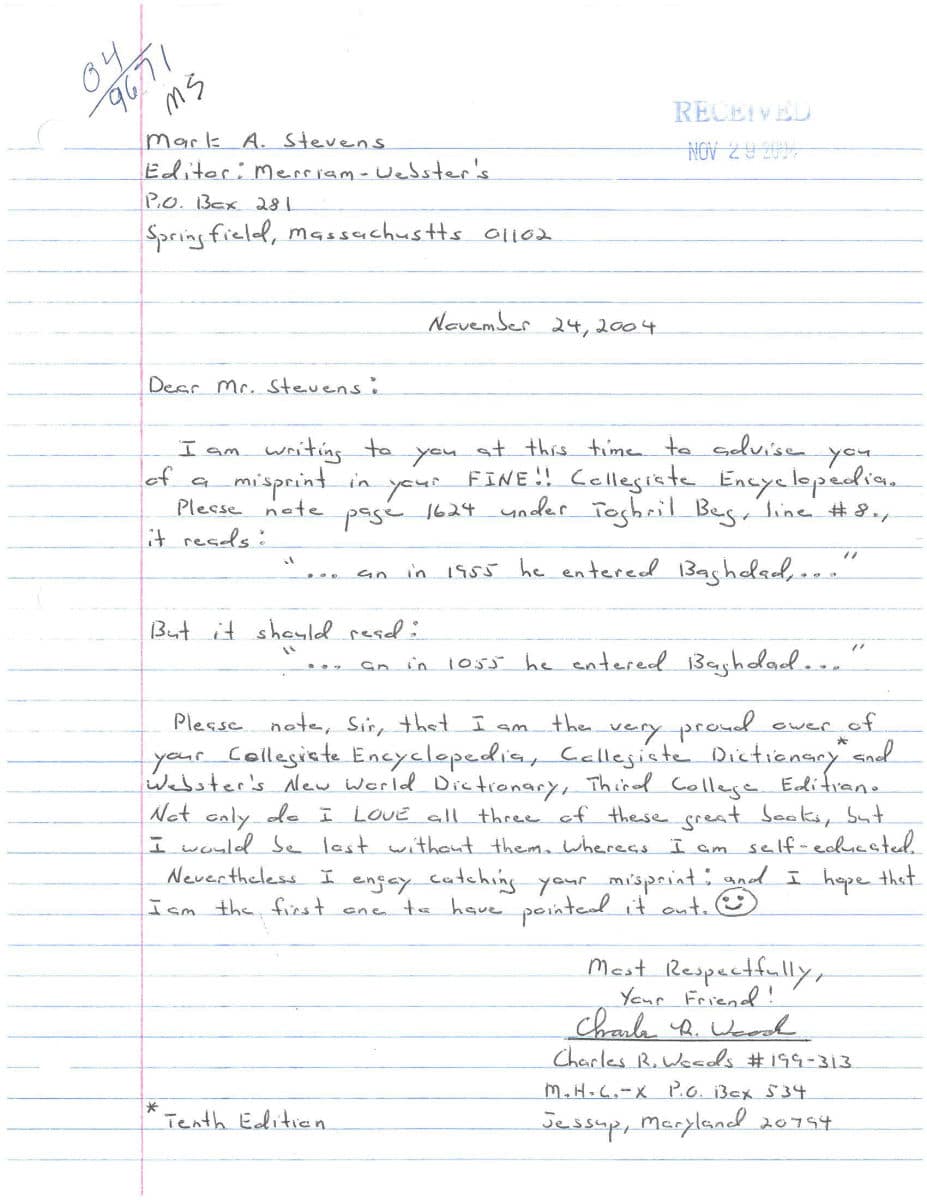
Woods spotted a typo and sent a letter to the editor. The rest, as the story unfolds, is not only history but a heartwarming tale about the role literacy and books, which we usually take for granted, can play in one’s life...
Woods’ first letter to Stevens, written in 2004, courtesy of The New Yorker.
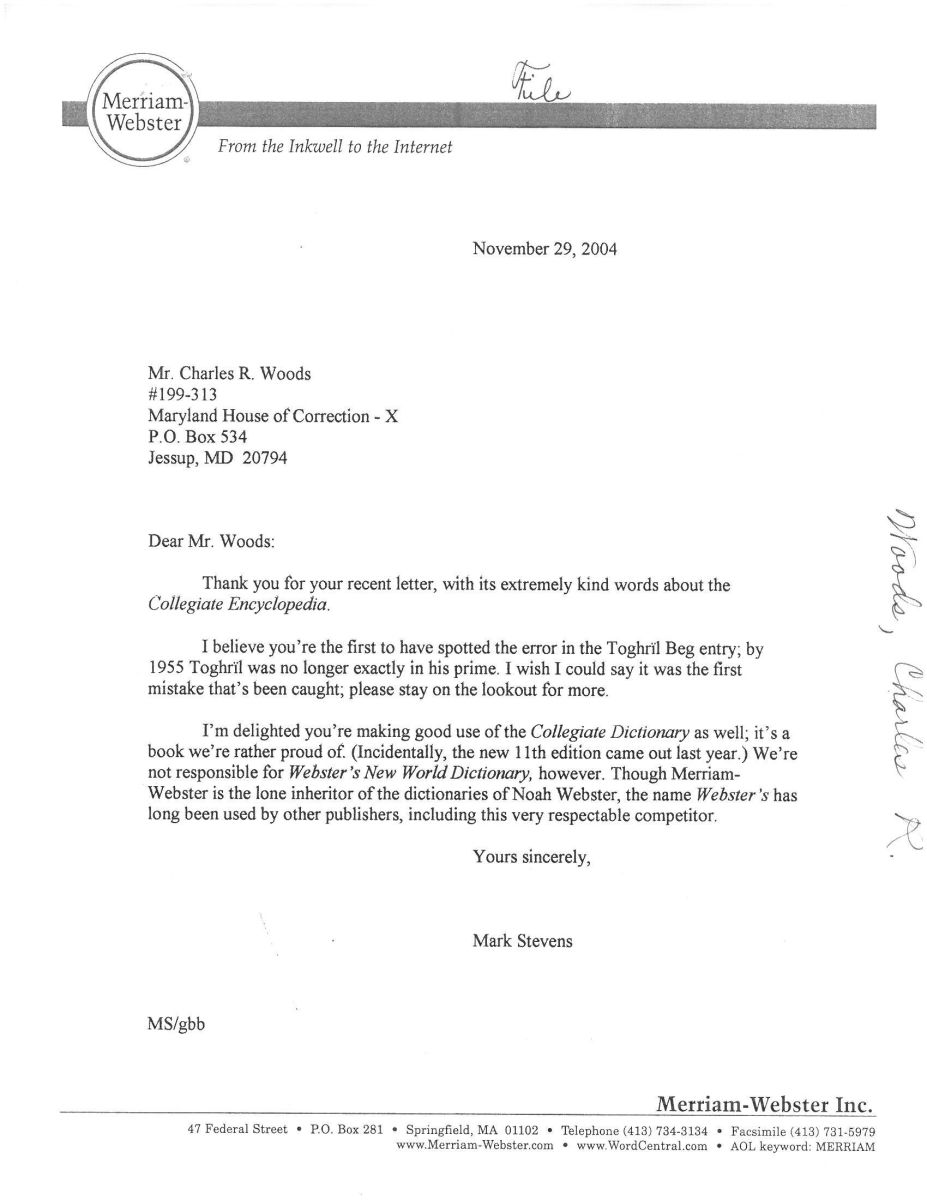
Stevens’ response to Woods’ first letter, courtesy of The New Yorker.
Need Some AI?
Whether we like it or not, Artificial Intelligence (AI)) is booming. A big part of our lives, we might not see and feel it still, but the trends in computing are obvious enough for businesses to try and harness the tech to best serve their interests.
Victor Golovtchenko Senior Editor
Recently, none other than the CEO of SpaceX and Tesla, Elon Musk, led an effort to democratize AI for fear of putting too much power into the hands of the few companies like Facebook and Google which have been working on this next generation of computing for some time.
Wired.com reports on another startup which is aiming in the same direction by enabling others to deliver a set of products to a market place.
Founded by Diego Openheimer, Algorithmia is set to become the place to go for developers that are willing to share their technology for free or for a fee with counterparties that are interested in using it for their own needs.
Creating competition for the likes of Google, Facebook and Microsoft is essential for the revival of small and medium sized businesses. If only the Federal Reserve could take away the interest rate accommodation that is enabling financial engineering…
That ends another week of stories that our editors are reading. Feel free to share your views in the comment section and any recommendations of your own. We look forward to hearing your opinions!
In this week's edition, our editors once again take a brief detour away from the news desk to tell us about their favourite stories and reading recommendations.
Avi Mizrahi kicks off with his contribution relating to an article that might just show you how deep the rabbit hole goes...
As someone with a great love for theoretical science and futurism, I was not at all surprised that Elon Musk, the guy who wants to back up humanity on Mars, is aware of the simulation hypothesis.
However, the fact that such a well-known business figure was willing to discuss it publicly was a surprise.
Now, thanks to Musk, more people whose job it is to think about our world have become aware of the theory - and this story proves it.
If you are really interested you have to search for Nick Bostrom's work, but this just might be the first step that will send you down the rabbit hole.
Wearable Computers and Tron Movies
Somewhere between articles on Forex and other markets, I like to see what’s going on in the world of technology and science.
Sylwester Majewski Chief Analyst
This week I found an interesting article on what can be described as 'wearable computers'. Yes, really wearable – not one of those fancy, so-called ‘smart watches’. Can you imagine clothes that have computing power? It might actually be possible one day.
Scientists from the University of Pittsburgh have designed a material that can solve pattern-recognition problems. It uses changes in the oscillations of a chemically powered gel that pulsates like a human heart.
"The hope is it will complete part of the computing as the sensor itself so you don't need extra processors," reveals Yan Fang, the lead author of the new study.
To quote from the article: "The material's oscillations are due to chemical reactions inside the gel that cause it to continually expand and contract when certain chemical reagents are present. These pulses cause a piezoelectric beam lying across the gel to bend and generate a voltage. Piezoelectric materials generate electricity in response to mechanical stress.” Wow!
As always in such a case, I try to imagine how new technology might help the trading industry. Traders wearing special gloves at home in order to make a faster trades? Or maybe traders on the floor of commodity exchanges wearing costumes that we know from the Tron movies?
Now, wouldn't that be really fun to watch?!
The Encyclopedia Reader
Jonathan Fine Head Of Content Projects
It takes a certain kind of reader to send the editor comments about typos. Vigilant, eloquent, and, more often than not, quite malicious. In seven years of publishing fast pace news, we’ve encountered quite a few of them.
But this New Yorker story presents us with an unlikely proofreader. Robin Woods, a prisoner in Maryland USA, has re-educated himself in prison through Merriam-Webster’s Collegiate Encyclopedia, “a four-pound tome that starts with an entry on the German city of Aachen and ends with zymogen”.
Woods spotted a typo and sent a letter to the editor. The rest, as the story unfolds, is not only history but a heartwarming tale about the role literacy and books, which we usually take for granted, can play in one’s life...
Woods’ first letter to Stevens, written in 2004, courtesy of The New Yorker.
Stevens’ response to Woods’ first letter, courtesy of The New Yorker.
Need Some AI?
Whether we like it or not, Artificial Intelligence (AI)) is booming. A big part of our lives, we might not see and feel it still, but the trends in computing are obvious enough for businesses to try and harness the tech to best serve their interests.
Victor Golovtchenko Senior Editor
Recently, none other than the CEO of SpaceX and Tesla, Elon Musk, led an effort to democratize AI for fear of putting too much power into the hands of the few companies like Facebook and Google which have been working on this next generation of computing for some time.
Wired.com reports on another startup which is aiming in the same direction by enabling others to deliver a set of products to a market place.
Founded by Diego Openheimer, Algorithmia is set to become the place to go for developers that are willing to share their technology for free or for a fee with counterparties that are interested in using it for their own needs.
Creating competition for the likes of Google, Facebook and Microsoft is essential for the revival of small and medium sized businesses. If only the Federal Reserve could take away the interest rate accommodation that is enabling financial engineering…
That ends another week of stories that our editors are reading. Feel free to share your views in the comment section and any recommendations of your own. We look forward to hearing your opinions!
42% of Swiss Financial Firms Have No Digital Fraud Policy, FINMA Finds
FP Markets Winner Spotlight 🏆 | Global Broker of the Year 2025 #Trading #Broker #Innovation #Shorts
FP Markets Winner Spotlight 🏆 | Global Broker of the Year 2025 #Trading #Broker #Innovation #Shorts
FP Markets takes the spotlight as Global Broker of the Year 2025 at the Finance Magnates Awards.
Martin Stoilov, Head of Client Experience, shares that trust, innovation, and people played a key role in the company’s success, supported by a strong foundation of integrity and client-centricity.
Following this milestone, FP Markets continues to focus on growth, technology investment, and its core values of transparency and excellence.
👉 Be part of FM Awards 2026: https://awards.financemagnates.com/#nominate
FP Markets takes the spotlight as Global Broker of the Year 2025 at the Finance Magnates Awards.
Martin Stoilov, Head of Client Experience, shares that trust, innovation, and people played a key role in the company’s success, supported by a strong foundation of integrity and client-centricity.
Following this milestone, FP Markets continues to focus on growth, technology investment, and its core values of transparency and excellence.
👉 Be part of FM Awards 2026: https://awards.financemagnates.com/#nominate
In this video, we review @HolaPrimeMarketsOfficial, a multi-asset forex and CFDs broker offering different account types, trading platforms, and flexible trading conditions.
We cover the broker’s overall offering, including account options, trading environment, platforms like MT4 and MT5, and additional services such as managed accounts and fast withdrawals.
Watch the full video to see if Hola Prime Markets fits your trading needs.
📣 Stay up to date with the latest in finance and trading. Follow Finance Magnates for industry news, insights, and global event coverage.
Connect with us:
🔗 LinkedIn: /financemagnates
👍 Facebook: /financemagnates
📸 Instagram: https://www.instagram.com/financemagnates
🐦 X: https://x.com/financemagnates
🎥 TikTok: https://www.tiktok.com/tag/financemagnates
▶️ YouTube: /@financemagnates_official
#HolaPrime #ForexBroker #CFDTrading #FinanceMagnates #Trading #Forex #BrokerReview
In this video, we review @HolaPrimeMarketsOfficial, a multi-asset forex and CFDs broker offering different account types, trading platforms, and flexible trading conditions.
We cover the broker’s overall offering, including account options, trading environment, platforms like MT4 and MT5, and additional services such as managed accounts and fast withdrawals.
Watch the full video to see if Hola Prime Markets fits your trading needs.
📣 Stay up to date with the latest in finance and trading. Follow Finance Magnates for industry news, insights, and global event coverage.
Connect with us:
🔗 LinkedIn: /financemagnates
👍 Facebook: /financemagnates
📸 Instagram: https://www.instagram.com/financemagnates
🐦 X: https://x.com/financemagnates
🎥 TikTok: https://www.tiktok.com/tag/financemagnates
▶️ YouTube: /@financemagnates_official
#HolaPrime #ForexBroker #CFDTrading #FinanceMagnates #Trading #Forex #BrokerReview
Hola Prime Review: What You Need to Know | Full Breakdown by Finance Magnates
Hola Prime Review: What You Need to Know | Full Breakdown by Finance Magnates
In this video, we review @HolaPrime_Global, a proprietary trading firm offering evaluation programs and performance-based payouts in simulated market environments.
We cover how the challenge model works, including account types, profit splits (up to 95%), trading rules, and what it takes to reach a funded account. You’ll also learn about available platforms like MT4, MT5, cTrader, and more, along with insights into payouts, support, and trading conditions.
Watch the full video to see if Hola Prime fits your trading style.
📣 Stay up to date with the latest in finance and trading. Follow Finance Magnates for industry news, insights, and global event coverage.
Connect with us:
🔗 LinkedIn: /financemagnates
👍 Facebook: /financemagnates
📸 Instagram: https://www.instagram.com/financemagnates
🐦 X: https://x.com/financemagnates
🎥 TikTok: https://www.tiktok.com/tag/financemagnates
▶️ YouTube: /@financemagnates_official
#HolaPrime #PropFirm #Trading #FinanceMagnates #Forex #FuturesTrading #TradingReview #PropFirmReview
In this video, we review @HolaPrime_Global, a proprietary trading firm offering evaluation programs and performance-based payouts in simulated market environments.
We cover how the challenge model works, including account types, profit splits (up to 95%), trading rules, and what it takes to reach a funded account. You’ll also learn about available platforms like MT4, MT5, cTrader, and more, along with insights into payouts, support, and trading conditions.
Watch the full video to see if Hola Prime fits your trading style.
📣 Stay up to date with the latest in finance and trading. Follow Finance Magnates for industry news, insights, and global event coverage.
Connect with us:
🔗 LinkedIn: /financemagnates
👍 Facebook: /financemagnates
📸 Instagram: https://www.instagram.com/financemagnates
🐦 X: https://x.com/financemagnates
🎥 TikTok: https://www.tiktok.com/tag/financemagnates
▶️ YouTube: /@financemagnates_official
#HolaPrime #PropFirm #Trading #FinanceMagnates #Forex #FuturesTrading #TradingReview #PropFirmReview
Axi Winner Spotlight 🏆 | Global Most Innovative Broker 2025 #Innovation #Trading #Fintech #Broker
Axi Winner Spotlight 🏆 | Global Most Innovative Broker 2025 #Innovation #Trading #Fintech #Broker
Axi takes the spotlight at the Finance Magnates Awards, winning Global Most Innovative Broker 2025.
Olivia Xenofontos and Ivanna Openko share how the team will feel: proud, motivated, and ready to keep delivering.
They also describe the night as well-organized, focused, and enjoyable for all.
👉 Be part of FM Awards 2026.
Axi takes the spotlight at the Finance Magnates Awards, winning Global Most Innovative Broker 2025.
Olivia Xenofontos and Ivanna Openko share how the team will feel: proud, motivated, and ready to keep delivering.
They also describe the night as well-organized, focused, and enjoyable for all.
👉 Be part of FM Awards 2026.
Recognition that matters.
Built on transparency.
Driven by the industry.
The Finance Magnates Awards 2026.
Nominations are now open.
🔗 https://awards.financemagnates.com/?utm_source=SM&utm_medium=social&utm_campaign=recognition-matters
Recognition that matters.
Built on transparency.
Driven by the industry.
The Finance Magnates Awards 2026.
Nominations are now open.
🔗 https://awards.financemagnates.com/?utm_source=SM&utm_medium=social&utm_campaign=recognition-matters