Have the Chinese GDP figures been artificially inflated for years? Finance Magnates takes a closer look.
FM Studio
In recent years, the controversial topic of alleged macroeconomic data felicitation by the Chinese statistics offices keeps returning like a boomerang. An attempt to overstate the most important indicators that assess the dynamics of economic growth or purchasing managers’ sentiments is widely covered by the world media. Adding to that, with the gossip about corruption and unauthorized use of sensitive data by the third parties, a really negative image of the Middle Kingdom’s credibility might emerge.
In the second part of 2015 much was said about the fact, that the results of Chinese GDP have been artificially inflated for many years. The illegal activities and attempts to mask weaker results probably involved local research institutes representing the particular administrative districts. Is that the main reason for the dynamic economic growth in China over last few decades?
Does China have something on its conscience?
In 2015, much attention has been paid to the yearly GDP forecasts. Although officials initially stated that the 7% barrier will be overcome without major problems, at the same time the independent analysts suggested that the results will come closer to 6.8%. Finally, gross domestic product was placed below the threshold established by the Chinese politicians, reflecting a very negative sentiment on global markets.
Allegedly, even the current lower readings may not have too much in common with the real condition of the economy. According to some statistical offices in the north-eastern parts of China, GDP landslides are caused by inflating the previous values in recent years. The aim was to cover up unfavorable growth, incompatible with the government’s propaganda.
Take Liaoning province as an example. In 2012 it noted GDP growth rate of 9.5% and few years later (2015), the same value fell unexpectedly to a mere 2.7%. Is it possible that a single region really declined so strongly in economic terms in just 3 years?
Let’s block the indicators publication
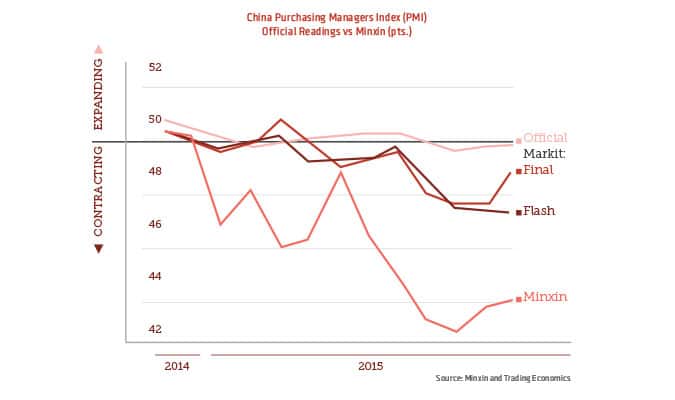
In addition to allegations of possible macroeconomic data falsification, China must also fend off accusations concerning the blockade of relevant indicators publication. At the end of last year, the PMI results published by the Caixin institute were suddenly banned. Interestingly, at the same time they have presented a strong decline in relation to the official governmental data. Two months later releases by another institute were blocked – this time Minxin.
While the official PMI readings remained above the 50.00 level, the Minxin index fell well under 45.00 showing strong regression in the overall sentiment. Tomasz Wiśniewski, chief analyst at Alpari Group, thinks that in the market there is a strong suspicion that alleged manipulation can be the real issue: “Now every data from China that hits the wire is taken skeptically. Some traders say that those numbers completely lost relevance and can be more considered as a folklore rather than influential game changer.”
Facing an economic slowdown, the Middle Kingdom is trying to maintain its status of the fastest developing market. Unfortunately, this cannot be achieved by artificially inflating the most important macroeconomic data, or blocking those indicators, that show the wrong picture of the real economy. The question is, whether only the Chinese are guilty of this or the issue applies to other economies as well?
Want know more about the Chinese economy? Get the brand new FM Intelligence Report:
In recent years, the controversial topic of alleged macroeconomic data felicitation by the Chinese statistics offices keeps returning like a boomerang. An attempt to overstate the most important indicators that assess the dynamics of economic growth or purchasing managers’ sentiments is widely covered by the world media. Adding to that, with the gossip about corruption and unauthorized use of sensitive data by the third parties, a really negative image of the Middle Kingdom’s credibility might emerge.
In the second part of 2015 much was said about the fact, that the results of Chinese GDP have been artificially inflated for many years. The illegal activities and attempts to mask weaker results probably involved local research institutes representing the particular administrative districts. Is that the main reason for the dynamic economic growth in China over last few decades?
Does China have something on its conscience?
In 2015, much attention has been paid to the yearly GDP forecasts. Although officials initially stated that the 7% barrier will be overcome without major problems, at the same time the independent analysts suggested that the results will come closer to 6.8%. Finally, gross domestic product was placed below the threshold established by the Chinese politicians, reflecting a very negative sentiment on global markets.
Allegedly, even the current lower readings may not have too much in common with the real condition of the economy. According to some statistical offices in the north-eastern parts of China, GDP landslides are caused by inflating the previous values in recent years. The aim was to cover up unfavorable growth, incompatible with the government’s propaganda.
Take Liaoning province as an example. In 2012 it noted GDP growth rate of 9.5% and few years later (2015), the same value fell unexpectedly to a mere 2.7%. Is it possible that a single region really declined so strongly in economic terms in just 3 years?
Let’s block the indicators publication
In addition to allegations of possible macroeconomic data falsification, China must also fend off accusations concerning the blockade of relevant indicators publication. At the end of last year, the PMI results published by the Caixin institute were suddenly banned. Interestingly, at the same time they have presented a strong decline in relation to the official governmental data. Two months later releases by another institute were blocked – this time Minxin.
While the official PMI readings remained above the 50.00 level, the Minxin index fell well under 45.00 showing strong regression in the overall sentiment. Tomasz Wiśniewski, chief analyst at Alpari Group, thinks that in the market there is a strong suspicion that alleged manipulation can be the real issue: “Now every data from China that hits the wire is taken skeptically. Some traders say that those numbers completely lost relevance and can be more considered as a folklore rather than influential game changer.”
Facing an economic slowdown, the Middle Kingdom is trying to maintain its status of the fastest developing market. Unfortunately, this cannot be achieved by artificially inflating the most important macroeconomic data, or blocking those indicators, that show the wrong picture of the real economy. The question is, whether only the Chinese are guilty of this or the issue applies to other economies as well?
Want know more about the Chinese economy? Get the brand new FM Intelligence Report:
Damian Chmiel is a Senior Analyst & Editor at Finance Magnates with more than 15 years of experience in the CFD and online trading industry. Active as both a trader and journalist since 2010, he focuses on broker coverage, fintech innovation, and regulatory developments across Europe, the Middle East, and Asia.
His work includes interviews with C-level leaders at major brokerages and fintech platforms, as well as co-authoring Finance Magnates’ quarterly industry benchmarking reports. Damian’s reporting is data-driven, market-aware, and grounded in direct industry engagement. His analysis and commentary have also been cited by external media outlets, including Investing.com, Binance, The Asset, Stockhead, and Dispatch.
Education:
MA in Finance and Accounting, Cracow University of Economics
Italy’s Consob Tightens Net on AI-Fueled Scams With Fresh Website Bans
FP Markets Winner Spotlight 🏆 | Global Broker of the Year 2025 #Trading #Broker #Innovation #Shorts
FP Markets Winner Spotlight 🏆 | Global Broker of the Year 2025 #Trading #Broker #Innovation #Shorts
FP Markets takes the spotlight as Global Broker of the Year 2025 at the Finance Magnates Awards.
Martin Stoilov, Head of Client Experience, shares that trust, innovation, and people played a key role in the company’s success, supported by a strong foundation of integrity and client-centricity.
Following this milestone, FP Markets continues to focus on growth, technology investment, and its core values of transparency and excellence.
👉 Be part of FM Awards 2026: https://awards.financemagnates.com/#nominate
FP Markets takes the spotlight as Global Broker of the Year 2025 at the Finance Magnates Awards.
Martin Stoilov, Head of Client Experience, shares that trust, innovation, and people played a key role in the company’s success, supported by a strong foundation of integrity and client-centricity.
Following this milestone, FP Markets continues to focus on growth, technology investment, and its core values of transparency and excellence.
👉 Be part of FM Awards 2026: https://awards.financemagnates.com/#nominate
In this video, we review @HolaPrimeMarketsOfficial, a multi-asset forex and CFDs broker offering different account types, trading platforms, and flexible trading conditions.
We cover the broker’s overall offering, including account options, trading environment, platforms like MT4 and MT5, and additional services such as managed accounts and fast withdrawals.
Watch the full video to see if Hola Prime Markets fits your trading needs.
📣 Stay up to date with the latest in finance and trading. Follow Finance Magnates for industry news, insights, and global event coverage.
Connect with us:
🔗 LinkedIn: /financemagnates
👍 Facebook: /financemagnates
📸 Instagram: https://www.instagram.com/financemagnates
🐦 X: https://x.com/financemagnates
🎥 TikTok: https://www.tiktok.com/tag/financemagnates
▶️ YouTube: /@financemagnates_official
#HolaPrime #ForexBroker #CFDTrading #FinanceMagnates #Trading #Forex #BrokerReview
In this video, we review @HolaPrimeMarketsOfficial, a multi-asset forex and CFDs broker offering different account types, trading platforms, and flexible trading conditions.
We cover the broker’s overall offering, including account options, trading environment, platforms like MT4 and MT5, and additional services such as managed accounts and fast withdrawals.
Watch the full video to see if Hola Prime Markets fits your trading needs.
📣 Stay up to date with the latest in finance and trading. Follow Finance Magnates for industry news, insights, and global event coverage.
Connect with us:
🔗 LinkedIn: /financemagnates
👍 Facebook: /financemagnates
📸 Instagram: https://www.instagram.com/financemagnates
🐦 X: https://x.com/financemagnates
🎥 TikTok: https://www.tiktok.com/tag/financemagnates
▶️ YouTube: /@financemagnates_official
#HolaPrime #ForexBroker #CFDTrading #FinanceMagnates #Trading #Forex #BrokerReview
Hola Prime Review: What You Need to Know | Full Breakdown by Finance Magnates
Hola Prime Review: What You Need to Know | Full Breakdown by Finance Magnates
In this video, we review @HolaPrime_Global, a proprietary trading firm offering evaluation programs and performance-based payouts in simulated market environments.
We cover how the challenge model works, including account types, profit splits (up to 95%), trading rules, and what it takes to reach a funded account. You’ll also learn about available platforms like MT4, MT5, cTrader, and more, along with insights into payouts, support, and trading conditions.
Watch the full video to see if Hola Prime fits your trading style.
📣 Stay up to date with the latest in finance and trading. Follow Finance Magnates for industry news, insights, and global event coverage.
Connect with us:
🔗 LinkedIn: /financemagnates
👍 Facebook: /financemagnates
📸 Instagram: https://www.instagram.com/financemagnates
🐦 X: https://x.com/financemagnates
🎥 TikTok: https://www.tiktok.com/tag/financemagnates
▶️ YouTube: /@financemagnates_official
#HolaPrime #PropFirm #Trading #FinanceMagnates #Forex #FuturesTrading #TradingReview #PropFirmReview
In this video, we review @HolaPrime_Global, a proprietary trading firm offering evaluation programs and performance-based payouts in simulated market environments.
We cover how the challenge model works, including account types, profit splits (up to 95%), trading rules, and what it takes to reach a funded account. You’ll also learn about available platforms like MT4, MT5, cTrader, and more, along with insights into payouts, support, and trading conditions.
Watch the full video to see if Hola Prime fits your trading style.
📣 Stay up to date with the latest in finance and trading. Follow Finance Magnates for industry news, insights, and global event coverage.
Connect with us:
🔗 LinkedIn: /financemagnates
👍 Facebook: /financemagnates
📸 Instagram: https://www.instagram.com/financemagnates
🐦 X: https://x.com/financemagnates
🎥 TikTok: https://www.tiktok.com/tag/financemagnates
▶️ YouTube: /@financemagnates_official
#HolaPrime #PropFirm #Trading #FinanceMagnates #Forex #FuturesTrading #TradingReview #PropFirmReview
Axi Winner Spotlight 🏆 | Global Most Innovative Broker 2025 #Innovation #Trading #Fintech #Broker
Axi Winner Spotlight 🏆 | Global Most Innovative Broker 2025 #Innovation #Trading #Fintech #Broker
Axi takes the spotlight at the Finance Magnates Awards, winning Global Most Innovative Broker 2025.
Olivia Xenofontos and Ivanna Openko share how the team will feel: proud, motivated, and ready to keep delivering.
They also describe the night as well-organized, focused, and enjoyable for all.
👉 Be part of FM Awards 2026.
Axi takes the spotlight at the Finance Magnates Awards, winning Global Most Innovative Broker 2025.
Olivia Xenofontos and Ivanna Openko share how the team will feel: proud, motivated, and ready to keep delivering.
They also describe the night as well-organized, focused, and enjoyable for all.
👉 Be part of FM Awards 2026.
Recognition that matters.
Built on transparency.
Driven by the industry.
The Finance Magnates Awards 2026.
Nominations are now open.
🔗 https://awards.financemagnates.com/?utm_source=SM&utm_medium=social&utm_campaign=recognition-matters
Recognition that matters.
Built on transparency.
Driven by the industry.
The Finance Magnates Awards 2026.
Nominations are now open.
🔗 https://awards.financemagnates.com/?utm_source=SM&utm_medium=social&utm_campaign=recognition-matters