CFD firms are burning through CMOs faster than ever, with median tenure dropping to less than 18 months.
According to the FYI study, nearly half of the analyzed brokers currently have no marketing expert after their previous executive departed.
Chief
marketing officers (CMOs) at online trading firms are leaving their jobs faster
than ever, with new data from FYI showing the median tenure has dropped to just
17.5 months across the industry.
CFD Industry CMO Tenure
Drops to Lowest Level Since 2014
The
findings come from an analysis of 50 data points covering 40 individual CMOs
across 38 companies in the CFD and online trading space between 2014 and 2024.
The research, which examined LinkedIn profiles and announcements,
paints a picture of an industry where marketing leadership struggles to gain
traction.
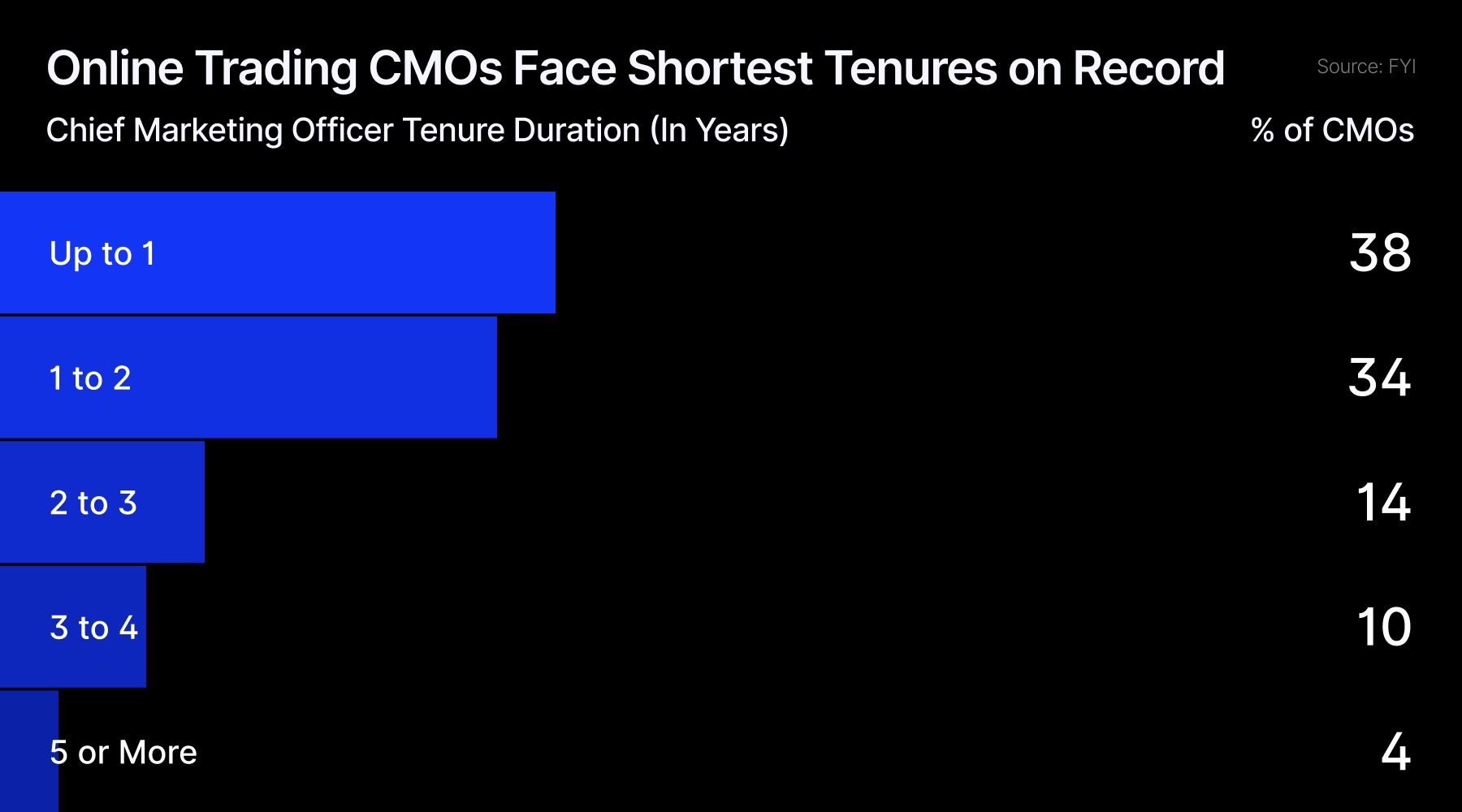
Nearly 40%
of the CMOs studied lasted less than one year in their roles, while only 4%
managed to stay five years or longer. The average tenure of 22.4 months is
pulled higher by a handful of longer-serving executives, but the median tells a
starker story.
“2024
showing the lowest average tenure in the entire dataset” suggests the
problem is getting worse, not better. The data shows no correlation between
company size and CMO turnover, with both large brokers and smaller firms
experiencing similar churn rates.
Christian Görgen from FYI
“Our aim
was to understand how long CMOs usually stay in these roles, why it’s so hard
for them to last long-term and what this says about leadership and marketing in
the online trading industry,” Christian Görgen from Marketing Agency FYI commented on the report’s
findings.
Perhaps
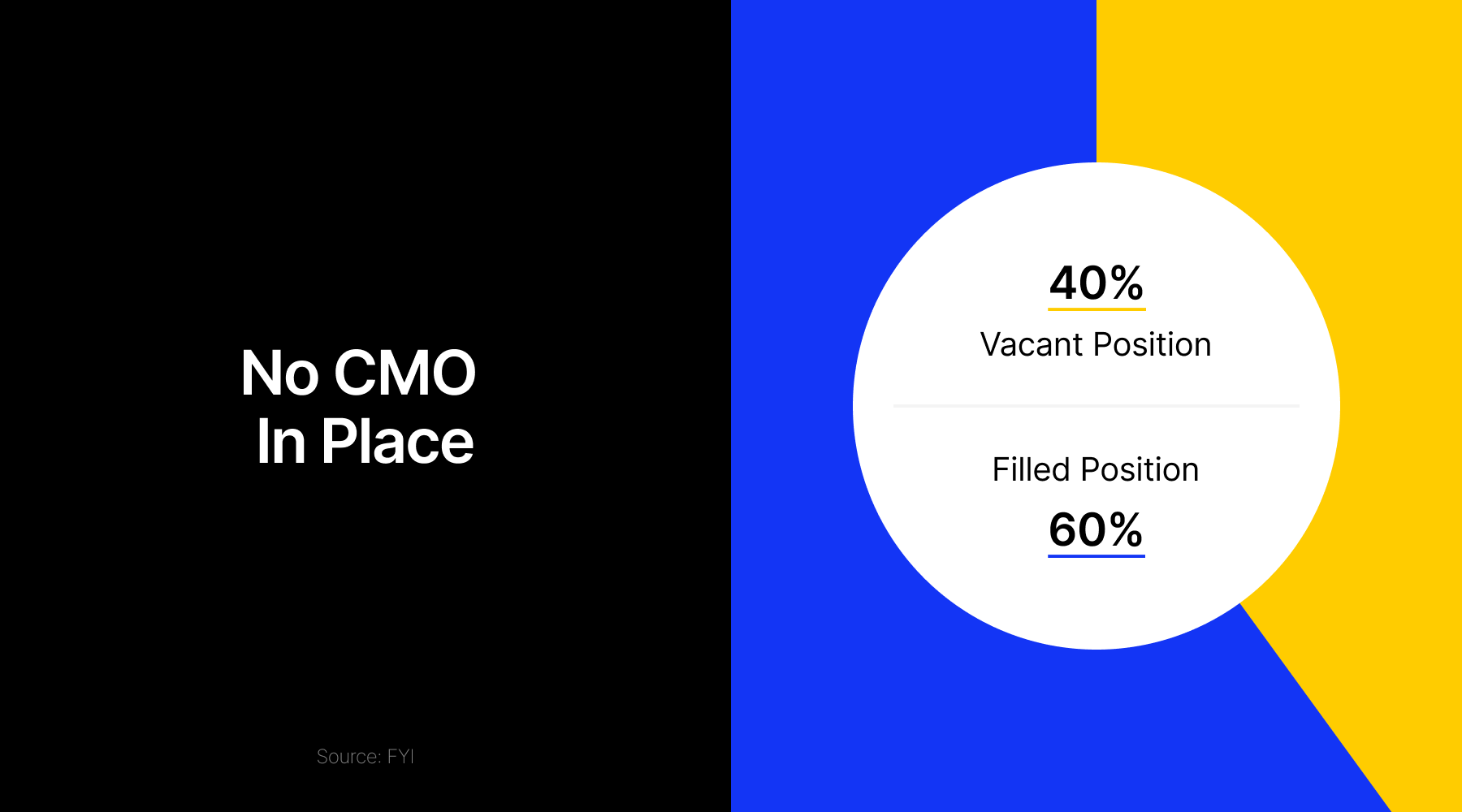
more telling is what happens after these marketing chiefs leave: 40% of the
brokers analyzed currently have no CMO in place following their previous
executive's departure. Of the 40 brokers investigated, 16 had no one holding
the official Chief Marketing Officer title at the time of review.
Industry Structure Creates
Impossible Expectations
The
research points to fundamental misalignment between what CMOs can deliver and
what trading firm founders expect. Unlike technology startups that focus on
user engagement metrics, CFD brokers prioritize traditional financial KPIs like
customer acquisition cost and lifetime value.
“Founders
want rapid user growth and quick revenue, often within months. But marketing
isn't something you can switch on overnight,” Görgen adds. This creates a
cycle where CMOs are brought in when growth stalls, expected to deliver
immediate results, then removed when quick fixes don't materialize.
The
competitive landscape doesn't help. Cyprus financial regulator CySEC lists 247
approved domains as of July 2025, with most offering similar services:
multi-asset access, fast execution, and tight spreads. This commoditization
makes differentiation difficult and puts additional pressure on marketing teams
to find unique angles.
The
research also highlights how heavily the industry relies on affiliate
marketing, with brokers often paying 25% to over 50% of their revenue to
affiliates and introducing brokers. While some affiliates provide legitimate
value, the analysis describes a “darker side” involving “fake
traffic, shady referrals and recycled client books.”
Successful Marketing
Leaders Buck Traditional Mold
The few
CMOs who do succeed in online trading don't fit the typical marketing executive
profile. The research found that effective marketing leaders in this space “tend to be hands-on, highly technical, and closely aligned with the
trading side of the business.”
Many come
from within the company or have backgrounds in business, computer science, or
trading rather than traditional marketing disciplines. “They follow
structured frameworks, focus on execution, and know when to turn up the
volume,” the analysis states.
This
suggests the industry may need to rethink what it looks for in marketing
leadership, moving away from brand-focused executives toward more
operationally-minded professionals who understand the technical aspects of
trading platforms.
The
research concludes that traditional CMO models aren't working in online
trading, and that sustainable change requires treating marketing as part of
core business strategy rather than a support function brought in during growth
emergencies.
Chief
marketing officers (CMOs) at online trading firms are leaving their jobs faster
than ever, with new data from FYI showing the median tenure has dropped to just
17.5 months across the industry.
CFD Industry CMO Tenure
Drops to Lowest Level Since 2014
The
findings come from an analysis of 50 data points covering 40 individual CMOs
across 38 companies in the CFD and online trading space between 2014 and 2024.
The research, which examined LinkedIn profiles and announcements,
paints a picture of an industry where marketing leadership struggles to gain
traction.
Nearly 40%
of the CMOs studied lasted less than one year in their roles, while only 4%
managed to stay five years or longer. The average tenure of 22.4 months is
pulled higher by a handful of longer-serving executives, but the median tells a
starker story.
“2024
showing the lowest average tenure in the entire dataset” suggests the
problem is getting worse, not better. The data shows no correlation between
company size and CMO turnover, with both large brokers and smaller firms
experiencing similar churn rates.
Christian Görgen from FYI
“Our aim
was to understand how long CMOs usually stay in these roles, why it’s so hard
for them to last long-term and what this says about leadership and marketing in
the online trading industry,” Christian Görgen from Marketing Agency FYI commented on the report’s
findings.
Perhaps
more telling is what happens after these marketing chiefs leave: 40% of the
brokers analyzed currently have no CMO in place following their previous
executive's departure. Of the 40 brokers investigated, 16 had no one holding
the official Chief Marketing Officer title at the time of review.
Industry Structure Creates
Impossible Expectations
The
research points to fundamental misalignment between what CMOs can deliver and
what trading firm founders expect. Unlike technology startups that focus on
user engagement metrics, CFD brokers prioritize traditional financial KPIs like
customer acquisition cost and lifetime value.
“Founders
want rapid user growth and quick revenue, often within months. But marketing
isn't something you can switch on overnight,” Görgen adds. This creates a
cycle where CMOs are brought in when growth stalls, expected to deliver
immediate results, then removed when quick fixes don't materialize.
The
competitive landscape doesn't help. Cyprus financial regulator CySEC lists 247
approved domains as of July 2025, with most offering similar services:
multi-asset access, fast execution, and tight spreads. This commoditization
makes differentiation difficult and puts additional pressure on marketing teams
to find unique angles.
The
research also highlights how heavily the industry relies on affiliate
marketing, with brokers often paying 25% to over 50% of their revenue to
affiliates and introducing brokers. While some affiliates provide legitimate
value, the analysis describes a “darker side” involving “fake
traffic, shady referrals and recycled client books.”
Successful Marketing
Leaders Buck Traditional Mold
The few
CMOs who do succeed in online trading don't fit the typical marketing executive
profile. The research found that effective marketing leaders in this space “tend to be hands-on, highly technical, and closely aligned with the
trading side of the business.”
Many come
from within the company or have backgrounds in business, computer science, or
trading rather than traditional marketing disciplines. “They follow
structured frameworks, focus on execution, and know when to turn up the
volume,” the analysis states.
This
suggests the industry may need to rethink what it looks for in marketing
leadership, moving away from brand-focused executives toward more
operationally-minded professionals who understand the technical aspects of
trading platforms.
The
research concludes that traditional CMO models aren't working in online
trading, and that sustainable change requires treating marketing as part of
core business strategy rather than a support function brought in during growth
emergencies.
Damian Chmiel is a Senior Analyst & Editor at Finance Magnates with more than 15 years of experience in the CFD and online trading industry. Active as both a trader and journalist since 2010, he focuses on broker coverage, fintech innovation, and regulatory developments across Europe, the Middle East, and Asia.
His work includes interviews with C-level leaders at major brokerages and fintech platforms, as well as co-authoring Finance Magnates’ quarterly industry benchmarking reports. Damian’s reporting is data-driven, market-aware, and grounded in direct industry engagement. His analysis and commentary have also been cited by external media outlets, including Investing.com, Binance, The Asset, Stockhead, and Dispatch.
Education:
MA in Finance and Accounting, Cracow University of Economics
Italy’s Consob Tightens Net on AI-Fueled Scams With Fresh Website Bans
FP Markets Winner Spotlight 🏆 | Global Broker of the Year 2025 #Trading #Broker #Innovation #Shorts
FP Markets Winner Spotlight 🏆 | Global Broker of the Year 2025 #Trading #Broker #Innovation #Shorts
FP Markets takes the spotlight as Global Broker of the Year 2025 at the Finance Magnates Awards.
Martin Stoilov, Head of Client Experience, shares that trust, innovation, and people played a key role in the company’s success, supported by a strong foundation of integrity and client-centricity.
Following this milestone, FP Markets continues to focus on growth, technology investment, and its core values of transparency and excellence.
👉 Be part of FM Awards 2026: https://awards.financemagnates.com/#nominate
FP Markets takes the spotlight as Global Broker of the Year 2025 at the Finance Magnates Awards.
Martin Stoilov, Head of Client Experience, shares that trust, innovation, and people played a key role in the company’s success, supported by a strong foundation of integrity and client-centricity.
Following this milestone, FP Markets continues to focus on growth, technology investment, and its core values of transparency and excellence.
👉 Be part of FM Awards 2026: https://awards.financemagnates.com/#nominate
In this video, we review @HolaPrimeMarketsOfficial, a multi-asset forex and CFDs broker offering different account types, trading platforms, and flexible trading conditions.
We cover the broker’s overall offering, including account options, trading environment, platforms like MT4 and MT5, and additional services such as managed accounts and fast withdrawals.
Watch the full video to see if Hola Prime Markets fits your trading needs.
📣 Stay up to date with the latest in finance and trading. Follow Finance Magnates for industry news, insights, and global event coverage.
Connect with us:
🔗 LinkedIn: /financemagnates
👍 Facebook: /financemagnates
📸 Instagram: https://www.instagram.com/financemagnates
🐦 X: https://x.com/financemagnates
🎥 TikTok: https://www.tiktok.com/tag/financemagnates
▶️ YouTube: /@financemagnates_official
#HolaPrime #ForexBroker #CFDTrading #FinanceMagnates #Trading #Forex #BrokerReview
In this video, we review @HolaPrimeMarketsOfficial, a multi-asset forex and CFDs broker offering different account types, trading platforms, and flexible trading conditions.
We cover the broker’s overall offering, including account options, trading environment, platforms like MT4 and MT5, and additional services such as managed accounts and fast withdrawals.
Watch the full video to see if Hola Prime Markets fits your trading needs.
📣 Stay up to date with the latest in finance and trading. Follow Finance Magnates for industry news, insights, and global event coverage.
Connect with us:
🔗 LinkedIn: /financemagnates
👍 Facebook: /financemagnates
📸 Instagram: https://www.instagram.com/financemagnates
🐦 X: https://x.com/financemagnates
🎥 TikTok: https://www.tiktok.com/tag/financemagnates
▶️ YouTube: /@financemagnates_official
#HolaPrime #ForexBroker #CFDTrading #FinanceMagnates #Trading #Forex #BrokerReview
Hola Prime Review: What You Need to Know | Full Breakdown by Finance Magnates
Hola Prime Review: What You Need to Know | Full Breakdown by Finance Magnates
In this video, we review @HolaPrime_Global, a proprietary trading firm offering evaluation programs and performance-based payouts in simulated market environments.
We cover how the challenge model works, including account types, profit splits (up to 95%), trading rules, and what it takes to reach a funded account. You’ll also learn about available platforms like MT4, MT5, cTrader, and more, along with insights into payouts, support, and trading conditions.
Watch the full video to see if Hola Prime fits your trading style.
📣 Stay up to date with the latest in finance and trading. Follow Finance Magnates for industry news, insights, and global event coverage.
Connect with us:
🔗 LinkedIn: /financemagnates
👍 Facebook: /financemagnates
📸 Instagram: https://www.instagram.com/financemagnates
🐦 X: https://x.com/financemagnates
🎥 TikTok: https://www.tiktok.com/tag/financemagnates
▶️ YouTube: /@financemagnates_official
#HolaPrime #PropFirm #Trading #FinanceMagnates #Forex #FuturesTrading #TradingReview #PropFirmReview
In this video, we review @HolaPrime_Global, a proprietary trading firm offering evaluation programs and performance-based payouts in simulated market environments.
We cover how the challenge model works, including account types, profit splits (up to 95%), trading rules, and what it takes to reach a funded account. You’ll also learn about available platforms like MT4, MT5, cTrader, and more, along with insights into payouts, support, and trading conditions.
Watch the full video to see if Hola Prime fits your trading style.
📣 Stay up to date with the latest in finance and trading. Follow Finance Magnates for industry news, insights, and global event coverage.
Connect with us:
🔗 LinkedIn: /financemagnates
👍 Facebook: /financemagnates
📸 Instagram: https://www.instagram.com/financemagnates
🐦 X: https://x.com/financemagnates
🎥 TikTok: https://www.tiktok.com/tag/financemagnates
▶️ YouTube: /@financemagnates_official
#HolaPrime #PropFirm #Trading #FinanceMagnates #Forex #FuturesTrading #TradingReview #PropFirmReview
Axi Winner Spotlight 🏆 | Global Most Innovative Broker 2025 #Innovation #Trading #Fintech #Broker
Axi Winner Spotlight 🏆 | Global Most Innovative Broker 2025 #Innovation #Trading #Fintech #Broker
Axi takes the spotlight at the Finance Magnates Awards, winning Global Most Innovative Broker 2025.
Olivia Xenofontos and Ivanna Openko share how the team will feel: proud, motivated, and ready to keep delivering.
They also describe the night as well-organized, focused, and enjoyable for all.
👉 Be part of FM Awards 2026.
Axi takes the spotlight at the Finance Magnates Awards, winning Global Most Innovative Broker 2025.
Olivia Xenofontos and Ivanna Openko share how the team will feel: proud, motivated, and ready to keep delivering.
They also describe the night as well-organized, focused, and enjoyable for all.
👉 Be part of FM Awards 2026.
Recognition that matters.
Built on transparency.
Driven by the industry.
The Finance Magnates Awards 2026.
Nominations are now open.
🔗 https://awards.financemagnates.com/?utm_source=SM&utm_medium=social&utm_campaign=recognition-matters
Recognition that matters.
Built on transparency.
Driven by the industry.
The Finance Magnates Awards 2026.
Nominations are now open.
🔗 https://awards.financemagnates.com/?utm_source=SM&utm_medium=social&utm_campaign=recognition-matters