The AI-powered schemes targeting retail investors now lead all authorized push payment fraud categories.
The global scam losses hit $62 billion in 2025, growing more than twice as fast as traditional bank fraud.
Investment
scams, including those targeting cryptocurrency and stock market participants, have
become the single most commonly reported form of authorized push payment (APP) fraud,
outpacing every other fraud category tracked in a new industry report released today
(Wednesday).
The finding
comes from Nasdaq
Verafin's 2026 Global Financial Crime Report, which surveyed 505
anti-financial crime professionals worldwide. When asked which types of APP
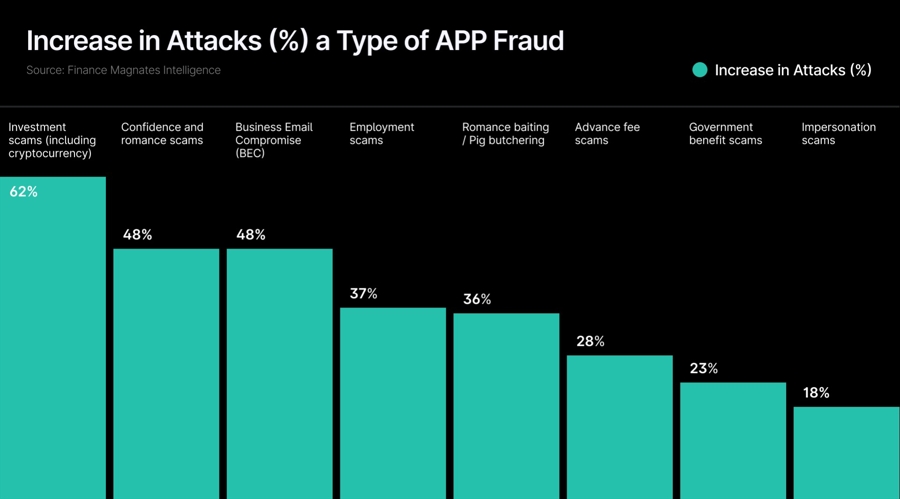
fraud were generating the greatest increase in customer attacks, 62% of
respondents pointed to investment scams, nearly 15 percentage points above the
next-closest categories, business email compromise and confidence scams, each
cited by 48% of participants. Romance baiting came in at 36%, and pig
butchering at 28%.
That result
sits inside a broader surge in scam activity. Global losses from fraud scams
reached $62 billion in 2025, the report said, growing at a compound annual rate
of 19.3% over the past two years, more than double the 8.2% annualized growth
rate recorded for traditional bank fraud schemes.
Stephanie Champion, Executive Vice President and Head of Nasdaq Verafin
"We
are currently in the midst of a full-blown financial crime crisis, powered by
criminal networks that are leveraging AI to super-charge scam playbooks and
operating with the scale and coordination of multinational corporations,"
said Stephanie Champion, Executive Vice President and Head of Nasdaq Verafin.
Investment Scams Pull
Ahead of Every Other Fraud Category
APP fraud, where
victims are deceived or manipulated into authorizing transfers to criminals, has
become a primary target as banks have strengthened internal controls. As
institutions tighten defenses at the institutional level, the report argues,
criminal networks have pivoted to targeting customers directly through social
engineering, taking the path of least resistance.
The
mechanics behind investment scams follow a recognizable pattern. Fraudsters
present fabricated profit statements, fake brokerage dashboards, and
manufactured performance records to convince victims to commit funds to stocks,
commodities, digital assets, or real estate. The investment is either
nonexistent or worthless, according to the report, and perpetrators eventually
cut contact once they have the funds.
Nearly
three-quarters of the professionals surveyed - 72% - said APP fraud volumes
increased at their institutions over the past year, with only 7% reporting a
decline. More than half cited APP fraud as a major industry threat, and nearly
three-quarters reported an increase in such attacks since 2024.
What's
accelerating the threat is not just scale, it's automation. The report
identifies two emerging models that the company says are reshaping the fraud
landscape: scams-as-a-service, where successful fraud infrastructures are
packaged and sold to other criminal operators, enabling high-volume attacks
from parties with minimal technical expertise; and AI-enabled hyper scams,
where generative AI and deepfakes are used to produce more convincing,
personalized pitches at machine speed.
"The
ability to develop scams leveraging AI and other technology-based solutions has
really created an epidemic for us," one unnamed industry executive said in
the report's interview series.
Ninety
percent of respondents reported an increase in AI-driven attacks at their
institution over the past two years, according to the report. More than half
described the increase as significant or exponential. Criminal origination has
shifted away from individual email inboxes and scaled across social media
platforms, with funds typically moved via instant payment rails before victims
realize what has happened, Nasdaq Verafin said.
Jorij
Abraham, Managing Director of the Global Anti-Scam Alliance (GASA), who
contributed to the report, put the dynamic plainly: "Scammers are using AI
the same way legitimate businesses do to work faster, cheaper, and at
scale."
North
American regulators have been tracking this pattern closely. The North American
Securities Administrators Association previously
flagged AI-generated investment content and deepfake celebrity endorsements
as top threats to retail investors, noting that more than 32% of reported fraud
was already targeting investors through social media platforms.
Cyber-Enabled Fraud Adds
Another $14 Billion to the Bill
Separate
from investment scams but closely entangled, cyber-enabled fraud - covering
business email compromise, phishing, and data breaches - accounted for $14.3
billion in global losses in 2025, growing at 19.6% annually, the report said.
The
Americas bore the largest regional share at $7.75 billion, with BEC alone
generating $5.37 billion in the region. Cyber-enabled crime was ranked by
respondents as the top financial crime threat facing their customers,
ahead of APP scams and money mule activity.
Cryptocurrency
continues to feature prominently in how fraud proceeds move. In the UK, crypto fraud
has risen to the top of the regulatory agenda as mounting losses spur new legislative
strategy, a trend mirrored globally in the report's data, where 53% of AML
professionals ranked laundering through crypto assets as their second-highest
money laundering concern.
Americas Drive the Fastest
Growth in Fraud Losses
Regionally, the
Asia-Pacific region recorded the largest absolute fraud losses at $235
billion, though its 3% compound annual growth rate was the slowest of any
region. The Americas followed with $211.5 billion in total fraud losses but
posted the fastest growth at 18.3% annually. EMEA logged $132.9 billion, led by
account-to-account payment fraud in the EU.
The U.S.
picture is particularly acute. American consumers and businesses absorbed
$17.47 billion in fraud scam losses in 2025, growing at 24% annually - above
the regional average. Business email compromise reached $4.76 billion in the
U.S. alone, while employment fraud climbed 30% annually to $1.72 billion.
Investment
scams, including those targeting cryptocurrency and stock market participants, have
become the single most commonly reported form of authorized push payment (APP) fraud,
outpacing every other fraud category tracked in a new industry report released today
(Wednesday).
The finding
comes from Nasdaq
Verafin's 2026 Global Financial Crime Report, which surveyed 505
anti-financial crime professionals worldwide. When asked which types of APP
fraud were generating the greatest increase in customer attacks, 62% of
respondents pointed to investment scams, nearly 15 percentage points above the
next-closest categories, business email compromise and confidence scams, each
cited by 48% of participants. Romance baiting came in at 36%, and pig
butchering at 28%.
That result
sits inside a broader surge in scam activity. Global losses from fraud scams
reached $62 billion in 2025, the report said, growing at a compound annual rate
of 19.3% over the past two years, more than double the 8.2% annualized growth
rate recorded for traditional bank fraud schemes.
Stephanie Champion, Executive Vice President and Head of Nasdaq Verafin
"We
are currently in the midst of a full-blown financial crime crisis, powered by
criminal networks that are leveraging AI to super-charge scam playbooks and
operating with the scale and coordination of multinational corporations,"
said Stephanie Champion, Executive Vice President and Head of Nasdaq Verafin.
Investment Scams Pull
Ahead of Every Other Fraud Category
APP fraud, where
victims are deceived or manipulated into authorizing transfers to criminals, has
become a primary target as banks have strengthened internal controls. As
institutions tighten defenses at the institutional level, the report argues,
criminal networks have pivoted to targeting customers directly through social
engineering, taking the path of least resistance.
The
mechanics behind investment scams follow a recognizable pattern. Fraudsters
present fabricated profit statements, fake brokerage dashboards, and
manufactured performance records to convince victims to commit funds to stocks,
commodities, digital assets, or real estate. The investment is either
nonexistent or worthless, according to the report, and perpetrators eventually
cut contact once they have the funds.
Nearly
three-quarters of the professionals surveyed - 72% - said APP fraud volumes
increased at their institutions over the past year, with only 7% reporting a
decline. More than half cited APP fraud as a major industry threat, and nearly
three-quarters reported an increase in such attacks since 2024.
What's
accelerating the threat is not just scale, it's automation. The report
identifies two emerging models that the company says are reshaping the fraud
landscape: scams-as-a-service, where successful fraud infrastructures are
packaged and sold to other criminal operators, enabling high-volume attacks
from parties with minimal technical expertise; and AI-enabled hyper scams,
where generative AI and deepfakes are used to produce more convincing,
personalized pitches at machine speed.
"The
ability to develop scams leveraging AI and other technology-based solutions has
really created an epidemic for us," one unnamed industry executive said in
the report's interview series.
Ninety
percent of respondents reported an increase in AI-driven attacks at their
institution over the past two years, according to the report. More than half
described the increase as significant or exponential. Criminal origination has
shifted away from individual email inboxes and scaled across social media
platforms, with funds typically moved via instant payment rails before victims
realize what has happened, Nasdaq Verafin said.
Jorij
Abraham, Managing Director of the Global Anti-Scam Alliance (GASA), who
contributed to the report, put the dynamic plainly: "Scammers are using AI
the same way legitimate businesses do to work faster, cheaper, and at
scale."
North
American regulators have been tracking this pattern closely. The North American
Securities Administrators Association previously
flagged AI-generated investment content and deepfake celebrity endorsements
as top threats to retail investors, noting that more than 32% of reported fraud
was already targeting investors through social media platforms.
Cyber-Enabled Fraud Adds
Another $14 Billion to the Bill
Separate
from investment scams but closely entangled, cyber-enabled fraud - covering
business email compromise, phishing, and data breaches - accounted for $14.3
billion in global losses in 2025, growing at 19.6% annually, the report said.
The
Americas bore the largest regional share at $7.75 billion, with BEC alone
generating $5.37 billion in the region. Cyber-enabled crime was ranked by
respondents as the top financial crime threat facing their customers,
ahead of APP scams and money mule activity.
Cryptocurrency
continues to feature prominently in how fraud proceeds move. In the UK, crypto fraud
has risen to the top of the regulatory agenda as mounting losses spur new legislative
strategy, a trend mirrored globally in the report's data, where 53% of AML
professionals ranked laundering through crypto assets as their second-highest
money laundering concern.
Americas Drive the Fastest
Growth in Fraud Losses
Regionally, the
Asia-Pacific region recorded the largest absolute fraud losses at $235
billion, though its 3% compound annual growth rate was the slowest of any
region. The Americas followed with $211.5 billion in total fraud losses but
posted the fastest growth at 18.3% annually. EMEA logged $132.9 billion, led by
account-to-account payment fraud in the EU.
The U.S.
picture is particularly acute. American consumers and businesses absorbed
$17.47 billion in fraud scam losses in 2025, growing at 24% annually - above
the regional average. Business email compromise reached $4.76 billion in the
U.S. alone, while employment fraud climbed 30% annually to $1.72 billion.
Damian Chmiel is a Senior Analyst & Editor at Finance Magnates with more than 15 years of experience in the CFD and online trading industry. Active as both a trader and journalist since 2010, he focuses on broker coverage, fintech innovation, and regulatory developments across Europe, the Middle East, and Asia.
His work includes interviews with C-level leaders at major brokerages and fintech platforms, as well as co-authoring Finance Magnates’ quarterly industry benchmarking reports. Damian’s reporting is data-driven, market-aware, and grounded in direct industry engagement. His analysis and commentary have also been cited by external media outlets, including Investing.com, Binance, The Asset, Stockhead, and Dispatch.
Education:
MA in Finance and Accounting, Cracow University of Economics
IG Japan Confirms Potential Data Exposure of 163K Clients, but No ‘External Leak’
Featured Videos
FM Daily Brief - 28 April 2026
FM Daily Brief - 28 April 2026
FM Daily Brief - 28 April 2026
FM Daily Brief - 28 April 2026
Startrader posts three-point-one trillion dollars in first-quarter volume — up three hundred and forty percent from a year ago. Also ahead: Fintokei claims sub-second trader payouts, and eToro opens its premium subscription tier to all investors.
Startrader posts three-point-one trillion dollars in first-quarter volume — up three hundred and forty percent from a year ago. Also ahead: Fintokei claims sub-second trader payouts, and eToro opens its premium subscription tier to all investors.
Startrader posts three-point-one trillion dollars in first-quarter volume — up three hundred and forty percent from a year ago. Also ahead: Fintokei claims sub-second trader payouts, and eToro opens its premium subscription tier to all investors.
Startrader posts three-point-one trillion dollars in first-quarter volume — up three hundred and forty percent from a year ago. Also ahead: Fintokei claims sub-second trader payouts, and eToro opens its premium subscription tier to all investors.
Finance Magnates spoke with IG Group's MENA CEO. Also ahead: EC Markets posts a record five-point-one-three trillion dollar first quarter. Plus Hola Prime brings in Deloitte to audit prop firm payouts.
Finance Magnates spoke with IG Group's MENA CEO. Also ahead: EC Markets posts a record five-point-one-three trillion dollar first quarter. Plus Hola Prime brings in Deloitte to audit prop firm payouts.
Finance Magnates spoke with IG Group's MENA CEO. Also ahead: EC Markets posts a record five-point-one-three trillion dollar first quarter. Plus Hola Prime brings in Deloitte to audit prop firm payouts.
Finance Magnates spoke with IG Group's MENA CEO. Also ahead: EC Markets posts a record five-point-one-three trillion dollar first quarter. Plus Hola Prime brings in Deloitte to audit prop firm payouts.
Finance Magnates spoke with IG Group's MENA CEO. Also ahead: EC Markets posts a record five-point-one-three trillion dollar first quarter. Plus Hola Prime brings in Deloitte to audit prop firm payouts.
Finance Magnates spoke with IG Group's MENA CEO. Also ahead: EC Markets posts a record five-point-one-three trillion dollar first quarter. Plus Hola Prime brings in Deloitte to audit prop firm payouts.
OneRoyal takes the spotlight as Most Innovative Broker 2025 (MENA).
Dominic Poynter describes the night as high-quality and professional; a reflection of years of dedication.
With 20 years in the market, the focus now is on continued growth across MENA and the GCC.
👉 Be part of FM Awards 2026: https://awards.financemagnates.com?utm_source=SM&utm_medium=sm_post&utm_campaign=testimonials
OneRoyal takes the spotlight as Most Innovative Broker 2025 (MENA).
Dominic Poynter describes the night as high-quality and professional; a reflection of years of dedication.
With 20 years in the market, the focus now is on continued growth across MENA and the GCC.
👉 Be part of FM Awards 2026: https://awards.financemagnates.com?utm_source=SM&utm_medium=sm_post&utm_campaign=testimonials
OneRoyal takes the spotlight as Most Innovative Broker 2025 (MENA).
Dominic Poynter describes the night as high-quality and professional; a reflection of years of dedication.
With 20 years in the market, the focus now is on continued growth across MENA and the GCC.
👉 Be part of FM Awards 2026: https://awards.financemagnates.com?utm_source=SM&utm_medium=sm_post&utm_campaign=testimonials
OneRoyal takes the spotlight as Most Innovative Broker 2025 (MENA).
Dominic Poynter describes the night as high-quality and professional; a reflection of years of dedication.
With 20 years in the market, the focus now is on continued growth across MENA and the GCC.
👉 Be part of FM Awards 2026: https://awards.financemagnates.com?utm_source=SM&utm_medium=sm_post&utm_campaign=testimonials
OneRoyal takes the spotlight as Most Innovative Broker 2025 (MENA).
Dominic Poynter describes the night as high-quality and professional; a reflection of years of dedication.
With 20 years in the market, the focus now is on continued growth across MENA and the GCC.
👉 Be part of FM Awards 2026: https://awards.financemagnates.com?utm_source=SM&utm_medium=sm_post&utm_campaign=testimonials
OneRoyal takes the spotlight as Most Innovative Broker 2025 (MENA).
Dominic Poynter describes the night as high-quality and professional; a reflection of years of dedication.
With 20 years in the market, the focus now is on continued growth across MENA and the GCC.
👉 Be part of FM Awards 2026: https://awards.financemagnates.com?utm_source=SM&utm_medium=sm_post&utm_campaign=testimonials
FM Daily Brief - 24 April 2026
FM Daily Brief - 24 April 2026
FM Daily Brief - 24 April 2026
FM Daily Brief - 24 April 2026
FM Daily Brief - 24 April 2026
FM Daily Brief - 24 April 2026
It's Friday, the twenty-fourth of April 2026. You're listening to the Finance Magnates Daily Brief. Today's lead: Finance Magnates can exclusively report on ACCM's all-time Q1 volume record. Also ahead: the FCA's first coordinated crypto raids in the UK, and a major US day trading rule change. Listen to the full episode...
It's Friday, the twenty-fourth of April 2026. You're listening to the Finance Magnates Daily Brief. Today's lead: Finance Magnates can exclusively report on ACCM's all-time Q1 volume record. Also ahead: the FCA's first coordinated crypto raids in the UK, and a major US day trading rule change. Listen to the full episode...
It's Friday, the twenty-fourth of April 2026. You're listening to the Finance Magnates Daily Brief. Today's lead: Finance Magnates can exclusively report on ACCM's all-time Q1 volume record. Also ahead: the FCA's first coordinated crypto raids in the UK, and a major US day trading rule change. Listen to the full episode...
It's Friday, the twenty-fourth of April 2026. You're listening to the Finance Magnates Daily Brief. Today's lead: Finance Magnates can exclusively report on ACCM's all-time Q1 volume record. Also ahead: the FCA's first coordinated crypto raids in the UK, and a major US day trading rule change. Listen to the full episode...
It's Friday, the twenty-fourth of April 2026. You're listening to the Finance Magnates Daily Brief. Today's lead: Finance Magnates can exclusively report on ACCM's all-time Q1 volume record. Also ahead: the FCA's first coordinated crypto raids in the UK, and a major US day trading rule change. Listen to the full episode...
It's Friday, the twenty-fourth of April 2026. You're listening to the Finance Magnates Daily Brief. Today's lead: Finance Magnates can exclusively report on ACCM's all-time Q1 volume record. Also ahead: the FCA's first coordinated crypto raids in the UK, and a major US day trading rule change. Listen to the full episode...
FM Daily Brief: 23 April 2026
FM Daily Brief: 23 April 2026
FM Daily Brief: 23 April 2026
FM Daily Brief: 23 April 2026
FM Daily Brief: 23 April 2026
FM Daily Brief: 23 April 2026
It's Wednesday, the twenty-third of April 2026. You're listening to the Finance Magnates Daily Brief. Broker results first today: NAGA posts its first profitable quarter, and Hantec's Q1 volume hits one-point-two trillion. Also ahead: prop firm payout data and a three-hundred-million-dollar exchange deal.
Sponsored by FM Academy
It's Wednesday, the twenty-third of April 2026. You're listening to the Finance Magnates Daily Brief. Broker results first today: NAGA posts its first profitable quarter, and Hantec's Q1 volume hits one-point-two trillion. Also ahead: prop firm payout data and a three-hundred-million-dollar exchange deal.
Sponsored by FM Academy
It's Wednesday, the twenty-third of April 2026. You're listening to the Finance Magnates Daily Brief. Broker results first today: NAGA posts its first profitable quarter, and Hantec's Q1 volume hits one-point-two trillion. Also ahead: prop firm payout data and a three-hundred-million-dollar exchange deal.
Sponsored by FM Academy
It's Wednesday, the twenty-third of April 2026. You're listening to the Finance Magnates Daily Brief. Broker results first today: NAGA posts its first profitable quarter, and Hantec's Q1 volume hits one-point-two trillion. Also ahead: prop firm payout data and a three-hundred-million-dollar exchange deal.
Sponsored by FM Academy
It's Wednesday, the twenty-third of April 2026. You're listening to the Finance Magnates Daily Brief. Broker results first today: NAGA posts its first profitable quarter, and Hantec's Q1 volume hits one-point-two trillion. Also ahead: prop firm payout data and a three-hundred-million-dollar exchange deal.
Sponsored by FM Academy
It's Wednesday, the twenty-third of April 2026. You're listening to the Finance Magnates Daily Brief. Broker results first today: NAGA posts its first profitable quarter, and Hantec's Q1 volume hits one-point-two trillion. Also ahead: prop firm payout data and a three-hundred-million-dollar exchange deal.
Sponsored by FM Academy