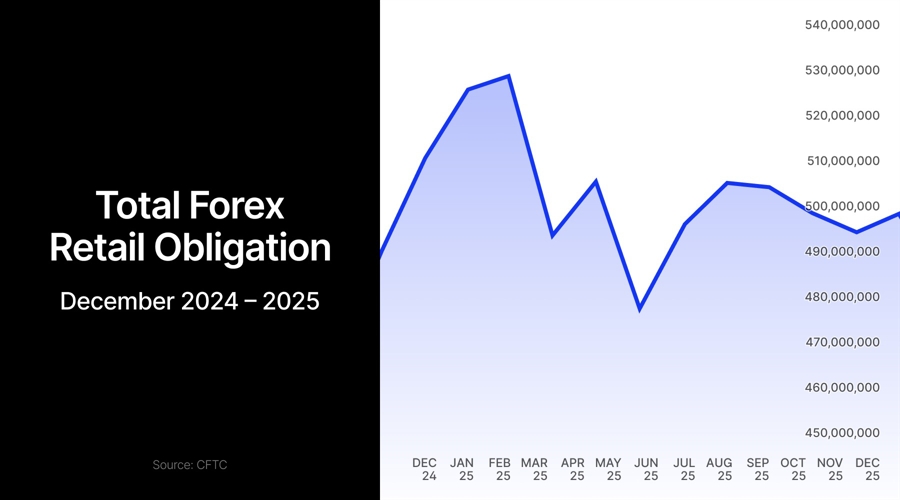
The retail forex obligations edged up 0.8% to $499.9 million in December 2025, snapping a three-month decline.
The modest industry recovery came as three of six major platforms reported outflows, with year-over-year growth of just 2%.
Retail
forex deposits across major US platforms edged up 0.8% in December 2025, rising
to $499.9 million from November's $495.7 million as the industry snapped a
three-month decline that started in September.
The modest
recovery pushed total deposits back toward the $500 million threshold but
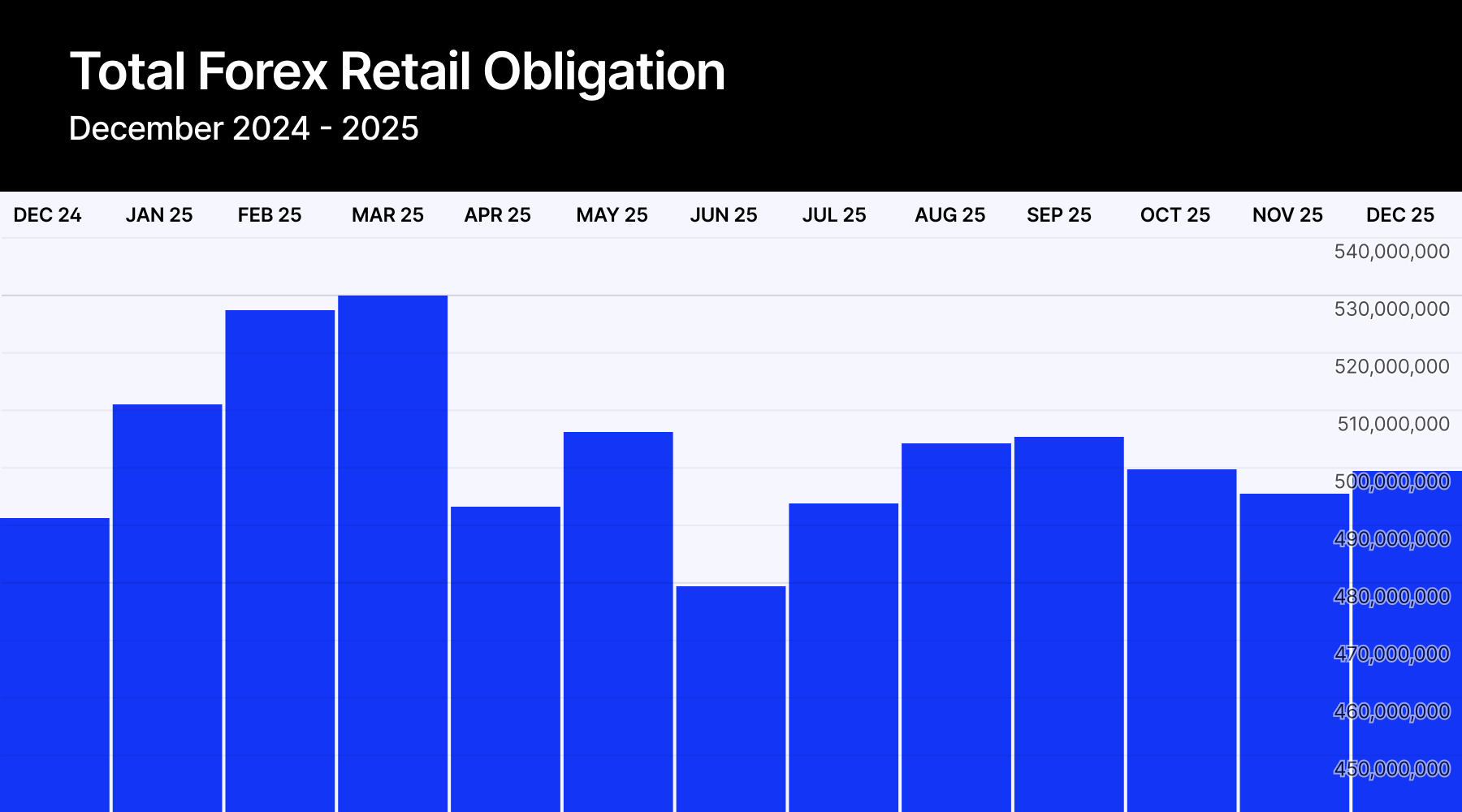
remained well below the $530.1 million peak reached in March 2025. Year-over-year, deposits grew 2%
from December
2024's $491.3 million,
suggesting retail currency traders faced persistent headwinds throughout the
year despite isolated spurts of growth.
Interactive Brokers Posts
Sharp Recovery
Interactive
Brokers delivered December's most dramatic turnaround, jumping 20.8% to $32.5
million from November's
$25.7 million. The
$6.8 million monthly gain reversed the broker's steep November pullback and
marked its strongest month-over-month percentage increase in recent periods.
The rebound
coincided with broader momentum at the electronic broker. Interactive
Brokers reported fourth-quarter 2025 revenue of $1.64 billion and earnings per share
of $0.65, surpassing analyst expectations. Trading volume in options, futures,
and stocks increased by 27%, 22%, and 16% respectively during the quarter.
Year-over-year,
Interactive Brokers forex deposits climbed 8% from December 2024's $29.8
million, extending the platform's longer-term client acquisition momentum
despite volatile monthly swings.
Schwab Recovers Ground
After Sustained Decline
Charles
Schwab posted the second-largest monthly gain in dollar terms, climbing 5.4% to
$61.8 million from November's $58.5 million. The $3.3 million increase
represented Schwab's strongest monthly performance since August and halted a
slide that began in October.
The
institutional broker added forex trading capabilities to its thinkorswim
platform in April 2024, offering commission-free access to
over 65 currency pairs. Schwab also expanded
24-hour trading access to retail clients in February 2025, joining an industry push
toward round-the-clock market accessibility.
GAIN
Capital recorded December's largest monthly decline in dollar terms, dropping
1.9% to $211.8 million from November's $215.8 million. The $4.0 million outflow
marked the broker's fourth consecutive monthly decrease and extended a pattern
of client fund withdrawals that began in September.
Despite the
recent slide, GAIN Capital maintained its position as the largest US retail
forex broker by client funds and posted a 7% year-over-year gain from December
2024's $197.9 million. The platform held nearly 43% of total US retail forex
deposits at year-end, though its market share has eroded from earlier peaks
above 44%.
Smaller Brokers Show Mixed
Results
tastyfx,
the US brand of UK-based IG Group, declined 2.6% to $46.3 million from
November's $47.5 million, shedding $1.2 million during the month. The pullback
snapped two months of gains and brought deposits below the broker's September
level.
Year-over-year,
tastyfx posted a 13% increase from December 2024's $40.1 million, reflecting
strong longer-term growth. The broker launched Prime
accounts in
September targeting professional traders with 6% promotional yields and reduced
trading costs. Parent company IG Group reported record revenue of $50.9 million
in the third quarter of fiscal 2025, up 30% year-over-year.
Trading.com
slipped 4.7% to $2.9 million from November's $3.0 million, posting a $136,000
monthly decline. Despite the December setback, the platform showed the fastest
annual growth rate among tracked brokers with deposits up 27% from December
2024's $2.1 million. Trading.com, part of the Trading Point Group that also
operates XM, secured US
regulatory approval as
a retail forex dealer in April 2020.
OANDA Holds Steady Amid
Ownership Transition
OANDA edged
down 0.4% to $144.6 million from November's $145.2 million, slipping $614,000
during the month. The marginal decline extended the broker's losing streak to
six consecutive months and marked its lowest deposit level since December 2024.
The
December data arrived as prop trading firm FTMO completed its
acquisition of OANDA from
private equity firm CVC Asia Fund IV. The transaction, announced earlier in
2025, received final regulatory approval in November after an eight-month
process involving five separate regulators. FTMO has indicated plans to
maintain OANDA as a standalone business.
The figures
reported monthly by US forex brokers represent “Total Retail Forex
Obligations” rather than simple customer deposits. These obligations
reflect the total amount brokers owe to retail forex customers, combining
initial cash deposits with unrealized profits or losses on open positions plus
other payable balances like margin excess and account credits.
Retail
forex deposits across major US platforms edged up 0.8% in December 2025, rising
to $499.9 million from November's $495.7 million as the industry snapped a
three-month decline that started in September.
The modest
recovery pushed total deposits back toward the $500 million threshold but
remained well below the $530.1 million peak reached in March 2025. Year-over-year, deposits grew 2%
from December
2024's $491.3 million,
suggesting retail currency traders faced persistent headwinds throughout the
year despite isolated spurts of growth.
Interactive Brokers Posts
Sharp Recovery
Interactive
Brokers delivered December's most dramatic turnaround, jumping 20.8% to $32.5
million from November's
$25.7 million. The
$6.8 million monthly gain reversed the broker's steep November pullback and
marked its strongest month-over-month percentage increase in recent periods.
The rebound
coincided with broader momentum at the electronic broker. Interactive
Brokers reported fourth-quarter 2025 revenue of $1.64 billion and earnings per share
of $0.65, surpassing analyst expectations. Trading volume in options, futures,
and stocks increased by 27%, 22%, and 16% respectively during the quarter.
Year-over-year,
Interactive Brokers forex deposits climbed 8% from December 2024's $29.8
million, extending the platform's longer-term client acquisition momentum
despite volatile monthly swings.
Schwab Recovers Ground
After Sustained Decline
Charles
Schwab posted the second-largest monthly gain in dollar terms, climbing 5.4% to
$61.8 million from November's $58.5 million. The $3.3 million increase
represented Schwab's strongest monthly performance since August and halted a
slide that began in October.
The
institutional broker added forex trading capabilities to its thinkorswim
platform in April 2024, offering commission-free access to
over 65 currency pairs. Schwab also expanded
24-hour trading access to retail clients in February 2025, joining an industry push
toward round-the-clock market accessibility.
GAIN
Capital recorded December's largest monthly decline in dollar terms, dropping
1.9% to $211.8 million from November's $215.8 million. The $4.0 million outflow
marked the broker's fourth consecutive monthly decrease and extended a pattern
of client fund withdrawals that began in September.
Despite the
recent slide, GAIN Capital maintained its position as the largest US retail
forex broker by client funds and posted a 7% year-over-year gain from December
2024's $197.9 million. The platform held nearly 43% of total US retail forex
deposits at year-end, though its market share has eroded from earlier peaks
above 44%.
Smaller Brokers Show Mixed
Results
tastyfx,
the US brand of UK-based IG Group, declined 2.6% to $46.3 million from
November's $47.5 million, shedding $1.2 million during the month. The pullback
snapped two months of gains and brought deposits below the broker's September
level.
Year-over-year,
tastyfx posted a 13% increase from December 2024's $40.1 million, reflecting
strong longer-term growth. The broker launched Prime
accounts in
September targeting professional traders with 6% promotional yields and reduced
trading costs. Parent company IG Group reported record revenue of $50.9 million
in the third quarter of fiscal 2025, up 30% year-over-year.
Trading.com
slipped 4.7% to $2.9 million from November's $3.0 million, posting a $136,000
monthly decline. Despite the December setback, the platform showed the fastest
annual growth rate among tracked brokers with deposits up 27% from December
2024's $2.1 million. Trading.com, part of the Trading Point Group that also
operates XM, secured US
regulatory approval as
a retail forex dealer in April 2020.
OANDA Holds Steady Amid
Ownership Transition
OANDA edged
down 0.4% to $144.6 million from November's $145.2 million, slipping $614,000
during the month. The marginal decline extended the broker's losing streak to
six consecutive months and marked its lowest deposit level since December 2024.
The
December data arrived as prop trading firm FTMO completed its
acquisition of OANDA from
private equity firm CVC Asia Fund IV. The transaction, announced earlier in
2025, received final regulatory approval in November after an eight-month
process involving five separate regulators. FTMO has indicated plans to
maintain OANDA as a standalone business.
The figures
reported monthly by US forex brokers represent “Total Retail Forex
Obligations” rather than simple customer deposits. These obligations
reflect the total amount brokers owe to retail forex customers, combining
initial cash deposits with unrealized profits or losses on open positions plus
other payable balances like margin excess and account credits.
Damian Chmiel is a Senior Analyst & Editor at Finance Magnates with more than 15 years of experience in the CFD and online trading industry. Active as both a trader and journalist since 2010, he focuses on broker coverage, fintech innovation, and regulatory developments across Europe, the Middle East, and Asia.
His work includes interviews with C-level leaders at major brokerages and fintech platforms, as well as co-authoring Finance Magnates’ quarterly industry benchmarking reports. Damian’s reporting is data-driven, market-aware, and grounded in direct industry engagement. His analysis and commentary have also been cited by external media outlets, including Investing.com, Binance, The Asset, Stockhead, and Dispatch.
Education:
MA in Finance and Accounting, Cracow University of Economics
XM’s Sister Brand Trading.com Secures MiCA License in Cyprus
Featured Videos
FM Daily Brief - 29 May 2026
Today is Friday, the 29th of May 2026, and these are our main stories: three global regulators are converging on trading platform design, and a Singapore prop firm launches a deferred-fee challenge model.
Today is Thursday, the 28th of May 2026, and these are our main stories: the chair of CySEC makes clear that prediction markets look like binary options to Brussels, Robinhood enters the age of AI agents, and a Google engineer faces insider trading charges over Polymarket activity.
Nick Strain, Country Manager Singapore at LMAX Digital, discusses the future of digital assets and shares his views on crypto markets, perpetuals, institutional adoption, tokenization, and why regulatory clarity remains the biggest driver in the space.
The discussion, hosted by Jonathan Fine, Content Strategist at Finance Magnates, covers:
Crypto market sentiment
Bitcoin and Ethereum's role as macro assets
The mechanics of perpetuals and funding rates
Institutional adoption beyond buying crypto
The opportunity in tokenization and programmable money
The critical role of regulation in market growth
Nick Strain, Country Manager Singapore at LMAX Digital, discusses the future of digital assets and shares his views on crypto markets, perpetuals, institutional adoption, tokenization, and why regulatory clarity remains the biggest driver in the space.
The discussion, hosted by Jonathan Fine, Content Strategist at Finance Magnates, covers:
Crypto market sentiment
Bitcoin and Ethereum's role as macro assets
The mechanics of perpetuals and funding rates
Institutional adoption beyond buying crypto
The opportunity in tokenization and programmable money
The critical role of regulation in market growth
Nick Strain, Country Manager Singapore at LMAX Digital, discusses the future of digital assets and shares his views on crypto markets, perpetuals, institutional adoption, tokenization, and why regulatory clarity remains the biggest driver in the space.
The discussion, hosted by Jonathan Fine, Content Strategist at Finance Magnates, covers:
Crypto market sentiment
Bitcoin and Ethereum's role as macro assets
The mechanics of perpetuals and funding rates
Institutional adoption beyond buying crypto
The opportunity in tokenization and programmable money
The critical role of regulation in market growth
Nick Strain, Country Manager Singapore at LMAX Digital, discusses the future of digital assets and shares his views on crypto markets, perpetuals, institutional adoption, tokenization, and why regulatory clarity remains the biggest driver in the space.
The discussion, hosted by Jonathan Fine, Content Strategist at Finance Magnates, covers:
Crypto market sentiment
Bitcoin and Ethereum's role as macro assets
The mechanics of perpetuals and funding rates
Institutional adoption beyond buying crypto
The opportunity in tokenization and programmable money
The critical role of regulation in market growth
Nick Strain, Country Manager Singapore at LMAX Digital, discusses the future of digital assets and shares his views on crypto markets, perpetuals, institutional adoption, tokenization, and why regulatory clarity remains the biggest driver in the space.
The discussion, hosted by Jonathan Fine, Content Strategist at Finance Magnates, covers:
Crypto market sentiment
Bitcoin and Ethereum's role as macro assets
The mechanics of perpetuals and funding rates
Institutional adoption beyond buying crypto
The opportunity in tokenization and programmable money
The critical role of regulation in market growth
Nick Strain, Country Manager Singapore at LMAX Digital, discusses the future of digital assets and shares his views on crypto markets, perpetuals, institutional adoption, tokenization, and why regulatory clarity remains the biggest driver in the space.
The discussion, hosted by Jonathan Fine, Content Strategist at Finance Magnates, covers:
Crypto market sentiment
Bitcoin and Ethereum's role as macro assets
The mechanics of perpetuals and funding rates
Institutional adoption beyond buying crypto
The opportunity in tokenization and programmable money
The critical role of regulation in market growth
FM Daily Brief - 27 May 2026
Today is Wednesday, the 27th of May 2026, and these are our main stories: questions are swirling around the futures of FXCM and Tradu, as owner Jefferies reportedly weighs a sale, an acquisition of a prop firm, and the demographics of prediction markets.
FYNXT CEO Samuel Aeby: Why Brokers Need Operating Systems, Not Just CRMs
Should brokers build their own technology, or buy existing solutions? And with AI changing how firms manage clients, retention, and risk, are traditional CRM systems still enough?
At the Finance Magnates Singapore Summit, Jonathan Fine, Content Strategist at Finance Magnates, spoke with Samuel Aeby, CEO & Founder of FYNXT, about the future of broker technology, AI, and why operational complexity may be holding firms back.
🎥 Watch the interview: What does Samuel Aeby think most brokers are getting wrong when it comes to technology?
Should brokers build their own technology, or buy existing solutions? And with AI changing how firms manage clients, retention, and risk, are traditional CRM systems still enough?
At the Finance Magnates Singapore Summit, Jonathan Fine, Content Strategist at Finance Magnates, spoke with Samuel Aeby, CEO & Founder of FYNXT, about the future of broker technology, AI, and why operational complexity may be holding firms back.
🎥 Watch the interview: What does Samuel Aeby think most brokers are getting wrong when it comes to technology?
Should brokers build their own technology, or buy existing solutions? And with AI changing how firms manage clients, retention, and risk, are traditional CRM systems still enough?
At the Finance Magnates Singapore Summit, Jonathan Fine, Content Strategist at Finance Magnates, spoke with Samuel Aeby, CEO & Founder of FYNXT, about the future of broker technology, AI, and why operational complexity may be holding firms back.
🎥 Watch the interview: What does Samuel Aeby think most brokers are getting wrong when it comes to technology?
Should brokers build their own technology, or buy existing solutions? And with AI changing how firms manage clients, retention, and risk, are traditional CRM systems still enough?
At the Finance Magnates Singapore Summit, Jonathan Fine, Content Strategist at Finance Magnates, spoke with Samuel Aeby, CEO & Founder of FYNXT, about the future of broker technology, AI, and why operational complexity may be holding firms back.
🎥 Watch the interview: What does Samuel Aeby think most brokers are getting wrong when it comes to technology?
Should brokers build their own technology, or buy existing solutions? And with AI changing how firms manage clients, retention, and risk, are traditional CRM systems still enough?
At the Finance Magnates Singapore Summit, Jonathan Fine, Content Strategist at Finance Magnates, spoke with Samuel Aeby, CEO & Founder of FYNXT, about the future of broker technology, AI, and why operational complexity may be holding firms back.
🎥 Watch the interview: What does Samuel Aeby think most brokers are getting wrong when it comes to technology?
Should brokers build their own technology, or buy existing solutions? And with AI changing how firms manage clients, retention, and risk, are traditional CRM systems still enough?
At the Finance Magnates Singapore Summit, Jonathan Fine, Content Strategist at Finance Magnates, spoke with Samuel Aeby, CEO & Founder of FYNXT, about the future of broker technology, AI, and why operational complexity may be holding firms back.
🎥 Watch the interview: What does Samuel Aeby think most brokers are getting wrong when it comes to technology?