Shares of the company traded 6 percent lower as the brokerage announced that its quarterly revenues had declined by 4 percent when compared to Q3
IG Group
IG Group (LON:IGG) published its yearly results, which have shown that the firm is registering continued underlying growth in revenues on a yearly basis. Notwithstanding the effects of the Swiss National Bank turmoil which caused the company to mark a reduction to its revenues by £12 million ($18.7 million) and increased bad debt charges by £15 million ($23.3 million), the fourth quarter results of IG Group have marked a trend of declining revenues.
Share prices of IG Group (LON:IGG) declined by more than 5 percent in today's trading, in the aftermath of the full-year results announcement. However, the effect of the company's CEO Tim Howkins stepping down should not be underestimated. He has proven himself as a leader taking charge of the massive growth of the IG Group (LON:IGG) for the past 16 years.
Looking at the Key Performance Indicators (KPIs), the metrics which IG Group reported have been mixed. The domestic market for the brokerage in the U.K. has been very buoyant throughout the year with revenues per user rising 8 percent and active client growth coming in at 2 percent. However, after the massive growth in the second quarter the figures have subsided.
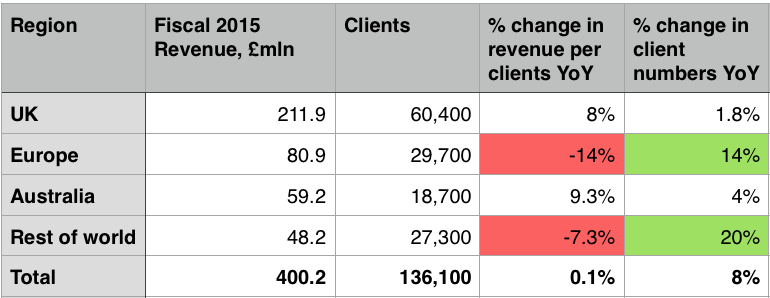
IG Group Revenues and Client Numbers, Source: IG Group
For the final quarter of the year, revenues from U.K. clients have increased by 2.4 percent year-on-year when compared to 27 percent in the second quarter and 5.8 percent in the third.
The bulk of the growth of the company has come from increasing revenues from Australia and the Rest of the World (RoW) business segments. In the final quarter revenue numbers from Australia increased by 26 percent, while those from the RoW region almost doubled, marking 44 percent growth. These figures contributed to a total year-on-year change for the year of 13 and 11 percent respectively.
The European business of IG Group (LON:IGG) has stagnated with revenues per client falling by 14 percent for the year and the final quarter of the year. That said, the number of active users from the region increased markedly by 14 percent for the year and by 13 percent in the final quarter. Overall revenues from Europe declined by 1.5 percent for the full-year and by 3.4 percent in the final quarter.
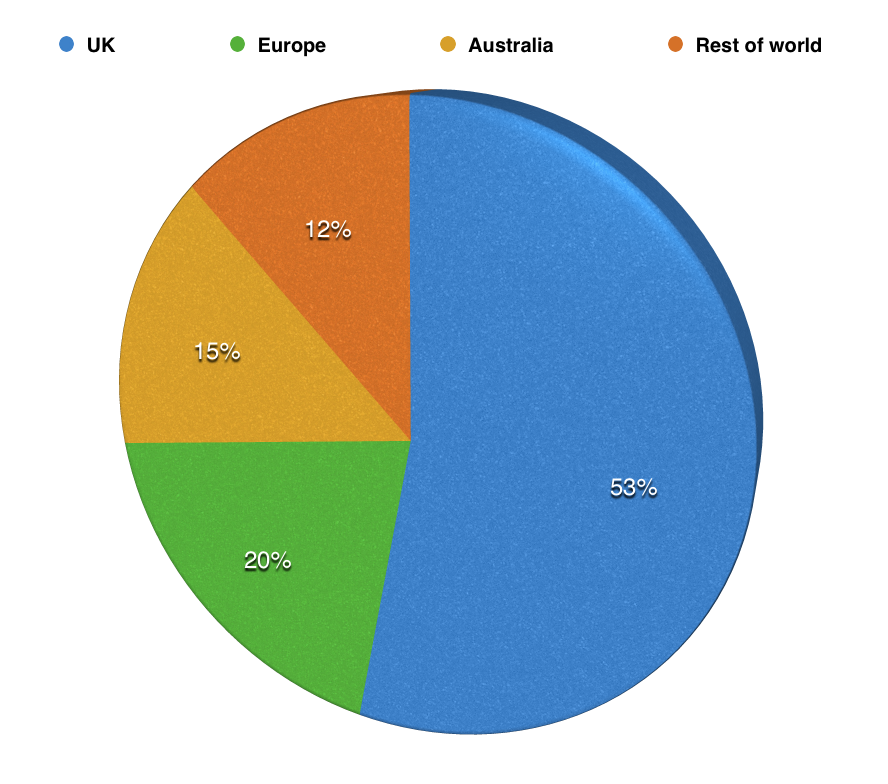
Regional Distribution of Revenues, Source: Finance Magnates Research
A special factor worth considering when we look at the year-on-year declines in revenues is the value of the euro against sterling. The drop in the EUR/GBP exchange rate is precisely 14 percent year-on-year.
Mr. Howkins elaborated on the declining European revenues issue, explaining, “Overnight funding revenue has fallen as clients have held fewer positions overnight. At the same time although the number of trades per client increased significantly, this was more than offset by a drop in the overall average trade size, reflecting a movement towards smaller size contracts.”
Through the second half, we also saw a widening of spreads in the underlying DAX futures contract, which increased the cost of hedging in what is the most popular traded product across our European business,” he explained.
Nadex
The North American Derivatives Exchange (Nadex) which is a subsidiary of IG Group dedicated to offering on exchange binary options contracts in the U.S. has continued gaining traction throughout the year. Revenues increased by 68 percent, while growth figures were the strongest in the fourth quarter when revenues doubled over last year.
The IG Group explains the success of its North American subsidiary with the introduction of a second market maker on the exchange and improvements related to marketing efficiency and some operational upgrades, such as the relocation of the firm’s IT infrastructure.
According to IG’s CEO Tim Howkins, “In the final months of the year the company increased its U.S. marketing expenditure to take advantage of the improving return on investment that it was yielding.”
IG Group (LON:IGG) published its yearly results, which have shown that the firm is registering continued underlying growth in revenues on a yearly basis. Notwithstanding the effects of the Swiss National Bank turmoil which caused the company to mark a reduction to its revenues by £12 million ($18.7 million) and increased bad debt charges by £15 million ($23.3 million), the fourth quarter results of IG Group have marked a trend of declining revenues.
Share prices of IG Group (LON:IGG) declined by more than 5 percent in today's trading, in the aftermath of the full-year results announcement. However, the effect of the company's CEO Tim Howkins stepping down should not be underestimated. He has proven himself as a leader taking charge of the massive growth of the IG Group (LON:IGG) for the past 16 years.
Looking at the Key Performance Indicators (KPIs), the metrics which IG Group reported have been mixed. The domestic market for the brokerage in the U.K. has been very buoyant throughout the year with revenues per user rising 8 percent and active client growth coming in at 2 percent. However, after the massive growth in the second quarter the figures have subsided.
IG Group Revenues and Client Numbers, Source: IG Group
For the final quarter of the year, revenues from U.K. clients have increased by 2.4 percent year-on-year when compared to 27 percent in the second quarter and 5.8 percent in the third.
The bulk of the growth of the company has come from increasing revenues from Australia and the Rest of the World (RoW) business segments. In the final quarter revenue numbers from Australia increased by 26 percent, while those from the RoW region almost doubled, marking 44 percent growth. These figures contributed to a total year-on-year change for the year of 13 and 11 percent respectively.
The European business of IG Group (LON:IGG) has stagnated with revenues per client falling by 14 percent for the year and the final quarter of the year. That said, the number of active users from the region increased markedly by 14 percent for the year and by 13 percent in the final quarter. Overall revenues from Europe declined by 1.5 percent for the full-year and by 3.4 percent in the final quarter.
Regional Distribution of Revenues, Source: Finance Magnates Research
A special factor worth considering when we look at the year-on-year declines in revenues is the value of the euro against sterling. The drop in the EUR/GBP exchange rate is precisely 14 percent year-on-year.
Mr. Howkins elaborated on the declining European revenues issue, explaining, “Overnight funding revenue has fallen as clients have held fewer positions overnight. At the same time although the number of trades per client increased significantly, this was more than offset by a drop in the overall average trade size, reflecting a movement towards smaller size contracts.”
Through the second half, we also saw a widening of spreads in the underlying DAX futures contract, which increased the cost of hedging in what is the most popular traded product across our European business,” he explained.
Nadex
The North American Derivatives Exchange (Nadex) which is a subsidiary of IG Group dedicated to offering on exchange binary options contracts in the U.S. has continued gaining traction throughout the year. Revenues increased by 68 percent, while growth figures were the strongest in the fourth quarter when revenues doubled over last year.
The IG Group explains the success of its North American subsidiary with the introduction of a second market maker on the exchange and improvements related to marketing efficiency and some operational upgrades, such as the relocation of the firm’s IT infrastructure.
According to IG’s CEO Tim Howkins, “In the final months of the year the company increased its U.S. marketing expenditure to take advantage of the improving return on investment that it was yielding.”
Sky Links Capital Adds LBMA Gold Fixing, Options and Weekend Trading
Featured Videos
FM Daily Brief – 9 June 2026
Today’s Tuesday, the 9th of June 2026, and these are our main stories: eToro’s customer assets climbed back above $20 billion, Prop trading model in prediction markets, and Leverate launched a new AI assistant for brokers and traders.
War Stories: Lessons from 20 Years in Markets (the pain, the pitfalls and the profits)
The trades that taught me the most aren't the ones that worked. They're the ones that didn't — or the ones I almost caught and didn't have the nerve to ride. In this session, I'll tell you about the Brexit miss, the SNB shocker that nearly handed me a 5400% return, the BoJ surprise that punched me in the gut, and a few wins along the way. Each story carries a lesson, but the lessons aren't the point. Everyone who trades long enough collects a portfolio of moments like these; what separates the people who stay in the game is what they do with them.
The Engine and the Fuel: How AI & Data Drives African Future
If AI is the engine, data is the fuel. Without quality, accessible data, AI cannot work well; and without the right mindset, data remains just numbers instead of insight. In this session, leading experts will explore how AI and data are democratizing opportunities for businesses and personal growth. Discover practical ways to make AI accessible today, anticipate its transformative impact on African markets, and learn actionable steps to prepare for what's next. Let's talk about:
-How AI and data drive business efficiency and innovation in trading and fintech
-AI tools to elevate trading or business strategies
-How to access and maximise the power of data and AI
-Emerging AI and data trends in Africa and their economic ripple effects
If AI is the engine, data is the fuel. Without quality, accessible data, AI cannot work well; and without the right mindset, data remains just numbers instead of insight. In this session, leading experts will explore how AI and data are democratizing opportunities for businesses and personal growth. Discover practical ways to make AI accessible today, anticipate its transformative impact on African markets, and learn actionable steps to prepare for what's next. Let's talk about:
-How AI and data drive business efficiency and innovation in trading and fintech
-AI tools to elevate trading or business strategies
-How to access and maximise the power of data and AI
-Emerging AI and data trends in Africa and their economic ripple effects
If AI is the engine, data is the fuel. Without quality, accessible data, AI cannot work well; and without the right mindset, data remains just numbers instead of insight. In this session, leading experts will explore how AI and data are democratizing opportunities for businesses and personal growth. Discover practical ways to make AI accessible today, anticipate its transformative impact on African markets, and learn actionable steps to prepare for what's next. Let's talk about:
-How AI and data drive business efficiency and innovation in trading and fintech
-AI tools to elevate trading or business strategies
-How to access and maximise the power of data and AI
-Emerging AI and data trends in Africa and their economic ripple effects
If AI is the engine, data is the fuel. Without quality, accessible data, AI cannot work well; and without the right mindset, data remains just numbers instead of insight. In this session, leading experts will explore how AI and data are democratizing opportunities for businesses and personal growth. Discover practical ways to make AI accessible today, anticipate its transformative impact on African markets, and learn actionable steps to prepare for what's next. Let's talk about:
-How AI and data drive business efficiency and innovation in trading and fintech
-AI tools to elevate trading or business strategies
-How to access and maximise the power of data and AI
-Emerging AI and data trends in Africa and their economic ripple effects
If AI is the engine, data is the fuel. Without quality, accessible data, AI cannot work well; and without the right mindset, data remains just numbers instead of insight. In this session, leading experts will explore how AI and data are democratizing opportunities for businesses and personal growth. Discover practical ways to make AI accessible today, anticipate its transformative impact on African markets, and learn actionable steps to prepare for what's next. Let's talk about:
-How AI and data drive business efficiency and innovation in trading and fintech
-AI tools to elevate trading or business strategies
-How to access and maximise the power of data and AI
-Emerging AI and data trends in Africa and their economic ripple effects
If AI is the engine, data is the fuel. Without quality, accessible data, AI cannot work well; and without the right mindset, data remains just numbers instead of insight. In this session, leading experts will explore how AI and data are democratizing opportunities for businesses and personal growth. Discover practical ways to make AI accessible today, anticipate its transformative impact on African markets, and learn actionable steps to prepare for what's next. Let's talk about:
-How AI and data drive business efficiency and innovation in trading and fintech
-AI tools to elevate trading or business strategies
-How to access and maximise the power of data and AI
-Emerging AI and data trends in Africa and their economic ripple effects
Inside My Best Trade with Jimmy Moyaha
Most market post-mortems describe what happened to prices. Few describe what happened in the trading room while the position was open: the entry conviction, the moments that tested it, and the exit decision that closed the book.
This session brings one seasoned trader to the stage for an unfiltered account of the position that still defines how they think about markets.
Attendees will walk away with:
-A first-hand account of how a conviction trade is built, from thesis and entry through position management and exit
-Understanding of what turns a market observation into a live position, and what holds it when conditions shift
-Insight into how timing, execution quality, and market structure shaped the final result
-Perspective on what the trade revealed about edge, risk tolerance, and when to hold through a position moving against you
-Clarity on what separates a well-built trade from a well-timed one
Most market post-mortems describe what happened to prices. Few describe what happened in the trading room while the position was open: the entry conviction, the moments that tested it, and the exit decision that closed the book.
This session brings one seasoned trader to the stage for an unfiltered account of the position that still defines how they think about markets.
Attendees will walk away with:
-A first-hand account of how a conviction trade is built, from thesis and entry through position management and exit
-Understanding of what turns a market observation into a live position, and what holds it when conditions shift
-Insight into how timing, execution quality, and market structure shaped the final result
-Perspective on what the trade revealed about edge, risk tolerance, and when to hold through a position moving against you
-Clarity on what separates a well-built trade from a well-timed one
Most market post-mortems describe what happened to prices. Few describe what happened in the trading room while the position was open: the entry conviction, the moments that tested it, and the exit decision that closed the book.
This session brings one seasoned trader to the stage for an unfiltered account of the position that still defines how they think about markets.
Attendees will walk away with:
-A first-hand account of how a conviction trade is built, from thesis and entry through position management and exit
-Understanding of what turns a market observation into a live position, and what holds it when conditions shift
-Insight into how timing, execution quality, and market structure shaped the final result
-Perspective on what the trade revealed about edge, risk tolerance, and when to hold through a position moving against you
-Clarity on what separates a well-built trade from a well-timed one
Most market post-mortems describe what happened to prices. Few describe what happened in the trading room while the position was open: the entry conviction, the moments that tested it, and the exit decision that closed the book.
This session brings one seasoned trader to the stage for an unfiltered account of the position that still defines how they think about markets.
Attendees will walk away with:
-A first-hand account of how a conviction trade is built, from thesis and entry through position management and exit
-Understanding of what turns a market observation into a live position, and what holds it when conditions shift
-Insight into how timing, execution quality, and market structure shaped the final result
-Perspective on what the trade revealed about edge, risk tolerance, and when to hold through a position moving against you
-Clarity on what separates a well-built trade from a well-timed one
Most market post-mortems describe what happened to prices. Few describe what happened in the trading room while the position was open: the entry conviction, the moments that tested it, and the exit decision that closed the book.
This session brings one seasoned trader to the stage for an unfiltered account of the position that still defines how they think about markets.
Attendees will walk away with:
-A first-hand account of how a conviction trade is built, from thesis and entry through position management and exit
-Understanding of what turns a market observation into a live position, and what holds it when conditions shift
-Insight into how timing, execution quality, and market structure shaped the final result
-Perspective on what the trade revealed about edge, risk tolerance, and when to hold through a position moving against you
-Clarity on what separates a well-built trade from a well-timed one
Most market post-mortems describe what happened to prices. Few describe what happened in the trading room while the position was open: the entry conviction, the moments that tested it, and the exit decision that closed the book.
This session brings one seasoned trader to the stage for an unfiltered account of the position that still defines how they think about markets.
Attendees will walk away with:
-A first-hand account of how a conviction trade is built, from thesis and entry through position management and exit
-Understanding of what turns a market observation into a live position, and what holds it when conditions shift
-Insight into how timing, execution quality, and market structure shaped the final result
-Perspective on what the trade revealed about edge, risk tolerance, and when to hold through a position moving against you
-Clarity on what separates a well-built trade from a well-timed one
Agentic Inequality: Democratizing Financial Access Through AI & Blockchain
As crypto and CFD trading continue to expand across Africa, access to advanced tools and market insights remains uneven. This session explores how AI and blockchain can bridge that gap by empowering informal traders and underserved communities to participate more effectively in digital financial markets. The discussion will focus on practical applications of technology to improve accessibility, education, and investment outcomes in both formal and informal sectors.
In this discussion, we will explore:
-The role of AI in democratizing access to trading tools, insights, and strategy development
-How crypto and blockchain can enable broader participation beyond traditional financial systems
-Addressing access barriers: infrastructure, education, and affordability in underserved communities
-Opportunities for brokers and platforms to tap into the informal trading economy
As crypto and CFD trading continue to expand across Africa, access to advanced tools and market insights remains uneven. This session explores how AI and blockchain can bridge that gap by empowering informal traders and underserved communities to participate more effectively in digital financial markets. The discussion will focus on practical applications of technology to improve accessibility, education, and investment outcomes in both formal and informal sectors.
In this discussion, we will explore:
-The role of AI in democratizing access to trading tools, insights, and strategy development
-How crypto and blockchain can enable broader participation beyond traditional financial systems
-Addressing access barriers: infrastructure, education, and affordability in underserved communities
-Opportunities for brokers and platforms to tap into the informal trading economy
As crypto and CFD trading continue to expand across Africa, access to advanced tools and market insights remains uneven. This session explores how AI and blockchain can bridge that gap by empowering informal traders and underserved communities to participate more effectively in digital financial markets. The discussion will focus on practical applications of technology to improve accessibility, education, and investment outcomes in both formal and informal sectors.
In this discussion, we will explore:
-The role of AI in democratizing access to trading tools, insights, and strategy development
-How crypto and blockchain can enable broader participation beyond traditional financial systems
-Addressing access barriers: infrastructure, education, and affordability in underserved communities
-Opportunities for brokers and platforms to tap into the informal trading economy
As crypto and CFD trading continue to expand across Africa, access to advanced tools and market insights remains uneven. This session explores how AI and blockchain can bridge that gap by empowering informal traders and underserved communities to participate more effectively in digital financial markets. The discussion will focus on practical applications of technology to improve accessibility, education, and investment outcomes in both formal and informal sectors.
In this discussion, we will explore:
-The role of AI in democratizing access to trading tools, insights, and strategy development
-How crypto and blockchain can enable broader participation beyond traditional financial systems
-Addressing access barriers: infrastructure, education, and affordability in underserved communities
-Opportunities for brokers and platforms to tap into the informal trading economy
As crypto and CFD trading continue to expand across Africa, access to advanced tools and market insights remains uneven. This session explores how AI and blockchain can bridge that gap by empowering informal traders and underserved communities to participate more effectively in digital financial markets. The discussion will focus on practical applications of technology to improve accessibility, education, and investment outcomes in both formal and informal sectors.
In this discussion, we will explore:
-The role of AI in democratizing access to trading tools, insights, and strategy development
-How crypto and blockchain can enable broader participation beyond traditional financial systems
-Addressing access barriers: infrastructure, education, and affordability in underserved communities
-Opportunities for brokers and platforms to tap into the informal trading economy
As crypto and CFD trading continue to expand across Africa, access to advanced tools and market insights remains uneven. This session explores how AI and blockchain can bridge that gap by empowering informal traders and underserved communities to participate more effectively in digital financial markets. The discussion will focus on practical applications of technology to improve accessibility, education, and investment outcomes in both formal and informal sectors.
In this discussion, we will explore:
-The role of AI in democratizing access to trading tools, insights, and strategy development
-How crypto and blockchain can enable broader participation beyond traditional financial systems
-Addressing access barriers: infrastructure, education, and affordability in underserved communities
-Opportunities for brokers and platforms to tap into the informal trading economy