
The Bank of England’s study of the SNB crisis concludes there was no anticipation of what was about to happen
Finance Magnates, Repercussions for brokers in the aftermath of the SNB crisis continue
Even since the dawn of algorithmic trading in the FX market, the day of the SNB crisis, a little over three years ago has been the most memorable one for many market participants. The shock observed across CHF pairs and the EUR/CHF and the USD/CHF, in particular, has been the subject of a study by the Bank of England’s research team.
Experts from the British central bank have been tasked to find out whether there was any party that has been aware of the prospects for the SNB to remove the floor from under the EUR/CHF 1.20 rate.
As it turns out, the four experts that conducted the study on part of the Bank of England didn’t find evidence of market manipulation. What they did find out, however, was that during the day and the following days, the lack of algorithmic trading produced a number of arbitrage opportunities on the market, which are typically not present nowadays.
Man vs. Machine
By studying a detailed set of data from EBS Markets, the team from the Bank of England set out to explore what happened on SNB day and why did the market tank as much as it did in the aftermath of the removal of the floor by the Swiss central bank.
In the aftermath of the SNB’s announcement, human traders took over and were the main actors in finding the efficient price of the market. At the same time, the algorithms greatly amplified the trends in subsequent hours and days. Algorithms used by banks were the main contributors to EUR/CHF volatility, while trade aggregators exacerbated the moves.
A significant outcome of the event was the conclusion that algorithms did not play a contagion role, as the rest of the FX market didn’t follow on the moves in CHF pairs.
What Happened at 09:30 GMT
In the run up to the announcement from the SNB, seconds before the release of the official announcement that the SNB will not be selling an unlimited amount of Swiss francs on the open market, the central bank started removing its sell orders from the market. It took the market a whopping 44 seconds to start swiftly acting to price in the significance of the communique from Thomas Jordan and Co.
EUR bids disappeared at the minute after the announcement and both sides of the book collapsed in size.
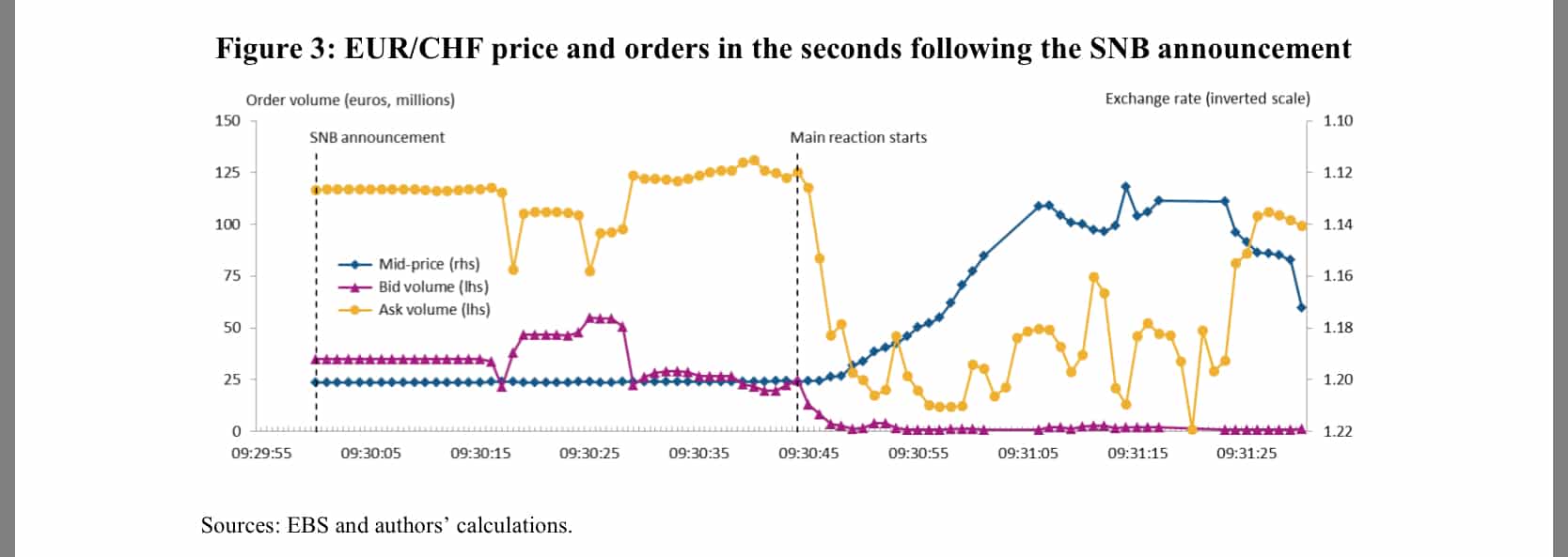
EUR/CHF price and orders seconds after the SNB's announcement
During the 30 minutes in the aftermath of the SNB's announcement, the algorithms of major banks consumed liquidity at extreme prices. As a result, the Bank of England's paper states that about 75 percent of the appreciation of the Swiss currency in the 20 minutes to 09:50 GMT was attributable to the algorithmic interfaces of major banks.
Those accounted for 61 percent of volume trades. Bank algorithms also provided liquidity for some extreme price trades. Human traders accounted for about 50 percent of liquidity providing trades and for about 19 percent of liquidity consuming trades.
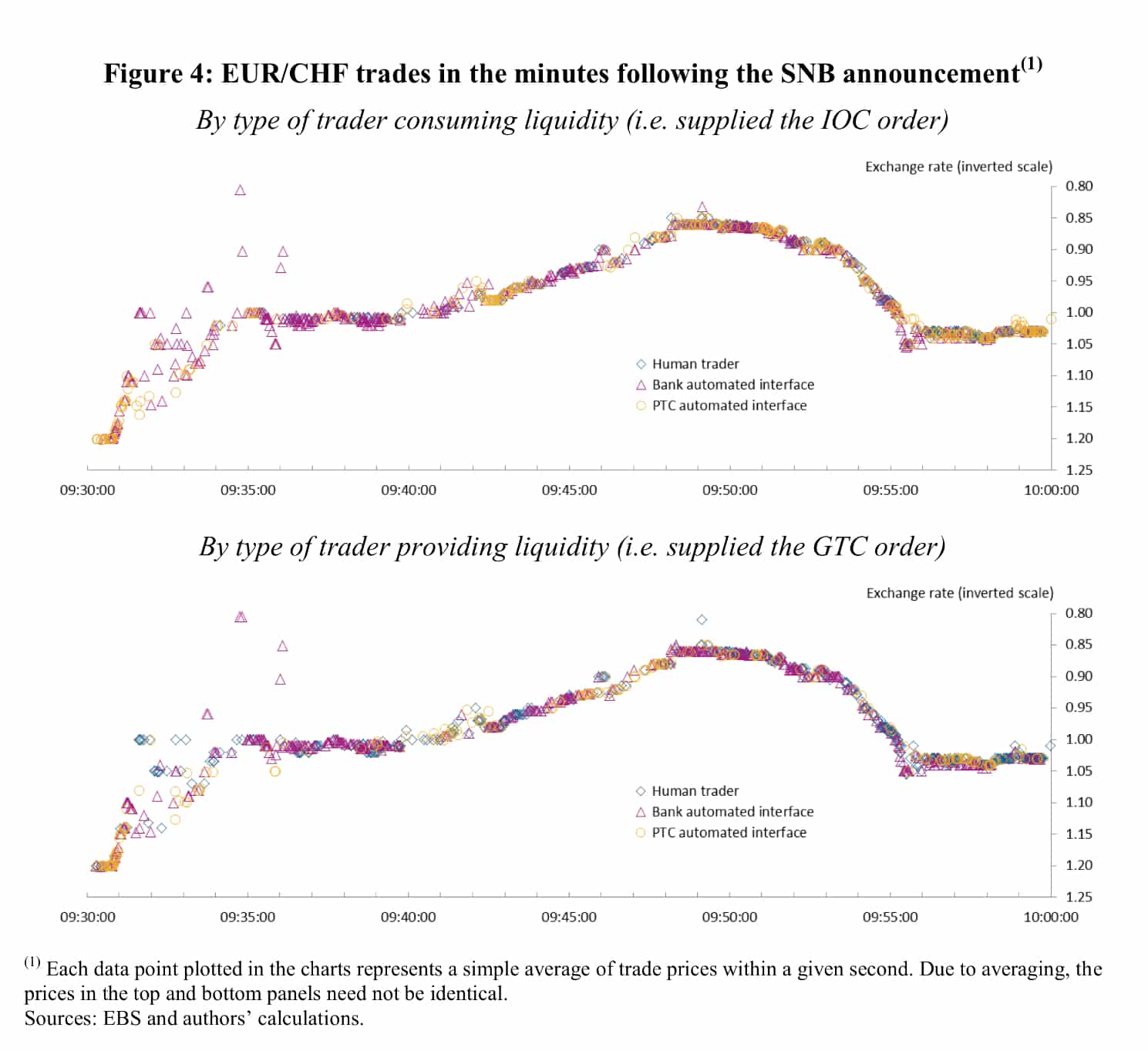
EUR/CHF Types of Liquidity Makers and Takers, where PTCs are Professional Traders
Changing the Game
Net liquidity provision by algorithmic interfaces fell on the day of the event and in the following days, while human trading picked up. The increases of human trading activity were significant, pointing towards a market that is materially different than usual. From 54.1 percent in the period leading to the event, the participation of major banks' algos as market makers dropped to 25.1 percent on the day of the event and to 35.3 percent in the aftermath.
During the same period, human traders were the main liquidity providers. From 38.8 percent on the days before the SNB crisis, the roles were switched dramatically. On the day when the CHF market broke, human traders provided 68.4 percent of the liquidity, a figure that dropped to about 50 percent in the following days.
The slow reaction of major trading desks to the event is a key catalyst to the blowup of many hedge funds that were using algorithmic trading strategies. The exit door for them was virtually slammed shut as the automated liquidity provision mechanisms detected the irregularities on the market and pulled out of the risky market.
A number of algorithmic traders that have been relying on continuous liquidity provision on part of major banks were significantly affected by the event. Strategies that were relying on smooth exits from the short CHF trade were massively hit and negative balances have been difficult to collect for all brokers that chose to go after those.
Arguably, some of the new regulations that the ESMA is mulling over the retail FX marketplace are also a direct result from the SNB black swan. While there is no particular vernacular on how to act during such events, the industry is better prepared to handle such crises nowadays. The full 30 pages-long research paper by the Bank of England is available below.
Even since the dawn of algorithmic trading in the FX market, the day of the SNB crisis, a little over three years ago has been the most memorable one for many market participants. The shock observed across CHF pairs and the EUR/CHF and the USD/CHF, in particular, has been the subject of a study by the Bank of England’s research team.
Experts from the British central bank have been tasked to find out whether there was any party that has been aware of the prospects for the SNB to remove the floor from under the EUR/CHF 1.20 rate.
As it turns out, the four experts that conducted the study on part of the Bank of England didn’t find evidence of market manipulation. What they did find out, however, was that during the day and the following days, the lack of algorithmic trading produced a number of arbitrage opportunities on the market, which are typically not present nowadays.
Man vs. Machine
By studying a detailed set of data from EBS Markets, the team from the Bank of England set out to explore what happened on SNB day and why did the market tank as much as it did in the aftermath of the removal of the floor by the Swiss central bank.
In the aftermath of the SNB’s announcement, human traders took over and were the main actors in finding the efficient price of the market. At the same time, the algorithms greatly amplified the trends in subsequent hours and days. Algorithms used by banks were the main contributors to EUR/CHF volatility, while trade aggregators exacerbated the moves.
A significant outcome of the event was the conclusion that algorithms did not play a contagion role, as the rest of the FX market didn’t follow on the moves in CHF pairs.
What Happened at 09:30 GMT
In the run up to the announcement from the SNB, seconds before the release of the official announcement that the SNB will not be selling an unlimited amount of Swiss francs on the open market, the central bank started removing its sell orders from the market. It took the market a whopping 44 seconds to start swiftly acting to price in the significance of the communique from Thomas Jordan and Co.
EUR bids disappeared at the minute after the announcement and both sides of the book collapsed in size.
EUR/CHF price and orders seconds after the SNB's announcement
During the 30 minutes in the aftermath of the SNB's announcement, the algorithms of major banks consumed liquidity at extreme prices. As a result, the Bank of England's paper states that about 75 percent of the appreciation of the Swiss currency in the 20 minutes to 09:50 GMT was attributable to the algorithmic interfaces of major banks.
Those accounted for 61 percent of volume trades. Bank algorithms also provided liquidity for some extreme price trades. Human traders accounted for about 50 percent of liquidity providing trades and for about 19 percent of liquidity consuming trades.
EUR/CHF Types of Liquidity Makers and Takers, where PTCs are Professional Traders
Changing the Game
Net liquidity provision by algorithmic interfaces fell on the day of the event and in the following days, while human trading picked up. The increases of human trading activity were significant, pointing towards a market that is materially different than usual. From 54.1 percent in the period leading to the event, the participation of major banks' algos as market makers dropped to 25.1 percent on the day of the event and to 35.3 percent in the aftermath.
During the same period, human traders were the main liquidity providers. From 38.8 percent on the days before the SNB crisis, the roles were switched dramatically. On the day when the CHF market broke, human traders provided 68.4 percent of the liquidity, a figure that dropped to about 50 percent in the following days.
The slow reaction of major trading desks to the event is a key catalyst to the blowup of many hedge funds that were using algorithmic trading strategies. The exit door for them was virtually slammed shut as the automated liquidity provision mechanisms detected the irregularities on the market and pulled out of the risky market.
A number of algorithmic traders that have been relying on continuous liquidity provision on part of major banks were significantly affected by the event. Strategies that were relying on smooth exits from the short CHF trade were massively hit and negative balances have been difficult to collect for all brokers that chose to go after those.
Arguably, some of the new regulations that the ESMA is mulling over the retail FX marketplace are also a direct result from the SNB black swan. While there is no particular vernacular on how to act during such events, the industry is better prepared to handle such crises nowadays. The full 30 pages-long research paper by the Bank of England is available below.
The US Prediction-Markets Fight Just Split Into Two Opposite Lawsuits. Plus500 Sits In The Middle
Featured Videos
FM Daily Brief - 1 May 2026
iForex's CEO tells Finance Magnates the cost of their IPO delay. Also ahead: the US prediction markets legal battle splits in two, and the FCA greenlights onchain funds. It's Friday, the first of May 2026. You're listening to the Finance Magnates Daily Brief.
Not All Video Reviews Are Created Equal | Finance Magnates
We deliver fast, structured, neutral reviews covering regulation, platforms, leverage, payouts, and risk across brokers, prop firms, and fintech platforms.
Book your Finance Magnates video review: https://lnkd.in/dDubZJ2S
#FinanceMagnates #BrokerReview #PropTrading #Fintech #Forex #Crypto #CFD #TradingPlatforms #DigitalAssets
We deliver fast, structured, neutral reviews covering regulation, platforms, leverage, payouts, and risk across brokers, prop firms, and fintech platforms.
Book your Finance Magnates video review: https://lnkd.in/dDubZJ2S
#FinanceMagnates #BrokerReview #PropTrading #Fintech #Forex #Crypto #CFD #TradingPlatforms #DigitalAssets
We deliver fast, structured, neutral reviews covering regulation, platforms, leverage, payouts, and risk across brokers, prop firms, and fintech platforms.
Book your Finance Magnates video review: https://lnkd.in/dDubZJ2S
#FinanceMagnates #BrokerReview #PropTrading #Fintech #Forex #Crypto #CFD #TradingPlatforms #DigitalAssets
We deliver fast, structured, neutral reviews covering regulation, platforms, leverage, payouts, and risk across brokers, prop firms, and fintech platforms.
Book your Finance Magnates video review: https://lnkd.in/dDubZJ2S
#FinanceMagnates #BrokerReview #PropTrading #Fintech #Forex #Crypto #CFD #TradingPlatforms #DigitalAssets
We deliver fast, structured, neutral reviews covering regulation, platforms, leverage, payouts, and risk across brokers, prop firms, and fintech platforms.
Book your Finance Magnates video review: https://lnkd.in/dDubZJ2S
#FinanceMagnates #BrokerReview #PropTrading #Fintech #Forex #Crypto #CFD #TradingPlatforms #DigitalAssets
We deliver fast, structured, neutral reviews covering regulation, platforms, leverage, payouts, and risk across brokers, prop firms, and fintech platforms.
Book your Finance Magnates video review: https://lnkd.in/dDubZJ2S
#FinanceMagnates #BrokerReview #PropTrading #Fintech #Forex #Crypto #CFD #TradingPlatforms #DigitalAssets
FM Daily Brief - 30 April 2026
iForex posts its first annual results as a listed broker. Also ahead: CFI Financial secures a Brazil license, and prediction markets have a big week, with new ETF launches and fresh Polymarket loss data. It's Thursday, the thirtieth of April 2026. You're listening to the Finance Magnates Daily Brief.
FM Daily Brief - 29 April 2026
XTB and Robinhood both post first-quarter earnings. But the numbers point in very different directions. Also ahead: Capital.com pushes into three new markets and signals a move into payments.
It's Wednesday, the 29th of April 2026. You're listening to the Finance Magnates Daily Brief.
XTB and Robinhood both post first-quarter earnings. But the numbers point in very different directions. Also ahead: Capital.com pushes into three new markets and signals a move into payments.
It's Wednesday, the 29th of April 2026. You're listening to the Finance Magnates Daily Brief.
XTB and Robinhood both post first-quarter earnings. But the numbers point in very different directions. Also ahead: Capital.com pushes into three new markets and signals a move into payments.
It's Wednesday, the 29th of April 2026. You're listening to the Finance Magnates Daily Brief.
XTB and Robinhood both post first-quarter earnings. But the numbers point in very different directions. Also ahead: Capital.com pushes into three new markets and signals a move into payments.
It's Wednesday, the 29th of April 2026. You're listening to the Finance Magnates Daily Brief.
XTB and Robinhood both post first-quarter earnings. But the numbers point in very different directions. Also ahead: Capital.com pushes into three new markets and signals a move into payments.
It's Wednesday, the 29th of April 2026. You're listening to the Finance Magnates Daily Brief.
XTB and Robinhood both post first-quarter earnings. But the numbers point in very different directions. Also ahead: Capital.com pushes into three new markets and signals a move into payments.
It's Wednesday, the 29th of April 2026. You're listening to the Finance Magnates Daily Brief.
FM Daily Brief - 28 April 2026
Startrader posts three-point-one trillion dollars in first-quarter volume — up three hundred and forty percent from a year ago. Also ahead: Fintokei claims sub-second trader payouts, and eToro opens its premium subscription tier to all investors.