A new analysis by FMintel, drawing on data from more than 50 retail brokers worldwide, finds that retail CFD trading now accounts for roughly 14% of daily global FX turnover, a figure that was barely 2.7% just five years ago.
The research, published on the newly launched FMIntel data portal, introduces a new framework for measuring retail's growing weight in a market long defined by institutional players.
A Market Quietly Transformed
The backdrop is the Bank for International Settlements' latest Triennial Survey, published in October 2025, which put daily over-the-counter FX turnover at $9.6 trillion in April 2025, up 28% from $7.5 trillion in 2022. That growth reflected the usual institutional drivers: dollar volatility , widening interest-rate differentials, and a pickup in emerging-market currencies.
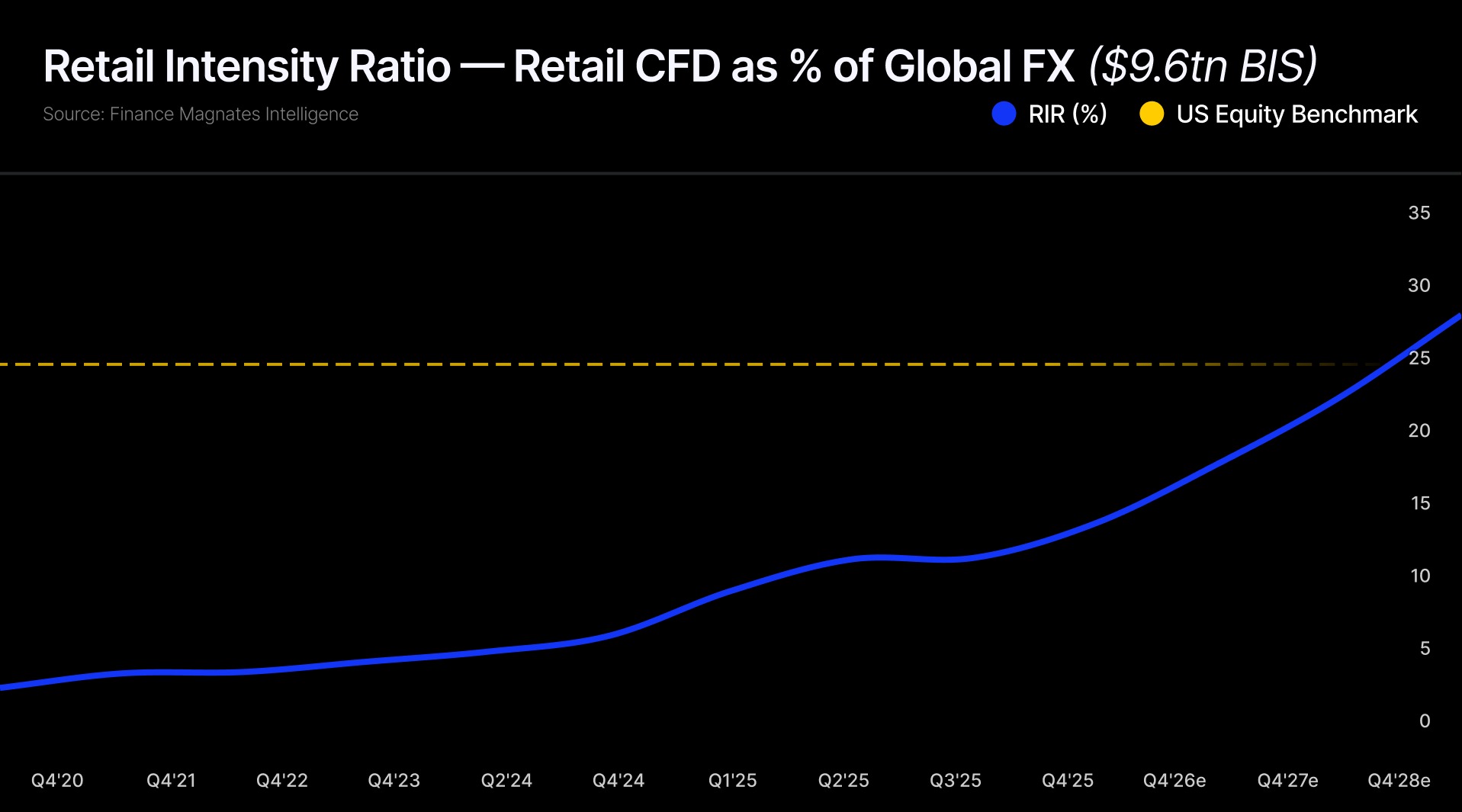
Retail CFD volumes grew at a dramatically different pace. Over the same five-year window, the segment expanded roughly 442%, by more than fifteen times the institutional rate. Finance Magnates Intelligence has branded the new tracking framework the Retail Intensity Ratio, or RIR, defined as retail daily CFD turnover expressed as a percentage of BIS-reported global FX volume. In Q4 2020, that ratio sat at 2.7%. By Q4 2025, it had reached 14.1%.
- Does Web Traffic Actually Drive CFD Volumes? We Ran the Numbers
- iFX EXPO Dubai 2026: Strategy Starts with the Data You Can Trust
- From Volumes to Regulation: Patterns Shaping the Online Trading Industry
The growth wasn't steady. From 2020 through late 2023, the RIR climbed gradually from 2.7% to around 4.5%. Then volume took off, sharply. The acceleration coincided with an unprecedented surge in gold and metals trading that reshaped the retail brokerage product mix almost entirely. By Q4 2025, metals accounted for 74% of all retail CFD activity, up from roughly 42% five years earlier. Currency pairs, once the core of the industry, now represent just 14% of total volume.
From Rounding Error to Market Force
The numbers translate into something concrete: retail CFD traders are now collectively moving more volume each day than many mid-sized institutional participants. Five brokers crossed the $1 trillion monthly volume threshold in Q4 2025 alone, a milestone that only three firms had reached in the prior quarter.
The most striking element of the FMIntel analysis is what the numbers point to ahead. At the growth trajectory observed over the past five years, retail CFD trading could approach the structural weight that retail traders hold in US equity markets within the next few years. You can access the full data here.
The implications reach beyond retail brokers. Prime brokers, liquidity providers, and exchange operators are already responding. CME Group launched a Dubai hub last October, citing a 16% jump in regional derivatives activity, a move that coincided with a broader migration of CFD brokers toward the UAE. Regulators are also paying closer attention: ESMA finalized new derivative reporting rules in Q4 2025, while the UK's Financial Conduct Authority rolled out enhanced consumer protection tools in response to a sharp rise in investment fraud cases.
The full analysis, including the complete RIR time series, forward projections through 2028, and a regional breakdown of where retail volume is growing fastest, is available on the FMIntel portal. Registration is free.