>
Australia and China Sign Historic Free Trade Agreement as Businesses Rejoice
Australia and China Sign Historic Free Trade Agreement as Businesses Rejoice
Tuesday,18/11/2014|05:24GMTby
George Tchetvertakov
Australia has agreed to the closest trade ties with China compared to any other region aside from HK and Macau. With negotiations concluded, the agribusiness revenue frenzy can commence subject to Parliamentary and JSCOT approval.
Upon conclusion of the highly awaited G20 Summit in Brisbane, Australia, this past weekend, one of the more 'lucrative' announcements made was about the China-Australia Free Trade Agreement (ChAFTA).
In a historically large deal almost on par with China's exclusive arrangements with Hong Kong and Macau, the two countries have forged closer trade ties in almost every sector of their respective economies, worth an approximate $20 billion Australian dollars over the next 10 years. The ramifications of the sector-specific agreements could potentially affect every single commercial enterprise doing cross-border business between China and Australia.
The all-encompassing FTA deal includes mutually beneficial improvements via lower tariffs, fewer restrictions and greater trade in a host of sectors including legal services, financial services, education, telecommunications, tourism travel, construction, engineering, healthcare, mining, manufacturing, architecture, urban planning, transport and (possibly to the greatest extent) in agriculture. Agribusinesses are rejoicing
Among the big winners are the mining sector, dairy farmers and wine exporters. The FTA will be eliminating all of China's tariffs on Australian resources and energy products including a 3% tariff on coking coal and a 6% levy on thermal coal.
In the services sector banks, insurers, lawyers and universities will find it much easier to operate in China with Australian companies able to open hotels, restaurants and nursing homes. Australian dairy farmers have been heavy lobbyists of the current 'Liberal' (Conservative) government in Australia, worried about the continuing decline in dairy prices. The Australian dairy sector got an equal (if not better) deal than New Zealand, with tariffs to be phased out by 2025.
Banking, Finance and Fund Management in the Spotlight
China has agreed to reduce the waiting period for Australian banks to engage in local currency (RMB) business from 3 years to 1 year. China will also remove the 2 year profit-making requirement as a precondition to provision of local currency services. Where a branch established in China by an Australian bank already has permission to engage in local currency banking business, other branches established by the same bank will be eligible for streamlined approvals to conduct RMB business.
China will remove the minimum RMB100 million working capital requirements for branches of Australian banks operating as subsidiaries in China, therefore "facilitating faster growth and new business opportunities," according to the Department of Foreign Affairs and Trade (DFAT).
Australian bank subsidiaries in China will be the first foreign banks in China eligible to engage in credit asset securitisation business provided for under China’s Financial Institution Credit Asset Securitization Pilot Program.
For the first time, China has agreed to:
Permit Australian financial service providers to establish joint venture futures companies with up to 49% Australian ownership (foreign participation was not previously permitted).
Extend national treatment to Australian financial institutions for approved securitisation business in China.
Australian securities firms in China will benefit from new commitments raising foreign equity limits to 49 per cent (above China’s WTO commitment of 33 percent) for participation in underwriting of domestic ‘A’ and ‘B’ shares as well as H shares (listed in Hong Kong) and guaranteeing the ability to conduct domestic securities funds management business.
In the funds management sector, China will allow Australian securities brokerage and advisory firms to provide cross-border securities trading accounts, custody, advice and portfolio management services to Chinese Qualified Domestic Institutional Investors (i.e. Chinese investors allowed to invest offshore).
As Forex Magnates reported earlier this month, a significant stumbling block was Australia’s reticence in recognising Chinese state-owned companies as private entities thereby triggering a variety of commercial benefits and profit exploration opportunities. Australia failed to secure deals relating to cotton, wheat, sugar, rice and oilseed farmers due to the state commercial status impasse.
On the investment threshold as reported by Forex Magnates, in return for scrapping tariffs, China wanted greater access to invest in Australia. Under the deal, the threshold for screening by the Foreign Investment Review Board (FIRB) quadrupled from $248 million to $1.1 billion, thereby raising the threshold at which businesses are scrutinised to a higher degree. However, all investment proposals by Chinese government-owned companies will be scrutinised by the FIRB.
The Bigger Posture
Prime Minister Tony Abbott and Chinese counterpart, President Xi Jinping, both welcomed the deal with Mr. Abbott proclaiming, "In particular it's a very good day for Australia." President Xi Jinping made the quirky remark: "As the Chinese saying goes it takes 10 years to sharpen a sword, so we are very glad to see that after nearly 10 years of negotiation our two sides have announced this substantive conclusion to the bilateral FTA negotiation." Adding, "This will provide a bigger market, more favourable conditions and better institutional support for our cooperation."
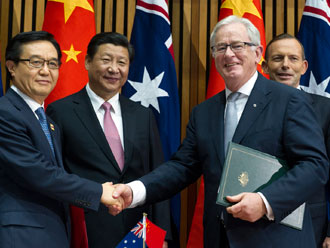
From left to right: Commerce Minister Gao Hucheng, President Xi Jinping, Trade Minister Andrew Robb and Prime Minister Tony Abbott
The various specific agreements were signed by a cavalcade of political and business leaders attending the summit, with almost 95% of Australian exports expected to enter the Chinese market tariff-free over the coming years, the question that begs to be asked - Is mutual tariff-free trade as advantageous for Australia as it is for China?
Signing a Declaration of Intent with his Chinese counterpart, Trade Minister Andrew Robb said the deal was the most significant China had ever signed with a developed country.
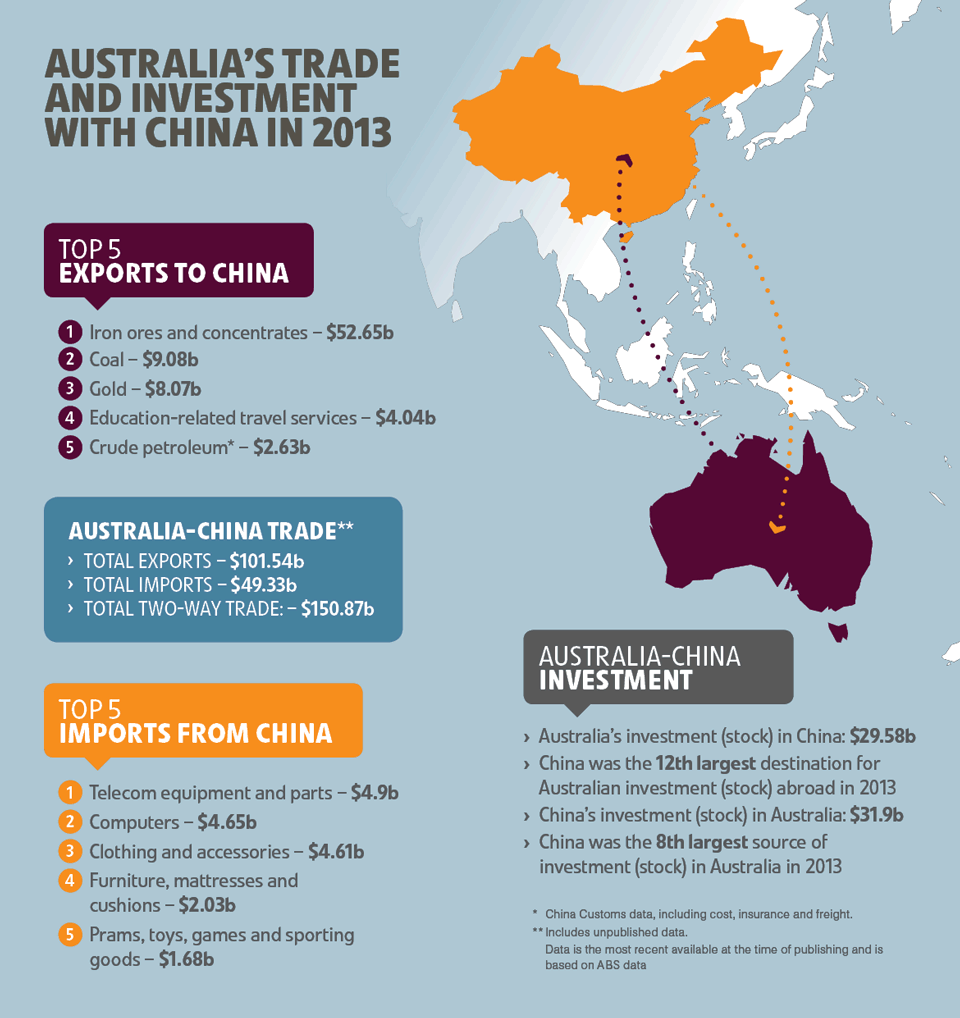
From one perspective, the FTA deal allows greater access for Australian businesses to a market with over 1 billon people. From another perspective, the 2nd largest economy in the world with over 1 billion people now has greater access to a country with a population of 25 million - renowned for its natural resources. It is worth remembering that approximately 70% of Australia's GDP is derived from Services but only 17% of Australia's total export volume.
Flip That Coin
The agreement signed by the two nations could have detrimental effects too. When economic policy changes, resources are reallocated so there is inevitably a group of market participants likely to suffer from the incoming changes.
An Australian MP representing the Green Party, Peter Whish-Wilson, commented on the deal, "This is what we heard 10 years ago in the US Free Trade Agreement - tens of billions of dollars of benefits for the Australian economy and we know that actually it hasn't delivered anything that it promised." Furthermore, in a 2010 study, Australia's Productivity Commission found little or no economic benefit from free trade deals and warned that governments have exaggerated the positives and downplayed the negatives.
Various Australian manufacturers say the deal is a mixed bag with potentially cheaper input costs being outweighed by tougher competition on the other. Labour costs in China remain a fraction of what they are in Australia. Trade unions are also worried that Chinese contractors will soon be able to bring in their own workers into infrastructure projects carried out in Australia.
Going for the Trifecta
Trade Minister, Andrew Robb, said the agreement with China is "part of the trifecta." Adding, "We've got the Japanese one concluded in May and we've got the Korean one concluded before that. The three countries themselves, in north Asia, represent 52% of our current exports. So we have got a big spread. We are now starting to talk to India about a free trade agreement over the next 12 months; that's another 1.2 billion people and we've got a big effort going on in Indonesia and the Gulf States."
Upon conclusion of the highly awaited G20 Summit in Brisbane, Australia, this past weekend, one of the more 'lucrative' announcements made was about the China-Australia Free Trade Agreement (ChAFTA).
In a historically large deal almost on par with China's exclusive arrangements with Hong Kong and Macau, the two countries have forged closer trade ties in almost every sector of their respective economies, worth an approximate $20 billion Australian dollars over the next 10 years. The ramifications of the sector-specific agreements could potentially affect every single commercial enterprise doing cross-border business between China and Australia.
The all-encompassing FTA deal includes mutually beneficial improvements via lower tariffs, fewer restrictions and greater trade in a host of sectors including legal services, financial services, education, telecommunications, tourism travel, construction, engineering, healthcare, mining, manufacturing, architecture, urban planning, transport and (possibly to the greatest extent) in agriculture. Agribusinesses are rejoicing
Among the big winners are the mining sector, dairy farmers and wine exporters. The FTA will be eliminating all of China's tariffs on Australian resources and energy products including a 3% tariff on coking coal and a 6% levy on thermal coal.
In the services sector banks, insurers, lawyers and universities will find it much easier to operate in China with Australian companies able to open hotels, restaurants and nursing homes. Australian dairy farmers have been heavy lobbyists of the current 'Liberal' (Conservative) government in Australia, worried about the continuing decline in dairy prices. The Australian dairy sector got an equal (if not better) deal than New Zealand, with tariffs to be phased out by 2025.
Banking, Finance and Fund Management in the Spotlight
China has agreed to reduce the waiting period for Australian banks to engage in local currency (RMB) business from 3 years to 1 year. China will also remove the 2 year profit-making requirement as a precondition to provision of local currency services. Where a branch established in China by an Australian bank already has permission to engage in local currency banking business, other branches established by the same bank will be eligible for streamlined approvals to conduct RMB business.
China will remove the minimum RMB100 million working capital requirements for branches of Australian banks operating as subsidiaries in China, therefore "facilitating faster growth and new business opportunities," according to the Department of Foreign Affairs and Trade (DFAT).
Australian bank subsidiaries in China will be the first foreign banks in China eligible to engage in credit asset securitisation business provided for under China’s Financial Institution Credit Asset Securitization Pilot Program.
For the first time, China has agreed to:
Permit Australian financial service providers to establish joint venture futures companies with up to 49% Australian ownership (foreign participation was not previously permitted).
Extend national treatment to Australian financial institutions for approved securitisation business in China.
Australian securities firms in China will benefit from new commitments raising foreign equity limits to 49 per cent (above China’s WTO commitment of 33 percent) for participation in underwriting of domestic ‘A’ and ‘B’ shares as well as H shares (listed in Hong Kong) and guaranteeing the ability to conduct domestic securities funds management business.
In the funds management sector, China will allow Australian securities brokerage and advisory firms to provide cross-border securities trading accounts, custody, advice and portfolio management services to Chinese Qualified Domestic Institutional Investors (i.e. Chinese investors allowed to invest offshore).
As Forex Magnates reported earlier this month, a significant stumbling block was Australia’s reticence in recognising Chinese state-owned companies as private entities thereby triggering a variety of commercial benefits and profit exploration opportunities. Australia failed to secure deals relating to cotton, wheat, sugar, rice and oilseed farmers due to the state commercial status impasse.
On the investment threshold as reported by Forex Magnates, in return for scrapping tariffs, China wanted greater access to invest in Australia. Under the deal, the threshold for screening by the Foreign Investment Review Board (FIRB) quadrupled from $248 million to $1.1 billion, thereby raising the threshold at which businesses are scrutinised to a higher degree. However, all investment proposals by Chinese government-owned companies will be scrutinised by the FIRB.
The Bigger Posture
Prime Minister Tony Abbott and Chinese counterpart, President Xi Jinping, both welcomed the deal with Mr. Abbott proclaiming, "In particular it's a very good day for Australia." President Xi Jinping made the quirky remark: "As the Chinese saying goes it takes 10 years to sharpen a sword, so we are very glad to see that after nearly 10 years of negotiation our two sides have announced this substantive conclusion to the bilateral FTA negotiation." Adding, "This will provide a bigger market, more favourable conditions and better institutional support for our cooperation."
From left to right: Commerce Minister Gao Hucheng, President Xi Jinping, Trade Minister Andrew Robb and Prime Minister Tony Abbott
The various specific agreements were signed by a cavalcade of political and business leaders attending the summit, with almost 95% of Australian exports expected to enter the Chinese market tariff-free over the coming years, the question that begs to be asked - Is mutual tariff-free trade as advantageous for Australia as it is for China?
Signing a Declaration of Intent with his Chinese counterpart, Trade Minister Andrew Robb said the deal was the most significant China had ever signed with a developed country.
From one perspective, the FTA deal allows greater access for Australian businesses to a market with over 1 billon people. From another perspective, the 2nd largest economy in the world with over 1 billion people now has greater access to a country with a population of 25 million - renowned for its natural resources. It is worth remembering that approximately 70% of Australia's GDP is derived from Services but only 17% of Australia's total export volume.
Flip That Coin
The agreement signed by the two nations could have detrimental effects too. When economic policy changes, resources are reallocated so there is inevitably a group of market participants likely to suffer from the incoming changes.
An Australian MP representing the Green Party, Peter Whish-Wilson, commented on the deal, "This is what we heard 10 years ago in the US Free Trade Agreement - tens of billions of dollars of benefits for the Australian economy and we know that actually it hasn't delivered anything that it promised." Furthermore, in a 2010 study, Australia's Productivity Commission found little or no economic benefit from free trade deals and warned that governments have exaggerated the positives and downplayed the negatives.
Various Australian manufacturers say the deal is a mixed bag with potentially cheaper input costs being outweighed by tougher competition on the other. Labour costs in China remain a fraction of what they are in Australia. Trade unions are also worried that Chinese contractors will soon be able to bring in their own workers into infrastructure projects carried out in Australia.
Going for the Trifecta
Trade Minister, Andrew Robb, said the agreement with China is "part of the trifecta." Adding, "We've got the Japanese one concluded in May and we've got the Korean one concluded before that. The three countries themselves, in north Asia, represent 52% of our current exports. So we have got a big spread. We are now starting to talk to India about a free trade agreement over the next 12 months; that's another 1.2 billion people and we've got a big effort going on in Indonesia and the Gulf States."
Italy’s Consob Tightens Net on AI-Fueled Scams With Fresh Website Bans
Featured Videos
FP Markets Winner Spotlight 🏆 | Global Broker of the Year 2025 #Trading #Broker #Innovation #Shorts
FP Markets Winner Spotlight 🏆 | Global Broker of the Year 2025 #Trading #Broker #Innovation #Shorts
FP Markets Winner Spotlight 🏆 | Global Broker of the Year 2025 #Trading #Broker #Innovation #Shorts
FP Markets Winner Spotlight 🏆 | Global Broker of the Year 2025 #Trading #Broker #Innovation #Shorts
FP Markets takes the spotlight as Global Broker of the Year 2025 at the Finance Magnates Awards.
Martin Stoilov, Head of Client Experience, shares that trust, innovation, and people played a key role in the company’s success, supported by a strong foundation of integrity and client-centricity.
Following this milestone, FP Markets continues to focus on growth, technology investment, and its core values of transparency and excellence.
👉 Be part of FM Awards 2026: https://awards.financemagnates.com/#nominate
FP Markets takes the spotlight as Global Broker of the Year 2025 at the Finance Magnates Awards.
Martin Stoilov, Head of Client Experience, shares that trust, innovation, and people played a key role in the company’s success, supported by a strong foundation of integrity and client-centricity.
Following this milestone, FP Markets continues to focus on growth, technology investment, and its core values of transparency and excellence.
👉 Be part of FM Awards 2026: https://awards.financemagnates.com/#nominate
FP Markets takes the spotlight as Global Broker of the Year 2025 at the Finance Magnates Awards.
Martin Stoilov, Head of Client Experience, shares that trust, innovation, and people played a key role in the company’s success, supported by a strong foundation of integrity and client-centricity.
Following this milestone, FP Markets continues to focus on growth, technology investment, and its core values of transparency and excellence.
👉 Be part of FM Awards 2026: https://awards.financemagnates.com/#nominate
FP Markets takes the spotlight as Global Broker of the Year 2025 at the Finance Magnates Awards.
Martin Stoilov, Head of Client Experience, shares that trust, innovation, and people played a key role in the company’s success, supported by a strong foundation of integrity and client-centricity.
Following this milestone, FP Markets continues to focus on growth, technology investment, and its core values of transparency and excellence.
👉 Be part of FM Awards 2026: https://awards.financemagnates.com/#nominate
In this video, we review @HolaPrimeMarketsOfficial, a multi-asset forex and CFDs broker offering different account types, trading platforms, and flexible trading conditions.
We cover the broker’s overall offering, including account options, trading environment, platforms like MT4 and MT5, and additional services such as managed accounts and fast withdrawals.
Watch the full video to see if Hola Prime Markets fits your trading needs.
📣 Stay up to date with the latest in finance and trading. Follow Finance Magnates for industry news, insights, and global event coverage.
Connect with us:
🔗 LinkedIn: /financemagnates
👍 Facebook: /financemagnates
📸 Instagram: https://www.instagram.com/financemagnates
🐦 X: https://x.com/financemagnates
🎥 TikTok: https://www.tiktok.com/tag/financemagnates
▶️ YouTube: /@financemagnates_official
#HolaPrime #ForexBroker #CFDTrading #FinanceMagnates #Trading #Forex #BrokerReview
In this video, we review @HolaPrimeMarketsOfficial, a multi-asset forex and CFDs broker offering different account types, trading platforms, and flexible trading conditions.
We cover the broker’s overall offering, including account options, trading environment, platforms like MT4 and MT5, and additional services such as managed accounts and fast withdrawals.
Watch the full video to see if Hola Prime Markets fits your trading needs.
📣 Stay up to date with the latest in finance and trading. Follow Finance Magnates for industry news, insights, and global event coverage.
Connect with us:
🔗 LinkedIn: /financemagnates
👍 Facebook: /financemagnates
📸 Instagram: https://www.instagram.com/financemagnates
🐦 X: https://x.com/financemagnates
🎥 TikTok: https://www.tiktok.com/tag/financemagnates
▶️ YouTube: /@financemagnates_official
#HolaPrime #ForexBroker #CFDTrading #FinanceMagnates #Trading #Forex #BrokerReview
In this video, we review @HolaPrimeMarketsOfficial, a multi-asset forex and CFDs broker offering different account types, trading platforms, and flexible trading conditions.
We cover the broker’s overall offering, including account options, trading environment, platforms like MT4 and MT5, and additional services such as managed accounts and fast withdrawals.
Watch the full video to see if Hola Prime Markets fits your trading needs.
📣 Stay up to date with the latest in finance and trading. Follow Finance Magnates for industry news, insights, and global event coverage.
Connect with us:
🔗 LinkedIn: /financemagnates
👍 Facebook: /financemagnates
📸 Instagram: https://www.instagram.com/financemagnates
🐦 X: https://x.com/financemagnates
🎥 TikTok: https://www.tiktok.com/tag/financemagnates
▶️ YouTube: /@financemagnates_official
#HolaPrime #ForexBroker #CFDTrading #FinanceMagnates #Trading #Forex #BrokerReview
In this video, we review @HolaPrimeMarketsOfficial, a multi-asset forex and CFDs broker offering different account types, trading platforms, and flexible trading conditions.
We cover the broker’s overall offering, including account options, trading environment, platforms like MT4 and MT5, and additional services such as managed accounts and fast withdrawals.
Watch the full video to see if Hola Prime Markets fits your trading needs.
📣 Stay up to date with the latest in finance and trading. Follow Finance Magnates for industry news, insights, and global event coverage.
Connect with us:
🔗 LinkedIn: /financemagnates
👍 Facebook: /financemagnates
📸 Instagram: https://www.instagram.com/financemagnates
🐦 X: https://x.com/financemagnates
🎥 TikTok: https://www.tiktok.com/tag/financemagnates
▶️ YouTube: /@financemagnates_official
#HolaPrime #ForexBroker #CFDTrading #FinanceMagnates #Trading #Forex #BrokerReview
In this video, we review @HolaPrimeMarketsOfficial, a multi-asset forex and CFDs broker offering different account types, trading platforms, and flexible trading conditions.
We cover the broker’s overall offering, including account options, trading environment, platforms like MT4 and MT5, and additional services such as managed accounts and fast withdrawals.
Watch the full video to see if Hola Prime Markets fits your trading needs.
📣 Stay up to date with the latest in finance and trading. Follow Finance Magnates for industry news, insights, and global event coverage.
Connect with us:
🔗 LinkedIn: /financemagnates
👍 Facebook: /financemagnates
📸 Instagram: https://www.instagram.com/financemagnates
🐦 X: https://x.com/financemagnates
🎥 TikTok: https://www.tiktok.com/tag/financemagnates
▶️ YouTube: /@financemagnates_official
#HolaPrime #ForexBroker #CFDTrading #FinanceMagnates #Trading #Forex #BrokerReview
In this video, we review @HolaPrimeMarketsOfficial, a multi-asset forex and CFDs broker offering different account types, trading platforms, and flexible trading conditions.
We cover the broker’s overall offering, including account options, trading environment, platforms like MT4 and MT5, and additional services such as managed accounts and fast withdrawals.
Watch the full video to see if Hola Prime Markets fits your trading needs.
📣 Stay up to date with the latest in finance and trading. Follow Finance Magnates for industry news, insights, and global event coverage.
Connect with us:
🔗 LinkedIn: /financemagnates
👍 Facebook: /financemagnates
📸 Instagram: https://www.instagram.com/financemagnates
🐦 X: https://x.com/financemagnates
🎥 TikTok: https://www.tiktok.com/tag/financemagnates
▶️ YouTube: /@financemagnates_official
#HolaPrime #ForexBroker #CFDTrading #FinanceMagnates #Trading #Forex #BrokerReview
Hola Prime Review: What You Need to Know | Full Breakdown by Finance Magnates
Hola Prime Review: What You Need to Know | Full Breakdown by Finance Magnates
Hola Prime Review: What You Need to Know | Full Breakdown by Finance Magnates
Hola Prime Review: What You Need to Know | Full Breakdown by Finance Magnates
Hola Prime Review: What You Need to Know | Full Breakdown by Finance Magnates
Hola Prime Review: What You Need to Know | Full Breakdown by Finance Magnates
In this video, we review @HolaPrime_Global, a proprietary trading firm offering evaluation programs and performance-based payouts in simulated market environments.
We cover how the challenge model works, including account types, profit splits (up to 95%), trading rules, and what it takes to reach a funded account. You’ll also learn about available platforms like MT4, MT5, cTrader, and more, along with insights into payouts, support, and trading conditions.
Watch the full video to see if Hola Prime fits your trading style.
📣 Stay up to date with the latest in finance and trading. Follow Finance Magnates for industry news, insights, and global event coverage.
Connect with us:
🔗 LinkedIn: /financemagnates
👍 Facebook: /financemagnates
📸 Instagram: https://www.instagram.com/financemagnates
🐦 X: https://x.com/financemagnates
🎥 TikTok: https://www.tiktok.com/tag/financemagnates
▶️ YouTube: /@financemagnates_official
#HolaPrime #PropFirm #Trading #FinanceMagnates #Forex #FuturesTrading #TradingReview #PropFirmReview
In this video, we review @HolaPrime_Global, a proprietary trading firm offering evaluation programs and performance-based payouts in simulated market environments.
We cover how the challenge model works, including account types, profit splits (up to 95%), trading rules, and what it takes to reach a funded account. You’ll also learn about available platforms like MT4, MT5, cTrader, and more, along with insights into payouts, support, and trading conditions.
Watch the full video to see if Hola Prime fits your trading style.
📣 Stay up to date with the latest in finance and trading. Follow Finance Magnates for industry news, insights, and global event coverage.
Connect with us:
🔗 LinkedIn: /financemagnates
👍 Facebook: /financemagnates
📸 Instagram: https://www.instagram.com/financemagnates
🐦 X: https://x.com/financemagnates
🎥 TikTok: https://www.tiktok.com/tag/financemagnates
▶️ YouTube: /@financemagnates_official
#HolaPrime #PropFirm #Trading #FinanceMagnates #Forex #FuturesTrading #TradingReview #PropFirmReview
In this video, we review @HolaPrime_Global, a proprietary trading firm offering evaluation programs and performance-based payouts in simulated market environments.
We cover how the challenge model works, including account types, profit splits (up to 95%), trading rules, and what it takes to reach a funded account. You’ll also learn about available platforms like MT4, MT5, cTrader, and more, along with insights into payouts, support, and trading conditions.
Watch the full video to see if Hola Prime fits your trading style.
📣 Stay up to date with the latest in finance and trading. Follow Finance Magnates for industry news, insights, and global event coverage.
Connect with us:
🔗 LinkedIn: /financemagnates
👍 Facebook: /financemagnates
📸 Instagram: https://www.instagram.com/financemagnates
🐦 X: https://x.com/financemagnates
🎥 TikTok: https://www.tiktok.com/tag/financemagnates
▶️ YouTube: /@financemagnates_official
#HolaPrime #PropFirm #Trading #FinanceMagnates #Forex #FuturesTrading #TradingReview #PropFirmReview
In this video, we review @HolaPrime_Global, a proprietary trading firm offering evaluation programs and performance-based payouts in simulated market environments.
We cover how the challenge model works, including account types, profit splits (up to 95%), trading rules, and what it takes to reach a funded account. You’ll also learn about available platforms like MT4, MT5, cTrader, and more, along with insights into payouts, support, and trading conditions.
Watch the full video to see if Hola Prime fits your trading style.
📣 Stay up to date with the latest in finance and trading. Follow Finance Magnates for industry news, insights, and global event coverage.
Connect with us:
🔗 LinkedIn: /financemagnates
👍 Facebook: /financemagnates
📸 Instagram: https://www.instagram.com/financemagnates
🐦 X: https://x.com/financemagnates
🎥 TikTok: https://www.tiktok.com/tag/financemagnates
▶️ YouTube: /@financemagnates_official
#HolaPrime #PropFirm #Trading #FinanceMagnates #Forex #FuturesTrading #TradingReview #PropFirmReview
In this video, we review @HolaPrime_Global, a proprietary trading firm offering evaluation programs and performance-based payouts in simulated market environments.
We cover how the challenge model works, including account types, profit splits (up to 95%), trading rules, and what it takes to reach a funded account. You’ll also learn about available platforms like MT4, MT5, cTrader, and more, along with insights into payouts, support, and trading conditions.
Watch the full video to see if Hola Prime fits your trading style.
📣 Stay up to date with the latest in finance and trading. Follow Finance Magnates for industry news, insights, and global event coverage.
Connect with us:
🔗 LinkedIn: /financemagnates
👍 Facebook: /financemagnates
📸 Instagram: https://www.instagram.com/financemagnates
🐦 X: https://x.com/financemagnates
🎥 TikTok: https://www.tiktok.com/tag/financemagnates
▶️ YouTube: /@financemagnates_official
#HolaPrime #PropFirm #Trading #FinanceMagnates #Forex #FuturesTrading #TradingReview #PropFirmReview
In this video, we review @HolaPrime_Global, a proprietary trading firm offering evaluation programs and performance-based payouts in simulated market environments.
We cover how the challenge model works, including account types, profit splits (up to 95%), trading rules, and what it takes to reach a funded account. You’ll also learn about available platforms like MT4, MT5, cTrader, and more, along with insights into payouts, support, and trading conditions.
Watch the full video to see if Hola Prime fits your trading style.
📣 Stay up to date with the latest in finance and trading. Follow Finance Magnates for industry news, insights, and global event coverage.
Connect with us:
🔗 LinkedIn: /financemagnates
👍 Facebook: /financemagnates
📸 Instagram: https://www.instagram.com/financemagnates
🐦 X: https://x.com/financemagnates
🎥 TikTok: https://www.tiktok.com/tag/financemagnates
▶️ YouTube: /@financemagnates_official
#HolaPrime #PropFirm #Trading #FinanceMagnates #Forex #FuturesTrading #TradingReview #PropFirmReview
Axi Winner Spotlight 🏆 | Global Most Innovative Broker 2025 #Innovation #Trading #Fintech #Broker
Axi Winner Spotlight 🏆 | Global Most Innovative Broker 2025 #Innovation #Trading #Fintech #Broker
Axi Winner Spotlight 🏆 | Global Most Innovative Broker 2025 #Innovation #Trading #Fintech #Broker
Axi Winner Spotlight 🏆 | Global Most Innovative Broker 2025 #Innovation #Trading #Fintech #Broker
Axi Winner Spotlight 🏆 | Global Most Innovative Broker 2025 #Innovation #Trading #Fintech #Broker
Axi Winner Spotlight 🏆 | Global Most Innovative Broker 2025 #Innovation #Trading #Fintech #Broker
Axi takes the spotlight at the Finance Magnates Awards, winning Global Most Innovative Broker 2025.
Olivia Xenofontos and Ivanna Openko share how the team will feel: proud, motivated, and ready to keep delivering.
They also describe the night as well-organized, focused, and enjoyable for all.
👉 Be part of FM Awards 2026.
Axi takes the spotlight at the Finance Magnates Awards, winning Global Most Innovative Broker 2025.
Olivia Xenofontos and Ivanna Openko share how the team will feel: proud, motivated, and ready to keep delivering.
They also describe the night as well-organized, focused, and enjoyable for all.
👉 Be part of FM Awards 2026.
Axi takes the spotlight at the Finance Magnates Awards, winning Global Most Innovative Broker 2025.
Olivia Xenofontos and Ivanna Openko share how the team will feel: proud, motivated, and ready to keep delivering.
They also describe the night as well-organized, focused, and enjoyable for all.
👉 Be part of FM Awards 2026.
Axi takes the spotlight at the Finance Magnates Awards, winning Global Most Innovative Broker 2025.
Olivia Xenofontos and Ivanna Openko share how the team will feel: proud, motivated, and ready to keep delivering.
They also describe the night as well-organized, focused, and enjoyable for all.
👉 Be part of FM Awards 2026.
Axi takes the spotlight at the Finance Magnates Awards, winning Global Most Innovative Broker 2025.
Olivia Xenofontos and Ivanna Openko share how the team will feel: proud, motivated, and ready to keep delivering.
They also describe the night as well-organized, focused, and enjoyable for all.
👉 Be part of FM Awards 2026.
Axi takes the spotlight at the Finance Magnates Awards, winning Global Most Innovative Broker 2025.
Olivia Xenofontos and Ivanna Openko share how the team will feel: proud, motivated, and ready to keep delivering.
They also describe the night as well-organized, focused, and enjoyable for all.
👉 Be part of FM Awards 2026.
Recognition that matters.
Built on transparency.
Driven by the industry.
The Finance Magnates Awards 2026.
Nominations are now open.
🔗 https://awards.financemagnates.com/?utm_source=SM&utm_medium=social&utm_campaign=recognition-matters
Recognition that matters.
Built on transparency.
Driven by the industry.
The Finance Magnates Awards 2026.
Nominations are now open.
🔗 https://awards.financemagnates.com/?utm_source=SM&utm_medium=social&utm_campaign=recognition-matters
Recognition that matters.
Built on transparency.
Driven by the industry.
The Finance Magnates Awards 2026.
Nominations are now open.
🔗 https://awards.financemagnates.com/?utm_source=SM&utm_medium=social&utm_campaign=recognition-matters
Recognition that matters.
Built on transparency.
Driven by the industry.
The Finance Magnates Awards 2026.
Nominations are now open.
🔗 https://awards.financemagnates.com/?utm_source=SM&utm_medium=social&utm_campaign=recognition-matters
Recognition that matters.
Built on transparency.
Driven by the industry.
The Finance Magnates Awards 2026.
Nominations are now open.
🔗 https://awards.financemagnates.com/?utm_source=SM&utm_medium=social&utm_campaign=recognition-matters
Recognition that matters.
Built on transparency.
Driven by the industry.
The Finance Magnates Awards 2026.
Nominations are now open.
🔗 https://awards.financemagnates.com/?utm_source=SM&utm_medium=social&utm_campaign=recognition-matters