As the ECB starts buying asset backed securities, Mario Draghi emphasized that EU governments should deliver structural reforms for economic growth and help the central bank reach its 2 percent inflation target.
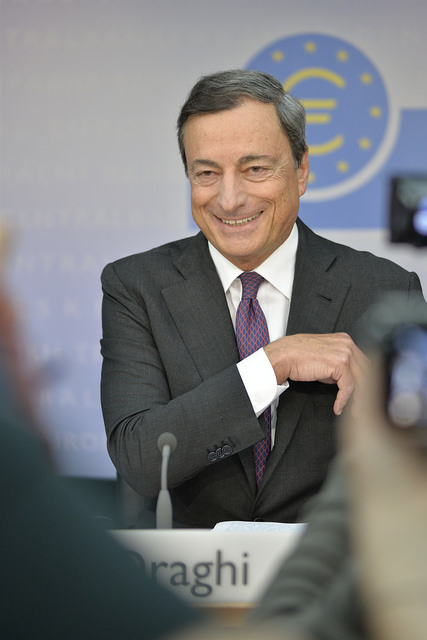
Mr. Draghi Smiling before Delivering His Speech, Image: European Central Bank
Another press conference by Mr. Draghi delivered a round of daily volatility unseen since June, when the ECB President's speech triggered the best trading day of the year in terms of volumes.
Today was no different - after the intense central bankers speeches in Jackson Hole, Wyoming, this was the first eagerly awaited opportunity to listen to Mr. Draghi.
The ECB's governing council decided to lower rates across the board with the interest rate on the main refinancing operations of the euro system, down to 0.05%, the marginal lending facility down to 0.30% and the deposit rate dropping further into negative territory to -0.20%.
This came as a surprise to the market, as it had already started selling the euro into the announcement, as rumors circulated about the central bank starting to buy asset-backed securities (ABS) to the tune of $500 billion.
The ECB did announce an ABS buying program, but it did not specify its size. Mr. Draghi clarified during his Q & A session that the central bank is looking to bring back the levels of its balance sheet to numbers seen in early 2012.
That being said, this expansion of the balance sheet should not be done only though ABS purchases, rather the existing TLTRO (Targeted Long-Term Refinancing Operation) program relies on banks to start borrowing at ultra-low interest rates from the ECB and trickle down funds to the real economy.
This essentially takes away the main factor for euro strength during the past couple of years - the shrinking balance sheet of the ECB when compared to other major central banks.
However, Mr. Draghi didn't focus on the amounts in the press conference, instead he chose to state that the size of the balance sheet of the ECB is going to have to go back to levels last seen mid-2012.
However, this was far from the end of the single currency's selloff - the bombs just kept dropping and the euro kept tanking, erasing barriers at around 1.3000 and dropping to 1.2925 as of writing, for a total of 230 pips as of writing (biggest daily decline since October 2011).
Governing Council Majority Delivers a Blow to ECB Hawks
Mr. Draghi openly stated that the decision of the ECB's Governing Council was not unanimous this time around, and we can only guess that the party which opposed the move was headed by Bundesbank President, Jens Weidmann.
More interestingly, the decision was split three ways, with some members of the Governing Council backing even more action from the ECB. Mr. Draghi shared that a form of quantitative easing (QE) was also discussed.
Welcome to Draghinomics
As Mr. Draghi highlighted geopolitical risks and reiterated his long dating urge for European governments to commit to more structural reforms to boost economic growth, he went back to his Jackson Hole speech to clarify his remarks and present what Draghinomics are exactly.
The first and only "arrow" of Draghinomics is to deploy ECB's monetary policy tools to make sovereign governments across the Eurozone indulge in structural reforms.
It's a major step for the ECB, as President Draghi highlighted that the ECB alone can not beat deflationary pressures - actions from the governments of the Euro Area members are key to putting unemployment on a sustainable path, and this can not be accomplished with fiscal policy measures.
He reiterated, "The deficit rules should not be broken, and all action should be taken within the rules of the fiscal compact, without undermining the essence of the stability and growth pact."
He backed budget consolidation and balanced budget tax cuts while cutting expenditures in the most unproductive parts of government spending.
Additionally, Mr. Draghi clarified the move on the interest rates, by saying, "Banks should not expect any further lowering of interest rates, for all practical purposes we are already at the bottom."
Will European Governments Finally Deliver?
Managing Director of the International Monetary Fund (IMF), Ms. Christine Lagarde, stated her strong support after the ECB’s decision today, saying, “We strongly welcome the measures taken by the ECB, which will help to counteract the dangers posed by an extended period of low inflation.”
Very good Ms. Lagarde, but when are you going to tell the French government to get its act together? With the country allegedly being in the core of the Eurozone, it is one of the biggest underperformers across the continent with growth rates stagnating and public deficits off the target this year.
Speculation about additional easing measures by the ECB is running rampant and according to Danske Bank, which correctly predicted that the Euro is going to 1.30, "European interest rates and the Euro will continue to be pressured, while a continuation of solid US data eventually will trigger a re-pricing of the first rate hike from the FED."
The research note adds on the value of the euro, stating, "The steady fall in the Euro over past several months is expected to continue."
Swedish bank Nordea highlighted, "Draghi is clearly continuing to 'walk the walk'" and not only "talk the talk", especially as the door for further easing was "unanimously" kept open. ABS purchases will commence in October and should, together with the TLTROs, boost the ECB's balance sheet significantly."
They continued saying, "Price action and market psychology seen when other central banks (the Fed) were about to launch somewhat similar programmes suggests the EUR will remain under pressure, at least until the smoke clears, possibly in October."
As we have already stated in our previous analysis on foreign exchange volatility - we are preparing for one hell of a market in the final quarter of 2014. Buckle your seat belts, spring-summer 2014 is over next Tuesday.
Mr. Draghi Smiling before Delivering His Speech, Image: European Central Bank
Another press conference by Mr. Draghi delivered a round of daily volatility unseen since June, when the ECB President's speech triggered the best trading day of the year in terms of volumes.
Today was no different - after the intense central bankers speeches in Jackson Hole, Wyoming, this was the first eagerly awaited opportunity to listen to Mr. Draghi.
The ECB's governing council decided to lower rates across the board with the interest rate on the main refinancing operations of the euro system, down to 0.05%, the marginal lending facility down to 0.30% and the deposit rate dropping further into negative territory to -0.20%.
This came as a surprise to the market, as it had already started selling the euro into the announcement, as rumors circulated about the central bank starting to buy asset-backed securities (ABS) to the tune of $500 billion.
The ECB did announce an ABS buying program, but it did not specify its size. Mr. Draghi clarified during his Q & A session that the central bank is looking to bring back the levels of its balance sheet to numbers seen in early 2012.
That being said, this expansion of the balance sheet should not be done only though ABS purchases, rather the existing TLTRO (Targeted Long-Term Refinancing Operation) program relies on banks to start borrowing at ultra-low interest rates from the ECB and trickle down funds to the real economy.
This essentially takes away the main factor for euro strength during the past couple of years - the shrinking balance sheet of the ECB when compared to other major central banks.
However, Mr. Draghi didn't focus on the amounts in the press conference, instead he chose to state that the size of the balance sheet of the ECB is going to have to go back to levels last seen mid-2012.
However, this was far from the end of the single currency's selloff - the bombs just kept dropping and the euro kept tanking, erasing barriers at around 1.3000 and dropping to 1.2925 as of writing, for a total of 230 pips as of writing (biggest daily decline since October 2011).
Governing Council Majority Delivers a Blow to ECB Hawks
Mr. Draghi openly stated that the decision of the ECB's Governing Council was not unanimous this time around, and we can only guess that the party which opposed the move was headed by Bundesbank President, Jens Weidmann.
More interestingly, the decision was split three ways, with some members of the Governing Council backing even more action from the ECB. Mr. Draghi shared that a form of quantitative easing (QE) was also discussed.
Welcome to Draghinomics
As Mr. Draghi highlighted geopolitical risks and reiterated his long dating urge for European governments to commit to more structural reforms to boost economic growth, he went back to his Jackson Hole speech to clarify his remarks and present what Draghinomics are exactly.
The first and only "arrow" of Draghinomics is to deploy ECB's monetary policy tools to make sovereign governments across the Eurozone indulge in structural reforms.
It's a major step for the ECB, as President Draghi highlighted that the ECB alone can not beat deflationary pressures - actions from the governments of the Euro Area members are key to putting unemployment on a sustainable path, and this can not be accomplished with fiscal policy measures.
He reiterated, "The deficit rules should not be broken, and all action should be taken within the rules of the fiscal compact, without undermining the essence of the stability and growth pact."
He backed budget consolidation and balanced budget tax cuts while cutting expenditures in the most unproductive parts of government spending.
Additionally, Mr. Draghi clarified the move on the interest rates, by saying, "Banks should not expect any further lowering of interest rates, for all practical purposes we are already at the bottom."
Will European Governments Finally Deliver?
Managing Director of the International Monetary Fund (IMF), Ms. Christine Lagarde, stated her strong support after the ECB’s decision today, saying, “We strongly welcome the measures taken by the ECB, which will help to counteract the dangers posed by an extended period of low inflation.”
Very good Ms. Lagarde, but when are you going to tell the French government to get its act together? With the country allegedly being in the core of the Eurozone, it is one of the biggest underperformers across the continent with growth rates stagnating and public deficits off the target this year.
Speculation about additional easing measures by the ECB is running rampant and according to Danske Bank, which correctly predicted that the Euro is going to 1.30, "European interest rates and the Euro will continue to be pressured, while a continuation of solid US data eventually will trigger a re-pricing of the first rate hike from the FED."
The research note adds on the value of the euro, stating, "The steady fall in the Euro over past several months is expected to continue."
Swedish bank Nordea highlighted, "Draghi is clearly continuing to 'walk the walk'" and not only "talk the talk", especially as the door for further easing was "unanimously" kept open. ABS purchases will commence in October and should, together with the TLTROs, boost the ECB's balance sheet significantly."
They continued saying, "Price action and market psychology seen when other central banks (the Fed) were about to launch somewhat similar programmes suggests the EUR will remain under pressure, at least until the smoke clears, possibly in October."
As we have already stated in our previous analysis on foreign exchange volatility - we are preparing for one hell of a market in the final quarter of 2014. Buckle your seat belts, spring-summer 2014 is over next Tuesday.
Tradition Posts Record CHF 1.2 Billion Revenue as UAE Business Rises 55%
Featured Videos
CMC Markets’ Artur Delijergijevs on Metals Demand, Volatility, & Stable Execution
CMC Markets’ Artur Delijergijevs on Metals Demand, Volatility, & Stable Execution
CMC Markets’ Artur Delijergijevs on Metals Demand, Volatility, & Stable Execution
CMC Markets’ Artur Delijergijevs on Metals Demand, Volatility, & Stable Execution
In this exclusive Executive Interview, Finance Magnates speaks with Artur Delijergijevs, Head of Systematic Market Making at CMC Markets, about the current state of metals demand and market volatility.
Delijergijevs offers a desk-level view on:
- Metals Demand: Why metals are seeing the strongest demand from both retail and institutional clients right now.
- The Safe-Haven Debate: Questioning whether gold still fits the classic safe-haven definition given large daily price movements.
- Volatile Market Prep: How a market-making desk prepares its systems and pricing for stressed market conditions and high-impact economic events.
- Hybrid Execution: Why the best execution model combines electronic speed with human relationship support, especially during volatility.
- AI in Workflow: Where CMC Markets is integrating machine learning for risk management and pricing, and the limitations of AI during stressed markets.
- Dubai's Role: The strategic importance of Dubai’s location for covering global trading sessions across Asia, Europe, and the US.
Watch to understand how CMC Markets maintains stable pricing and reliable execution quality in high-volatility environments.
#CMCmarkets #forex #metals #gold #trading #volatility #MarketMaking #iFXDubai #FinanceMagnates #Finance #Fintech #Execution #AlgorithmicTrading #RiskManagement
In this exclusive Executive Interview, Finance Magnates speaks with Artur Delijergijevs, Head of Systematic Market Making at CMC Markets, about the current state of metals demand and market volatility.
Delijergijevs offers a desk-level view on:
- Metals Demand: Why metals are seeing the strongest demand from both retail and institutional clients right now.
- The Safe-Haven Debate: Questioning whether gold still fits the classic safe-haven definition given large daily price movements.
- Volatile Market Prep: How a market-making desk prepares its systems and pricing for stressed market conditions and high-impact economic events.
- Hybrid Execution: Why the best execution model combines electronic speed with human relationship support, especially during volatility.
- AI in Workflow: Where CMC Markets is integrating machine learning for risk management and pricing, and the limitations of AI during stressed markets.
- Dubai's Role: The strategic importance of Dubai’s location for covering global trading sessions across Asia, Europe, and the US.
Watch to understand how CMC Markets maintains stable pricing and reliable execution quality in high-volatility environments.
#CMCmarkets #forex #metals #gold #trading #volatility #MarketMaking #iFXDubai #FinanceMagnates #Finance #Fintech #Execution #AlgorithmicTrading #RiskManagement
In this exclusive Executive Interview, Finance Magnates speaks with Artur Delijergijevs, Head of Systematic Market Making at CMC Markets, about the current state of metals demand and market volatility.
Delijergijevs offers a desk-level view on:
- Metals Demand: Why metals are seeing the strongest demand from both retail and institutional clients right now.
- The Safe-Haven Debate: Questioning whether gold still fits the classic safe-haven definition given large daily price movements.
- Volatile Market Prep: How a market-making desk prepares its systems and pricing for stressed market conditions and high-impact economic events.
- Hybrid Execution: Why the best execution model combines electronic speed with human relationship support, especially during volatility.
- AI in Workflow: Where CMC Markets is integrating machine learning for risk management and pricing, and the limitations of AI during stressed markets.
- Dubai's Role: The strategic importance of Dubai’s location for covering global trading sessions across Asia, Europe, and the US.
Watch to understand how CMC Markets maintains stable pricing and reliable execution quality in high-volatility environments.
#CMCmarkets #forex #metals #gold #trading #volatility #MarketMaking #iFXDubai #FinanceMagnates #Finance #Fintech #Execution #AlgorithmicTrading #RiskManagement
In this exclusive Executive Interview, Finance Magnates speaks with Artur Delijergijevs, Head of Systematic Market Making at CMC Markets, about the current state of metals demand and market volatility.
Delijergijevs offers a desk-level view on:
- Metals Demand: Why metals are seeing the strongest demand from both retail and institutional clients right now.
- The Safe-Haven Debate: Questioning whether gold still fits the classic safe-haven definition given large daily price movements.
- Volatile Market Prep: How a market-making desk prepares its systems and pricing for stressed market conditions and high-impact economic events.
- Hybrid Execution: Why the best execution model combines electronic speed with human relationship support, especially during volatility.
- AI in Workflow: Where CMC Markets is integrating machine learning for risk management and pricing, and the limitations of AI during stressed markets.
- Dubai's Role: The strategic importance of Dubai’s location for covering global trading sessions across Asia, Europe, and the US.
Watch to understand how CMC Markets maintains stable pricing and reliable execution quality in high-volatility environments.
#CMCmarkets #forex #metals #gold #trading #volatility #MarketMaking #iFXDubai #FinanceMagnates #Finance #Fintech #Execution #AlgorithmicTrading #RiskManagement
Finance Magnates Awards 2026 – Nominations Now Open
Finance Magnates Awards 2026 – Nominations Now Open
Finance Magnates Awards 2026 – Nominations Now Open
Finance Magnates Awards 2026 – Nominations Now Open
Finance Magnates Awards 2026 – Nominations Now Open
Finance Magnates Awards 2026 – Nominations Now Open
The Finance Magnates Awards 2026 nominations are now open. 🏆
From fintech innovators to leading brokers, this is where the finance industry celebrates its biggest achievements.
Winners will be announced at the Cyprus Gala Dinner on November 6, 2026.
Nominate your brand now.
https://awards.financemagnates.com/?utm_source=linkedin&utm_medium=video&utm_campaign=nominations-open
#FMAwards #FinanceMagnates #FintechAwards #Fintech #FinanceIndustry
The Finance Magnates Awards 2026 nominations are now open. 🏆
From fintech innovators to leading brokers, this is where the finance industry celebrates its biggest achievements.
Winners will be announced at the Cyprus Gala Dinner on November 6, 2026.
Nominate your brand now.
https://awards.financemagnates.com/?utm_source=linkedin&utm_medium=video&utm_campaign=nominations-open
#FMAwards #FinanceMagnates #FintechAwards #Fintech #FinanceIndustry
The Finance Magnates Awards 2026 nominations are now open. 🏆
From fintech innovators to leading brokers, this is where the finance industry celebrates its biggest achievements.
Winners will be announced at the Cyprus Gala Dinner on November 6, 2026.
Nominate your brand now.
https://awards.financemagnates.com/?utm_source=linkedin&utm_medium=video&utm_campaign=nominations-open
#FMAwards #FinanceMagnates #FintechAwards #Fintech #FinanceIndustry
The Finance Magnates Awards 2026 nominations are now open. 🏆
From fintech innovators to leading brokers, this is where the finance industry celebrates its biggest achievements.
Winners will be announced at the Cyprus Gala Dinner on November 6, 2026.
Nominate your brand now.
https://awards.financemagnates.com/?utm_source=linkedin&utm_medium=video&utm_campaign=nominations-open
#FMAwards #FinanceMagnates #FintechAwards #Fintech #FinanceIndustry
The Finance Magnates Awards 2026 nominations are now open. 🏆
From fintech innovators to leading brokers, this is where the finance industry celebrates its biggest achievements.
Winners will be announced at the Cyprus Gala Dinner on November 6, 2026.
Nominate your brand now.
https://awards.financemagnates.com/?utm_source=linkedin&utm_medium=video&utm_campaign=nominations-open
#FMAwards #FinanceMagnates #FintechAwards #Fintech #FinanceIndustry
The Finance Magnates Awards 2026 nominations are now open. 🏆
From fintech innovators to leading brokers, this is where the finance industry celebrates its biggest achievements.
Winners will be announced at the Cyprus Gala Dinner on November 6, 2026.
Nominate your brand now.
https://awards.financemagnates.com/?utm_source=linkedin&utm_medium=video&utm_campaign=nominations-open
#FMAwards #FinanceMagnates #FintechAwards #Fintech #FinanceIndustry
Finance Magnates Awards 2026 | Nominations Now Open 🏆#Fintech #FMAwards #TradingIndustry
Finance Magnates Awards 2026 | Nominations Now Open 🏆#Fintech #FMAwards #TradingIndustry
Finance Magnates Awards 2026 | Nominations Now Open 🏆#Fintech #FMAwards #TradingIndustry
Finance Magnates Awards 2026 | Nominations Now Open 🏆#Fintech #FMAwards #TradingIndustry
Finance Magnates Awards 2026 | Nominations Now Open 🏆#Fintech #FMAwards #TradingIndustry
Finance Magnates Awards 2026 | Nominations Now Open 🏆#Fintech #FMAwards #TradingIndustry
Lights on. Cameras ready. 🎬
Finance Magnates Awards 2026 nominations are now open. 🏆
#FMAwards #FinanceMagnates #FintechAwards #Fintech
Lights on. Cameras ready. 🎬
Finance Magnates Awards 2026 nominations are now open. 🏆
#FMAwards #FinanceMagnates #FintechAwards #Fintech
Lights on. Cameras ready. 🎬
Finance Magnates Awards 2026 nominations are now open. 🏆
#FMAwards #FinanceMagnates #FintechAwards #Fintech
Lights on. Cameras ready. 🎬
Finance Magnates Awards 2026 nominations are now open. 🏆
#FMAwards #FinanceMagnates #FintechAwards #Fintech
Lights on. Cameras ready. 🎬
Finance Magnates Awards 2026 nominations are now open. 🏆
#FMAwards #FinanceMagnates #FintechAwards #Fintech
Lights on. Cameras ready. 🎬
Finance Magnates Awards 2026 nominations are now open. 🏆
#FMAwards #FinanceMagnates #FintechAwards #Fintech
Exness sees trust as the key theme for growth in MENA Trading Growth for 2026
Exness sees trust as the key theme for growth in MENA Trading Growth for 2026
Exness sees trust as the key theme for growth in MENA Trading Growth for 2026
Exness sees trust as the key theme for growth in MENA Trading Growth for 2026
Exness sees trust as the key theme for growth in MENA Trading Growth for 2026
Exness sees trust as the key theme for growth in MENA Trading Growth for 2026
Mohammad Amer, Regional Commercial Director at Exness, sits down to discuss the booming MENA financial trading market. Find out why Dubai is key to the company's growth strategy, how a mobile-first generation is changing expectations, and why trust will be the defining theme for traders in 2026.
In this interview, you'll learn:
* Why Dubai and the MENA region are critical growth markets for fintech and online trading.
* How Exness is addressing the demands of mobile-first, younger traders through engineering, platform stability, and transparent conditions.
* The essential role local talent plays in providing a culturally relevant and compliant user experience.
* Mohammad Amer's outlook on the future of the online trading industry and why stronger controls and systems are necessary.
* Why "trust" isn't just a brand value, but has commercial value—and why he predicts 2026 will be the "Year of Trust."
Key Takeaways:
➡️ The MENA region is rapidly shaping global financial markets.
➡️ New traders expect stability, precise execution, and transparency.
➡️ Local expertise is key to regulatory compliance and user experience.
➡️ Future success belongs to firms capable of meeting rising standards across regulation and platform consistency.
Read the full article at: https://www.financemagnates.com/thought-leadership/exness-sees-trust-as-the-key-theme-for-growth-in-mena-trading-growth-for-2026/
#Exness #MENA #Trading #FinTech #Dubai #OnlineTrading #FinanceMagnates #MohammadAmer #Trust #MobileTrading
Mohammad Amer, Regional Commercial Director at Exness, sits down to discuss the booming MENA financial trading market. Find out why Dubai is key to the company's growth strategy, how a mobile-first generation is changing expectations, and why trust will be the defining theme for traders in 2026.
In this interview, you'll learn:
* Why Dubai and the MENA region are critical growth markets for fintech and online trading.
* How Exness is addressing the demands of mobile-first, younger traders through engineering, platform stability, and transparent conditions.
* The essential role local talent plays in providing a culturally relevant and compliant user experience.
* Mohammad Amer's outlook on the future of the online trading industry and why stronger controls and systems are necessary.
* Why "trust" isn't just a brand value, but has commercial value—and why he predicts 2026 will be the "Year of Trust."
Key Takeaways:
➡️ The MENA region is rapidly shaping global financial markets.
➡️ New traders expect stability, precise execution, and transparency.
➡️ Local expertise is key to regulatory compliance and user experience.
➡️ Future success belongs to firms capable of meeting rising standards across regulation and platform consistency.
Read the full article at: https://www.financemagnates.com/thought-leadership/exness-sees-trust-as-the-key-theme-for-growth-in-mena-trading-growth-for-2026/
#Exness #MENA #Trading #FinTech #Dubai #OnlineTrading #FinanceMagnates #MohammadAmer #Trust #MobileTrading
Mohammad Amer, Regional Commercial Director at Exness, sits down to discuss the booming MENA financial trading market. Find out why Dubai is key to the company's growth strategy, how a mobile-first generation is changing expectations, and why trust will be the defining theme for traders in 2026.
In this interview, you'll learn:
* Why Dubai and the MENA region are critical growth markets for fintech and online trading.
* How Exness is addressing the demands of mobile-first, younger traders through engineering, platform stability, and transparent conditions.
* The essential role local talent plays in providing a culturally relevant and compliant user experience.
* Mohammad Amer's outlook on the future of the online trading industry and why stronger controls and systems are necessary.
* Why "trust" isn't just a brand value, but has commercial value—and why he predicts 2026 will be the "Year of Trust."
Key Takeaways:
➡️ The MENA region is rapidly shaping global financial markets.
➡️ New traders expect stability, precise execution, and transparency.
➡️ Local expertise is key to regulatory compliance and user experience.
➡️ Future success belongs to firms capable of meeting rising standards across regulation and platform consistency.
Read the full article at: https://www.financemagnates.com/thought-leadership/exness-sees-trust-as-the-key-theme-for-growth-in-mena-trading-growth-for-2026/
#Exness #MENA #Trading #FinTech #Dubai #OnlineTrading #FinanceMagnates #MohammadAmer #Trust #MobileTrading
Mohammad Amer, Regional Commercial Director at Exness, sits down to discuss the booming MENA financial trading market. Find out why Dubai is key to the company's growth strategy, how a mobile-first generation is changing expectations, and why trust will be the defining theme for traders in 2026.
In this interview, you'll learn:
* Why Dubai and the MENA region are critical growth markets for fintech and online trading.
* How Exness is addressing the demands of mobile-first, younger traders through engineering, platform stability, and transparent conditions.
* The essential role local talent plays in providing a culturally relevant and compliant user experience.
* Mohammad Amer's outlook on the future of the online trading industry and why stronger controls and systems are necessary.
* Why "trust" isn't just a brand value, but has commercial value—and why he predicts 2026 will be the "Year of Trust."
Key Takeaways:
➡️ The MENA region is rapidly shaping global financial markets.
➡️ New traders expect stability, precise execution, and transparency.
➡️ Local expertise is key to regulatory compliance and user experience.
➡️ Future success belongs to firms capable of meeting rising standards across regulation and platform consistency.
Read the full article at: https://www.financemagnates.com/thought-leadership/exness-sees-trust-as-the-key-theme-for-growth-in-mena-trading-growth-for-2026/
#Exness #MENA #Trading #FinTech #Dubai #OnlineTrading #FinanceMagnates #MohammadAmer #Trust #MobileTrading
Mohammad Amer, Regional Commercial Director at Exness, sits down to discuss the booming MENA financial trading market. Find out why Dubai is key to the company's growth strategy, how a mobile-first generation is changing expectations, and why trust will be the defining theme for traders in 2026.
In this interview, you'll learn:
* Why Dubai and the MENA region are critical growth markets for fintech and online trading.
* How Exness is addressing the demands of mobile-first, younger traders through engineering, platform stability, and transparent conditions.
* The essential role local talent plays in providing a culturally relevant and compliant user experience.
* Mohammad Amer's outlook on the future of the online trading industry and why stronger controls and systems are necessary.
* Why "trust" isn't just a brand value, but has commercial value—and why he predicts 2026 will be the "Year of Trust."
Key Takeaways:
➡️ The MENA region is rapidly shaping global financial markets.
➡️ New traders expect stability, precise execution, and transparency.
➡️ Local expertise is key to regulatory compliance and user experience.
➡️ Future success belongs to firms capable of meeting rising standards across regulation and platform consistency.
Read the full article at: https://www.financemagnates.com/thought-leadership/exness-sees-trust-as-the-key-theme-for-growth-in-mena-trading-growth-for-2026/
#Exness #MENA #Trading #FinTech #Dubai #OnlineTrading #FinanceMagnates #MohammadAmer #Trust #MobileTrading
Mohammad Amer, Regional Commercial Director at Exness, sits down to discuss the booming MENA financial trading market. Find out why Dubai is key to the company's growth strategy, how a mobile-first generation is changing expectations, and why trust will be the defining theme for traders in 2026.
In this interview, you'll learn:
* Why Dubai and the MENA region are critical growth markets for fintech and online trading.
* How Exness is addressing the demands of mobile-first, younger traders through engineering, platform stability, and transparent conditions.
* The essential role local talent plays in providing a culturally relevant and compliant user experience.
* Mohammad Amer's outlook on the future of the online trading industry and why stronger controls and systems are necessary.
* Why "trust" isn't just a brand value, but has commercial value—and why he predicts 2026 will be the "Year of Trust."
Key Takeaways:
➡️ The MENA region is rapidly shaping global financial markets.
➡️ New traders expect stability, precise execution, and transparency.
➡️ Local expertise is key to regulatory compliance and user experience.
➡️ Future success belongs to firms capable of meeting rising standards across regulation and platform consistency.
Read the full article at: https://www.financemagnates.com/thought-leadership/exness-sees-trust-as-the-key-theme-for-growth-in-mena-trading-growth-for-2026/
#Exness #MENA #Trading #FinTech #Dubai #OnlineTrading #FinanceMagnates #MohammadAmer #Trust #MobileTrading
Paytiko CEO Razi Salih on Why Payment Orchestration is a MUST-HAVE for Brokers in 2026
Paytiko CEO Razi Salih on Why Payment Orchestration is a MUST-HAVE for Brokers in 2026
Paytiko CEO Razi Salih on Why Payment Orchestration is a MUST-HAVE for Brokers in 2026
Paytiko CEO Razi Salih on Why Payment Orchestration is a MUST-HAVE for Brokers in 2026
Paytiko CEO Razi Salih on Why Payment Orchestration is a MUST-HAVE for Brokers in 2026
Paytiko CEO Razi Salih on Why Payment Orchestration is a MUST-HAVE for Brokers in 2026
At iFX Expo Dubai, Finance Magnates spoke with Razi Salih, CEO at Paytiko, about the evolution of the payments ecosystem and why payment orchestration has shifted from an option to a necessity for brokers, prop firms, and exchanges.
Mr. Salih explains how global expansion, the need for deep localisation, and the sheer number of new payment methods, from instant banking to stablecoins, are driving this critical infrastructure shift.
#PaymentOrchestration #Fintech #Brokerage #TradingPayments #RaziSalih #Paytiko #iFXExpoDubai #Stablecoins #AIinFintech
At iFX Expo Dubai, Finance Magnates spoke with Razi Salih, CEO at Paytiko, about the evolution of the payments ecosystem and why payment orchestration has shifted from an option to a necessity for brokers, prop firms, and exchanges.
Mr. Salih explains how global expansion, the need for deep localisation, and the sheer number of new payment methods, from instant banking to stablecoins, are driving this critical infrastructure shift.
#PaymentOrchestration #Fintech #Brokerage #TradingPayments #RaziSalih #Paytiko #iFXExpoDubai #Stablecoins #AIinFintech
At iFX Expo Dubai, Finance Magnates spoke with Razi Salih, CEO at Paytiko, about the evolution of the payments ecosystem and why payment orchestration has shifted from an option to a necessity for brokers, prop firms, and exchanges.
Mr. Salih explains how global expansion, the need for deep localisation, and the sheer number of new payment methods, from instant banking to stablecoins, are driving this critical infrastructure shift.
#PaymentOrchestration #Fintech #Brokerage #TradingPayments #RaziSalih #Paytiko #iFXExpoDubai #Stablecoins #AIinFintech
At iFX Expo Dubai, Finance Magnates spoke with Razi Salih, CEO at Paytiko, about the evolution of the payments ecosystem and why payment orchestration has shifted from an option to a necessity for brokers, prop firms, and exchanges.
Mr. Salih explains how global expansion, the need for deep localisation, and the sheer number of new payment methods, from instant banking to stablecoins, are driving this critical infrastructure shift.
#PaymentOrchestration #Fintech #Brokerage #TradingPayments #RaziSalih #Paytiko #iFXExpoDubai #Stablecoins #AIinFintech
At iFX Expo Dubai, Finance Magnates spoke with Razi Salih, CEO at Paytiko, about the evolution of the payments ecosystem and why payment orchestration has shifted from an option to a necessity for brokers, prop firms, and exchanges.
Mr. Salih explains how global expansion, the need for deep localisation, and the sheer number of new payment methods, from instant banking to stablecoins, are driving this critical infrastructure shift.
#PaymentOrchestration #Fintech #Brokerage #TradingPayments #RaziSalih #Paytiko #iFXExpoDubai #Stablecoins #AIinFintech
At iFX Expo Dubai, Finance Magnates spoke with Razi Salih, CEO at Paytiko, about the evolution of the payments ecosystem and why payment orchestration has shifted from an option to a necessity for brokers, prop firms, and exchanges.
Mr. Salih explains how global expansion, the need for deep localisation, and the sheer number of new payment methods, from instant banking to stablecoins, are driving this critical infrastructure shift.
#PaymentOrchestration #Fintech #Brokerage #TradingPayments #RaziSalih #Paytiko #iFXExpoDubai #Stablecoins #AIinFintech