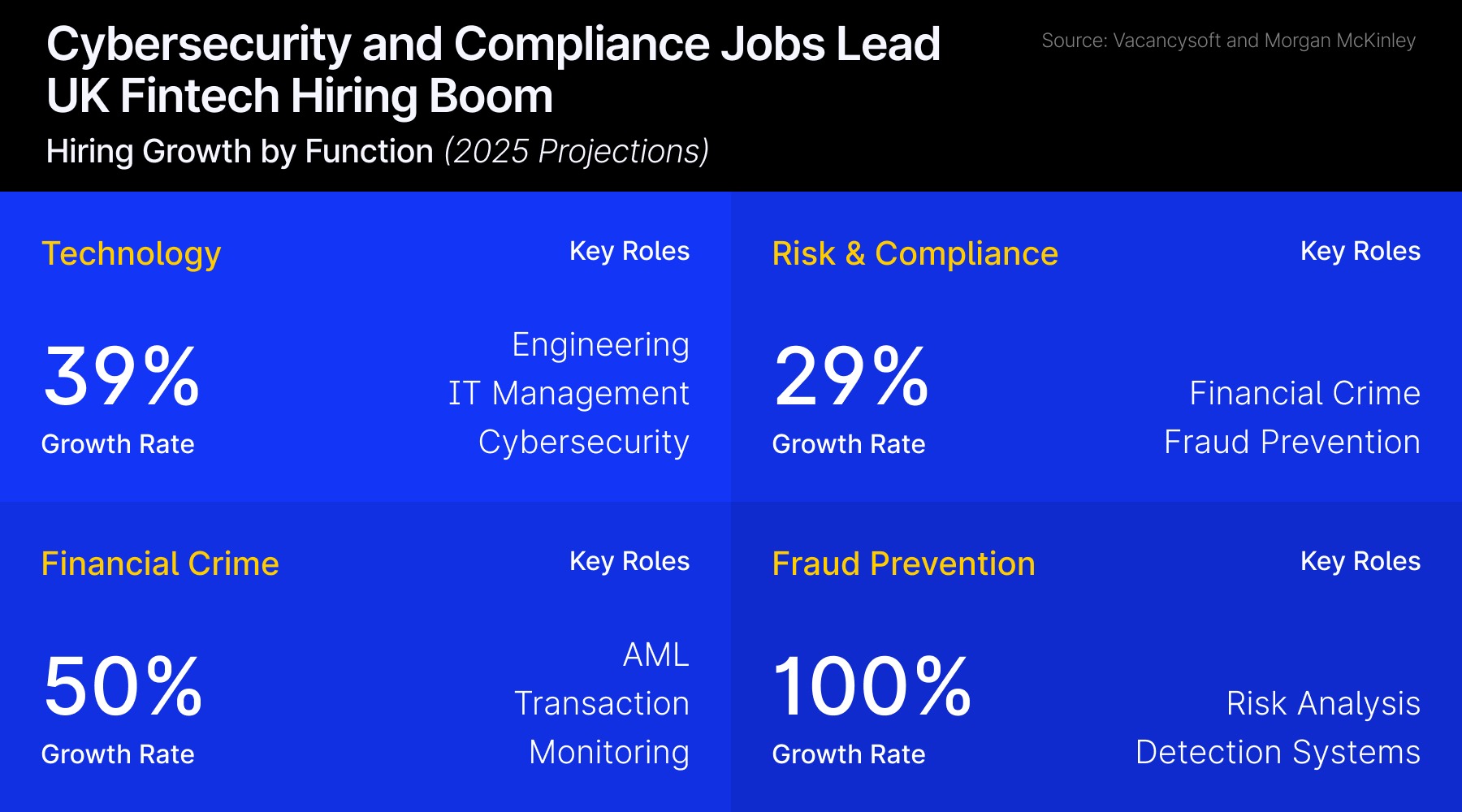
According to the latest Morgan McKinley report, financial crime specialists and regulatory experts are currently the most in-demand.
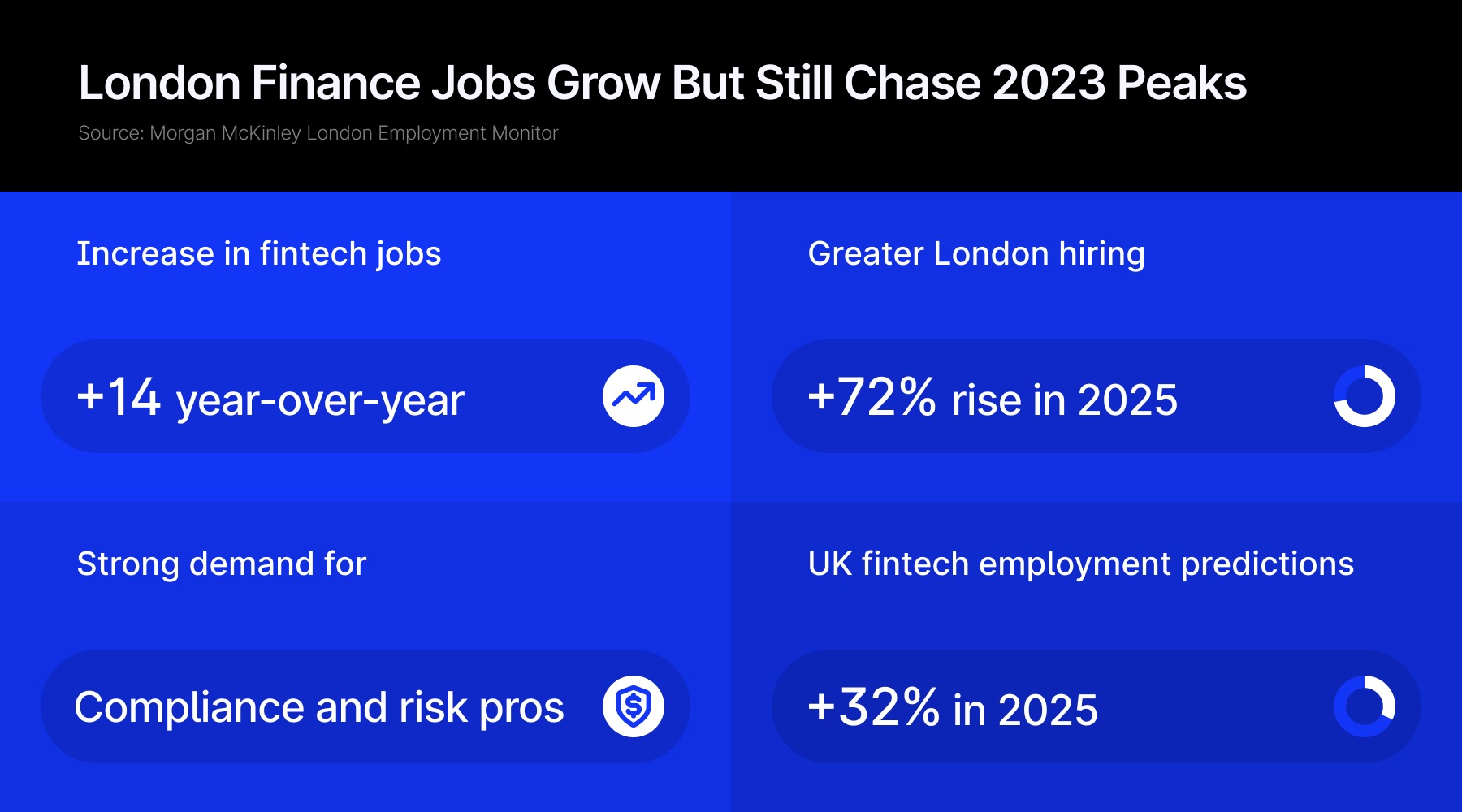
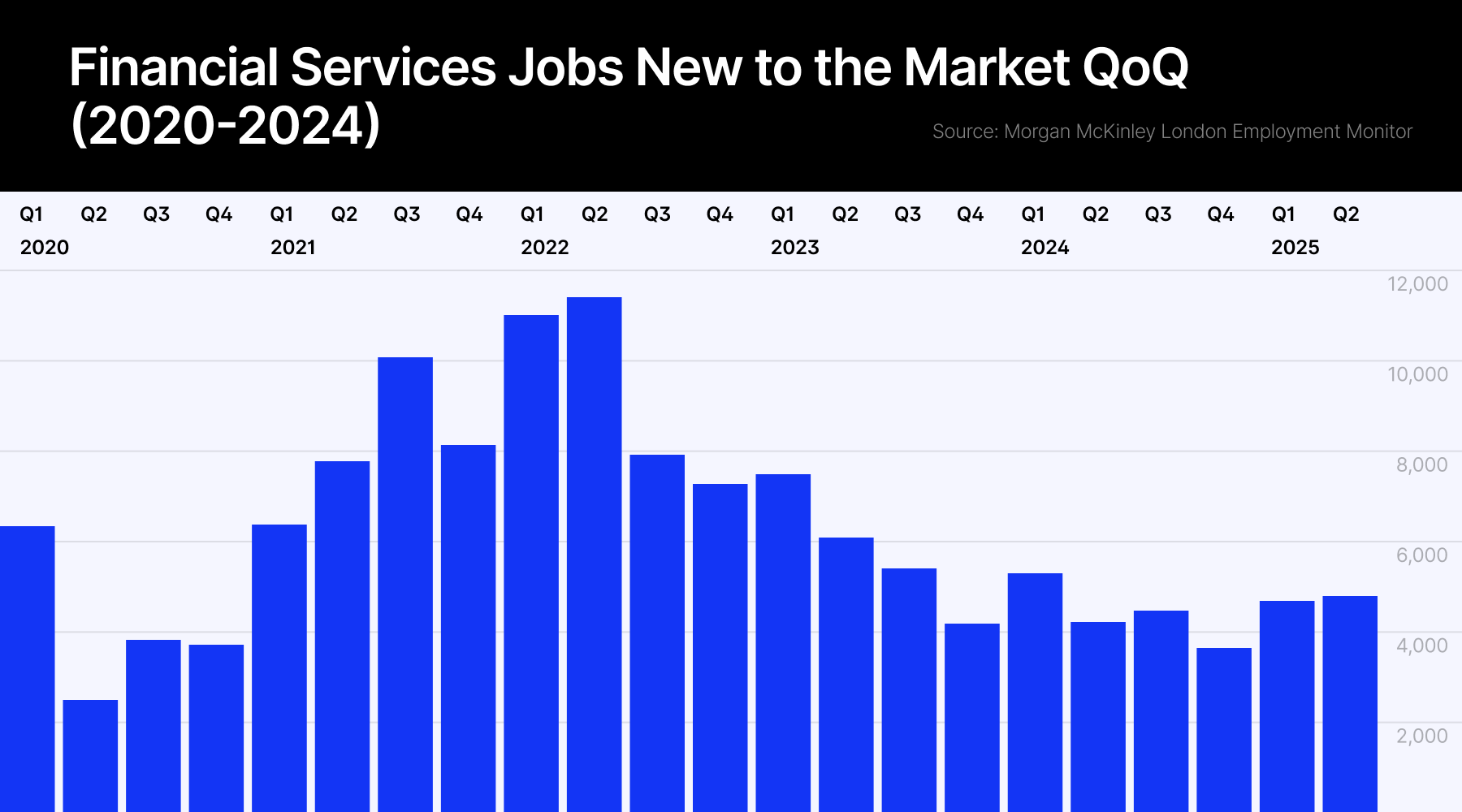
City’s finance job vacancies rose 14% year-on-year in Q2 2025, driven by fintech growth, but hiring levels remain below 2023 peaks.
Financial
services and fintech job openings in London climbed 14% compared to the same
period last year, according to new data from recruitment firm Morgan McKinley,
though hiring levels remain below their 2023 highs.
London Finance Jobs Rise
14% as Fintech Drives Hiring Recovery
The firm's
latest employment monitor found job vacancies rose 3% in the second quarter
compared to the first quarter of 2025. The figures suggest London's finance
sector continues recovering from last year's downturn, but the pace remains
measured.
Fintech
companies are leading the charge, with compliance and risk roles seeing
particularly strong demand. Morgan McKinley projects Greater London will see a
72% jump in fintech hiring throughout 2025, making it the UK's fastest-growing
sector for recruitment.
“The
latest figures from our London Employment Monitor points to a continued rebound
in London's financial services hiring,” said Mark Astbury, director at
Morgan McKinley. “Following a 12% seasonal bounce in Q1, we've seen a
further 3% increase this quarter and a 14% year-on-year uplift.”
Mark Astbury, director at Morgan McKinley
What’s Holding Back a
Stronger Jump?
But Astbury
cautioned that several factors are holding back stronger growth. Global market
volatility, Middle East tensions, and uncertainty around US trade policies have
dampened momentum since the year began with renewed optimism.
The UK
government's decision to raise employer National Insurance contributions has
also weighed on business confidence, according to the recruitment firm. Many
companies remain cautious about expanding their workforce amid ongoing
cost-cutting pressures and economic uncertainty.
Contract Market Cools as
Firms Favor Permanent Staff
While
permanent hiring held steady with a 3% quarterly increase, the contract market
has softened since Easter. Companies are prioritizing stable, full-time teams
over temporary coverage as they focus on long-term efficiency rather than
short-term headcount growth.
“From
what I'm seeing on the ground, interim recruitment has been subdued with firms
prioritising stable, permanent teams in core business areas over short-term
cover,” Astbury said.
Artificial intelligence and automation are
pushing companies to streamline operations and reduce their reliance on
traditional entry-level positions. Investment is increasingly flowing toward
technology upgrades and operational improvements.
Industry Awaits
Chancellor's Speech
The finance
sector is closely watching Chancellor's upcoming Mansion House speech on July
15 for concrete measures that could boost business confidence and hiring
demand. Industry observers expect the speech to focus on economic growth and
the future of the City of London.
Potential
initiatives could include unlocking pension capital for investment in UK
businesses and improving financial services competitiveness, though the
industry wants to see specific, actionable policies rather than broad
ambitions.
“While
these ambitions are welcome, the industry is hoping for clear, actionable
measures that translate into real-world hiring and business confidence,”
Astbury said. “Despite ongoing headwinds, employers that remain agile and
deliberate in their planning will be best placed to adapt, navigate and grow in
this evolving market.”
The data
comes from Morgan McKinley's quarterly London Employment Monitor, which tracks
job vacancy trends across the capital's financial services sector.
Financial
services and fintech job openings in London climbed 14% compared to the same
period last year, according to new data from recruitment firm Morgan McKinley,
though hiring levels remain below their 2023 highs.
London Finance Jobs Rise
14% as Fintech Drives Hiring Recovery
The firm's
latest employment monitor found job vacancies rose 3% in the second quarter
compared to the first quarter of 2025. The figures suggest London's finance
sector continues recovering from last year's downturn, but the pace remains
measured.
Fintech
companies are leading the charge, with compliance and risk roles seeing
particularly strong demand. Morgan McKinley projects Greater London will see a
72% jump in fintech hiring throughout 2025, making it the UK's fastest-growing
sector for recruitment.
“The
latest figures from our London Employment Monitor points to a continued rebound
in London's financial services hiring,” said Mark Astbury, director at
Morgan McKinley. “Following a 12% seasonal bounce in Q1, we've seen a
further 3% increase this quarter and a 14% year-on-year uplift.”
Mark Astbury, director at Morgan McKinley
What’s Holding Back a
Stronger Jump?
But Astbury
cautioned that several factors are holding back stronger growth. Global market
volatility, Middle East tensions, and uncertainty around US trade policies have
dampened momentum since the year began with renewed optimism.
The UK
government's decision to raise employer National Insurance contributions has
also weighed on business confidence, according to the recruitment firm. Many
companies remain cautious about expanding their workforce amid ongoing
cost-cutting pressures and economic uncertainty.
Contract Market Cools as
Firms Favor Permanent Staff
While
permanent hiring held steady with a 3% quarterly increase, the contract market
has softened since Easter. Companies are prioritizing stable, full-time teams
over temporary coverage as they focus on long-term efficiency rather than
short-term headcount growth.
“From
what I'm seeing on the ground, interim recruitment has been subdued with firms
prioritising stable, permanent teams in core business areas over short-term
cover,” Astbury said.
Artificial intelligence and automation are
pushing companies to streamline operations and reduce their reliance on
traditional entry-level positions. Investment is increasingly flowing toward
technology upgrades and operational improvements.
Industry Awaits
Chancellor's Speech
The finance
sector is closely watching Chancellor's upcoming Mansion House speech on July
15 for concrete measures that could boost business confidence and hiring
demand. Industry observers expect the speech to focus on economic growth and
the future of the City of London.
Potential
initiatives could include unlocking pension capital for investment in UK
businesses and improving financial services competitiveness, though the
industry wants to see specific, actionable policies rather than broad
ambitions.
“While
these ambitions are welcome, the industry is hoping for clear, actionable
measures that translate into real-world hiring and business confidence,”
Astbury said. “Despite ongoing headwinds, employers that remain agile and
deliberate in their planning will be best placed to adapt, navigate and grow in
this evolving market.”
The data
comes from Morgan McKinley's quarterly London Employment Monitor, which tracks
job vacancy trends across the capital's financial services sector.
Damian Chmiel is a Senior Analyst & Editor at Finance Magnates with more than 15 years of experience in the CFD and online trading industry. Active as both a trader and journalist since 2010, he focuses on broker coverage, fintech innovation, and regulatory developments across Europe, the Middle East, and Asia.
His work includes interviews with C-level leaders at major brokerages and fintech platforms, as well as co-authoring Finance Magnates’ quarterly industry benchmarking reports. Damian’s reporting is data-driven, market-aware, and grounded in direct industry engagement. His analysis and commentary have also been cited by external media outlets, including Investing.com, Binance, The Asset, Stockhead, and Dispatch.
Education:
MA in Finance and Accounting, Cracow University of Economics
Polymarket Replaces Bridged USDC Aiming for a U.S. Relaunch
FP Markets Winner Spotlight 🏆 | Global Broker of the Year 2025 #Trading #Broker #Innovation #Shorts
FP Markets Winner Spotlight 🏆 | Global Broker of the Year 2025 #Trading #Broker #Innovation #Shorts
FP Markets takes the spotlight as Global Broker of the Year 2025 at the Finance Magnates Awards.
Martin Stoilov, Head of Client Experience, shares that trust, innovation, and people played a key role in the company’s success, supported by a strong foundation of integrity and client-centricity.
Following this milestone, FP Markets continues to focus on growth, technology investment, and its core values of transparency and excellence.
👉 Be part of FM Awards 2026: https://awards.financemagnates.com/#nominate
FP Markets takes the spotlight as Global Broker of the Year 2025 at the Finance Magnates Awards.
Martin Stoilov, Head of Client Experience, shares that trust, innovation, and people played a key role in the company’s success, supported by a strong foundation of integrity and client-centricity.
Following this milestone, FP Markets continues to focus on growth, technology investment, and its core values of transparency and excellence.
👉 Be part of FM Awards 2026: https://awards.financemagnates.com/#nominate
In this video, we review @HolaPrimeMarketsOfficial, a multi-asset forex and CFDs broker offering different account types, trading platforms, and flexible trading conditions.
We cover the broker’s overall offering, including account options, trading environment, platforms like MT4 and MT5, and additional services such as managed accounts and fast withdrawals.
Watch the full video to see if Hola Prime Markets fits your trading needs.
📣 Stay up to date with the latest in finance and trading. Follow Finance Magnates for industry news, insights, and global event coverage.
Connect with us:
🔗 LinkedIn: /financemagnates
👍 Facebook: /financemagnates
📸 Instagram: https://www.instagram.com/financemagnates
🐦 X: https://x.com/financemagnates
🎥 TikTok: https://www.tiktok.com/tag/financemagnates
▶️ YouTube: /@financemagnates_official
#HolaPrime #ForexBroker #CFDTrading #FinanceMagnates #Trading #Forex #BrokerReview
In this video, we review @HolaPrimeMarketsOfficial, a multi-asset forex and CFDs broker offering different account types, trading platforms, and flexible trading conditions.
We cover the broker’s overall offering, including account options, trading environment, platforms like MT4 and MT5, and additional services such as managed accounts and fast withdrawals.
Watch the full video to see if Hola Prime Markets fits your trading needs.
📣 Stay up to date with the latest in finance and trading. Follow Finance Magnates for industry news, insights, and global event coverage.
Connect with us:
🔗 LinkedIn: /financemagnates
👍 Facebook: /financemagnates
📸 Instagram: https://www.instagram.com/financemagnates
🐦 X: https://x.com/financemagnates
🎥 TikTok: https://www.tiktok.com/tag/financemagnates
▶️ YouTube: /@financemagnates_official
#HolaPrime #ForexBroker #CFDTrading #FinanceMagnates #Trading #Forex #BrokerReview
Hola Prime Review: What You Need to Know | Full Breakdown by Finance Magnates
Hola Prime Review: What You Need to Know | Full Breakdown by Finance Magnates
In this video, we review @HolaPrime_Global, a proprietary trading firm offering evaluation programs and performance-based payouts in simulated market environments.
We cover how the challenge model works, including account types, profit splits (up to 95%), trading rules, and what it takes to reach a funded account. You’ll also learn about available platforms like MT4, MT5, cTrader, and more, along with insights into payouts, support, and trading conditions.
Watch the full video to see if Hola Prime fits your trading style.
📣 Stay up to date with the latest in finance and trading. Follow Finance Magnates for industry news, insights, and global event coverage.
Connect with us:
🔗 LinkedIn: /financemagnates
👍 Facebook: /financemagnates
📸 Instagram: https://www.instagram.com/financemagnates
🐦 X: https://x.com/financemagnates
🎥 TikTok: https://www.tiktok.com/tag/financemagnates
▶️ YouTube: /@financemagnates_official
#HolaPrime #PropFirm #Trading #FinanceMagnates #Forex #FuturesTrading #TradingReview #PropFirmReview
In this video, we review @HolaPrime_Global, a proprietary trading firm offering evaluation programs and performance-based payouts in simulated market environments.
We cover how the challenge model works, including account types, profit splits (up to 95%), trading rules, and what it takes to reach a funded account. You’ll also learn about available platforms like MT4, MT5, cTrader, and more, along with insights into payouts, support, and trading conditions.
Watch the full video to see if Hola Prime fits your trading style.
📣 Stay up to date with the latest in finance and trading. Follow Finance Magnates for industry news, insights, and global event coverage.
Connect with us:
🔗 LinkedIn: /financemagnates
👍 Facebook: /financemagnates
📸 Instagram: https://www.instagram.com/financemagnates
🐦 X: https://x.com/financemagnates
🎥 TikTok: https://www.tiktok.com/tag/financemagnates
▶️ YouTube: /@financemagnates_official
#HolaPrime #PropFirm #Trading #FinanceMagnates #Forex #FuturesTrading #TradingReview #PropFirmReview
Axi Winner Spotlight 🏆 | Global Most Innovative Broker 2025 #Innovation #Trading #Fintech #Broker
Axi Winner Spotlight 🏆 | Global Most Innovative Broker 2025 #Innovation #Trading #Fintech #Broker
Axi takes the spotlight at the Finance Magnates Awards, winning Global Most Innovative Broker 2025.
Olivia Xenofontos and Ivanna Openko share how the team will feel: proud, motivated, and ready to keep delivering.
They also describe the night as well-organized, focused, and enjoyable for all.
👉 Be part of FM Awards 2026.
Axi takes the spotlight at the Finance Magnates Awards, winning Global Most Innovative Broker 2025.
Olivia Xenofontos and Ivanna Openko share how the team will feel: proud, motivated, and ready to keep delivering.
They also describe the night as well-organized, focused, and enjoyable for all.
👉 Be part of FM Awards 2026.
Recognition that matters.
Built on transparency.
Driven by the industry.
The Finance Magnates Awards 2026.
Nominations are now open.
🔗 https://awards.financemagnates.com/?utm_source=SM&utm_medium=social&utm_campaign=recognition-matters
Recognition that matters.
Built on transparency.
Driven by the industry.
The Finance Magnates Awards 2026.
Nominations are now open.
🔗 https://awards.financemagnates.com/?utm_source=SM&utm_medium=social&utm_campaign=recognition-matters