The Philippines leads the region in mobile fintech usage, with Indonesia showing the fastest growth.
Digital wallets and mobile banking are two leading segments of popular apps.
A new study
by UnaFinancial reveals that mobile fintech app adoption in Southeast Asia is
on track to reach 60% by 2030, up from 49% in 2024. The research highlights
significant growth in the region's digital financial services sector, with some
countries poised for particularly high penetration rates.
Southeast Asian Fintech
App Adoption Set to Surge by 2030
The study,
which analyzed data from over 8,700 apps across six Southeast Asian nations,
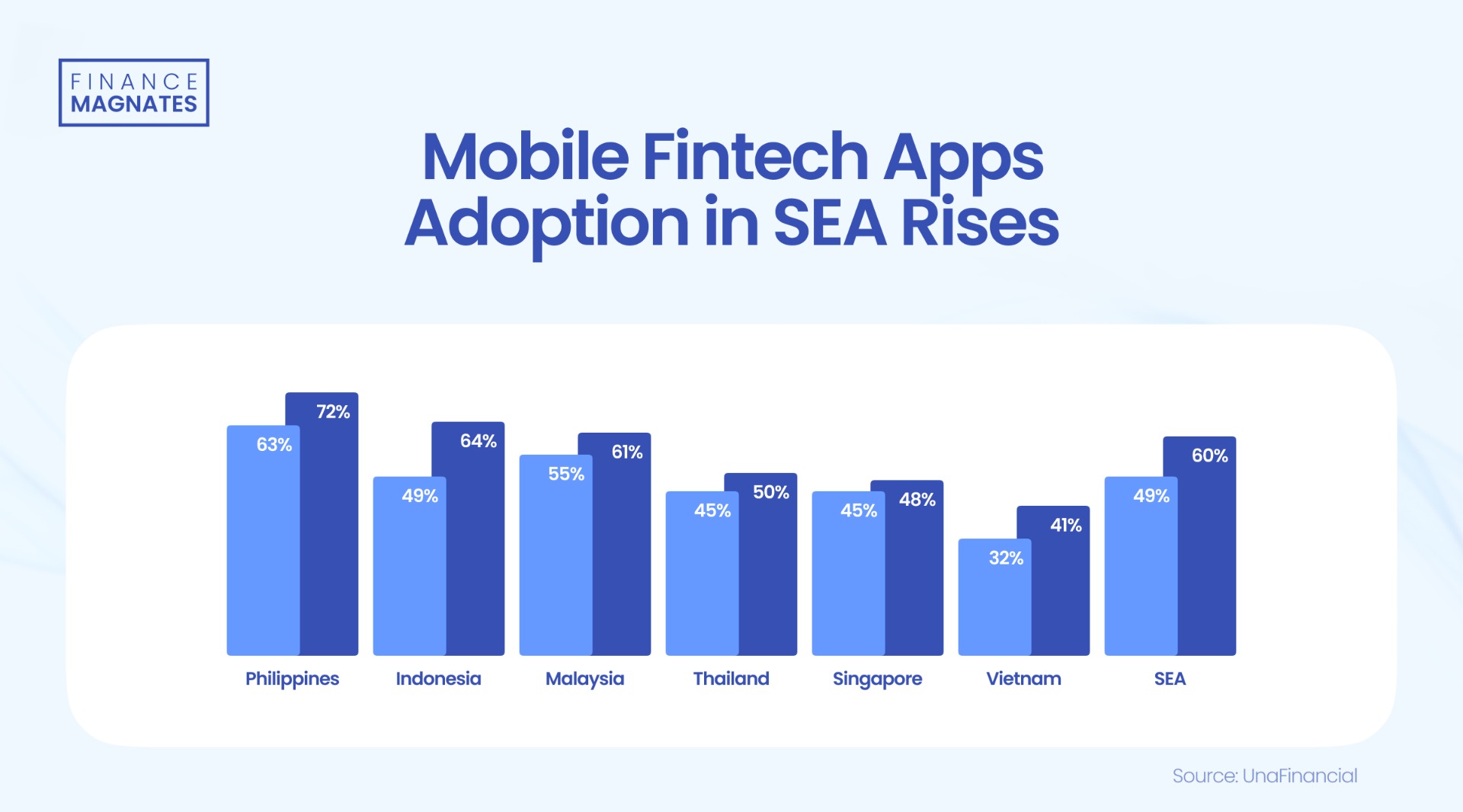
found that the Philippines currently leads the region with a 63% adoption rate.
This is expected to climb to 72% by 2030, maintaining the country's top
position.
Sergey Sedov, the CEO of UnaFinancial
“The
leadership of the Philippines is due to several factors, including the large
share of the unbanked population, efforts of regulators to develop digital
financial technologies, a large proportion of young and tech-savvy population
and a growing level of mobile and Internet penetration,” explained a
UnaFinancial analyst.
Indonesia
has shown the most visible growth, with fintech app usage surging from 9% in
2019 to 49% in 2024. The country is projected to reach 64% adoption by 2030,
securing the second spot in the region.
“The
level of mobile fintech app adoption increased from 9% in 2019 to 49% in 2024.
Similar to the Philippines, Indonesia is actively developing fintech, supported
by government efforts and a large share of the unbanked population,” UnaFinancial
added.
Other
countries in the study include Malaysia, currently at 55% adoption and expected
to reach 61% by 2030, Thailand (45% to 50%), Singapore (45% to 48%), and
Vietnam (32% to 41%).
The
research also broke down adoption rates by fintech segments. Digital wallets
and payment apps lead with 35% penetration, followed by mobile banking at 18%.
Lending apps have shown significant growth, increasing from 1% in 2019 to 5% in
2024.
Investing
and cryptocurrency trading apps lag behind at 2% each, which analysts attribute
to reduced investment activity amid global economic uncertainty.
The study's
findings underscore the rapid digitalization of financial services in Southeast
Asia, a trend that appears set to continue through the end of the decade. As
these technologies become more prevalent, they have the potential to reshape
the region's financial landscape and improve access to services for millions of
consumers.
UnaFinancial
is one of the companies operating in the payments and fintech industry itself.
At the end of July, it presented results for the first half of 2024, when it earned $4.7 million, increasing its net profit by 18%.
Fintech in ASEAN
Within the
Association of Southeast Asian Nations (ASEAN), Singapore maintained a leading
position in 2023 by securing $747 million in FinTech funding, representing 59%
of the total funding in this region. Despite a significant drop of over 65%
compared to the previous year, Singapore still managed to secure 51 deals, the
most in the region, spanning eight different FinTech categories. That was the
broadest range observed locally.
However,
Singapore and other ASEAN-based FinTech companies continue to experience a
global downturn in funding. In the first nine months of 2023, fintech
investments across the six largest ASEAN economies totaled US$1.3 billion,
marking a drastic 70% reduction from the same period in 2022.
Last month,
MUFG and the Finnoventure Private Equity Trust fund collectively invested $195
million in Ascend Money, a fintech unicorn based in Thailand. Ascend Money, a
subsidiary of the Charoen Pokphand Group, has extensive operations across seven
Southeast Asian countries.
A new study
by UnaFinancial reveals that mobile fintech app adoption in Southeast Asia is
on track to reach 60% by 2030, up from 49% in 2024. The research highlights
significant growth in the region's digital financial services sector, with some
countries poised for particularly high penetration rates.
Southeast Asian Fintech
App Adoption Set to Surge by 2030
The study,
which analyzed data from over 8,700 apps across six Southeast Asian nations,
found that the Philippines currently leads the region with a 63% adoption rate.
This is expected to climb to 72% by 2030, maintaining the country's top
position.
Sergey Sedov, the CEO of UnaFinancial
“The
leadership of the Philippines is due to several factors, including the large
share of the unbanked population, efforts of regulators to develop digital
financial technologies, a large proportion of young and tech-savvy population
and a growing level of mobile and Internet penetration,” explained a
UnaFinancial analyst.
Indonesia
has shown the most visible growth, with fintech app usage surging from 9% in
2019 to 49% in 2024. The country is projected to reach 64% adoption by 2030,
securing the second spot in the region.
“The
level of mobile fintech app adoption increased from 9% in 2019 to 49% in 2024.
Similar to the Philippines, Indonesia is actively developing fintech, supported
by government efforts and a large share of the unbanked population,” UnaFinancial
added.
Other
countries in the study include Malaysia, currently at 55% adoption and expected
to reach 61% by 2030, Thailand (45% to 50%), Singapore (45% to 48%), and
Vietnam (32% to 41%).
The
research also broke down adoption rates by fintech segments. Digital wallets
and payment apps lead with 35% penetration, followed by mobile banking at 18%.
Lending apps have shown significant growth, increasing from 1% in 2019 to 5% in
2024.
Investing
and cryptocurrency trading apps lag behind at 2% each, which analysts attribute
to reduced investment activity amid global economic uncertainty.
The study's
findings underscore the rapid digitalization of financial services in Southeast
Asia, a trend that appears set to continue through the end of the decade. As
these technologies become more prevalent, they have the potential to reshape
the region's financial landscape and improve access to services for millions of
consumers.
UnaFinancial
is one of the companies operating in the payments and fintech industry itself.
At the end of July, it presented results for the first half of 2024, when it earned $4.7 million, increasing its net profit by 18%.
Fintech in ASEAN
Within the
Association of Southeast Asian Nations (ASEAN), Singapore maintained a leading
position in 2023 by securing $747 million in FinTech funding, representing 59%
of the total funding in this region. Despite a significant drop of over 65%
compared to the previous year, Singapore still managed to secure 51 deals, the
most in the region, spanning eight different FinTech categories. That was the
broadest range observed locally.
However,
Singapore and other ASEAN-based FinTech companies continue to experience a
global downturn in funding. In the first nine months of 2023, fintech
investments across the six largest ASEAN economies totaled US$1.3 billion,
marking a drastic 70% reduction from the same period in 2022.
Last month,
MUFG and the Finnoventure Private Equity Trust fund collectively invested $195
million in Ascend Money, a fintech unicorn based in Thailand. Ascend Money, a
subsidiary of the Charoen Pokphand Group, has extensive operations across seven
Southeast Asian countries.
Damian Chmiel is a Senior Analyst & Editor at Finance Magnates with more than 15 years of experience in the CFD and online trading industry. Active as both a trader and journalist since 2010, he focuses on broker coverage, fintech innovation, and regulatory developments across Europe, the Middle East, and Asia.
His work includes interviews with C-level leaders at major brokerages and fintech platforms, as well as co-authoring Finance Magnates’ quarterly industry benchmarking reports. Damian’s reporting is data-driven, market-aware, and grounded in direct industry engagement. His analysis and commentary have also been cited by external media outlets, including Investing.com, Binance, The Asset, Stockhead, and Dispatch.
Education:
MA in Finance and Accounting, Cracow University of Economics
Retail Investors Shift to Energy, Rare Earths, and AI Amid Tensions, eToro Finds
FP Markets Winner Spotlight 🏆 | Global Broker of the Year 2025 #Trading #Broker #Innovation #Shorts
FP Markets Winner Spotlight 🏆 | Global Broker of the Year 2025 #Trading #Broker #Innovation #Shorts
FP Markets takes the spotlight as Global Broker of the Year 2025 at the Finance Magnates Awards.
Martin Stoilov, Head of Client Experience, shares that trust, innovation, and people played a key role in the company’s success, supported by a strong foundation of integrity and client-centricity.
Following this milestone, FP Markets continues to focus on growth, technology investment, and its core values of transparency and excellence.
👉 Be part of FM Awards 2026: https://awards.financemagnates.com/#nominate
FP Markets takes the spotlight as Global Broker of the Year 2025 at the Finance Magnates Awards.
Martin Stoilov, Head of Client Experience, shares that trust, innovation, and people played a key role in the company’s success, supported by a strong foundation of integrity and client-centricity.
Following this milestone, FP Markets continues to focus on growth, technology investment, and its core values of transparency and excellence.
👉 Be part of FM Awards 2026: https://awards.financemagnates.com/#nominate
In this video, we review @HolaPrimeMarketsOfficial, a multi-asset forex and CFDs broker offering different account types, trading platforms, and flexible trading conditions.
We cover the broker’s overall offering, including account options, trading environment, platforms like MT4 and MT5, and additional services such as managed accounts and fast withdrawals.
Watch the full video to see if Hola Prime Markets fits your trading needs.
📣 Stay up to date with the latest in finance and trading. Follow Finance Magnates for industry news, insights, and global event coverage.
Connect with us:
🔗 LinkedIn: /financemagnates
👍 Facebook: /financemagnates
📸 Instagram: https://www.instagram.com/financemagnates
🐦 X: https://x.com/financemagnates
🎥 TikTok: https://www.tiktok.com/tag/financemagnates
▶️ YouTube: /@financemagnates_official
#HolaPrime #ForexBroker #CFDTrading #FinanceMagnates #Trading #Forex #BrokerReview
In this video, we review @HolaPrimeMarketsOfficial, a multi-asset forex and CFDs broker offering different account types, trading platforms, and flexible trading conditions.
We cover the broker’s overall offering, including account options, trading environment, platforms like MT4 and MT5, and additional services such as managed accounts and fast withdrawals.
Watch the full video to see if Hola Prime Markets fits your trading needs.
📣 Stay up to date with the latest in finance and trading. Follow Finance Magnates for industry news, insights, and global event coverage.
Connect with us:
🔗 LinkedIn: /financemagnates
👍 Facebook: /financemagnates
📸 Instagram: https://www.instagram.com/financemagnates
🐦 X: https://x.com/financemagnates
🎥 TikTok: https://www.tiktok.com/tag/financemagnates
▶️ YouTube: /@financemagnates_official
#HolaPrime #ForexBroker #CFDTrading #FinanceMagnates #Trading #Forex #BrokerReview
Hola Prime Review: What You Need to Know | Full Breakdown by Finance Magnates
Hola Prime Review: What You Need to Know | Full Breakdown by Finance Magnates
In this video, we review @HolaPrime_Global, a proprietary trading firm offering evaluation programs and performance-based payouts in simulated market environments.
We cover how the challenge model works, including account types, profit splits (up to 95%), trading rules, and what it takes to reach a funded account. You’ll also learn about available platforms like MT4, MT5, cTrader, and more, along with insights into payouts, support, and trading conditions.
Watch the full video to see if Hola Prime fits your trading style.
📣 Stay up to date with the latest in finance and trading. Follow Finance Magnates for industry news, insights, and global event coverage.
Connect with us:
🔗 LinkedIn: /financemagnates
👍 Facebook: /financemagnates
📸 Instagram: https://www.instagram.com/financemagnates
🐦 X: https://x.com/financemagnates
🎥 TikTok: https://www.tiktok.com/tag/financemagnates
▶️ YouTube: /@financemagnates_official
#HolaPrime #PropFirm #Trading #FinanceMagnates #Forex #FuturesTrading #TradingReview #PropFirmReview
In this video, we review @HolaPrime_Global, a proprietary trading firm offering evaluation programs and performance-based payouts in simulated market environments.
We cover how the challenge model works, including account types, profit splits (up to 95%), trading rules, and what it takes to reach a funded account. You’ll also learn about available platforms like MT4, MT5, cTrader, and more, along with insights into payouts, support, and trading conditions.
Watch the full video to see if Hola Prime fits your trading style.
📣 Stay up to date with the latest in finance and trading. Follow Finance Magnates for industry news, insights, and global event coverage.
Connect with us:
🔗 LinkedIn: /financemagnates
👍 Facebook: /financemagnates
📸 Instagram: https://www.instagram.com/financemagnates
🐦 X: https://x.com/financemagnates
🎥 TikTok: https://www.tiktok.com/tag/financemagnates
▶️ YouTube: /@financemagnates_official
#HolaPrime #PropFirm #Trading #FinanceMagnates #Forex #FuturesTrading #TradingReview #PropFirmReview
Axi Winner Spotlight 🏆 | Global Most Innovative Broker 2025 #Innovation #Trading #Fintech #Broker
Axi Winner Spotlight 🏆 | Global Most Innovative Broker 2025 #Innovation #Trading #Fintech #Broker
Axi takes the spotlight at the Finance Magnates Awards, winning Global Most Innovative Broker 2025.
Olivia Xenofontos and Ivanna Openko share how the team will feel: proud, motivated, and ready to keep delivering.
They also describe the night as well-organized, focused, and enjoyable for all.
👉 Be part of FM Awards 2026.
Axi takes the spotlight at the Finance Magnates Awards, winning Global Most Innovative Broker 2025.
Olivia Xenofontos and Ivanna Openko share how the team will feel: proud, motivated, and ready to keep delivering.
They also describe the night as well-organized, focused, and enjoyable for all.
👉 Be part of FM Awards 2026.
Recognition that matters.
Built on transparency.
Driven by the industry.
The Finance Magnates Awards 2026.
Nominations are now open.
🔗 https://awards.financemagnates.com/?utm_source=SM&utm_medium=social&utm_campaign=recognition-matters
Recognition that matters.
Built on transparency.
Driven by the industry.
The Finance Magnates Awards 2026.
Nominations are now open.
🔗 https://awards.financemagnates.com/?utm_source=SM&utm_medium=social&utm_campaign=recognition-matters