

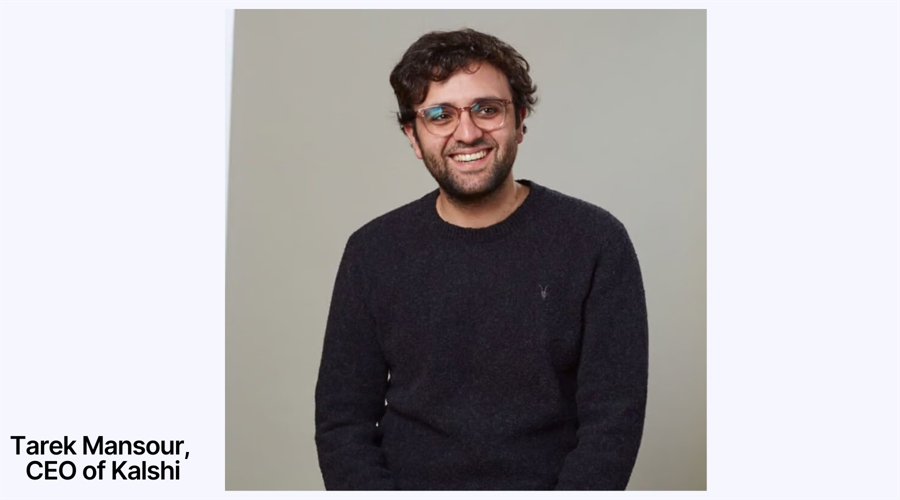
Kalshi's co-founders argue that the platform's predictive accuracy comes not from Wall Street professionals, but from a broader base of retail users with no particular financial background.
Singapore Summit: Meet the largest APAC brokers you know (and those you still don't!)
In a recent interview, CEO Tarek Mansour described prediction markets as a way to "bring in a much larger set of people" into forecasting.
An analysis of Kalshi's top 1,000 traders, he said, shows that few have Ivy League degrees, few come from wealthy backgrounds, and few have prior experience in traditional financial markets or sports betting.
"You need the people in Kansas trading out of their garage," Mansour said. "They're just people that know how to read the news and are very self-calibrated."
What Research Suggests
Some academic research supports parts of this claim. Studies from the National Bureau of Economic Research and Federal Reserve researchers have found that prediction markets on platforms like Kalshi can match or outperform traditional forecasts on certain macroeconomic indicators — inflation and Federal Reserve rate decisions chief among them.
The main advantage is frequency: market-implied expectations update continuously, rather than on the schedule of surveys or official data releases.
A more diverse — but not necessarily dominant — crowd Kalshi has seen rapid growth in its share of women traders (reaching 26% recently), higher than many expected for a trading platform, with different segments active across politics, entertainment, and economics.
The broad range of event-driven contracts extends participation beyond the typical financial audience. Not everyone, however, attributes the accuracy primarily to distributed retail knowledge.
- Kalshi Sells Prediction Market Data to Fox, Expanding Beyond Trading
- Kalshi Launches Ad Campaign in Washington D.C. but Not Everyone Is Buying It
- Kalshi Pushes Prediction Markets Into Derivatives Territory With Margin Plans
Some analysts argue that price formation in prediction markets is significantly influenced by a smaller group of sophisticated participants — including hedge funds and experienced traders — rather than the broad crowd.
On this reading, prediction markets function less as pure aggregation of public opinion and more as a venue where informed capital sets prices. Kalshi's own founders haven't addressed this tension directly.
Automation Changes the Dynamic
A separate factor complicates the "garage trader" narrative. As volumes grow, activity is starting to shift toward automation. In mature markets like FX, algorithmic trading already accounts for the majority of flow, and prediction markets may be following the same path.
Early signs are visible on Polymarket, where a significant share of the most profitable accounts appear to be automated. If that pattern holds across platforms, price formation will increasingly reflect execution speed and sophisticated strategies as much as distributed knowledge.
An Edge That May Not Last
For institutional users, the core question is what happens to forecasting accuracy as participation changes. If more sophisticated capital and automated strategies enter, the retail informational advantage may narrow — the same dynamic that has played out in equities, FX, and crypto over the past two decades.
Retail traders tend to be crowded out as a market matures. For now, prediction markets offer a fast, probability-based read on expectations.
Whether that read is generated primarily by the crowd, or priced by a smaller set of well-capitalized and automated participants, is harder to know than the founders suggest.


