M4Markets' CEO Oscar Asly highlights how ARR could become another vanity metric if fintech companies obscure the underlying economics.
After $210bn boom, ARR is fintech’s new favourite. But £1m January annualised isn’t predictability.
Not long ago, the standard announcement from a fast-growing
technology company tended to involve a funding round, an
impressive valuation and a photograph of the founders looking as though
raising $100 million was roughly what they had expected to happen that Tuesday.
The amount raised often did most of the work. A large cheque from a respected
investor carried its own implication that things inside the company must be
going rather well. The language is changing.
Starling has been talking publicly about the annual
recurring revenue generated by Engine, its banking technology business. Carta
has published its ARR milestones. Similar figures increasingly appear in
investor updates, founder interviews and company announcements across financial
technology, and we have been discussing whether to publish a run rate number
ourselves.
Why ARR has become attractive
I understand the attraction because the market has become
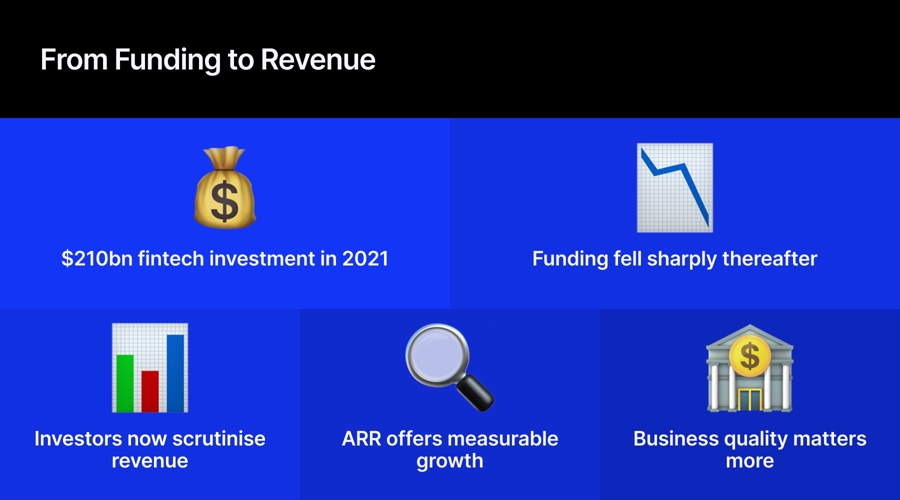
much more interested in what happens after the money arrives. Between about
2020 and 2022, fintech became remarkably good at producing spectacular
private valuations.
Capital was cheap, investors were chasing growth, and a
funding round could create the impression of commercial momentum before the
company had generated very much revenue at all. Some excellent businesses were
financed that way; some less excellent ones benefited, too. Venture capital,
like most forms of human enthusiasm, occasionally gets carried away.
The correction that followed changed the questions.
Investors looking at growth stage fintechs now spend much more time on margins,
customer concentration, cash generation and the durability of revenue.
Companies still raise money, and valuations still matter, but a funding
announcement has lost some of its former ability to serve as a general
certificate of corporate health.
Hence ARR.
A revenue figure appears reassuringly tangible. Customers
have bought something, money is moving through the business, and an outsider has
at least one number against which to judge all the talk of growth. For private
companies whose statutory accounts inevitably describe a business several
months behind where it is today, a sensible run rate figure can be genuinely
informative. The difficulty begins with the word “sensible”.
One Acronym, Different Businesses
ARR originally had a fairly obvious home in subscription
software, where a company might have thousands of customers paying contracted
annual fees. Fintech has borrowed the acronym for businesses whose economics
can look completely different.
Lending brings credit cycles and
balance sheet considerations into the equation. Two founders can therefore
announce identical ARR figures while describing businesses with very different
levels of predictability.
AI has recently made the terminology even more entertaining.
The extraordinary speed at which some AI companies have reported revenue growth
has encouraged closer examination of what exactly sits inside those numbers.
Investors have debated the treatment of contracted revenue, customers that have
signed but have yet to go live, unusually strong recent months and annualised
figures based on very short trading periods.
None of those calculations is inherently absurd. They simply
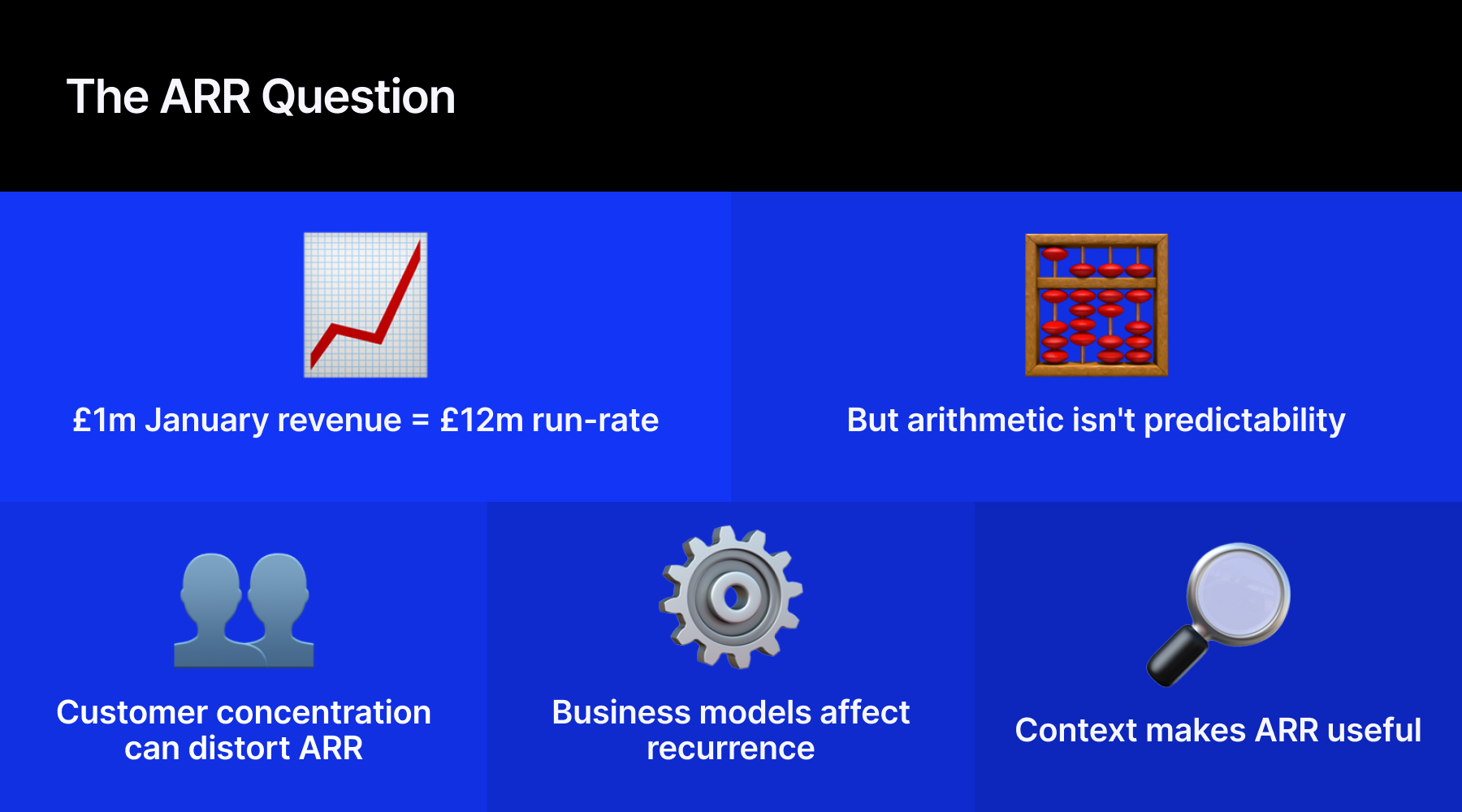
answer different questions. If a company earns £1 million in January and calls
itself a £12 million annualised run rate business, the arithmetic is beyond
reproach. Whether January will repeat itself another eleven times is the more
interesting question.
For fintech, that distinction matters enormously because
transaction volumes can move, customers can ramp at different speeds, and market
activity can make one quarter look rather more handsome than the next. A
headline figure becomes useful only when readers can understand the machinery
producing it.
That is the standard I would apply if we publish one
ourselves. I would want people to know the period being annualised, how much
revenue is live today, how much has been contractually committed, whether a
handful of customers account for a large share of it and how the economics
change as volumes grow.
A smaller figure with a clear explanation tells me
considerably more about a business than a giant number that develops
complications the moment somebody opens Excel.
It attracts astonishing
amounts of capital, produces founders who become famous remarkably quickly and
generates revenue milestones at a speed that has caused an entire venture
industry to reach repeatedly for its calculator.
Fintech, meanwhile, is growing up. That sounds less
glamorous than being the next technological revolution, although there are
worse commercial positions to occupy.
Many fintech businesses now have
regulated operations, institutional customers, established payment flows,
banking relationships and years of operating data. The sector can increasingly
make its case through what customers actually use and pay for.
ARR fits that stage of development rather well. It also
comes with a danger familiar to anyone who lived through the valuation boom.
Once a number becomes associated with success, companies inevitably become
inventive about making the number larger.
The Risk of Another Vanity Metric
A decade ago, valuation sometimes told us more about the
availability of capital than the quality of the company receiving it. ARR could
acquire the same weakness if every form of projected, committed, annualised, and
repeatable revenue ends up placed beneath one convenient acronym.
That would be a shame because the underlying change is
healthy. Fintech should be able to show that businesses are generating
substantial revenue, that customers stay with them, and that years of investment
have produced companies with genuine commercial weight.
Publishing those
figures gives the market more information and gives management teams something
more demanding to talk about than the valuation attached to their last funding
round.
But if ARR is going to become fintech’s new favourite
number, the industry should spend a little less time admiring the acronym and a
little more time explaining the arithmetic.
Not long ago, the standard announcement from a fast-growing
technology company tended to involve a funding round, an
impressive valuation and a photograph of the founders looking as though
raising $100 million was roughly what they had expected to happen that Tuesday.
The amount raised often did most of the work. A large cheque from a respected
investor carried its own implication that things inside the company must be
going rather well. The language is changing.
Starling has been talking publicly about the annual
recurring revenue generated by Engine, its banking technology business. Carta
has published its ARR milestones. Similar figures increasingly appear in
investor updates, founder interviews and company announcements across financial
technology, and we have been discussing whether to publish a run rate number
ourselves.
Why ARR has become attractive
I understand the attraction because the market has become
much more interested in what happens after the money arrives. Between about
2020 and 2022, fintech became remarkably good at producing spectacular
private valuations.
Capital was cheap, investors were chasing growth, and a
funding round could create the impression of commercial momentum before the
company had generated very much revenue at all. Some excellent businesses were
financed that way; some less excellent ones benefited, too. Venture capital,
like most forms of human enthusiasm, occasionally gets carried away.
The correction that followed changed the questions.
Investors looking at growth stage fintechs now spend much more time on margins,
customer concentration, cash generation and the durability of revenue.
Companies still raise money, and valuations still matter, but a funding
announcement has lost some of its former ability to serve as a general
certificate of corporate health.
Hence ARR.
A revenue figure appears reassuringly tangible. Customers
have bought something, money is moving through the business, and an outsider has
at least one number against which to judge all the talk of growth. For private
companies whose statutory accounts inevitably describe a business several
months behind where it is today, a sensible run rate figure can be genuinely
informative. The difficulty begins with the word “sensible”.
One Acronym, Different Businesses
ARR originally had a fairly obvious home in subscription
software, where a company might have thousands of customers paying contracted
annual fees. Fintech has borrowed the acronym for businesses whose economics
can look completely different.
Lending brings credit cycles and
balance sheet considerations into the equation. Two founders can therefore
announce identical ARR figures while describing businesses with very different
levels of predictability.
AI has recently made the terminology even more entertaining.
The extraordinary speed at which some AI companies have reported revenue growth
has encouraged closer examination of what exactly sits inside those numbers.
Investors have debated the treatment of contracted revenue, customers that have
signed but have yet to go live, unusually strong recent months and annualised
figures based on very short trading periods.
None of those calculations is inherently absurd. They simply
answer different questions. If a company earns £1 million in January and calls
itself a £12 million annualised run rate business, the arithmetic is beyond
reproach. Whether January will repeat itself another eleven times is the more
interesting question.
For fintech, that distinction matters enormously because
transaction volumes can move, customers can ramp at different speeds, and market
activity can make one quarter look rather more handsome than the next. A
headline figure becomes useful only when readers can understand the machinery
producing it.
That is the standard I would apply if we publish one
ourselves. I would want people to know the period being annualised, how much
revenue is live today, how much has been contractually committed, whether a
handful of customers account for a large share of it and how the economics
change as volumes grow.
A smaller figure with a clear explanation tells me
considerably more about a business than a giant number that develops
complications the moment somebody opens Excel.
It attracts astonishing
amounts of capital, produces founders who become famous remarkably quickly and
generates revenue milestones at a speed that has caused an entire venture
industry to reach repeatedly for its calculator.
Fintech, meanwhile, is growing up. That sounds less
glamorous than being the next technological revolution, although there are
worse commercial positions to occupy.
Many fintech businesses now have
regulated operations, institutional customers, established payment flows,
banking relationships and years of operating data. The sector can increasingly
make its case through what customers actually use and pay for.
ARR fits that stage of development rather well. It also
comes with a danger familiar to anyone who lived through the valuation boom.
Once a number becomes associated with success, companies inevitably become
inventive about making the number larger.
The Risk of Another Vanity Metric
A decade ago, valuation sometimes told us more about the
availability of capital than the quality of the company receiving it. ARR could
acquire the same weakness if every form of projected, committed, annualised, and
repeatable revenue ends up placed beneath one convenient acronym.
That would be a shame because the underlying change is
healthy. Fintech should be able to show that businesses are generating
substantial revenue, that customers stay with them, and that years of investment
have produced companies with genuine commercial weight.
Publishing those
figures gives the market more information and gives management teams something
more demanding to talk about than the valuation attached to their last funding
round.
But if ARR is going to become fintech’s new favourite
number, the industry should spend a little less time admiring the acronym and a
little more time explaining the arithmetic.
Oscar Asly is Group CEO of M4Markets, helping shape the company’s strategy, governance and international growth.
Based in Dubai, Oscar began his career at Deutsche Bank’s Investment Bank, advising sovereign and institutional clients across the Middle East. He later moved into fintech, blockchain and digital assets, including supporting Binance’s expansion across the MENA region.
Today, he oversees M4Markets’ expansion across Asia and international markets and is a recognised commentator on financial markets, regulation and fintech.
Why the CFTC Is Rewriting Swap Rules for Prediction Markets and How It Shifts the Balance of Power
Featured Videos
FxPro Sells EU Clients to Capital.com; NAGA H1 Profit Revised
FxPro Sells EU Clients to Capital.com; NAGA H1 Profit Revised
FxPro Sells EU Clients to Capital.com; NAGA H1 Profit Revised
FxPro Sells EU Clients to Capital.com; NAGA H1 Profit Revised
Today’s financial news recap covers FxPro agrees to sell its European client book to Capital.com, NAGA raises its first-half profit estimate, Trade Republic prepares a fee-free pension account, and Interactive Brokers introduces Ether staking.
Finance Magnates Daily Recap brings you the latest news from forex and CFD brokers, fintech, payments, cryptocurrency, digital assets, trading platforms, financial regulation and global markets.
Get the key company news, executive moves, deals, regulatory updates and market developments of the day, in just a few minutes. New episodes published every weekday.
Read more: https://www.financemagnates.com
#FinanceMagnates #ForexNews #FintechNews
Today’s financial news recap covers FxPro agrees to sell its European client book to Capital.com, NAGA raises its first-half profit estimate, Trade Republic prepares a fee-free pension account, and Interactive Brokers introduces Ether staking.
Finance Magnates Daily Recap brings you the latest news from forex and CFD brokers, fintech, payments, cryptocurrency, digital assets, trading platforms, financial regulation and global markets.
Get the key company news, executive moves, deals, regulatory updates and market developments of the day, in just a few minutes. New episodes published every weekday.
Read more: https://www.financemagnates.com
#FinanceMagnates #ForexNews #FintechNews
Today’s financial news recap covers FxPro agrees to sell its European client book to Capital.com, NAGA raises its first-half profit estimate, Trade Republic prepares a fee-free pension account, and Interactive Brokers introduces Ether staking.
Finance Magnates Daily Recap brings you the latest news from forex and CFD brokers, fintech, payments, cryptocurrency, digital assets, trading platforms, financial regulation and global markets.
Get the key company news, executive moves, deals, regulatory updates and market developments of the day, in just a few minutes. New episodes published every weekday.
Read more: https://www.financemagnates.com
#FinanceMagnates #ForexNews #FintechNews
Today’s financial news recap covers FxPro agrees to sell its European client book to Capital.com, NAGA raises its first-half profit estimate, Trade Republic prepares a fee-free pension account, and Interactive Brokers introduces Ether staking.
Finance Magnates Daily Recap brings you the latest news from forex and CFD brokers, fintech, payments, cryptocurrency, digital assets, trading platforms, financial regulation and global markets.
Get the key company news, executive moves, deals, regulatory updates and market developments of the day, in just a few minutes. New episodes published every weekday.
Read more: https://www.financemagnates.com
#FinanceMagnates #ForexNews #FintechNews
Plus500 Plans US Super-App; Investec to Offer IG Platform
Plus500 Plans US Super-App; Investec to Offer IG Platform
Plus500 Plans US Super-App; Investec to Offer IG Platform
Plus500 Plans US Super-App; Investec to Offer IG Platform
Plus500 Plans US Super-App; Investec to Offer IG Platform
Plus500 Plans US Super-App; Investec to Offer IG Platform
Today’s financial news recap covers Plus500 plans a US trading super-app, Investec partners with IG, Trade Republic reports a sevenfold profit jump, and BingX adds thousands of US stocks.
Finance Magnates Daily Recap brings you the latest news from forex and CFD brokers, fintech, payments, cryptocurrency, digital assets, trading platforms, financial regulation and global markets.
Get the key company news, executive moves, deals, regulatory updates and market developments of the day, in just a few minutes. New episodes published every weekday.
Read more: https://www.financemagnates.com
#FinanceMagnates #ForexNews #FintechNews
Today’s financial news recap covers Plus500 plans a US trading super-app, Investec partners with IG, Trade Republic reports a sevenfold profit jump, and BingX adds thousands of US stocks.
Finance Magnates Daily Recap brings you the latest news from forex and CFD brokers, fintech, payments, cryptocurrency, digital assets, trading platforms, financial regulation and global markets.
Get the key company news, executive moves, deals, regulatory updates and market developments of the day, in just a few minutes. New episodes published every weekday.
Read more: https://www.financemagnates.com
#FinanceMagnates #ForexNews #FintechNews
Today’s financial news recap covers Plus500 plans a US trading super-app, Investec partners with IG, Trade Republic reports a sevenfold profit jump, and BingX adds thousands of US stocks.
Finance Magnates Daily Recap brings you the latest news from forex and CFD brokers, fintech, payments, cryptocurrency, digital assets, trading platforms, financial regulation and global markets.
Get the key company news, executive moves, deals, regulatory updates and market developments of the day, in just a few minutes. New episodes published every weekday.
Read more: https://www.financemagnates.com
#FinanceMagnates #ForexNews #FintechNews
Today’s financial news recap covers Plus500 plans a US trading super-app, Investec partners with IG, Trade Republic reports a sevenfold profit jump, and BingX adds thousands of US stocks.
Finance Magnates Daily Recap brings you the latest news from forex and CFD brokers, fintech, payments, cryptocurrency, digital assets, trading platforms, financial regulation and global markets.
Get the key company news, executive moves, deals, regulatory updates and market developments of the day, in just a few minutes. New episodes published every weekday.
Read more: https://www.financemagnates.com
#FinanceMagnates #ForexNews #FintechNews
Today’s financial news recap covers Plus500 plans a US trading super-app, Investec partners with IG, Trade Republic reports a sevenfold profit jump, and BingX adds thousands of US stocks.
Finance Magnates Daily Recap brings you the latest news from forex and CFD brokers, fintech, payments, cryptocurrency, digital assets, trading platforms, financial regulation and global markets.
Get the key company news, executive moves, deals, regulatory updates and market developments of the day, in just a few minutes. New episodes published every weekday.
Read more: https://www.financemagnates.com
#FinanceMagnates #ForexNews #FintechNews
Today’s financial news recap covers Plus500 plans a US trading super-app, Investec partners with IG, Trade Republic reports a sevenfold profit jump, and BingX adds thousands of US stocks.
Finance Magnates Daily Recap brings you the latest news from forex and CFD brokers, fintech, payments, cryptocurrency, digital assets, trading platforms, financial regulation and global markets.
Get the key company news, executive moves, deals, regulatory updates and market developments of the day, in just a few minutes. New episodes published every weekday.
Read more: https://www.financemagnates.com
#FinanceMagnates #ForexNews #FintechNews
FXCM UK Holds $110m in Client Money; IG CEO Questions Prediction Market Volumes
FXCM UK Holds $110m in Client Money; IG CEO Questions Prediction Market Volumes
FXCM UK Holds $110m in Client Money; IG CEO Questions Prediction Market Volumes
FXCM UK Holds $110m in Client Money; IG CEO Questions Prediction Market Volumes
FXCM UK Holds $110m in Client Money; IG CEO Questions Prediction Market Volumes
FXCM UK Holds $110m in Client Money; IG CEO Questions Prediction Market Volumes
Today’s financial news recap covers FXCM's UK arm holds $110 million in client money ahead of its sale to Trade Nation, Citadel Securities' UK profit falls 38 per cent, and Kraken secures its final Dubai crypto licence.
Finance Magnates Daily Recap brings you the latest news from forex and CFD brokers, fintech, payments, cryptocurrency, digital assets, trading platforms, financial regulation and global markets.
Get the key company news, executive moves, deals, regulatory updates and market developments of the day, in just a few minutes. New episodes published every weekday.
Read more: https://www.financemagnates.com
#FinanceMagnates #ForexNews #FintechNews
Today’s financial news recap covers FXCM's UK arm holds $110 million in client money ahead of its sale to Trade Nation, Citadel Securities' UK profit falls 38 per cent, and Kraken secures its final Dubai crypto licence.
Finance Magnates Daily Recap brings you the latest news from forex and CFD brokers, fintech, payments, cryptocurrency, digital assets, trading platforms, financial regulation and global markets.
Get the key company news, executive moves, deals, regulatory updates and market developments of the day, in just a few minutes. New episodes published every weekday.
Read more: https://www.financemagnates.com
#FinanceMagnates #ForexNews #FintechNews
Today’s financial news recap covers FXCM's UK arm holds $110 million in client money ahead of its sale to Trade Nation, Citadel Securities' UK profit falls 38 per cent, and Kraken secures its final Dubai crypto licence.
Finance Magnates Daily Recap brings you the latest news from forex and CFD brokers, fintech, payments, cryptocurrency, digital assets, trading platforms, financial regulation and global markets.
Get the key company news, executive moves, deals, regulatory updates and market developments of the day, in just a few minutes. New episodes published every weekday.
Read more: https://www.financemagnates.com
#FinanceMagnates #ForexNews #FintechNews
Today’s financial news recap covers FXCM's UK arm holds $110 million in client money ahead of its sale to Trade Nation, Citadel Securities' UK profit falls 38 per cent, and Kraken secures its final Dubai crypto licence.
Finance Magnates Daily Recap brings you the latest news from forex and CFD brokers, fintech, payments, cryptocurrency, digital assets, trading platforms, financial regulation and global markets.
Get the key company news, executive moves, deals, regulatory updates and market developments of the day, in just a few minutes. New episodes published every weekday.
Read more: https://www.financemagnates.com
#FinanceMagnates #ForexNews #FintechNews
Today’s financial news recap covers FXCM's UK arm holds $110 million in client money ahead of its sale to Trade Nation, Citadel Securities' UK profit falls 38 per cent, and Kraken secures its final Dubai crypto licence.
Finance Magnates Daily Recap brings you the latest news from forex and CFD brokers, fintech, payments, cryptocurrency, digital assets, trading platforms, financial regulation and global markets.
Get the key company news, executive moves, deals, regulatory updates and market developments of the day, in just a few minutes. New episodes published every weekday.
Read more: https://www.financemagnates.com
#FinanceMagnates #ForexNews #FintechNews
Today’s financial news recap covers FXCM's UK arm holds $110 million in client money ahead of its sale to Trade Nation, Citadel Securities' UK profit falls 38 per cent, and Kraken secures its final Dubai crypto licence.
Finance Magnates Daily Recap brings you the latest news from forex and CFD brokers, fintech, payments, cryptocurrency, digital assets, trading platforms, financial regulation and global markets.
Get the key company news, executive moves, deals, regulatory updates and market developments of the day, in just a few minutes. New episodes published every weekday.
Read more: https://www.financemagnates.com
#FinanceMagnates #ForexNews #FintechNews
AvaTrade to Acquire Most of FXCM; NAGA Raises $8M
AvaTrade to Acquire Most of FXCM; NAGA Raises $8M
AvaTrade to Acquire Most of FXCM; NAGA Raises $8M
AvaTrade to Acquire Most of FXCM; NAGA Raises $8M
AvaTrade to Acquire Most of FXCM; NAGA Raises $8M
AvaTrade to Acquire Most of FXCM; NAGA Raises $8M
Today’s financial news recap covers AvaTrade agrees to acquire most of FXCM, NAGA secures eight million dollars in new financing, and Wise seeks a tax settlement in the UK.
Finance Magnates Daily Recap brings you the latest news from forex and CFD brokers, fintech, payments, cryptocurrency, digital assets, trading platforms, financial regulation and global markets.
Get the key company news, executive moves, deals, regulatory updates and market developments of the day, in just a few minutes. New episodes published every weekday.
Read more: https://www.financemagnates.com
#FinanceMagnates #ForexNews #FintechNews
Today’s financial news recap covers AvaTrade agrees to acquire most of FXCM, NAGA secures eight million dollars in new financing, and Wise seeks a tax settlement in the UK.
Finance Magnates Daily Recap brings you the latest news from forex and CFD brokers, fintech, payments, cryptocurrency, digital assets, trading platforms, financial regulation and global markets.
Get the key company news, executive moves, deals, regulatory updates and market developments of the day, in just a few minutes. New episodes published every weekday.
Read more: https://www.financemagnates.com
#FinanceMagnates #ForexNews #FintechNews
Today’s financial news recap covers AvaTrade agrees to acquire most of FXCM, NAGA secures eight million dollars in new financing, and Wise seeks a tax settlement in the UK.
Finance Magnates Daily Recap brings you the latest news from forex and CFD brokers, fintech, payments, cryptocurrency, digital assets, trading platforms, financial regulation and global markets.
Get the key company news, executive moves, deals, regulatory updates and market developments of the day, in just a few minutes. New episodes published every weekday.
Read more: https://www.financemagnates.com
#FinanceMagnates #ForexNews #FintechNews
Today’s financial news recap covers AvaTrade agrees to acquire most of FXCM, NAGA secures eight million dollars in new financing, and Wise seeks a tax settlement in the UK.
Finance Magnates Daily Recap brings you the latest news from forex and CFD brokers, fintech, payments, cryptocurrency, digital assets, trading platforms, financial regulation and global markets.
Get the key company news, executive moves, deals, regulatory updates and market developments of the day, in just a few minutes. New episodes published every weekday.
Read more: https://www.financemagnates.com
#FinanceMagnates #ForexNews #FintechNews
Today’s financial news recap covers AvaTrade agrees to acquire most of FXCM, NAGA secures eight million dollars in new financing, and Wise seeks a tax settlement in the UK.
Finance Magnates Daily Recap brings you the latest news from forex and CFD brokers, fintech, payments, cryptocurrency, digital assets, trading platforms, financial regulation and global markets.
Get the key company news, executive moves, deals, regulatory updates and market developments of the day, in just a few minutes. New episodes published every weekday.
Read more: https://www.financemagnates.com
#FinanceMagnates #ForexNews #FintechNews
Today’s financial news recap covers AvaTrade agrees to acquire most of FXCM, NAGA secures eight million dollars in new financing, and Wise seeks a tax settlement in the UK.
Finance Magnates Daily Recap brings you the latest news from forex and CFD brokers, fintech, payments, cryptocurrency, digital assets, trading platforms, financial regulation and global markets.
Get the key company news, executive moves, deals, regulatory updates and market developments of the day, in just a few minutes. New episodes published every weekday.
Read more: https://www.financemagnates.com
#FinanceMagnates #ForexNews #FintechNews
XTB Adds Overnight US Stock Trading; Nasdaq Ventures Invests in One Trading
XTB Adds Overnight US Stock Trading; Nasdaq Ventures Invests in One Trading
XTB Adds Overnight US Stock Trading; Nasdaq Ventures Invests in One Trading
XTB Adds Overnight US Stock Trading; Nasdaq Ventures Invests in One Trading
XTB Adds Overnight US Stock Trading; Nasdaq Ventures Invests in One Trading
XTB Adds Overnight US Stock Trading; Nasdaq Ventures Invests in One Trading
Today’s financial news recap covers XTB expands overnight US stock trading, Fortrade reports higher revenue, Nasdaq backs One Trading, and Vest Labs raises 13 million dollars.
Finance Magnates Daily Recap brings you the latest news from forex and CFD brokers, fintech, payments, cryptocurrency, digital assets, trading platforms, financial regulation and global markets.
Get the key company news, executive moves, deals, regulatory updates and market developments of the day, in just a few minutes. New episodes published every weekday.
Read more: https://www.financemagnates.com
#FinanceMagnates #ForexNews #FintechNews
Today’s financial news recap covers XTB expands overnight US stock trading, Fortrade reports higher revenue, Nasdaq backs One Trading, and Vest Labs raises 13 million dollars.
Finance Magnates Daily Recap brings you the latest news from forex and CFD brokers, fintech, payments, cryptocurrency, digital assets, trading platforms, financial regulation and global markets.
Get the key company news, executive moves, deals, regulatory updates and market developments of the day, in just a few minutes. New episodes published every weekday.
Read more: https://www.financemagnates.com
#FinanceMagnates #ForexNews #FintechNews
Today’s financial news recap covers XTB expands overnight US stock trading, Fortrade reports higher revenue, Nasdaq backs One Trading, and Vest Labs raises 13 million dollars.
Finance Magnates Daily Recap brings you the latest news from forex and CFD brokers, fintech, payments, cryptocurrency, digital assets, trading platforms, financial regulation and global markets.
Get the key company news, executive moves, deals, regulatory updates and market developments of the day, in just a few minutes. New episodes published every weekday.
Read more: https://www.financemagnates.com
#FinanceMagnates #ForexNews #FintechNews
Today’s financial news recap covers XTB expands overnight US stock trading, Fortrade reports higher revenue, Nasdaq backs One Trading, and Vest Labs raises 13 million dollars.
Finance Magnates Daily Recap brings you the latest news from forex and CFD brokers, fintech, payments, cryptocurrency, digital assets, trading platforms, financial regulation and global markets.
Get the key company news, executive moves, deals, regulatory updates and market developments of the day, in just a few minutes. New episodes published every weekday.
Read more: https://www.financemagnates.com
#FinanceMagnates #ForexNews #FintechNews
Today’s financial news recap covers XTB expands overnight US stock trading, Fortrade reports higher revenue, Nasdaq backs One Trading, and Vest Labs raises 13 million dollars.
Finance Magnates Daily Recap brings you the latest news from forex and CFD brokers, fintech, payments, cryptocurrency, digital assets, trading platforms, financial regulation and global markets.
Get the key company news, executive moves, deals, regulatory updates and market developments of the day, in just a few minutes. New episodes published every weekday.
Read more: https://www.financemagnates.com
#FinanceMagnates #ForexNews #FintechNews
Today’s financial news recap covers XTB expands overnight US stock trading, Fortrade reports higher revenue, Nasdaq backs One Trading, and Vest Labs raises 13 million dollars.
Finance Magnates Daily Recap brings you the latest news from forex and CFD brokers, fintech, payments, cryptocurrency, digital assets, trading platforms, financial regulation and global markets.
Get the key company news, executive moves, deals, regulatory updates and market developments of the day, in just a few minutes. New episodes published every weekday.
Read more: https://www.financemagnates.com
#FinanceMagnates #ForexNews #FintechNews