Bitcoin price rebounded on March 6 after a 20% February slump fueled by institutional accumulation and easing geopolitical tensions.
Analysts forecast 2025 targets between $70,000 and $250,000, contingent on ETF flows, Fed policies, and regulatory developments.
Let's check why Bitcoin price is surging today and what are the BTC predictions for 2025
As of Thursday,
March 6, 2025, the Bitcoin (BTC) price stays at $91,264, marking a 6% rebound
from its February 27 low of $83,000. This resurgence comes amid easing trade
tensions and renewed institutional confidence, though analysts remain divided
on whether this signals sustainable growth or a temporary reprieve.
Let’s check
why Bitcoin price is going up today, what are the current Bitcoin predictions
for 2025, and why two hammer patterns on the BTC daily chart might be a good
reason to think about buying the oldest cryptocurrency.
What Is Bitcoin Price
Today? BTC Tests $92,790
Bitcoin
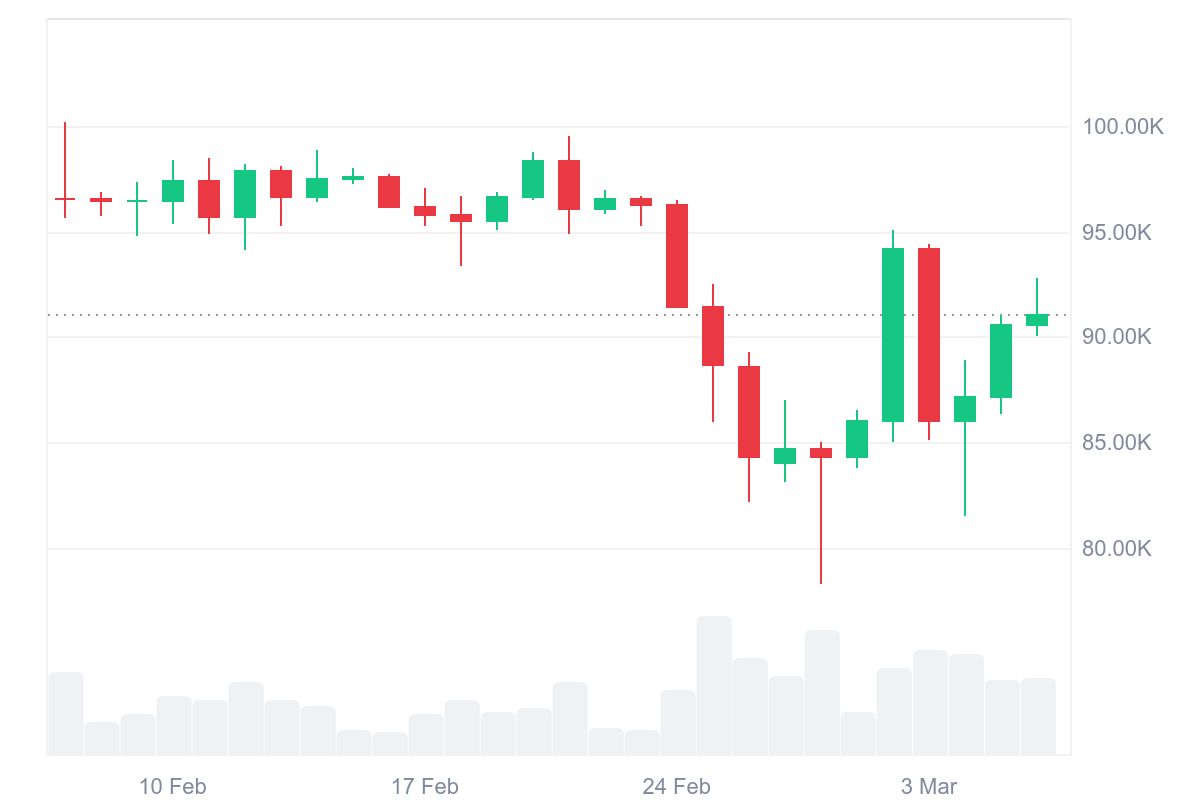
prices are rising for the third consecutive session today (Thursday), returning
to the consolidation range that has been forming since November. During
Wednesday's session, Bitcoin gained nearly 4%, and it is currently up 0.75%,
trading just below $91,300. However, the intraday high was set at $92,790.
Bitcoin price today. Source: CoinMarketCap
The
positive momentum in the Bitcoin market is also driving gains in altcoins.
Ethereum (ETH) and XRP are up by approximately 4%, while Solana (SOL) and
Dogecoin (DOGE) have gained over 5%.
Current Bitcoin
Market Dynamics: March 6 Snapshot:
Price:
$91,264 (24-hour high: $91,612)
Market
Cap: $1.81 trillion (+5.9% weekly)
Volume:
$50.82 billion (-17% from February peak)
Fear
& Greed Index: 25 (Extreme Fear)
DeFi:
Total Value Locked (TVL) rebounds 12% to $98B
Mining:
Hashprice recovers to $0.098/TH/day (+18% weekly)
Will Bitcoin Go Up?
BTC/USDT Technical Analysis
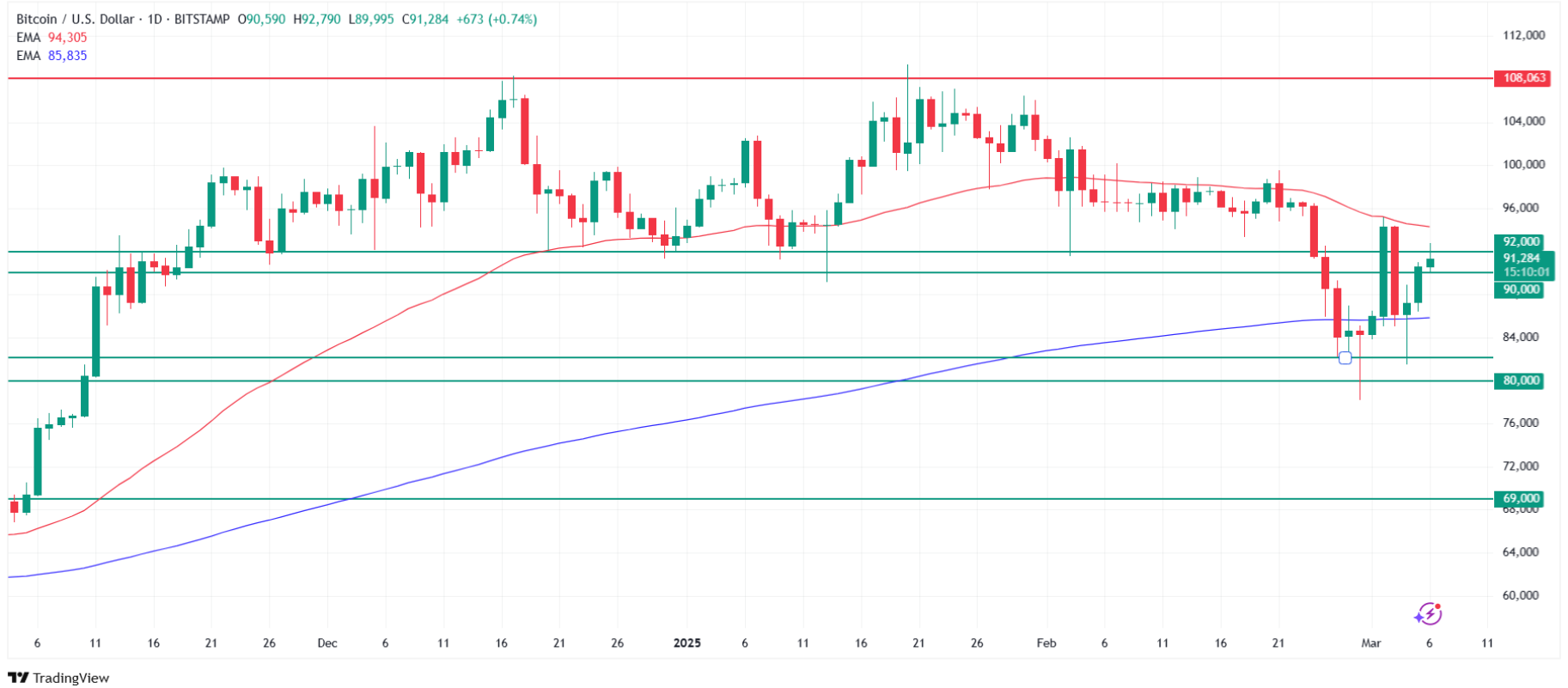
In my
previous Bitcoin technical analyses, I highlighted key buy signals that emerged
between late February and early March. Twice, these signals took the form of
pin bars (hammer patterns):
The second formed on March 4,
as the price attempted to drop below the 200 EMA.
Both of
these single-candle formations indicated strong rejection of lower levels and
significant accumulation by buyers around the November lows. As a result, BTC
has been rising for the third consecutive session, returning to the
consolidation range observed over the past four months.
Currently,
Bitcoin is “stuck” at the lower boundary of this range, between
$90,000 and $92,000, a level defined by the lows from November to January.
Additionally, it faces resistance from the 50 EMA, located around $94,400.
However, the technical outlook is far better than it was a month ago, and in my
view, we are gradually heading toward the $108,000–$109,000 range, with a
potential 20% upside.
At this
point, I wouldn’t enter long positions yet. Instead, I would wait for another
confirmation signal—either around the current price zone or above the 50 EMA.
What Happened to Bitcoin?
The February Slump:
Anatomy of a 20% Correction
Bitcoin's
decline from its January peak of $109,350 to $83,000 between February 21–27
erased nearly $300 billion in market capitalization. Three primary factors
drove this correction:
1.
Institutional Profit-Taking and ETF Outflows
The
approval of spot Bitcoin ETFs in January 2024 initially propelled prices to
record highs, but February saw $20 billion flow out of these instruments as
institutions locked in gains. Avinash Shekhar, CEO of Pi42, noted that over
79,000 BTC were sold at a loss within 24 hours during the correction's peak,
signaling panic among leveraged traders.
2.
Geopolitical Tensions and Dollar Strength
Former
President Donald Trump's threat of 25% tariffs on EU imports triggered risk-off
sentiment across global markets. The U.S. dollar index (DXY) strengthened to
105.4 during this period, pressuring Bitcoin's dollar-denominated valuation.
Ryan Lee of Bitget Research observed that Bitcoin's correlation with tech
stocks hit 0.87 during the sell-off, its highest since 2020.
3.
Technical Breakdowns and Liquidation Cascades
The breach
of the $85,000 support level on February 25 triggered $1.2 billion in
derivatives liquidations. Glassnode data revealed Bitcoin's 30-day realized
volatility spiked to 82%, exceeding levels seen during the 2020 COVID crash.
The Average Directional Index (ADX) plunged from 27.6 to 17.5, indicating trend
exhaustion.
The March Rebound:
Catalysts Behind the 10% Recovery
Bitcoin's
resurgence to $91,264 by March 6 stems from four converging drivers:
1.
Tariff Relief and Dollar Weakness
Trump's
decision to delay auto tariffs on Canada and Mexico until April 2025 eased
trade war fears, weakening the DXY to 103.77. This boosted demand for
inflation-hedge assets, with Bitcoin's 30-day correlation to gold turning
positive (+0.34) for the first time since 2022.
2.
Institutional Accumulation Signals
MicroStrategy
added $43.9 million worth of BTC on March 5, expanding its holdings to 205,000
BTC. Concurrently, Coinbase reported a 40% surge in institutional OTC trades
above $1 million, suggesting renewed accumulation.
3.
Technical Re-Entry Patterns
The
Directional Movement Index (DMI) flipped bullish on March 4, with +DI rising
from 17.7 to 27.9 and -DI dropping to 20.56. Bitcoin's break above the Ichimoku
Cloud's Senkou Span A ($88,200) confirmed a bullish trend reversal.
4.
Regulatory Tailwinds
The White
House Crypto Summit announcement on March 5 fueled speculation about potential
U.S. Bitcoin reserve policies. Analysts at Fidelity Digital Assets estimate
that 1% of Treasury reserves allocated to BTC could add $80 billion in buying
pressure.
Glassnode:
$74,000 support level tied to realized price of long-term holders.
Bitcoin's
2025 price action reflects its maturation into a macro asset class, with 30-day
volatility now comparable to Nasdaq (-18% vs -24% in February). While
short-term fluctuations persist, the convergence of institutional adoption,
regulatory clarity, and macroeconomic instability creates a bullish structural
backdrop.
Bicoin News, FAQ
Why Is Bitcoin Going Up
Now?
Bitcoin has
been rising for three consecutive sessions, currently trading around $91,264
after rebounding from its late February low of $83,000. This price recovery is
driven by a combination of easing trade tensions, renewed institutional buying,
and technical indicators signaling accumulation. Specifically, former President
Donald Trump's decision to delay auto tariffs on Canada and Mexico has softened
trade war concerns, leading to a weaker U.S. dollar.
What If I Bought $1 of
Bitcoin 10 Years Ago?
If you had
purchased $1 worth of Bitcoin in March 2015, when Bitcoin was trading around
$250, you would have acquired approximately 0.004 BTC. At today’s price of
$91,264, that small investment would now be worth about $365—an increase of
over 36,000%. This growth reflects Bitcoin’s evolution from a niche digital
asset to a globally recognized store of value.
Is Bitcoin Expected to
Rise?
Forecasts
from institutions like Fundstrat and Standard Chartered predict Bitcoin could
reach between $180,000 and $250,000 in 2025.
Can Bitcoin Reach $200,000
in 2025?
Yes, Bitcoin
reaching $200,000 in 2025 is within the realm of possibility, but it would
require a combination of strong institutional demand, favorable macroeconomic
conditions, and continued adoption. While $200,000 is possible, a more
conservative base-case forecast places Bitcoin between $120,000 and $150,000 by
the end of 2025.
As of Thursday,
March 6, 2025, the Bitcoin (BTC) price stays at $91,264, marking a 6% rebound
from its February 27 low of $83,000. This resurgence comes amid easing trade
tensions and renewed institutional confidence, though analysts remain divided
on whether this signals sustainable growth or a temporary reprieve.
Let’s check
why Bitcoin price is going up today, what are the current Bitcoin predictions
for 2025, and why two hammer patterns on the BTC daily chart might be a good
reason to think about buying the oldest cryptocurrency.
What Is Bitcoin Price
Today? BTC Tests $92,790
Bitcoin
prices are rising for the third consecutive session today (Thursday), returning
to the consolidation range that has been forming since November. During
Wednesday's session, Bitcoin gained nearly 4%, and it is currently up 0.75%,
trading just below $91,300. However, the intraday high was set at $92,790.
Bitcoin price today. Source: CoinMarketCap
The
positive momentum in the Bitcoin market is also driving gains in altcoins.
Ethereum (ETH) and XRP are up by approximately 4%, while Solana (SOL) and
Dogecoin (DOGE) have gained over 5%.
Current Bitcoin
Market Dynamics: March 6 Snapshot:
Price:
$91,264 (24-hour high: $91,612)
Market
Cap: $1.81 trillion (+5.9% weekly)
Volume:
$50.82 billion (-17% from February peak)
Fear
& Greed Index: 25 (Extreme Fear)
DeFi:
Total Value Locked (TVL) rebounds 12% to $98B
Mining:
Hashprice recovers to $0.098/TH/day (+18% weekly)
Will Bitcoin Go Up?
BTC/USDT Technical Analysis
In my
previous Bitcoin technical analyses, I highlighted key buy signals that emerged
between late February and early March. Twice, these signals took the form of
pin bars (hammer patterns):
The second formed on March 4,
as the price attempted to drop below the 200 EMA.
Both of
these single-candle formations indicated strong rejection of lower levels and
significant accumulation by buyers around the November lows. As a result, BTC
has been rising for the third consecutive session, returning to the
consolidation range observed over the past four months.
Currently,
Bitcoin is “stuck” at the lower boundary of this range, between
$90,000 and $92,000, a level defined by the lows from November to January.
Additionally, it faces resistance from the 50 EMA, located around $94,400.
However, the technical outlook is far better than it was a month ago, and in my
view, we are gradually heading toward the $108,000–$109,000 range, with a
potential 20% upside.
At this
point, I wouldn’t enter long positions yet. Instead, I would wait for another
confirmation signal—either around the current price zone or above the 50 EMA.
What Happened to Bitcoin?
The February Slump:
Anatomy of a 20% Correction
Bitcoin's
decline from its January peak of $109,350 to $83,000 between February 21–27
erased nearly $300 billion in market capitalization. Three primary factors
drove this correction:
1.
Institutional Profit-Taking and ETF Outflows
The
approval of spot Bitcoin ETFs in January 2024 initially propelled prices to
record highs, but February saw $20 billion flow out of these instruments as
institutions locked in gains. Avinash Shekhar, CEO of Pi42, noted that over
79,000 BTC were sold at a loss within 24 hours during the correction's peak,
signaling panic among leveraged traders.
2.
Geopolitical Tensions and Dollar Strength
Former
President Donald Trump's threat of 25% tariffs on EU imports triggered risk-off
sentiment across global markets. The U.S. dollar index (DXY) strengthened to
105.4 during this period, pressuring Bitcoin's dollar-denominated valuation.
Ryan Lee of Bitget Research observed that Bitcoin's correlation with tech
stocks hit 0.87 during the sell-off, its highest since 2020.
3.
Technical Breakdowns and Liquidation Cascades
The breach
of the $85,000 support level on February 25 triggered $1.2 billion in
derivatives liquidations. Glassnode data revealed Bitcoin's 30-day realized
volatility spiked to 82%, exceeding levels seen during the 2020 COVID crash.
The Average Directional Index (ADX) plunged from 27.6 to 17.5, indicating trend
exhaustion.
The March Rebound:
Catalysts Behind the 10% Recovery
Bitcoin's
resurgence to $91,264 by March 6 stems from four converging drivers:
1.
Tariff Relief and Dollar Weakness
Trump's
decision to delay auto tariffs on Canada and Mexico until April 2025 eased
trade war fears, weakening the DXY to 103.77. This boosted demand for
inflation-hedge assets, with Bitcoin's 30-day correlation to gold turning
positive (+0.34) for the first time since 2022.
2.
Institutional Accumulation Signals
MicroStrategy
added $43.9 million worth of BTC on March 5, expanding its holdings to 205,000
BTC. Concurrently, Coinbase reported a 40% surge in institutional OTC trades
above $1 million, suggesting renewed accumulation.
3.
Technical Re-Entry Patterns
The
Directional Movement Index (DMI) flipped bullish on March 4, with +DI rising
from 17.7 to 27.9 and -DI dropping to 20.56. Bitcoin's break above the Ichimoku
Cloud's Senkou Span A ($88,200) confirmed a bullish trend reversal.
4.
Regulatory Tailwinds
The White
House Crypto Summit announcement on March 5 fueled speculation about potential
U.S. Bitcoin reserve policies. Analysts at Fidelity Digital Assets estimate
that 1% of Treasury reserves allocated to BTC could add $80 billion in buying
pressure.
Glassnode:
$74,000 support level tied to realized price of long-term holders.
Bitcoin's
2025 price action reflects its maturation into a macro asset class, with 30-day
volatility now comparable to Nasdaq (-18% vs -24% in February). While
short-term fluctuations persist, the convergence of institutional adoption,
regulatory clarity, and macroeconomic instability creates a bullish structural
backdrop.
Bicoin News, FAQ
Why Is Bitcoin Going Up
Now?
Bitcoin has
been rising for three consecutive sessions, currently trading around $91,264
after rebounding from its late February low of $83,000. This price recovery is
driven by a combination of easing trade tensions, renewed institutional buying,
and technical indicators signaling accumulation. Specifically, former President
Donald Trump's decision to delay auto tariffs on Canada and Mexico has softened
trade war concerns, leading to a weaker U.S. dollar.
What If I Bought $1 of
Bitcoin 10 Years Ago?
If you had
purchased $1 worth of Bitcoin in March 2015, when Bitcoin was trading around
$250, you would have acquired approximately 0.004 BTC. At today’s price of
$91,264, that small investment would now be worth about $365—an increase of
over 36,000%. This growth reflects Bitcoin’s evolution from a niche digital
asset to a globally recognized store of value.
Is Bitcoin Expected to
Rise?
Forecasts
from institutions like Fundstrat and Standard Chartered predict Bitcoin could
reach between $180,000 and $250,000 in 2025.
Can Bitcoin Reach $200,000
in 2025?
Yes, Bitcoin
reaching $200,000 in 2025 is within the realm of possibility, but it would
require a combination of strong institutional demand, favorable macroeconomic
conditions, and continued adoption. While $200,000 is possible, a more
conservative base-case forecast places Bitcoin between $120,000 and $150,000 by
the end of 2025.
Damian Chmiel is a Senior Analyst & Editor at Finance Magnates with more than 15 years of experience in the CFD and online trading industry. Active as both a trader and journalist since 2010, he focuses on broker coverage, fintech innovation, and regulatory developments across Europe, the Middle East, and Asia.
His work includes interviews with C-level leaders at major brokerages and fintech platforms, as well as co-authoring Finance Magnates’ quarterly industry benchmarking reports. Damian’s reporting is data-driven, market-aware, and grounded in direct industry engagement. His analysis and commentary have also been cited by external media outlets, including Investing.com, Binance, The Asset, Stockhead, and Dispatch.
Education:
MA in Finance and Accounting, Cracow University of Economics
Kraken Steps Up Speed Race with New Equinix Colocation Service for Crypto Traders
FP Markets Winner Spotlight 🏆 | Global Broker of the Year 2025 #Trading #Broker #Innovation #Shorts
FP Markets Winner Spotlight 🏆 | Global Broker of the Year 2025 #Trading #Broker #Innovation #Shorts
FP Markets takes the spotlight as Global Broker of the Year 2025 at the Finance Magnates Awards.
Martin Stoilov, Head of Client Experience, shares that trust, innovation, and people played a key role in the company’s success, supported by a strong foundation of integrity and client-centricity.
Following this milestone, FP Markets continues to focus on growth, technology investment, and its core values of transparency and excellence.
👉 Be part of FM Awards 2026: https://awards.financemagnates.com/#nominate
FP Markets takes the spotlight as Global Broker of the Year 2025 at the Finance Magnates Awards.
Martin Stoilov, Head of Client Experience, shares that trust, innovation, and people played a key role in the company’s success, supported by a strong foundation of integrity and client-centricity.
Following this milestone, FP Markets continues to focus on growth, technology investment, and its core values of transparency and excellence.
👉 Be part of FM Awards 2026: https://awards.financemagnates.com/#nominate
In this video, we review @HolaPrimeMarketsOfficial, a multi-asset forex and CFDs broker offering different account types, trading platforms, and flexible trading conditions.
We cover the broker’s overall offering, including account options, trading environment, platforms like MT4 and MT5, and additional services such as managed accounts and fast withdrawals.
Watch the full video to see if Hola Prime Markets fits your trading needs.
📣 Stay up to date with the latest in finance and trading. Follow Finance Magnates for industry news, insights, and global event coverage.
Connect with us:
🔗 LinkedIn: /financemagnates
👍 Facebook: /financemagnates
📸 Instagram: https://www.instagram.com/financemagnates
🐦 X: https://x.com/financemagnates
🎥 TikTok: https://www.tiktok.com/tag/financemagnates
▶️ YouTube: /@financemagnates_official
#HolaPrime #ForexBroker #CFDTrading #FinanceMagnates #Trading #Forex #BrokerReview
In this video, we review @HolaPrimeMarketsOfficial, a multi-asset forex and CFDs broker offering different account types, trading platforms, and flexible trading conditions.
We cover the broker’s overall offering, including account options, trading environment, platforms like MT4 and MT5, and additional services such as managed accounts and fast withdrawals.
Watch the full video to see if Hola Prime Markets fits your trading needs.
📣 Stay up to date with the latest in finance and trading. Follow Finance Magnates for industry news, insights, and global event coverage.
Connect with us:
🔗 LinkedIn: /financemagnates
👍 Facebook: /financemagnates
📸 Instagram: https://www.instagram.com/financemagnates
🐦 X: https://x.com/financemagnates
🎥 TikTok: https://www.tiktok.com/tag/financemagnates
▶️ YouTube: /@financemagnates_official
#HolaPrime #ForexBroker #CFDTrading #FinanceMagnates #Trading #Forex #BrokerReview
Hola Prime Review: What You Need to Know | Full Breakdown by Finance Magnates
Hola Prime Review: What You Need to Know | Full Breakdown by Finance Magnates
In this video, we review @HolaPrime_Global, a proprietary trading firm offering evaluation programs and performance-based payouts in simulated market environments.
We cover how the challenge model works, including account types, profit splits (up to 95%), trading rules, and what it takes to reach a funded account. You’ll also learn about available platforms like MT4, MT5, cTrader, and more, along with insights into payouts, support, and trading conditions.
Watch the full video to see if Hola Prime fits your trading style.
📣 Stay up to date with the latest in finance and trading. Follow Finance Magnates for industry news, insights, and global event coverage.
Connect with us:
🔗 LinkedIn: /financemagnates
👍 Facebook: /financemagnates
📸 Instagram: https://www.instagram.com/financemagnates
🐦 X: https://x.com/financemagnates
🎥 TikTok: https://www.tiktok.com/tag/financemagnates
▶️ YouTube: /@financemagnates_official
#HolaPrime #PropFirm #Trading #FinanceMagnates #Forex #FuturesTrading #TradingReview #PropFirmReview
In this video, we review @HolaPrime_Global, a proprietary trading firm offering evaluation programs and performance-based payouts in simulated market environments.
We cover how the challenge model works, including account types, profit splits (up to 95%), trading rules, and what it takes to reach a funded account. You’ll also learn about available platforms like MT4, MT5, cTrader, and more, along with insights into payouts, support, and trading conditions.
Watch the full video to see if Hola Prime fits your trading style.
📣 Stay up to date with the latest in finance and trading. Follow Finance Magnates for industry news, insights, and global event coverage.
Connect with us:
🔗 LinkedIn: /financemagnates
👍 Facebook: /financemagnates
📸 Instagram: https://www.instagram.com/financemagnates
🐦 X: https://x.com/financemagnates
🎥 TikTok: https://www.tiktok.com/tag/financemagnates
▶️ YouTube: /@financemagnates_official
#HolaPrime #PropFirm #Trading #FinanceMagnates #Forex #FuturesTrading #TradingReview #PropFirmReview
Axi Winner Spotlight 🏆 | Global Most Innovative Broker 2025 #Innovation #Trading #Fintech #Broker
Axi Winner Spotlight 🏆 | Global Most Innovative Broker 2025 #Innovation #Trading #Fintech #Broker
Axi takes the spotlight at the Finance Magnates Awards, winning Global Most Innovative Broker 2025.
Olivia Xenofontos and Ivanna Openko share how the team will feel: proud, motivated, and ready to keep delivering.
They also describe the night as well-organized, focused, and enjoyable for all.
👉 Be part of FM Awards 2026.
Axi takes the spotlight at the Finance Magnates Awards, winning Global Most Innovative Broker 2025.
Olivia Xenofontos and Ivanna Openko share how the team will feel: proud, motivated, and ready to keep delivering.
They also describe the night as well-organized, focused, and enjoyable for all.
👉 Be part of FM Awards 2026.
Recognition that matters.
Built on transparency.
Driven by the industry.
The Finance Magnates Awards 2026.
Nominations are now open.
🔗 https://awards.financemagnates.com/?utm_source=SM&utm_medium=social&utm_campaign=recognition-matters
Recognition that matters.
Built on transparency.
Driven by the industry.
The Finance Magnates Awards 2026.
Nominations are now open.
🔗 https://awards.financemagnates.com/?utm_source=SM&utm_medium=social&utm_campaign=recognition-matters