BTC mining profitability hit a new record in December, with hashprice rising 5% despite miners selling significant holdings.
US-listed miners now control 29% of the global network hashrate, though facing challenges due to rising mining difficulty.
The crypto
mining sector witnessed significant economic improvements in December, with
mining profitability reaching its highest levels in seven months. The
hashprice, a key metric for daily profitability of the publicly listed Wall
Street Bitcoin Miners, increased by 5% since November's end.
Wall Street Bitcoin Miners' Profitability Surges amid December Rally
Daily block
reward revenue has climbed to $57,300 per exahash per second (EH/s) in early
December, marking a seven-month peak, though still remaining 40% below
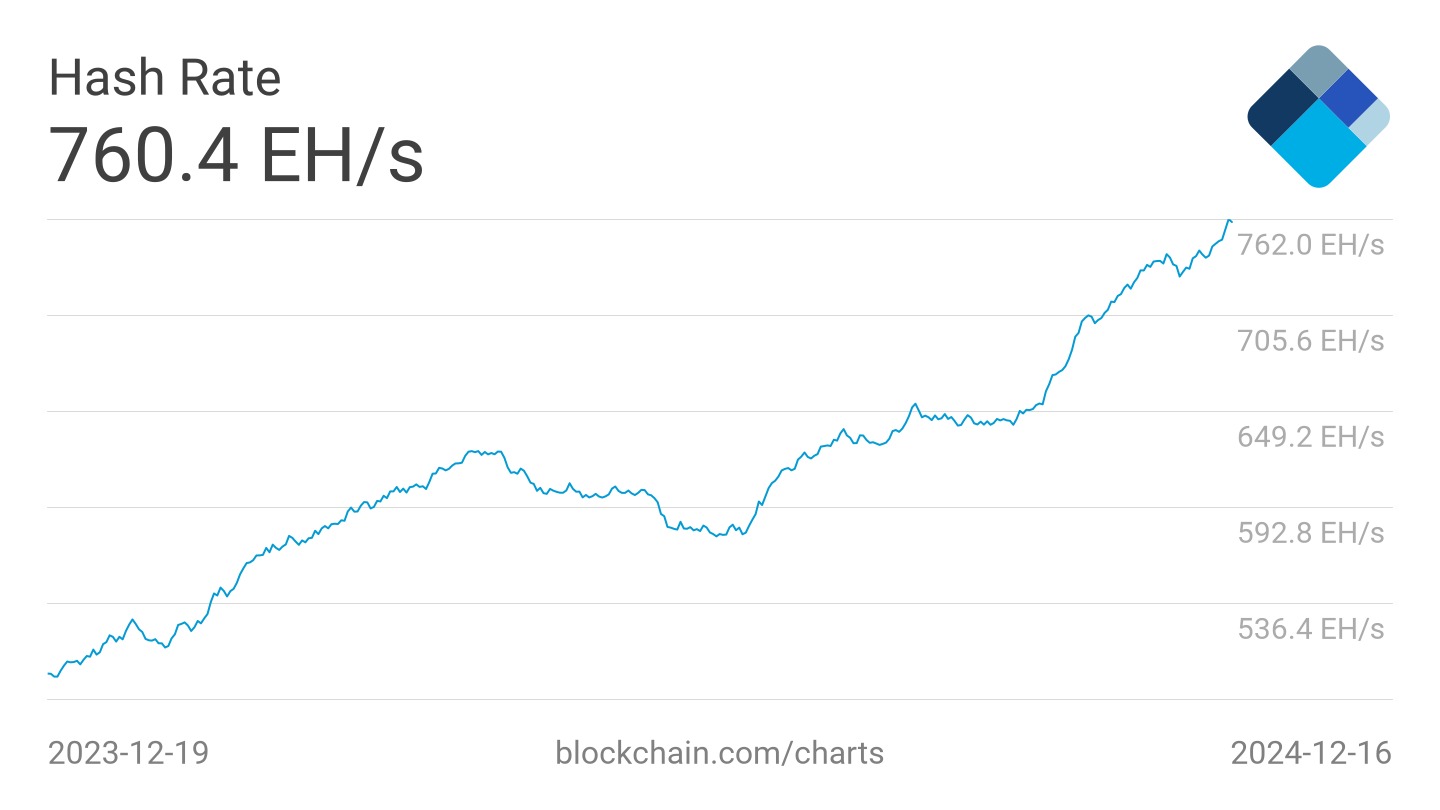
pre-halving levels. The network's total hashrate has expanded 6% this month,
averaging 773 EH/s.
Source: blockchain.com
Certainly,
the ongoing rally in major cryptocurrencies is not without significance.
Bitcoin has climbed 40% since the beginning of November, testing
historic highs above $107,000. Meanwhile, altcoins, including the
BGB utility token, have surged by 120% this December alone.
“We
note miners earned about $57,300 in daily block reward revenue per EH/s over
the first two weeks of December,” analysts Reginald Smith and Charles
Pearce from JPMorgan wrote on Monday.
Wall
Street Bitcoin miners from the US have significantly strengthened their
market position, with their combined hashrate surging 94% year-to-date to 222
EH/s. These miners now control approximately 29% of the global network.
However, their aggregate market capitalization experienced a $1.5 billion
decline in December's first two weeks.
Bitcoin Miners News: Behavior and
Revenues
Moreover, Bitcoin miners have substantially reduced their
holdings, selling over 140,000 BTC (valued at $13.72 billion) in December. This
has decreased their total holdings from 2.08 million to 1.95 million BTC.
Despite this significant sell-off, Bitcoin's price has shown resilience,
experiencing only minor pullbacks.
Mining
revenue has also reached impressive levels, with daily earnings touching
approximately $50 million, the highest since April's peak of nearly $100
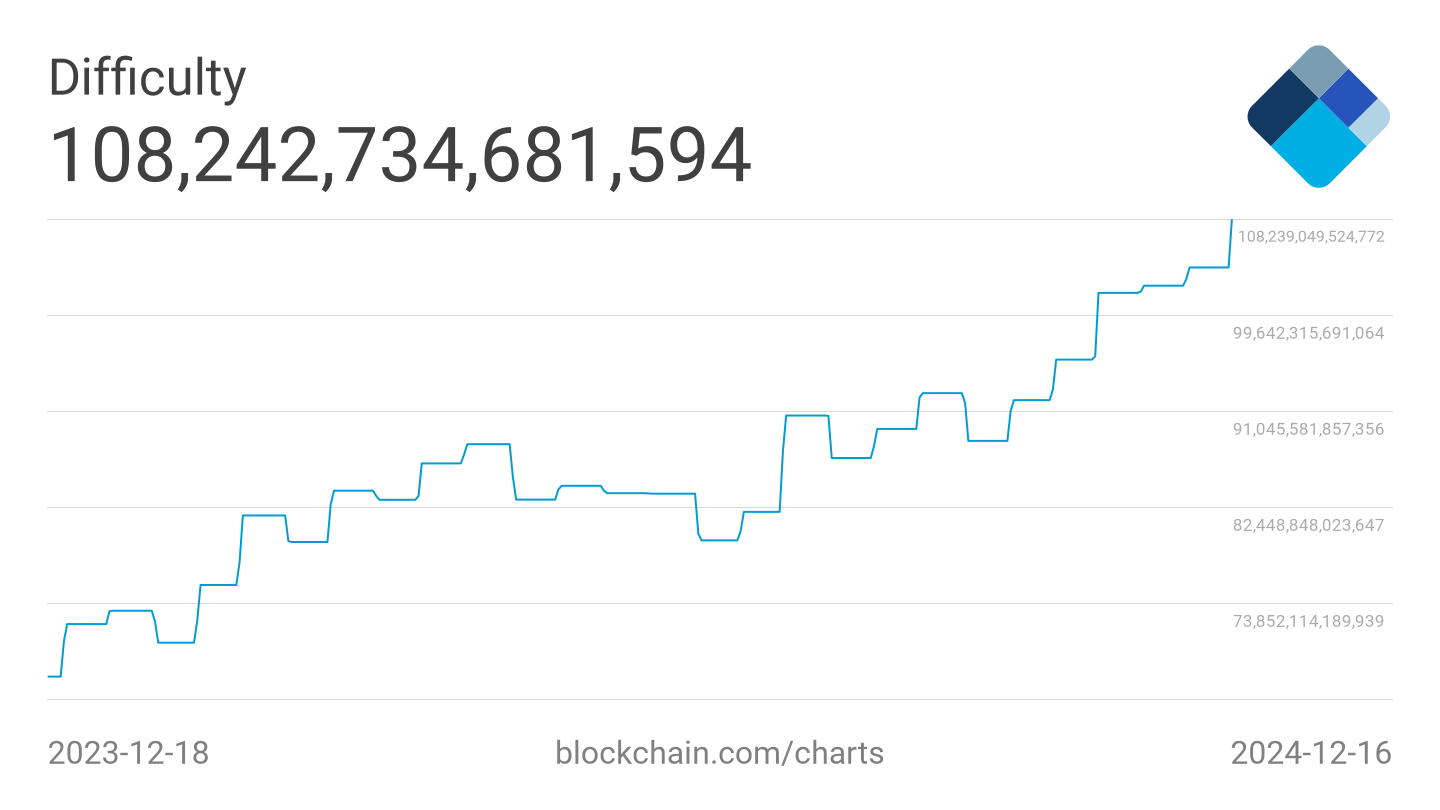
million. However, increased mining difficulty, now at 106T compared to April's
85T, has created additional challenges for miners.
Source: blockchain.com
For
example, in November—when Bitcoin was also testing its all-time highs—eight
Wall Street miners reported
lower BTC production. Although these miners are continually expanding their
mining capacity, the increasing difficulty level makes it harder to boost
output. The higher the “difficulty” metric, the more computing power is
required to extract the same amount of cryptocurrency.
Why are Bitcoin miners
selling large amounts of BTC in December?
The primary
driver behind the selling appears to be covering regular operational expenses,
including electricity bills and other running costs. The selling has been
steady rather than panic-driven, suggesting a calculated approach to
maintaining operations.
Moreover, with
Bitcoin reaching new all-time highs above $107,000, miners are likely
capitalizing on favorable market conditions to secure profits. This timing
allows them to maximize returns on their mined assets.
Not
everyone is selling their Bitcoins, though. An increasing number of publicly
listed Wall Street Bitcoin miners are choosing to issue bonds or other debt
instruments to raise additional funds and build up their BTC reserves.
The crypto
mining sector witnessed significant economic improvements in December, with
mining profitability reaching its highest levels in seven months. The
hashprice, a key metric for daily profitability of the publicly listed Wall
Street Bitcoin Miners, increased by 5% since November's end.
Wall Street Bitcoin Miners' Profitability Surges amid December Rally
Daily block
reward revenue has climbed to $57,300 per exahash per second (EH/s) in early
December, marking a seven-month peak, though still remaining 40% below
pre-halving levels. The network's total hashrate has expanded 6% this month,
averaging 773 EH/s.
Source: blockchain.com
Certainly,
the ongoing rally in major cryptocurrencies is not without significance.
Bitcoin has climbed 40% since the beginning of November, testing
historic highs above $107,000. Meanwhile, altcoins, including the
BGB utility token, have surged by 120% this December alone.
“We
note miners earned about $57,300 in daily block reward revenue per EH/s over
the first two weeks of December,” analysts Reginald Smith and Charles
Pearce from JPMorgan wrote on Monday.
Wall
Street Bitcoin miners from the US have significantly strengthened their
market position, with their combined hashrate surging 94% year-to-date to 222
EH/s. These miners now control approximately 29% of the global network.
However, their aggregate market capitalization experienced a $1.5 billion
decline in December's first two weeks.
Bitcoin Miners News: Behavior and
Revenues
Moreover, Bitcoin miners have substantially reduced their
holdings, selling over 140,000 BTC (valued at $13.72 billion) in December. This
has decreased their total holdings from 2.08 million to 1.95 million BTC.
Despite this significant sell-off, Bitcoin's price has shown resilience,
experiencing only minor pullbacks.
Mining
revenue has also reached impressive levels, with daily earnings touching
approximately $50 million, the highest since April's peak of nearly $100
million. However, increased mining difficulty, now at 106T compared to April's
85T, has created additional challenges for miners.
Source: blockchain.com
For
example, in November—when Bitcoin was also testing its all-time highs—eight
Wall Street miners reported
lower BTC production. Although these miners are continually expanding their
mining capacity, the increasing difficulty level makes it harder to boost
output. The higher the “difficulty” metric, the more computing power is
required to extract the same amount of cryptocurrency.
Why are Bitcoin miners
selling large amounts of BTC in December?
The primary
driver behind the selling appears to be covering regular operational expenses,
including electricity bills and other running costs. The selling has been
steady rather than panic-driven, suggesting a calculated approach to
maintaining operations.
Moreover, with
Bitcoin reaching new all-time highs above $107,000, miners are likely
capitalizing on favorable market conditions to secure profits. This timing
allows them to maximize returns on their mined assets.
Not
everyone is selling their Bitcoins, though. An increasing number of publicly
listed Wall Street Bitcoin miners are choosing to issue bonds or other debt
instruments to raise additional funds and build up their BTC reserves.
Damian Chmiel is a Senior Analyst & Editor at Finance Magnates with more than 15 years of experience in the CFD and online trading industry. Active as both a trader and journalist since 2010, he focuses on broker coverage, fintech innovation, and regulatory developments across Europe, the Middle East, and Asia.
His work includes interviews with C-level leaders at major brokerages and fintech platforms, as well as co-authoring Finance Magnates’ quarterly industry benchmarking reports. Damian’s reporting is data-driven, market-aware, and grounded in direct industry engagement. His analysis and commentary have also been cited by external media outlets, including Investing.com, Binance, The Asset, Stockhead, and Dispatch.
Education:
MA in Finance and Accounting, Cracow University of Economics
Kraken Steps Up Speed Race with New Equinix Colocation Service for Crypto Traders
FP Markets Winner Spotlight 🏆 | Global Broker of the Year 2025 #Trading #Broker #Innovation #Shorts
FP Markets Winner Spotlight 🏆 | Global Broker of the Year 2025 #Trading #Broker #Innovation #Shorts
FP Markets takes the spotlight as Global Broker of the Year 2025 at the Finance Magnates Awards.
Martin Stoilov, Head of Client Experience, shares that trust, innovation, and people played a key role in the company’s success, supported by a strong foundation of integrity and client-centricity.
Following this milestone, FP Markets continues to focus on growth, technology investment, and its core values of transparency and excellence.
👉 Be part of FM Awards 2026: https://awards.financemagnates.com/#nominate
FP Markets takes the spotlight as Global Broker of the Year 2025 at the Finance Magnates Awards.
Martin Stoilov, Head of Client Experience, shares that trust, innovation, and people played a key role in the company’s success, supported by a strong foundation of integrity and client-centricity.
Following this milestone, FP Markets continues to focus on growth, technology investment, and its core values of transparency and excellence.
👉 Be part of FM Awards 2026: https://awards.financemagnates.com/#nominate
In this video, we review @HolaPrimeMarketsOfficial, a multi-asset forex and CFDs broker offering different account types, trading platforms, and flexible trading conditions.
We cover the broker’s overall offering, including account options, trading environment, platforms like MT4 and MT5, and additional services such as managed accounts and fast withdrawals.
Watch the full video to see if Hola Prime Markets fits your trading needs.
📣 Stay up to date with the latest in finance and trading. Follow Finance Magnates for industry news, insights, and global event coverage.
Connect with us:
🔗 LinkedIn: /financemagnates
👍 Facebook: /financemagnates
📸 Instagram: https://www.instagram.com/financemagnates
🐦 X: https://x.com/financemagnates
🎥 TikTok: https://www.tiktok.com/tag/financemagnates
▶️ YouTube: /@financemagnates_official
#HolaPrime #ForexBroker #CFDTrading #FinanceMagnates #Trading #Forex #BrokerReview
In this video, we review @HolaPrimeMarketsOfficial, a multi-asset forex and CFDs broker offering different account types, trading platforms, and flexible trading conditions.
We cover the broker’s overall offering, including account options, trading environment, platforms like MT4 and MT5, and additional services such as managed accounts and fast withdrawals.
Watch the full video to see if Hola Prime Markets fits your trading needs.
📣 Stay up to date with the latest in finance and trading. Follow Finance Magnates for industry news, insights, and global event coverage.
Connect with us:
🔗 LinkedIn: /financemagnates
👍 Facebook: /financemagnates
📸 Instagram: https://www.instagram.com/financemagnates
🐦 X: https://x.com/financemagnates
🎥 TikTok: https://www.tiktok.com/tag/financemagnates
▶️ YouTube: /@financemagnates_official
#HolaPrime #ForexBroker #CFDTrading #FinanceMagnates #Trading #Forex #BrokerReview
Hola Prime Review: What You Need to Know | Full Breakdown by Finance Magnates
Hola Prime Review: What You Need to Know | Full Breakdown by Finance Magnates
In this video, we review @HolaPrime_Global, a proprietary trading firm offering evaluation programs and performance-based payouts in simulated market environments.
We cover how the challenge model works, including account types, profit splits (up to 95%), trading rules, and what it takes to reach a funded account. You’ll also learn about available platforms like MT4, MT5, cTrader, and more, along with insights into payouts, support, and trading conditions.
Watch the full video to see if Hola Prime fits your trading style.
📣 Stay up to date with the latest in finance and trading. Follow Finance Magnates for industry news, insights, and global event coverage.
Connect with us:
🔗 LinkedIn: /financemagnates
👍 Facebook: /financemagnates
📸 Instagram: https://www.instagram.com/financemagnates
🐦 X: https://x.com/financemagnates
🎥 TikTok: https://www.tiktok.com/tag/financemagnates
▶️ YouTube: /@financemagnates_official
#HolaPrime #PropFirm #Trading #FinanceMagnates #Forex #FuturesTrading #TradingReview #PropFirmReview
In this video, we review @HolaPrime_Global, a proprietary trading firm offering evaluation programs and performance-based payouts in simulated market environments.
We cover how the challenge model works, including account types, profit splits (up to 95%), trading rules, and what it takes to reach a funded account. You’ll also learn about available platforms like MT4, MT5, cTrader, and more, along with insights into payouts, support, and trading conditions.
Watch the full video to see if Hola Prime fits your trading style.
📣 Stay up to date with the latest in finance and trading. Follow Finance Magnates for industry news, insights, and global event coverage.
Connect with us:
🔗 LinkedIn: /financemagnates
👍 Facebook: /financemagnates
📸 Instagram: https://www.instagram.com/financemagnates
🐦 X: https://x.com/financemagnates
🎥 TikTok: https://www.tiktok.com/tag/financemagnates
▶️ YouTube: /@financemagnates_official
#HolaPrime #PropFirm #Trading #FinanceMagnates #Forex #FuturesTrading #TradingReview #PropFirmReview
Axi Winner Spotlight 🏆 | Global Most Innovative Broker 2025 #Innovation #Trading #Fintech #Broker
Axi Winner Spotlight 🏆 | Global Most Innovative Broker 2025 #Innovation #Trading #Fintech #Broker
Axi takes the spotlight at the Finance Magnates Awards, winning Global Most Innovative Broker 2025.
Olivia Xenofontos and Ivanna Openko share how the team will feel: proud, motivated, and ready to keep delivering.
They also describe the night as well-organized, focused, and enjoyable for all.
👉 Be part of FM Awards 2026.
Axi takes the spotlight at the Finance Magnates Awards, winning Global Most Innovative Broker 2025.
Olivia Xenofontos and Ivanna Openko share how the team will feel: proud, motivated, and ready to keep delivering.
They also describe the night as well-organized, focused, and enjoyable for all.
👉 Be part of FM Awards 2026.
Recognition that matters.
Built on transparency.
Driven by the industry.
The Finance Magnates Awards 2026.
Nominations are now open.
🔗 https://awards.financemagnates.com/?utm_source=SM&utm_medium=social&utm_campaign=recognition-matters
Recognition that matters.
Built on transparency.
Driven by the industry.
The Finance Magnates Awards 2026.
Nominations are now open.
🔗 https://awards.financemagnates.com/?utm_source=SM&utm_medium=social&utm_campaign=recognition-matters