Contrary to exit polls, Polymarket bettors are still favouring Trump’s victory.
Meanwhile, BTC recently exceeded $73,000, only to drop below $69,000.
The US Presidential election is only a day away. Although current Vice President Kamala Harris started on the back foot in her race against former President Donald Trump, her odds on Polymarket have narrowed significantly recently.
Harris Leads Polls, but Trump Is Bettors’ Favourite
The odds between Harris and Trump have always been narrow in various election polls. In the New York Times poll, Harris is even ahead of Trump, though the lead is very marginal—only 1 percentage point. A similar sentiment can be seen across other US election polls.
However, in the betting markets, where real money is involved, things are different. Polymarket, the largest blockchain-based betting market, keeps Trump ahead of Harris. The gap between them widened to 66.6:33.4 in favor of Trump last week but pushed Harris up over the weekend, narrowing the gap to 56:42, still in Trump’s favor.
Although Polymarket is the largest election betting market, with a volume of more than $2.8 billion, it is an offshore platform. Interestingly, political betting is also available in the US. Kalshi and Interactive Brokers-owned ForecastEx are the top two platforms, but their volumes remain significantly lower than their crypto counterpart.
The bettors on Kalshi are giving Trump a 52 percent odd against 48 percent for Harris on a market of over $185.6 million.
However, ForecastEx is a bit different as it has two separate markets for Harris’s and Trump’s victories. Only 49 percent of the ForecastEx bettors bought the contract favoring Harris’s win, while 54 percent of the bettors favored a Trump victory. The market betting on Harris’s victory has over $80.3 million in open interest, while the one for Trump’s victory has over $74.1 million.
The Legal Political Betting Market in the US
Notably, the onshore dollar-based US elections prediction markets received a setback in opening political markets, as the Commodity Futures Trading Commission (CFTC) blocked Kalshi over concerns regarding gaming and other activities that were not in the public’s interest. However, Kalshi sued the agency, and the court sided with it; even an appeals court favored the prediction market.
“Ensuring the integrity of elections and avoiding improper interference and misinformation are undoubtedly paramount public interests, and a substantiated risk of distorting the electoral process would amount to irreparable harm,” the ruling by an appeals court in favor of Kalshi stated.
“The problem is that the CFTC has given this court no concrete basis to conclude that event contracts would likely be a vehicle for such harms.”
Bitcoin Tests Another All-Time High
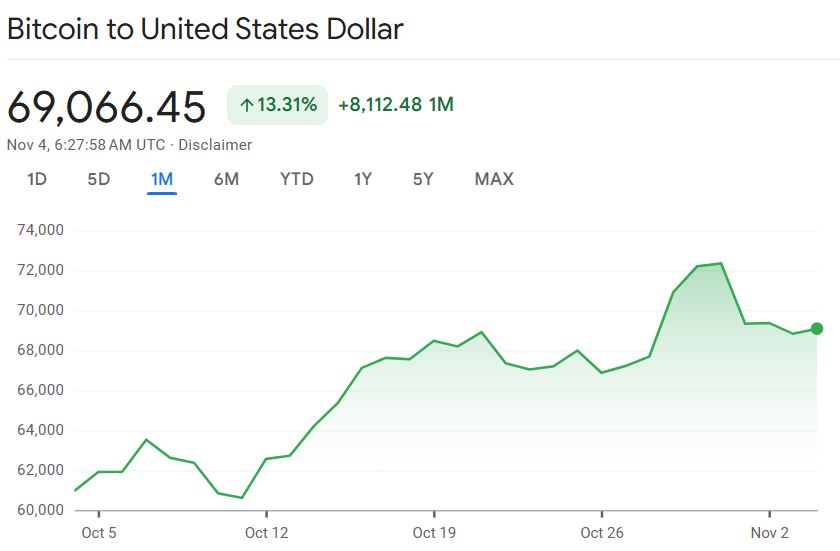
Meanwhile, the cryptocurrency market is also testing a new all-time high ahead of the US elections. Bitcoin, which has a market cap of $1.3 trillion, went past $73,000 and almost touched its previous all-time high. However, the token’s price dropped from that near-peak and is currently moving around $69,000.
Bitcoin price movement; Source: Google Finance
David Lawant, Head of Research at FalconX; Photo: LinkedIn
“The relationship between election win odds and crypto prices has fluctuated significantly, partly due to multiple non-electoral factors driving markets. The strongest correlations emerged during periods of Republican momentum—both in mid-July and in recent days,” said David Lawant, Head of Research at FalconX.
However, Ether, the second-largest token on the crypto market, underperformed. The only major asset that outperformed Bitcoin was DOGE.
“DOGE was the sole major asset to outperform BTC this week, perhaps due to the Elon Musk association amid election news flow,” Lawant added.
“After six months of directionless trading, markets appear eager to move past election uncertainty towards firmer ground,” he continued. “Trading volumes, typically a reliable confirmation of crypto trends, are starting to show signs of life and have jumped 30–40% above their three-month average in the past couple of days.”
The US Presidential election is only a day away. Although current Vice President Kamala Harris started on the back foot in her race against former President Donald Trump, her odds on Polymarket have narrowed significantly recently.
Harris Leads Polls, but Trump Is Bettors’ Favourite
The odds between Harris and Trump have always been narrow in various election polls. In the New York Times poll, Harris is even ahead of Trump, though the lead is very marginal—only 1 percentage point. A similar sentiment can be seen across other US election polls.
However, in the betting markets, where real money is involved, things are different. Polymarket, the largest blockchain-based betting market, keeps Trump ahead of Harris. The gap between them widened to 66.6:33.4 in favor of Trump last week but pushed Harris up over the weekend, narrowing the gap to 56:42, still in Trump’s favor.
Although Polymarket is the largest election betting market, with a volume of more than $2.8 billion, it is an offshore platform. Interestingly, political betting is also available in the US. Kalshi and Interactive Brokers-owned ForecastEx are the top two platforms, but their volumes remain significantly lower than their crypto counterpart.
The bettors on Kalshi are giving Trump a 52 percent odd against 48 percent for Harris on a market of over $185.6 million.
However, ForecastEx is a bit different as it has two separate markets for Harris’s and Trump’s victories. Only 49 percent of the ForecastEx bettors bought the contract favoring Harris’s win, while 54 percent of the bettors favored a Trump victory. The market betting on Harris’s victory has over $80.3 million in open interest, while the one for Trump’s victory has over $74.1 million.
The Legal Political Betting Market in the US
Notably, the onshore dollar-based US elections prediction markets received a setback in opening political markets, as the Commodity Futures Trading Commission (CFTC) blocked Kalshi over concerns regarding gaming and other activities that were not in the public’s interest. However, Kalshi sued the agency, and the court sided with it; even an appeals court favored the prediction market.
“Ensuring the integrity of elections and avoiding improper interference and misinformation are undoubtedly paramount public interests, and a substantiated risk of distorting the electoral process would amount to irreparable harm,” the ruling by an appeals court in favor of Kalshi stated.
“The problem is that the CFTC has given this court no concrete basis to conclude that event contracts would likely be a vehicle for such harms.”
Bitcoin Tests Another All-Time High
Meanwhile, the cryptocurrency market is also testing a new all-time high ahead of the US elections. Bitcoin, which has a market cap of $1.3 trillion, went past $73,000 and almost touched its previous all-time high. However, the token’s price dropped from that near-peak and is currently moving around $69,000.
Bitcoin price movement; Source: Google Finance
David Lawant, Head of Research at FalconX; Photo: LinkedIn
“The relationship between election win odds and crypto prices has fluctuated significantly, partly due to multiple non-electoral factors driving markets. The strongest correlations emerged during periods of Republican momentum—both in mid-July and in recent days,” said David Lawant, Head of Research at FalconX.
However, Ether, the second-largest token on the crypto market, underperformed. The only major asset that outperformed Bitcoin was DOGE.
“DOGE was the sole major asset to outperform BTC this week, perhaps due to the Elon Musk association amid election news flow,” Lawant added.
“After six months of directionless trading, markets appear eager to move past election uncertainty towards firmer ground,” he continued. “Trading volumes, typically a reliable confirmation of crypto trends, are starting to show signs of life and have jumped 30–40% above their three-month average in the past couple of days.”
Arnab Shome is an electronics engineer-turned-financial editor. He holds a Bachelor of Technology from the National Institute of Technology, Agartala. He entered the retail trading industry about a decade ago, covering the cryptocurrency market for Finance Magnates, and later expanded his coverage to include forex and CFDs as well.
His work at Finance Magnates includes C-level interviews, data-driven analysis, opinion pieces, and scoops of industry exclusives. He also contributes to Finance Magnates’ quarterly industry report.
Area of coverage:
1. CFD broker-related news
2. Industry-related Regulatory updates and developments
3. New retail trading trends
4. Prop trading industry updates
5. Executive interviews
Education:
Bachelor of Technology - National Institute of Technology, Agartala (India)
Kraken Steps Up Speed Race with New Equinix Colocation Service for Crypto Traders
FP Markets Winner Spotlight 🏆 | Global Broker of the Year 2025 #Trading #Broker #Innovation #Shorts
FP Markets Winner Spotlight 🏆 | Global Broker of the Year 2025 #Trading #Broker #Innovation #Shorts
FP Markets takes the spotlight as Global Broker of the Year 2025 at the Finance Magnates Awards.
Martin Stoilov, Head of Client Experience, shares that trust, innovation, and people played a key role in the company’s success, supported by a strong foundation of integrity and client-centricity.
Following this milestone, FP Markets continues to focus on growth, technology investment, and its core values of transparency and excellence.
👉 Be part of FM Awards 2026: https://awards.financemagnates.com/#nominate
FP Markets takes the spotlight as Global Broker of the Year 2025 at the Finance Magnates Awards.
Martin Stoilov, Head of Client Experience, shares that trust, innovation, and people played a key role in the company’s success, supported by a strong foundation of integrity and client-centricity.
Following this milestone, FP Markets continues to focus on growth, technology investment, and its core values of transparency and excellence.
👉 Be part of FM Awards 2026: https://awards.financemagnates.com/#nominate
In this video, we review @HolaPrimeMarketsOfficial, a multi-asset forex and CFDs broker offering different account types, trading platforms, and flexible trading conditions.
We cover the broker’s overall offering, including account options, trading environment, platforms like MT4 and MT5, and additional services such as managed accounts and fast withdrawals.
Watch the full video to see if Hola Prime Markets fits your trading needs.
📣 Stay up to date with the latest in finance and trading. Follow Finance Magnates for industry news, insights, and global event coverage.
Connect with us:
🔗 LinkedIn: /financemagnates
👍 Facebook: /financemagnates
📸 Instagram: https://www.instagram.com/financemagnates
🐦 X: https://x.com/financemagnates
🎥 TikTok: https://www.tiktok.com/tag/financemagnates
▶️ YouTube: /@financemagnates_official
#HolaPrime #ForexBroker #CFDTrading #FinanceMagnates #Trading #Forex #BrokerReview
In this video, we review @HolaPrimeMarketsOfficial, a multi-asset forex and CFDs broker offering different account types, trading platforms, and flexible trading conditions.
We cover the broker’s overall offering, including account options, trading environment, platforms like MT4 and MT5, and additional services such as managed accounts and fast withdrawals.
Watch the full video to see if Hola Prime Markets fits your trading needs.
📣 Stay up to date with the latest in finance and trading. Follow Finance Magnates for industry news, insights, and global event coverage.
Connect with us:
🔗 LinkedIn: /financemagnates
👍 Facebook: /financemagnates
📸 Instagram: https://www.instagram.com/financemagnates
🐦 X: https://x.com/financemagnates
🎥 TikTok: https://www.tiktok.com/tag/financemagnates
▶️ YouTube: /@financemagnates_official
#HolaPrime #ForexBroker #CFDTrading #FinanceMagnates #Trading #Forex #BrokerReview
Hola Prime Review: What You Need to Know | Full Breakdown by Finance Magnates
Hola Prime Review: What You Need to Know | Full Breakdown by Finance Magnates
In this video, we review @HolaPrime_Global, a proprietary trading firm offering evaluation programs and performance-based payouts in simulated market environments.
We cover how the challenge model works, including account types, profit splits (up to 95%), trading rules, and what it takes to reach a funded account. You’ll also learn about available platforms like MT4, MT5, cTrader, and more, along with insights into payouts, support, and trading conditions.
Watch the full video to see if Hola Prime fits your trading style.
📣 Stay up to date with the latest in finance and trading. Follow Finance Magnates for industry news, insights, and global event coverage.
Connect with us:
🔗 LinkedIn: /financemagnates
👍 Facebook: /financemagnates
📸 Instagram: https://www.instagram.com/financemagnates
🐦 X: https://x.com/financemagnates
🎥 TikTok: https://www.tiktok.com/tag/financemagnates
▶️ YouTube: /@financemagnates_official
#HolaPrime #PropFirm #Trading #FinanceMagnates #Forex #FuturesTrading #TradingReview #PropFirmReview
In this video, we review @HolaPrime_Global, a proprietary trading firm offering evaluation programs and performance-based payouts in simulated market environments.
We cover how the challenge model works, including account types, profit splits (up to 95%), trading rules, and what it takes to reach a funded account. You’ll also learn about available platforms like MT4, MT5, cTrader, and more, along with insights into payouts, support, and trading conditions.
Watch the full video to see if Hola Prime fits your trading style.
📣 Stay up to date with the latest in finance and trading. Follow Finance Magnates for industry news, insights, and global event coverage.
Connect with us:
🔗 LinkedIn: /financemagnates
👍 Facebook: /financemagnates
📸 Instagram: https://www.instagram.com/financemagnates
🐦 X: https://x.com/financemagnates
🎥 TikTok: https://www.tiktok.com/tag/financemagnates
▶️ YouTube: /@financemagnates_official
#HolaPrime #PropFirm #Trading #FinanceMagnates #Forex #FuturesTrading #TradingReview #PropFirmReview
Axi Winner Spotlight 🏆 | Global Most Innovative Broker 2025 #Innovation #Trading #Fintech #Broker
Axi Winner Spotlight 🏆 | Global Most Innovative Broker 2025 #Innovation #Trading #Fintech #Broker
Axi takes the spotlight at the Finance Magnates Awards, winning Global Most Innovative Broker 2025.
Olivia Xenofontos and Ivanna Openko share how the team will feel: proud, motivated, and ready to keep delivering.
They also describe the night as well-organized, focused, and enjoyable for all.
👉 Be part of FM Awards 2026.
Axi takes the spotlight at the Finance Magnates Awards, winning Global Most Innovative Broker 2025.
Olivia Xenofontos and Ivanna Openko share how the team will feel: proud, motivated, and ready to keep delivering.
They also describe the night as well-organized, focused, and enjoyable for all.
👉 Be part of FM Awards 2026.
Recognition that matters.
Built on transparency.
Driven by the industry.
The Finance Magnates Awards 2026.
Nominations are now open.
🔗 https://awards.financemagnates.com/?utm_source=SM&utm_medium=social&utm_campaign=recognition-matters
Recognition that matters.
Built on transparency.
Driven by the industry.
The Finance Magnates Awards 2026.
Nominations are now open.
🔗 https://awards.financemagnates.com/?utm_source=SM&utm_medium=social&utm_campaign=recognition-matters