The pardon fulfills Donald Trump's campaign promise and comes with support from the Libertarian movement.
Ulbricht served a decade of his original sentence of 40 years plus two life terms.
Ross Ulbricht, the creator of infamous darknet marketplace Silk Road
U.S.
President Donald Trump granted a full and unconditional pardon to Ross
Ulbricht, the founder of the infamous darknet marketplace Silk Road, who had
been serving multiple life sentences for operating the platform that
facilitated over $200 million in illicit trade using Bitcoin (BTC).
Trump Pardons Silk Road
Founder Ross Ulbricht After Decade-Long Imprisonment
The
40-year-old Ulbricht, who had been imprisoned in Arizona, was arrested in 2013
and sentenced in 2015 for running what prosecutors described as a global black
market bazaar used by more than 100,000 people to trade illegal drugs and other
illicit services.
Trump
announced the decision on his Truth Social platform, criticizing those involved
in Ulbricht's conviction and highlighting support from the Libertarian movement.
The pardon fulfills a campaign promise Trump made during a speech at the
Libertarian National Convention.
“I just
called the mother of Ross William Ulbricht to let her know that in honor of her
and the Libertarian Movement, which supported me so strongly, it was my
pleasure to have just signed a full and unconditional pardon of her son, Ross,”
Trump
commented.
“The scum
that worked to convict him were some of the same lunatics who were involved in
the modern day weaponization of government against me,” he added.
Who Is Ross Ulbricht?
Ulbricht
operated Silk Road under the alias “Dread Pirate Roberts” from 2011
to 2013, creating a platform that leveraged the Tor network for anonymous
communications and Bitcoin for payments. While his defense argued the site was
intended as a “freewheeling, free market site,” prosecutors alleged
Ulbricht took extreme measures to protect the operation, including allegedly
soliciting murders, though no evidence showed any were carried out.
Silk Road
was so popular in 2013 that it is speculated that 80% of all Bitcoin mined up
to that point (over 50% of the total supply of 21 million) had been involved
with the dark market founded by Ulbricht. In 2022, the U.S. seized $3.5 billion worth of Bitcoin allegedly linked to marketplace operations.
The
landmark prosecution came during the early days of cryptocurrency adoption,
with Ulbricht's case highlighting the intersection of digital currencies and
illicit activities. His original sentence included 40 years plus two life
terms, which Trump called “ridiculous” in his pardon announcement.
“I wanted to empower people to make choices in their lives and have privacy and anonymity,” Ulbricht said during his sentencing almost 10 years ago.
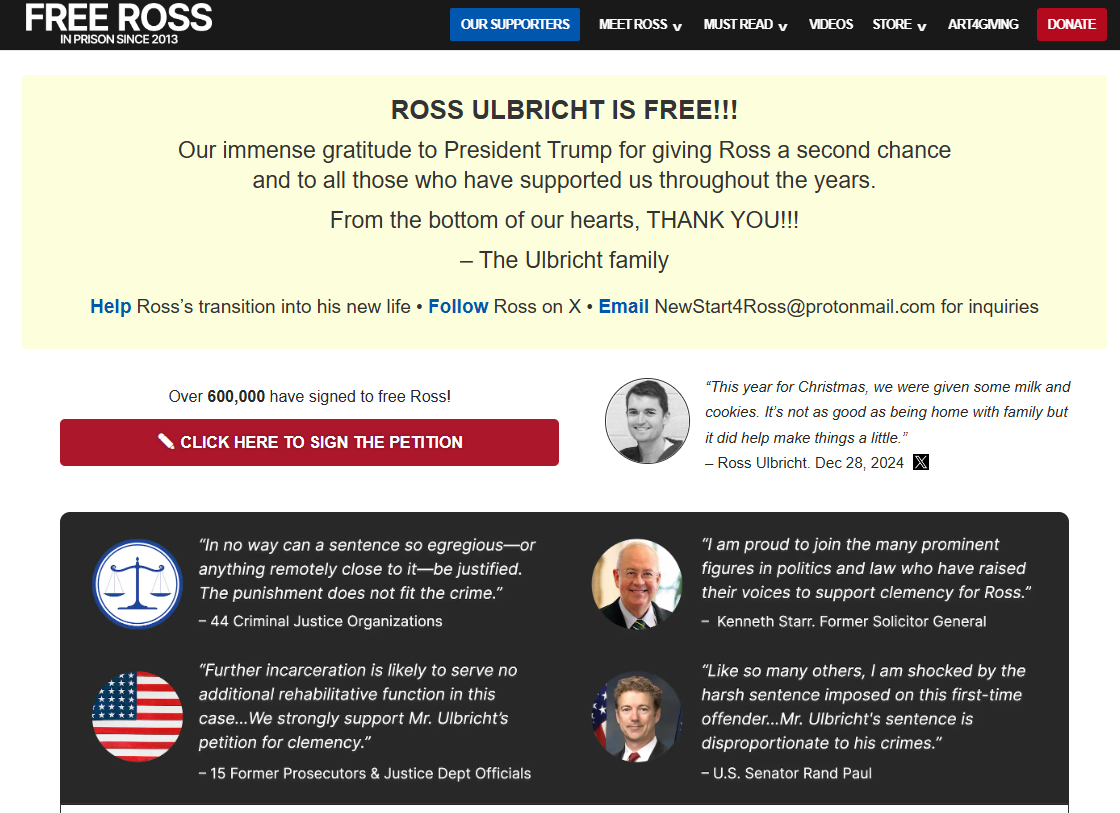
The verdict sparked significant controversy, and for years, a “Free Ross” campaign has been ongoing, gathering over 600,000 signatures on petitions.
Source: Freeross.org
“After enduring over a decade of incarceration, this decision offers Ross the opportunity to begin anew, to rebuild his life, and to contribute positively to society,” Ulbricht's clemency attorney, Brandon Sample, commented.
U.S.
President Donald Trump granted a full and unconditional pardon to Ross
Ulbricht, the founder of the infamous darknet marketplace Silk Road, who had
been serving multiple life sentences for operating the platform that
facilitated over $200 million in illicit trade using Bitcoin (BTC).
Trump Pardons Silk Road
Founder Ross Ulbricht After Decade-Long Imprisonment
The
40-year-old Ulbricht, who had been imprisoned in Arizona, was arrested in 2013
and sentenced in 2015 for running what prosecutors described as a global black
market bazaar used by more than 100,000 people to trade illegal drugs and other
illicit services.
Trump
announced the decision on his Truth Social platform, criticizing those involved
in Ulbricht's conviction and highlighting support from the Libertarian movement.
The pardon fulfills a campaign promise Trump made during a speech at the
Libertarian National Convention.
“I just
called the mother of Ross William Ulbricht to let her know that in honor of her
and the Libertarian Movement, which supported me so strongly, it was my
pleasure to have just signed a full and unconditional pardon of her son, Ross,”
Trump
commented.
“The scum
that worked to convict him were some of the same lunatics who were involved in
the modern day weaponization of government against me,” he added.
Who Is Ross Ulbricht?
Ulbricht
operated Silk Road under the alias “Dread Pirate Roberts” from 2011
to 2013, creating a platform that leveraged the Tor network for anonymous
communications and Bitcoin for payments. While his defense argued the site was
intended as a “freewheeling, free market site,” prosecutors alleged
Ulbricht took extreme measures to protect the operation, including allegedly
soliciting murders, though no evidence showed any were carried out.
Silk Road
was so popular in 2013 that it is speculated that 80% of all Bitcoin mined up
to that point (over 50% of the total supply of 21 million) had been involved
with the dark market founded by Ulbricht. In 2022, the U.S. seized $3.5 billion worth of Bitcoin allegedly linked to marketplace operations.
The
landmark prosecution came during the early days of cryptocurrency adoption,
with Ulbricht's case highlighting the intersection of digital currencies and
illicit activities. His original sentence included 40 years plus two life
terms, which Trump called “ridiculous” in his pardon announcement.
“I wanted to empower people to make choices in their lives and have privacy and anonymity,” Ulbricht said during his sentencing almost 10 years ago.
The verdict sparked significant controversy, and for years, a “Free Ross” campaign has been ongoing, gathering over 600,000 signatures on petitions.
Source: Freeross.org
“After enduring over a decade of incarceration, this decision offers Ross the opportunity to begin anew, to rebuild his life, and to contribute positively to society,” Ulbricht's clemency attorney, Brandon Sample, commented.
Damian Chmiel is a Senior Analyst & Editor at Finance Magnates with more than 15 years of experience in the CFD and online trading industry. Active as both a trader and journalist since 2010, he focuses on broker coverage, fintech innovation, and regulatory developments across Europe, the Middle East, and Asia.
His work includes interviews with C-level leaders at major brokerages and fintech platforms, as well as co-authoring Finance Magnates’ quarterly industry benchmarking reports. Damian’s reporting is data-driven, market-aware, and grounded in direct industry engagement. His analysis and commentary have also been cited by external media outlets, including Investing.com, Binance, The Asset, Stockhead, and Dispatch.
Education:
MA in Finance and Accounting, Cracow University of Economics
Kraken Steps Up Speed Race with New Equinix Colocation Service for Crypto Traders
FP Markets Winner Spotlight 🏆 | Global Broker of the Year 2025 #Trading #Broker #Innovation #Shorts
FP Markets Winner Spotlight 🏆 | Global Broker of the Year 2025 #Trading #Broker #Innovation #Shorts
FP Markets takes the spotlight as Global Broker of the Year 2025 at the Finance Magnates Awards.
Martin Stoilov, Head of Client Experience, shares that trust, innovation, and people played a key role in the company’s success, supported by a strong foundation of integrity and client-centricity.
Following this milestone, FP Markets continues to focus on growth, technology investment, and its core values of transparency and excellence.
👉 Be part of FM Awards 2026: https://awards.financemagnates.com/#nominate
FP Markets takes the spotlight as Global Broker of the Year 2025 at the Finance Magnates Awards.
Martin Stoilov, Head of Client Experience, shares that trust, innovation, and people played a key role in the company’s success, supported by a strong foundation of integrity and client-centricity.
Following this milestone, FP Markets continues to focus on growth, technology investment, and its core values of transparency and excellence.
👉 Be part of FM Awards 2026: https://awards.financemagnates.com/#nominate
In this video, we review @HolaPrimeMarketsOfficial, a multi-asset forex and CFDs broker offering different account types, trading platforms, and flexible trading conditions.
We cover the broker’s overall offering, including account options, trading environment, platforms like MT4 and MT5, and additional services such as managed accounts and fast withdrawals.
Watch the full video to see if Hola Prime Markets fits your trading needs.
📣 Stay up to date with the latest in finance and trading. Follow Finance Magnates for industry news, insights, and global event coverage.
Connect with us:
🔗 LinkedIn: /financemagnates
👍 Facebook: /financemagnates
📸 Instagram: https://www.instagram.com/financemagnates
🐦 X: https://x.com/financemagnates
🎥 TikTok: https://www.tiktok.com/tag/financemagnates
▶️ YouTube: /@financemagnates_official
#HolaPrime #ForexBroker #CFDTrading #FinanceMagnates #Trading #Forex #BrokerReview
In this video, we review @HolaPrimeMarketsOfficial, a multi-asset forex and CFDs broker offering different account types, trading platforms, and flexible trading conditions.
We cover the broker’s overall offering, including account options, trading environment, platforms like MT4 and MT5, and additional services such as managed accounts and fast withdrawals.
Watch the full video to see if Hola Prime Markets fits your trading needs.
📣 Stay up to date with the latest in finance and trading. Follow Finance Magnates for industry news, insights, and global event coverage.
Connect with us:
🔗 LinkedIn: /financemagnates
👍 Facebook: /financemagnates
📸 Instagram: https://www.instagram.com/financemagnates
🐦 X: https://x.com/financemagnates
🎥 TikTok: https://www.tiktok.com/tag/financemagnates
▶️ YouTube: /@financemagnates_official
#HolaPrime #ForexBroker #CFDTrading #FinanceMagnates #Trading #Forex #BrokerReview
Hola Prime Review: What You Need to Know | Full Breakdown by Finance Magnates
Hola Prime Review: What You Need to Know | Full Breakdown by Finance Magnates
In this video, we review @HolaPrime_Global, a proprietary trading firm offering evaluation programs and performance-based payouts in simulated market environments.
We cover how the challenge model works, including account types, profit splits (up to 95%), trading rules, and what it takes to reach a funded account. You’ll also learn about available platforms like MT4, MT5, cTrader, and more, along with insights into payouts, support, and trading conditions.
Watch the full video to see if Hola Prime fits your trading style.
📣 Stay up to date with the latest in finance and trading. Follow Finance Magnates for industry news, insights, and global event coverage.
Connect with us:
🔗 LinkedIn: /financemagnates
👍 Facebook: /financemagnates
📸 Instagram: https://www.instagram.com/financemagnates
🐦 X: https://x.com/financemagnates
🎥 TikTok: https://www.tiktok.com/tag/financemagnates
▶️ YouTube: /@financemagnates_official
#HolaPrime #PropFirm #Trading #FinanceMagnates #Forex #FuturesTrading #TradingReview #PropFirmReview
In this video, we review @HolaPrime_Global, a proprietary trading firm offering evaluation programs and performance-based payouts in simulated market environments.
We cover how the challenge model works, including account types, profit splits (up to 95%), trading rules, and what it takes to reach a funded account. You’ll also learn about available platforms like MT4, MT5, cTrader, and more, along with insights into payouts, support, and trading conditions.
Watch the full video to see if Hola Prime fits your trading style.
📣 Stay up to date with the latest in finance and trading. Follow Finance Magnates for industry news, insights, and global event coverage.
Connect with us:
🔗 LinkedIn: /financemagnates
👍 Facebook: /financemagnates
📸 Instagram: https://www.instagram.com/financemagnates
🐦 X: https://x.com/financemagnates
🎥 TikTok: https://www.tiktok.com/tag/financemagnates
▶️ YouTube: /@financemagnates_official
#HolaPrime #PropFirm #Trading #FinanceMagnates #Forex #FuturesTrading #TradingReview #PropFirmReview
Axi Winner Spotlight 🏆 | Global Most Innovative Broker 2025 #Innovation #Trading #Fintech #Broker
Axi Winner Spotlight 🏆 | Global Most Innovative Broker 2025 #Innovation #Trading #Fintech #Broker
Axi takes the spotlight at the Finance Magnates Awards, winning Global Most Innovative Broker 2025.
Olivia Xenofontos and Ivanna Openko share how the team will feel: proud, motivated, and ready to keep delivering.
They also describe the night as well-organized, focused, and enjoyable for all.
👉 Be part of FM Awards 2026.
Axi takes the spotlight at the Finance Magnates Awards, winning Global Most Innovative Broker 2025.
Olivia Xenofontos and Ivanna Openko share how the team will feel: proud, motivated, and ready to keep delivering.
They also describe the night as well-organized, focused, and enjoyable for all.
👉 Be part of FM Awards 2026.
Recognition that matters.
Built on transparency.
Driven by the industry.
The Finance Magnates Awards 2026.
Nominations are now open.
🔗 https://awards.financemagnates.com/?utm_source=SM&utm_medium=social&utm_campaign=recognition-matters
Recognition that matters.
Built on transparency.
Driven by the industry.
The Finance Magnates Awards 2026.
Nominations are now open.
🔗 https://awards.financemagnates.com/?utm_source=SM&utm_medium=social&utm_campaign=recognition-matters