Back then, the watchdog was still contemplating how to handle offshore call centers and whether to outlaw binary options. Fintech was a nice buzzword, whereas cryptocurrency was just a fringe hobby for geeks and daring investors.
Since then, Kalogerou was reappointed as the czar of the Cypriot financial industry. This time around, on top of her Sisyphean task of regulating the forex, CFDs and more traditional financial industries, Kalogerou now faces the new challenge of taming the wild bull of cryptocurrency. Concurrently, like most of the worlds' leading financial regulators, CySEC is looking for ways to harness financial innovation to improve its relationship with its regulated entities and to optimize the ecosystem in terms of regulatory practices.
Regulation has typically been a human endeavour: ensuring the transfer of financial goods and services between people is done in a fair and not misleading way. Today, maintaining exceedingly high standards of investor protection isn’t just about supervision of persons, but the very technology we use. We don’t want our regulatory framework to be static.
We want it to progress in line with the demands of today’s and tomorrow’s investor. A Hub allows to experiment new technology in a safe space and understand the risks and benefits before potential investors are exposed to new investment products."
What tools and/or perks do you provide to the firms joining the innovation hub?
"We won’t be providing any perks. The Innovation Hub will serve as a communication channel for supervised and non-supervised entities to understand how existing regulation applies to new products or business models, whilst identifying what regulatory frameworks and licensing requirements might need to be established to ensure the safety and security of the end-investor, without stifling innovation.
Unlike a regulatory sandbox, the Hub aims to offer support, advice and guidance to regulated or unregulated firms; not a live or virtual testing of new products and services. It is designed to be a two-way information exchange, too – creating a platform for innovative firms to share ideas about new financial technology at the same time as identifying opportunities for our own regtech innovation. We see it as a two-way street."
How can blockchain technology change the regtech industry?
"Distributed Ledger Technology such as blockchain has a wide range of potential applications which are currently being evaluated by several research initiatives. Whilst blockchain technology is best known for being the technology behind cryptocurrencies like bitcoin and Ethereum, new decentralised technology serves as a bookkeeping platform ledger in which transactions are processed, verified and recorded.
Blockchain can be used for a variety of applications, not only cryptocurrencies, such as tracing shareholding certifications, recording transfers in ownership or voting rights or physical assets. This means that blockchain give us new opportunities to rethink how parts of our society work. Whether or not blockchain systems are trustworthy is an interesting question.
It is still unclear whether it could overcome the challenges associated with becoming a mainstream tool for financial markets, which inter alia includes legal and regulatory aspects that need to be taken into consideration, such as the legal certainty attached to Blockchain records or settlement finality. In the context of monitoring market developments around blockchain technology CySEC is open for discussing with experts on this area, in order to better understand the benefits that blockchain technology may bring to financial markets, but also evaluate the possible risks associated with it.
In this context, CySEC is part of a University College London project looking at Blockchain Technology for Algorithmic Regulation and Compliance (BARAC). BARAC investigates the feasibility of using blockchain technology for automating regulation and compliance as well as facilitating knowledge transfer by means of a bottom-up, cross-disciplinary approach developed together with industry and regulators. In this project, the technical, legal and managerial aspects related to use of DLT in the services industry - including the significance of new business models and their effects on industry structure – is under investigation."
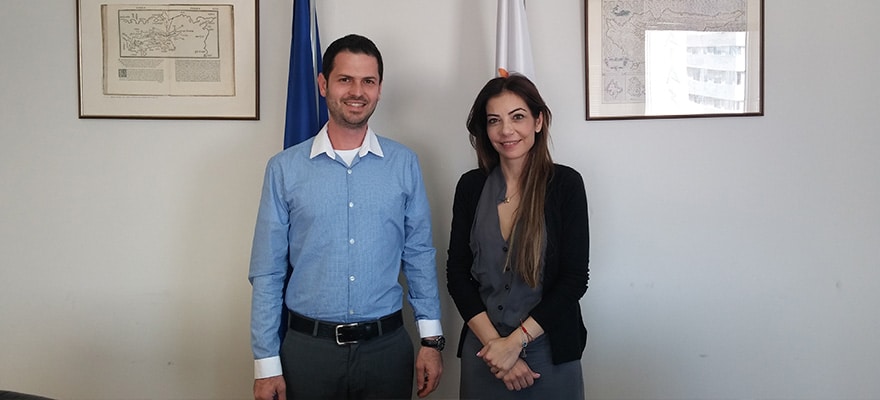
Demetra Kalogerou of CySEC and Michael Pearl of Finance Magnates
CySEC is now joining the FCA, ASIC, ISA and other financial regulators that have recently launched similar initiatives. Why now?
"It is important to remember that we don’t necessarily have to have a “hub” to respond to and manage innovation in the sector which we supervise. Post-crisis financial regulation has been underpinned by innovation of the European regulatory framework to make it fit for purpose: seeking redress for past failures and criminal wrongdoing amongst firms and introducing new rules to curtail repeated non-compliance.
We have a strong relationship with our European counterparts who are already well-advanced with fostering innovation in their own market. Much of this knowledge is readily applicable, so we can take advantage of the work done to date. On the basis of the new business models the time is ripe to formalize our approach to innovation and ensure disruption is not happening at the expense of investor protection."
What are CySEC's qualifications for (and approach to) regulating pure cryptocurrency exchanges?
"We have been evaluating the risks and benefits of crypto innovation to determine whether further actions and legislative requirements are needed to ensure full investor protection. We are keeping a very close eye on the types of products firms are bringing to market – and whether our existing regulatory framework at the EU level adequately caters to them, and if not, why not?
We don’t want to act prematurely as our primary goal is take stock and not cause any dislocation in an otherwise smooth functioning of our capital market."
How many crypto companies are currently registered with CIF licenses?
"Crypto is not a regulated activity. A limited number of CIFs are offering such products as spot as a non-regulated activity, which is MiFID compliant. This means they have to adhere to strict limitations in relation to the percentage of their turnover attributed to such activity and who they sell these investment products to. We are watching them closely."
Malta, Gibraltar, Estonia and other countries are competing to be Europe’s crypto hub. CySEC seems to be lagging behind. Why?
"CySEC is a regulatory authority mandated to safeguard the market’s integrity and maintain full investor protection. We have published several warnings outlining the risks that crypto investments entail, as this area remains widely unregulated.
We have highlighted in accordance with the relevant ESMA warning that depending on how they are structured, ICOs may fall within the scope of the existing EU legislation and therefore careful consideration should be given as to whether the firms’ activities constitute regulated activities. We cannot neglect that both retail and professional investors appear to be interested in this fledging area but we’re not going to be rushed into regulating a product set that is yet to be fully developed.
A limited number of firms are innovating in this area but part of our role is to encourage best practice by implementing and maintaining robust internal policies and procedures for ensuring the adequate management of conflicts of interest, client identification procedures and safeguarding clients’ rights. Inspiration for this can be drawn from the existing regulatory framework including AML Directive V and the MiFID II regime.
Back then, the watchdog was still contemplating how to handle offshore call centers and whether to outlaw binary options. Fintech was a nice buzzword, whereas cryptocurrency was just a fringe hobby for geeks and daring investors.
Since then, Kalogerou was reappointed as the czar of the Cypriot financial industry. This time around, on top of her Sisyphean task of regulating the forex, CFDs and more traditional financial industries, Kalogerou now faces the new challenge of taming the wild bull of cryptocurrency. Concurrently, like most of the worlds' leading financial regulators, CySEC is looking for ways to harness financial innovation to improve its relationship with its regulated entities and to optimize the ecosystem in terms of regulatory practices.
Regulation has typically been a human endeavour: ensuring the transfer of financial goods and services between people is done in a fair and not misleading way. Today, maintaining exceedingly high standards of investor protection isn’t just about supervision of persons, but the very technology we use. We don’t want our regulatory framework to be static.
We want it to progress in line with the demands of today’s and tomorrow’s investor. A Hub allows to experiment new technology in a safe space and understand the risks and benefits before potential investors are exposed to new investment products."
What tools and/or perks do you provide to the firms joining the innovation hub?
"We won’t be providing any perks. The Innovation Hub will serve as a communication channel for supervised and non-supervised entities to understand how existing regulation applies to new products or business models, whilst identifying what regulatory frameworks and licensing requirements might need to be established to ensure the safety and security of the end-investor, without stifling innovation.
Unlike a regulatory sandbox, the Hub aims to offer support, advice and guidance to regulated or unregulated firms; not a live or virtual testing of new products and services. It is designed to be a two-way information exchange, too – creating a platform for innovative firms to share ideas about new financial technology at the same time as identifying opportunities for our own regtech innovation. We see it as a two-way street."
How can blockchain technology change the regtech industry?
"Distributed Ledger Technology such as blockchain has a wide range of potential applications which are currently being evaluated by several research initiatives. Whilst blockchain technology is best known for being the technology behind cryptocurrencies like bitcoin and Ethereum, new decentralised technology serves as a bookkeeping platform ledger in which transactions are processed, verified and recorded.
Blockchain can be used for a variety of applications, not only cryptocurrencies, such as tracing shareholding certifications, recording transfers in ownership or voting rights or physical assets. This means that blockchain give us new opportunities to rethink how parts of our society work. Whether or not blockchain systems are trustworthy is an interesting question.
It is still unclear whether it could overcome the challenges associated with becoming a mainstream tool for financial markets, which inter alia includes legal and regulatory aspects that need to be taken into consideration, such as the legal certainty attached to Blockchain records or settlement finality. In the context of monitoring market developments around blockchain technology CySEC is open for discussing with experts on this area, in order to better understand the benefits that blockchain technology may bring to financial markets, but also evaluate the possible risks associated with it.
In this context, CySEC is part of a University College London project looking at Blockchain Technology for Algorithmic Regulation and Compliance (BARAC). BARAC investigates the feasibility of using blockchain technology for automating regulation and compliance as well as facilitating knowledge transfer by means of a bottom-up, cross-disciplinary approach developed together with industry and regulators. In this project, the technical, legal and managerial aspects related to use of DLT in the services industry - including the significance of new business models and their effects on industry structure – is under investigation."
Demetra Kalogerou of CySEC and Michael Pearl of Finance Magnates
CySEC is now joining the FCA, ASIC, ISA and other financial regulators that have recently launched similar initiatives. Why now?
"It is important to remember that we don’t necessarily have to have a “hub” to respond to and manage innovation in the sector which we supervise. Post-crisis financial regulation has been underpinned by innovation of the European regulatory framework to make it fit for purpose: seeking redress for past failures and criminal wrongdoing amongst firms and introducing new rules to curtail repeated non-compliance.
We have a strong relationship with our European counterparts who are already well-advanced with fostering innovation in their own market. Much of this knowledge is readily applicable, so we can take advantage of the work done to date. On the basis of the new business models the time is ripe to formalize our approach to innovation and ensure disruption is not happening at the expense of investor protection."
What are CySEC's qualifications for (and approach to) regulating pure cryptocurrency exchanges?
"We have been evaluating the risks and benefits of crypto innovation to determine whether further actions and legislative requirements are needed to ensure full investor protection. We are keeping a very close eye on the types of products firms are bringing to market – and whether our existing regulatory framework at the EU level adequately caters to them, and if not, why not?
We don’t want to act prematurely as our primary goal is take stock and not cause any dislocation in an otherwise smooth functioning of our capital market."
How many crypto companies are currently registered with CIF licenses?
"Crypto is not a regulated activity. A limited number of CIFs are offering such products as spot as a non-regulated activity, which is MiFID compliant. This means they have to adhere to strict limitations in relation to the percentage of their turnover attributed to such activity and who they sell these investment products to. We are watching them closely."
Malta, Gibraltar, Estonia and other countries are competing to be Europe’s crypto hub. CySEC seems to be lagging behind. Why?
"CySEC is a regulatory authority mandated to safeguard the market’s integrity and maintain full investor protection. We have published several warnings outlining the risks that crypto investments entail, as this area remains widely unregulated.
We have highlighted in accordance with the relevant ESMA warning that depending on how they are structured, ICOs may fall within the scope of the existing EU legislation and therefore careful consideration should be given as to whether the firms’ activities constitute regulated activities. We cannot neglect that both retail and professional investors appear to be interested in this fledging area but we’re not going to be rushed into regulating a product set that is yet to be fully developed.
A limited number of firms are innovating in this area but part of our role is to encourage best practice by implementing and maintaining robust internal policies and procedures for ensuring the adequate management of conflicts of interest, client identification procedures and safeguarding clients’ rights. Inspiration for this can be drawn from the existing regulatory framework including AML Directive V and the MiFID II regime.
Binance Launches Retail AI Assistant, Repackages Existing Trading Tools
Featured Videos
AvaTrade to Acquire Most of FXCM; NAGA Raises $8M
AvaTrade to Acquire Most of FXCM; NAGA Raises $8M
AvaTrade to Acquire Most of FXCM; NAGA Raises $8M
AvaTrade to Acquire Most of FXCM; NAGA Raises $8M
Today’s financial news recap covers AvaTrade agrees to acquire most of FXCM, NAGA secures eight million dollars in new financing, and Wise seeks a tax settlement in the UK.
Finance Magnates Daily Recap brings you the latest news from forex and CFD brokers, fintech, payments, cryptocurrency, digital assets, trading platforms, financial regulation and global markets.
Get the key company news, executive moves, deals, regulatory updates and market developments of the day, in just a few minutes. New episodes published every weekday.
Read more: https://www.financemagnates.com
#FinanceMagnates #ForexNews #FintechNews
Today’s financial news recap covers AvaTrade agrees to acquire most of FXCM, NAGA secures eight million dollars in new financing, and Wise seeks a tax settlement in the UK.
Finance Magnates Daily Recap brings you the latest news from forex and CFD brokers, fintech, payments, cryptocurrency, digital assets, trading platforms, financial regulation and global markets.
Get the key company news, executive moves, deals, regulatory updates and market developments of the day, in just a few minutes. New episodes published every weekday.
Read more: https://www.financemagnates.com
#FinanceMagnates #ForexNews #FintechNews
Today’s financial news recap covers AvaTrade agrees to acquire most of FXCM, NAGA secures eight million dollars in new financing, and Wise seeks a tax settlement in the UK.
Finance Magnates Daily Recap brings you the latest news from forex and CFD brokers, fintech, payments, cryptocurrency, digital assets, trading platforms, financial regulation and global markets.
Get the key company news, executive moves, deals, regulatory updates and market developments of the day, in just a few minutes. New episodes published every weekday.
Read more: https://www.financemagnates.com
#FinanceMagnates #ForexNews #FintechNews
Today’s financial news recap covers AvaTrade agrees to acquire most of FXCM, NAGA secures eight million dollars in new financing, and Wise seeks a tax settlement in the UK.
Finance Magnates Daily Recap brings you the latest news from forex and CFD brokers, fintech, payments, cryptocurrency, digital assets, trading platforms, financial regulation and global markets.
Get the key company news, executive moves, deals, regulatory updates and market developments of the day, in just a few minutes. New episodes published every weekday.
Read more: https://www.financemagnates.com
#FinanceMagnates #ForexNews #FintechNews
XTB Adds Overnight US Stock Trading; Nasdaq Ventures Invests in One Trading
XTB Adds Overnight US Stock Trading; Nasdaq Ventures Invests in One Trading
XTB Adds Overnight US Stock Trading; Nasdaq Ventures Invests in One Trading
XTB Adds Overnight US Stock Trading; Nasdaq Ventures Invests in One Trading
XTB Adds Overnight US Stock Trading; Nasdaq Ventures Invests in One Trading
XTB Adds Overnight US Stock Trading; Nasdaq Ventures Invests in One Trading
Today’s financial news recap covers XTB expands overnight US stock trading, Fortrade reports higher revenue, Nasdaq backs One Trading, and Vest Labs raises 13 million dollars.
Finance Magnates Daily Recap brings you the latest news from forex and CFD brokers, fintech, payments, cryptocurrency, digital assets, trading platforms, financial regulation and global markets.
Get the key company news, executive moves, deals, regulatory updates and market developments of the day, in just a few minutes. New episodes published every weekday.
Read more: https://www.financemagnates.com
#FinanceMagnates #ForexNews #FintechNews
Today’s financial news recap covers XTB expands overnight US stock trading, Fortrade reports higher revenue, Nasdaq backs One Trading, and Vest Labs raises 13 million dollars.
Finance Magnates Daily Recap brings you the latest news from forex and CFD brokers, fintech, payments, cryptocurrency, digital assets, trading platforms, financial regulation and global markets.
Get the key company news, executive moves, deals, regulatory updates and market developments of the day, in just a few minutes. New episodes published every weekday.
Read more: https://www.financemagnates.com
#FinanceMagnates #ForexNews #FintechNews
Today’s financial news recap covers XTB expands overnight US stock trading, Fortrade reports higher revenue, Nasdaq backs One Trading, and Vest Labs raises 13 million dollars.
Finance Magnates Daily Recap brings you the latest news from forex and CFD brokers, fintech, payments, cryptocurrency, digital assets, trading platforms, financial regulation and global markets.
Get the key company news, executive moves, deals, regulatory updates and market developments of the day, in just a few minutes. New episodes published every weekday.
Read more: https://www.financemagnates.com
#FinanceMagnates #ForexNews #FintechNews
Today’s financial news recap covers XTB expands overnight US stock trading, Fortrade reports higher revenue, Nasdaq backs One Trading, and Vest Labs raises 13 million dollars.
Finance Magnates Daily Recap brings you the latest news from forex and CFD brokers, fintech, payments, cryptocurrency, digital assets, trading platforms, financial regulation and global markets.
Get the key company news, executive moves, deals, regulatory updates and market developments of the day, in just a few minutes. New episodes published every weekday.
Read more: https://www.financemagnates.com
#FinanceMagnates #ForexNews #FintechNews
Today’s financial news recap covers XTB expands overnight US stock trading, Fortrade reports higher revenue, Nasdaq backs One Trading, and Vest Labs raises 13 million dollars.
Finance Magnates Daily Recap brings you the latest news from forex and CFD brokers, fintech, payments, cryptocurrency, digital assets, trading platforms, financial regulation and global markets.
Get the key company news, executive moves, deals, regulatory updates and market developments of the day, in just a few minutes. New episodes published every weekday.
Read more: https://www.financemagnates.com
#FinanceMagnates #ForexNews #FintechNews
Today’s financial news recap covers XTB expands overnight US stock trading, Fortrade reports higher revenue, Nasdaq backs One Trading, and Vest Labs raises 13 million dollars.
Finance Magnates Daily Recap brings you the latest news from forex and CFD brokers, fintech, payments, cryptocurrency, digital assets, trading platforms, financial regulation and global markets.
Get the key company news, executive moves, deals, regulatory updates and market developments of the day, in just a few minutes. New episodes published every weekday.
Read more: https://www.financemagnates.com
#FinanceMagnates #ForexNews #FintechNews
CMC Founder Downplays Volatility Hit; Devexperts Names CEO
CMC Founder Downplays Volatility Hit; Devexperts Names CEO
CMC Founder Downplays Volatility Hit; Devexperts Names CEO
CMC Founder Downplays Volatility Hit; Devexperts Names CEO
CMC Founder Downplays Volatility Hit; Devexperts Names CEO
CMC Founder Downplays Volatility Hit; Devexperts Names CEO
Today’s financial news recap covers low volatility pressures brokers, Devexperts names a new CEO, Saxo cuts onboarding time, and OKX reaches a 25 billion dollar valuation.
Finance Magnates Daily Recap brings you the latest news from forex and CFD brokers, fintech, payments, cryptocurrency, digital assets, trading platforms, financial regulation and global markets.
Get the key company news, executive moves, deals, regulatory updates and market developments of the day, in just a few minutes. New episodes published every weekday.
Read more: https://www.financemagnates.com
#FinanceMagnates #ForexNews #FintechNews
Today’s financial news recap covers low volatility pressures brokers, Devexperts names a new CEO, Saxo cuts onboarding time, and OKX reaches a 25 billion dollar valuation.
Finance Magnates Daily Recap brings you the latest news from forex and CFD brokers, fintech, payments, cryptocurrency, digital assets, trading platforms, financial regulation and global markets.
Get the key company news, executive moves, deals, regulatory updates and market developments of the day, in just a few minutes. New episodes published every weekday.
Read more: https://www.financemagnates.com
#FinanceMagnates #ForexNews #FintechNews
Today’s financial news recap covers low volatility pressures brokers, Devexperts names a new CEO, Saxo cuts onboarding time, and OKX reaches a 25 billion dollar valuation.
Finance Magnates Daily Recap brings you the latest news from forex and CFD brokers, fintech, payments, cryptocurrency, digital assets, trading platforms, financial regulation and global markets.
Get the key company news, executive moves, deals, regulatory updates and market developments of the day, in just a few minutes. New episodes published every weekday.
Read more: https://www.financemagnates.com
#FinanceMagnates #ForexNews #FintechNews
Today’s financial news recap covers low volatility pressures brokers, Devexperts names a new CEO, Saxo cuts onboarding time, and OKX reaches a 25 billion dollar valuation.
Finance Magnates Daily Recap brings you the latest news from forex and CFD brokers, fintech, payments, cryptocurrency, digital assets, trading platforms, financial regulation and global markets.
Get the key company news, executive moves, deals, regulatory updates and market developments of the day, in just a few minutes. New episodes published every weekday.
Read more: https://www.financemagnates.com
#FinanceMagnates #ForexNews #FintechNews
Today’s financial news recap covers low volatility pressures brokers, Devexperts names a new CEO, Saxo cuts onboarding time, and OKX reaches a 25 billion dollar valuation.
Finance Magnates Daily Recap brings you the latest news from forex and CFD brokers, fintech, payments, cryptocurrency, digital assets, trading platforms, financial regulation and global markets.
Get the key company news, executive moves, deals, regulatory updates and market developments of the day, in just a few minutes. New episodes published every weekday.
Read more: https://www.financemagnates.com
#FinanceMagnates #ForexNews #FintechNews
Today’s financial news recap covers low volatility pressures brokers, Devexperts names a new CEO, Saxo cuts onboarding time, and OKX reaches a 25 billion dollar valuation.
Finance Magnates Daily Recap brings you the latest news from forex and CFD brokers, fintech, payments, cryptocurrency, digital assets, trading platforms, financial regulation and global markets.
Get the key company news, executive moves, deals, regulatory updates and market developments of the day, in just a few minutes. New episodes published every weekday.
Read more: https://www.financemagnates.com
#FinanceMagnates #ForexNews #FintechNews
Today’s financial news recap covers Trade Nation buys FXCM's UK client book, Trading 212 reports higher revenue, the CFTC's move to allow perpetual index futures.
Finance Magnates Daily Recap brings you the latest news from forex and CFD brokers, fintech, payments, cryptocurrency, digital assets, trading platforms, financial regulation and global markets.
Get the key company news, executive moves, deals, regulatory updates and market developments of the day, in just a few minutes. New episodes published every weekday.
Read more: https://www.financemagnates.com
#FinanceMagnates #ForexNews #FintechNews
Today’s financial news recap covers Trade Nation buys FXCM's UK client book, Trading 212 reports higher revenue, the CFTC's move to allow perpetual index futures.
Finance Magnates Daily Recap brings you the latest news from forex and CFD brokers, fintech, payments, cryptocurrency, digital assets, trading platforms, financial regulation and global markets.
Get the key company news, executive moves, deals, regulatory updates and market developments of the day, in just a few minutes. New episodes published every weekday.
Read more: https://www.financemagnates.com
#FinanceMagnates #ForexNews #FintechNews
Today’s financial news recap covers Trade Nation buys FXCM's UK client book, Trading 212 reports higher revenue, the CFTC's move to allow perpetual index futures.
Finance Magnates Daily Recap brings you the latest news from forex and CFD brokers, fintech, payments, cryptocurrency, digital assets, trading platforms, financial regulation and global markets.
Get the key company news, executive moves, deals, regulatory updates and market developments of the day, in just a few minutes. New episodes published every weekday.
Read more: https://www.financemagnates.com
#FinanceMagnates #ForexNews #FintechNews
Today’s financial news recap covers Trade Nation buys FXCM's UK client book, Trading 212 reports higher revenue, the CFTC's move to allow perpetual index futures.
Finance Magnates Daily Recap brings you the latest news from forex and CFD brokers, fintech, payments, cryptocurrency, digital assets, trading platforms, financial regulation and global markets.
Get the key company news, executive moves, deals, regulatory updates and market developments of the day, in just a few minutes. New episodes published every weekday.
Read more: https://www.financemagnates.com
#FinanceMagnates #ForexNews #FintechNews
Today’s financial news recap covers Trade Nation buys FXCM's UK client book, Trading 212 reports higher revenue, the CFTC's move to allow perpetual index futures.
Finance Magnates Daily Recap brings you the latest news from forex and CFD brokers, fintech, payments, cryptocurrency, digital assets, trading platforms, financial regulation and global markets.
Get the key company news, executive moves, deals, regulatory updates and market developments of the day, in just a few minutes. New episodes published every weekday.
Read more: https://www.financemagnates.com
#FinanceMagnates #ForexNews #FintechNews
Today’s financial news recap covers Trade Nation buys FXCM's UK client book, Trading 212 reports higher revenue, the CFTC's move to allow perpetual index futures.
Finance Magnates Daily Recap brings you the latest news from forex and CFD brokers, fintech, payments, cryptocurrency, digital assets, trading platforms, financial regulation and global markets.
Get the key company news, executive moves, deals, regulatory updates and market developments of the day, in just a few minutes. New episodes published every weekday.
Read more: https://www.financemagnates.com
#FinanceMagnates #ForexNews #FintechNews
Your career isn’t a linear path.
Your career isn’t a linear path.
Your career isn’t a linear path.
Your career isn’t a linear path.
Your career isn’t a linear path.
Your career isn’t a linear path.
Roles change. Career goals change. Sometimes you want a completely new challenge.
But the skills and knowledge you build along the way can stay with you and give you something to build on.
For Jeff Patterson, that continued growth is key to long-term career development.
You bring the skills. FM Academy helps you build the knowledge.
#FMAcademy #FinanceMagnates #FinanceCareers #ProfessionalDevelopment #Fintech
Roles change. Career goals change. Sometimes you want a completely new challenge.
But the skills and knowledge you build along the way can stay with you and give you something to build on.
For Jeff Patterson, that continued growth is key to long-term career development.
You bring the skills. FM Academy helps you build the knowledge.
#FMAcademy #FinanceMagnates #FinanceCareers #ProfessionalDevelopment #Fintech
Roles change. Career goals change. Sometimes you want a completely new challenge.
But the skills and knowledge you build along the way can stay with you and give you something to build on.
For Jeff Patterson, that continued growth is key to long-term career development.
You bring the skills. FM Academy helps you build the knowledge.
#FMAcademy #FinanceMagnates #FinanceCareers #ProfessionalDevelopment #Fintech
Roles change. Career goals change. Sometimes you want a completely new challenge.
But the skills and knowledge you build along the way can stay with you and give you something to build on.
For Jeff Patterson, that continued growth is key to long-term career development.
You bring the skills. FM Academy helps you build the knowledge.
#FMAcademy #FinanceMagnates #FinanceCareers #ProfessionalDevelopment #Fintech
Roles change. Career goals change. Sometimes you want a completely new challenge.
But the skills and knowledge you build along the way can stay with you and give you something to build on.
For Jeff Patterson, that continued growth is key to long-term career development.
You bring the skills. FM Academy helps you build the knowledge.
#FMAcademy #FinanceMagnates #FinanceCareers #ProfessionalDevelopment #Fintech
Roles change. Career goals change. Sometimes you want a completely new challenge.
But the skills and knowledge you build along the way can stay with you and give you something to build on.
For Jeff Patterson, that continued growth is key to long-term career development.
You bring the skills. FM Academy helps you build the knowledge.
#FMAcademy #FinanceMagnates #FinanceCareers #ProfessionalDevelopment #Fintech