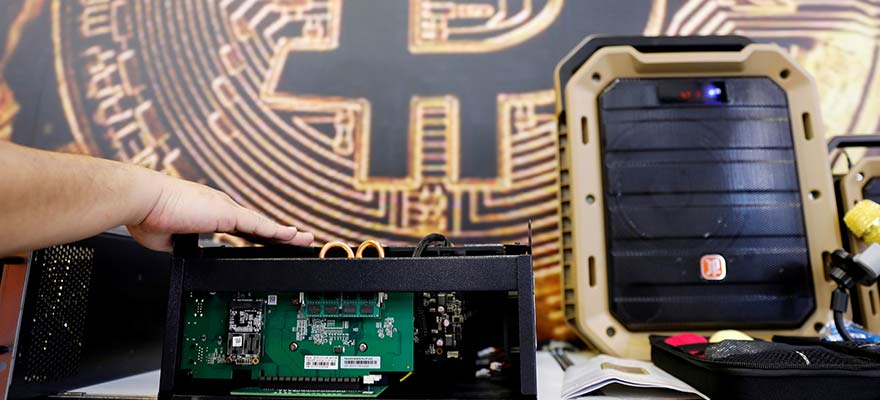
When the halving occurs, BTC miners' profits will instantly be cut in half. What does this mean for miners?
FM
To the crypto outsider, Bitcoin' halvings' may appear as a semi-mythical and quirky anomaly unique to the BTC sphere: much like a solar eclipse, they come every once in a while, greeted with much anticipation.
If you don't already know, a halving (or 'halvening,' as some say) is an event in which the coin rewards that are paid out to miners are cut in half. The next halving is expected to take place on Monday of next week around 7:45 PM EST. These events occur once every 210,000 blocks, or roughly one time every four years.
In the longer-term, a number of analysts and traders expect the halving to boost the price of Bitcoin--in the past, Bitcoin has seen a significant rally 12-18 months after a halving has occurred.
This is generally believed to be because of increased scarcity: fewer Bitcoins are produced each day as more users join the network; the combination of these two factors allegedly drives the price of BTC up over the long term (though the halving already seems to be boosting BTC in the short-term).
However, in the shorter-term, the halving could have much swifter and more severe consequences for another group of crypto industry insiders: miners.
The halving could have fatal consequences to miners without capital to ride out a potential loss in profits
After all, miners face an imminent and significant problem: the profits from their operations are literally about to be cut in half. Certainly, the expected post-halving price boost could eventually make up for this; however, historically speaking, it could be at least 12-18 months before a rally big enough to cover the losses will occur.
Therefore, it's almost certain that we're going to see some major changes in the cryptocurrency mining landscape as it currently stands: mining operations that cannot afford to take the loss in profits over the next 12-18 months (or more) may be forced to shut their operations down.
This is particularly true for small- and medium-sized independent mining firms that may not have the possibility to run their operations at a loss for an extended period of time, or for mining operations running on older, less-efficient mining equipment.
This halving for bitcoin will be a significant milestone. Baby is all grown up. No longer a hobbyist endeavor. Even the most hardcore amateur miners will struggle as institutional mining begins. Very interesting days ahead.
Indeed, Dr. Marc Fleury, CEO and co-founder of Two Prime, a fintech company that focuses on the financial application of crypto to the real economy, told Finance Magnates that "the current halving is the third in Bitcoin's history and every halving has witnessed similarities and differences."
Dr. Mark Fleury, an open-source pioneer and founder of Two Prime.
However, "what remains the same has been the mechanics of the supply shock — the rate at which bitcoins are mined is halved, so the income is halved (assuming a stable price) and the cost is fixed (assuming a similar hash power). This is a catastrophic margin hit on the miners, as they are down 50% on new Bitcoin mined."
Nathan Nichols, a managing partner at Imperium Investments, also told Finance Magnates that he believes that the upcoming halving "will hurt the majority of miners." Imperium is a private equity firm that "uses Bitcoin, via one of the largest mining operations in North America, as the arbitrage vehicle to turn energy into cash"--in other words, a firm that produces BTC at a low cost.
Therefore, as the cost of producing BTC continues to rise, miners may be forced to sell off their equipment: "with high costs comes the pressure to sell off a miner's BTC inventory since power expenses must be paid in fiat," Nichols said.
"The dropoff may not be a cliff."
Therefore, "post-halving, we expect to see miners with high costs, weak balance sheets, and lack of access to capital start to close their doors."
Nichols also pointed out that the miners who will survive in the post-halving world will have to have enough capital to wait for Bitcoin's price to increase before they could be profitable again--and he seems certain that, although it may be a while, the bull run will eventually arrive.
"You may see a short-term upward [BTC] price trend from new investors, but the supply-side sell pressure will eventually hit," he said. "When it does, if current demand for Bitcoin stays the same while the rate of supply is cut in half, simple principles of economics teach us that price should increase proportionally with the lack of supply in order to attain market equilibrium."
However, "timing is tricky as it depends on each miner's specific situation, access to capital, and risk appetite," Nichols explained. "So, the dropoff may not be a cliff.
However, downward price pressure from the supply-side is not an 'if,' it's a 'when' in terms of miners' effect on BTC price. Third-party research suggests that older machines (e.g., S9s) account for 30–40% of the total hash rate. If this is true, we should see those miners be forced to leave the network."
About a week out until bitcoin halving, and things look good for the mining sector.
If BTC had stayed at $6k, many machines would have shut down post halving.
Even if a post-halving pullback occurs, above $6k should keep most smart miners healthy.
On the other hand, "any other industry would be put out of business overnight."
In other words, there could be an exodus of mines who are responsible for 30-40% of the total computing power on the Bitcoin network; this could certainly be a big shock to the security of the Bitcoin ecosystem, and could contribute further to mining centralization on the network.
In a way, though, it's almost remarkable that only these miners seem to be in imminent danger of shutting down: Dr. Marc Fleury pointed out that the reality of the impact on halving is hard to stomach: "while cost is held steady, income is halved overnight," he said.
"This idiosyncratic feature of Bitcoin has proven itself to only be successful in the crypto industry, as any other industry would be put out of business overnight with that type of impact on margins. Miners are a persistent, patient, and well-capitalized group," he said.
"They play into the two reasons why Bitcoin price tends to go up after the halving. Firstly, because new supply from miners is halved, supply is also halved. And secondly, miners tend to hold onto Bitcoin until the price is right, which usually means when the price doubles," he said.
In other words, miners won't sell their BTC at a loss: Jeremy Britton, chief financial officer at Boston Trading Co., explained to Finance Magnates earlier this year that "at present, it costs around $3000 just in electricity to mine a single bitcoin (notwithstanding the cost of hardware, and internet access)."
"This is why, when BTC 'crashed' earlier in 2019, the price did not go below $3000; miners did not wish to sell for a loss."
Jeremy Britton, chief financial officer at Boston Trading Co.
Therefore, when the next halving occurs in May, "the price to mine a single bitcoin will increase to a minimum of $6000. Whatever the new ceiling is, the floor will be $6k, as miners will refuse to sell for a loss," he said; some estimates have put that figure over $12,000.
Dr. Fleury compared this to the "OPEC of the 70s": it "was able to dictate the price of oil due to its control of oil supply. The halving is a supply shock. Many miners, who do first reap the rewards, will not survive."
Is the halving already priced in?
The effects could be particularly severe for miners if the expected price increase won't ever come; a number of cryptocurrency analysts believe this to be the case.
Why? Jimmy Nguyen, president of the BSV advocacy organization known as the Bitcoin Association, told Finance Magnates that "these events have been known from the outset--a halving is not new information."
Similarly, Steven Wagner, Senior Contributor at Decred.org, told Finance Magnates that "this will be Bitcoin's [3rd] halving, so no one is expecting any surprises," and that although "historically, there has been some correlation with price increase," Wagner believes that "a price rise could even be a self-fulfilling prophecy."
Jimmy Nguyen, President of the Bitcoin Association and BitcoinSV advocate.
Dr. Marc Fleury also commented that "many people believe in the theory of effective markets, which essentially says that all the information available about the halving should already be priced in."
However, Dr. Fleury also seemed to imply that crypto markets don't necessarily behave in the ways that traditional markets do, and that the theory of effective markets may not apply in the same way.
"Let's pass in silence over the fact that crypto markets are notoriously irrational and prone to manipulation," he continued. "Far from 'transparent', the crypto markets are notoriously asymmetrical with a few whales, miners included, who have outsized influence."
" The halving may turn out to be a non-event", and the "influence of miners" could "wane"
However, Fleury isn't totally opposed to the idea that the effects of the halving may not have a big impact on price: "depending on whether demand expansion or supply constraints will play a bigger role, there are two possible outcomes of the halving," he said.
The first is that "the halving may turn out to be a non-event based on stock-to-flow analysis; as there is less flow (coins produced by miners) while the stock (circulating supply) increases, the influence of miners wanes."
"It may seem ironic, or even incomprehensible, that crypto-assets currently appear to be safer during the current crisis, but that is the state that we are currently in," he continued. "Therefore, the current economy has the potential to make or break crypto."
Therefore, even though "the intrinsic impact of the halving may be mild," Dr. Fleury believes that "the macro environment is strongly bullish for cryptos."
"Play at your own risk," he said.
What do you think the effects of the halving will be on the Bitcoin mining industry and the crypto industry as a whole? Let us know in the comments below.
To the crypto outsider, Bitcoin' halvings' may appear as a semi-mythical and quirky anomaly unique to the BTC sphere: much like a solar eclipse, they come every once in a while, greeted with much anticipation.
If you don't already know, a halving (or 'halvening,' as some say) is an event in which the coin rewards that are paid out to miners are cut in half. The next halving is expected to take place on Monday of next week around 7:45 PM EST. These events occur once every 210,000 blocks, or roughly one time every four years.
In the longer-term, a number of analysts and traders expect the halving to boost the price of Bitcoin--in the past, Bitcoin has seen a significant rally 12-18 months after a halving has occurred.
This is generally believed to be because of increased scarcity: fewer Bitcoins are produced each day as more users join the network; the combination of these two factors allegedly drives the price of BTC up over the long term (though the halving already seems to be boosting BTC in the short-term).
However, in the shorter-term, the halving could have much swifter and more severe consequences for another group of crypto industry insiders: miners.
The halving could have fatal consequences to miners without capital to ride out a potential loss in profits
After all, miners face an imminent and significant problem: the profits from their operations are literally about to be cut in half. Certainly, the expected post-halving price boost could eventually make up for this; however, historically speaking, it could be at least 12-18 months before a rally big enough to cover the losses will occur.
Therefore, it's almost certain that we're going to see some major changes in the cryptocurrency mining landscape as it currently stands: mining operations that cannot afford to take the loss in profits over the next 12-18 months (or more) may be forced to shut their operations down.
This is particularly true for small- and medium-sized independent mining firms that may not have the possibility to run their operations at a loss for an extended period of time, or for mining operations running on older, less-efficient mining equipment.
This halving for bitcoin will be a significant milestone. Baby is all grown up. No longer a hobbyist endeavor. Even the most hardcore amateur miners will struggle as institutional mining begins. Very interesting days ahead.
Indeed, Dr. Marc Fleury, CEO and co-founder of Two Prime, a fintech company that focuses on the financial application of crypto to the real economy, told Finance Magnates that "the current halving is the third in Bitcoin's history and every halving has witnessed similarities and differences."
Dr. Mark Fleury, an open-source pioneer and founder of Two Prime.
However, "what remains the same has been the mechanics of the supply shock — the rate at which bitcoins are mined is halved, so the income is halved (assuming a stable price) and the cost is fixed (assuming a similar hash power). This is a catastrophic margin hit on the miners, as they are down 50% on new Bitcoin mined."
Nathan Nichols, a managing partner at Imperium Investments, also told Finance Magnates that he believes that the upcoming halving "will hurt the majority of miners." Imperium is a private equity firm that "uses Bitcoin, via one of the largest mining operations in North America, as the arbitrage vehicle to turn energy into cash"--in other words, a firm that produces BTC at a low cost.
Therefore, as the cost of producing BTC continues to rise, miners may be forced to sell off their equipment: "with high costs comes the pressure to sell off a miner's BTC inventory since power expenses must be paid in fiat," Nichols said.
"The dropoff may not be a cliff."
Therefore, "post-halving, we expect to see miners with high costs, weak balance sheets, and lack of access to capital start to close their doors."
Nichols also pointed out that the miners who will survive in the post-halving world will have to have enough capital to wait for Bitcoin's price to increase before they could be profitable again--and he seems certain that, although it may be a while, the bull run will eventually arrive.
"You may see a short-term upward [BTC] price trend from new investors, but the supply-side sell pressure will eventually hit," he said. "When it does, if current demand for Bitcoin stays the same while the rate of supply is cut in half, simple principles of economics teach us that price should increase proportionally with the lack of supply in order to attain market equilibrium."
However, "timing is tricky as it depends on each miner's specific situation, access to capital, and risk appetite," Nichols explained. "So, the dropoff may not be a cliff.
However, downward price pressure from the supply-side is not an 'if,' it's a 'when' in terms of miners' effect on BTC price. Third-party research suggests that older machines (e.g., S9s) account for 30–40% of the total hash rate. If this is true, we should see those miners be forced to leave the network."
About a week out until bitcoin halving, and things look good for the mining sector.
If BTC had stayed at $6k, many machines would have shut down post halving.
Even if a post-halving pullback occurs, above $6k should keep most smart miners healthy.
On the other hand, "any other industry would be put out of business overnight."
In other words, there could be an exodus of mines who are responsible for 30-40% of the total computing power on the Bitcoin network; this could certainly be a big shock to the security of the Bitcoin ecosystem, and could contribute further to mining centralization on the network.
In a way, though, it's almost remarkable that only these miners seem to be in imminent danger of shutting down: Dr. Marc Fleury pointed out that the reality of the impact on halving is hard to stomach: "while cost is held steady, income is halved overnight," he said.
"This idiosyncratic feature of Bitcoin has proven itself to only be successful in the crypto industry, as any other industry would be put out of business overnight with that type of impact on margins. Miners are a persistent, patient, and well-capitalized group," he said.
"They play into the two reasons why Bitcoin price tends to go up after the halving. Firstly, because new supply from miners is halved, supply is also halved. And secondly, miners tend to hold onto Bitcoin until the price is right, which usually means when the price doubles," he said.
In other words, miners won't sell their BTC at a loss: Jeremy Britton, chief financial officer at Boston Trading Co., explained to Finance Magnates earlier this year that "at present, it costs around $3000 just in electricity to mine a single bitcoin (notwithstanding the cost of hardware, and internet access)."
"This is why, when BTC 'crashed' earlier in 2019, the price did not go below $3000; miners did not wish to sell for a loss."
Jeremy Britton, chief financial officer at Boston Trading Co.
Therefore, when the next halving occurs in May, "the price to mine a single bitcoin will increase to a minimum of $6000. Whatever the new ceiling is, the floor will be $6k, as miners will refuse to sell for a loss," he said; some estimates have put that figure over $12,000.
Dr. Fleury compared this to the "OPEC of the 70s": it "was able to dictate the price of oil due to its control of oil supply. The halving is a supply shock. Many miners, who do first reap the rewards, will not survive."
Is the halving already priced in?
The effects could be particularly severe for miners if the expected price increase won't ever come; a number of cryptocurrency analysts believe this to be the case.
Why? Jimmy Nguyen, president of the BSV advocacy organization known as the Bitcoin Association, told Finance Magnates that "these events have been known from the outset--a halving is not new information."
Similarly, Steven Wagner, Senior Contributor at Decred.org, told Finance Magnates that "this will be Bitcoin's [3rd] halving, so no one is expecting any surprises," and that although "historically, there has been some correlation with price increase," Wagner believes that "a price rise could even be a self-fulfilling prophecy."
Jimmy Nguyen, President of the Bitcoin Association and BitcoinSV advocate.
Dr. Marc Fleury also commented that "many people believe in the theory of effective markets, which essentially says that all the information available about the halving should already be priced in."
However, Dr. Fleury also seemed to imply that crypto markets don't necessarily behave in the ways that traditional markets do, and that the theory of effective markets may not apply in the same way.
"Let's pass in silence over the fact that crypto markets are notoriously irrational and prone to manipulation," he continued. "Far from 'transparent', the crypto markets are notoriously asymmetrical with a few whales, miners included, who have outsized influence."
" The halving may turn out to be a non-event", and the "influence of miners" could "wane"
However, Fleury isn't totally opposed to the idea that the effects of the halving may not have a big impact on price: "depending on whether demand expansion or supply constraints will play a bigger role, there are two possible outcomes of the halving," he said.
The first is that "the halving may turn out to be a non-event based on stock-to-flow analysis; as there is less flow (coins produced by miners) while the stock (circulating supply) increases, the influence of miners wanes."
"It may seem ironic, or even incomprehensible, that crypto-assets currently appear to be safer during the current crisis, but that is the state that we are currently in," he continued. "Therefore, the current economy has the potential to make or break crypto."
Therefore, even though "the intrinsic impact of the halving may be mild," Dr. Fleury believes that "the macro environment is strongly bullish for cryptos."
"Play at your own risk," he said.
What do you think the effects of the halving will be on the Bitcoin mining industry and the crypto industry as a whole? Let us know in the comments below.
Rachel is a self-taught crypto geek and a passionate writer. She believes in the power that the written word has to educate, connect and empower individuals to make positive and powerful financial choices. She is the Podcast Host and a Cryptocurrency Editor at Finance Magnates.
Crypto Built More Rails, but the Next Battle Is Over How Much Work a Dollar Can Do
Featured Videos
FP Markets Winner Spotlight 🏆 | Global Broker of the Year 2025 #Trading #Broker #Innovation #Shorts
FP Markets Winner Spotlight 🏆 | Global Broker of the Year 2025 #Trading #Broker #Innovation #Shorts
FP Markets Winner Spotlight 🏆 | Global Broker of the Year 2025 #Trading #Broker #Innovation #Shorts
FP Markets Winner Spotlight 🏆 | Global Broker of the Year 2025 #Trading #Broker #Innovation #Shorts
FP Markets takes the spotlight as Global Broker of the Year 2025 at the Finance Magnates Awards.
Martin Stoilov, Head of Client Experience, shares that trust, innovation, and people played a key role in the company’s success, supported by a strong foundation of integrity and client-centricity.
Following this milestone, FP Markets continues to focus on growth, technology investment, and its core values of transparency and excellence.
👉 Be part of FM Awards 2026: https://awards.financemagnates.com/#nominate
FP Markets takes the spotlight as Global Broker of the Year 2025 at the Finance Magnates Awards.
Martin Stoilov, Head of Client Experience, shares that trust, innovation, and people played a key role in the company’s success, supported by a strong foundation of integrity and client-centricity.
Following this milestone, FP Markets continues to focus on growth, technology investment, and its core values of transparency and excellence.
👉 Be part of FM Awards 2026: https://awards.financemagnates.com/#nominate
FP Markets takes the spotlight as Global Broker of the Year 2025 at the Finance Magnates Awards.
Martin Stoilov, Head of Client Experience, shares that trust, innovation, and people played a key role in the company’s success, supported by a strong foundation of integrity and client-centricity.
Following this milestone, FP Markets continues to focus on growth, technology investment, and its core values of transparency and excellence.
👉 Be part of FM Awards 2026: https://awards.financemagnates.com/#nominate
FP Markets takes the spotlight as Global Broker of the Year 2025 at the Finance Magnates Awards.
Martin Stoilov, Head of Client Experience, shares that trust, innovation, and people played a key role in the company’s success, supported by a strong foundation of integrity and client-centricity.
Following this milestone, FP Markets continues to focus on growth, technology investment, and its core values of transparency and excellence.
👉 Be part of FM Awards 2026: https://awards.financemagnates.com/#nominate
In this video, we review @HolaPrimeMarketsOfficial, a multi-asset forex and CFDs broker offering different account types, trading platforms, and flexible trading conditions.
We cover the broker’s overall offering, including account options, trading environment, platforms like MT4 and MT5, and additional services such as managed accounts and fast withdrawals.
Watch the full video to see if Hola Prime Markets fits your trading needs.
📣 Stay up to date with the latest in finance and trading. Follow Finance Magnates for industry news, insights, and global event coverage.
Connect with us:
🔗 LinkedIn: /financemagnates
👍 Facebook: /financemagnates
📸 Instagram: https://www.instagram.com/financemagnates
🐦 X: https://x.com/financemagnates
🎥 TikTok: https://www.tiktok.com/tag/financemagnates
▶️ YouTube: /@financemagnates_official
#HolaPrime #ForexBroker #CFDTrading #FinanceMagnates #Trading #Forex #BrokerReview
In this video, we review @HolaPrimeMarketsOfficial, a multi-asset forex and CFDs broker offering different account types, trading platforms, and flexible trading conditions.
We cover the broker’s overall offering, including account options, trading environment, platforms like MT4 and MT5, and additional services such as managed accounts and fast withdrawals.
Watch the full video to see if Hola Prime Markets fits your trading needs.
📣 Stay up to date with the latest in finance and trading. Follow Finance Magnates for industry news, insights, and global event coverage.
Connect with us:
🔗 LinkedIn: /financemagnates
👍 Facebook: /financemagnates
📸 Instagram: https://www.instagram.com/financemagnates
🐦 X: https://x.com/financemagnates
🎥 TikTok: https://www.tiktok.com/tag/financemagnates
▶️ YouTube: /@financemagnates_official
#HolaPrime #ForexBroker #CFDTrading #FinanceMagnates #Trading #Forex #BrokerReview
In this video, we review @HolaPrimeMarketsOfficial, a multi-asset forex and CFDs broker offering different account types, trading platforms, and flexible trading conditions.
We cover the broker’s overall offering, including account options, trading environment, platforms like MT4 and MT5, and additional services such as managed accounts and fast withdrawals.
Watch the full video to see if Hola Prime Markets fits your trading needs.
📣 Stay up to date with the latest in finance and trading. Follow Finance Magnates for industry news, insights, and global event coverage.
Connect with us:
🔗 LinkedIn: /financemagnates
👍 Facebook: /financemagnates
📸 Instagram: https://www.instagram.com/financemagnates
🐦 X: https://x.com/financemagnates
🎥 TikTok: https://www.tiktok.com/tag/financemagnates
▶️ YouTube: /@financemagnates_official
#HolaPrime #ForexBroker #CFDTrading #FinanceMagnates #Trading #Forex #BrokerReview
In this video, we review @HolaPrimeMarketsOfficial, a multi-asset forex and CFDs broker offering different account types, trading platforms, and flexible trading conditions.
We cover the broker’s overall offering, including account options, trading environment, platforms like MT4 and MT5, and additional services such as managed accounts and fast withdrawals.
Watch the full video to see if Hola Prime Markets fits your trading needs.
📣 Stay up to date with the latest in finance and trading. Follow Finance Magnates for industry news, insights, and global event coverage.
Connect with us:
🔗 LinkedIn: /financemagnates
👍 Facebook: /financemagnates
📸 Instagram: https://www.instagram.com/financemagnates
🐦 X: https://x.com/financemagnates
🎥 TikTok: https://www.tiktok.com/tag/financemagnates
▶️ YouTube: /@financemagnates_official
#HolaPrime #ForexBroker #CFDTrading #FinanceMagnates #Trading #Forex #BrokerReview
In this video, we review @HolaPrimeMarketsOfficial, a multi-asset forex and CFDs broker offering different account types, trading platforms, and flexible trading conditions.
We cover the broker’s overall offering, including account options, trading environment, platforms like MT4 and MT5, and additional services such as managed accounts and fast withdrawals.
Watch the full video to see if Hola Prime Markets fits your trading needs.
📣 Stay up to date with the latest in finance and trading. Follow Finance Magnates for industry news, insights, and global event coverage.
Connect with us:
🔗 LinkedIn: /financemagnates
👍 Facebook: /financemagnates
📸 Instagram: https://www.instagram.com/financemagnates
🐦 X: https://x.com/financemagnates
🎥 TikTok: https://www.tiktok.com/tag/financemagnates
▶️ YouTube: /@financemagnates_official
#HolaPrime #ForexBroker #CFDTrading #FinanceMagnates #Trading #Forex #BrokerReview
In this video, we review @HolaPrimeMarketsOfficial, a multi-asset forex and CFDs broker offering different account types, trading platforms, and flexible trading conditions.
We cover the broker’s overall offering, including account options, trading environment, platforms like MT4 and MT5, and additional services such as managed accounts and fast withdrawals.
Watch the full video to see if Hola Prime Markets fits your trading needs.
📣 Stay up to date with the latest in finance and trading. Follow Finance Magnates for industry news, insights, and global event coverage.
Connect with us:
🔗 LinkedIn: /financemagnates
👍 Facebook: /financemagnates
📸 Instagram: https://www.instagram.com/financemagnates
🐦 X: https://x.com/financemagnates
🎥 TikTok: https://www.tiktok.com/tag/financemagnates
▶️ YouTube: /@financemagnates_official
#HolaPrime #ForexBroker #CFDTrading #FinanceMagnates #Trading #Forex #BrokerReview
Hola Prime Review: What You Need to Know | Full Breakdown by Finance Magnates
Hola Prime Review: What You Need to Know | Full Breakdown by Finance Magnates
Hola Prime Review: What You Need to Know | Full Breakdown by Finance Magnates
Hola Prime Review: What You Need to Know | Full Breakdown by Finance Magnates
Hola Prime Review: What You Need to Know | Full Breakdown by Finance Magnates
Hola Prime Review: What You Need to Know | Full Breakdown by Finance Magnates
In this video, we review @HolaPrime_Global, a proprietary trading firm offering evaluation programs and performance-based payouts in simulated market environments.
We cover how the challenge model works, including account types, profit splits (up to 95%), trading rules, and what it takes to reach a funded account. You’ll also learn about available platforms like MT4, MT5, cTrader, and more, along with insights into payouts, support, and trading conditions.
Watch the full video to see if Hola Prime fits your trading style.
📣 Stay up to date with the latest in finance and trading. Follow Finance Magnates for industry news, insights, and global event coverage.
Connect with us:
🔗 LinkedIn: /financemagnates
👍 Facebook: /financemagnates
📸 Instagram: https://www.instagram.com/financemagnates
🐦 X: https://x.com/financemagnates
🎥 TikTok: https://www.tiktok.com/tag/financemagnates
▶️ YouTube: /@financemagnates_official
#HolaPrime #PropFirm #Trading #FinanceMagnates #Forex #FuturesTrading #TradingReview #PropFirmReview
In this video, we review @HolaPrime_Global, a proprietary trading firm offering evaluation programs and performance-based payouts in simulated market environments.
We cover how the challenge model works, including account types, profit splits (up to 95%), trading rules, and what it takes to reach a funded account. You’ll also learn about available platforms like MT4, MT5, cTrader, and more, along with insights into payouts, support, and trading conditions.
Watch the full video to see if Hola Prime fits your trading style.
📣 Stay up to date with the latest in finance and trading. Follow Finance Magnates for industry news, insights, and global event coverage.
Connect with us:
🔗 LinkedIn: /financemagnates
👍 Facebook: /financemagnates
📸 Instagram: https://www.instagram.com/financemagnates
🐦 X: https://x.com/financemagnates
🎥 TikTok: https://www.tiktok.com/tag/financemagnates
▶️ YouTube: /@financemagnates_official
#HolaPrime #PropFirm #Trading #FinanceMagnates #Forex #FuturesTrading #TradingReview #PropFirmReview
In this video, we review @HolaPrime_Global, a proprietary trading firm offering evaluation programs and performance-based payouts in simulated market environments.
We cover how the challenge model works, including account types, profit splits (up to 95%), trading rules, and what it takes to reach a funded account. You’ll also learn about available platforms like MT4, MT5, cTrader, and more, along with insights into payouts, support, and trading conditions.
Watch the full video to see if Hola Prime fits your trading style.
📣 Stay up to date with the latest in finance and trading. Follow Finance Magnates for industry news, insights, and global event coverage.
Connect with us:
🔗 LinkedIn: /financemagnates
👍 Facebook: /financemagnates
📸 Instagram: https://www.instagram.com/financemagnates
🐦 X: https://x.com/financemagnates
🎥 TikTok: https://www.tiktok.com/tag/financemagnates
▶️ YouTube: /@financemagnates_official
#HolaPrime #PropFirm #Trading #FinanceMagnates #Forex #FuturesTrading #TradingReview #PropFirmReview
In this video, we review @HolaPrime_Global, a proprietary trading firm offering evaluation programs and performance-based payouts in simulated market environments.
We cover how the challenge model works, including account types, profit splits (up to 95%), trading rules, and what it takes to reach a funded account. You’ll also learn about available platforms like MT4, MT5, cTrader, and more, along with insights into payouts, support, and trading conditions.
Watch the full video to see if Hola Prime fits your trading style.
📣 Stay up to date with the latest in finance and trading. Follow Finance Magnates for industry news, insights, and global event coverage.
Connect with us:
🔗 LinkedIn: /financemagnates
👍 Facebook: /financemagnates
📸 Instagram: https://www.instagram.com/financemagnates
🐦 X: https://x.com/financemagnates
🎥 TikTok: https://www.tiktok.com/tag/financemagnates
▶️ YouTube: /@financemagnates_official
#HolaPrime #PropFirm #Trading #FinanceMagnates #Forex #FuturesTrading #TradingReview #PropFirmReview
In this video, we review @HolaPrime_Global, a proprietary trading firm offering evaluation programs and performance-based payouts in simulated market environments.
We cover how the challenge model works, including account types, profit splits (up to 95%), trading rules, and what it takes to reach a funded account. You’ll also learn about available platforms like MT4, MT5, cTrader, and more, along with insights into payouts, support, and trading conditions.
Watch the full video to see if Hola Prime fits your trading style.
📣 Stay up to date with the latest in finance and trading. Follow Finance Magnates for industry news, insights, and global event coverage.
Connect with us:
🔗 LinkedIn: /financemagnates
👍 Facebook: /financemagnates
📸 Instagram: https://www.instagram.com/financemagnates
🐦 X: https://x.com/financemagnates
🎥 TikTok: https://www.tiktok.com/tag/financemagnates
▶️ YouTube: /@financemagnates_official
#HolaPrime #PropFirm #Trading #FinanceMagnates #Forex #FuturesTrading #TradingReview #PropFirmReview
In this video, we review @HolaPrime_Global, a proprietary trading firm offering evaluation programs and performance-based payouts in simulated market environments.
We cover how the challenge model works, including account types, profit splits (up to 95%), trading rules, and what it takes to reach a funded account. You’ll also learn about available platforms like MT4, MT5, cTrader, and more, along with insights into payouts, support, and trading conditions.
Watch the full video to see if Hola Prime fits your trading style.
📣 Stay up to date with the latest in finance and trading. Follow Finance Magnates for industry news, insights, and global event coverage.
Connect with us:
🔗 LinkedIn: /financemagnates
👍 Facebook: /financemagnates
📸 Instagram: https://www.instagram.com/financemagnates
🐦 X: https://x.com/financemagnates
🎥 TikTok: https://www.tiktok.com/tag/financemagnates
▶️ YouTube: /@financemagnates_official
#HolaPrime #PropFirm #Trading #FinanceMagnates #Forex #FuturesTrading #TradingReview #PropFirmReview
Axi Winner Spotlight 🏆 | Global Most Innovative Broker 2025 #Innovation #Trading #Fintech #Broker
Axi Winner Spotlight 🏆 | Global Most Innovative Broker 2025 #Innovation #Trading #Fintech #Broker
Axi Winner Spotlight 🏆 | Global Most Innovative Broker 2025 #Innovation #Trading #Fintech #Broker
Axi Winner Spotlight 🏆 | Global Most Innovative Broker 2025 #Innovation #Trading #Fintech #Broker
Axi Winner Spotlight 🏆 | Global Most Innovative Broker 2025 #Innovation #Trading #Fintech #Broker
Axi Winner Spotlight 🏆 | Global Most Innovative Broker 2025 #Innovation #Trading #Fintech #Broker
Axi takes the spotlight at the Finance Magnates Awards, winning Global Most Innovative Broker 2025.
Olivia Xenofontos and Ivanna Openko share how the team will feel: proud, motivated, and ready to keep delivering.
They also describe the night as well-organized, focused, and enjoyable for all.
👉 Be part of FM Awards 2026.
Axi takes the spotlight at the Finance Magnates Awards, winning Global Most Innovative Broker 2025.
Olivia Xenofontos and Ivanna Openko share how the team will feel: proud, motivated, and ready to keep delivering.
They also describe the night as well-organized, focused, and enjoyable for all.
👉 Be part of FM Awards 2026.
Axi takes the spotlight at the Finance Magnates Awards, winning Global Most Innovative Broker 2025.
Olivia Xenofontos and Ivanna Openko share how the team will feel: proud, motivated, and ready to keep delivering.
They also describe the night as well-organized, focused, and enjoyable for all.
👉 Be part of FM Awards 2026.
Axi takes the spotlight at the Finance Magnates Awards, winning Global Most Innovative Broker 2025.
Olivia Xenofontos and Ivanna Openko share how the team will feel: proud, motivated, and ready to keep delivering.
They also describe the night as well-organized, focused, and enjoyable for all.
👉 Be part of FM Awards 2026.
Axi takes the spotlight at the Finance Magnates Awards, winning Global Most Innovative Broker 2025.
Olivia Xenofontos and Ivanna Openko share how the team will feel: proud, motivated, and ready to keep delivering.
They also describe the night as well-organized, focused, and enjoyable for all.
👉 Be part of FM Awards 2026.
Axi takes the spotlight at the Finance Magnates Awards, winning Global Most Innovative Broker 2025.
Olivia Xenofontos and Ivanna Openko share how the team will feel: proud, motivated, and ready to keep delivering.
They also describe the night as well-organized, focused, and enjoyable for all.
👉 Be part of FM Awards 2026.
Recognition that matters.
Built on transparency.
Driven by the industry.
The Finance Magnates Awards 2026.
Nominations are now open.
🔗 https://awards.financemagnates.com/?utm_source=SM&utm_medium=social&utm_campaign=recognition-matters
Recognition that matters.
Built on transparency.
Driven by the industry.
The Finance Magnates Awards 2026.
Nominations are now open.
🔗 https://awards.financemagnates.com/?utm_source=SM&utm_medium=social&utm_campaign=recognition-matters
Recognition that matters.
Built on transparency.
Driven by the industry.
The Finance Magnates Awards 2026.
Nominations are now open.
🔗 https://awards.financemagnates.com/?utm_source=SM&utm_medium=social&utm_campaign=recognition-matters
Recognition that matters.
Built on transparency.
Driven by the industry.
The Finance Magnates Awards 2026.
Nominations are now open.
🔗 https://awards.financemagnates.com/?utm_source=SM&utm_medium=social&utm_campaign=recognition-matters
Recognition that matters.
Built on transparency.
Driven by the industry.
The Finance Magnates Awards 2026.
Nominations are now open.
🔗 https://awards.financemagnates.com/?utm_source=SM&utm_medium=social&utm_campaign=recognition-matters
Recognition that matters.
Built on transparency.
Driven by the industry.
The Finance Magnates Awards 2026.
Nominations are now open.
🔗 https://awards.financemagnates.com/?utm_source=SM&utm_medium=social&utm_campaign=recognition-matters