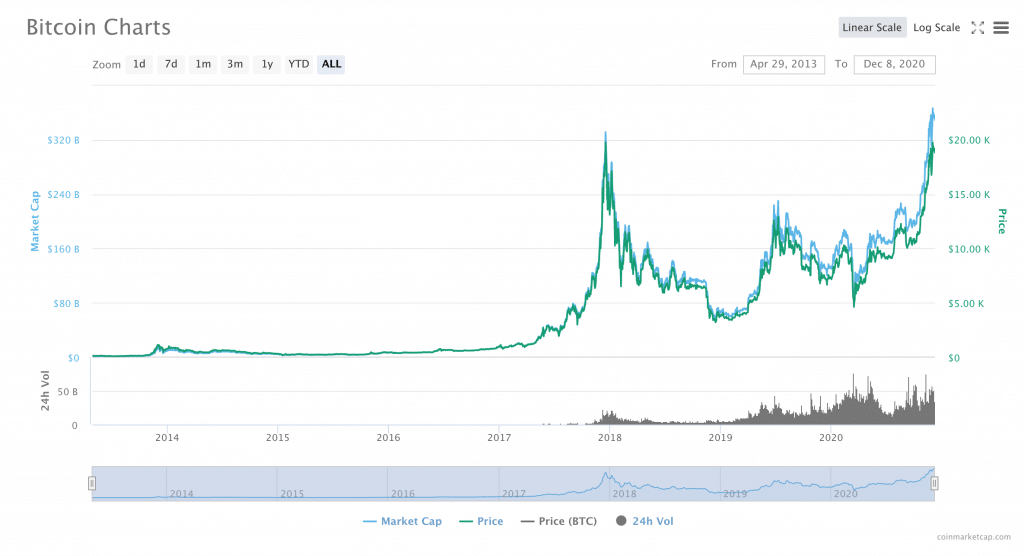
Additionally, beyond Bitcoin, crypto markets, in general, are at the center of more attention than ever before. As a result, the DeFi ecosystem is burgeoning; Ethereum is making progress toward the launch of Eth2.0. If things continue along this trajectory, 2021 could be a very good year for cryptocurrency.
Recently, Finance Magnates sat down with Simon Peters, Market Analyst at eToro, to discuss recent market movements in the cryptocurrency space, as well as what the most important trends and moments of 2020 have been so far.
This is an excerpt that has been edited for clarity and length. To hear Finance Magnates’ full interview with Simon Peters, Market Analyst at eToro, visit us on Soundcloud or Youtube.
“The Recent Price Movement Has Been Pretty Astonishing, to Say the Least.”
We asked Peters about his unique approach to market analysis.
“I try to keep things as simple as possible,” Peters said. “There’s a lot of information out there; there are a lot of technical analysis strategies. Because I’m more ‘long-term’, I tend to look at the bigger picture and the higher time frames.”
We asked Peters what kinds of fundamental trends that he sees driving Bitcoin at the moment.
“The recent price movement has been pretty astonishing, to say the least,” he said. Why is it happening? “I think it stems indirectly from COVID. That’s been a big factor for crypto markets.”
“Where we saw the crash in March, we saw a big selloff that week, we learned about economies, especially in the US, going into lockdown,” and how Bitcoin reacts to that, Peters said.
“Now that we’ve got a better idea in terms of what governments and central banks are doing regarding stimulus to prop up these global economies, the ‘bitcoin as an inflation hedge’ narrative has grown in strength since then,” he continued. “We’ve seen not just institutional investors and retail investors go on board, but listed companies actually buy Bitcoin for this purpose as well.”
“With a Price Increase That Happens That Fast, You Always Have to Anticipate a Period of Consolidation or Correction.”
Therefore, in spite of the fact that BTC’s recent push to $20k has happened rather quickly, Peters believes that the speed of the move was “warranted to some degree.”
“What we are seeing is a growing trend where the amount of Bitcoin that’s being held in exchange wallets is decreasing as the demand for Bitcoin is increasing,” he said. “That warrants the price increase that we have seen.”
However, “with a price increase that happens that fast, you always have to anticipate a period of consolidation or correction, so I think that’s on the cards,” he said. Still, “the overall trend, given what we’ve seen with this increase in ‘holding mentality’ amongst investors...that just spells good news for the price of crypto overall in the years to come.”
While price increases may be the main source of hype around Bitcoin and other cryptocurrencies, Peters believes that BTC actually has a much deeper value in terms of its potential benefits to society.
”Bitcoin Is the Natural Transition to the ‘New Money.’”
“You hear about Bitcoin being the ‘future of money’, and naturally you want to look at the history of money and how we’ve gotten to the state that we are in,” he said. “The more you look at the history of money, and how we’ve gone from the exchange of bars to gold coins, to dollars backed by gold, to what we have now, Bitcoin is the natural transition to the ‘new money.’”
“New money,” in this case, refers to a financial value system that is “peer-to-peer and has no central authority.”
Is another financial crisis on the horizon? “It could happen,” Peters said.
“If you look at stock markets and the amount of liquidity that’s being pumped into the system at the moment, you see stock prices going higher and higher, and some stock prices going even more volatile than Bitcoin this year, which is interesting to see,” he said. “How much higher can they keep going?”
“You have to ask yourself the question: when will we see a correction?” he said.
However, “whether this will turn into a full-blown financial crisis, we’ll have to, unfortunately, wait and see, but, if we do get to that situation, where there are restrictions on withdrawing cash and withdrawing money, that could present an opportunity for crypto. With crypto, you can freely move your money around, and no one can tell you what to do with it.”
“Bitcoin Has the Name; It’s the ‘Brand’ That People Associate the Crypto World With.”
Still, it is unclear whether this 'new money' will be Bitcoin or another cryptocurrency. After all, Bitcoin’s scalability issues have caused it to take on more of a role as a sort of ‘digital gold’ than ‘digital cash’ that it may have originally been created to be. In other words, BTC is much more practical as an asset to buy and hold than to try to use for everyday purchases.
“At the moment, it seems that Bitcoin is a ‘store-of-value’, ‘inflation hedge’, or ‘digital gold’. That seems to be the direction it’s going in, especially in times like now when we’re seeing central bank inflation and traditional markets increasing the monetary supply,” he said.
“There seem to be more advocates in support of Bitcoin for those reasons, but I think that in time when volatility decreases, and we see things stabilize, it may be seen as more of a currency,” Peters explained, adding that second-layer solutions could be used to make Bitcoin more suitable for this purpose.
Of course, “there’s also an ongoing argument going for central bank digital currencies (CBDCs) that says developing CBDCs negates the need for having a currency like Bitcoin. In some ways, you could argue that.”
However, “even though it’s technically a crypto asset, a CBDC could be highly centralized, and I think that if people do lose trust in the governmental financial system going forward, then it may just prompt the transition toward alternative assets.”
And Peters believes that “Bitcoin, more than any other currency at this time,” has the potential to be the alternative asset of choice.
“Bitcoin has the name; it’s the ‘brand’ that people associate the crypto world with,” he said.
Beyond Bitcoin
Peters said that beyond the Bitcoin world, as exciting as it has been in recent weeks, there is quite a lot of promising activity in the Ether space.
“What we’re seeing on Ethereum is quite exciting,” he said, specifically mentioning the progress that Ethereum has made toward launching Eth2.0.
Peters said that Eth2.0 will “enable more transactions” to run through the Ethereum network, and could also lower gas fees. In turn, this could improve Ethereum’s viability as the potential 'backbone' of the burgeoning decentralized finance (DeFi) ecosystem.
Peters said that in spite of the fact that “there are similarities to the ICO wave we saw back in 2017,” this time around, “there are some really good projects out there.”
This is an excerpt. To hear Finance Magnates’ full interview with Simon Peters, Market Analyst at eToro, visit us on Soundcloud or Youtube.
Additionally, beyond Bitcoin, crypto markets, in general, are at the center of more attention than ever before. As a result, the DeFi ecosystem is burgeoning; Ethereum is making progress toward the launch of Eth2.0. If things continue along this trajectory, 2021 could be a very good year for cryptocurrency.
Recently, Finance Magnates sat down with Simon Peters, Market Analyst at eToro, to discuss recent market movements in the cryptocurrency space, as well as what the most important trends and moments of 2020 have been so far.
This is an excerpt that has been edited for clarity and length. To hear Finance Magnates’ full interview with Simon Peters, Market Analyst at eToro, visit us on Soundcloud or Youtube.
“The Recent Price Movement Has Been Pretty Astonishing, to Say the Least.”
We asked Peters about his unique approach to market analysis.
“I try to keep things as simple as possible,” Peters said. “There’s a lot of information out there; there are a lot of technical analysis strategies. Because I’m more ‘long-term’, I tend to look at the bigger picture and the higher time frames.”
We asked Peters what kinds of fundamental trends that he sees driving Bitcoin at the moment.
“The recent price movement has been pretty astonishing, to say the least,” he said. Why is it happening? “I think it stems indirectly from COVID. That’s been a big factor for crypto markets.”
“Where we saw the crash in March, we saw a big selloff that week, we learned about economies, especially in the US, going into lockdown,” and how Bitcoin reacts to that, Peters said.
“Now that we’ve got a better idea in terms of what governments and central banks are doing regarding stimulus to prop up these global economies, the ‘bitcoin as an inflation hedge’ narrative has grown in strength since then,” he continued. “We’ve seen not just institutional investors and retail investors go on board, but listed companies actually buy Bitcoin for this purpose as well.”
“With a Price Increase That Happens That Fast, You Always Have to Anticipate a Period of Consolidation or Correction.”
Therefore, in spite of the fact that BTC’s recent push to $20k has happened rather quickly, Peters believes that the speed of the move was “warranted to some degree.”
“What we are seeing is a growing trend where the amount of Bitcoin that’s being held in exchange wallets is decreasing as the demand for Bitcoin is increasing,” he said. “That warrants the price increase that we have seen.”
However, “with a price increase that happens that fast, you always have to anticipate a period of consolidation or correction, so I think that’s on the cards,” he said. Still, “the overall trend, given what we’ve seen with this increase in ‘holding mentality’ amongst investors...that just spells good news for the price of crypto overall in the years to come.”
While price increases may be the main source of hype around Bitcoin and other cryptocurrencies, Peters believes that BTC actually has a much deeper value in terms of its potential benefits to society.
”Bitcoin Is the Natural Transition to the ‘New Money.’”
“You hear about Bitcoin being the ‘future of money’, and naturally you want to look at the history of money and how we’ve gotten to the state that we are in,” he said. “The more you look at the history of money, and how we’ve gone from the exchange of bars to gold coins, to dollars backed by gold, to what we have now, Bitcoin is the natural transition to the ‘new money.’”
“New money,” in this case, refers to a financial value system that is “peer-to-peer and has no central authority.”
Is another financial crisis on the horizon? “It could happen,” Peters said.
“If you look at stock markets and the amount of liquidity that’s being pumped into the system at the moment, you see stock prices going higher and higher, and some stock prices going even more volatile than Bitcoin this year, which is interesting to see,” he said. “How much higher can they keep going?”
“You have to ask yourself the question: when will we see a correction?” he said.
However, “whether this will turn into a full-blown financial crisis, we’ll have to, unfortunately, wait and see, but, if we do get to that situation, where there are restrictions on withdrawing cash and withdrawing money, that could present an opportunity for crypto. With crypto, you can freely move your money around, and no one can tell you what to do with it.”
“Bitcoin Has the Name; It’s the ‘Brand’ That People Associate the Crypto World With.”
Still, it is unclear whether this 'new money' will be Bitcoin or another cryptocurrency. After all, Bitcoin’s scalability issues have caused it to take on more of a role as a sort of ‘digital gold’ than ‘digital cash’ that it may have originally been created to be. In other words, BTC is much more practical as an asset to buy and hold than to try to use for everyday purchases.
“At the moment, it seems that Bitcoin is a ‘store-of-value’, ‘inflation hedge’, or ‘digital gold’. That seems to be the direction it’s going in, especially in times like now when we’re seeing central bank inflation and traditional markets increasing the monetary supply,” he said.
“There seem to be more advocates in support of Bitcoin for those reasons, but I think that in time when volatility decreases, and we see things stabilize, it may be seen as more of a currency,” Peters explained, adding that second-layer solutions could be used to make Bitcoin more suitable for this purpose.
Of course, “there’s also an ongoing argument going for central bank digital currencies (CBDCs) that says developing CBDCs negates the need for having a currency like Bitcoin. In some ways, you could argue that.”
However, “even though it’s technically a crypto asset, a CBDC could be highly centralized, and I think that if people do lose trust in the governmental financial system going forward, then it may just prompt the transition toward alternative assets.”
And Peters believes that “Bitcoin, more than any other currency at this time,” has the potential to be the alternative asset of choice.
“Bitcoin has the name; it’s the ‘brand’ that people associate the crypto world with,” he said.
Beyond Bitcoin
Peters said that beyond the Bitcoin world, as exciting as it has been in recent weeks, there is quite a lot of promising activity in the Ether space.
“What we’re seeing on Ethereum is quite exciting,” he said, specifically mentioning the progress that Ethereum has made toward launching Eth2.0.
Peters said that Eth2.0 will “enable more transactions” to run through the Ethereum network, and could also lower gas fees. In turn, this could improve Ethereum’s viability as the potential 'backbone' of the burgeoning decentralized finance (DeFi) ecosystem.
Peters said that in spite of the fact that “there are similarities to the ICO wave we saw back in 2017,” this time around, “there are some really good projects out there.”
This is an excerpt. To hear Finance Magnates’ full interview with Simon Peters, Market Analyst at eToro, visit us on Soundcloud or Youtube.
Rachel is a self-taught crypto geek and a passionate writer. She believes in the power that the written word has to educate, connect and empower individuals to make positive and powerful financial choices. She is the Podcast Host and a Cryptocurrency Editor at Finance Magnates.
Crypto Built More Rails, but the Next Battle Is Over How Much Work a Dollar Can Do
Featured Videos
FP Markets Winner Spotlight 🏆 | Global Broker of the Year 2025 #Trading #Broker #Innovation #Shorts
FP Markets Winner Spotlight 🏆 | Global Broker of the Year 2025 #Trading #Broker #Innovation #Shorts
FP Markets Winner Spotlight 🏆 | Global Broker of the Year 2025 #Trading #Broker #Innovation #Shorts
FP Markets Winner Spotlight 🏆 | Global Broker of the Year 2025 #Trading #Broker #Innovation #Shorts
FP Markets takes the spotlight as Global Broker of the Year 2025 at the Finance Magnates Awards.
Martin Stoilov, Head of Client Experience, shares that trust, innovation, and people played a key role in the company’s success, supported by a strong foundation of integrity and client-centricity.
Following this milestone, FP Markets continues to focus on growth, technology investment, and its core values of transparency and excellence.
👉 Be part of FM Awards 2026: https://awards.financemagnates.com/#nominate
FP Markets takes the spotlight as Global Broker of the Year 2025 at the Finance Magnates Awards.
Martin Stoilov, Head of Client Experience, shares that trust, innovation, and people played a key role in the company’s success, supported by a strong foundation of integrity and client-centricity.
Following this milestone, FP Markets continues to focus on growth, technology investment, and its core values of transparency and excellence.
👉 Be part of FM Awards 2026: https://awards.financemagnates.com/#nominate
FP Markets takes the spotlight as Global Broker of the Year 2025 at the Finance Magnates Awards.
Martin Stoilov, Head of Client Experience, shares that trust, innovation, and people played a key role in the company’s success, supported by a strong foundation of integrity and client-centricity.
Following this milestone, FP Markets continues to focus on growth, technology investment, and its core values of transparency and excellence.
👉 Be part of FM Awards 2026: https://awards.financemagnates.com/#nominate
FP Markets takes the spotlight as Global Broker of the Year 2025 at the Finance Magnates Awards.
Martin Stoilov, Head of Client Experience, shares that trust, innovation, and people played a key role in the company’s success, supported by a strong foundation of integrity and client-centricity.
Following this milestone, FP Markets continues to focus on growth, technology investment, and its core values of transparency and excellence.
👉 Be part of FM Awards 2026: https://awards.financemagnates.com/#nominate
In this video, we review @HolaPrimeMarketsOfficial, a multi-asset forex and CFDs broker offering different account types, trading platforms, and flexible trading conditions.
We cover the broker’s overall offering, including account options, trading environment, platforms like MT4 and MT5, and additional services such as managed accounts and fast withdrawals.
Watch the full video to see if Hola Prime Markets fits your trading needs.
📣 Stay up to date with the latest in finance and trading. Follow Finance Magnates for industry news, insights, and global event coverage.
Connect with us:
🔗 LinkedIn: /financemagnates
👍 Facebook: /financemagnates
📸 Instagram: https://www.instagram.com/financemagnates
🐦 X: https://x.com/financemagnates
🎥 TikTok: https://www.tiktok.com/tag/financemagnates
▶️ YouTube: /@financemagnates_official
#HolaPrime #ForexBroker #CFDTrading #FinanceMagnates #Trading #Forex #BrokerReview
In this video, we review @HolaPrimeMarketsOfficial, a multi-asset forex and CFDs broker offering different account types, trading platforms, and flexible trading conditions.
We cover the broker’s overall offering, including account options, trading environment, platforms like MT4 and MT5, and additional services such as managed accounts and fast withdrawals.
Watch the full video to see if Hola Prime Markets fits your trading needs.
📣 Stay up to date with the latest in finance and trading. Follow Finance Magnates for industry news, insights, and global event coverage.
Connect with us:
🔗 LinkedIn: /financemagnates
👍 Facebook: /financemagnates
📸 Instagram: https://www.instagram.com/financemagnates
🐦 X: https://x.com/financemagnates
🎥 TikTok: https://www.tiktok.com/tag/financemagnates
▶️ YouTube: /@financemagnates_official
#HolaPrime #ForexBroker #CFDTrading #FinanceMagnates #Trading #Forex #BrokerReview
In this video, we review @HolaPrimeMarketsOfficial, a multi-asset forex and CFDs broker offering different account types, trading platforms, and flexible trading conditions.
We cover the broker’s overall offering, including account options, trading environment, platforms like MT4 and MT5, and additional services such as managed accounts and fast withdrawals.
Watch the full video to see if Hola Prime Markets fits your trading needs.
📣 Stay up to date with the latest in finance and trading. Follow Finance Magnates for industry news, insights, and global event coverage.
Connect with us:
🔗 LinkedIn: /financemagnates
👍 Facebook: /financemagnates
📸 Instagram: https://www.instagram.com/financemagnates
🐦 X: https://x.com/financemagnates
🎥 TikTok: https://www.tiktok.com/tag/financemagnates
▶️ YouTube: /@financemagnates_official
#HolaPrime #ForexBroker #CFDTrading #FinanceMagnates #Trading #Forex #BrokerReview
In this video, we review @HolaPrimeMarketsOfficial, a multi-asset forex and CFDs broker offering different account types, trading platforms, and flexible trading conditions.
We cover the broker’s overall offering, including account options, trading environment, platforms like MT4 and MT5, and additional services such as managed accounts and fast withdrawals.
Watch the full video to see if Hola Prime Markets fits your trading needs.
📣 Stay up to date with the latest in finance and trading. Follow Finance Magnates for industry news, insights, and global event coverage.
Connect with us:
🔗 LinkedIn: /financemagnates
👍 Facebook: /financemagnates
📸 Instagram: https://www.instagram.com/financemagnates
🐦 X: https://x.com/financemagnates
🎥 TikTok: https://www.tiktok.com/tag/financemagnates
▶️ YouTube: /@financemagnates_official
#HolaPrime #ForexBroker #CFDTrading #FinanceMagnates #Trading #Forex #BrokerReview
In this video, we review @HolaPrimeMarketsOfficial, a multi-asset forex and CFDs broker offering different account types, trading platforms, and flexible trading conditions.
We cover the broker’s overall offering, including account options, trading environment, platforms like MT4 and MT5, and additional services such as managed accounts and fast withdrawals.
Watch the full video to see if Hola Prime Markets fits your trading needs.
📣 Stay up to date with the latest in finance and trading. Follow Finance Magnates for industry news, insights, and global event coverage.
Connect with us:
🔗 LinkedIn: /financemagnates
👍 Facebook: /financemagnates
📸 Instagram: https://www.instagram.com/financemagnates
🐦 X: https://x.com/financemagnates
🎥 TikTok: https://www.tiktok.com/tag/financemagnates
▶️ YouTube: /@financemagnates_official
#HolaPrime #ForexBroker #CFDTrading #FinanceMagnates #Trading #Forex #BrokerReview
In this video, we review @HolaPrimeMarketsOfficial, a multi-asset forex and CFDs broker offering different account types, trading platforms, and flexible trading conditions.
We cover the broker’s overall offering, including account options, trading environment, platforms like MT4 and MT5, and additional services such as managed accounts and fast withdrawals.
Watch the full video to see if Hola Prime Markets fits your trading needs.
📣 Stay up to date with the latest in finance and trading. Follow Finance Magnates for industry news, insights, and global event coverage.
Connect with us:
🔗 LinkedIn: /financemagnates
👍 Facebook: /financemagnates
📸 Instagram: https://www.instagram.com/financemagnates
🐦 X: https://x.com/financemagnates
🎥 TikTok: https://www.tiktok.com/tag/financemagnates
▶️ YouTube: /@financemagnates_official
#HolaPrime #ForexBroker #CFDTrading #FinanceMagnates #Trading #Forex #BrokerReview
Hola Prime Review: What You Need to Know | Full Breakdown by Finance Magnates
Hola Prime Review: What You Need to Know | Full Breakdown by Finance Magnates
Hola Prime Review: What You Need to Know | Full Breakdown by Finance Magnates
Hola Prime Review: What You Need to Know | Full Breakdown by Finance Magnates
Hola Prime Review: What You Need to Know | Full Breakdown by Finance Magnates
Hola Prime Review: What You Need to Know | Full Breakdown by Finance Magnates
In this video, we review @HolaPrime_Global, a proprietary trading firm offering evaluation programs and performance-based payouts in simulated market environments.
We cover how the challenge model works, including account types, profit splits (up to 95%), trading rules, and what it takes to reach a funded account. You’ll also learn about available platforms like MT4, MT5, cTrader, and more, along with insights into payouts, support, and trading conditions.
Watch the full video to see if Hola Prime fits your trading style.
📣 Stay up to date with the latest in finance and trading. Follow Finance Magnates for industry news, insights, and global event coverage.
Connect with us:
🔗 LinkedIn: /financemagnates
👍 Facebook: /financemagnates
📸 Instagram: https://www.instagram.com/financemagnates
🐦 X: https://x.com/financemagnates
🎥 TikTok: https://www.tiktok.com/tag/financemagnates
▶️ YouTube: /@financemagnates_official
#HolaPrime #PropFirm #Trading #FinanceMagnates #Forex #FuturesTrading #TradingReview #PropFirmReview
In this video, we review @HolaPrime_Global, a proprietary trading firm offering evaluation programs and performance-based payouts in simulated market environments.
We cover how the challenge model works, including account types, profit splits (up to 95%), trading rules, and what it takes to reach a funded account. You’ll also learn about available platforms like MT4, MT5, cTrader, and more, along with insights into payouts, support, and trading conditions.
Watch the full video to see if Hola Prime fits your trading style.
📣 Stay up to date with the latest in finance and trading. Follow Finance Magnates for industry news, insights, and global event coverage.
Connect with us:
🔗 LinkedIn: /financemagnates
👍 Facebook: /financemagnates
📸 Instagram: https://www.instagram.com/financemagnates
🐦 X: https://x.com/financemagnates
🎥 TikTok: https://www.tiktok.com/tag/financemagnates
▶️ YouTube: /@financemagnates_official
#HolaPrime #PropFirm #Trading #FinanceMagnates #Forex #FuturesTrading #TradingReview #PropFirmReview
In this video, we review @HolaPrime_Global, a proprietary trading firm offering evaluation programs and performance-based payouts in simulated market environments.
We cover how the challenge model works, including account types, profit splits (up to 95%), trading rules, and what it takes to reach a funded account. You’ll also learn about available platforms like MT4, MT5, cTrader, and more, along with insights into payouts, support, and trading conditions.
Watch the full video to see if Hola Prime fits your trading style.
📣 Stay up to date with the latest in finance and trading. Follow Finance Magnates for industry news, insights, and global event coverage.
Connect with us:
🔗 LinkedIn: /financemagnates
👍 Facebook: /financemagnates
📸 Instagram: https://www.instagram.com/financemagnates
🐦 X: https://x.com/financemagnates
🎥 TikTok: https://www.tiktok.com/tag/financemagnates
▶️ YouTube: /@financemagnates_official
#HolaPrime #PropFirm #Trading #FinanceMagnates #Forex #FuturesTrading #TradingReview #PropFirmReview
In this video, we review @HolaPrime_Global, a proprietary trading firm offering evaluation programs and performance-based payouts in simulated market environments.
We cover how the challenge model works, including account types, profit splits (up to 95%), trading rules, and what it takes to reach a funded account. You’ll also learn about available platforms like MT4, MT5, cTrader, and more, along with insights into payouts, support, and trading conditions.
Watch the full video to see if Hola Prime fits your trading style.
📣 Stay up to date with the latest in finance and trading. Follow Finance Magnates for industry news, insights, and global event coverage.
Connect with us:
🔗 LinkedIn: /financemagnates
👍 Facebook: /financemagnates
📸 Instagram: https://www.instagram.com/financemagnates
🐦 X: https://x.com/financemagnates
🎥 TikTok: https://www.tiktok.com/tag/financemagnates
▶️ YouTube: /@financemagnates_official
#HolaPrime #PropFirm #Trading #FinanceMagnates #Forex #FuturesTrading #TradingReview #PropFirmReview
In this video, we review @HolaPrime_Global, a proprietary trading firm offering evaluation programs and performance-based payouts in simulated market environments.
We cover how the challenge model works, including account types, profit splits (up to 95%), trading rules, and what it takes to reach a funded account. You’ll also learn about available platforms like MT4, MT5, cTrader, and more, along with insights into payouts, support, and trading conditions.
Watch the full video to see if Hola Prime fits your trading style.
📣 Stay up to date with the latest in finance and trading. Follow Finance Magnates for industry news, insights, and global event coverage.
Connect with us:
🔗 LinkedIn: /financemagnates
👍 Facebook: /financemagnates
📸 Instagram: https://www.instagram.com/financemagnates
🐦 X: https://x.com/financemagnates
🎥 TikTok: https://www.tiktok.com/tag/financemagnates
▶️ YouTube: /@financemagnates_official
#HolaPrime #PropFirm #Trading #FinanceMagnates #Forex #FuturesTrading #TradingReview #PropFirmReview
In this video, we review @HolaPrime_Global, a proprietary trading firm offering evaluation programs and performance-based payouts in simulated market environments.
We cover how the challenge model works, including account types, profit splits (up to 95%), trading rules, and what it takes to reach a funded account. You’ll also learn about available platforms like MT4, MT5, cTrader, and more, along with insights into payouts, support, and trading conditions.
Watch the full video to see if Hola Prime fits your trading style.
📣 Stay up to date with the latest in finance and trading. Follow Finance Magnates for industry news, insights, and global event coverage.
Connect with us:
🔗 LinkedIn: /financemagnates
👍 Facebook: /financemagnates
📸 Instagram: https://www.instagram.com/financemagnates
🐦 X: https://x.com/financemagnates
🎥 TikTok: https://www.tiktok.com/tag/financemagnates
▶️ YouTube: /@financemagnates_official
#HolaPrime #PropFirm #Trading #FinanceMagnates #Forex #FuturesTrading #TradingReview #PropFirmReview
Axi Winner Spotlight 🏆 | Global Most Innovative Broker 2025 #Innovation #Trading #Fintech #Broker
Axi Winner Spotlight 🏆 | Global Most Innovative Broker 2025 #Innovation #Trading #Fintech #Broker
Axi Winner Spotlight 🏆 | Global Most Innovative Broker 2025 #Innovation #Trading #Fintech #Broker
Axi Winner Spotlight 🏆 | Global Most Innovative Broker 2025 #Innovation #Trading #Fintech #Broker
Axi Winner Spotlight 🏆 | Global Most Innovative Broker 2025 #Innovation #Trading #Fintech #Broker
Axi Winner Spotlight 🏆 | Global Most Innovative Broker 2025 #Innovation #Trading #Fintech #Broker
Axi takes the spotlight at the Finance Magnates Awards, winning Global Most Innovative Broker 2025.
Olivia Xenofontos and Ivanna Openko share how the team will feel: proud, motivated, and ready to keep delivering.
They also describe the night as well-organized, focused, and enjoyable for all.
👉 Be part of FM Awards 2026.
Axi takes the spotlight at the Finance Magnates Awards, winning Global Most Innovative Broker 2025.
Olivia Xenofontos and Ivanna Openko share how the team will feel: proud, motivated, and ready to keep delivering.
They also describe the night as well-organized, focused, and enjoyable for all.
👉 Be part of FM Awards 2026.
Axi takes the spotlight at the Finance Magnates Awards, winning Global Most Innovative Broker 2025.
Olivia Xenofontos and Ivanna Openko share how the team will feel: proud, motivated, and ready to keep delivering.
They also describe the night as well-organized, focused, and enjoyable for all.
👉 Be part of FM Awards 2026.
Axi takes the spotlight at the Finance Magnates Awards, winning Global Most Innovative Broker 2025.
Olivia Xenofontos and Ivanna Openko share how the team will feel: proud, motivated, and ready to keep delivering.
They also describe the night as well-organized, focused, and enjoyable for all.
👉 Be part of FM Awards 2026.
Axi takes the spotlight at the Finance Magnates Awards, winning Global Most Innovative Broker 2025.
Olivia Xenofontos and Ivanna Openko share how the team will feel: proud, motivated, and ready to keep delivering.
They also describe the night as well-organized, focused, and enjoyable for all.
👉 Be part of FM Awards 2026.
Axi takes the spotlight at the Finance Magnates Awards, winning Global Most Innovative Broker 2025.
Olivia Xenofontos and Ivanna Openko share how the team will feel: proud, motivated, and ready to keep delivering.
They also describe the night as well-organized, focused, and enjoyable for all.
👉 Be part of FM Awards 2026.
Recognition that matters.
Built on transparency.
Driven by the industry.
The Finance Magnates Awards 2026.
Nominations are now open.
🔗 https://awards.financemagnates.com/?utm_source=SM&utm_medium=social&utm_campaign=recognition-matters
Recognition that matters.
Built on transparency.
Driven by the industry.
The Finance Magnates Awards 2026.
Nominations are now open.
🔗 https://awards.financemagnates.com/?utm_source=SM&utm_medium=social&utm_campaign=recognition-matters
Recognition that matters.
Built on transparency.
Driven by the industry.
The Finance Magnates Awards 2026.
Nominations are now open.
🔗 https://awards.financemagnates.com/?utm_source=SM&utm_medium=social&utm_campaign=recognition-matters
Recognition that matters.
Built on transparency.
Driven by the industry.
The Finance Magnates Awards 2026.
Nominations are now open.
🔗 https://awards.financemagnates.com/?utm_source=SM&utm_medium=social&utm_campaign=recognition-matters
Recognition that matters.
Built on transparency.
Driven by the industry.
The Finance Magnates Awards 2026.
Nominations are now open.
🔗 https://awards.financemagnates.com/?utm_source=SM&utm_medium=social&utm_campaign=recognition-matters
Recognition that matters.
Built on transparency.
Driven by the industry.
The Finance Magnates Awards 2026.
Nominations are now open.
🔗 https://awards.financemagnates.com/?utm_source=SM&utm_medium=social&utm_campaign=recognition-matters