Big movements in DeFi token prices could signify traders' uncertainty. What's causing markets to move?
FM
For much of the first three quarters of the year, the amount of capital in the DeFi space was climbing, seemingly without any end in sight.
However, it seems that change is in the air.
Indeed, after Ethereum network transaction fees skyrocketed last week, the DeFi space as a whole has been on a bit of a rollercoaster. Combined with this weekend’s SushiSwap debacle, token prices are all over the place.
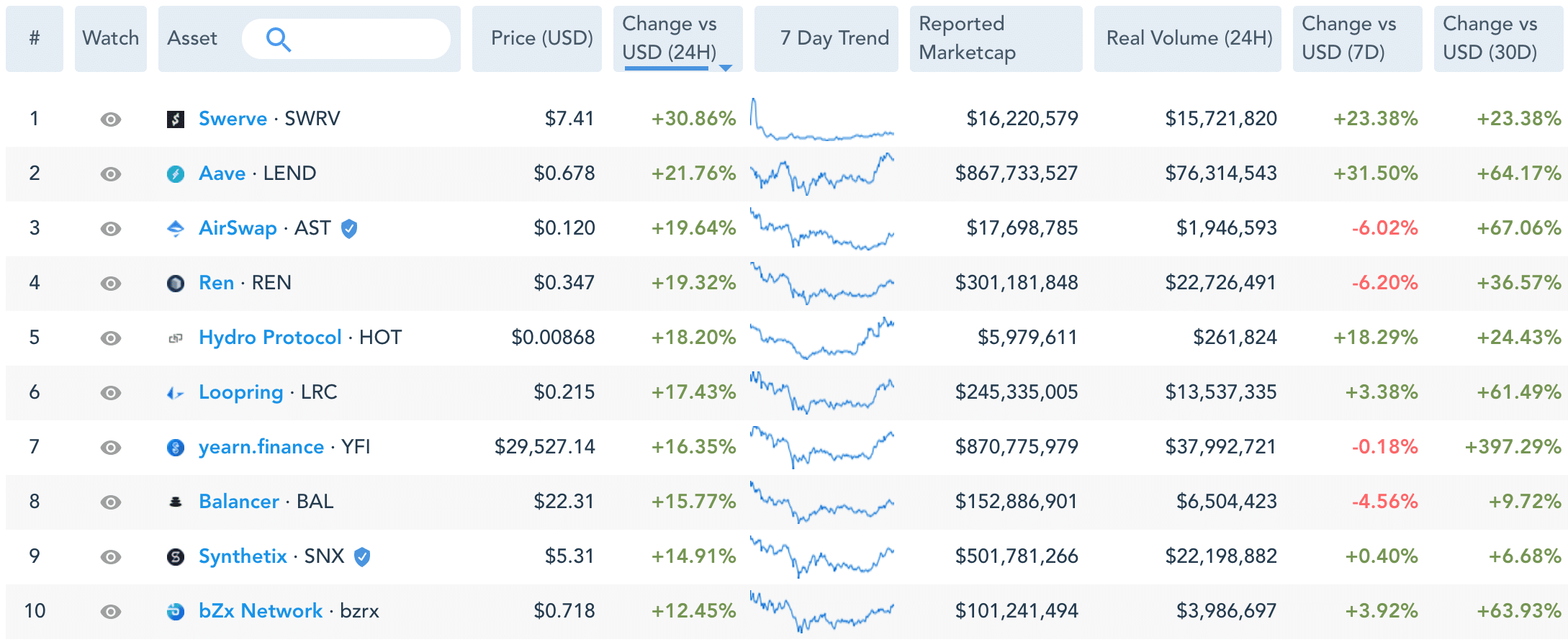
For example, yesterday, a number of analysts were saying that the DeFi 'bubble' had officially popped. According to data from cryptocurrency market analytics firm Messari, the prices of 32 out of 37 DeFi tokens were down over the course of seven days.
And the losses were nothing to sniff at: CoinTelegraph reported yesterday that Curve had lost 65 percent of its value; Meta followed closely behind with a 58 percent loss. Similarly, Ren, AirSwap, bZx Network, and Wrapped Nexus Mutual had all lost roughly 50 percent of their value.
Rough week in DeFi land with 6 assets dipping more than 50% + over the last 7 days
However, as of today, nearly all of those markets have made some kind of recovery. At press time, data from Messari showed that 32 the 37 tokens were back in the green, including the tokens that had lost out the worse earlier in the week.
The rapid upward and downward movements of token prices are enough to give one whiplash. What is driving the movements in the DeFi market, and are we headed toward further gains, or is this a period of cooling off?
“The Economic Fallout from the Coronavirus Has Contributed to the Growing Interest in DeFi."
Corey Caplan, a partner of the DeFi Money Market Foundation, told Finance Magnates that the primary driver behind interest in the DeFi space over the past several months has been the continuing economic turmoil brought about by the COVID-19 pandemic.
“The economic fallout from the coronavirus has contributed to the growing interest in DeFi, the core of which is the decentralization of finance to empower everyday people with more control over their own value,” he said.
Indeed, the DeFi ecosystem has presented a number of new earning opportunities to a growing audience with a healthy appetite for cash.
In a recent article for Finance Magnates,OKEx chief executive Jay Hao wrote that one such earning opportunity, namely, yield farming. It is one of the factors that has been driving DeFi token prices so high.
Essentially, yield farming the practice of earning fixed or variable interest by 'locking' cryptocurrency into a DeFi protocol. For example, while investing in ETH alone is not yield farming, lending out ETH tokens on Aave or another protocol for a return in addition to any ETH price appreciation would be considered yield farming.
Corey Caplan, partner of the DeFi Money Market Foundation.
It seems like a win-win, right? Token holders can earn higher gains while other users can gain access to loans and other financial services through decentralized platforms.
The Downside of DeFi Fever
However, the explosive popularity of yield farming and other ways of earning passive income through DeFi tokens and platforms has a dark side.
Specifically, Jay Hao explained that the feverish interest in DeFi farming may place too much strain on the DeFi ecosystem too soon.
Indeed, Hao said that yield farming “is starting to place too much pressure on the projects in the system.”
OKEx CEO Jay Hao.
“DeFi mania is forcing decentralized finance to run before it can walk and, if the pressure gets too great, could place a strain on its future development,” he explained.
There have already been a number of examples of DeFi projects running into serious trouble because of systemic issues.
Perhaps most famously is the Ethereum network itself: as more and more DeFi projects and decentralized applications have been built on top of the Ethereum network, the network has become congested with high transaction fees and low transaction speeds.
This has led a number of analysts to question Ethereum’s long-term viability as the backbone of the DeFi ecosystem, even with the update to ETH 2.0 on the horizon. Additionally, second-layer solutions that could help with Ethereum congestion exist, but have not been adopted in a meaningful way.
A Number of Hacks and Exploits Have Shown that DeFi Infrastructure May Have a Ways to Go before It Can Safely Hold Users’ Funds
Beyond the Ethereum network, there have been a number of incidents on DeFi protocols that have seriously called the readiness of DeFi ecosystem into question when it comes to taking care of users’ funds.
One of the most famous examples of this took place in April when Lendf.me, a subsect of the dForce DeFi platform, was exploited to the tune of $25 million.
The hacker eventually returned the funds, but the incident served as an important learning experience for the DeFi space as a whole. At the time of the hack, Anton Mozgovoy, chief technical officer of fintech firm Humaniq, told Finance Magnates that at the end of the day, “DeFi platforms are only as safe as the code they have.”
Anton Mozgovoy, chief technical officer of fintech firm Humaniq,
Since there is no standardized ‘quality assurance’ test for DeFi platforms. However, these platforms and their users are tested in a 'trial-by-fire' manner.
On the other hand, Bison Trails chief executive, Joe Lallouz told Finance Magnates in a recent interview that it is better for these kinds of incidents to happen sooner rather than later: “the sooner and faster that these things happen, the sooner and faster that these kinks can be ironed out, and the sooner that we can transition these services and products to be a little bit more ‘mainstream-ready'.”
“The pace of innovation in DeFi is fascinating, and the pace at which it’s being ‘battled-tested’ is also fascinating,” he said.
Joe Lallouz, founder and CEO of Bison Trails.
The Yield-Farming Craze
Beyond technical hurdles that may be holding the DeFi ecosystem back, speculators in DeFi token markets may be creating another set of issues in the decentralized finance space.
Specifically, Chris Williamson, principal at crypto advisory firm MB Technology Limited, told Finance Magnates that in the short-term, promises of high returns may lead token holders to 'lock' their coins into platforms that have no long-term viability.
“Unfortunately, these new users and the new money are driving projects to bring products to market [for the sole purpose of] chasing the money,” he said. “Many of these projects include token rewards that lack utility.”
As such, the DeFi space is beginning to look a bit similar to the ICO craze at the end of 2017: “we're seeing a flood of new tokens with little to no utility,” Williamson explained to Finance Magnates. “As such, these tokens aren't holding their value when sellers outnumber buyers.”
Chris Williamson, principal at crypto advisory firm MB Technology Limited.
Speculators Are Driving Token Prices Beyond Their Fundamental Value
And even when tokens do have utility in the systems they are designed to be used in, the DeFi token market seems to be so flooded with speculators that coin prices are still overbought.
“The ratio of speculative value is increasing compared to the fundamental value” in the DeFi ecosystem, he said.
“It’s not that these products are not amazing. They are super amazing, but when I see a several-thousand-dollar valuation for some kind of governance token, I’m not sure the capture mechanism allows for so much value to go up.”
Therefore, market corrections, including the one that happened over the course of the last week, are going to be a fairly regular occurrence as long as the ratio of speculative value to fundamental value is tipped toward the former.
Deniz Omer, head of ecosystem growth at Kyber Network.
And eventually (much like the ICO market), the ratio should tip further towards fundamental value, “especially as more people join in,” Deniz said.
For example, “in 2017, if you look at the actual value that existed, I would say that 98 percent of that was speculative value, and only two percent was fundamental value.
“Over 2018 and 2019, as the market deflated,” the ratio began to reverse course: “fundamental value went higher and higher, and speculative value kind of dropped.”
“In any nascent sphere, a single entity’s failure or success can have an outsized effect on the entire space.”
There have also been several incidents that have left a dark mark on the DeFi industry that have not involved technical problems or overbought token prices.
Rather, these incidents have involved elements of bad faith: exit scams and other kinds of fraud that are not as common as they were during the ICO craze of late 2017 where there have been several mishaps.
While incidents of fraud were much more commonplace in the ICO sphere, both incidents have been the subject of much conversation. Corey Caplan pointed out that though much less frequent, incidents of fraud in the DeFi space could be having a large impact.
“In any nascent sphere, a single entity’s failure or success can have an outsized effect on the entire space,” he said. “This is what happened with the SushiSwap snafu, but I don't believe this incident should be viewed as an encapsulation of the entire DeFi ecosystem.”
Indeed, despite the many growing pains of DeFi, things are moving ahead. “Developments such as yield farming and other neat incentivization schemes continue to spark interest among traders and those newer to crypto who are interested in how to gain more value for themselves. On-chain activity continues to thrive and protocol developments are continuing forward."
Therefore, while the market may continue to correct itself in the short term, DeFi seems to be poised for a major expansion over the long term.
What are your thoughts on the growth of the DeFi ecosystem? Let us know in the comments below.
For much of the first three quarters of the year, the amount of capital in the DeFi space was climbing, seemingly without any end in sight.
However, it seems that change is in the air.
Indeed, after Ethereum network transaction fees skyrocketed last week, the DeFi space as a whole has been on a bit of a rollercoaster. Combined with this weekend’s SushiSwap debacle, token prices are all over the place.
For example, yesterday, a number of analysts were saying that the DeFi 'bubble' had officially popped. According to data from cryptocurrency market analytics firm Messari, the prices of 32 out of 37 DeFi tokens were down over the course of seven days.
And the losses were nothing to sniff at: CoinTelegraph reported yesterday that Curve had lost 65 percent of its value; Meta followed closely behind with a 58 percent loss. Similarly, Ren, AirSwap, bZx Network, and Wrapped Nexus Mutual had all lost roughly 50 percent of their value.
Rough week in DeFi land with 6 assets dipping more than 50% + over the last 7 days
However, as of today, nearly all of those markets have made some kind of recovery. At press time, data from Messari showed that 32 the 37 tokens were back in the green, including the tokens that had lost out the worse earlier in the week.
The rapid upward and downward movements of token prices are enough to give one whiplash. What is driving the movements in the DeFi market, and are we headed toward further gains, or is this a period of cooling off?
“The Economic Fallout from the Coronavirus Has Contributed to the Growing Interest in DeFi."
Corey Caplan, a partner of the DeFi Money Market Foundation, told Finance Magnates that the primary driver behind interest in the DeFi space over the past several months has been the continuing economic turmoil brought about by the COVID-19 pandemic.
“The economic fallout from the coronavirus has contributed to the growing interest in DeFi, the core of which is the decentralization of finance to empower everyday people with more control over their own value,” he said.
Indeed, the DeFi ecosystem has presented a number of new earning opportunities to a growing audience with a healthy appetite for cash.
In a recent article for Finance Magnates,OKEx chief executive Jay Hao wrote that one such earning opportunity, namely, yield farming. It is one of the factors that has been driving DeFi token prices so high.
Essentially, yield farming the practice of earning fixed or variable interest by 'locking' cryptocurrency into a DeFi protocol. For example, while investing in ETH alone is not yield farming, lending out ETH tokens on Aave or another protocol for a return in addition to any ETH price appreciation would be considered yield farming.
Corey Caplan, partner of the DeFi Money Market Foundation.
It seems like a win-win, right? Token holders can earn higher gains while other users can gain access to loans and other financial services through decentralized platforms.
The Downside of DeFi Fever
However, the explosive popularity of yield farming and other ways of earning passive income through DeFi tokens and platforms has a dark side.
Specifically, Jay Hao explained that the feverish interest in DeFi farming may place too much strain on the DeFi ecosystem too soon.
Indeed, Hao said that yield farming “is starting to place too much pressure on the projects in the system.”
OKEx CEO Jay Hao.
“DeFi mania is forcing decentralized finance to run before it can walk and, if the pressure gets too great, could place a strain on its future development,” he explained.
There have already been a number of examples of DeFi projects running into serious trouble because of systemic issues.
Perhaps most famously is the Ethereum network itself: as more and more DeFi projects and decentralized applications have been built on top of the Ethereum network, the network has become congested with high transaction fees and low transaction speeds.
This has led a number of analysts to question Ethereum’s long-term viability as the backbone of the DeFi ecosystem, even with the update to ETH 2.0 on the horizon. Additionally, second-layer solutions that could help with Ethereum congestion exist, but have not been adopted in a meaningful way.
A Number of Hacks and Exploits Have Shown that DeFi Infrastructure May Have a Ways to Go before It Can Safely Hold Users’ Funds
Beyond the Ethereum network, there have been a number of incidents on DeFi protocols that have seriously called the readiness of DeFi ecosystem into question when it comes to taking care of users’ funds.
One of the most famous examples of this took place in April when Lendf.me, a subsect of the dForce DeFi platform, was exploited to the tune of $25 million.
The hacker eventually returned the funds, but the incident served as an important learning experience for the DeFi space as a whole. At the time of the hack, Anton Mozgovoy, chief technical officer of fintech firm Humaniq, told Finance Magnates that at the end of the day, “DeFi platforms are only as safe as the code they have.”
Anton Mozgovoy, chief technical officer of fintech firm Humaniq,
Since there is no standardized ‘quality assurance’ test for DeFi platforms. However, these platforms and their users are tested in a 'trial-by-fire' manner.
On the other hand, Bison Trails chief executive, Joe Lallouz told Finance Magnates in a recent interview that it is better for these kinds of incidents to happen sooner rather than later: “the sooner and faster that these things happen, the sooner and faster that these kinks can be ironed out, and the sooner that we can transition these services and products to be a little bit more ‘mainstream-ready'.”
“The pace of innovation in DeFi is fascinating, and the pace at which it’s being ‘battled-tested’ is also fascinating,” he said.
Joe Lallouz, founder and CEO of Bison Trails.
The Yield-Farming Craze
Beyond technical hurdles that may be holding the DeFi ecosystem back, speculators in DeFi token markets may be creating another set of issues in the decentralized finance space.
Specifically, Chris Williamson, principal at crypto advisory firm MB Technology Limited, told Finance Magnates that in the short-term, promises of high returns may lead token holders to 'lock' their coins into platforms that have no long-term viability.
“Unfortunately, these new users and the new money are driving projects to bring products to market [for the sole purpose of] chasing the money,” he said. “Many of these projects include token rewards that lack utility.”
As such, the DeFi space is beginning to look a bit similar to the ICO craze at the end of 2017: “we're seeing a flood of new tokens with little to no utility,” Williamson explained to Finance Magnates. “As such, these tokens aren't holding their value when sellers outnumber buyers.”
Chris Williamson, principal at crypto advisory firm MB Technology Limited.
Speculators Are Driving Token Prices Beyond Their Fundamental Value
And even when tokens do have utility in the systems they are designed to be used in, the DeFi token market seems to be so flooded with speculators that coin prices are still overbought.
“The ratio of speculative value is increasing compared to the fundamental value” in the DeFi ecosystem, he said.
“It’s not that these products are not amazing. They are super amazing, but when I see a several-thousand-dollar valuation for some kind of governance token, I’m not sure the capture mechanism allows for so much value to go up.”
Therefore, market corrections, including the one that happened over the course of the last week, are going to be a fairly regular occurrence as long as the ratio of speculative value to fundamental value is tipped toward the former.
Deniz Omer, head of ecosystem growth at Kyber Network.
And eventually (much like the ICO market), the ratio should tip further towards fundamental value, “especially as more people join in,” Deniz said.
For example, “in 2017, if you look at the actual value that existed, I would say that 98 percent of that was speculative value, and only two percent was fundamental value.
“Over 2018 and 2019, as the market deflated,” the ratio began to reverse course: “fundamental value went higher and higher, and speculative value kind of dropped.”
“In any nascent sphere, a single entity’s failure or success can have an outsized effect on the entire space.”
There have also been several incidents that have left a dark mark on the DeFi industry that have not involved technical problems or overbought token prices.
Rather, these incidents have involved elements of bad faith: exit scams and other kinds of fraud that are not as common as they were during the ICO craze of late 2017 where there have been several mishaps.
While incidents of fraud were much more commonplace in the ICO sphere, both incidents have been the subject of much conversation. Corey Caplan pointed out that though much less frequent, incidents of fraud in the DeFi space could be having a large impact.
“In any nascent sphere, a single entity’s failure or success can have an outsized effect on the entire space,” he said. “This is what happened with the SushiSwap snafu, but I don't believe this incident should be viewed as an encapsulation of the entire DeFi ecosystem.”
Indeed, despite the many growing pains of DeFi, things are moving ahead. “Developments such as yield farming and other neat incentivization schemes continue to spark interest among traders and those newer to crypto who are interested in how to gain more value for themselves. On-chain activity continues to thrive and protocol developments are continuing forward."
Therefore, while the market may continue to correct itself in the short term, DeFi seems to be poised for a major expansion over the long term.
What are your thoughts on the growth of the DeFi ecosystem? Let us know in the comments below.
Rachel is a self-taught crypto geek and a passionate writer. She believes in the power that the written word has to educate, connect and empower individuals to make positive and powerful financial choices. She is the Podcast Host and a Cryptocurrency Editor at Finance Magnates.
Crypto Built More Rails, but the Next Battle Is Over How Much Work a Dollar Can Do
Featured Videos
FP Markets Winner Spotlight 🏆 | Global Broker of the Year 2025 #Trading #Broker #Innovation #Shorts
FP Markets Winner Spotlight 🏆 | Global Broker of the Year 2025 #Trading #Broker #Innovation #Shorts
FP Markets Winner Spotlight 🏆 | Global Broker of the Year 2025 #Trading #Broker #Innovation #Shorts
FP Markets Winner Spotlight 🏆 | Global Broker of the Year 2025 #Trading #Broker #Innovation #Shorts
FP Markets takes the spotlight as Global Broker of the Year 2025 at the Finance Magnates Awards.
Martin Stoilov, Head of Client Experience, shares that trust, innovation, and people played a key role in the company’s success, supported by a strong foundation of integrity and client-centricity.
Following this milestone, FP Markets continues to focus on growth, technology investment, and its core values of transparency and excellence.
👉 Be part of FM Awards 2026: https://awards.financemagnates.com/#nominate
FP Markets takes the spotlight as Global Broker of the Year 2025 at the Finance Magnates Awards.
Martin Stoilov, Head of Client Experience, shares that trust, innovation, and people played a key role in the company’s success, supported by a strong foundation of integrity and client-centricity.
Following this milestone, FP Markets continues to focus on growth, technology investment, and its core values of transparency and excellence.
👉 Be part of FM Awards 2026: https://awards.financemagnates.com/#nominate
FP Markets takes the spotlight as Global Broker of the Year 2025 at the Finance Magnates Awards.
Martin Stoilov, Head of Client Experience, shares that trust, innovation, and people played a key role in the company’s success, supported by a strong foundation of integrity and client-centricity.
Following this milestone, FP Markets continues to focus on growth, technology investment, and its core values of transparency and excellence.
👉 Be part of FM Awards 2026: https://awards.financemagnates.com/#nominate
FP Markets takes the spotlight as Global Broker of the Year 2025 at the Finance Magnates Awards.
Martin Stoilov, Head of Client Experience, shares that trust, innovation, and people played a key role in the company’s success, supported by a strong foundation of integrity and client-centricity.
Following this milestone, FP Markets continues to focus on growth, technology investment, and its core values of transparency and excellence.
👉 Be part of FM Awards 2026: https://awards.financemagnates.com/#nominate
In this video, we review @HolaPrimeMarketsOfficial, a multi-asset forex and CFDs broker offering different account types, trading platforms, and flexible trading conditions.
We cover the broker’s overall offering, including account options, trading environment, platforms like MT4 and MT5, and additional services such as managed accounts and fast withdrawals.
Watch the full video to see if Hola Prime Markets fits your trading needs.
📣 Stay up to date with the latest in finance and trading. Follow Finance Magnates for industry news, insights, and global event coverage.
Connect with us:
🔗 LinkedIn: /financemagnates
👍 Facebook: /financemagnates
📸 Instagram: https://www.instagram.com/financemagnates
🐦 X: https://x.com/financemagnates
🎥 TikTok: https://www.tiktok.com/tag/financemagnates
▶️ YouTube: /@financemagnates_official
#HolaPrime #ForexBroker #CFDTrading #FinanceMagnates #Trading #Forex #BrokerReview
In this video, we review @HolaPrimeMarketsOfficial, a multi-asset forex and CFDs broker offering different account types, trading platforms, and flexible trading conditions.
We cover the broker’s overall offering, including account options, trading environment, platforms like MT4 and MT5, and additional services such as managed accounts and fast withdrawals.
Watch the full video to see if Hola Prime Markets fits your trading needs.
📣 Stay up to date with the latest in finance and trading. Follow Finance Magnates for industry news, insights, and global event coverage.
Connect with us:
🔗 LinkedIn: /financemagnates
👍 Facebook: /financemagnates
📸 Instagram: https://www.instagram.com/financemagnates
🐦 X: https://x.com/financemagnates
🎥 TikTok: https://www.tiktok.com/tag/financemagnates
▶️ YouTube: /@financemagnates_official
#HolaPrime #ForexBroker #CFDTrading #FinanceMagnates #Trading #Forex #BrokerReview
In this video, we review @HolaPrimeMarketsOfficial, a multi-asset forex and CFDs broker offering different account types, trading platforms, and flexible trading conditions.
We cover the broker’s overall offering, including account options, trading environment, platforms like MT4 and MT5, and additional services such as managed accounts and fast withdrawals.
Watch the full video to see if Hola Prime Markets fits your trading needs.
📣 Stay up to date with the latest in finance and trading. Follow Finance Magnates for industry news, insights, and global event coverage.
Connect with us:
🔗 LinkedIn: /financemagnates
👍 Facebook: /financemagnates
📸 Instagram: https://www.instagram.com/financemagnates
🐦 X: https://x.com/financemagnates
🎥 TikTok: https://www.tiktok.com/tag/financemagnates
▶️ YouTube: /@financemagnates_official
#HolaPrime #ForexBroker #CFDTrading #FinanceMagnates #Trading #Forex #BrokerReview
In this video, we review @HolaPrimeMarketsOfficial, a multi-asset forex and CFDs broker offering different account types, trading platforms, and flexible trading conditions.
We cover the broker’s overall offering, including account options, trading environment, platforms like MT4 and MT5, and additional services such as managed accounts and fast withdrawals.
Watch the full video to see if Hola Prime Markets fits your trading needs.
📣 Stay up to date with the latest in finance and trading. Follow Finance Magnates for industry news, insights, and global event coverage.
Connect with us:
🔗 LinkedIn: /financemagnates
👍 Facebook: /financemagnates
📸 Instagram: https://www.instagram.com/financemagnates
🐦 X: https://x.com/financemagnates
🎥 TikTok: https://www.tiktok.com/tag/financemagnates
▶️ YouTube: /@financemagnates_official
#HolaPrime #ForexBroker #CFDTrading #FinanceMagnates #Trading #Forex #BrokerReview
In this video, we review @HolaPrimeMarketsOfficial, a multi-asset forex and CFDs broker offering different account types, trading platforms, and flexible trading conditions.
We cover the broker’s overall offering, including account options, trading environment, platforms like MT4 and MT5, and additional services such as managed accounts and fast withdrawals.
Watch the full video to see if Hola Prime Markets fits your trading needs.
📣 Stay up to date with the latest in finance and trading. Follow Finance Magnates for industry news, insights, and global event coverage.
Connect with us:
🔗 LinkedIn: /financemagnates
👍 Facebook: /financemagnates
📸 Instagram: https://www.instagram.com/financemagnates
🐦 X: https://x.com/financemagnates
🎥 TikTok: https://www.tiktok.com/tag/financemagnates
▶️ YouTube: /@financemagnates_official
#HolaPrime #ForexBroker #CFDTrading #FinanceMagnates #Trading #Forex #BrokerReview
In this video, we review @HolaPrimeMarketsOfficial, a multi-asset forex and CFDs broker offering different account types, trading platforms, and flexible trading conditions.
We cover the broker’s overall offering, including account options, trading environment, platforms like MT4 and MT5, and additional services such as managed accounts and fast withdrawals.
Watch the full video to see if Hola Prime Markets fits your trading needs.
📣 Stay up to date with the latest in finance and trading. Follow Finance Magnates for industry news, insights, and global event coverage.
Connect with us:
🔗 LinkedIn: /financemagnates
👍 Facebook: /financemagnates
📸 Instagram: https://www.instagram.com/financemagnates
🐦 X: https://x.com/financemagnates
🎥 TikTok: https://www.tiktok.com/tag/financemagnates
▶️ YouTube: /@financemagnates_official
#HolaPrime #ForexBroker #CFDTrading #FinanceMagnates #Trading #Forex #BrokerReview
Hola Prime Review: What You Need to Know | Full Breakdown by Finance Magnates
Hola Prime Review: What You Need to Know | Full Breakdown by Finance Magnates
Hola Prime Review: What You Need to Know | Full Breakdown by Finance Magnates
Hola Prime Review: What You Need to Know | Full Breakdown by Finance Magnates
Hola Prime Review: What You Need to Know | Full Breakdown by Finance Magnates
Hola Prime Review: What You Need to Know | Full Breakdown by Finance Magnates
In this video, we review @HolaPrime_Global, a proprietary trading firm offering evaluation programs and performance-based payouts in simulated market environments.
We cover how the challenge model works, including account types, profit splits (up to 95%), trading rules, and what it takes to reach a funded account. You’ll also learn about available platforms like MT4, MT5, cTrader, and more, along with insights into payouts, support, and trading conditions.
Watch the full video to see if Hola Prime fits your trading style.
📣 Stay up to date with the latest in finance and trading. Follow Finance Magnates for industry news, insights, and global event coverage.
Connect with us:
🔗 LinkedIn: /financemagnates
👍 Facebook: /financemagnates
📸 Instagram: https://www.instagram.com/financemagnates
🐦 X: https://x.com/financemagnates
🎥 TikTok: https://www.tiktok.com/tag/financemagnates
▶️ YouTube: /@financemagnates_official
#HolaPrime #PropFirm #Trading #FinanceMagnates #Forex #FuturesTrading #TradingReview #PropFirmReview
In this video, we review @HolaPrime_Global, a proprietary trading firm offering evaluation programs and performance-based payouts in simulated market environments.
We cover how the challenge model works, including account types, profit splits (up to 95%), trading rules, and what it takes to reach a funded account. You’ll also learn about available platforms like MT4, MT5, cTrader, and more, along with insights into payouts, support, and trading conditions.
Watch the full video to see if Hola Prime fits your trading style.
📣 Stay up to date with the latest in finance and trading. Follow Finance Magnates for industry news, insights, and global event coverage.
Connect with us:
🔗 LinkedIn: /financemagnates
👍 Facebook: /financemagnates
📸 Instagram: https://www.instagram.com/financemagnates
🐦 X: https://x.com/financemagnates
🎥 TikTok: https://www.tiktok.com/tag/financemagnates
▶️ YouTube: /@financemagnates_official
#HolaPrime #PropFirm #Trading #FinanceMagnates #Forex #FuturesTrading #TradingReview #PropFirmReview
In this video, we review @HolaPrime_Global, a proprietary trading firm offering evaluation programs and performance-based payouts in simulated market environments.
We cover how the challenge model works, including account types, profit splits (up to 95%), trading rules, and what it takes to reach a funded account. You’ll also learn about available platforms like MT4, MT5, cTrader, and more, along with insights into payouts, support, and trading conditions.
Watch the full video to see if Hola Prime fits your trading style.
📣 Stay up to date with the latest in finance and trading. Follow Finance Magnates for industry news, insights, and global event coverage.
Connect with us:
🔗 LinkedIn: /financemagnates
👍 Facebook: /financemagnates
📸 Instagram: https://www.instagram.com/financemagnates
🐦 X: https://x.com/financemagnates
🎥 TikTok: https://www.tiktok.com/tag/financemagnates
▶️ YouTube: /@financemagnates_official
#HolaPrime #PropFirm #Trading #FinanceMagnates #Forex #FuturesTrading #TradingReview #PropFirmReview
In this video, we review @HolaPrime_Global, a proprietary trading firm offering evaluation programs and performance-based payouts in simulated market environments.
We cover how the challenge model works, including account types, profit splits (up to 95%), trading rules, and what it takes to reach a funded account. You’ll also learn about available platforms like MT4, MT5, cTrader, and more, along with insights into payouts, support, and trading conditions.
Watch the full video to see if Hola Prime fits your trading style.
📣 Stay up to date with the latest in finance and trading. Follow Finance Magnates for industry news, insights, and global event coverage.
Connect with us:
🔗 LinkedIn: /financemagnates
👍 Facebook: /financemagnates
📸 Instagram: https://www.instagram.com/financemagnates
🐦 X: https://x.com/financemagnates
🎥 TikTok: https://www.tiktok.com/tag/financemagnates
▶️ YouTube: /@financemagnates_official
#HolaPrime #PropFirm #Trading #FinanceMagnates #Forex #FuturesTrading #TradingReview #PropFirmReview
In this video, we review @HolaPrime_Global, a proprietary trading firm offering evaluation programs and performance-based payouts in simulated market environments.
We cover how the challenge model works, including account types, profit splits (up to 95%), trading rules, and what it takes to reach a funded account. You’ll also learn about available platforms like MT4, MT5, cTrader, and more, along with insights into payouts, support, and trading conditions.
Watch the full video to see if Hola Prime fits your trading style.
📣 Stay up to date with the latest in finance and trading. Follow Finance Magnates for industry news, insights, and global event coverage.
Connect with us:
🔗 LinkedIn: /financemagnates
👍 Facebook: /financemagnates
📸 Instagram: https://www.instagram.com/financemagnates
🐦 X: https://x.com/financemagnates
🎥 TikTok: https://www.tiktok.com/tag/financemagnates
▶️ YouTube: /@financemagnates_official
#HolaPrime #PropFirm #Trading #FinanceMagnates #Forex #FuturesTrading #TradingReview #PropFirmReview
In this video, we review @HolaPrime_Global, a proprietary trading firm offering evaluation programs and performance-based payouts in simulated market environments.
We cover how the challenge model works, including account types, profit splits (up to 95%), trading rules, and what it takes to reach a funded account. You’ll also learn about available platforms like MT4, MT5, cTrader, and more, along with insights into payouts, support, and trading conditions.
Watch the full video to see if Hola Prime fits your trading style.
📣 Stay up to date with the latest in finance and trading. Follow Finance Magnates for industry news, insights, and global event coverage.
Connect with us:
🔗 LinkedIn: /financemagnates
👍 Facebook: /financemagnates
📸 Instagram: https://www.instagram.com/financemagnates
🐦 X: https://x.com/financemagnates
🎥 TikTok: https://www.tiktok.com/tag/financemagnates
▶️ YouTube: /@financemagnates_official
#HolaPrime #PropFirm #Trading #FinanceMagnates #Forex #FuturesTrading #TradingReview #PropFirmReview
Axi Winner Spotlight 🏆 | Global Most Innovative Broker 2025 #Innovation #Trading #Fintech #Broker
Axi Winner Spotlight 🏆 | Global Most Innovative Broker 2025 #Innovation #Trading #Fintech #Broker
Axi Winner Spotlight 🏆 | Global Most Innovative Broker 2025 #Innovation #Trading #Fintech #Broker
Axi Winner Spotlight 🏆 | Global Most Innovative Broker 2025 #Innovation #Trading #Fintech #Broker
Axi Winner Spotlight 🏆 | Global Most Innovative Broker 2025 #Innovation #Trading #Fintech #Broker
Axi Winner Spotlight 🏆 | Global Most Innovative Broker 2025 #Innovation #Trading #Fintech #Broker
Axi takes the spotlight at the Finance Magnates Awards, winning Global Most Innovative Broker 2025.
Olivia Xenofontos and Ivanna Openko share how the team will feel: proud, motivated, and ready to keep delivering.
They also describe the night as well-organized, focused, and enjoyable for all.
👉 Be part of FM Awards 2026.
Axi takes the spotlight at the Finance Magnates Awards, winning Global Most Innovative Broker 2025.
Olivia Xenofontos and Ivanna Openko share how the team will feel: proud, motivated, and ready to keep delivering.
They also describe the night as well-organized, focused, and enjoyable for all.
👉 Be part of FM Awards 2026.
Axi takes the spotlight at the Finance Magnates Awards, winning Global Most Innovative Broker 2025.
Olivia Xenofontos and Ivanna Openko share how the team will feel: proud, motivated, and ready to keep delivering.
They also describe the night as well-organized, focused, and enjoyable for all.
👉 Be part of FM Awards 2026.
Axi takes the spotlight at the Finance Magnates Awards, winning Global Most Innovative Broker 2025.
Olivia Xenofontos and Ivanna Openko share how the team will feel: proud, motivated, and ready to keep delivering.
They also describe the night as well-organized, focused, and enjoyable for all.
👉 Be part of FM Awards 2026.
Axi takes the spotlight at the Finance Magnates Awards, winning Global Most Innovative Broker 2025.
Olivia Xenofontos and Ivanna Openko share how the team will feel: proud, motivated, and ready to keep delivering.
They also describe the night as well-organized, focused, and enjoyable for all.
👉 Be part of FM Awards 2026.
Axi takes the spotlight at the Finance Magnates Awards, winning Global Most Innovative Broker 2025.
Olivia Xenofontos and Ivanna Openko share how the team will feel: proud, motivated, and ready to keep delivering.
They also describe the night as well-organized, focused, and enjoyable for all.
👉 Be part of FM Awards 2026.
Recognition that matters.
Built on transparency.
Driven by the industry.
The Finance Magnates Awards 2026.
Nominations are now open.
🔗 https://awards.financemagnates.com/?utm_source=SM&utm_medium=social&utm_campaign=recognition-matters
Recognition that matters.
Built on transparency.
Driven by the industry.
The Finance Magnates Awards 2026.
Nominations are now open.
🔗 https://awards.financemagnates.com/?utm_source=SM&utm_medium=social&utm_campaign=recognition-matters
Recognition that matters.
Built on transparency.
Driven by the industry.
The Finance Magnates Awards 2026.
Nominations are now open.
🔗 https://awards.financemagnates.com/?utm_source=SM&utm_medium=social&utm_campaign=recognition-matters
Recognition that matters.
Built on transparency.
Driven by the industry.
The Finance Magnates Awards 2026.
Nominations are now open.
🔗 https://awards.financemagnates.com/?utm_source=SM&utm_medium=social&utm_campaign=recognition-matters
Recognition that matters.
Built on transparency.
Driven by the industry.
The Finance Magnates Awards 2026.
Nominations are now open.
🔗 https://awards.financemagnates.com/?utm_source=SM&utm_medium=social&utm_campaign=recognition-matters
Recognition that matters.
Built on transparency.
Driven by the industry.
The Finance Magnates Awards 2026.
Nominations are now open.
🔗 https://awards.financemagnates.com/?utm_source=SM&utm_medium=social&utm_campaign=recognition-matters