The trouble started over the weekend, when the pseudonymous founder of SushiSwap, known only as ‘Chef Nomi’, suddenly made the decision to sell all of his SUSHI tokens. A move that caused the token price to suddenly take a significant dive.
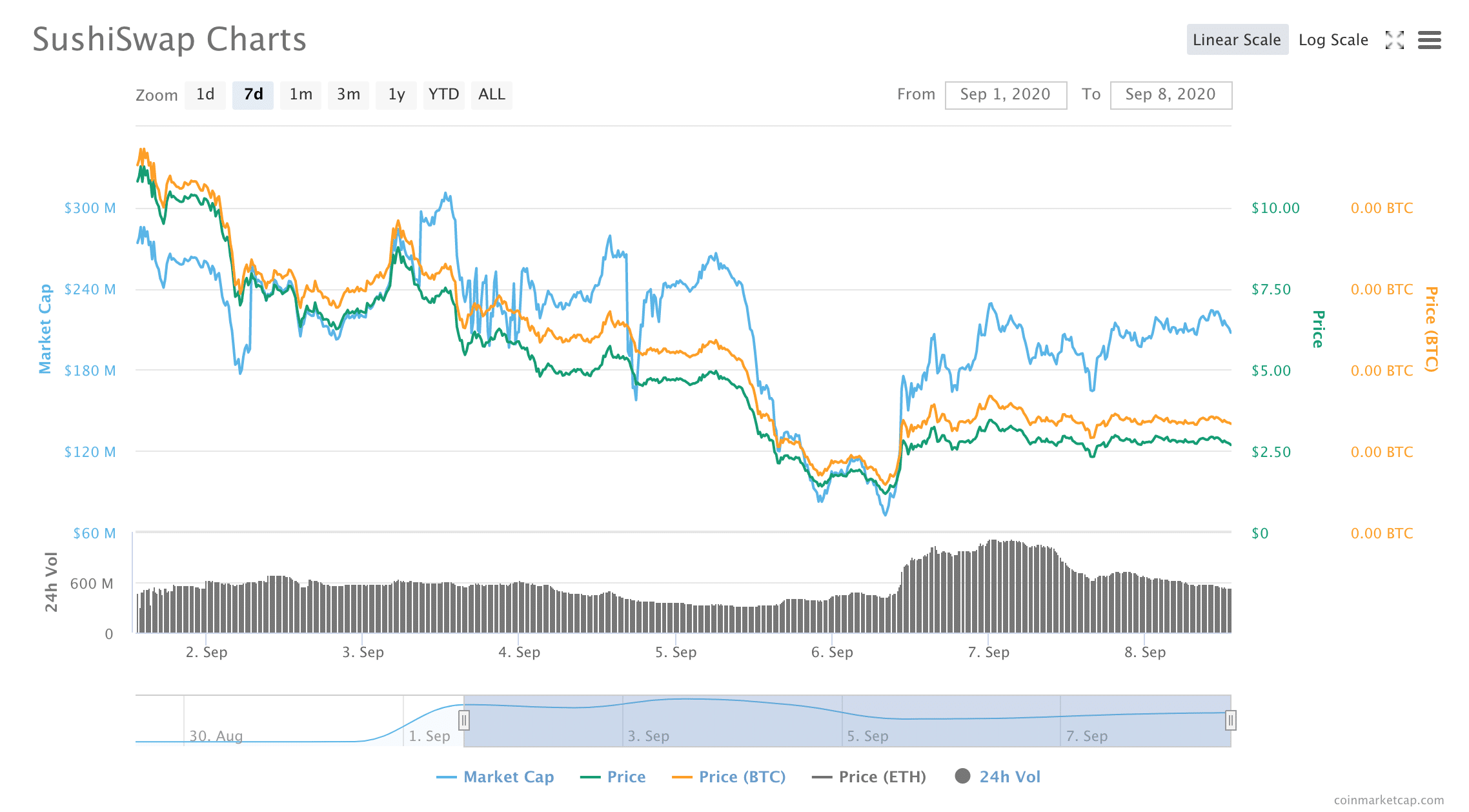
The token had already been sliding down before Chef Nomi sold off his coins: after peaking $11.27 on Tuesday, September 1st. By Friday, the SUSHI token price had dipped to roughly $4.50; when Chef Nomi sold his tokens on Saturday, SUSHI quickly dopped from $4.44 to $1.21, where it bottomed out.
All told, the price slid down roughly 90 percent from Tuesday to Sunday. By press time, the price had recovered to $2.84, softening the blow a bit: at $2.84, SUSHI is 74 percent below its peak price.
Chef Nomi's Decision to Cash Out Led Many to Cry 'Exit Scam'
The decision by Chef Nomi to cash out of the project also allegedly led many to believe SushiSwap was some kind of an ‘exit scam’, where a protocol is built for the sole purpose of building up a token price before the scammer sells all of the tokens, abandons the project, and makes off with all of the cash.
For example, crypto lawyer Preston Byrne, who practices at Anderson Kill Law, advised Twitter users that “If you lost money in the SushiSwap exit scam, file a report with the FBI and lawyer up.”
“This coin is regulated as a security, appears not to comply with Section 5 or an exemption from registration and therefore a sale is subject to a right of rescission,” he said. “With an alleged ‘exit scam’ you could also probably find common law claims. There are ways.”
However, on his unverified Twitter account, Chef Nomi insisted that he was not exiting the project (in spite of the decision to sell all of his SUSHI tokens.)
“People asked if I exited scam. I did not. I am still here. I will continue to participate in the discussion. I will help with the technical part. I will help ensure we have a successful migration (sic),” he wrote.
“@SatoshiLite did that and Litecoin had no problem surviving,” Nomi said.
People asked if I exited scam. I did not. I am still here. I will continue to participate in the discussion. I will help with the technical part. I will help ensure we have a successful migration.@SatoshiLite did that and Litecoin had no problem surviving.
And, like Charlie Lee, Nomi also said that his decision to cash out of the project was actually made for the benefit of the SushiSwap community: “I did the recent move because I care about the community[...] I stop caring about the price, and I will focus on the technicality of the migration,” he wrote.
After Outcry from the Community, Chef Nomi Transferred Control of SushiSwap to Sam Bankman-Fried
However, in spite of Chef Nomi’s poetic waxings about how he was not going to 'abandon' the SushiSwap project, Nomi did, in fact, make the decision to relinquish control of the SushiSwap protocol again, citing a desire to do what is best for the community.
Nomi, whose real identity remains unknown, Tweeted on Sunday, September 6th, that he would be transferring control of the project to Sam Bankman-Fried, the chief executive of cryptocurrency derivatives exchange FTX.
“I hope SushiSwap does well without me. Again I did not intend to do any harm. I’m sorry if my decision did not follow what you expected,” Chef Nomi wrote after announcing the decision.
Bankman-Fried, who was one of SushiSwap’s largest supporters and token holders, said that he would ensure that SushiSwap’s migration away from Uniswap (the protocol that SushiSwap is based on) would go smoothly.
“To be clear, if it’s given to me, I’ll make sure migration happens as planned and transfer it to a real multisig,” Bankman-Fried wrote.
The transfer of control has been well-received by much of the crypto community: for example, BitMEX founder and chief executive, Arthur Hayes wrote “please save me from a bad SUSHI investment, Sam Bankman-Fried,” calling Bankman-Fried “our new master chef.”
Please save me from a bad $SUSHI investment @SBF_Alameda. He is our new master chef.
However, the fact that Bankman-Fried is known to own so many SUSHI tokens and has been such a prominent supporter of SushiSwap from the beginning has given way to some conspiracy theories.
For example, Spencer Noon, the head of DTC Capital, pointed out that because Chef Nomi’s identity is unknown, the transfer of power could have been an illusion.
“So let me get this straight,” he wrote. “The ‘anonymous’ founder of SushiSwap just out of the blue ‘transferred’ control of the project to the largest farmer of Sushi, and y’all are just going to take them at their word they’re two different people?”
However, Bankman-Fried has denied the allegations: “ I AM NOT AND NEVER HAVE BEEN NOMI. I DON'T EVEN EAT FISH,” he wrote on Twitter.
10) Anyway on the eve of the end of my chefdom I wanted to present one vision for Sushi. It's not the only one. But it's mine.
Now sushi is going to be yours, finally. Make of it what you will.
Bankman-Fried’s 'chefdom' will also be very short-lived: almost as soon as Bankman-Fried took control of the protocol, he made the decision to transfer ownership of the protocol to a number of users who would each hold individual pieces of a multi-signature key.
“Going to transfer control to a multisig,” he wrote on September 6th, adding that if you would like to be a member of this, please comment on this post with ‘I would like to be a multisig key holder for sushi’. We'll take the top 20 by likes, and have a proper vote on them.
“Will then transfer keys to that multisig group,” he continued, “After that -- Sushi shall be back in the community's hands.”
Bankman-Fried also said that he would be holding a vote on the multisig concept itself: “we'll put up a vote on this whole plan, if majority vote against then we'll scrap it and go back to the drawing board.”
4) will then transfer keys to that multisig group.
After that -- Sushi shall be back in the community's hands.
We'll put up a vote on this whole plan, if majority vote against then we'll scrap it and go back to the drawing board.
The reception of the plan appears to have been mixed: “Control of the multisig keys for sushiswap will be determined by a twitter popularity contest,” one twitter user wrote, adding “bullish”, perhaps sarcastically.
Control of the multisig keys for sushiswap will be determined by a twitter popularity contest.
However, as of press time it appeared that the plan was moving forward. Twelve candidates were in the race for becoming multisig holders, with Bankman-Fried at the top of the list.
In other words, the plan to save SushiSwap (and SUSHI token holders) seems like it may be working.
"There Are No Good Guys"
However, while a true crisis may have been averted, there seems to be a lot to unpack as far as lessons that can be learned from this sushi-themed series of events.
Mikko Ohtamaa, chief technical officer of FirstBloodIo, wrote that “there are no good guys” in this particular chapter of the DeFi development saga.
“There are only controversial characters on this one,” he said, including “commentators, farmers, traders, exchanges.”
For one thing, the fact that Chef Nomi decided to financially exit the project will always cast a shadow over SushiSwap’s history: “The developer(s) cashed out in a way that showed a lack of integrity,” Mikko wrote.
At the same time, the explosive popularity of the Sushi protocol also shows a lack of due diligence on the behalf of users and exchanges who eagerly bought into the project and listed SUSHI tokens.
“Users were greed--they thought [that] 1500% APY can be sustained,” Mikko said. And indeed, DefiRatereported at the end of August that SushiSwap was 'netting upwards of 1500% APY', and that the total value of capital locked in the ecosystem was quickly growing: by a whopping $1.27 billion was 'locked' inside the protocol just eleven days after its launch on Uniswap.
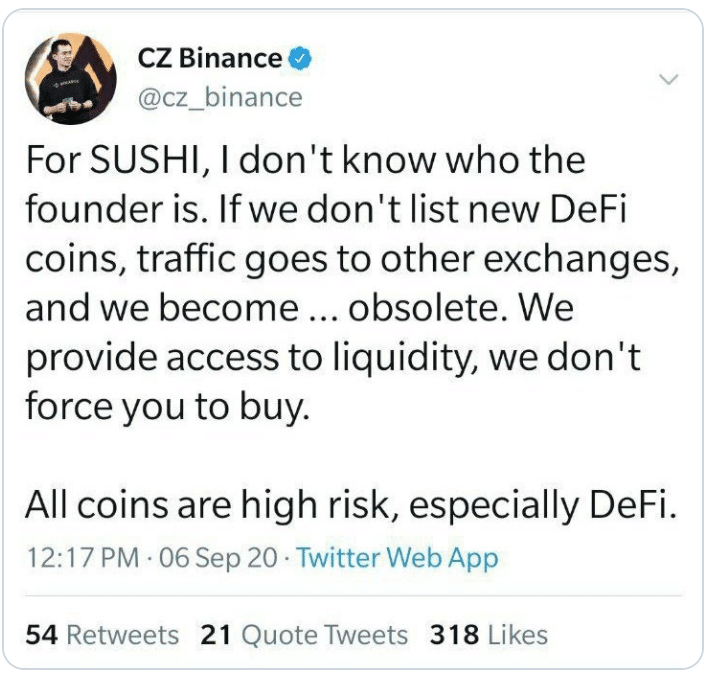
The huge amounts of money that were flowing into SushiSwap also prompted cryptocurrency Binance to quickly list SUSHI tokens, causing many to accuse the exchange of having neglected due diligence responsibilities for users.
“Binance listed $SUSHI in 2 days when it usually takes months for a good project,” Mikko wrote.
22/ CZ from Binance even tweeted that "we need to list fast to stay relevant"
Adel Meyer, the head of the DAPScoin project, also wrote on Twitter that “the whole $Sushi and @cz_binance story is exactly what’s wrong with the #crypto industry. Few days old project with unknown founder gets listed instantly on @binance FOR FREE where legit projects get charged $$$ or just never get a chance.”
On the same day that Chef Nomi exited SushiSwap, there was also a significant decrease in the total amount of value that is locked in the DeFi ecosystem. On September 2nd, total value locked peaked over $9.5 billion before crashing as low as $7.56 billion on Sunday, September 6th. At press time, total value locked had recovered $8.02 billion.
The trouble started over the weekend, when the pseudonymous founder of SushiSwap, known only as ‘Chef Nomi’, suddenly made the decision to sell all of his SUSHI tokens. A move that caused the token price to suddenly take a significant dive.
The token had already been sliding down before Chef Nomi sold off his coins: after peaking $11.27 on Tuesday, September 1st. By Friday, the SUSHI token price had dipped to roughly $4.50; when Chef Nomi sold his tokens on Saturday, SUSHI quickly dopped from $4.44 to $1.21, where it bottomed out.
All told, the price slid down roughly 90 percent from Tuesday to Sunday. By press time, the price had recovered to $2.84, softening the blow a bit: at $2.84, SUSHI is 74 percent below its peak price.
Chef Nomi's Decision to Cash Out Led Many to Cry 'Exit Scam'
The decision by Chef Nomi to cash out of the project also allegedly led many to believe SushiSwap was some kind of an ‘exit scam’, where a protocol is built for the sole purpose of building up a token price before the scammer sells all of the tokens, abandons the project, and makes off with all of the cash.
For example, crypto lawyer Preston Byrne, who practices at Anderson Kill Law, advised Twitter users that “If you lost money in the SushiSwap exit scam, file a report with the FBI and lawyer up.”
“This coin is regulated as a security, appears not to comply with Section 5 or an exemption from registration and therefore a sale is subject to a right of rescission,” he said. “With an alleged ‘exit scam’ you could also probably find common law claims. There are ways.”
However, on his unverified Twitter account, Chef Nomi insisted that he was not exiting the project (in spite of the decision to sell all of his SUSHI tokens.)
“People asked if I exited scam. I did not. I am still here. I will continue to participate in the discussion. I will help with the technical part. I will help ensure we have a successful migration (sic),” he wrote.
“@SatoshiLite did that and Litecoin had no problem surviving,” Nomi said.
People asked if I exited scam. I did not. I am still here. I will continue to participate in the discussion. I will help with the technical part. I will help ensure we have a successful migration.@SatoshiLite did that and Litecoin had no problem surviving.
And, like Charlie Lee, Nomi also said that his decision to cash out of the project was actually made for the benefit of the SushiSwap community: “I did the recent move because I care about the community[...] I stop caring about the price, and I will focus on the technicality of the migration,” he wrote.
After Outcry from the Community, Chef Nomi Transferred Control of SushiSwap to Sam Bankman-Fried
However, in spite of Chef Nomi’s poetic waxings about how he was not going to 'abandon' the SushiSwap project, Nomi did, in fact, make the decision to relinquish control of the SushiSwap protocol again, citing a desire to do what is best for the community.
Nomi, whose real identity remains unknown, Tweeted on Sunday, September 6th, that he would be transferring control of the project to Sam Bankman-Fried, the chief executive of cryptocurrency derivatives exchange FTX.
“I hope SushiSwap does well without me. Again I did not intend to do any harm. I’m sorry if my decision did not follow what you expected,” Chef Nomi wrote after announcing the decision.
Bankman-Fried, who was one of SushiSwap’s largest supporters and token holders, said that he would ensure that SushiSwap’s migration away from Uniswap (the protocol that SushiSwap is based on) would go smoothly.
“To be clear, if it’s given to me, I’ll make sure migration happens as planned and transfer it to a real multisig,” Bankman-Fried wrote.
The transfer of control has been well-received by much of the crypto community: for example, BitMEX founder and chief executive, Arthur Hayes wrote “please save me from a bad SUSHI investment, Sam Bankman-Fried,” calling Bankman-Fried “our new master chef.”
Please save me from a bad $SUSHI investment @SBF_Alameda. He is our new master chef.
However, the fact that Bankman-Fried is known to own so many SUSHI tokens and has been such a prominent supporter of SushiSwap from the beginning has given way to some conspiracy theories.
For example, Spencer Noon, the head of DTC Capital, pointed out that because Chef Nomi’s identity is unknown, the transfer of power could have been an illusion.
“So let me get this straight,” he wrote. “The ‘anonymous’ founder of SushiSwap just out of the blue ‘transferred’ control of the project to the largest farmer of Sushi, and y’all are just going to take them at their word they’re two different people?”
However, Bankman-Fried has denied the allegations: “ I AM NOT AND NEVER HAVE BEEN NOMI. I DON'T EVEN EAT FISH,” he wrote on Twitter.
10) Anyway on the eve of the end of my chefdom I wanted to present one vision for Sushi. It's not the only one. But it's mine.
Now sushi is going to be yours, finally. Make of it what you will.
Bankman-Fried’s 'chefdom' will also be very short-lived: almost as soon as Bankman-Fried took control of the protocol, he made the decision to transfer ownership of the protocol to a number of users who would each hold individual pieces of a multi-signature key.
“Going to transfer control to a multisig,” he wrote on September 6th, adding that if you would like to be a member of this, please comment on this post with ‘I would like to be a multisig key holder for sushi’. We'll take the top 20 by likes, and have a proper vote on them.
“Will then transfer keys to that multisig group,” he continued, “After that -- Sushi shall be back in the community's hands.”
Bankman-Fried also said that he would be holding a vote on the multisig concept itself: “we'll put up a vote on this whole plan, if majority vote against then we'll scrap it and go back to the drawing board.”
4) will then transfer keys to that multisig group.
After that -- Sushi shall be back in the community's hands.
We'll put up a vote on this whole plan, if majority vote against then we'll scrap it and go back to the drawing board.
The reception of the plan appears to have been mixed: “Control of the multisig keys for sushiswap will be determined by a twitter popularity contest,” one twitter user wrote, adding “bullish”, perhaps sarcastically.
Control of the multisig keys for sushiswap will be determined by a twitter popularity contest.
However, as of press time it appeared that the plan was moving forward. Twelve candidates were in the race for becoming multisig holders, with Bankman-Fried at the top of the list.
In other words, the plan to save SushiSwap (and SUSHI token holders) seems like it may be working.
"There Are No Good Guys"
However, while a true crisis may have been averted, there seems to be a lot to unpack as far as lessons that can be learned from this sushi-themed series of events.
Mikko Ohtamaa, chief technical officer of FirstBloodIo, wrote that “there are no good guys” in this particular chapter of the DeFi development saga.
“There are only controversial characters on this one,” he said, including “commentators, farmers, traders, exchanges.”
For one thing, the fact that Chef Nomi decided to financially exit the project will always cast a shadow over SushiSwap’s history: “The developer(s) cashed out in a way that showed a lack of integrity,” Mikko wrote.
At the same time, the explosive popularity of the Sushi protocol also shows a lack of due diligence on the behalf of users and exchanges who eagerly bought into the project and listed SUSHI tokens.
“Users were greed--they thought [that] 1500% APY can be sustained,” Mikko said. And indeed, DefiRatereported at the end of August that SushiSwap was 'netting upwards of 1500% APY', and that the total value of capital locked in the ecosystem was quickly growing: by a whopping $1.27 billion was 'locked' inside the protocol just eleven days after its launch on Uniswap.
The huge amounts of money that were flowing into SushiSwap also prompted cryptocurrency Binance to quickly list SUSHI tokens, causing many to accuse the exchange of having neglected due diligence responsibilities for users.
“Binance listed $SUSHI in 2 days when it usually takes months for a good project,” Mikko wrote.
22/ CZ from Binance even tweeted that "we need to list fast to stay relevant"
Adel Meyer, the head of the DAPScoin project, also wrote on Twitter that “the whole $Sushi and @cz_binance story is exactly what’s wrong with the #crypto industry. Few days old project with unknown founder gets listed instantly on @binance FOR FREE where legit projects get charged $$$ or just never get a chance.”
On the same day that Chef Nomi exited SushiSwap, there was also a significant decrease in the total amount of value that is locked in the DeFi ecosystem. On September 2nd, total value locked peaked over $9.5 billion before crashing as low as $7.56 billion on Sunday, September 6th. At press time, total value locked had recovered $8.02 billion.
Rachel is a self-taught crypto geek and a passionate writer. She believes in the power that the written word has to educate, connect and empower individuals to make positive and powerful financial choices. She is the Podcast Host and a Cryptocurrency Editor at Finance Magnates.
Binance Launches Retail AI Assistant, Repackages Existing Trading Tools
Featured Videos
AvaTrade to Acquire Most of FXCM; NAGA Raises $8M
AvaTrade to Acquire Most of FXCM; NAGA Raises $8M
AvaTrade to Acquire Most of FXCM; NAGA Raises $8M
AvaTrade to Acquire Most of FXCM; NAGA Raises $8M
Today’s financial news recap covers AvaTrade agrees to acquire most of FXCM, NAGA secures eight million dollars in new financing, and Wise seeks a tax settlement in the UK.
Finance Magnates Daily Recap brings you the latest news from forex and CFD brokers, fintech, payments, cryptocurrency, digital assets, trading platforms, financial regulation and global markets.
Get the key company news, executive moves, deals, regulatory updates and market developments of the day, in just a few minutes. New episodes published every weekday.
Read more: https://www.financemagnates.com
#FinanceMagnates #ForexNews #FintechNews
Today’s financial news recap covers AvaTrade agrees to acquire most of FXCM, NAGA secures eight million dollars in new financing, and Wise seeks a tax settlement in the UK.
Finance Magnates Daily Recap brings you the latest news from forex and CFD brokers, fintech, payments, cryptocurrency, digital assets, trading platforms, financial regulation and global markets.
Get the key company news, executive moves, deals, regulatory updates and market developments of the day, in just a few minutes. New episodes published every weekday.
Read more: https://www.financemagnates.com
#FinanceMagnates #ForexNews #FintechNews
Today’s financial news recap covers AvaTrade agrees to acquire most of FXCM, NAGA secures eight million dollars in new financing, and Wise seeks a tax settlement in the UK.
Finance Magnates Daily Recap brings you the latest news from forex and CFD brokers, fintech, payments, cryptocurrency, digital assets, trading platforms, financial regulation and global markets.
Get the key company news, executive moves, deals, regulatory updates and market developments of the day, in just a few minutes. New episodes published every weekday.
Read more: https://www.financemagnates.com
#FinanceMagnates #ForexNews #FintechNews
Today’s financial news recap covers AvaTrade agrees to acquire most of FXCM, NAGA secures eight million dollars in new financing, and Wise seeks a tax settlement in the UK.
Finance Magnates Daily Recap brings you the latest news from forex and CFD brokers, fintech, payments, cryptocurrency, digital assets, trading platforms, financial regulation and global markets.
Get the key company news, executive moves, deals, regulatory updates and market developments of the day, in just a few minutes. New episodes published every weekday.
Read more: https://www.financemagnates.com
#FinanceMagnates #ForexNews #FintechNews
XTB Adds Overnight US Stock Trading; Nasdaq Ventures Invests in One Trading
XTB Adds Overnight US Stock Trading; Nasdaq Ventures Invests in One Trading
XTB Adds Overnight US Stock Trading; Nasdaq Ventures Invests in One Trading
XTB Adds Overnight US Stock Trading; Nasdaq Ventures Invests in One Trading
XTB Adds Overnight US Stock Trading; Nasdaq Ventures Invests in One Trading
XTB Adds Overnight US Stock Trading; Nasdaq Ventures Invests in One Trading
Today’s financial news recap covers XTB expands overnight US stock trading, Fortrade reports higher revenue, Nasdaq backs One Trading, and Vest Labs raises 13 million dollars.
Finance Magnates Daily Recap brings you the latest news from forex and CFD brokers, fintech, payments, cryptocurrency, digital assets, trading platforms, financial regulation and global markets.
Get the key company news, executive moves, deals, regulatory updates and market developments of the day, in just a few minutes. New episodes published every weekday.
Read more: https://www.financemagnates.com
#FinanceMagnates #ForexNews #FintechNews
Today’s financial news recap covers XTB expands overnight US stock trading, Fortrade reports higher revenue, Nasdaq backs One Trading, and Vest Labs raises 13 million dollars.
Finance Magnates Daily Recap brings you the latest news from forex and CFD brokers, fintech, payments, cryptocurrency, digital assets, trading platforms, financial regulation and global markets.
Get the key company news, executive moves, deals, regulatory updates and market developments of the day, in just a few minutes. New episodes published every weekday.
Read more: https://www.financemagnates.com
#FinanceMagnates #ForexNews #FintechNews
Today’s financial news recap covers XTB expands overnight US stock trading, Fortrade reports higher revenue, Nasdaq backs One Trading, and Vest Labs raises 13 million dollars.
Finance Magnates Daily Recap brings you the latest news from forex and CFD brokers, fintech, payments, cryptocurrency, digital assets, trading platforms, financial regulation and global markets.
Get the key company news, executive moves, deals, regulatory updates and market developments of the day, in just a few minutes. New episodes published every weekday.
Read more: https://www.financemagnates.com
#FinanceMagnates #ForexNews #FintechNews
Today’s financial news recap covers XTB expands overnight US stock trading, Fortrade reports higher revenue, Nasdaq backs One Trading, and Vest Labs raises 13 million dollars.
Finance Magnates Daily Recap brings you the latest news from forex and CFD brokers, fintech, payments, cryptocurrency, digital assets, trading platforms, financial regulation and global markets.
Get the key company news, executive moves, deals, regulatory updates and market developments of the day, in just a few minutes. New episodes published every weekday.
Read more: https://www.financemagnates.com
#FinanceMagnates #ForexNews #FintechNews
Today’s financial news recap covers XTB expands overnight US stock trading, Fortrade reports higher revenue, Nasdaq backs One Trading, and Vest Labs raises 13 million dollars.
Finance Magnates Daily Recap brings you the latest news from forex and CFD brokers, fintech, payments, cryptocurrency, digital assets, trading platforms, financial regulation and global markets.
Get the key company news, executive moves, deals, regulatory updates and market developments of the day, in just a few minutes. New episodes published every weekday.
Read more: https://www.financemagnates.com
#FinanceMagnates #ForexNews #FintechNews
Today’s financial news recap covers XTB expands overnight US stock trading, Fortrade reports higher revenue, Nasdaq backs One Trading, and Vest Labs raises 13 million dollars.
Finance Magnates Daily Recap brings you the latest news from forex and CFD brokers, fintech, payments, cryptocurrency, digital assets, trading platforms, financial regulation and global markets.
Get the key company news, executive moves, deals, regulatory updates and market developments of the day, in just a few minutes. New episodes published every weekday.
Read more: https://www.financemagnates.com
#FinanceMagnates #ForexNews #FintechNews
CMC Founder Downplays Volatility Hit; Devexperts Names CEO
CMC Founder Downplays Volatility Hit; Devexperts Names CEO
CMC Founder Downplays Volatility Hit; Devexperts Names CEO
CMC Founder Downplays Volatility Hit; Devexperts Names CEO
CMC Founder Downplays Volatility Hit; Devexperts Names CEO
CMC Founder Downplays Volatility Hit; Devexperts Names CEO
Today’s financial news recap covers low volatility pressures brokers, Devexperts names a new CEO, Saxo cuts onboarding time, and OKX reaches a 25 billion dollar valuation.
Finance Magnates Daily Recap brings you the latest news from forex and CFD brokers, fintech, payments, cryptocurrency, digital assets, trading platforms, financial regulation and global markets.
Get the key company news, executive moves, deals, regulatory updates and market developments of the day, in just a few minutes. New episodes published every weekday.
Read more: https://www.financemagnates.com
#FinanceMagnates #ForexNews #FintechNews
Today’s financial news recap covers low volatility pressures brokers, Devexperts names a new CEO, Saxo cuts onboarding time, and OKX reaches a 25 billion dollar valuation.
Finance Magnates Daily Recap brings you the latest news from forex and CFD brokers, fintech, payments, cryptocurrency, digital assets, trading platforms, financial regulation and global markets.
Get the key company news, executive moves, deals, regulatory updates and market developments of the day, in just a few minutes. New episodes published every weekday.
Read more: https://www.financemagnates.com
#FinanceMagnates #ForexNews #FintechNews
Today’s financial news recap covers low volatility pressures brokers, Devexperts names a new CEO, Saxo cuts onboarding time, and OKX reaches a 25 billion dollar valuation.
Finance Magnates Daily Recap brings you the latest news from forex and CFD brokers, fintech, payments, cryptocurrency, digital assets, trading platforms, financial regulation and global markets.
Get the key company news, executive moves, deals, regulatory updates and market developments of the day, in just a few minutes. New episodes published every weekday.
Read more: https://www.financemagnates.com
#FinanceMagnates #ForexNews #FintechNews
Today’s financial news recap covers low volatility pressures brokers, Devexperts names a new CEO, Saxo cuts onboarding time, and OKX reaches a 25 billion dollar valuation.
Finance Magnates Daily Recap brings you the latest news from forex and CFD brokers, fintech, payments, cryptocurrency, digital assets, trading platforms, financial regulation and global markets.
Get the key company news, executive moves, deals, regulatory updates and market developments of the day, in just a few minutes. New episodes published every weekday.
Read more: https://www.financemagnates.com
#FinanceMagnates #ForexNews #FintechNews
Today’s financial news recap covers low volatility pressures brokers, Devexperts names a new CEO, Saxo cuts onboarding time, and OKX reaches a 25 billion dollar valuation.
Finance Magnates Daily Recap brings you the latest news from forex and CFD brokers, fintech, payments, cryptocurrency, digital assets, trading platforms, financial regulation and global markets.
Get the key company news, executive moves, deals, regulatory updates and market developments of the day, in just a few minutes. New episodes published every weekday.
Read more: https://www.financemagnates.com
#FinanceMagnates #ForexNews #FintechNews
Today’s financial news recap covers low volatility pressures brokers, Devexperts names a new CEO, Saxo cuts onboarding time, and OKX reaches a 25 billion dollar valuation.
Finance Magnates Daily Recap brings you the latest news from forex and CFD brokers, fintech, payments, cryptocurrency, digital assets, trading platforms, financial regulation and global markets.
Get the key company news, executive moves, deals, regulatory updates and market developments of the day, in just a few minutes. New episodes published every weekday.
Read more: https://www.financemagnates.com
#FinanceMagnates #ForexNews #FintechNews
Today’s financial news recap covers Trade Nation buys FXCM's UK client book, Trading 212 reports higher revenue, the CFTC's move to allow perpetual index futures.
Finance Magnates Daily Recap brings you the latest news from forex and CFD brokers, fintech, payments, cryptocurrency, digital assets, trading platforms, financial regulation and global markets.
Get the key company news, executive moves, deals, regulatory updates and market developments of the day, in just a few minutes. New episodes published every weekday.
Read more: https://www.financemagnates.com
#FinanceMagnates #ForexNews #FintechNews
Today’s financial news recap covers Trade Nation buys FXCM's UK client book, Trading 212 reports higher revenue, the CFTC's move to allow perpetual index futures.
Finance Magnates Daily Recap brings you the latest news from forex and CFD brokers, fintech, payments, cryptocurrency, digital assets, trading platforms, financial regulation and global markets.
Get the key company news, executive moves, deals, regulatory updates and market developments of the day, in just a few minutes. New episodes published every weekday.
Read more: https://www.financemagnates.com
#FinanceMagnates #ForexNews #FintechNews
Today’s financial news recap covers Trade Nation buys FXCM's UK client book, Trading 212 reports higher revenue, the CFTC's move to allow perpetual index futures.
Finance Magnates Daily Recap brings you the latest news from forex and CFD brokers, fintech, payments, cryptocurrency, digital assets, trading platforms, financial regulation and global markets.
Get the key company news, executive moves, deals, regulatory updates and market developments of the day, in just a few minutes. New episodes published every weekday.
Read more: https://www.financemagnates.com
#FinanceMagnates #ForexNews #FintechNews
Today’s financial news recap covers Trade Nation buys FXCM's UK client book, Trading 212 reports higher revenue, the CFTC's move to allow perpetual index futures.
Finance Magnates Daily Recap brings you the latest news from forex and CFD brokers, fintech, payments, cryptocurrency, digital assets, trading platforms, financial regulation and global markets.
Get the key company news, executive moves, deals, regulatory updates and market developments of the day, in just a few minutes. New episodes published every weekday.
Read more: https://www.financemagnates.com
#FinanceMagnates #ForexNews #FintechNews
Today’s financial news recap covers Trade Nation buys FXCM's UK client book, Trading 212 reports higher revenue, the CFTC's move to allow perpetual index futures.
Finance Magnates Daily Recap brings you the latest news from forex and CFD brokers, fintech, payments, cryptocurrency, digital assets, trading platforms, financial regulation and global markets.
Get the key company news, executive moves, deals, regulatory updates and market developments of the day, in just a few minutes. New episodes published every weekday.
Read more: https://www.financemagnates.com
#FinanceMagnates #ForexNews #FintechNews
Today’s financial news recap covers Trade Nation buys FXCM's UK client book, Trading 212 reports higher revenue, the CFTC's move to allow perpetual index futures.
Finance Magnates Daily Recap brings you the latest news from forex and CFD brokers, fintech, payments, cryptocurrency, digital assets, trading platforms, financial regulation and global markets.
Get the key company news, executive moves, deals, regulatory updates and market developments of the day, in just a few minutes. New episodes published every weekday.
Read more: https://www.financemagnates.com
#FinanceMagnates #ForexNews #FintechNews
Your career isn’t a linear path.
Your career isn’t a linear path.
Your career isn’t a linear path.
Your career isn’t a linear path.
Your career isn’t a linear path.
Your career isn’t a linear path.
Roles change. Career goals change. Sometimes you want a completely new challenge.
But the skills and knowledge you build along the way can stay with you and give you something to build on.
For Jeff Patterson, that continued growth is key to long-term career development.
You bring the skills. FM Academy helps you build the knowledge.
#FMAcademy #FinanceMagnates #FinanceCareers #ProfessionalDevelopment #Fintech
Roles change. Career goals change. Sometimes you want a completely new challenge.
But the skills and knowledge you build along the way can stay with you and give you something to build on.
For Jeff Patterson, that continued growth is key to long-term career development.
You bring the skills. FM Academy helps you build the knowledge.
#FMAcademy #FinanceMagnates #FinanceCareers #ProfessionalDevelopment #Fintech
Roles change. Career goals change. Sometimes you want a completely new challenge.
But the skills and knowledge you build along the way can stay with you and give you something to build on.
For Jeff Patterson, that continued growth is key to long-term career development.
You bring the skills. FM Academy helps you build the knowledge.
#FMAcademy #FinanceMagnates #FinanceCareers #ProfessionalDevelopment #Fintech
Roles change. Career goals change. Sometimes you want a completely new challenge.
But the skills and knowledge you build along the way can stay with you and give you something to build on.
For Jeff Patterson, that continued growth is key to long-term career development.
You bring the skills. FM Academy helps you build the knowledge.
#FMAcademy #FinanceMagnates #FinanceCareers #ProfessionalDevelopment #Fintech
Roles change. Career goals change. Sometimes you want a completely new challenge.
But the skills and knowledge you build along the way can stay with you and give you something to build on.
For Jeff Patterson, that continued growth is key to long-term career development.
You bring the skills. FM Academy helps you build the knowledge.
#FMAcademy #FinanceMagnates #FinanceCareers #ProfessionalDevelopment #Fintech
Roles change. Career goals change. Sometimes you want a completely new challenge.
But the skills and knowledge you build along the way can stay with you and give you something to build on.
For Jeff Patterson, that continued growth is key to long-term career development.
You bring the skills. FM Academy helps you build the knowledge.
#FMAcademy #FinanceMagnates #FinanceCareers #ProfessionalDevelopment #Fintech