Since NFTs hit the mainstream several weeks ago, artists have pointed out their problems. Are their concerns valid?
NFT
For a brief moment when non-fungible tokens (NFTs) 'arrived' in the global news cycle in early March, the art world was filled with hope. Finally, it seemed, there was a new piece of technology that could help creators get paid for their work. However, it was not long before criticism of NFTs seemed to dominate the conversation.
What happened? For many of the creators who are hesitant about entering the NFT space, sustainability quickly arose as the biggest barrier. Indeed, within a week of several high-profile NFT sales, Twitter was alight almost immediately with environment-focused pushback against artists who issued NFTs.
But, it is not just sustainability. Critics of NFTs have laundry lists of concerns about non-fungible tokens, including fraud and theft.
Are their concerns justified? And could the benefits of NFT issuance outweigh the drawbacks in the short- and long-term?
“[...] The reason that there is energy expenditure for cryptocurrency transactions is because of the distributed ledger feature of blockchain software. For a cryptocurrency to run effectively, many computers around the world need to be running the blockchain software,” Tunstall explained. On networks that operate with Proof-of-Work algorithm’s–like Ethereum–this software (and the hardware it runs on) requires significant amounts of energy.
Mercedes Tunstall, former FTC lawyer and partner with Loeb & Loeb’s payments technology and fintech practices
Tunstall added that: “between the creation (minting) of the NFT and the selling of it,” each NFT triggers at least three transactions. As a result, “those who have concluded that a lot of energy is required for cryptocurrency transactions, further conclude that NFTs are even more energy-intensive.”
“Having said that, I have not seen any serious examinations of this issue, so far,” she concluded.
”The Issue of Sustainable Platforms Not Only Needs to Be Part of the Crypto Conversation, It Is the Conversation.”
In the weeks since NFTs hit the scene in early, a number of news organizations have published pieces on the subject. The Hill, the MIT Technology Review, MSBNC, The Verge and even the World Economic Forum have published pieces on the subject–and with good reason.
As artist Memo Akten explained in a recent interview with Flash Art that: “I realized that the issue of sustainable platforms not only needs to be part of the crypto conversation, it is the conversation — into which systems, functional applications and power structures are all enmeshed. New businesses and platforms must align with the values we are hoping to carry into the future.”
How Does Energy Consumption Work on the Ethereum Blockchain?
However, the exact amount of CO2 that each NFT transaction puts into the Earth’s atmosphere is up for debate. Brian Turner, Chief Technical Officer of Convert Binary, told Finance Magnates that: “it is not yet currently known exactly what the energy cost is.”
“Some say the NFT industry already has the energy output of a small country, and others say that 70% of the energy is from clean sources (which would make it far greener than many other industries),” Turner said.
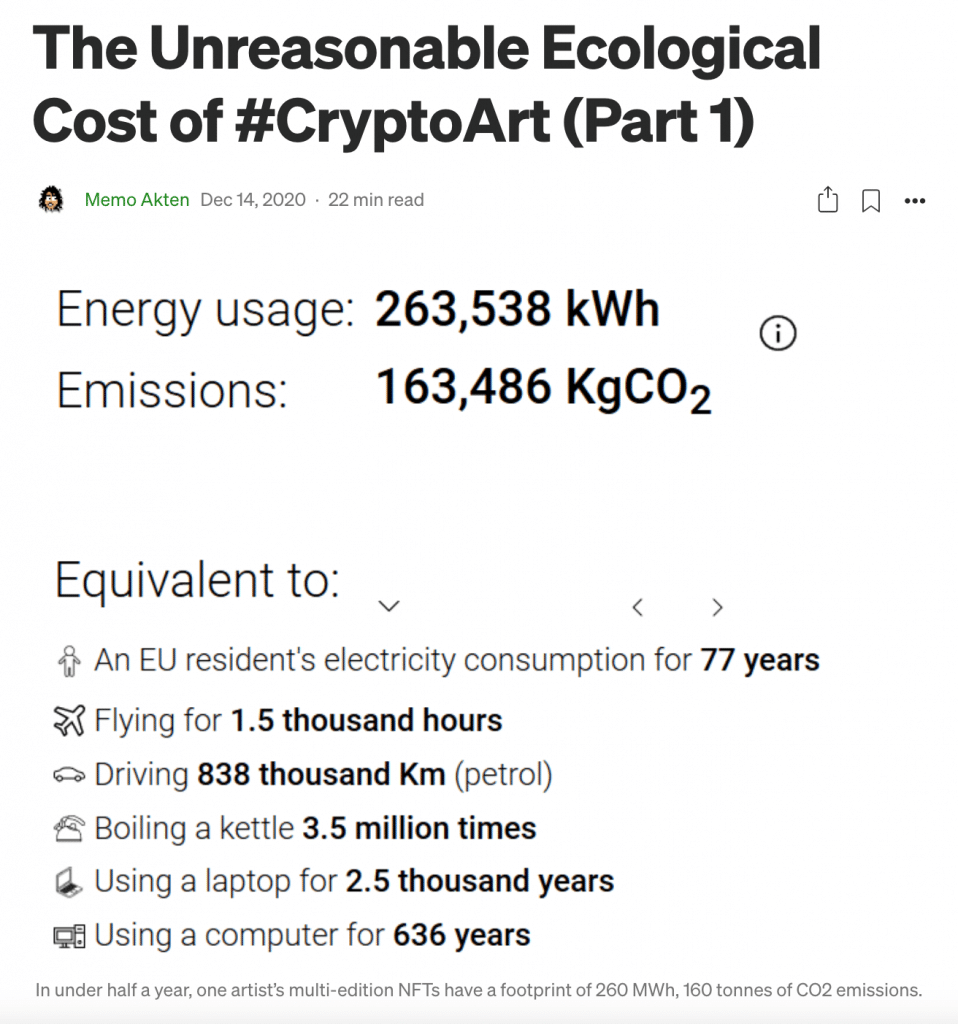
Memo Akten said that through his own research, he found that issuing a single NFT is equivalent to driving a car for 1,000 kilometres. For multiple-NFT issuances, Akten reports that the carbon footprint is equivalent to dozens of transatlantic flights.
Source: Memo Akten, Medium.
However, the exact environmental impact of NFT issuance seems to be up for debate. A Medium piece by NFT issuance platform, SuperRare explained that: “while the network is constantly processing transactions (financial trades, NFT minting etc.) these transactions do not actually increase or affect the energy consumption of the network.”
“Rather, the total energy spent on mining depends on a relationship between Ethereum price, which is the source revenue for miners, and the cost of energy,” the piece explained.
Content creator CryptoStache (“best moustache in crypto”) told Finance Magnates that in other words, “the Ethereum network is still going to be operating at full capacity, so in essence, the impact is zero.”
NFT content creator CryptoStache
“The same could be said for any network that is heavily used like the Visa network. If 10,000 stores stop accepting Visa, that does not mean the environmental impact of ‘accepting Visa’ is suddenly reduced,” he said.
Still, without a doubt, the Earth pays a hefty toll to operate the Ethereum blockchain. “In terms of Ethereum compared to other chains, the number of resources used to maintain the network may be less, but there is always going to be some impact,” CryptoStache said.
The Carbon Footprint of the Ethereum Blockchain
The NFT space’s carbon reckoning seems to be part of a broader environmental reckoning of the cryptocurrency industry as a whole. “We have heard this same exact argument about Bitcoin over and over again, it's simply not a concern in comparison to similar ‘transfer of value’ networks, which would include NFTs,” CryptoStache explained.
According to data from the CleanCoin project. Ethereum’s carbon footprint is equivalent to that of Namibia.
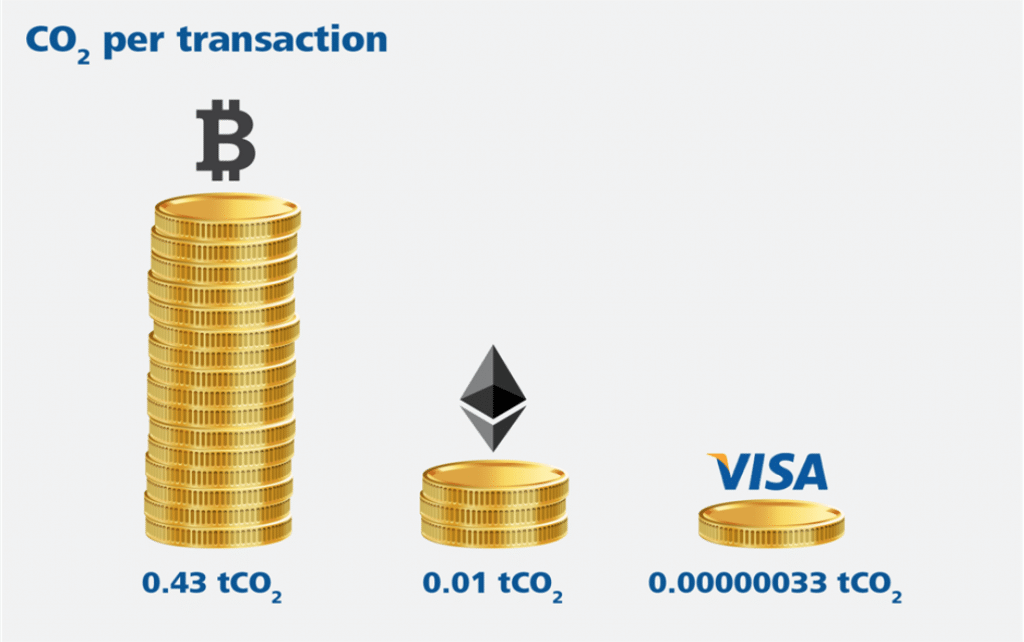
If you were to divide the total footprint by the number of transactions, CleanCoin says that the CO2 output of a single transaction on the Ethereum blockchain (0.01 tCO2) is roughly 3,030,200% more energy than a single Visa transaction (0.00000033 tCO2.) Still, some say that Ethereum’s total carbon footprint may still be lower than Visa’s.
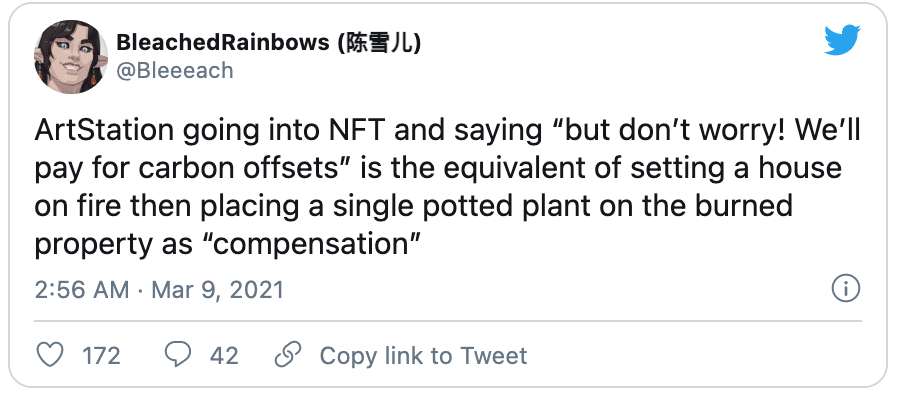
It is possible to purchase Carbon offsets in the short-term. Tools like Offsetra, Carbon.fyi, and Co2ken.io can help determine exactly how much your bill to offset your carbon footprint is. However, not everyone is satisfied with this solution.
Of course, the Ethereum network, which is also the largest NFT marketplace in the world, is in the process of moving to a Proof-of-Stake (PoS) algorithm. Because this algorithm relies on the storage of coins in the network rather than running energy-intensive software on energy-intensive hardware, the migration to PoS is slated to cut down Ethereum’s carbon footprint significantly. However, some critics have raised concerns that PoS may make Ethereum into a centralized network.
In other words, there are still a few kinks to work out. Jason Bailey (@artnome), Founder of the art and tech blog Artnome.com, wrote in a piece for Flash Art that “most technologies start off inefficiently and improve over time.”
“Exchanging some limited short-term inefficiency in the NFT process to build a new decentralized art market in which hopefully everyone can participate and nobody needs to fly anywhere or ship and store art seems like a fair trade-off,” he said. Additionally, other blockchains with lower carbon footprints can also be used for NFT production.
What Can Artists Do If an NFT Issuer Has Stolen Their Work?
However, environmental problems are not the NFT space’s only woes.
A number of artists, both large and small, have been the victims of fraud in the NFT space. An NFT artist that appears to be impersonating Banksy has netted over $1 million in token sales. A number of smaller artists have also reported that their work has been stolen and sold by NFT-issuing fraudsters.
Getting justice on these fraudulent NFT sales can be extremely difficult.
Moish E. Peltz, Esq, the Chairman of the Intellectual Property Practice Group at Falcon Rappaport & Berkman PLLC, told Finance Magnates that: “artists have already reported finding that their art has been stolen and sold as NFTs without their knowledge.”
“To the extent that an artist might be able to identify their work being minted as an NFT without their authorization, and due to the fact that an NFT may be irreversibly committed to a blockchain, it could be incredibly difficult or perhaps even impossible to have it taken down (or to otherwise enforce your intellectual property rights),” Peltz explained.
Moish E. Peltz, Esq, the Chairman of the Intellectual Property Practice Group at Falcon Rappaport & Berkman PLLC
“To the extent that the NFT is listed on a platform, it is unclear to what extent traditional takedown mechanisms such as the DMCA apply to NFT platforms, and how different platforms will respond to such infringement submissions,” he continued.
“Additionally, it may be extremely difficult, impossible, or just not economically feasible to pursue random copycats duplicating your intellectual property within an NFT. However, to the extent you can identify an infringer, it may still be possible to apply traditional IP rules to remedy infringement of your work.”
If someone in the NFT world is impersonating your work, contact the platform on which the NFTs are hosted immediately.
”NFT Buyers Should Seek Out Reputable Participants from Which to Buy NFTs.”
It is not only sellers that the buyers of these tokens have paid high amounts for fraudulent work.
While many NFT platforms have offered artist verification and other features that should make NFT art fraud more difficult, many analysts believe that the industry’s best fraud prevention at the moment is education and due diligence.
Paige Mason, Managing Director at Guidepost Solutions, explained to Finance Magnates that: “an analogous example in the crypto space is choosing a reputable exchange versus relying on peer-to-peer purchase or sale opportunities.”
“By choosing a cryptocurrency exchange that is subject to a higher standard of regulation or oversight, a customer might have more confidence that the exchange is subject to specific cybersecurity and financial crime regulatory requirements that will, in turn, protect the customer’s crypto assets,” Mason added Finance Magnates.
“Much like an art buyer can limit, although not eliminate entirely, their risk of buying fakes by going through a reputable dealer or auction house, NFT buyers should also seek out reputable participants from which to buy NFTs. A large auction house like Christie’s will perform a certain level of due diligence about all artwork, including provenance, before listing something like EVERYDAYS: THE FIRST 5000 DAYS for sale.” EVERYDAYS is an NFT work by Beeple that sold for $69 million.
Protecting NFT Holders from Theft
Once legitimate NFTs are purchased, their holders need to take extra care to keep them safe from theft.
For those of us who have been operating in the cryptosphere for a while, the importance of keeping private keys safe is old news. However, the influx of new investors in the crypto space may not all know that yes, it is possible to permanently lose your holdings if you send a transaction to the wrong address; that no, you should never show your seed phrase to anyone–ever.
Furthermore, users on NFT platforms should take extra care to keep their accounts safe. Earlier in March, reports emerged that said hackers stole digital artwork worth thousands of dollars from users of NFT marketplace, Nifty Gateway.
However, when the details of the thefts emerged, it seemed that the account takeovers were not the result of a flaw on the platform. Rather, account holders may not have been taking the appropriate security cautions.
For example, Mason told Finance Magnates that in any NFT marketplace, “users should definitely have 2-factor authentication (2FA) enabled, even if not required by the platform.”
Paige Mason, Managing Director at Guidepost Solutions
Beyond 2FA, “participants in the crypto markets can take a number of measures to mitigate security concerns, including the use of cold wallets (i.e., wallets that aren’t connected to the internet), multiple-factor authentication, and passwordless security options.”
Can Stolen NFTs Be Recovered?
It is important to note that some NFT platforms can and do offer recovery services for stolen assets.
“While some of the means by which a security event happens, e.g. an account takeover, might be the same with respect to those in the crypto markets, the resulting impacts can certainly vary,” Mason told Finance Magnates.
“One user reported that Nifty Gateway was able to return artwork stolen by the person responsible for the account takeover, but that may only have been possible because the stolen NFT was not moved out of the Nifty Gateway marketplace,” Mason said.
On the other hand, NFTs may not have some of the same safeguards in place that the crypto industry at large does. “Crypto exchanges also pay a great deal of money to blockchain analytics companies that can track the movement of a cryptocurrency that is associated with darknet markets, sanctioned persons or reports of account takeovers or fraud, but stolen cryptocurrency is potentially monetarily replaceable in the way that a unique NFT is not.”
"I Firmly Believe That NFTs Will Go from Strength to Strength over the Next Few Years.”
Convert Binary’s Brain Turner also pointed out that the economics of NFTs may not be stable in the short-term.
“The biggest issue around NFTs right now is their fluctuating value,” he told Finance Magnates. “The market is still being created, and many of the people driving the value are betting on the future.”
Therefore, “the biggest concern I can see for NFTs in the short term is that the supply will soon outweigh the demand, and the value will drop shortly after. The most significant parts of the industry (NBA Top Shots, CryptoPunks) will likely have great long-term value, but many of the other NFTs on the market (in fact, the majority) will have very little value in the medium-term.”
All the same, Turner believes that: “NFTs are here to stay.”
“The fact that they can be used to digitally authenticate so many different things is of tremendous importance. Not just to the world of art, but to digital creators and others that do business online. It has innumerable applications, and I firmly believe that NFTs will go from strength to strength over the next few years.”
For a brief moment when non-fungible tokens (NFTs) 'arrived' in the global news cycle in early March, the art world was filled with hope. Finally, it seemed, there was a new piece of technology that could help creators get paid for their work. However, it was not long before criticism of NFTs seemed to dominate the conversation.
What happened? For many of the creators who are hesitant about entering the NFT space, sustainability quickly arose as the biggest barrier. Indeed, within a week of several high-profile NFT sales, Twitter was alight almost immediately with environment-focused pushback against artists who issued NFTs.
But, it is not just sustainability. Critics of NFTs have laundry lists of concerns about non-fungible tokens, including fraud and theft.
Are their concerns justified? And could the benefits of NFT issuance outweigh the drawbacks in the short- and long-term?
“[...] The reason that there is energy expenditure for cryptocurrency transactions is because of the distributed ledger feature of blockchain software. For a cryptocurrency to run effectively, many computers around the world need to be running the blockchain software,” Tunstall explained. On networks that operate with Proof-of-Work algorithm’s–like Ethereum–this software (and the hardware it runs on) requires significant amounts of energy.
Mercedes Tunstall, former FTC lawyer and partner with Loeb & Loeb’s payments technology and fintech practices
Tunstall added that: “between the creation (minting) of the NFT and the selling of it,” each NFT triggers at least three transactions. As a result, “those who have concluded that a lot of energy is required for cryptocurrency transactions, further conclude that NFTs are even more energy-intensive.”
“Having said that, I have not seen any serious examinations of this issue, so far,” she concluded.
”The Issue of Sustainable Platforms Not Only Needs to Be Part of the Crypto Conversation, It Is the Conversation.”
In the weeks since NFTs hit the scene in early, a number of news organizations have published pieces on the subject. The Hill, the MIT Technology Review, MSBNC, The Verge and even the World Economic Forum have published pieces on the subject–and with good reason.
As artist Memo Akten explained in a recent interview with Flash Art that: “I realized that the issue of sustainable platforms not only needs to be part of the crypto conversation, it is the conversation — into which systems, functional applications and power structures are all enmeshed. New businesses and platforms must align with the values we are hoping to carry into the future.”
How Does Energy Consumption Work on the Ethereum Blockchain?
However, the exact amount of CO2 that each NFT transaction puts into the Earth’s atmosphere is up for debate. Brian Turner, Chief Technical Officer of Convert Binary, told Finance Magnates that: “it is not yet currently known exactly what the energy cost is.”
“Some say the NFT industry already has the energy output of a small country, and others say that 70% of the energy is from clean sources (which would make it far greener than many other industries),” Turner said.
Memo Akten said that through his own research, he found that issuing a single NFT is equivalent to driving a car for 1,000 kilometres. For multiple-NFT issuances, Akten reports that the carbon footprint is equivalent to dozens of transatlantic flights.
Source: Memo Akten, Medium.
However, the exact environmental impact of NFT issuance seems to be up for debate. A Medium piece by NFT issuance platform, SuperRare explained that: “while the network is constantly processing transactions (financial trades, NFT minting etc.) these transactions do not actually increase or affect the energy consumption of the network.”
“Rather, the total energy spent on mining depends on a relationship between Ethereum price, which is the source revenue for miners, and the cost of energy,” the piece explained.
Content creator CryptoStache (“best moustache in crypto”) told Finance Magnates that in other words, “the Ethereum network is still going to be operating at full capacity, so in essence, the impact is zero.”
NFT content creator CryptoStache
“The same could be said for any network that is heavily used like the Visa network. If 10,000 stores stop accepting Visa, that does not mean the environmental impact of ‘accepting Visa’ is suddenly reduced,” he said.
Still, without a doubt, the Earth pays a hefty toll to operate the Ethereum blockchain. “In terms of Ethereum compared to other chains, the number of resources used to maintain the network may be less, but there is always going to be some impact,” CryptoStache said.
The Carbon Footprint of the Ethereum Blockchain
The NFT space’s carbon reckoning seems to be part of a broader environmental reckoning of the cryptocurrency industry as a whole. “We have heard this same exact argument about Bitcoin over and over again, it's simply not a concern in comparison to similar ‘transfer of value’ networks, which would include NFTs,” CryptoStache explained.
According to data from the CleanCoin project. Ethereum’s carbon footprint is equivalent to that of Namibia.
If you were to divide the total footprint by the number of transactions, CleanCoin says that the CO2 output of a single transaction on the Ethereum blockchain (0.01 tCO2) is roughly 3,030,200% more energy than a single Visa transaction (0.00000033 tCO2.) Still, some say that Ethereum’s total carbon footprint may still be lower than Visa’s.
It is possible to purchase Carbon offsets in the short-term. Tools like Offsetra, Carbon.fyi, and Co2ken.io can help determine exactly how much your bill to offset your carbon footprint is. However, not everyone is satisfied with this solution.
Of course, the Ethereum network, which is also the largest NFT marketplace in the world, is in the process of moving to a Proof-of-Stake (PoS) algorithm. Because this algorithm relies on the storage of coins in the network rather than running energy-intensive software on energy-intensive hardware, the migration to PoS is slated to cut down Ethereum’s carbon footprint significantly. However, some critics have raised concerns that PoS may make Ethereum into a centralized network.
In other words, there are still a few kinks to work out. Jason Bailey (@artnome), Founder of the art and tech blog Artnome.com, wrote in a piece for Flash Art that “most technologies start off inefficiently and improve over time.”
“Exchanging some limited short-term inefficiency in the NFT process to build a new decentralized art market in which hopefully everyone can participate and nobody needs to fly anywhere or ship and store art seems like a fair trade-off,” he said. Additionally, other blockchains with lower carbon footprints can also be used for NFT production.
What Can Artists Do If an NFT Issuer Has Stolen Their Work?
However, environmental problems are not the NFT space’s only woes.
A number of artists, both large and small, have been the victims of fraud in the NFT space. An NFT artist that appears to be impersonating Banksy has netted over $1 million in token sales. A number of smaller artists have also reported that their work has been stolen and sold by NFT-issuing fraudsters.
Getting justice on these fraudulent NFT sales can be extremely difficult.
Moish E. Peltz, Esq, the Chairman of the Intellectual Property Practice Group at Falcon Rappaport & Berkman PLLC, told Finance Magnates that: “artists have already reported finding that their art has been stolen and sold as NFTs without their knowledge.”
“To the extent that an artist might be able to identify their work being minted as an NFT without their authorization, and due to the fact that an NFT may be irreversibly committed to a blockchain, it could be incredibly difficult or perhaps even impossible to have it taken down (or to otherwise enforce your intellectual property rights),” Peltz explained.
Moish E. Peltz, Esq, the Chairman of the Intellectual Property Practice Group at Falcon Rappaport & Berkman PLLC
“To the extent that the NFT is listed on a platform, it is unclear to what extent traditional takedown mechanisms such as the DMCA apply to NFT platforms, and how different platforms will respond to such infringement submissions,” he continued.
“Additionally, it may be extremely difficult, impossible, or just not economically feasible to pursue random copycats duplicating your intellectual property within an NFT. However, to the extent you can identify an infringer, it may still be possible to apply traditional IP rules to remedy infringement of your work.”
If someone in the NFT world is impersonating your work, contact the platform on which the NFTs are hosted immediately.
”NFT Buyers Should Seek Out Reputable Participants from Which to Buy NFTs.”
It is not only sellers that the buyers of these tokens have paid high amounts for fraudulent work.
While many NFT platforms have offered artist verification and other features that should make NFT art fraud more difficult, many analysts believe that the industry’s best fraud prevention at the moment is education and due diligence.
Paige Mason, Managing Director at Guidepost Solutions, explained to Finance Magnates that: “an analogous example in the crypto space is choosing a reputable exchange versus relying on peer-to-peer purchase or sale opportunities.”
“By choosing a cryptocurrency exchange that is subject to a higher standard of regulation or oversight, a customer might have more confidence that the exchange is subject to specific cybersecurity and financial crime regulatory requirements that will, in turn, protect the customer’s crypto assets,” Mason added Finance Magnates.
“Much like an art buyer can limit, although not eliminate entirely, their risk of buying fakes by going through a reputable dealer or auction house, NFT buyers should also seek out reputable participants from which to buy NFTs. A large auction house like Christie’s will perform a certain level of due diligence about all artwork, including provenance, before listing something like EVERYDAYS: THE FIRST 5000 DAYS for sale.” EVERYDAYS is an NFT work by Beeple that sold for $69 million.
Protecting NFT Holders from Theft
Once legitimate NFTs are purchased, their holders need to take extra care to keep them safe from theft.
For those of us who have been operating in the cryptosphere for a while, the importance of keeping private keys safe is old news. However, the influx of new investors in the crypto space may not all know that yes, it is possible to permanently lose your holdings if you send a transaction to the wrong address; that no, you should never show your seed phrase to anyone–ever.
Furthermore, users on NFT platforms should take extra care to keep their accounts safe. Earlier in March, reports emerged that said hackers stole digital artwork worth thousands of dollars from users of NFT marketplace, Nifty Gateway.
However, when the details of the thefts emerged, it seemed that the account takeovers were not the result of a flaw on the platform. Rather, account holders may not have been taking the appropriate security cautions.
For example, Mason told Finance Magnates that in any NFT marketplace, “users should definitely have 2-factor authentication (2FA) enabled, even if not required by the platform.”
Paige Mason, Managing Director at Guidepost Solutions
Beyond 2FA, “participants in the crypto markets can take a number of measures to mitigate security concerns, including the use of cold wallets (i.e., wallets that aren’t connected to the internet), multiple-factor authentication, and passwordless security options.”
Can Stolen NFTs Be Recovered?
It is important to note that some NFT platforms can and do offer recovery services for stolen assets.
“While some of the means by which a security event happens, e.g. an account takeover, might be the same with respect to those in the crypto markets, the resulting impacts can certainly vary,” Mason told Finance Magnates.
“One user reported that Nifty Gateway was able to return artwork stolen by the person responsible for the account takeover, but that may only have been possible because the stolen NFT was not moved out of the Nifty Gateway marketplace,” Mason said.
On the other hand, NFTs may not have some of the same safeguards in place that the crypto industry at large does. “Crypto exchanges also pay a great deal of money to blockchain analytics companies that can track the movement of a cryptocurrency that is associated with darknet markets, sanctioned persons or reports of account takeovers or fraud, but stolen cryptocurrency is potentially monetarily replaceable in the way that a unique NFT is not.”
"I Firmly Believe That NFTs Will Go from Strength to Strength over the Next Few Years.”
Convert Binary’s Brain Turner also pointed out that the economics of NFTs may not be stable in the short-term.
“The biggest issue around NFTs right now is their fluctuating value,” he told Finance Magnates. “The market is still being created, and many of the people driving the value are betting on the future.”
Therefore, “the biggest concern I can see for NFTs in the short term is that the supply will soon outweigh the demand, and the value will drop shortly after. The most significant parts of the industry (NBA Top Shots, CryptoPunks) will likely have great long-term value, but many of the other NFTs on the market (in fact, the majority) will have very little value in the medium-term.”
All the same, Turner believes that: “NFTs are here to stay.”
“The fact that they can be used to digitally authenticate so many different things is of tremendous importance. Not just to the world of art, but to digital creators and others that do business online. It has innumerable applications, and I firmly believe that NFTs will go from strength to strength over the next few years.”
Rachel is a self-taught crypto geek and a passionate writer. She believes in the power that the written word has to educate, connect and empower individuals to make positive and powerful financial choices. She is the Podcast Host and a Cryptocurrency Editor at Finance Magnates.
Crypto Built More Rails, but the Next Battle Is Over How Much Work a Dollar Can Do
Featured Videos
FP Markets Winner Spotlight 🏆 | Global Broker of the Year 2025 #Trading #Broker #Innovation #Shorts
FP Markets Winner Spotlight 🏆 | Global Broker of the Year 2025 #Trading #Broker #Innovation #Shorts
FP Markets Winner Spotlight 🏆 | Global Broker of the Year 2025 #Trading #Broker #Innovation #Shorts
FP Markets Winner Spotlight 🏆 | Global Broker of the Year 2025 #Trading #Broker #Innovation #Shorts
FP Markets takes the spotlight as Global Broker of the Year 2025 at the Finance Magnates Awards.
Martin Stoilov, Head of Client Experience, shares that trust, innovation, and people played a key role in the company’s success, supported by a strong foundation of integrity and client-centricity.
Following this milestone, FP Markets continues to focus on growth, technology investment, and its core values of transparency and excellence.
👉 Be part of FM Awards 2026: https://awards.financemagnates.com/#nominate
FP Markets takes the spotlight as Global Broker of the Year 2025 at the Finance Magnates Awards.
Martin Stoilov, Head of Client Experience, shares that trust, innovation, and people played a key role in the company’s success, supported by a strong foundation of integrity and client-centricity.
Following this milestone, FP Markets continues to focus on growth, technology investment, and its core values of transparency and excellence.
👉 Be part of FM Awards 2026: https://awards.financemagnates.com/#nominate
FP Markets takes the spotlight as Global Broker of the Year 2025 at the Finance Magnates Awards.
Martin Stoilov, Head of Client Experience, shares that trust, innovation, and people played a key role in the company’s success, supported by a strong foundation of integrity and client-centricity.
Following this milestone, FP Markets continues to focus on growth, technology investment, and its core values of transparency and excellence.
👉 Be part of FM Awards 2026: https://awards.financemagnates.com/#nominate
FP Markets takes the spotlight as Global Broker of the Year 2025 at the Finance Magnates Awards.
Martin Stoilov, Head of Client Experience, shares that trust, innovation, and people played a key role in the company’s success, supported by a strong foundation of integrity and client-centricity.
Following this milestone, FP Markets continues to focus on growth, technology investment, and its core values of transparency and excellence.
👉 Be part of FM Awards 2026: https://awards.financemagnates.com/#nominate
In this video, we review @HolaPrimeMarketsOfficial, a multi-asset forex and CFDs broker offering different account types, trading platforms, and flexible trading conditions.
We cover the broker’s overall offering, including account options, trading environment, platforms like MT4 and MT5, and additional services such as managed accounts and fast withdrawals.
Watch the full video to see if Hola Prime Markets fits your trading needs.
📣 Stay up to date with the latest in finance and trading. Follow Finance Magnates for industry news, insights, and global event coverage.
Connect with us:
🔗 LinkedIn: /financemagnates
👍 Facebook: /financemagnates
📸 Instagram: https://www.instagram.com/financemagnates
🐦 X: https://x.com/financemagnates
🎥 TikTok: https://www.tiktok.com/tag/financemagnates
▶️ YouTube: /@financemagnates_official
#HolaPrime #ForexBroker #CFDTrading #FinanceMagnates #Trading #Forex #BrokerReview
In this video, we review @HolaPrimeMarketsOfficial, a multi-asset forex and CFDs broker offering different account types, trading platforms, and flexible trading conditions.
We cover the broker’s overall offering, including account options, trading environment, platforms like MT4 and MT5, and additional services such as managed accounts and fast withdrawals.
Watch the full video to see if Hola Prime Markets fits your trading needs.
📣 Stay up to date with the latest in finance and trading. Follow Finance Magnates for industry news, insights, and global event coverage.
Connect with us:
🔗 LinkedIn: /financemagnates
👍 Facebook: /financemagnates
📸 Instagram: https://www.instagram.com/financemagnates
🐦 X: https://x.com/financemagnates
🎥 TikTok: https://www.tiktok.com/tag/financemagnates
▶️ YouTube: /@financemagnates_official
#HolaPrime #ForexBroker #CFDTrading #FinanceMagnates #Trading #Forex #BrokerReview
In this video, we review @HolaPrimeMarketsOfficial, a multi-asset forex and CFDs broker offering different account types, trading platforms, and flexible trading conditions.
We cover the broker’s overall offering, including account options, trading environment, platforms like MT4 and MT5, and additional services such as managed accounts and fast withdrawals.
Watch the full video to see if Hola Prime Markets fits your trading needs.
📣 Stay up to date with the latest in finance and trading. Follow Finance Magnates for industry news, insights, and global event coverage.
Connect with us:
🔗 LinkedIn: /financemagnates
👍 Facebook: /financemagnates
📸 Instagram: https://www.instagram.com/financemagnates
🐦 X: https://x.com/financemagnates
🎥 TikTok: https://www.tiktok.com/tag/financemagnates
▶️ YouTube: /@financemagnates_official
#HolaPrime #ForexBroker #CFDTrading #FinanceMagnates #Trading #Forex #BrokerReview
In this video, we review @HolaPrimeMarketsOfficial, a multi-asset forex and CFDs broker offering different account types, trading platforms, and flexible trading conditions.
We cover the broker’s overall offering, including account options, trading environment, platforms like MT4 and MT5, and additional services such as managed accounts and fast withdrawals.
Watch the full video to see if Hola Prime Markets fits your trading needs.
📣 Stay up to date with the latest in finance and trading. Follow Finance Magnates for industry news, insights, and global event coverage.
Connect with us:
🔗 LinkedIn: /financemagnates
👍 Facebook: /financemagnates
📸 Instagram: https://www.instagram.com/financemagnates
🐦 X: https://x.com/financemagnates
🎥 TikTok: https://www.tiktok.com/tag/financemagnates
▶️ YouTube: /@financemagnates_official
#HolaPrime #ForexBroker #CFDTrading #FinanceMagnates #Trading #Forex #BrokerReview
In this video, we review @HolaPrimeMarketsOfficial, a multi-asset forex and CFDs broker offering different account types, trading platforms, and flexible trading conditions.
We cover the broker’s overall offering, including account options, trading environment, platforms like MT4 and MT5, and additional services such as managed accounts and fast withdrawals.
Watch the full video to see if Hola Prime Markets fits your trading needs.
📣 Stay up to date with the latest in finance and trading. Follow Finance Magnates for industry news, insights, and global event coverage.
Connect with us:
🔗 LinkedIn: /financemagnates
👍 Facebook: /financemagnates
📸 Instagram: https://www.instagram.com/financemagnates
🐦 X: https://x.com/financemagnates
🎥 TikTok: https://www.tiktok.com/tag/financemagnates
▶️ YouTube: /@financemagnates_official
#HolaPrime #ForexBroker #CFDTrading #FinanceMagnates #Trading #Forex #BrokerReview
In this video, we review @HolaPrimeMarketsOfficial, a multi-asset forex and CFDs broker offering different account types, trading platforms, and flexible trading conditions.
We cover the broker’s overall offering, including account options, trading environment, platforms like MT4 and MT5, and additional services such as managed accounts and fast withdrawals.
Watch the full video to see if Hola Prime Markets fits your trading needs.
📣 Stay up to date with the latest in finance and trading. Follow Finance Magnates for industry news, insights, and global event coverage.
Connect with us:
🔗 LinkedIn: /financemagnates
👍 Facebook: /financemagnates
📸 Instagram: https://www.instagram.com/financemagnates
🐦 X: https://x.com/financemagnates
🎥 TikTok: https://www.tiktok.com/tag/financemagnates
▶️ YouTube: /@financemagnates_official
#HolaPrime #ForexBroker #CFDTrading #FinanceMagnates #Trading #Forex #BrokerReview
Hola Prime Review: What You Need to Know | Full Breakdown by Finance Magnates
Hola Prime Review: What You Need to Know | Full Breakdown by Finance Magnates
Hola Prime Review: What You Need to Know | Full Breakdown by Finance Magnates
Hola Prime Review: What You Need to Know | Full Breakdown by Finance Magnates
Hola Prime Review: What You Need to Know | Full Breakdown by Finance Magnates
Hola Prime Review: What You Need to Know | Full Breakdown by Finance Magnates
In this video, we review @HolaPrime_Global, a proprietary trading firm offering evaluation programs and performance-based payouts in simulated market environments.
We cover how the challenge model works, including account types, profit splits (up to 95%), trading rules, and what it takes to reach a funded account. You’ll also learn about available platforms like MT4, MT5, cTrader, and more, along with insights into payouts, support, and trading conditions.
Watch the full video to see if Hola Prime fits your trading style.
📣 Stay up to date with the latest in finance and trading. Follow Finance Magnates for industry news, insights, and global event coverage.
Connect with us:
🔗 LinkedIn: /financemagnates
👍 Facebook: /financemagnates
📸 Instagram: https://www.instagram.com/financemagnates
🐦 X: https://x.com/financemagnates
🎥 TikTok: https://www.tiktok.com/tag/financemagnates
▶️ YouTube: /@financemagnates_official
#HolaPrime #PropFirm #Trading #FinanceMagnates #Forex #FuturesTrading #TradingReview #PropFirmReview
In this video, we review @HolaPrime_Global, a proprietary trading firm offering evaluation programs and performance-based payouts in simulated market environments.
We cover how the challenge model works, including account types, profit splits (up to 95%), trading rules, and what it takes to reach a funded account. You’ll also learn about available platforms like MT4, MT5, cTrader, and more, along with insights into payouts, support, and trading conditions.
Watch the full video to see if Hola Prime fits your trading style.
📣 Stay up to date with the latest in finance and trading. Follow Finance Magnates for industry news, insights, and global event coverage.
Connect with us:
🔗 LinkedIn: /financemagnates
👍 Facebook: /financemagnates
📸 Instagram: https://www.instagram.com/financemagnates
🐦 X: https://x.com/financemagnates
🎥 TikTok: https://www.tiktok.com/tag/financemagnates
▶️ YouTube: /@financemagnates_official
#HolaPrime #PropFirm #Trading #FinanceMagnates #Forex #FuturesTrading #TradingReview #PropFirmReview
In this video, we review @HolaPrime_Global, a proprietary trading firm offering evaluation programs and performance-based payouts in simulated market environments.
We cover how the challenge model works, including account types, profit splits (up to 95%), trading rules, and what it takes to reach a funded account. You’ll also learn about available platforms like MT4, MT5, cTrader, and more, along with insights into payouts, support, and trading conditions.
Watch the full video to see if Hola Prime fits your trading style.
📣 Stay up to date with the latest in finance and trading. Follow Finance Magnates for industry news, insights, and global event coverage.
Connect with us:
🔗 LinkedIn: /financemagnates
👍 Facebook: /financemagnates
📸 Instagram: https://www.instagram.com/financemagnates
🐦 X: https://x.com/financemagnates
🎥 TikTok: https://www.tiktok.com/tag/financemagnates
▶️ YouTube: /@financemagnates_official
#HolaPrime #PropFirm #Trading #FinanceMagnates #Forex #FuturesTrading #TradingReview #PropFirmReview
In this video, we review @HolaPrime_Global, a proprietary trading firm offering evaluation programs and performance-based payouts in simulated market environments.
We cover how the challenge model works, including account types, profit splits (up to 95%), trading rules, and what it takes to reach a funded account. You’ll also learn about available platforms like MT4, MT5, cTrader, and more, along with insights into payouts, support, and trading conditions.
Watch the full video to see if Hola Prime fits your trading style.
📣 Stay up to date with the latest in finance and trading. Follow Finance Magnates for industry news, insights, and global event coverage.
Connect with us:
🔗 LinkedIn: /financemagnates
👍 Facebook: /financemagnates
📸 Instagram: https://www.instagram.com/financemagnates
🐦 X: https://x.com/financemagnates
🎥 TikTok: https://www.tiktok.com/tag/financemagnates
▶️ YouTube: /@financemagnates_official
#HolaPrime #PropFirm #Trading #FinanceMagnates #Forex #FuturesTrading #TradingReview #PropFirmReview
In this video, we review @HolaPrime_Global, a proprietary trading firm offering evaluation programs and performance-based payouts in simulated market environments.
We cover how the challenge model works, including account types, profit splits (up to 95%), trading rules, and what it takes to reach a funded account. You’ll also learn about available platforms like MT4, MT5, cTrader, and more, along with insights into payouts, support, and trading conditions.
Watch the full video to see if Hola Prime fits your trading style.
📣 Stay up to date with the latest in finance and trading. Follow Finance Magnates for industry news, insights, and global event coverage.
Connect with us:
🔗 LinkedIn: /financemagnates
👍 Facebook: /financemagnates
📸 Instagram: https://www.instagram.com/financemagnates
🐦 X: https://x.com/financemagnates
🎥 TikTok: https://www.tiktok.com/tag/financemagnates
▶️ YouTube: /@financemagnates_official
#HolaPrime #PropFirm #Trading #FinanceMagnates #Forex #FuturesTrading #TradingReview #PropFirmReview
In this video, we review @HolaPrime_Global, a proprietary trading firm offering evaluation programs and performance-based payouts in simulated market environments.
We cover how the challenge model works, including account types, profit splits (up to 95%), trading rules, and what it takes to reach a funded account. You’ll also learn about available platforms like MT4, MT5, cTrader, and more, along with insights into payouts, support, and trading conditions.
Watch the full video to see if Hola Prime fits your trading style.
📣 Stay up to date with the latest in finance and trading. Follow Finance Magnates for industry news, insights, and global event coverage.
Connect with us:
🔗 LinkedIn: /financemagnates
👍 Facebook: /financemagnates
📸 Instagram: https://www.instagram.com/financemagnates
🐦 X: https://x.com/financemagnates
🎥 TikTok: https://www.tiktok.com/tag/financemagnates
▶️ YouTube: /@financemagnates_official
#HolaPrime #PropFirm #Trading #FinanceMagnates #Forex #FuturesTrading #TradingReview #PropFirmReview
Axi Winner Spotlight 🏆 | Global Most Innovative Broker 2025 #Innovation #Trading #Fintech #Broker
Axi Winner Spotlight 🏆 | Global Most Innovative Broker 2025 #Innovation #Trading #Fintech #Broker
Axi Winner Spotlight 🏆 | Global Most Innovative Broker 2025 #Innovation #Trading #Fintech #Broker
Axi Winner Spotlight 🏆 | Global Most Innovative Broker 2025 #Innovation #Trading #Fintech #Broker
Axi Winner Spotlight 🏆 | Global Most Innovative Broker 2025 #Innovation #Trading #Fintech #Broker
Axi Winner Spotlight 🏆 | Global Most Innovative Broker 2025 #Innovation #Trading #Fintech #Broker
Axi takes the spotlight at the Finance Magnates Awards, winning Global Most Innovative Broker 2025.
Olivia Xenofontos and Ivanna Openko share how the team will feel: proud, motivated, and ready to keep delivering.
They also describe the night as well-organized, focused, and enjoyable for all.
👉 Be part of FM Awards 2026.
Axi takes the spotlight at the Finance Magnates Awards, winning Global Most Innovative Broker 2025.
Olivia Xenofontos and Ivanna Openko share how the team will feel: proud, motivated, and ready to keep delivering.
They also describe the night as well-organized, focused, and enjoyable for all.
👉 Be part of FM Awards 2026.
Axi takes the spotlight at the Finance Magnates Awards, winning Global Most Innovative Broker 2025.
Olivia Xenofontos and Ivanna Openko share how the team will feel: proud, motivated, and ready to keep delivering.
They also describe the night as well-organized, focused, and enjoyable for all.
👉 Be part of FM Awards 2026.
Axi takes the spotlight at the Finance Magnates Awards, winning Global Most Innovative Broker 2025.
Olivia Xenofontos and Ivanna Openko share how the team will feel: proud, motivated, and ready to keep delivering.
They also describe the night as well-organized, focused, and enjoyable for all.
👉 Be part of FM Awards 2026.
Axi takes the spotlight at the Finance Magnates Awards, winning Global Most Innovative Broker 2025.
Olivia Xenofontos and Ivanna Openko share how the team will feel: proud, motivated, and ready to keep delivering.
They also describe the night as well-organized, focused, and enjoyable for all.
👉 Be part of FM Awards 2026.
Axi takes the spotlight at the Finance Magnates Awards, winning Global Most Innovative Broker 2025.
Olivia Xenofontos and Ivanna Openko share how the team will feel: proud, motivated, and ready to keep delivering.
They also describe the night as well-organized, focused, and enjoyable for all.
👉 Be part of FM Awards 2026.
Recognition that matters.
Built on transparency.
Driven by the industry.
The Finance Magnates Awards 2026.
Nominations are now open.
🔗 https://awards.financemagnates.com/?utm_source=SM&utm_medium=social&utm_campaign=recognition-matters
Recognition that matters.
Built on transparency.
Driven by the industry.
The Finance Magnates Awards 2026.
Nominations are now open.
🔗 https://awards.financemagnates.com/?utm_source=SM&utm_medium=social&utm_campaign=recognition-matters
Recognition that matters.
Built on transparency.
Driven by the industry.
The Finance Magnates Awards 2026.
Nominations are now open.
🔗 https://awards.financemagnates.com/?utm_source=SM&utm_medium=social&utm_campaign=recognition-matters
Recognition that matters.
Built on transparency.
Driven by the industry.
The Finance Magnates Awards 2026.
Nominations are now open.
🔗 https://awards.financemagnates.com/?utm_source=SM&utm_medium=social&utm_campaign=recognition-matters
Recognition that matters.
Built on transparency.
Driven by the industry.
The Finance Magnates Awards 2026.
Nominations are now open.
🔗 https://awards.financemagnates.com/?utm_source=SM&utm_medium=social&utm_campaign=recognition-matters
Recognition that matters.
Built on transparency.
Driven by the industry.
The Finance Magnates Awards 2026.
Nominations are now open.
🔗 https://awards.financemagnates.com/?utm_source=SM&utm_medium=social&utm_campaign=recognition-matters