The bear market has changed the cryptocurrency industry. What are the real threats that exchanges face?
FM
Chances are that if you’re reading this, you already know that the cryptocurrency markets have changed quite a bit over the past year.
Market caps are way down. And the exchanges that founded themselves before or during the cryptocurrency boom are facing a challenging landscape ahead, one that will undoubtedly be marked by higher competition for an increasingly lean, mean, and more educated consumer base.
When looking at the upcoming year, what are the actual threats that cryptocurrency exchanges face? And what’s irrelevant?
One Report Claims that Only the Top 4 Cryptocurrency Exchanges Have Over 100,000 Active
Users
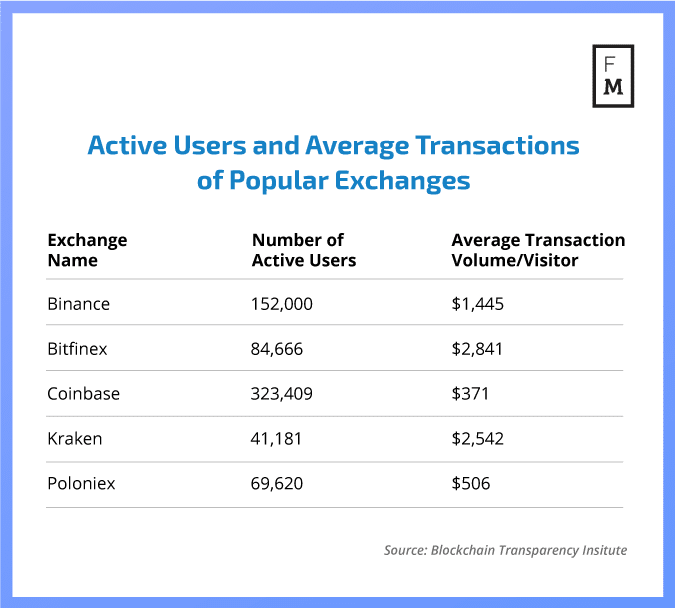
Coinbase led the pack with an average of 323,409 daily users; Binance followed with 152,000. Okex rang in at 105,000 and Huobi with 101,000. The rest of the 48 exchanges included in BTI’s report fell from 417 (Bisq) to 84,666 (Bitfinex.)
Then, in December, only two cryptocurrency exchanges were listed as having over 100,000 active users: Coinbase (323,409) and Binance (361,458.)
Are the report’s findings suggestive of a decline in users that could lead to eventual bankruptcy in some exchanges? Perhaps. However, this piece of information cannot be viewed in a vacuum. Before coming to the conclusion that all cryptocurrency exchanges are doomed, let’s assess what the data means, and what the real risks may be.
More Active Users Doesn’t Necessarily Mean Higher Trading Volume
For one thing, it’s important to note that a higher number of users does not necessarily correlate to a higher trading volume. The report also found that the transaction volume per user on Coinbase ($371) was just a fraction of the average transaction volume on, for example, Bitfinex ($2,841).
This means that (according to BTI’s data) if each of Coinbase’s 361,458 active users logged in this December and made one transaction in a single day, the exchange’s volume would be $134,100,918. If each of Bitfinex’ 84,666 users logged in and made a single transaction, its trading volume would be $240,536,106. Binance’s trading volume would be $522,306,810 if each of its users made an average-sized transaction of $1,445.
What this may suggest is that different cryptocurrency exchanges are more commonly used for different purposes and that as time progresses, each of them may continue to become further embedded in its own ‘niche.’ Exchanges like Coinbase for small, everyday trades and transactions, and exchanges like Binance for more serious, high-volume trades.
(Of course, none of this is to say that the bear market has not had a significant effect on the number of users of cryptocurrency exchanges--in fact, there is data to suggest that it has. However, there is not enough data to suggest that the industry has entered into a ‘death spiral’ just yet.)
Regardless if an exchange has higher numbers in terms of users or overall transaction volume, what might the future be of exchanges that are leading the market--and those who are not?
Crypto Exchanges May Consolidate
Evan Feng, Founder & CIO of Tapestry Capital, sees a future in which cryptocurrency exchanges eventually consolidate. “The large ones will get larger while smaller ones will go out of business,” he wrote in an email to Finance Magnates. “It's a natural result of these markets getting more efficient.”
Evan Feng.
However, Feng believes that consolidation trends are more likely to form along border lines than trading trends. “We'll probably start seeing consolidation across geographies once regulatory landscapes are more certain (e.g. 1 pan-EU exchange will be most trusted, same for Asia etc. vs. Vietnam and Thailand),” he explained.
Indeed, this could be the case if some regulatory trends continue to take hold. Regulators in many countries are cracking down on users of exchanges (and exchanges themselves) in order to ensure that risk is low and that taxes are being paid.
Consolidation Trends Could Form Across National Borders
One of these countries, incidentally, is the United States. Recently, US-based cryptocurrency exchange Kraken revealed in a tweet that it had received 300% more subpoenas in 2018 than in 2017, adding that “You can see why many businesses choose to block US users.”
Kraken went on to say that the “cost of handling subpoenas (regardless of licenses) is quickly becoming a barrier to entry.” If what Kraken says is true, trends that have already begun forming along national borders are only continuing to deepen, at least for the United States.
Peek at our Compliance team's 2018 Transparency Report. You can see why many businesses choose to block US users. Cost of handling subpoenas (regardless of licenses) is quickly becoming a barrier to entry. Inquiries up 3x YoY. pic.twitter.com/YbyLEqhOUf
Additionally, reports emerged earlier this week that regulators in both Denmark and Bulgaria are cracking down on cryptocurrency exchanges and their users.
Denmark’s story contains particularly important elements of how regulation may affect future consolidation trends--Denmark’s tax agency was tipped off by Finland's tax agency that some of its citizens had been using a Finnish exchange to trade crypto. As a result, the agency demanded that three of its domestic cryptocurrency exchanges hand over the trading data of their users so that it could ensure that users are correctly paying their taxes.
Regulators Could Become an Existential Threat to Crypto Exchanges Under the Right Circumstances
While cooperations between tax agencies across border lines could eventually lead to a more globalized market, cross-border cooperations inevitably take longer to organize than changing internal policies.
In this respect, it’s more likely that tax agencies like Denmark’s will take measures to limit their jurisdiction’s access to foreign crypto exchanges that they could be using to evade paying taxes. In other words, countries could attempt to ban their residents from using foreign exchanges. This kind of a scenario could further support consolidation across national and continental lines.
Therefore, consolidation is likely only an existential threat to cryptocurrency exchanges if governments are either hostile or extremely negligent. But, hey, it’s happened before.
Decentralized Exchanges: The Disruption that Wasn’t (Yet)
If centralized cryptocurrency exchanges do ever become victims of the long hand of the law, decentralized cryptocurrency exchanges may finally be in a position to be a viable alternative to them.
Last January, a number of analysts suggested that 2018 would be the “year of the DEX”--a year in which decentralized exchanges gained enough footing to be a threat to the popularity of centralized exchanges. After all, decentralized exchanges are much more secure to use than centralized exchanges, and they may have lower fees.
Decentralized exchanges are the wave of the future. They can never be shut down by governments or any regulatory agency.
However, there is no evidence to suggest that decentralized exchanges (DEXs) have gained enough clout for centralized exchanges to be concerned about them. Most DEXs--even the most popular ones--are less user-friendly than many centralized exchanges. Additionally, centralized exchanges may offer additional creature comforts (i.e., customer service) that DEXs just don’t have.
However, DEXs are--of course--decentralized. Like the Bitcoin network, they are not technically based in any one legal jurisdiction. Additionally, they do not require their users to submit identity information along with their transactions. Therefore, DEXs could see quite a bit of growth in terms of their numbers of users if regulations continue to tighten on centralized exchanges.
The crypto exchanges have become the thing that we have originally fought against. Their power is immense. Hitbtc, for example, has increased suffering for millions of poor people who cannot afford the minimum buy-in since it is greater than their monthly income. Boycott them.
Still, this moment is still far in the future, and the future impact of DEXs on the market is unknown. “It's still unclear what the impact of [decentralized] exchanges will be,” Feng said. “My base assumption is that they remain a niche product, but if someone figures out a way to structure smart-contracts safely, they may become even more used than the comparatively centralized exchanges.”
Ease-of-Use and Relevance Cannot Be Underestimated
Even if a regulatory chokehold that could threaten a cryptocurrency exchange never comes to pass in any jurisdiction, the future successes and failures of cryptocurrency exchanges could be determined by something that may appear to be incredibly simple at first glance: ease of use.
The entire cryptocurrency industry started as something that was really only accessible to a class of people we’ll call the “very tech-savvy”--some early cryptocurrency exchanges were so technical that they required their users to input lines of code.
Obviously, things have come quite a long way since then--but perhaps they haven’t come far enough for some exchanges.
Indeed, David Siemer, CEO of Wave Financial, told Finance Magnates that “low-tech, long-only exchanges with long-tail coins (i.e. 178th ranked coin on CoinMarketCap)” are the most likely to go under first. “No one is interested in buying those,” he said.
David Siemer
He also noted that even these kinds of exchanges were far more profitable in the past: “there was a great moment in time that exchanges were getting high listing fees, but that reality is now gone. That was the revenue model for many smaller exchanges, when in reality there were just a bunch of wash trades that the exchanges faked themselves.”
Siemer says that the exchanges he sees doing the best are those “that cater to institutional traders and offer additional sophisticated trading tools are doing well. They're not making the same money they were making in January, but they are still doing okay.”
“Most people that are trading in crypto are only playing with the top crypto assets,” he continued. “There's been a consolidation towards 'safer,' larger cap assets (i.e. BTC) - no one is betting on the long tail, so trading fees on altcoins and new token listing revenues are down.”
Bear Market Could Eventually Lead to Collapse--Recent Diar Report Claims that 2018 Trading Volumes Were Higher than Ever
While none of these threats to centralized exchanges may seem powerful enough in and of themselves to be matters of concern, it’s important to remember (and, frankly, impossible to ignore) the fact that the bear market that has plagued the cryptocurrency industry for the past year is putting quite a bit of pressure on centralized cryptocurrency exchanges.
Indeed, while a recent report by Diar said that cryptocurrency exchanges saw record high numbers of transactions in 2018, the outlook for the year ahead isn’t great. In other words, most centralized cryptocurrency exchanges haven’t faced serious existential threats yet, but the pressure is on--now more than ever.
Chances are that if you’re reading this, you already know that the cryptocurrency markets have changed quite a bit over the past year.
Market caps are way down. And the exchanges that founded themselves before or during the cryptocurrency boom are facing a challenging landscape ahead, one that will undoubtedly be marked by higher competition for an increasingly lean, mean, and more educated consumer base.
When looking at the upcoming year, what are the actual threats that cryptocurrency exchanges face? And what’s irrelevant?
One Report Claims that Only the Top 4 Cryptocurrency Exchanges Have Over 100,000 Active
Users
Coinbase led the pack with an average of 323,409 daily users; Binance followed with 152,000. Okex rang in at 105,000 and Huobi with 101,000. The rest of the 48 exchanges included in BTI’s report fell from 417 (Bisq) to 84,666 (Bitfinex.)
Then, in December, only two cryptocurrency exchanges were listed as having over 100,000 active users: Coinbase (323,409) and Binance (361,458.)
Are the report’s findings suggestive of a decline in users that could lead to eventual bankruptcy in some exchanges? Perhaps. However, this piece of information cannot be viewed in a vacuum. Before coming to the conclusion that all cryptocurrency exchanges are doomed, let’s assess what the data means, and what the real risks may be.
More Active Users Doesn’t Necessarily Mean Higher Trading Volume
For one thing, it’s important to note that a higher number of users does not necessarily correlate to a higher trading volume. The report also found that the transaction volume per user on Coinbase ($371) was just a fraction of the average transaction volume on, for example, Bitfinex ($2,841).
This means that (according to BTI’s data) if each of Coinbase’s 361,458 active users logged in this December and made one transaction in a single day, the exchange’s volume would be $134,100,918. If each of Bitfinex’ 84,666 users logged in and made a single transaction, its trading volume would be $240,536,106. Binance’s trading volume would be $522,306,810 if each of its users made an average-sized transaction of $1,445.
What this may suggest is that different cryptocurrency exchanges are more commonly used for different purposes and that as time progresses, each of them may continue to become further embedded in its own ‘niche.’ Exchanges like Coinbase for small, everyday trades and transactions, and exchanges like Binance for more serious, high-volume trades.
(Of course, none of this is to say that the bear market has not had a significant effect on the number of users of cryptocurrency exchanges--in fact, there is data to suggest that it has. However, there is not enough data to suggest that the industry has entered into a ‘death spiral’ just yet.)
Regardless if an exchange has higher numbers in terms of users or overall transaction volume, what might the future be of exchanges that are leading the market--and those who are not?
Crypto Exchanges May Consolidate
Evan Feng, Founder & CIO of Tapestry Capital, sees a future in which cryptocurrency exchanges eventually consolidate. “The large ones will get larger while smaller ones will go out of business,” he wrote in an email to Finance Magnates. “It's a natural result of these markets getting more efficient.”
Evan Feng.
However, Feng believes that consolidation trends are more likely to form along border lines than trading trends. “We'll probably start seeing consolidation across geographies once regulatory landscapes are more certain (e.g. 1 pan-EU exchange will be most trusted, same for Asia etc. vs. Vietnam and Thailand),” he explained.
Indeed, this could be the case if some regulatory trends continue to take hold. Regulators in many countries are cracking down on users of exchanges (and exchanges themselves) in order to ensure that risk is low and that taxes are being paid.
Consolidation Trends Could Form Across National Borders
One of these countries, incidentally, is the United States. Recently, US-based cryptocurrency exchange Kraken revealed in a tweet that it had received 300% more subpoenas in 2018 than in 2017, adding that “You can see why many businesses choose to block US users.”
Kraken went on to say that the “cost of handling subpoenas (regardless of licenses) is quickly becoming a barrier to entry.” If what Kraken says is true, trends that have already begun forming along national borders are only continuing to deepen, at least for the United States.
Peek at our Compliance team's 2018 Transparency Report. You can see why many businesses choose to block US users. Cost of handling subpoenas (regardless of licenses) is quickly becoming a barrier to entry. Inquiries up 3x YoY. pic.twitter.com/YbyLEqhOUf
Additionally, reports emerged earlier this week that regulators in both Denmark and Bulgaria are cracking down on cryptocurrency exchanges and their users.
Denmark’s story contains particularly important elements of how regulation may affect future consolidation trends--Denmark’s tax agency was tipped off by Finland's tax agency that some of its citizens had been using a Finnish exchange to trade crypto. As a result, the agency demanded that three of its domestic cryptocurrency exchanges hand over the trading data of their users so that it could ensure that users are correctly paying their taxes.
Regulators Could Become an Existential Threat to Crypto Exchanges Under the Right Circumstances
While cooperations between tax agencies across border lines could eventually lead to a more globalized market, cross-border cooperations inevitably take longer to organize than changing internal policies.
In this respect, it’s more likely that tax agencies like Denmark’s will take measures to limit their jurisdiction’s access to foreign crypto exchanges that they could be using to evade paying taxes. In other words, countries could attempt to ban their residents from using foreign exchanges. This kind of a scenario could further support consolidation across national and continental lines.
Therefore, consolidation is likely only an existential threat to cryptocurrency exchanges if governments are either hostile or extremely negligent. But, hey, it’s happened before.
Decentralized Exchanges: The Disruption that Wasn’t (Yet)
If centralized cryptocurrency exchanges do ever become victims of the long hand of the law, decentralized cryptocurrency exchanges may finally be in a position to be a viable alternative to them.
Last January, a number of analysts suggested that 2018 would be the “year of the DEX”--a year in which decentralized exchanges gained enough footing to be a threat to the popularity of centralized exchanges. After all, decentralized exchanges are much more secure to use than centralized exchanges, and they may have lower fees.
Decentralized exchanges are the wave of the future. They can never be shut down by governments or any regulatory agency.
However, there is no evidence to suggest that decentralized exchanges (DEXs) have gained enough clout for centralized exchanges to be concerned about them. Most DEXs--even the most popular ones--are less user-friendly than many centralized exchanges. Additionally, centralized exchanges may offer additional creature comforts (i.e., customer service) that DEXs just don’t have.
However, DEXs are--of course--decentralized. Like the Bitcoin network, they are not technically based in any one legal jurisdiction. Additionally, they do not require their users to submit identity information along with their transactions. Therefore, DEXs could see quite a bit of growth in terms of their numbers of users if regulations continue to tighten on centralized exchanges.
The crypto exchanges have become the thing that we have originally fought against. Their power is immense. Hitbtc, for example, has increased suffering for millions of poor people who cannot afford the minimum buy-in since it is greater than their monthly income. Boycott them.
Still, this moment is still far in the future, and the future impact of DEXs on the market is unknown. “It's still unclear what the impact of [decentralized] exchanges will be,” Feng said. “My base assumption is that they remain a niche product, but if someone figures out a way to structure smart-contracts safely, they may become even more used than the comparatively centralized exchanges.”
Ease-of-Use and Relevance Cannot Be Underestimated
Even if a regulatory chokehold that could threaten a cryptocurrency exchange never comes to pass in any jurisdiction, the future successes and failures of cryptocurrency exchanges could be determined by something that may appear to be incredibly simple at first glance: ease of use.
The entire cryptocurrency industry started as something that was really only accessible to a class of people we’ll call the “very tech-savvy”--some early cryptocurrency exchanges were so technical that they required their users to input lines of code.
Obviously, things have come quite a long way since then--but perhaps they haven’t come far enough for some exchanges.
Indeed, David Siemer, CEO of Wave Financial, told Finance Magnates that “low-tech, long-only exchanges with long-tail coins (i.e. 178th ranked coin on CoinMarketCap)” are the most likely to go under first. “No one is interested in buying those,” he said.
David Siemer
He also noted that even these kinds of exchanges were far more profitable in the past: “there was a great moment in time that exchanges were getting high listing fees, but that reality is now gone. That was the revenue model for many smaller exchanges, when in reality there were just a bunch of wash trades that the exchanges faked themselves.”
Siemer says that the exchanges he sees doing the best are those “that cater to institutional traders and offer additional sophisticated trading tools are doing well. They're not making the same money they were making in January, but they are still doing okay.”
“Most people that are trading in crypto are only playing with the top crypto assets,” he continued. “There's been a consolidation towards 'safer,' larger cap assets (i.e. BTC) - no one is betting on the long tail, so trading fees on altcoins and new token listing revenues are down.”
Bear Market Could Eventually Lead to Collapse--Recent Diar Report Claims that 2018 Trading Volumes Were Higher than Ever
While none of these threats to centralized exchanges may seem powerful enough in and of themselves to be matters of concern, it’s important to remember (and, frankly, impossible to ignore) the fact that the bear market that has plagued the cryptocurrency industry for the past year is putting quite a bit of pressure on centralized cryptocurrency exchanges.
Indeed, while a recent report by Diar said that cryptocurrency exchanges saw record high numbers of transactions in 2018, the outlook for the year ahead isn’t great. In other words, most centralized cryptocurrency exchanges haven’t faced serious existential threats yet, but the pressure is on--now more than ever.
Rachel is a self-taught crypto geek and a passionate writer. She believes in the power that the written word has to educate, connect and empower individuals to make positive and powerful financial choices. She is the Podcast Host and a Cryptocurrency Editor at Finance Magnates.
Crypto Built More Rails, but the Next Battle Is Over How Much Work a Dollar Can Do
Featured Videos
FP Markets Winner Spotlight 🏆 | Global Broker of the Year 2025 #Trading #Broker #Innovation #Shorts
FP Markets Winner Spotlight 🏆 | Global Broker of the Year 2025 #Trading #Broker #Innovation #Shorts
FP Markets Winner Spotlight 🏆 | Global Broker of the Year 2025 #Trading #Broker #Innovation #Shorts
FP Markets Winner Spotlight 🏆 | Global Broker of the Year 2025 #Trading #Broker #Innovation #Shorts
FP Markets takes the spotlight as Global Broker of the Year 2025 at the Finance Magnates Awards.
Martin Stoilov, Head of Client Experience, shares that trust, innovation, and people played a key role in the company’s success, supported by a strong foundation of integrity and client-centricity.
Following this milestone, FP Markets continues to focus on growth, technology investment, and its core values of transparency and excellence.
👉 Be part of FM Awards 2026: https://awards.financemagnates.com/#nominate
FP Markets takes the spotlight as Global Broker of the Year 2025 at the Finance Magnates Awards.
Martin Stoilov, Head of Client Experience, shares that trust, innovation, and people played a key role in the company’s success, supported by a strong foundation of integrity and client-centricity.
Following this milestone, FP Markets continues to focus on growth, technology investment, and its core values of transparency and excellence.
👉 Be part of FM Awards 2026: https://awards.financemagnates.com/#nominate
FP Markets takes the spotlight as Global Broker of the Year 2025 at the Finance Magnates Awards.
Martin Stoilov, Head of Client Experience, shares that trust, innovation, and people played a key role in the company’s success, supported by a strong foundation of integrity and client-centricity.
Following this milestone, FP Markets continues to focus on growth, technology investment, and its core values of transparency and excellence.
👉 Be part of FM Awards 2026: https://awards.financemagnates.com/#nominate
FP Markets takes the spotlight as Global Broker of the Year 2025 at the Finance Magnates Awards.
Martin Stoilov, Head of Client Experience, shares that trust, innovation, and people played a key role in the company’s success, supported by a strong foundation of integrity and client-centricity.
Following this milestone, FP Markets continues to focus on growth, technology investment, and its core values of transparency and excellence.
👉 Be part of FM Awards 2026: https://awards.financemagnates.com/#nominate
In this video, we review @HolaPrimeMarketsOfficial, a multi-asset forex and CFDs broker offering different account types, trading platforms, and flexible trading conditions.
We cover the broker’s overall offering, including account options, trading environment, platforms like MT4 and MT5, and additional services such as managed accounts and fast withdrawals.
Watch the full video to see if Hola Prime Markets fits your trading needs.
📣 Stay up to date with the latest in finance and trading. Follow Finance Magnates for industry news, insights, and global event coverage.
Connect with us:
🔗 LinkedIn: /financemagnates
👍 Facebook: /financemagnates
📸 Instagram: https://www.instagram.com/financemagnates
🐦 X: https://x.com/financemagnates
🎥 TikTok: https://www.tiktok.com/tag/financemagnates
▶️ YouTube: /@financemagnates_official
#HolaPrime #ForexBroker #CFDTrading #FinanceMagnates #Trading #Forex #BrokerReview
In this video, we review @HolaPrimeMarketsOfficial, a multi-asset forex and CFDs broker offering different account types, trading platforms, and flexible trading conditions.
We cover the broker’s overall offering, including account options, trading environment, platforms like MT4 and MT5, and additional services such as managed accounts and fast withdrawals.
Watch the full video to see if Hola Prime Markets fits your trading needs.
📣 Stay up to date with the latest in finance and trading. Follow Finance Magnates for industry news, insights, and global event coverage.
Connect with us:
🔗 LinkedIn: /financemagnates
👍 Facebook: /financemagnates
📸 Instagram: https://www.instagram.com/financemagnates
🐦 X: https://x.com/financemagnates
🎥 TikTok: https://www.tiktok.com/tag/financemagnates
▶️ YouTube: /@financemagnates_official
#HolaPrime #ForexBroker #CFDTrading #FinanceMagnates #Trading #Forex #BrokerReview
In this video, we review @HolaPrimeMarketsOfficial, a multi-asset forex and CFDs broker offering different account types, trading platforms, and flexible trading conditions.
We cover the broker’s overall offering, including account options, trading environment, platforms like MT4 and MT5, and additional services such as managed accounts and fast withdrawals.
Watch the full video to see if Hola Prime Markets fits your trading needs.
📣 Stay up to date with the latest in finance and trading. Follow Finance Magnates for industry news, insights, and global event coverage.
Connect with us:
🔗 LinkedIn: /financemagnates
👍 Facebook: /financemagnates
📸 Instagram: https://www.instagram.com/financemagnates
🐦 X: https://x.com/financemagnates
🎥 TikTok: https://www.tiktok.com/tag/financemagnates
▶️ YouTube: /@financemagnates_official
#HolaPrime #ForexBroker #CFDTrading #FinanceMagnates #Trading #Forex #BrokerReview
In this video, we review @HolaPrimeMarketsOfficial, a multi-asset forex and CFDs broker offering different account types, trading platforms, and flexible trading conditions.
We cover the broker’s overall offering, including account options, trading environment, platforms like MT4 and MT5, and additional services such as managed accounts and fast withdrawals.
Watch the full video to see if Hola Prime Markets fits your trading needs.
📣 Stay up to date with the latest in finance and trading. Follow Finance Magnates for industry news, insights, and global event coverage.
Connect with us:
🔗 LinkedIn: /financemagnates
👍 Facebook: /financemagnates
📸 Instagram: https://www.instagram.com/financemagnates
🐦 X: https://x.com/financemagnates
🎥 TikTok: https://www.tiktok.com/tag/financemagnates
▶️ YouTube: /@financemagnates_official
#HolaPrime #ForexBroker #CFDTrading #FinanceMagnates #Trading #Forex #BrokerReview
In this video, we review @HolaPrimeMarketsOfficial, a multi-asset forex and CFDs broker offering different account types, trading platforms, and flexible trading conditions.
We cover the broker’s overall offering, including account options, trading environment, platforms like MT4 and MT5, and additional services such as managed accounts and fast withdrawals.
Watch the full video to see if Hola Prime Markets fits your trading needs.
📣 Stay up to date with the latest in finance and trading. Follow Finance Magnates for industry news, insights, and global event coverage.
Connect with us:
🔗 LinkedIn: /financemagnates
👍 Facebook: /financemagnates
📸 Instagram: https://www.instagram.com/financemagnates
🐦 X: https://x.com/financemagnates
🎥 TikTok: https://www.tiktok.com/tag/financemagnates
▶️ YouTube: /@financemagnates_official
#HolaPrime #ForexBroker #CFDTrading #FinanceMagnates #Trading #Forex #BrokerReview
In this video, we review @HolaPrimeMarketsOfficial, a multi-asset forex and CFDs broker offering different account types, trading platforms, and flexible trading conditions.
We cover the broker’s overall offering, including account options, trading environment, platforms like MT4 and MT5, and additional services such as managed accounts and fast withdrawals.
Watch the full video to see if Hola Prime Markets fits your trading needs.
📣 Stay up to date with the latest in finance and trading. Follow Finance Magnates for industry news, insights, and global event coverage.
Connect with us:
🔗 LinkedIn: /financemagnates
👍 Facebook: /financemagnates
📸 Instagram: https://www.instagram.com/financemagnates
🐦 X: https://x.com/financemagnates
🎥 TikTok: https://www.tiktok.com/tag/financemagnates
▶️ YouTube: /@financemagnates_official
#HolaPrime #ForexBroker #CFDTrading #FinanceMagnates #Trading #Forex #BrokerReview
Hola Prime Review: What You Need to Know | Full Breakdown by Finance Magnates
Hola Prime Review: What You Need to Know | Full Breakdown by Finance Magnates
Hola Prime Review: What You Need to Know | Full Breakdown by Finance Magnates
Hola Prime Review: What You Need to Know | Full Breakdown by Finance Magnates
Hola Prime Review: What You Need to Know | Full Breakdown by Finance Magnates
Hola Prime Review: What You Need to Know | Full Breakdown by Finance Magnates
In this video, we review @HolaPrime_Global, a proprietary trading firm offering evaluation programs and performance-based payouts in simulated market environments.
We cover how the challenge model works, including account types, profit splits (up to 95%), trading rules, and what it takes to reach a funded account. You’ll also learn about available platforms like MT4, MT5, cTrader, and more, along with insights into payouts, support, and trading conditions.
Watch the full video to see if Hola Prime fits your trading style.
📣 Stay up to date with the latest in finance and trading. Follow Finance Magnates for industry news, insights, and global event coverage.
Connect with us:
🔗 LinkedIn: /financemagnates
👍 Facebook: /financemagnates
📸 Instagram: https://www.instagram.com/financemagnates
🐦 X: https://x.com/financemagnates
🎥 TikTok: https://www.tiktok.com/tag/financemagnates
▶️ YouTube: /@financemagnates_official
#HolaPrime #PropFirm #Trading #FinanceMagnates #Forex #FuturesTrading #TradingReview #PropFirmReview
In this video, we review @HolaPrime_Global, a proprietary trading firm offering evaluation programs and performance-based payouts in simulated market environments.
We cover how the challenge model works, including account types, profit splits (up to 95%), trading rules, and what it takes to reach a funded account. You’ll also learn about available platforms like MT4, MT5, cTrader, and more, along with insights into payouts, support, and trading conditions.
Watch the full video to see if Hola Prime fits your trading style.
📣 Stay up to date with the latest in finance and trading. Follow Finance Magnates for industry news, insights, and global event coverage.
Connect with us:
🔗 LinkedIn: /financemagnates
👍 Facebook: /financemagnates
📸 Instagram: https://www.instagram.com/financemagnates
🐦 X: https://x.com/financemagnates
🎥 TikTok: https://www.tiktok.com/tag/financemagnates
▶️ YouTube: /@financemagnates_official
#HolaPrime #PropFirm #Trading #FinanceMagnates #Forex #FuturesTrading #TradingReview #PropFirmReview
In this video, we review @HolaPrime_Global, a proprietary trading firm offering evaluation programs and performance-based payouts in simulated market environments.
We cover how the challenge model works, including account types, profit splits (up to 95%), trading rules, and what it takes to reach a funded account. You’ll also learn about available platforms like MT4, MT5, cTrader, and more, along with insights into payouts, support, and trading conditions.
Watch the full video to see if Hola Prime fits your trading style.
📣 Stay up to date with the latest in finance and trading. Follow Finance Magnates for industry news, insights, and global event coverage.
Connect with us:
🔗 LinkedIn: /financemagnates
👍 Facebook: /financemagnates
📸 Instagram: https://www.instagram.com/financemagnates
🐦 X: https://x.com/financemagnates
🎥 TikTok: https://www.tiktok.com/tag/financemagnates
▶️ YouTube: /@financemagnates_official
#HolaPrime #PropFirm #Trading #FinanceMagnates #Forex #FuturesTrading #TradingReview #PropFirmReview
In this video, we review @HolaPrime_Global, a proprietary trading firm offering evaluation programs and performance-based payouts in simulated market environments.
We cover how the challenge model works, including account types, profit splits (up to 95%), trading rules, and what it takes to reach a funded account. You’ll also learn about available platforms like MT4, MT5, cTrader, and more, along with insights into payouts, support, and trading conditions.
Watch the full video to see if Hola Prime fits your trading style.
📣 Stay up to date with the latest in finance and trading. Follow Finance Magnates for industry news, insights, and global event coverage.
Connect with us:
🔗 LinkedIn: /financemagnates
👍 Facebook: /financemagnates
📸 Instagram: https://www.instagram.com/financemagnates
🐦 X: https://x.com/financemagnates
🎥 TikTok: https://www.tiktok.com/tag/financemagnates
▶️ YouTube: /@financemagnates_official
#HolaPrime #PropFirm #Trading #FinanceMagnates #Forex #FuturesTrading #TradingReview #PropFirmReview
In this video, we review @HolaPrime_Global, a proprietary trading firm offering evaluation programs and performance-based payouts in simulated market environments.
We cover how the challenge model works, including account types, profit splits (up to 95%), trading rules, and what it takes to reach a funded account. You’ll also learn about available platforms like MT4, MT5, cTrader, and more, along with insights into payouts, support, and trading conditions.
Watch the full video to see if Hola Prime fits your trading style.
📣 Stay up to date with the latest in finance and trading. Follow Finance Magnates for industry news, insights, and global event coverage.
Connect with us:
🔗 LinkedIn: /financemagnates
👍 Facebook: /financemagnates
📸 Instagram: https://www.instagram.com/financemagnates
🐦 X: https://x.com/financemagnates
🎥 TikTok: https://www.tiktok.com/tag/financemagnates
▶️ YouTube: /@financemagnates_official
#HolaPrime #PropFirm #Trading #FinanceMagnates #Forex #FuturesTrading #TradingReview #PropFirmReview
In this video, we review @HolaPrime_Global, a proprietary trading firm offering evaluation programs and performance-based payouts in simulated market environments.
We cover how the challenge model works, including account types, profit splits (up to 95%), trading rules, and what it takes to reach a funded account. You’ll also learn about available platforms like MT4, MT5, cTrader, and more, along with insights into payouts, support, and trading conditions.
Watch the full video to see if Hola Prime fits your trading style.
📣 Stay up to date with the latest in finance and trading. Follow Finance Magnates for industry news, insights, and global event coverage.
Connect with us:
🔗 LinkedIn: /financemagnates
👍 Facebook: /financemagnates
📸 Instagram: https://www.instagram.com/financemagnates
🐦 X: https://x.com/financemagnates
🎥 TikTok: https://www.tiktok.com/tag/financemagnates
▶️ YouTube: /@financemagnates_official
#HolaPrime #PropFirm #Trading #FinanceMagnates #Forex #FuturesTrading #TradingReview #PropFirmReview
Axi Winner Spotlight 🏆 | Global Most Innovative Broker 2025 #Innovation #Trading #Fintech #Broker
Axi Winner Spotlight 🏆 | Global Most Innovative Broker 2025 #Innovation #Trading #Fintech #Broker
Axi Winner Spotlight 🏆 | Global Most Innovative Broker 2025 #Innovation #Trading #Fintech #Broker
Axi Winner Spotlight 🏆 | Global Most Innovative Broker 2025 #Innovation #Trading #Fintech #Broker
Axi Winner Spotlight 🏆 | Global Most Innovative Broker 2025 #Innovation #Trading #Fintech #Broker
Axi Winner Spotlight 🏆 | Global Most Innovative Broker 2025 #Innovation #Trading #Fintech #Broker
Axi takes the spotlight at the Finance Magnates Awards, winning Global Most Innovative Broker 2025.
Olivia Xenofontos and Ivanna Openko share how the team will feel: proud, motivated, and ready to keep delivering.
They also describe the night as well-organized, focused, and enjoyable for all.
👉 Be part of FM Awards 2026.
Axi takes the spotlight at the Finance Magnates Awards, winning Global Most Innovative Broker 2025.
Olivia Xenofontos and Ivanna Openko share how the team will feel: proud, motivated, and ready to keep delivering.
They also describe the night as well-organized, focused, and enjoyable for all.
👉 Be part of FM Awards 2026.
Axi takes the spotlight at the Finance Magnates Awards, winning Global Most Innovative Broker 2025.
Olivia Xenofontos and Ivanna Openko share how the team will feel: proud, motivated, and ready to keep delivering.
They also describe the night as well-organized, focused, and enjoyable for all.
👉 Be part of FM Awards 2026.
Axi takes the spotlight at the Finance Magnates Awards, winning Global Most Innovative Broker 2025.
Olivia Xenofontos and Ivanna Openko share how the team will feel: proud, motivated, and ready to keep delivering.
They also describe the night as well-organized, focused, and enjoyable for all.
👉 Be part of FM Awards 2026.
Axi takes the spotlight at the Finance Magnates Awards, winning Global Most Innovative Broker 2025.
Olivia Xenofontos and Ivanna Openko share how the team will feel: proud, motivated, and ready to keep delivering.
They also describe the night as well-organized, focused, and enjoyable for all.
👉 Be part of FM Awards 2026.
Axi takes the spotlight at the Finance Magnates Awards, winning Global Most Innovative Broker 2025.
Olivia Xenofontos and Ivanna Openko share how the team will feel: proud, motivated, and ready to keep delivering.
They also describe the night as well-organized, focused, and enjoyable for all.
👉 Be part of FM Awards 2026.
Recognition that matters.
Built on transparency.
Driven by the industry.
The Finance Magnates Awards 2026.
Nominations are now open.
🔗 https://awards.financemagnates.com/?utm_source=SM&utm_medium=social&utm_campaign=recognition-matters
Recognition that matters.
Built on transparency.
Driven by the industry.
The Finance Magnates Awards 2026.
Nominations are now open.
🔗 https://awards.financemagnates.com/?utm_source=SM&utm_medium=social&utm_campaign=recognition-matters
Recognition that matters.
Built on transparency.
Driven by the industry.
The Finance Magnates Awards 2026.
Nominations are now open.
🔗 https://awards.financemagnates.com/?utm_source=SM&utm_medium=social&utm_campaign=recognition-matters
Recognition that matters.
Built on transparency.
Driven by the industry.
The Finance Magnates Awards 2026.
Nominations are now open.
🔗 https://awards.financemagnates.com/?utm_source=SM&utm_medium=social&utm_campaign=recognition-matters
Recognition that matters.
Built on transparency.
Driven by the industry.
The Finance Magnates Awards 2026.
Nominations are now open.
🔗 https://awards.financemagnates.com/?utm_source=SM&utm_medium=social&utm_campaign=recognition-matters
Recognition that matters.
Built on transparency.
Driven by the industry.
The Finance Magnates Awards 2026.
Nominations are now open.
🔗 https://awards.financemagnates.com/?utm_source=SM&utm_medium=social&utm_campaign=recognition-matters