
The cyber-security company names cryptocurrency mining as its story of the year.
Reuters
Kaspersky Lab, a Moscow-based cyber-security firm, has named cryptocurrency mining as its story of the year. It has found that attacks have gradually declined over 2018, but remain a major concern.
It should be noted that the information in the report only concerns countries with a considerable number of Kaspersky Lab clients.
Crypto-jacking has become a worldwide issue over the past year. This refers to cryptocurrency mining programmes being installed on computers unbeknownst to the users.
The threat is compounded by the ease with which these protocols can be designed - there are ready-made programmes available on the market - and by website plugins that begin running when the site is opened.
The problem is not confined to home computers either; the servers of large companies and government agencies have been regularly hit too.
A new business direction
Kaspersky reports evidence that mining software is an increasingly popular tool for botnets.
Botnets are networks of infected computers under the control of a hacker, which are being used to execute large-scale attacks. In the first half of 2018, mining protocols made up almost 5 percent of botnet downloads, compared to 2.7 percent in early 2017.
One traditional tactic of botnets is the 'distributed denial of service' attack, which is when large numbers of devices are used to jam a system by overloading it with requests, typically along with a ransom demand. Kaspersky registered a decline in this type of attack, which it says is the result of these networks switching to cryptocurrency mining instead.
For example, the 'Yoyo' botnet, which was first sighted in March 2010 and which has carried out hundreds of DDoS attacks worldwide, has "dramatically" lowered its rate of these attacks, but does not appear to have been disbanded.
Malware is being repurposed and becoming more sophisticated. For example, the 'Trojan-Ransom.Win32.Rakhni', which was first detected by Kaspersky in 2013, was a typical Trojan virus, and since 2018 has become a mining programme. It is disguised as an Adobe product.
Unmarked bills
The most popular cryptocurrency for this activity is Monero, market capitalisation $1.06 billion. It is designed to be anonymous and easy to mine; it is actually used charity organisations as a donation option on their websites, although in these cases users are given the option of performing the task. The coin has been banned by Japanese cryptocurrency exchanges because it is so ideal for illicit use.
In December 2017, users of Facebook Messenger in several countries found themselves generating Monero for an unknown recipient, and in March 2018, a flaw in a Linux plugin led to $75,000 worth of Monero being crypto-jacked from users in Japan, Taiwan, China, India, and the US.
Kaspersky says that "by some accounts" a total of $175 million worth of Monero has been earned in this way,or around 5% of all Monero currently in circulation.
Outside of the law
Interestingly, Kaspersky found no correlation between the legal status of cryptocurrency and frequency of attack. In the below chart can be found countries which have banned cryptocurrency, countries which have legitimised it, and countries in between the two.
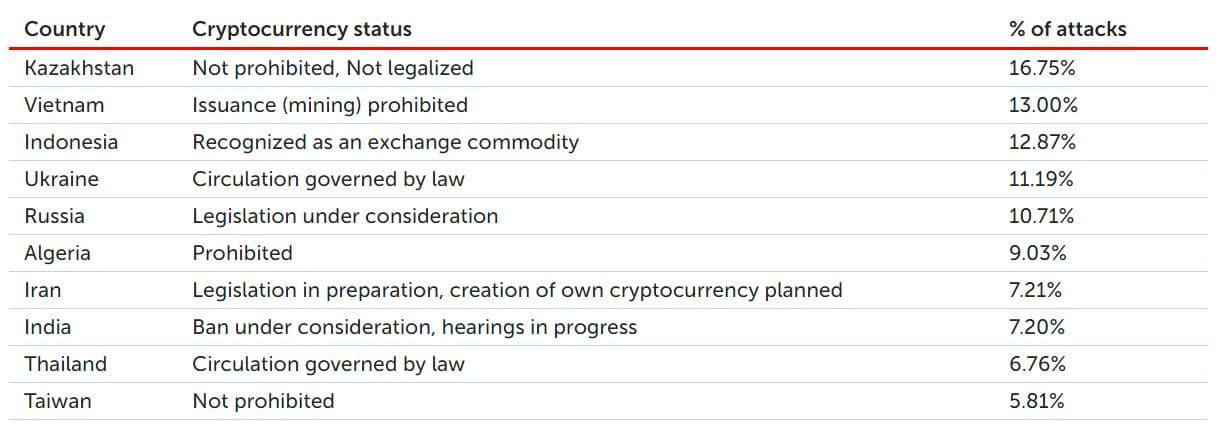
Countries by share of mining attacks, January–October 2018. Source: Kaspersky Lab
Having said that, there is one area in which the law affects crypto-jacking; there is a clear correlation between the distribution of unlicensed software and mining attacks. The least affected countries were found to be the US, Switzerland and the UK.
The more I think about this the worse it becomes. Attackers had arbitrary script injection on thousands of sites including many NHS websites here in England. Just stop and think for a few moments about what exactly they could have done with that capability... ?
Interestingly, mining software spread via hardware (USB drives) has increased annually since 2015. In 2016 this accounted for 4.2 percent of victims, in 2017 6.7 percent, and in 2019 one in ten.
Electricity prices, which are perhaps the main concern of cryptocurrency mining operations, are not taken into account by crypto-jackers, because they are not the ones paying for it.
Declining market
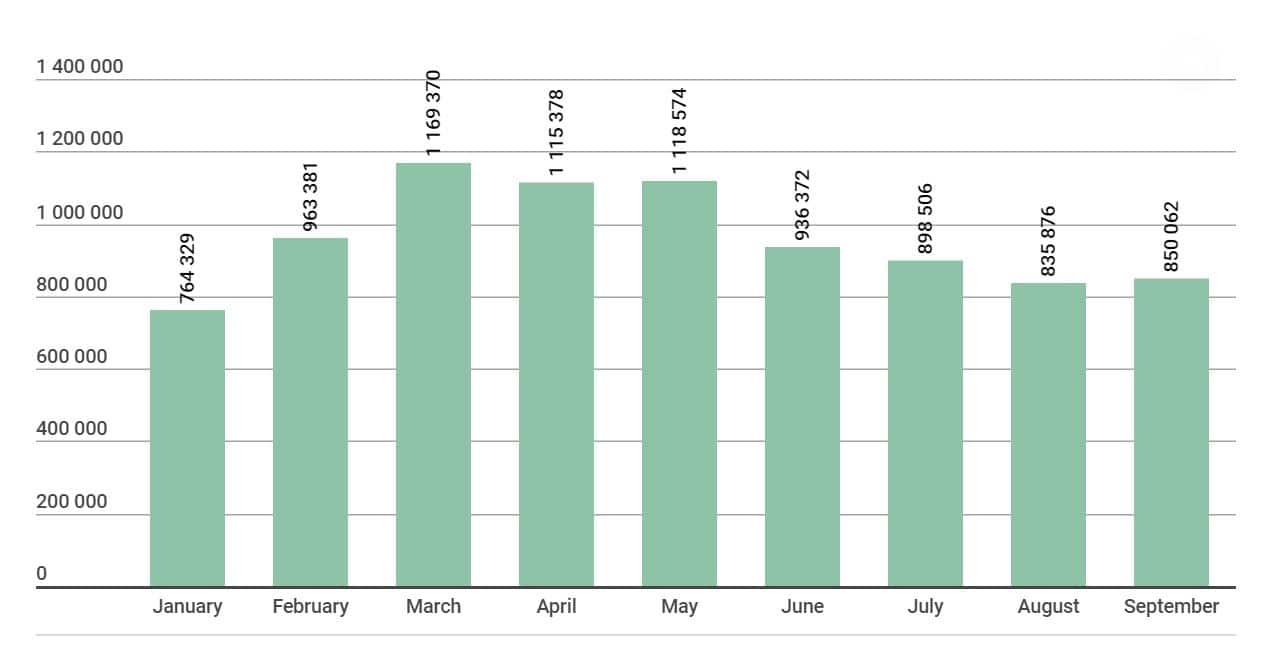
Number of unique users attacked, 2018. Source: Kaspersky Lab
As you can see from the above chart, attacks have declined. Kaspersky hypothesises that this reflects the general waning of interest in digital assets over the year.
Kaspersky Lab, a Moscow-based cyber-security firm, has named cryptocurrency mining as its story of the year. It has found that attacks have gradually declined over 2018, but remain a major concern.
It should be noted that the information in the report only concerns countries with a considerable number of Kaspersky Lab clients.
Crypto-jacking has become a worldwide issue over the past year. This refers to cryptocurrency mining programmes being installed on computers unbeknownst to the users.
The threat is compounded by the ease with which these protocols can be designed - there are ready-made programmes available on the market - and by website plugins that begin running when the site is opened.
The problem is not confined to home computers either; the servers of large companies and government agencies have been regularly hit too.
A new business direction
Kaspersky reports evidence that mining software is an increasingly popular tool for botnets.
Botnets are networks of infected computers under the control of a hacker, which are being used to execute large-scale attacks. In the first half of 2018, mining protocols made up almost 5 percent of botnet downloads, compared to 2.7 percent in early 2017.
One traditional tactic of botnets is the 'distributed denial of service' attack, which is when large numbers of devices are used to jam a system by overloading it with requests, typically along with a ransom demand. Kaspersky registered a decline in this type of attack, which it says is the result of these networks switching to cryptocurrency mining instead.
For example, the 'Yoyo' botnet, which was first sighted in March 2010 and which has carried out hundreds of DDoS attacks worldwide, has "dramatically" lowered its rate of these attacks, but does not appear to have been disbanded.
Malware is being repurposed and becoming more sophisticated. For example, the 'Trojan-Ransom.Win32.Rakhni', which was first detected by Kaspersky in 2013, was a typical Trojan virus, and since 2018 has become a mining programme. It is disguised as an Adobe product.
Unmarked bills
The most popular cryptocurrency for this activity is Monero, market capitalisation $1.06 billion. It is designed to be anonymous and easy to mine; it is actually used charity organisations as a donation option on their websites, although in these cases users are given the option of performing the task. The coin has been banned by Japanese cryptocurrency exchanges because it is so ideal for illicit use.
In December 2017, users of Facebook Messenger in several countries found themselves generating Monero for an unknown recipient, and in March 2018, a flaw in a Linux plugin led to $75,000 worth of Monero being crypto-jacked from users in Japan, Taiwan, China, India, and the US.
Kaspersky says that "by some accounts" a total of $175 million worth of Monero has been earned in this way,or around 5% of all Monero currently in circulation.
Outside of the law
Interestingly, Kaspersky found no correlation between the legal status of cryptocurrency and frequency of attack. In the below chart can be found countries which have banned cryptocurrency, countries which have legitimised it, and countries in between the two.
Countries by share of mining attacks, January–October 2018. Source: Kaspersky Lab
Having said that, there is one area in which the law affects crypto-jacking; there is a clear correlation between the distribution of unlicensed software and mining attacks. The least affected countries were found to be the US, Switzerland and the UK.
The more I think about this the worse it becomes. Attackers had arbitrary script injection on thousands of sites including many NHS websites here in England. Just stop and think for a few moments about what exactly they could have done with that capability... ?
Interestingly, mining software spread via hardware (USB drives) has increased annually since 2015. In 2016 this accounted for 4.2 percent of victims, in 2017 6.7 percent, and in 2019 one in ten.
Electricity prices, which are perhaps the main concern of cryptocurrency mining operations, are not taken into account by crypto-jackers, because they are not the ones paying for it.
Declining market
Number of unique users attacked, 2018. Source: Kaspersky Lab
As you can see from the above chart, attacks have declined. Kaspersky hypothesises that this reflects the general waning of interest in digital assets over the year.
SEC Draft Plan Would Curb Enforcement Reach and Cement Atkins's Crypto Turn
Featured Videos
FM Daily Brief – 9 June 2026
Today’s Tuesday, the 9th of June 2026, and these are our main stories: eToro’s customer assets climbed back above $20 billion, Prop trading model in prediction markets, and Leverate launched a new AI assistant for brokers and traders.
War Stories: Lessons from 20 Years in Markets (the pain, the pitfalls and the profits)
The trades that taught me the most aren't the ones that worked. They're the ones that didn't — or the ones I almost caught and didn't have the nerve to ride. In this session, I'll tell you about the Brexit miss, the SNB shocker that nearly handed me a 5400% return, the BoJ surprise that punched me in the gut, and a few wins along the way. Each story carries a lesson, but the lessons aren't the point. Everyone who trades long enough collects a portfolio of moments like these; what separates the people who stay in the game is what they do with them.
The Engine and the Fuel: How AI & Data Drives African Future
If AI is the engine, data is the fuel. Without quality, accessible data, AI cannot work well; and without the right mindset, data remains just numbers instead of insight. In this session, leading experts will explore how AI and data are democratizing opportunities for businesses and personal growth. Discover practical ways to make AI accessible today, anticipate its transformative impact on African markets, and learn actionable steps to prepare for what's next. Let's talk about:
-How AI and data drive business efficiency and innovation in trading and fintech
-AI tools to elevate trading or business strategies
-How to access and maximise the power of data and AI
-Emerging AI and data trends in Africa and their economic ripple effects
If AI is the engine, data is the fuel. Without quality, accessible data, AI cannot work well; and without the right mindset, data remains just numbers instead of insight. In this session, leading experts will explore how AI and data are democratizing opportunities for businesses and personal growth. Discover practical ways to make AI accessible today, anticipate its transformative impact on African markets, and learn actionable steps to prepare for what's next. Let's talk about:
-How AI and data drive business efficiency and innovation in trading and fintech
-AI tools to elevate trading or business strategies
-How to access and maximise the power of data and AI
-Emerging AI and data trends in Africa and their economic ripple effects
If AI is the engine, data is the fuel. Without quality, accessible data, AI cannot work well; and without the right mindset, data remains just numbers instead of insight. In this session, leading experts will explore how AI and data are democratizing opportunities for businesses and personal growth. Discover practical ways to make AI accessible today, anticipate its transformative impact on African markets, and learn actionable steps to prepare for what's next. Let's talk about:
-How AI and data drive business efficiency and innovation in trading and fintech
-AI tools to elevate trading or business strategies
-How to access and maximise the power of data and AI
-Emerging AI and data trends in Africa and their economic ripple effects
If AI is the engine, data is the fuel. Without quality, accessible data, AI cannot work well; and without the right mindset, data remains just numbers instead of insight. In this session, leading experts will explore how AI and data are democratizing opportunities for businesses and personal growth. Discover practical ways to make AI accessible today, anticipate its transformative impact on African markets, and learn actionable steps to prepare for what's next. Let's talk about:
-How AI and data drive business efficiency and innovation in trading and fintech
-AI tools to elevate trading or business strategies
-How to access and maximise the power of data and AI
-Emerging AI and data trends in Africa and their economic ripple effects
If AI is the engine, data is the fuel. Without quality, accessible data, AI cannot work well; and without the right mindset, data remains just numbers instead of insight. In this session, leading experts will explore how AI and data are democratizing opportunities for businesses and personal growth. Discover practical ways to make AI accessible today, anticipate its transformative impact on African markets, and learn actionable steps to prepare for what's next. Let's talk about:
-How AI and data drive business efficiency and innovation in trading and fintech
-AI tools to elevate trading or business strategies
-How to access and maximise the power of data and AI
-Emerging AI and data trends in Africa and their economic ripple effects
If AI is the engine, data is the fuel. Without quality, accessible data, AI cannot work well; and without the right mindset, data remains just numbers instead of insight. In this session, leading experts will explore how AI and data are democratizing opportunities for businesses and personal growth. Discover practical ways to make AI accessible today, anticipate its transformative impact on African markets, and learn actionable steps to prepare for what's next. Let's talk about:
-How AI and data drive business efficiency and innovation in trading and fintech
-AI tools to elevate trading or business strategies
-How to access and maximise the power of data and AI
-Emerging AI and data trends in Africa and their economic ripple effects
Inside My Best Trade with Jimmy Moyaha
Most market post-mortems describe what happened to prices. Few describe what happened in the trading room while the position was open: the entry conviction, the moments that tested it, and the exit decision that closed the book.
This session brings one seasoned trader to the stage for an unfiltered account of the position that still defines how they think about markets.
Attendees will walk away with:
-A first-hand account of how a conviction trade is built, from thesis and entry through position management and exit
-Understanding of what turns a market observation into a live position, and what holds it when conditions shift
-Insight into how timing, execution quality, and market structure shaped the final result
-Perspective on what the trade revealed about edge, risk tolerance, and when to hold through a position moving against you
-Clarity on what separates a well-built trade from a well-timed one
Most market post-mortems describe what happened to prices. Few describe what happened in the trading room while the position was open: the entry conviction, the moments that tested it, and the exit decision that closed the book.
This session brings one seasoned trader to the stage for an unfiltered account of the position that still defines how they think about markets.
Attendees will walk away with:
-A first-hand account of how a conviction trade is built, from thesis and entry through position management and exit
-Understanding of what turns a market observation into a live position, and what holds it when conditions shift
-Insight into how timing, execution quality, and market structure shaped the final result
-Perspective on what the trade revealed about edge, risk tolerance, and when to hold through a position moving against you
-Clarity on what separates a well-built trade from a well-timed one
Most market post-mortems describe what happened to prices. Few describe what happened in the trading room while the position was open: the entry conviction, the moments that tested it, and the exit decision that closed the book.
This session brings one seasoned trader to the stage for an unfiltered account of the position that still defines how they think about markets.
Attendees will walk away with:
-A first-hand account of how a conviction trade is built, from thesis and entry through position management and exit
-Understanding of what turns a market observation into a live position, and what holds it when conditions shift
-Insight into how timing, execution quality, and market structure shaped the final result
-Perspective on what the trade revealed about edge, risk tolerance, and when to hold through a position moving against you
-Clarity on what separates a well-built trade from a well-timed one
Most market post-mortems describe what happened to prices. Few describe what happened in the trading room while the position was open: the entry conviction, the moments that tested it, and the exit decision that closed the book.
This session brings one seasoned trader to the stage for an unfiltered account of the position that still defines how they think about markets.
Attendees will walk away with:
-A first-hand account of how a conviction trade is built, from thesis and entry through position management and exit
-Understanding of what turns a market observation into a live position, and what holds it when conditions shift
-Insight into how timing, execution quality, and market structure shaped the final result
-Perspective on what the trade revealed about edge, risk tolerance, and when to hold through a position moving against you
-Clarity on what separates a well-built trade from a well-timed one
Most market post-mortems describe what happened to prices. Few describe what happened in the trading room while the position was open: the entry conviction, the moments that tested it, and the exit decision that closed the book.
This session brings one seasoned trader to the stage for an unfiltered account of the position that still defines how they think about markets.
Attendees will walk away with:
-A first-hand account of how a conviction trade is built, from thesis and entry through position management and exit
-Understanding of what turns a market observation into a live position, and what holds it when conditions shift
-Insight into how timing, execution quality, and market structure shaped the final result
-Perspective on what the trade revealed about edge, risk tolerance, and when to hold through a position moving against you
-Clarity on what separates a well-built trade from a well-timed one
Most market post-mortems describe what happened to prices. Few describe what happened in the trading room while the position was open: the entry conviction, the moments that tested it, and the exit decision that closed the book.
This session brings one seasoned trader to the stage for an unfiltered account of the position that still defines how they think about markets.
Attendees will walk away with:
-A first-hand account of how a conviction trade is built, from thesis and entry through position management and exit
-Understanding of what turns a market observation into a live position, and what holds it when conditions shift
-Insight into how timing, execution quality, and market structure shaped the final result
-Perspective on what the trade revealed about edge, risk tolerance, and when to hold through a position moving against you
-Clarity on what separates a well-built trade from a well-timed one
Agentic Inequality: Democratizing Financial Access Through AI & Blockchain
As crypto and CFD trading continue to expand across Africa, access to advanced tools and market insights remains uneven. This session explores how AI and blockchain can bridge that gap by empowering informal traders and underserved communities to participate more effectively in digital financial markets. The discussion will focus on practical applications of technology to improve accessibility, education, and investment outcomes in both formal and informal sectors.
In this discussion, we will explore:
-The role of AI in democratizing access to trading tools, insights, and strategy development
-How crypto and blockchain can enable broader participation beyond traditional financial systems
-Addressing access barriers: infrastructure, education, and affordability in underserved communities
-Opportunities for brokers and platforms to tap into the informal trading economy
As crypto and CFD trading continue to expand across Africa, access to advanced tools and market insights remains uneven. This session explores how AI and blockchain can bridge that gap by empowering informal traders and underserved communities to participate more effectively in digital financial markets. The discussion will focus on practical applications of technology to improve accessibility, education, and investment outcomes in both formal and informal sectors.
In this discussion, we will explore:
-The role of AI in democratizing access to trading tools, insights, and strategy development
-How crypto and blockchain can enable broader participation beyond traditional financial systems
-Addressing access barriers: infrastructure, education, and affordability in underserved communities
-Opportunities for brokers and platforms to tap into the informal trading economy
As crypto and CFD trading continue to expand across Africa, access to advanced tools and market insights remains uneven. This session explores how AI and blockchain can bridge that gap by empowering informal traders and underserved communities to participate more effectively in digital financial markets. The discussion will focus on practical applications of technology to improve accessibility, education, and investment outcomes in both formal and informal sectors.
In this discussion, we will explore:
-The role of AI in democratizing access to trading tools, insights, and strategy development
-How crypto and blockchain can enable broader participation beyond traditional financial systems
-Addressing access barriers: infrastructure, education, and affordability in underserved communities
-Opportunities for brokers and platforms to tap into the informal trading economy
As crypto and CFD trading continue to expand across Africa, access to advanced tools and market insights remains uneven. This session explores how AI and blockchain can bridge that gap by empowering informal traders and underserved communities to participate more effectively in digital financial markets. The discussion will focus on practical applications of technology to improve accessibility, education, and investment outcomes in both formal and informal sectors.
In this discussion, we will explore:
-The role of AI in democratizing access to trading tools, insights, and strategy development
-How crypto and blockchain can enable broader participation beyond traditional financial systems
-Addressing access barriers: infrastructure, education, and affordability in underserved communities
-Opportunities for brokers and platforms to tap into the informal trading economy
As crypto and CFD trading continue to expand across Africa, access to advanced tools and market insights remains uneven. This session explores how AI and blockchain can bridge that gap by empowering informal traders and underserved communities to participate more effectively in digital financial markets. The discussion will focus on practical applications of technology to improve accessibility, education, and investment outcomes in both formal and informal sectors.
In this discussion, we will explore:
-The role of AI in democratizing access to trading tools, insights, and strategy development
-How crypto and blockchain can enable broader participation beyond traditional financial systems
-Addressing access barriers: infrastructure, education, and affordability in underserved communities
-Opportunities for brokers and platforms to tap into the informal trading economy
As crypto and CFD trading continue to expand across Africa, access to advanced tools and market insights remains uneven. This session explores how AI and blockchain can bridge that gap by empowering informal traders and underserved communities to participate more effectively in digital financial markets. The discussion will focus on practical applications of technology to improve accessibility, education, and investment outcomes in both formal and informal sectors.
In this discussion, we will explore:
-The role of AI in democratizing access to trading tools, insights, and strategy development
-How crypto and blockchain can enable broader participation beyond traditional financial systems
-Addressing access barriers: infrastructure, education, and affordability in underserved communities
-Opportunities for brokers and platforms to tap into the informal trading economy