Decentralized Finance, or 'DeFi', saw significant growth throughout 2019. Will the sector continue along this trajectory?
FM
After a year of massive growth, DeFi, or “decentralized finance,” has become one of the most important sectors of the cryptocurrency industry.
The term refers to any kind of financial service that is offered on a decentralized platform--indeed, Micha Benoliel, chief executive officer and founder of IoT connectivity provider Nodle, told Finance Magnates that essentially, “the ultimate goal of the DeFi community is to reproduce all the services and features provided by banks and other entities in a totally decentralized, trustless and peer-to-peer way.”
"The DeFi movement started by the development of decentralized and trustless lending platforms through Ethereum smart contracts," he explained. "People then developed alternative financial services such as synthetic assets (for example, gold, diamonds, other currencies), derivatives, or even decentralized exchanges. Besides these services, it also includes stable coins, which are coins (or tokens) stabilized through various solutions to another asset (such as the US dollar).
Charles Phan, chief technical officer of cryptocurrency exchange Interdax, also explained to Finance Magnates that the term “refers to the use of open-source protocols to make finance permissionless, enabling things like on-chain lending markets, credit markets, and identity services.”
Dan Schatt, co-founder and president of DeFi firm Cred, told Finance Magnates that "To some, it represents the ultimate dissolution of all financial intermediaries, in the same spirit that Bitcoin was created. The reality is that the world of finance is moving on a continuum, some faster than others toward decentralization. We aren’t there yet. Today, most would not trust your finances with a purely decentralized custodian."
Dan Schatt, co-founder and president of DeFi firm Cred.
DeFi "means something different to different people"
Charles Phan, CTO of cryptocurrency exchange Interdax.
Indeed, in an interview with Finance Magnates published earlier this week, Brian Kerr, co-founder and CEO of Kava Labs, said that the term DeFi is one that has evolved over the last year, and that as such, it “ means something different to different people.”
However, this year, Kerr said that what people really mean when they say ‘DeFi’ “tends to be lending–so, the ability to create some kind of financial service that a bank offers.” Indeed, his own company offers crypto lending services, in addition to stablecoins and bonds.
DeFi grew significantly over 2019
How much is the DeFi sector worth? While data for the total value of the DeFi corner of the crypto industry difficult to pinpoint, there are a few important statistics that point to significant growth over the past year.
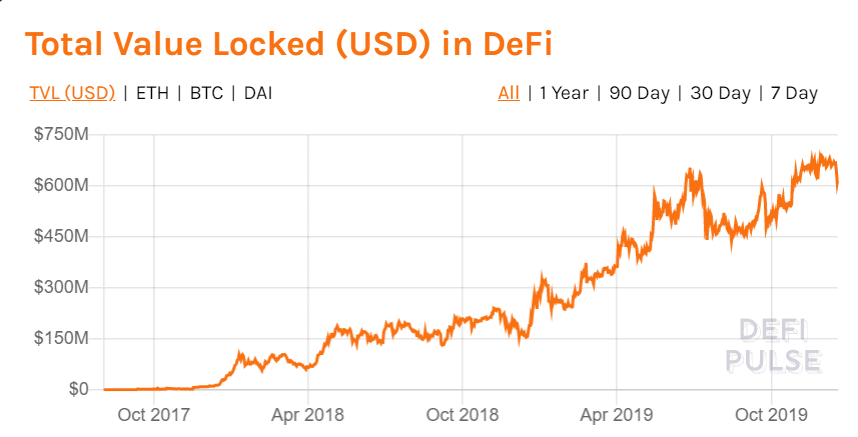
For example, DeFi Pulse, which is a site that collects data on DeFi projects built on top of the Ethereum blockchain, has tracked the growth of how much capital has been put into these projects--the ‘Total Value Locked’, or TVL, by “pulling the total balance of Ether (ETH) and ERC-20 tokens held by these smart contracts.”
Source: DeFi Pulse
According to TVL statistics for this year versus last year, the amount of capital inside of DeFi projects on the Ethereum network has more than tripled--on December 19th, 2018, TVL was roughly $190 million. Today, that figure has risen to $610 million; two years ago, in 2017, TVL was just around $30 million.
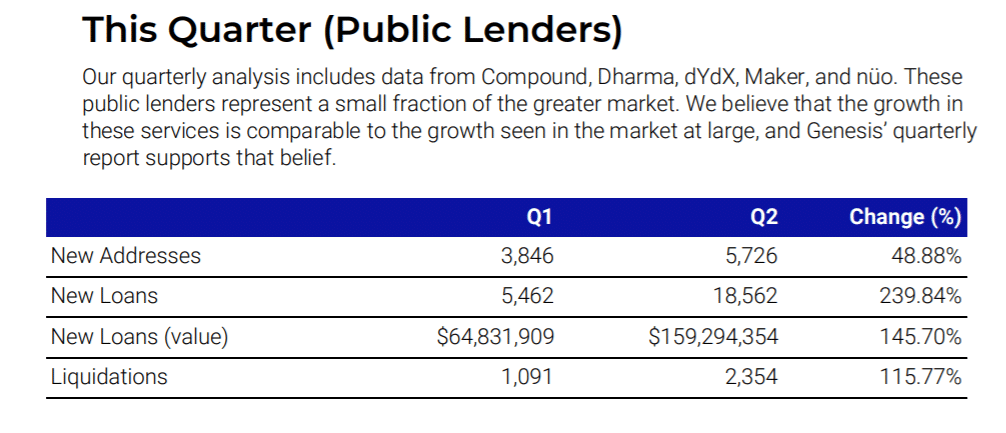
Additionally, crypto credit assessment firm Graychain reported massive growth from Q1 to Q2 of this year from four public crypto lenders: Compound, Dharma, dYdX, Maker, and nüo. The four firms saw a combined 239.84% increase in the number of new loans that were taken out (5,462 to 18,562) and a 145.7% increase in new loans quarter over quarter (from $64.8 to $159.3 million).
Graychain also reported that roughly $4.7 billion has been taken out in crypto loans over the history of the sector; by comparison, the total market cap of all cryptocurrencies at press time was roughly $177 billion.
Source: Graychain
However, Graychain also reported that of the $4.7 billion in loans that have been taken out from DeFi platforms, only $86 million--roughly 1.8 percent--has been earned back in returns.
Another bubble?
As such, the rate of growth of DeFi--and crypto lending in particular--has increased at such a rapid pace that some analysts have expressed that it could be a sort of second crypto bubble.
“Crypto credit has expanded too quickly and is headed for a blow-up, says a group of former Wall Street traders who are now seeking riches in digital assets,” said an October report by Bloomberg. Also citing data from Graychain, the report said that “a near $5 billion industry has emerged from nothing just two years ago and the number of loan platforms is rapidly proliferating.”
And indeed, the primary source of concern seems to stem from the fact that the loans that are being taken out from most crypto lending firms are being used as a roundabout way of margin trading.
Brian Kerr, co-founder and CEO of Kava Labs, a blockchain solution providing DeFi services including stablecoins, bonds, and lending.
After all, “if you’re not an accredited investor, but you still trade cryptocurrencies, in the US, you don’t have any access to lending products like margin trading,” Brian Kerr told Finance Magnates. “You couldn’t get a levered position on BTC if you wanted to–it used to be available, but regulators forced the exchanges to stop offering that to US customers.”
Jason Urban, chief executive of crypto loan platform Drawbridge Lending, told Bloomberg that the issue of credit risk “keeps him up at night.”: indeed, “the torpedo below the waterline is an MF Global-Lehman Brothers type event.” Previously, Urban was a former trader at DRW Holdings LLC and Goldman Sachs Group, Inc.
More growth ahead?
Still, most experts seem to agree that the sector isn’t due for a correction anytime soon--2020 is expected to be another year of big growth for DeFi.
Micha Benoliel told Finance Magnates that the growth of the DeFi sector that took place over 2019 marked a paradigm shift in the ways that most people see banking: “DeFi represents a mind shift from people looking for an alternative to the traditional banking systems which do not fit their needs,” he explained.
“In most cases, existing banking systems are working badly,” Benoliel said. “Of course, there may be a point in the future when DeFi growth may grow more slowly, but this is the case for anything. Bubble or not, DeFi is here to stay and grow.”
Micha Benoliel, chief executive officer and founder of IoT connectivity provider Nodle.
And how exactly will the sector continue to grow? “I would expect that more and more financial products will see their decentralized version appear in 2020,” Benoliel said.
Indeed, Benoliel predicts that “as more financial products continue to materialize in decentralized form, “this will bring new users and use cases that were not possible before for the blockchain industry.”
However, “the attractive interest rates provided may slowly decrease as more supply will come into the market,” Benoliel said, although “they would certainly remain higher than in the current financial industry as the middlemen simply do not exist for DeFi.”
One clear point of improvement that Benoliel sees for DeFi is the ways that things operate on the front ends of many platforms: “I think DeFi products, just as most blockchain products, critically need a better user experience,” he told Finance Magnates. “Indeed, today it is still very hard for a non-technical person, or a ‘non-initiated’ person to even understand nor use these products.”
2020: the dawn of “DeGov”?
Kadan Stadelmann, chief technical officer of composable Smart Chain platform Komodo, told Finance Magnates that he doesn’t see the astronomical growth of DeFi throughout 2019 as a bubble. After all, "throughout most of the year we’ve been facing intense bear market conditions," he explained.
“I believe the market in general, and the fintech sector in particular, is exploring this promising technology's capabilities, which is the main driver of the growth we’ve witnessed.”
As for the year ahead? Stadelmann sees growth--and the entry of government into DeFi.
“In addition to seeing more fiat-, commodity-, and cryptocurrency-backed stablecoins, we will likely see the first real ‘governmental-backed DeF’ applications in 2020,” he said. “This might sound paradoxical, due to the fact that (most) DeFi projects aim to revolutionize the traditional financial world into a decentralized architecture, outside of government control.
To that end, Stadelmann said, “it might actually be a unique and independent layer— not DeFi but DeGov.”
This “DeGov” layer could manifest itself in many ways: “cryptocurrencies similar to stablecoins, known as central bank digital currencies (CBDC), or it may be additional ‘decentralized and blockchain-based’ financial tools and technologies that offer strong forms of decentralized self-governance. Banks and the traditional fintech sector will most certainly join the ‘DeFi-rush.’”
The involvement of government in DeFi could potentially contribute to more regulations in the space, and thereby, more “legitimatization” of the sector, something that Stadelmann thinks that will be necessary in order for DeFi to grow in a sustainable manner.
“DeFi needs more official and legal acceptance to grow,” he explained. “It also needs increased awareness among the general public, regarding the technical but also economical potential of this emerging and promising technology. As this layer, and especially the technology itself, matures and as ‘DeGov’ gets involved, we will likely see more use-cases appear, and then we’ll also see the ‘big players’ joining in.”
Could over-regulation kill or fuel DeFi?
On the other hand, however, Pascal Thellmann, chief executive officer of CoinDiligent, a platform providing guides for cryptocurrency investors, pointed out that the relatively-unregulated nature of DeFi--particularly the lending aspect of the sector--is perhaps the thing that has spurred so much growth this year.
“DeFi thrives from overregulation and inefficiencies in traditional finance,” Thellmann said to Finance Magnates; in his view, “the ideal growth scenario for DeFi would be one where governments impose draconian financial surveillance legislation” on traditional financial institutions, “and where traditional financial services companies fail to adapt to an increasingly digital economy.”
In fact, Thellman also believes that regulation of certain aspects of the cryptosphere itself has already begun to fuel the rise of DeFi: “major exchanges are also getting increasing pressure from regulators, which is forcing them to implement KYC and stricter monitoring on its users,” he pointed out to Finance Magnates. “BitMEX, for example, is rumored to roll out full KYC in Q1 2020.”
Pascal Thellmann, chief executive officer of CoinDiligent, a platform providing guides for cryptocurrency investors.
“Hence, I think that throughout 2020, there will be a significant flow of liquidity from centralized cryptocurrency exchanges and OTC desks to DeFi alternatives,” he continued. “The continuation of this overregulation trend by the government and crackdown on crypto businesses will likely continue for the coming years and prove to be a powerful DeFi growth catalyst.”
And is DeFi a bubble? Thellmann thinks not--"contrary to Bitcoin or other cryptocurrencies, which can enter wild price bubbles that are barely connected to reality, Defi is just an ecosystem of tools," he said. "This means that its growth is directly related to the number of people seeking utility from tools in the ecosystem."
Do you think that the growth of DeFi throughout 2019 is a bubble? What do you see for the sector in 2020? Let us know in the comments below.
After a year of massive growth, DeFi, or “decentralized finance,” has become one of the most important sectors of the cryptocurrency industry.
The term refers to any kind of financial service that is offered on a decentralized platform--indeed, Micha Benoliel, chief executive officer and founder of IoT connectivity provider Nodle, told Finance Magnates that essentially, “the ultimate goal of the DeFi community is to reproduce all the services and features provided by banks and other entities in a totally decentralized, trustless and peer-to-peer way.”
"The DeFi movement started by the development of decentralized and trustless lending platforms through Ethereum smart contracts," he explained. "People then developed alternative financial services such as synthetic assets (for example, gold, diamonds, other currencies), derivatives, or even decentralized exchanges. Besides these services, it also includes stable coins, which are coins (or tokens) stabilized through various solutions to another asset (such as the US dollar).
Charles Phan, chief technical officer of cryptocurrency exchange Interdax, also explained to Finance Magnates that the term “refers to the use of open-source protocols to make finance permissionless, enabling things like on-chain lending markets, credit markets, and identity services.”
Dan Schatt, co-founder and president of DeFi firm Cred, told Finance Magnates that "To some, it represents the ultimate dissolution of all financial intermediaries, in the same spirit that Bitcoin was created. The reality is that the world of finance is moving on a continuum, some faster than others toward decentralization. We aren’t there yet. Today, most would not trust your finances with a purely decentralized custodian."
Dan Schatt, co-founder and president of DeFi firm Cred.
DeFi "means something different to different people"
Charles Phan, CTO of cryptocurrency exchange Interdax.
Indeed, in an interview with Finance Magnates published earlier this week, Brian Kerr, co-founder and CEO of Kava Labs, said that the term DeFi is one that has evolved over the last year, and that as such, it “ means something different to different people.”
However, this year, Kerr said that what people really mean when they say ‘DeFi’ “tends to be lending–so, the ability to create some kind of financial service that a bank offers.” Indeed, his own company offers crypto lending services, in addition to stablecoins and bonds.
DeFi grew significantly over 2019
How much is the DeFi sector worth? While data for the total value of the DeFi corner of the crypto industry difficult to pinpoint, there are a few important statistics that point to significant growth over the past year.
For example, DeFi Pulse, which is a site that collects data on DeFi projects built on top of the Ethereum blockchain, has tracked the growth of how much capital has been put into these projects--the ‘Total Value Locked’, or TVL, by “pulling the total balance of Ether (ETH) and ERC-20 tokens held by these smart contracts.”
Source: DeFi Pulse
According to TVL statistics for this year versus last year, the amount of capital inside of DeFi projects on the Ethereum network has more than tripled--on December 19th, 2018, TVL was roughly $190 million. Today, that figure has risen to $610 million; two years ago, in 2017, TVL was just around $30 million.
Additionally, crypto credit assessment firm Graychain reported massive growth from Q1 to Q2 of this year from four public crypto lenders: Compound, Dharma, dYdX, Maker, and nüo. The four firms saw a combined 239.84% increase in the number of new loans that were taken out (5,462 to 18,562) and a 145.7% increase in new loans quarter over quarter (from $64.8 to $159.3 million).
Graychain also reported that roughly $4.7 billion has been taken out in crypto loans over the history of the sector; by comparison, the total market cap of all cryptocurrencies at press time was roughly $177 billion.
Source: Graychain
However, Graychain also reported that of the $4.7 billion in loans that have been taken out from DeFi platforms, only $86 million--roughly 1.8 percent--has been earned back in returns.
Another bubble?
As such, the rate of growth of DeFi--and crypto lending in particular--has increased at such a rapid pace that some analysts have expressed that it could be a sort of second crypto bubble.
“Crypto credit has expanded too quickly and is headed for a blow-up, says a group of former Wall Street traders who are now seeking riches in digital assets,” said an October report by Bloomberg. Also citing data from Graychain, the report said that “a near $5 billion industry has emerged from nothing just two years ago and the number of loan platforms is rapidly proliferating.”
And indeed, the primary source of concern seems to stem from the fact that the loans that are being taken out from most crypto lending firms are being used as a roundabout way of margin trading.
Brian Kerr, co-founder and CEO of Kava Labs, a blockchain solution providing DeFi services including stablecoins, bonds, and lending.
After all, “if you’re not an accredited investor, but you still trade cryptocurrencies, in the US, you don’t have any access to lending products like margin trading,” Brian Kerr told Finance Magnates. “You couldn’t get a levered position on BTC if you wanted to–it used to be available, but regulators forced the exchanges to stop offering that to US customers.”
Jason Urban, chief executive of crypto loan platform Drawbridge Lending, told Bloomberg that the issue of credit risk “keeps him up at night.”: indeed, “the torpedo below the waterline is an MF Global-Lehman Brothers type event.” Previously, Urban was a former trader at DRW Holdings LLC and Goldman Sachs Group, Inc.
More growth ahead?
Still, most experts seem to agree that the sector isn’t due for a correction anytime soon--2020 is expected to be another year of big growth for DeFi.
Micha Benoliel told Finance Magnates that the growth of the DeFi sector that took place over 2019 marked a paradigm shift in the ways that most people see banking: “DeFi represents a mind shift from people looking for an alternative to the traditional banking systems which do not fit their needs,” he explained.
“In most cases, existing banking systems are working badly,” Benoliel said. “Of course, there may be a point in the future when DeFi growth may grow more slowly, but this is the case for anything. Bubble or not, DeFi is here to stay and grow.”
Micha Benoliel, chief executive officer and founder of IoT connectivity provider Nodle.
And how exactly will the sector continue to grow? “I would expect that more and more financial products will see their decentralized version appear in 2020,” Benoliel said.
Indeed, Benoliel predicts that “as more financial products continue to materialize in decentralized form, “this will bring new users and use cases that were not possible before for the blockchain industry.”
However, “the attractive interest rates provided may slowly decrease as more supply will come into the market,” Benoliel said, although “they would certainly remain higher than in the current financial industry as the middlemen simply do not exist for DeFi.”
One clear point of improvement that Benoliel sees for DeFi is the ways that things operate on the front ends of many platforms: “I think DeFi products, just as most blockchain products, critically need a better user experience,” he told Finance Magnates. “Indeed, today it is still very hard for a non-technical person, or a ‘non-initiated’ person to even understand nor use these products.”
2020: the dawn of “DeGov”?
Kadan Stadelmann, chief technical officer of composable Smart Chain platform Komodo, told Finance Magnates that he doesn’t see the astronomical growth of DeFi throughout 2019 as a bubble. After all, "throughout most of the year we’ve been facing intense bear market conditions," he explained.
“I believe the market in general, and the fintech sector in particular, is exploring this promising technology's capabilities, which is the main driver of the growth we’ve witnessed.”
As for the year ahead? Stadelmann sees growth--and the entry of government into DeFi.
“In addition to seeing more fiat-, commodity-, and cryptocurrency-backed stablecoins, we will likely see the first real ‘governmental-backed DeF’ applications in 2020,” he said. “This might sound paradoxical, due to the fact that (most) DeFi projects aim to revolutionize the traditional financial world into a decentralized architecture, outside of government control.
To that end, Stadelmann said, “it might actually be a unique and independent layer— not DeFi but DeGov.”
This “DeGov” layer could manifest itself in many ways: “cryptocurrencies similar to stablecoins, known as central bank digital currencies (CBDC), or it may be additional ‘decentralized and blockchain-based’ financial tools and technologies that offer strong forms of decentralized self-governance. Banks and the traditional fintech sector will most certainly join the ‘DeFi-rush.’”
The involvement of government in DeFi could potentially contribute to more regulations in the space, and thereby, more “legitimatization” of the sector, something that Stadelmann thinks that will be necessary in order for DeFi to grow in a sustainable manner.
“DeFi needs more official and legal acceptance to grow,” he explained. “It also needs increased awareness among the general public, regarding the technical but also economical potential of this emerging and promising technology. As this layer, and especially the technology itself, matures and as ‘DeGov’ gets involved, we will likely see more use-cases appear, and then we’ll also see the ‘big players’ joining in.”
Could over-regulation kill or fuel DeFi?
On the other hand, however, Pascal Thellmann, chief executive officer of CoinDiligent, a platform providing guides for cryptocurrency investors, pointed out that the relatively-unregulated nature of DeFi--particularly the lending aspect of the sector--is perhaps the thing that has spurred so much growth this year.
“DeFi thrives from overregulation and inefficiencies in traditional finance,” Thellmann said to Finance Magnates; in his view, “the ideal growth scenario for DeFi would be one where governments impose draconian financial surveillance legislation” on traditional financial institutions, “and where traditional financial services companies fail to adapt to an increasingly digital economy.”
In fact, Thellman also believes that regulation of certain aspects of the cryptosphere itself has already begun to fuel the rise of DeFi: “major exchanges are also getting increasing pressure from regulators, which is forcing them to implement KYC and stricter monitoring on its users,” he pointed out to Finance Magnates. “BitMEX, for example, is rumored to roll out full KYC in Q1 2020.”
Pascal Thellmann, chief executive officer of CoinDiligent, a platform providing guides for cryptocurrency investors.
“Hence, I think that throughout 2020, there will be a significant flow of liquidity from centralized cryptocurrency exchanges and OTC desks to DeFi alternatives,” he continued. “The continuation of this overregulation trend by the government and crackdown on crypto businesses will likely continue for the coming years and prove to be a powerful DeFi growth catalyst.”
And is DeFi a bubble? Thellmann thinks not--"contrary to Bitcoin or other cryptocurrencies, which can enter wild price bubbles that are barely connected to reality, Defi is just an ecosystem of tools," he said. "This means that its growth is directly related to the number of people seeking utility from tools in the ecosystem."
Do you think that the growth of DeFi throughout 2019 is a bubble? What do you see for the sector in 2020? Let us know in the comments below.
Rachel is a self-taught crypto geek and a passionate writer. She believes in the power that the written word has to educate, connect and empower individuals to make positive and powerful financial choices. She is the Podcast Host and a Cryptocurrency Editor at Finance Magnates.
In this video, we review @HolaPrimeMarketsOfficial, a multi-asset forex and CFDs broker offering different account types, trading platforms, and flexible trading conditions.
We cover the broker’s overall offering, including account options, trading environment, platforms like MT4 and MT5, and additional services such as managed accounts and fast withdrawals.
Watch the full video to see if Hola Prime Markets fits your trading needs.
📣 Stay up to date with the latest in finance and trading. Follow Finance Magnates for industry news, insights, and global event coverage.
Connect with us:
🔗 LinkedIn: /financemagnates
👍 Facebook: /financemagnates
📸 Instagram: https://www.instagram.com/financemagnates
🐦 X: https://x.com/financemagnates
🎥 TikTok: https://www.tiktok.com/tag/financemagnates
▶️ YouTube: /@financemagnates_official
#HolaPrime #ForexBroker #CFDTrading #FinanceMagnates #Trading #Forex #BrokerReview
In this video, we review @HolaPrimeMarketsOfficial, a multi-asset forex and CFDs broker offering different account types, trading platforms, and flexible trading conditions.
We cover the broker’s overall offering, including account options, trading environment, platforms like MT4 and MT5, and additional services such as managed accounts and fast withdrawals.
Watch the full video to see if Hola Prime Markets fits your trading needs.
📣 Stay up to date with the latest in finance and trading. Follow Finance Magnates for industry news, insights, and global event coverage.
Connect with us:
🔗 LinkedIn: /financemagnates
👍 Facebook: /financemagnates
📸 Instagram: https://www.instagram.com/financemagnates
🐦 X: https://x.com/financemagnates
🎥 TikTok: https://www.tiktok.com/tag/financemagnates
▶️ YouTube: /@financemagnates_official
#HolaPrime #ForexBroker #CFDTrading #FinanceMagnates #Trading #Forex #BrokerReview
In this video, we review @HolaPrimeMarketsOfficial, a multi-asset forex and CFDs broker offering different account types, trading platforms, and flexible trading conditions.
We cover the broker’s overall offering, including account options, trading environment, platforms like MT4 and MT5, and additional services such as managed accounts and fast withdrawals.
Watch the full video to see if Hola Prime Markets fits your trading needs.
📣 Stay up to date with the latest in finance and trading. Follow Finance Magnates for industry news, insights, and global event coverage.
Connect with us:
🔗 LinkedIn: /financemagnates
👍 Facebook: /financemagnates
📸 Instagram: https://www.instagram.com/financemagnates
🐦 X: https://x.com/financemagnates
🎥 TikTok: https://www.tiktok.com/tag/financemagnates
▶️ YouTube: /@financemagnates_official
#HolaPrime #ForexBroker #CFDTrading #FinanceMagnates #Trading #Forex #BrokerReview
In this video, we review @HolaPrimeMarketsOfficial, a multi-asset forex and CFDs broker offering different account types, trading platforms, and flexible trading conditions.
We cover the broker’s overall offering, including account options, trading environment, platforms like MT4 and MT5, and additional services such as managed accounts and fast withdrawals.
Watch the full video to see if Hola Prime Markets fits your trading needs.
📣 Stay up to date with the latest in finance and trading. Follow Finance Magnates for industry news, insights, and global event coverage.
Connect with us:
🔗 LinkedIn: /financemagnates
👍 Facebook: /financemagnates
📸 Instagram: https://www.instagram.com/financemagnates
🐦 X: https://x.com/financemagnates
🎥 TikTok: https://www.tiktok.com/tag/financemagnates
▶️ YouTube: /@financemagnates_official
#HolaPrime #ForexBroker #CFDTrading #FinanceMagnates #Trading #Forex #BrokerReview
Hola Prime Review: What You Need to Know | Full Breakdown by Finance Magnates
Hola Prime Review: What You Need to Know | Full Breakdown by Finance Magnates
Hola Prime Review: What You Need to Know | Full Breakdown by Finance Magnates
Hola Prime Review: What You Need to Know | Full Breakdown by Finance Magnates
Hola Prime Review: What You Need to Know | Full Breakdown by Finance Magnates
Hola Prime Review: What You Need to Know | Full Breakdown by Finance Magnates
In this video, we review @HolaPrime_Global, a proprietary trading firm offering evaluation programs and performance-based payouts in simulated market environments.
We cover how the challenge model works, including account types, profit splits (up to 95%), trading rules, and what it takes to reach a funded account. You’ll also learn about available platforms like MT4, MT5, cTrader, and more, along with insights into payouts, support, and trading conditions.
Watch the full video to see if Hola Prime fits your trading style.
📣 Stay up to date with the latest in finance and trading. Follow Finance Magnates for industry news, insights, and global event coverage.
Connect with us:
🔗 LinkedIn: /financemagnates
👍 Facebook: /financemagnates
📸 Instagram: https://www.instagram.com/financemagnates
🐦 X: https://x.com/financemagnates
🎥 TikTok: https://www.tiktok.com/tag/financemagnates
▶️ YouTube: /@financemagnates_official
#HolaPrime #PropFirm #Trading #FinanceMagnates #Forex #FuturesTrading #TradingReview #PropFirmReview
In this video, we review @HolaPrime_Global, a proprietary trading firm offering evaluation programs and performance-based payouts in simulated market environments.
We cover how the challenge model works, including account types, profit splits (up to 95%), trading rules, and what it takes to reach a funded account. You’ll also learn about available platforms like MT4, MT5, cTrader, and more, along with insights into payouts, support, and trading conditions.
Watch the full video to see if Hola Prime fits your trading style.
📣 Stay up to date with the latest in finance and trading. Follow Finance Magnates for industry news, insights, and global event coverage.
Connect with us:
🔗 LinkedIn: /financemagnates
👍 Facebook: /financemagnates
📸 Instagram: https://www.instagram.com/financemagnates
🐦 X: https://x.com/financemagnates
🎥 TikTok: https://www.tiktok.com/tag/financemagnates
▶️ YouTube: /@financemagnates_official
#HolaPrime #PropFirm #Trading #FinanceMagnates #Forex #FuturesTrading #TradingReview #PropFirmReview
In this video, we review @HolaPrime_Global, a proprietary trading firm offering evaluation programs and performance-based payouts in simulated market environments.
We cover how the challenge model works, including account types, profit splits (up to 95%), trading rules, and what it takes to reach a funded account. You’ll also learn about available platforms like MT4, MT5, cTrader, and more, along with insights into payouts, support, and trading conditions.
Watch the full video to see if Hola Prime fits your trading style.
📣 Stay up to date with the latest in finance and trading. Follow Finance Magnates for industry news, insights, and global event coverage.
Connect with us:
🔗 LinkedIn: /financemagnates
👍 Facebook: /financemagnates
📸 Instagram: https://www.instagram.com/financemagnates
🐦 X: https://x.com/financemagnates
🎥 TikTok: https://www.tiktok.com/tag/financemagnates
▶️ YouTube: /@financemagnates_official
#HolaPrime #PropFirm #Trading #FinanceMagnates #Forex #FuturesTrading #TradingReview #PropFirmReview
In this video, we review @HolaPrime_Global, a proprietary trading firm offering evaluation programs and performance-based payouts in simulated market environments.
We cover how the challenge model works, including account types, profit splits (up to 95%), trading rules, and what it takes to reach a funded account. You’ll also learn about available platforms like MT4, MT5, cTrader, and more, along with insights into payouts, support, and trading conditions.
Watch the full video to see if Hola Prime fits your trading style.
📣 Stay up to date with the latest in finance and trading. Follow Finance Magnates for industry news, insights, and global event coverage.
Connect with us:
🔗 LinkedIn: /financemagnates
👍 Facebook: /financemagnates
📸 Instagram: https://www.instagram.com/financemagnates
🐦 X: https://x.com/financemagnates
🎥 TikTok: https://www.tiktok.com/tag/financemagnates
▶️ YouTube: /@financemagnates_official
#HolaPrime #PropFirm #Trading #FinanceMagnates #Forex #FuturesTrading #TradingReview #PropFirmReview
In this video, we review @HolaPrime_Global, a proprietary trading firm offering evaluation programs and performance-based payouts in simulated market environments.
We cover how the challenge model works, including account types, profit splits (up to 95%), trading rules, and what it takes to reach a funded account. You’ll also learn about available platforms like MT4, MT5, cTrader, and more, along with insights into payouts, support, and trading conditions.
Watch the full video to see if Hola Prime fits your trading style.
📣 Stay up to date with the latest in finance and trading. Follow Finance Magnates for industry news, insights, and global event coverage.
Connect with us:
🔗 LinkedIn: /financemagnates
👍 Facebook: /financemagnates
📸 Instagram: https://www.instagram.com/financemagnates
🐦 X: https://x.com/financemagnates
🎥 TikTok: https://www.tiktok.com/tag/financemagnates
▶️ YouTube: /@financemagnates_official
#HolaPrime #PropFirm #Trading #FinanceMagnates #Forex #FuturesTrading #TradingReview #PropFirmReview
In this video, we review @HolaPrime_Global, a proprietary trading firm offering evaluation programs and performance-based payouts in simulated market environments.
We cover how the challenge model works, including account types, profit splits (up to 95%), trading rules, and what it takes to reach a funded account. You’ll also learn about available platforms like MT4, MT5, cTrader, and more, along with insights into payouts, support, and trading conditions.
Watch the full video to see if Hola Prime fits your trading style.
📣 Stay up to date with the latest in finance and trading. Follow Finance Magnates for industry news, insights, and global event coverage.
Connect with us:
🔗 LinkedIn: /financemagnates
👍 Facebook: /financemagnates
📸 Instagram: https://www.instagram.com/financemagnates
🐦 X: https://x.com/financemagnates
🎥 TikTok: https://www.tiktok.com/tag/financemagnates
▶️ YouTube: /@financemagnates_official
#HolaPrime #PropFirm #Trading #FinanceMagnates #Forex #FuturesTrading #TradingReview #PropFirmReview
Axi Winner Spotlight 🏆 | Global Most Innovative Broker 2025 #Innovation #Trading #Fintech #Broker
Axi Winner Spotlight 🏆 | Global Most Innovative Broker 2025 #Innovation #Trading #Fintech #Broker
Axi Winner Spotlight 🏆 | Global Most Innovative Broker 2025 #Innovation #Trading #Fintech #Broker
Axi Winner Spotlight 🏆 | Global Most Innovative Broker 2025 #Innovation #Trading #Fintech #Broker
Axi Winner Spotlight 🏆 | Global Most Innovative Broker 2025 #Innovation #Trading #Fintech #Broker
Axi Winner Spotlight 🏆 | Global Most Innovative Broker 2025 #Innovation #Trading #Fintech #Broker
Axi takes the spotlight at the Finance Magnates Awards, winning Global Most Innovative Broker 2025.
Olivia Xenofontos and Ivanna Openko share how the team will feel: proud, motivated, and ready to keep delivering.
They also describe the night as well-organized, focused, and enjoyable for all.
👉 Be part of FM Awards 2026.
Axi takes the spotlight at the Finance Magnates Awards, winning Global Most Innovative Broker 2025.
Olivia Xenofontos and Ivanna Openko share how the team will feel: proud, motivated, and ready to keep delivering.
They also describe the night as well-organized, focused, and enjoyable for all.
👉 Be part of FM Awards 2026.
Axi takes the spotlight at the Finance Magnates Awards, winning Global Most Innovative Broker 2025.
Olivia Xenofontos and Ivanna Openko share how the team will feel: proud, motivated, and ready to keep delivering.
They also describe the night as well-organized, focused, and enjoyable for all.
👉 Be part of FM Awards 2026.
Axi takes the spotlight at the Finance Magnates Awards, winning Global Most Innovative Broker 2025.
Olivia Xenofontos and Ivanna Openko share how the team will feel: proud, motivated, and ready to keep delivering.
They also describe the night as well-organized, focused, and enjoyable for all.
👉 Be part of FM Awards 2026.
Axi takes the spotlight at the Finance Magnates Awards, winning Global Most Innovative Broker 2025.
Olivia Xenofontos and Ivanna Openko share how the team will feel: proud, motivated, and ready to keep delivering.
They also describe the night as well-organized, focused, and enjoyable for all.
👉 Be part of FM Awards 2026.
Axi takes the spotlight at the Finance Magnates Awards, winning Global Most Innovative Broker 2025.
Olivia Xenofontos and Ivanna Openko share how the team will feel: proud, motivated, and ready to keep delivering.
They also describe the night as well-organized, focused, and enjoyable for all.
👉 Be part of FM Awards 2026.
Recognition that matters.
Built on transparency.
Driven by the industry.
The Finance Magnates Awards 2026.
Nominations are now open.
🔗 https://awards.financemagnates.com/?utm_source=SM&utm_medium=social&utm_campaign=recognition-matters
Recognition that matters.
Built on transparency.
Driven by the industry.
The Finance Magnates Awards 2026.
Nominations are now open.
🔗 https://awards.financemagnates.com/?utm_source=SM&utm_medium=social&utm_campaign=recognition-matters
Recognition that matters.
Built on transparency.
Driven by the industry.
The Finance Magnates Awards 2026.
Nominations are now open.
🔗 https://awards.financemagnates.com/?utm_source=SM&utm_medium=social&utm_campaign=recognition-matters
Recognition that matters.
Built on transparency.
Driven by the industry.
The Finance Magnates Awards 2026.
Nominations are now open.
🔗 https://awards.financemagnates.com/?utm_source=SM&utm_medium=social&utm_campaign=recognition-matters
Recognition that matters.
Built on transparency.
Driven by the industry.
The Finance Magnates Awards 2026.
Nominations are now open.
🔗 https://awards.financemagnates.com/?utm_source=SM&utm_medium=social&utm_campaign=recognition-matters
Recognition that matters.
Built on transparency.
Driven by the industry.
The Finance Magnates Awards 2026.
Nominations are now open.
🔗 https://awards.financemagnates.com/?utm_source=SM&utm_medium=social&utm_campaign=recognition-matters
Tickmill Winner Spotlight | Broker of the Year 2025 (LATAM) 🏆 | Finance Magnates Awards #Trading
Tickmill Winner Spotlight | Broker of the Year 2025 (LATAM) 🏆 | Finance Magnates Awards #Trading
Tickmill Winner Spotlight | Broker of the Year 2025 (LATAM) 🏆 | Finance Magnates Awards #Trading
Tickmill Winner Spotlight | Broker of the Year 2025 (LATAM) 🏆 | Finance Magnates Awards #Trading
Tickmill Winner Spotlight | Broker of the Year 2025 (LATAM) 🏆 | Finance Magnates Awards #Trading
Tickmill Winner Spotlight | Broker of the Year 2025 (LATAM) 🏆 | Finance Magnates Awards #Trading
What helped Tickmill stand out this year?
In this Winner Spotlight, Johnny Khalil, Executive Director at Tickmill Europe, shares how listening closely to clients and delivering strong trading conditions made the difference.
A big thank you to the community whose support continues to drive progress every day.
👉 Think your brand has what it takes? Nominate for the 2026 Finance Magnates Awards: https://awards.financemagnates.com/#nominate
What helped Tickmill stand out this year?
In this Winner Spotlight, Johnny Khalil, Executive Director at Tickmill Europe, shares how listening closely to clients and delivering strong trading conditions made the difference.
A big thank you to the community whose support continues to drive progress every day.
👉 Think your brand has what it takes? Nominate for the 2026 Finance Magnates Awards: https://awards.financemagnates.com/#nominate
What helped Tickmill stand out this year?
In this Winner Spotlight, Johnny Khalil, Executive Director at Tickmill Europe, shares how listening closely to clients and delivering strong trading conditions made the difference.
A big thank you to the community whose support continues to drive progress every day.
👉 Think your brand has what it takes? Nominate for the 2026 Finance Magnates Awards: https://awards.financemagnates.com/#nominate
What helped Tickmill stand out this year?
In this Winner Spotlight, Johnny Khalil, Executive Director at Tickmill Europe, shares how listening closely to clients and delivering strong trading conditions made the difference.
A big thank you to the community whose support continues to drive progress every day.
👉 Think your brand has what it takes? Nominate for the 2026 Finance Magnates Awards: https://awards.financemagnates.com/#nominate
What helped Tickmill stand out this year?
In this Winner Spotlight, Johnny Khalil, Executive Director at Tickmill Europe, shares how listening closely to clients and delivering strong trading conditions made the difference.
A big thank you to the community whose support continues to drive progress every day.
👉 Think your brand has what it takes? Nominate for the 2026 Finance Magnates Awards: https://awards.financemagnates.com/#nominate
What helped Tickmill stand out this year?
In this Winner Spotlight, Johnny Khalil, Executive Director at Tickmill Europe, shares how listening closely to clients and delivering strong trading conditions made the difference.
A big thank you to the community whose support continues to drive progress every day.
👉 Think your brand has what it takes? Nominate for the 2026 Finance Magnates Awards: https://awards.financemagnates.com/#nominate