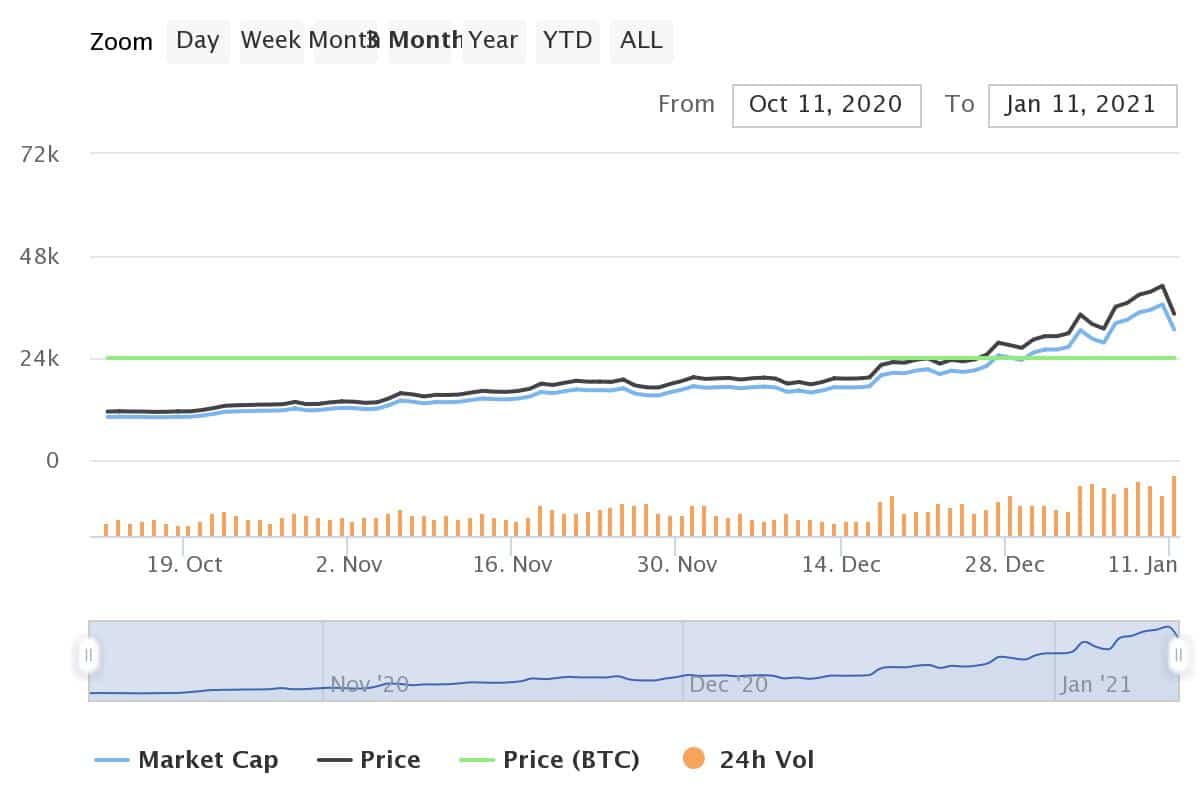
Indeed, at press time, the price of Bitcoin was down roughly 20 percent, sitting around $33,800 and poised for further drops. The drop follows a peak of roughly $41,670 on Friday.
The #Bitcoin price during this dip is higher than the Bitcoin price throughout all of 2020.
It is unclear exactly how low the dip will go. However, as long as Bitcoin maintains levels over $29,500, it will still cost more than it did throughout the entire year of 2020.
What is causing the dip? And is now a good time to buy BTC?
Is Bitcoin's Big Rally Finally Over?
Cracks in the Bitcoin rally that has gripped markets for weeks started to show as early as last Monday.
After hitting a new all-time high just over $34,000 on Sunday, January 3rd, the price of Bitcoin sunk to approximately $30,900 within 24 hours. a decline of nearly 10.6 percent. While some analysts are saying that markets will shrug it off, others seem to believe that the end of the current Bitcoin rally is nigh (or indeed, that it is already here.)
Today’s price drop followed a similar pattern: after reaching a new all-time high, the price of Bitcoin shed some extra weight. While last week’s price drop occurred within 24 hours of the new all-time high, this drop has been spread out over several days.
In both cases, the reason for the drop could be similar: as Bitcoin climbs higher and higher, buyers seem to be 'playing chicken' with each other. In other words, it seems that buyers have been waiting to see how high Bitcoin can climb before a meaningful sell-off begins, a game of 'who can hodl the longest' before losing profits.
However, it seems that the time may have finally come.
A number of analysts believe that a dip like this is par for the course, and in fact, that it has been expected for a while.
Specifically, “I think the price of Bitcoin will fall under 18,000 dollars and then rise back. Whale investors will sell once the financial year is over. So, January may be a rollercoaster ride for the cryptocurrency market,” he told Finance Magnates.
Is Now a Good Time to Buy Bitcoin?
Even if the Bitcoin dip does crack below its yearly lows so far, sentiment seems strong that Bitcoin’s long-term rally is far from over. Analyst Lark Davis wrote on Twitter that “While this dip could get worse, in all likelihood #bitcoin will hit $50,000 in the coming weeks.”
While this dip could get worse, in all likelihood #bitcoin will hit $50,000 in the coming weeks.
This is a view that seems to be shared by Bitcoin bulls across Crypto Twitter, which is why cries of 'Buy the dip!' are resounding through the virtual halls.
However, just as difficult as the art of selling Bitcoin at the right time can be, buying BTC at the right time can be even more difficult. During Bitcoin's rally last week, Rubix Chief Executive Andrew Hamilton told Finance Magnates, “the best time to buy [Bitcoin] is always yesterday.”
Buying the Bitcoin dip has worked every. single. time. ever.
(Although, if Bitcoin was over $41,000 yesterday and $34,000 today, you may have been better served to wait just one more day.)
Joaquim Matinero Tor previously told Finance Magnates that he believes Bitcoin could fall as low as $18,000 before making significant movement upward.
“I think the price of Bitcoin will fall under 18,000 dollars and then rise back,” he said. “Whale investors will sell once the financial year is over. So, January may be a rollercoaster ride for the cryptocurrency market.”
At the same time, though, it might be wise not to wait too long, Ramp Capital pointed out on Twitter last week that that “Bitcoin would have to drop 50% from here just to get back $16,500 — the level hit on Thanksgiving 2020.” Now, since Bitcoin has risen even further, the drop would have to be worth more than 50%.
2017 All over Again?
However, this is not entirely impossible, or even unlikely as Bitcoin has previously lost more than half of its value on multiple occasions.
The instance that is perhaps most comparable to this current moment is the rally that took Bitcoin over $20,000 in late 2017 and into early 2018. BTC reached a peak of nearly $20,000 in mid-December but dropped below $7,000 by the first week of February 2018. It would be three years before Bitcoin would come close to $20,000 again.
Could something similar happen this time? Could BTC lose nearly 70 percent of its value before embarking on another 3-year journey to recovery? It is certainly possible, but some analysts seem to think that this time might be different.
“We’re seeing fresh stories about institutional crypto adoption on almost a daily basis at this point,” he said.“[…] Sustained growth is likely from here, at least for the time being. We are being driven by corporations and billionaires now, not just retail investors.”
Therefore, the anti-inflationary mechanisms that Bitcoin has in place may make it far more attractive than it was in 2017. “The scarcity of BTC compared to the printability of dollars is likely to attract savvy individuals looking to diversify their assets in the event of a lapse in the traditional financial system,” Mintz explained.
“As the adoption rate of BTC increases and the supply remains constant, the value of BTC will only continue to rise.”
Indeed, at press time, the price of Bitcoin was down roughly 20 percent, sitting around $33,800 and poised for further drops. The drop follows a peak of roughly $41,670 on Friday.
The #Bitcoin price during this dip is higher than the Bitcoin price throughout all of 2020.
It is unclear exactly how low the dip will go. However, as long as Bitcoin maintains levels over $29,500, it will still cost more than it did throughout the entire year of 2020.
What is causing the dip? And is now a good time to buy BTC?
Is Bitcoin's Big Rally Finally Over?
Cracks in the Bitcoin rally that has gripped markets for weeks started to show as early as last Monday.
After hitting a new all-time high just over $34,000 on Sunday, January 3rd, the price of Bitcoin sunk to approximately $30,900 within 24 hours. a decline of nearly 10.6 percent. While some analysts are saying that markets will shrug it off, others seem to believe that the end of the current Bitcoin rally is nigh (or indeed, that it is already here.)
Today’s price drop followed a similar pattern: after reaching a new all-time high, the price of Bitcoin shed some extra weight. While last week’s price drop occurred within 24 hours of the new all-time high, this drop has been spread out over several days.
In both cases, the reason for the drop could be similar: as Bitcoin climbs higher and higher, buyers seem to be 'playing chicken' with each other. In other words, it seems that buyers have been waiting to see how high Bitcoin can climb before a meaningful sell-off begins, a game of 'who can hodl the longest' before losing profits.
However, it seems that the time may have finally come.
A number of analysts believe that a dip like this is par for the course, and in fact, that it has been expected for a while.
Specifically, “I think the price of Bitcoin will fall under 18,000 dollars and then rise back. Whale investors will sell once the financial year is over. So, January may be a rollercoaster ride for the cryptocurrency market,” he told Finance Magnates.
Is Now a Good Time to Buy Bitcoin?
Even if the Bitcoin dip does crack below its yearly lows so far, sentiment seems strong that Bitcoin’s long-term rally is far from over. Analyst Lark Davis wrote on Twitter that “While this dip could get worse, in all likelihood #bitcoin will hit $50,000 in the coming weeks.”
While this dip could get worse, in all likelihood #bitcoin will hit $50,000 in the coming weeks.
This is a view that seems to be shared by Bitcoin bulls across Crypto Twitter, which is why cries of 'Buy the dip!' are resounding through the virtual halls.
However, just as difficult as the art of selling Bitcoin at the right time can be, buying BTC at the right time can be even more difficult. During Bitcoin's rally last week, Rubix Chief Executive Andrew Hamilton told Finance Magnates, “the best time to buy [Bitcoin] is always yesterday.”
Buying the Bitcoin dip has worked every. single. time. ever.
(Although, if Bitcoin was over $41,000 yesterday and $34,000 today, you may have been better served to wait just one more day.)
Joaquim Matinero Tor previously told Finance Magnates that he believes Bitcoin could fall as low as $18,000 before making significant movement upward.
“I think the price of Bitcoin will fall under 18,000 dollars and then rise back,” he said. “Whale investors will sell once the financial year is over. So, January may be a rollercoaster ride for the cryptocurrency market.”
At the same time, though, it might be wise not to wait too long, Ramp Capital pointed out on Twitter last week that that “Bitcoin would have to drop 50% from here just to get back $16,500 — the level hit on Thanksgiving 2020.” Now, since Bitcoin has risen even further, the drop would have to be worth more than 50%.
2017 All over Again?
However, this is not entirely impossible, or even unlikely as Bitcoin has previously lost more than half of its value on multiple occasions.
The instance that is perhaps most comparable to this current moment is the rally that took Bitcoin over $20,000 in late 2017 and into early 2018. BTC reached a peak of nearly $20,000 in mid-December but dropped below $7,000 by the first week of February 2018. It would be three years before Bitcoin would come close to $20,000 again.
Could something similar happen this time? Could BTC lose nearly 70 percent of its value before embarking on another 3-year journey to recovery? It is certainly possible, but some analysts seem to think that this time might be different.
“We’re seeing fresh stories about institutional crypto adoption on almost a daily basis at this point,” he said.“[…] Sustained growth is likely from here, at least for the time being. We are being driven by corporations and billionaires now, not just retail investors.”
Therefore, the anti-inflationary mechanisms that Bitcoin has in place may make it far more attractive than it was in 2017. “The scarcity of BTC compared to the printability of dollars is likely to attract savvy individuals looking to diversify their assets in the event of a lapse in the traditional financial system,” Mintz explained.
“As the adoption rate of BTC increases and the supply remains constant, the value of BTC will only continue to rise.”
Rachel is a self-taught crypto geek and a passionate writer. She believes in the power that the written word has to educate, connect and empower individuals to make positive and powerful financial choices. She is the Podcast Host and a Cryptocurrency Editor at Finance Magnates.
Crypto Built More Rails, but the Next Battle Is Over How Much Work a Dollar Can Do
Featured Videos
FP Markets Winner Spotlight 🏆 | Global Broker of the Year 2025 #Trading #Broker #Innovation #Shorts
FP Markets Winner Spotlight 🏆 | Global Broker of the Year 2025 #Trading #Broker #Innovation #Shorts
FP Markets Winner Spotlight 🏆 | Global Broker of the Year 2025 #Trading #Broker #Innovation #Shorts
FP Markets Winner Spotlight 🏆 | Global Broker of the Year 2025 #Trading #Broker #Innovation #Shorts
FP Markets takes the spotlight as Global Broker of the Year 2025 at the Finance Magnates Awards.
Martin Stoilov, Head of Client Experience, shares that trust, innovation, and people played a key role in the company’s success, supported by a strong foundation of integrity and client-centricity.
Following this milestone, FP Markets continues to focus on growth, technology investment, and its core values of transparency and excellence.
👉 Be part of FM Awards 2026: https://awards.financemagnates.com/#nominate
FP Markets takes the spotlight as Global Broker of the Year 2025 at the Finance Magnates Awards.
Martin Stoilov, Head of Client Experience, shares that trust, innovation, and people played a key role in the company’s success, supported by a strong foundation of integrity and client-centricity.
Following this milestone, FP Markets continues to focus on growth, technology investment, and its core values of transparency and excellence.
👉 Be part of FM Awards 2026: https://awards.financemagnates.com/#nominate
FP Markets takes the spotlight as Global Broker of the Year 2025 at the Finance Magnates Awards.
Martin Stoilov, Head of Client Experience, shares that trust, innovation, and people played a key role in the company’s success, supported by a strong foundation of integrity and client-centricity.
Following this milestone, FP Markets continues to focus on growth, technology investment, and its core values of transparency and excellence.
👉 Be part of FM Awards 2026: https://awards.financemagnates.com/#nominate
FP Markets takes the spotlight as Global Broker of the Year 2025 at the Finance Magnates Awards.
Martin Stoilov, Head of Client Experience, shares that trust, innovation, and people played a key role in the company’s success, supported by a strong foundation of integrity and client-centricity.
Following this milestone, FP Markets continues to focus on growth, technology investment, and its core values of transparency and excellence.
👉 Be part of FM Awards 2026: https://awards.financemagnates.com/#nominate
In this video, we review @HolaPrimeMarketsOfficial, a multi-asset forex and CFDs broker offering different account types, trading platforms, and flexible trading conditions.
We cover the broker’s overall offering, including account options, trading environment, platforms like MT4 and MT5, and additional services such as managed accounts and fast withdrawals.
Watch the full video to see if Hola Prime Markets fits your trading needs.
📣 Stay up to date with the latest in finance and trading. Follow Finance Magnates for industry news, insights, and global event coverage.
Connect with us:
🔗 LinkedIn: /financemagnates
👍 Facebook: /financemagnates
📸 Instagram: https://www.instagram.com/financemagnates
🐦 X: https://x.com/financemagnates
🎥 TikTok: https://www.tiktok.com/tag/financemagnates
▶️ YouTube: /@financemagnates_official
#HolaPrime #ForexBroker #CFDTrading #FinanceMagnates #Trading #Forex #BrokerReview
In this video, we review @HolaPrimeMarketsOfficial, a multi-asset forex and CFDs broker offering different account types, trading platforms, and flexible trading conditions.
We cover the broker’s overall offering, including account options, trading environment, platforms like MT4 and MT5, and additional services such as managed accounts and fast withdrawals.
Watch the full video to see if Hola Prime Markets fits your trading needs.
📣 Stay up to date with the latest in finance and trading. Follow Finance Magnates for industry news, insights, and global event coverage.
Connect with us:
🔗 LinkedIn: /financemagnates
👍 Facebook: /financemagnates
📸 Instagram: https://www.instagram.com/financemagnates
🐦 X: https://x.com/financemagnates
🎥 TikTok: https://www.tiktok.com/tag/financemagnates
▶️ YouTube: /@financemagnates_official
#HolaPrime #ForexBroker #CFDTrading #FinanceMagnates #Trading #Forex #BrokerReview
In this video, we review @HolaPrimeMarketsOfficial, a multi-asset forex and CFDs broker offering different account types, trading platforms, and flexible trading conditions.
We cover the broker’s overall offering, including account options, trading environment, platforms like MT4 and MT5, and additional services such as managed accounts and fast withdrawals.
Watch the full video to see if Hola Prime Markets fits your trading needs.
📣 Stay up to date with the latest in finance and trading. Follow Finance Magnates for industry news, insights, and global event coverage.
Connect with us:
🔗 LinkedIn: /financemagnates
👍 Facebook: /financemagnates
📸 Instagram: https://www.instagram.com/financemagnates
🐦 X: https://x.com/financemagnates
🎥 TikTok: https://www.tiktok.com/tag/financemagnates
▶️ YouTube: /@financemagnates_official
#HolaPrime #ForexBroker #CFDTrading #FinanceMagnates #Trading #Forex #BrokerReview
In this video, we review @HolaPrimeMarketsOfficial, a multi-asset forex and CFDs broker offering different account types, trading platforms, and flexible trading conditions.
We cover the broker’s overall offering, including account options, trading environment, platforms like MT4 and MT5, and additional services such as managed accounts and fast withdrawals.
Watch the full video to see if Hola Prime Markets fits your trading needs.
📣 Stay up to date with the latest in finance and trading. Follow Finance Magnates for industry news, insights, and global event coverage.
Connect with us:
🔗 LinkedIn: /financemagnates
👍 Facebook: /financemagnates
📸 Instagram: https://www.instagram.com/financemagnates
🐦 X: https://x.com/financemagnates
🎥 TikTok: https://www.tiktok.com/tag/financemagnates
▶️ YouTube: /@financemagnates_official
#HolaPrime #ForexBroker #CFDTrading #FinanceMagnates #Trading #Forex #BrokerReview
In this video, we review @HolaPrimeMarketsOfficial, a multi-asset forex and CFDs broker offering different account types, trading platforms, and flexible trading conditions.
We cover the broker’s overall offering, including account options, trading environment, platforms like MT4 and MT5, and additional services such as managed accounts and fast withdrawals.
Watch the full video to see if Hola Prime Markets fits your trading needs.
📣 Stay up to date with the latest in finance and trading. Follow Finance Magnates for industry news, insights, and global event coverage.
Connect with us:
🔗 LinkedIn: /financemagnates
👍 Facebook: /financemagnates
📸 Instagram: https://www.instagram.com/financemagnates
🐦 X: https://x.com/financemagnates
🎥 TikTok: https://www.tiktok.com/tag/financemagnates
▶️ YouTube: /@financemagnates_official
#HolaPrime #ForexBroker #CFDTrading #FinanceMagnates #Trading #Forex #BrokerReview
In this video, we review @HolaPrimeMarketsOfficial, a multi-asset forex and CFDs broker offering different account types, trading platforms, and flexible trading conditions.
We cover the broker’s overall offering, including account options, trading environment, platforms like MT4 and MT5, and additional services such as managed accounts and fast withdrawals.
Watch the full video to see if Hola Prime Markets fits your trading needs.
📣 Stay up to date with the latest in finance and trading. Follow Finance Magnates for industry news, insights, and global event coverage.
Connect with us:
🔗 LinkedIn: /financemagnates
👍 Facebook: /financemagnates
📸 Instagram: https://www.instagram.com/financemagnates
🐦 X: https://x.com/financemagnates
🎥 TikTok: https://www.tiktok.com/tag/financemagnates
▶️ YouTube: /@financemagnates_official
#HolaPrime #ForexBroker #CFDTrading #FinanceMagnates #Trading #Forex #BrokerReview
Hola Prime Review: What You Need to Know | Full Breakdown by Finance Magnates
Hola Prime Review: What You Need to Know | Full Breakdown by Finance Magnates
Hola Prime Review: What You Need to Know | Full Breakdown by Finance Magnates
Hola Prime Review: What You Need to Know | Full Breakdown by Finance Magnates
Hola Prime Review: What You Need to Know | Full Breakdown by Finance Magnates
Hola Prime Review: What You Need to Know | Full Breakdown by Finance Magnates
In this video, we review @HolaPrime_Global, a proprietary trading firm offering evaluation programs and performance-based payouts in simulated market environments.
We cover how the challenge model works, including account types, profit splits (up to 95%), trading rules, and what it takes to reach a funded account. You’ll also learn about available platforms like MT4, MT5, cTrader, and more, along with insights into payouts, support, and trading conditions.
Watch the full video to see if Hola Prime fits your trading style.
📣 Stay up to date with the latest in finance and trading. Follow Finance Magnates for industry news, insights, and global event coverage.
Connect with us:
🔗 LinkedIn: /financemagnates
👍 Facebook: /financemagnates
📸 Instagram: https://www.instagram.com/financemagnates
🐦 X: https://x.com/financemagnates
🎥 TikTok: https://www.tiktok.com/tag/financemagnates
▶️ YouTube: /@financemagnates_official
#HolaPrime #PropFirm #Trading #FinanceMagnates #Forex #FuturesTrading #TradingReview #PropFirmReview
In this video, we review @HolaPrime_Global, a proprietary trading firm offering evaluation programs and performance-based payouts in simulated market environments.
We cover how the challenge model works, including account types, profit splits (up to 95%), trading rules, and what it takes to reach a funded account. You’ll also learn about available platforms like MT4, MT5, cTrader, and more, along with insights into payouts, support, and trading conditions.
Watch the full video to see if Hola Prime fits your trading style.
📣 Stay up to date with the latest in finance and trading. Follow Finance Magnates for industry news, insights, and global event coverage.
Connect with us:
🔗 LinkedIn: /financemagnates
👍 Facebook: /financemagnates
📸 Instagram: https://www.instagram.com/financemagnates
🐦 X: https://x.com/financemagnates
🎥 TikTok: https://www.tiktok.com/tag/financemagnates
▶️ YouTube: /@financemagnates_official
#HolaPrime #PropFirm #Trading #FinanceMagnates #Forex #FuturesTrading #TradingReview #PropFirmReview
In this video, we review @HolaPrime_Global, a proprietary trading firm offering evaluation programs and performance-based payouts in simulated market environments.
We cover how the challenge model works, including account types, profit splits (up to 95%), trading rules, and what it takes to reach a funded account. You’ll also learn about available platforms like MT4, MT5, cTrader, and more, along with insights into payouts, support, and trading conditions.
Watch the full video to see if Hola Prime fits your trading style.
📣 Stay up to date with the latest in finance and trading. Follow Finance Magnates for industry news, insights, and global event coverage.
Connect with us:
🔗 LinkedIn: /financemagnates
👍 Facebook: /financemagnates
📸 Instagram: https://www.instagram.com/financemagnates
🐦 X: https://x.com/financemagnates
🎥 TikTok: https://www.tiktok.com/tag/financemagnates
▶️ YouTube: /@financemagnates_official
#HolaPrime #PropFirm #Trading #FinanceMagnates #Forex #FuturesTrading #TradingReview #PropFirmReview
In this video, we review @HolaPrime_Global, a proprietary trading firm offering evaluation programs and performance-based payouts in simulated market environments.
We cover how the challenge model works, including account types, profit splits (up to 95%), trading rules, and what it takes to reach a funded account. You’ll also learn about available platforms like MT4, MT5, cTrader, and more, along with insights into payouts, support, and trading conditions.
Watch the full video to see if Hola Prime fits your trading style.
📣 Stay up to date with the latest in finance and trading. Follow Finance Magnates for industry news, insights, and global event coverage.
Connect with us:
🔗 LinkedIn: /financemagnates
👍 Facebook: /financemagnates
📸 Instagram: https://www.instagram.com/financemagnates
🐦 X: https://x.com/financemagnates
🎥 TikTok: https://www.tiktok.com/tag/financemagnates
▶️ YouTube: /@financemagnates_official
#HolaPrime #PropFirm #Trading #FinanceMagnates #Forex #FuturesTrading #TradingReview #PropFirmReview
In this video, we review @HolaPrime_Global, a proprietary trading firm offering evaluation programs and performance-based payouts in simulated market environments.
We cover how the challenge model works, including account types, profit splits (up to 95%), trading rules, and what it takes to reach a funded account. You’ll also learn about available platforms like MT4, MT5, cTrader, and more, along with insights into payouts, support, and trading conditions.
Watch the full video to see if Hola Prime fits your trading style.
📣 Stay up to date with the latest in finance and trading. Follow Finance Magnates for industry news, insights, and global event coverage.
Connect with us:
🔗 LinkedIn: /financemagnates
👍 Facebook: /financemagnates
📸 Instagram: https://www.instagram.com/financemagnates
🐦 X: https://x.com/financemagnates
🎥 TikTok: https://www.tiktok.com/tag/financemagnates
▶️ YouTube: /@financemagnates_official
#HolaPrime #PropFirm #Trading #FinanceMagnates #Forex #FuturesTrading #TradingReview #PropFirmReview
In this video, we review @HolaPrime_Global, a proprietary trading firm offering evaluation programs and performance-based payouts in simulated market environments.
We cover how the challenge model works, including account types, profit splits (up to 95%), trading rules, and what it takes to reach a funded account. You’ll also learn about available platforms like MT4, MT5, cTrader, and more, along with insights into payouts, support, and trading conditions.
Watch the full video to see if Hola Prime fits your trading style.
📣 Stay up to date with the latest in finance and trading. Follow Finance Magnates for industry news, insights, and global event coverage.
Connect with us:
🔗 LinkedIn: /financemagnates
👍 Facebook: /financemagnates
📸 Instagram: https://www.instagram.com/financemagnates
🐦 X: https://x.com/financemagnates
🎥 TikTok: https://www.tiktok.com/tag/financemagnates
▶️ YouTube: /@financemagnates_official
#HolaPrime #PropFirm #Trading #FinanceMagnates #Forex #FuturesTrading #TradingReview #PropFirmReview
Axi Winner Spotlight 🏆 | Global Most Innovative Broker 2025 #Innovation #Trading #Fintech #Broker
Axi Winner Spotlight 🏆 | Global Most Innovative Broker 2025 #Innovation #Trading #Fintech #Broker
Axi Winner Spotlight 🏆 | Global Most Innovative Broker 2025 #Innovation #Trading #Fintech #Broker
Axi Winner Spotlight 🏆 | Global Most Innovative Broker 2025 #Innovation #Trading #Fintech #Broker
Axi Winner Spotlight 🏆 | Global Most Innovative Broker 2025 #Innovation #Trading #Fintech #Broker
Axi Winner Spotlight 🏆 | Global Most Innovative Broker 2025 #Innovation #Trading #Fintech #Broker
Axi takes the spotlight at the Finance Magnates Awards, winning Global Most Innovative Broker 2025.
Olivia Xenofontos and Ivanna Openko share how the team will feel: proud, motivated, and ready to keep delivering.
They also describe the night as well-organized, focused, and enjoyable for all.
👉 Be part of FM Awards 2026.
Axi takes the spotlight at the Finance Magnates Awards, winning Global Most Innovative Broker 2025.
Olivia Xenofontos and Ivanna Openko share how the team will feel: proud, motivated, and ready to keep delivering.
They also describe the night as well-organized, focused, and enjoyable for all.
👉 Be part of FM Awards 2026.
Axi takes the spotlight at the Finance Magnates Awards, winning Global Most Innovative Broker 2025.
Olivia Xenofontos and Ivanna Openko share how the team will feel: proud, motivated, and ready to keep delivering.
They also describe the night as well-organized, focused, and enjoyable for all.
👉 Be part of FM Awards 2026.
Axi takes the spotlight at the Finance Magnates Awards, winning Global Most Innovative Broker 2025.
Olivia Xenofontos and Ivanna Openko share how the team will feel: proud, motivated, and ready to keep delivering.
They also describe the night as well-organized, focused, and enjoyable for all.
👉 Be part of FM Awards 2026.
Axi takes the spotlight at the Finance Magnates Awards, winning Global Most Innovative Broker 2025.
Olivia Xenofontos and Ivanna Openko share how the team will feel: proud, motivated, and ready to keep delivering.
They also describe the night as well-organized, focused, and enjoyable for all.
👉 Be part of FM Awards 2026.
Axi takes the spotlight at the Finance Magnates Awards, winning Global Most Innovative Broker 2025.
Olivia Xenofontos and Ivanna Openko share how the team will feel: proud, motivated, and ready to keep delivering.
They also describe the night as well-organized, focused, and enjoyable for all.
👉 Be part of FM Awards 2026.
Recognition that matters.
Built on transparency.
Driven by the industry.
The Finance Magnates Awards 2026.
Nominations are now open.
🔗 https://awards.financemagnates.com/?utm_source=SM&utm_medium=social&utm_campaign=recognition-matters
Recognition that matters.
Built on transparency.
Driven by the industry.
The Finance Magnates Awards 2026.
Nominations are now open.
🔗 https://awards.financemagnates.com/?utm_source=SM&utm_medium=social&utm_campaign=recognition-matters
Recognition that matters.
Built on transparency.
Driven by the industry.
The Finance Magnates Awards 2026.
Nominations are now open.
🔗 https://awards.financemagnates.com/?utm_source=SM&utm_medium=social&utm_campaign=recognition-matters
Recognition that matters.
Built on transparency.
Driven by the industry.
The Finance Magnates Awards 2026.
Nominations are now open.
🔗 https://awards.financemagnates.com/?utm_source=SM&utm_medium=social&utm_campaign=recognition-matters
Recognition that matters.
Built on transparency.
Driven by the industry.
The Finance Magnates Awards 2026.
Nominations are now open.
🔗 https://awards.financemagnates.com/?utm_source=SM&utm_medium=social&utm_campaign=recognition-matters
Recognition that matters.
Built on transparency.
Driven by the industry.
The Finance Magnates Awards 2026.
Nominations are now open.
🔗 https://awards.financemagnates.com/?utm_source=SM&utm_medium=social&utm_campaign=recognition-matters