User frustration with Robinhood's decision to shut down trades of GME may have proven the case for DeFi.
Bloomberg
For Robinhood, the stock brokerage platform on which many WallStreetBets users recently began buying GameStop (NYSE:GME) stock, the events of the past week have been nothing but trouble.
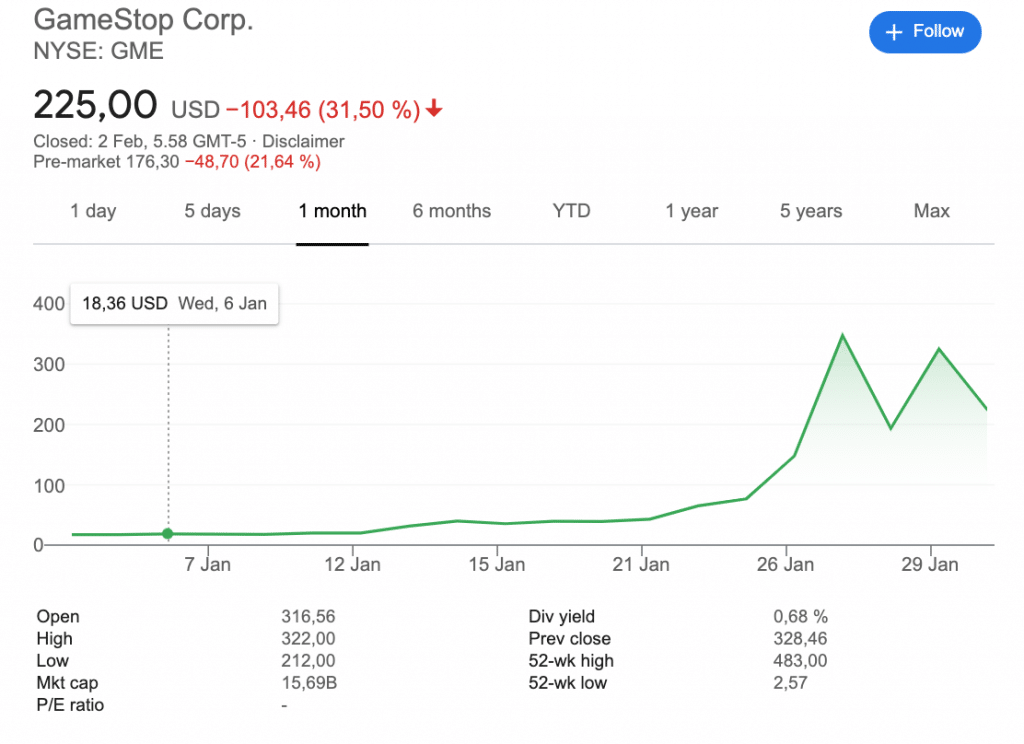
If you have not been following along, here is what went down: a group of millions of retail traders based on the WallStreetBets (WSB) subreddit organized a massive short squeeze effort against Wall Street hedge funds: they began buying huge amounts of stock from companies that hedge funds had bet against, including GameStop and a number of other 'meme stocks'.
As a result, the price of GME and several other stocks (ie Blackberry, NYSE:BB; and AMC Entertainment Holdings, NYSE:AMC) shot up by margins of triple- or even quadruple-digit percentage points. Thus, the hedge funds who had bet against the stocks were forced to either take losses, find replacement holders, or white-knuckle their holdings as GME and other stock prices continued to rise.
At the height of the drama last week, Robinhood made a controversial decision: the platform pulled the plug on most retail trading activities related to 50 of the stocks listed on its platform, including GME. Retail traders were suddenly barred from buying and trading certain assets, leaving selling the assets as their only option. The decision has drawn the ire from users and lawmakers alike; even Elon Musk threw shade at Robinhood Chief Executive, Vlad Tenev.
Robinhood still has not restored all trading activities on all of the stocks that it limited retail activities last week: retail users are once again allowed to buy shares of GME, but only until they own a total of 20 shares.
The events of the week have had huge implications for the future of financial markets: the roles of retail traders and hedge funds; the jurisdiction of trading platforms, and the flow of capital through it all. In fact, some of these implications already seem to be coming to fruition: specifically, for cryptocurrency.
There has been a lot of talk about cryptocurrencies this year. After all, a combination of talks over new COVID stimulus programs in the US increased institutional interest, and retail fever drove crypto prices to new highs in the first weeks of the year.
However, in the days before the WSB saga began, questions were beginning to arise over the viability of crypto’s rally over the long-term: sure, a new crop of institutional and retail investors have taken an interest in crypto in the short-term. But, what happens when the hype dies down in a few months? In a year? BTC was losing steam; other crypto tokens were also seeing price dips.
That was all before last week. The events that surrounded the WSB saga seemed to have had a positive effect on markets. At press time, data from Messari showed that BTC was up 9% over the course of the last seven days. ETH followed closely behind with a 6% rise over the same period. On the whole, the total cryptocurrency market cap had increased from $935 billion to $1.05 trillion.
Simultaneously, trading volumes on a number of cryptocurrency exchanges have seen spikes in trading activity coinciding with some of the WSB movement. CoinDesk reported that this has resulted in rises in the token prices of a number of exchange cryptocurrencies, including Binance Coin (BNB).
Why is the WSB phenomenon connected to the rise of cryptocurrency markets? Of course, some of the excitement around the WSB movement into GME and other stocks sparked 'spin-off' pumps into several crypto assets, including XRP, Stellar Lumens (XLM) and DogeCoin (DOGE.)
However, beyond the pumps into targeted cryptocurrency markets the WSB movement may have brought a crop of new traders (and new cash) into crypto for the long-term. Why is this? Frustration might just be the answer.
Indeed, CNBCreported that “[the] same underlying anger and frustration over how institutional investors make profits” that drove the WSB movement “has also played a role in bitcoin’s rise.”
u can’t sell houses u don’t own u can’t sell cars u don’t own but u *can* sell stock u don’t own!? this is bs – shorting is a scam legal only for vestigial reasons
Therefore, “investing in an independent cryptocurrency such as bitcoin...means you are putting your money toward a technology and a currency that could one day replace the modern financial system,” CNBC explained. “This is certainly not lost on retail traders looking for the ultimate way to cut institutional investors out of the equation.”
The Case for DeFi
Indeed, while cryptocurrencies may be some of the main benefactors of the WSB saga so far, WSB traders seem to be after something even bigger, a total change in the status quo; an ideological shift in the way that capital markets operate.
Indeed, some of the rhetoric surrounding the WSB discussion seems to focus around the need for a paradigm shift in the way that capital markets function: more power to retail investors, and less to Wall Street giants. WSB traders argue that this is the reality of the true democratization of finance, the same democratization of Finance that Robinhood has been preaching to its users for years.
However, when you are playing by the financial industry’s rulebook, there is a limit to how much 'democratization' that can really happen. Indeed, as Larry Tabb, Head of Market Structure at Bloomberg Intelligence, told the Financial Times: firms like Robinhood "can only be disruptive to a certain point, because, at the end of the day, you’re one side of a trade.”
Why did last week’s events bolster the case for DeFi? It all comes down to Robinhood’s controversial decision to bar retail traders from buying and trading GameStop (GME) and other stocks. The move outraged many of the platform's retail users, who pointed to Robinhood’s close relationship with Citadel Securities as well as other institutional clients as the real reason behind the decision to pull the plug on certain trading activities.
Robinhood explained in a blog post that the decision was based on its “many financial requirements, including SEC net capital obligations and clearinghouse deposits.”
“Some of these requirements fluctuate based on volatility in the markets and can be substantial in the current environment. These requirements exist to protect investors and the markets,” the blog post said.
Fed up with the Status Quo
Still, users are not convinced, and they are not happy. Even after Google Play removed 100,000 1-star reviews from Robinhood’s listing in its app store (raising its rating from 1-star to over 4 stars, where it was before the WSB saga), disgruntled users returned by the thousands to send Robinhood’s rating back down to 1.2 stars. At the same time, the hashtag #deleterobinhood has become more popular on Twitter as users have grown increasingly frustrated.
Cryptocurrency writer and analyst, William M. Peaster explained the anger this way in a post on blockchain-based blogging platform Voice: “they see the episode as just the latest high-profile reminder that mainstream finance is heavily rigged in favor of the wealthy and powerful.”
However, DeFi supporters argue that decentralized finance is the way forward: traders who would have been able to buy their GME stocks on a DeFi exchange would never have faced the risk of being barred from trading activities at the mercy of a centralized brokerage authority.
Indeed, Peaster explained that: “DeFi is open, permissionless, 24/7, and non-custodial, so you stay in control of your funds the whole time without having to worry about if a centralized company like Robinhood will freeze your funds or block you from selling.”
The Beginning of Something Bigger?
In the meantime, WSB traders are moving on, with or without Robinhood. And, while a number of these traders have made piles of cash from the WSB movement, it is not all about the money: some traders are out for blood, and hedge funds are squarely in their crosshairs.
The loss was so significant that Citadel Securities and Point72 had to rescue it: together, the two firms injected $3 billion into Melvin as an emergency effort. This brought the fund’s total AUM back up to roughly $8 billion; however, this is still significantly lower than the $12.5 billion it held before the squeeze began. Both Citadel and Point72 also sustained losses in January, though they were not nearly as serious as Melvin.
Despite WSB’s continued pump (GME is still up more than 1100% compared to 30 days ago), some hedge funds are holding onto their GME shares for dear life, hoping that their hodling can outlive the ire of WSB traders. And indeed, it is possible that the WSB movement could peter out before hedge funds are forced to take their losses.
Then again, WSB may only be the beginning of a much bigger movement toward the true democratization of finance: after all, if a group of traders on Reddit can orchestrate the "biggest short squeeze in 25 years", there is no telling what else they can do.
For Robinhood, the stock brokerage platform on which many WallStreetBets users recently began buying GameStop (NYSE:GME) stock, the events of the past week have been nothing but trouble.
If you have not been following along, here is what went down: a group of millions of retail traders based on the WallStreetBets (WSB) subreddit organized a massive short squeeze effort against Wall Street hedge funds: they began buying huge amounts of stock from companies that hedge funds had bet against, including GameStop and a number of other 'meme stocks'.
As a result, the price of GME and several other stocks (ie Blackberry, NYSE:BB; and AMC Entertainment Holdings, NYSE:AMC) shot up by margins of triple- or even quadruple-digit percentage points. Thus, the hedge funds who had bet against the stocks were forced to either take losses, find replacement holders, or white-knuckle their holdings as GME and other stock prices continued to rise.
At the height of the drama last week, Robinhood made a controversial decision: the platform pulled the plug on most retail trading activities related to 50 of the stocks listed on its platform, including GME. Retail traders were suddenly barred from buying and trading certain assets, leaving selling the assets as their only option. The decision has drawn the ire from users and lawmakers alike; even Elon Musk threw shade at Robinhood Chief Executive, Vlad Tenev.
Robinhood still has not restored all trading activities on all of the stocks that it limited retail activities last week: retail users are once again allowed to buy shares of GME, but only until they own a total of 20 shares.
The events of the week have had huge implications for the future of financial markets: the roles of retail traders and hedge funds; the jurisdiction of trading platforms, and the flow of capital through it all. In fact, some of these implications already seem to be coming to fruition: specifically, for cryptocurrency.
There has been a lot of talk about cryptocurrencies this year. After all, a combination of talks over new COVID stimulus programs in the US increased institutional interest, and retail fever drove crypto prices to new highs in the first weeks of the year.
However, in the days before the WSB saga began, questions were beginning to arise over the viability of crypto’s rally over the long-term: sure, a new crop of institutional and retail investors have taken an interest in crypto in the short-term. But, what happens when the hype dies down in a few months? In a year? BTC was losing steam; other crypto tokens were also seeing price dips.
That was all before last week. The events that surrounded the WSB saga seemed to have had a positive effect on markets. At press time, data from Messari showed that BTC was up 9% over the course of the last seven days. ETH followed closely behind with a 6% rise over the same period. On the whole, the total cryptocurrency market cap had increased from $935 billion to $1.05 trillion.
Simultaneously, trading volumes on a number of cryptocurrency exchanges have seen spikes in trading activity coinciding with some of the WSB movement. CoinDesk reported that this has resulted in rises in the token prices of a number of exchange cryptocurrencies, including Binance Coin (BNB).
Why is the WSB phenomenon connected to the rise of cryptocurrency markets? Of course, some of the excitement around the WSB movement into GME and other stocks sparked 'spin-off' pumps into several crypto assets, including XRP, Stellar Lumens (XLM) and DogeCoin (DOGE.)
However, beyond the pumps into targeted cryptocurrency markets the WSB movement may have brought a crop of new traders (and new cash) into crypto for the long-term. Why is this? Frustration might just be the answer.
Indeed, CNBCreported that “[the] same underlying anger and frustration over how institutional investors make profits” that drove the WSB movement “has also played a role in bitcoin’s rise.”
u can’t sell houses u don’t own u can’t sell cars u don’t own but u *can* sell stock u don’t own!? this is bs – shorting is a scam legal only for vestigial reasons
Therefore, “investing in an independent cryptocurrency such as bitcoin...means you are putting your money toward a technology and a currency that could one day replace the modern financial system,” CNBC explained. “This is certainly not lost on retail traders looking for the ultimate way to cut institutional investors out of the equation.”
The Case for DeFi
Indeed, while cryptocurrencies may be some of the main benefactors of the WSB saga so far, WSB traders seem to be after something even bigger, a total change in the status quo; an ideological shift in the way that capital markets operate.
Indeed, some of the rhetoric surrounding the WSB discussion seems to focus around the need for a paradigm shift in the way that capital markets function: more power to retail investors, and less to Wall Street giants. WSB traders argue that this is the reality of the true democratization of finance, the same democratization of Finance that Robinhood has been preaching to its users for years.
However, when you are playing by the financial industry’s rulebook, there is a limit to how much 'democratization' that can really happen. Indeed, as Larry Tabb, Head of Market Structure at Bloomberg Intelligence, told the Financial Times: firms like Robinhood "can only be disruptive to a certain point, because, at the end of the day, you’re one side of a trade.”
Why did last week’s events bolster the case for DeFi? It all comes down to Robinhood’s controversial decision to bar retail traders from buying and trading GameStop (GME) and other stocks. The move outraged many of the platform's retail users, who pointed to Robinhood’s close relationship with Citadel Securities as well as other institutional clients as the real reason behind the decision to pull the plug on certain trading activities.
Robinhood explained in a blog post that the decision was based on its “many financial requirements, including SEC net capital obligations and clearinghouse deposits.”
“Some of these requirements fluctuate based on volatility in the markets and can be substantial in the current environment. These requirements exist to protect investors and the markets,” the blog post said.
Fed up with the Status Quo
Still, users are not convinced, and they are not happy. Even after Google Play removed 100,000 1-star reviews from Robinhood’s listing in its app store (raising its rating from 1-star to over 4 stars, where it was before the WSB saga), disgruntled users returned by the thousands to send Robinhood’s rating back down to 1.2 stars. At the same time, the hashtag #deleterobinhood has become more popular on Twitter as users have grown increasingly frustrated.
Cryptocurrency writer and analyst, William M. Peaster explained the anger this way in a post on blockchain-based blogging platform Voice: “they see the episode as just the latest high-profile reminder that mainstream finance is heavily rigged in favor of the wealthy and powerful.”
However, DeFi supporters argue that decentralized finance is the way forward: traders who would have been able to buy their GME stocks on a DeFi exchange would never have faced the risk of being barred from trading activities at the mercy of a centralized brokerage authority.
Indeed, Peaster explained that: “DeFi is open, permissionless, 24/7, and non-custodial, so you stay in control of your funds the whole time without having to worry about if a centralized company like Robinhood will freeze your funds or block you from selling.”
The Beginning of Something Bigger?
In the meantime, WSB traders are moving on, with or without Robinhood. And, while a number of these traders have made piles of cash from the WSB movement, it is not all about the money: some traders are out for blood, and hedge funds are squarely in their crosshairs.
The loss was so significant that Citadel Securities and Point72 had to rescue it: together, the two firms injected $3 billion into Melvin as an emergency effort. This brought the fund’s total AUM back up to roughly $8 billion; however, this is still significantly lower than the $12.5 billion it held before the squeeze began. Both Citadel and Point72 also sustained losses in January, though they were not nearly as serious as Melvin.
Despite WSB’s continued pump (GME is still up more than 1100% compared to 30 days ago), some hedge funds are holding onto their GME shares for dear life, hoping that their hodling can outlive the ire of WSB traders. And indeed, it is possible that the WSB movement could peter out before hedge funds are forced to take their losses.
Then again, WSB may only be the beginning of a much bigger movement toward the true democratization of finance: after all, if a group of traders on Reddit can orchestrate the "biggest short squeeze in 25 years", there is no telling what else they can do.
Rachel is a self-taught crypto geek and a passionate writer. She believes in the power that the written word has to educate, connect and empower individuals to make positive and powerful financial choices. She is the Podcast Host and a Cryptocurrency Editor at Finance Magnates.
Binance Launches Retail AI Assistant, Repackages Existing Trading Tools
Featured Videos
AvaTrade to Acquire Most of FXCM; NAGA Raises $8M
AvaTrade to Acquire Most of FXCM; NAGA Raises $8M
AvaTrade to Acquire Most of FXCM; NAGA Raises $8M
AvaTrade to Acquire Most of FXCM; NAGA Raises $8M
Today’s financial news recap covers AvaTrade agrees to acquire most of FXCM, NAGA secures eight million dollars in new financing, and Wise seeks a tax settlement in the UK.
Finance Magnates Daily Recap brings you the latest news from forex and CFD brokers, fintech, payments, cryptocurrency, digital assets, trading platforms, financial regulation and global markets.
Get the key company news, executive moves, deals, regulatory updates and market developments of the day, in just a few minutes. New episodes published every weekday.
Read more: https://www.financemagnates.com
#FinanceMagnates #ForexNews #FintechNews
Today’s financial news recap covers AvaTrade agrees to acquire most of FXCM, NAGA secures eight million dollars in new financing, and Wise seeks a tax settlement in the UK.
Finance Magnates Daily Recap brings you the latest news from forex and CFD brokers, fintech, payments, cryptocurrency, digital assets, trading platforms, financial regulation and global markets.
Get the key company news, executive moves, deals, regulatory updates and market developments of the day, in just a few minutes. New episodes published every weekday.
Read more: https://www.financemagnates.com
#FinanceMagnates #ForexNews #FintechNews
Today’s financial news recap covers AvaTrade agrees to acquire most of FXCM, NAGA secures eight million dollars in new financing, and Wise seeks a tax settlement in the UK.
Finance Magnates Daily Recap brings you the latest news from forex and CFD brokers, fintech, payments, cryptocurrency, digital assets, trading platforms, financial regulation and global markets.
Get the key company news, executive moves, deals, regulatory updates and market developments of the day, in just a few minutes. New episodes published every weekday.
Read more: https://www.financemagnates.com
#FinanceMagnates #ForexNews #FintechNews
Today’s financial news recap covers AvaTrade agrees to acquire most of FXCM, NAGA secures eight million dollars in new financing, and Wise seeks a tax settlement in the UK.
Finance Magnates Daily Recap brings you the latest news from forex and CFD brokers, fintech, payments, cryptocurrency, digital assets, trading platforms, financial regulation and global markets.
Get the key company news, executive moves, deals, regulatory updates and market developments of the day, in just a few minutes. New episodes published every weekday.
Read more: https://www.financemagnates.com
#FinanceMagnates #ForexNews #FintechNews
XTB Adds Overnight US Stock Trading; Nasdaq Ventures Invests in One Trading
XTB Adds Overnight US Stock Trading; Nasdaq Ventures Invests in One Trading
XTB Adds Overnight US Stock Trading; Nasdaq Ventures Invests in One Trading
XTB Adds Overnight US Stock Trading; Nasdaq Ventures Invests in One Trading
XTB Adds Overnight US Stock Trading; Nasdaq Ventures Invests in One Trading
XTB Adds Overnight US Stock Trading; Nasdaq Ventures Invests in One Trading
Today’s financial news recap covers XTB expands overnight US stock trading, Fortrade reports higher revenue, Nasdaq backs One Trading, and Vest Labs raises 13 million dollars.
Finance Magnates Daily Recap brings you the latest news from forex and CFD brokers, fintech, payments, cryptocurrency, digital assets, trading platforms, financial regulation and global markets.
Get the key company news, executive moves, deals, regulatory updates and market developments of the day, in just a few minutes. New episodes published every weekday.
Read more: https://www.financemagnates.com
#FinanceMagnates #ForexNews #FintechNews
Today’s financial news recap covers XTB expands overnight US stock trading, Fortrade reports higher revenue, Nasdaq backs One Trading, and Vest Labs raises 13 million dollars.
Finance Magnates Daily Recap brings you the latest news from forex and CFD brokers, fintech, payments, cryptocurrency, digital assets, trading platforms, financial regulation and global markets.
Get the key company news, executive moves, deals, regulatory updates and market developments of the day, in just a few minutes. New episodes published every weekday.
Read more: https://www.financemagnates.com
#FinanceMagnates #ForexNews #FintechNews
Today’s financial news recap covers XTB expands overnight US stock trading, Fortrade reports higher revenue, Nasdaq backs One Trading, and Vest Labs raises 13 million dollars.
Finance Magnates Daily Recap brings you the latest news from forex and CFD brokers, fintech, payments, cryptocurrency, digital assets, trading platforms, financial regulation and global markets.
Get the key company news, executive moves, deals, regulatory updates and market developments of the day, in just a few minutes. New episodes published every weekday.
Read more: https://www.financemagnates.com
#FinanceMagnates #ForexNews #FintechNews
Today’s financial news recap covers XTB expands overnight US stock trading, Fortrade reports higher revenue, Nasdaq backs One Trading, and Vest Labs raises 13 million dollars.
Finance Magnates Daily Recap brings you the latest news from forex and CFD brokers, fintech, payments, cryptocurrency, digital assets, trading platforms, financial regulation and global markets.
Get the key company news, executive moves, deals, regulatory updates and market developments of the day, in just a few minutes. New episodes published every weekday.
Read more: https://www.financemagnates.com
#FinanceMagnates #ForexNews #FintechNews
Today’s financial news recap covers XTB expands overnight US stock trading, Fortrade reports higher revenue, Nasdaq backs One Trading, and Vest Labs raises 13 million dollars.
Finance Magnates Daily Recap brings you the latest news from forex and CFD brokers, fintech, payments, cryptocurrency, digital assets, trading platforms, financial regulation and global markets.
Get the key company news, executive moves, deals, regulatory updates and market developments of the day, in just a few minutes. New episodes published every weekday.
Read more: https://www.financemagnates.com
#FinanceMagnates #ForexNews #FintechNews
Today’s financial news recap covers XTB expands overnight US stock trading, Fortrade reports higher revenue, Nasdaq backs One Trading, and Vest Labs raises 13 million dollars.
Finance Magnates Daily Recap brings you the latest news from forex and CFD brokers, fintech, payments, cryptocurrency, digital assets, trading platforms, financial regulation and global markets.
Get the key company news, executive moves, deals, regulatory updates and market developments of the day, in just a few minutes. New episodes published every weekday.
Read more: https://www.financemagnates.com
#FinanceMagnates #ForexNews #FintechNews
CMC Founder Downplays Volatility Hit; Devexperts Names CEO
CMC Founder Downplays Volatility Hit; Devexperts Names CEO
CMC Founder Downplays Volatility Hit; Devexperts Names CEO
CMC Founder Downplays Volatility Hit; Devexperts Names CEO
CMC Founder Downplays Volatility Hit; Devexperts Names CEO
CMC Founder Downplays Volatility Hit; Devexperts Names CEO
Today’s financial news recap covers low volatility pressures brokers, Devexperts names a new CEO, Saxo cuts onboarding time, and OKX reaches a 25 billion dollar valuation.
Finance Magnates Daily Recap brings you the latest news from forex and CFD brokers, fintech, payments, cryptocurrency, digital assets, trading platforms, financial regulation and global markets.
Get the key company news, executive moves, deals, regulatory updates and market developments of the day, in just a few minutes. New episodes published every weekday.
Read more: https://www.financemagnates.com
#FinanceMagnates #ForexNews #FintechNews
Today’s financial news recap covers low volatility pressures brokers, Devexperts names a new CEO, Saxo cuts onboarding time, and OKX reaches a 25 billion dollar valuation.
Finance Magnates Daily Recap brings you the latest news from forex and CFD brokers, fintech, payments, cryptocurrency, digital assets, trading platforms, financial regulation and global markets.
Get the key company news, executive moves, deals, regulatory updates and market developments of the day, in just a few minutes. New episodes published every weekday.
Read more: https://www.financemagnates.com
#FinanceMagnates #ForexNews #FintechNews
Today’s financial news recap covers low volatility pressures brokers, Devexperts names a new CEO, Saxo cuts onboarding time, and OKX reaches a 25 billion dollar valuation.
Finance Magnates Daily Recap brings you the latest news from forex and CFD brokers, fintech, payments, cryptocurrency, digital assets, trading platforms, financial regulation and global markets.
Get the key company news, executive moves, deals, regulatory updates and market developments of the day, in just a few minutes. New episodes published every weekday.
Read more: https://www.financemagnates.com
#FinanceMagnates #ForexNews #FintechNews
Today’s financial news recap covers low volatility pressures brokers, Devexperts names a new CEO, Saxo cuts onboarding time, and OKX reaches a 25 billion dollar valuation.
Finance Magnates Daily Recap brings you the latest news from forex and CFD brokers, fintech, payments, cryptocurrency, digital assets, trading platforms, financial regulation and global markets.
Get the key company news, executive moves, deals, regulatory updates and market developments of the day, in just a few minutes. New episodes published every weekday.
Read more: https://www.financemagnates.com
#FinanceMagnates #ForexNews #FintechNews
Today’s financial news recap covers low volatility pressures brokers, Devexperts names a new CEO, Saxo cuts onboarding time, and OKX reaches a 25 billion dollar valuation.
Finance Magnates Daily Recap brings you the latest news from forex and CFD brokers, fintech, payments, cryptocurrency, digital assets, trading platforms, financial regulation and global markets.
Get the key company news, executive moves, deals, regulatory updates and market developments of the day, in just a few minutes. New episodes published every weekday.
Read more: https://www.financemagnates.com
#FinanceMagnates #ForexNews #FintechNews
Today’s financial news recap covers low volatility pressures brokers, Devexperts names a new CEO, Saxo cuts onboarding time, and OKX reaches a 25 billion dollar valuation.
Finance Magnates Daily Recap brings you the latest news from forex and CFD brokers, fintech, payments, cryptocurrency, digital assets, trading platforms, financial regulation and global markets.
Get the key company news, executive moves, deals, regulatory updates and market developments of the day, in just a few minutes. New episodes published every weekday.
Read more: https://www.financemagnates.com
#FinanceMagnates #ForexNews #FintechNews
Today’s financial news recap covers Trade Nation buys FXCM's UK client book, Trading 212 reports higher revenue, the CFTC's move to allow perpetual index futures.
Finance Magnates Daily Recap brings you the latest news from forex and CFD brokers, fintech, payments, cryptocurrency, digital assets, trading platforms, financial regulation and global markets.
Get the key company news, executive moves, deals, regulatory updates and market developments of the day, in just a few minutes. New episodes published every weekday.
Read more: https://www.financemagnates.com
#FinanceMagnates #ForexNews #FintechNews
Today’s financial news recap covers Trade Nation buys FXCM's UK client book, Trading 212 reports higher revenue, the CFTC's move to allow perpetual index futures.
Finance Magnates Daily Recap brings you the latest news from forex and CFD brokers, fintech, payments, cryptocurrency, digital assets, trading platforms, financial regulation and global markets.
Get the key company news, executive moves, deals, regulatory updates and market developments of the day, in just a few minutes. New episodes published every weekday.
Read more: https://www.financemagnates.com
#FinanceMagnates #ForexNews #FintechNews
Today’s financial news recap covers Trade Nation buys FXCM's UK client book, Trading 212 reports higher revenue, the CFTC's move to allow perpetual index futures.
Finance Magnates Daily Recap brings you the latest news from forex and CFD brokers, fintech, payments, cryptocurrency, digital assets, trading platforms, financial regulation and global markets.
Get the key company news, executive moves, deals, regulatory updates and market developments of the day, in just a few minutes. New episodes published every weekday.
Read more: https://www.financemagnates.com
#FinanceMagnates #ForexNews #FintechNews
Today’s financial news recap covers Trade Nation buys FXCM's UK client book, Trading 212 reports higher revenue, the CFTC's move to allow perpetual index futures.
Finance Magnates Daily Recap brings you the latest news from forex and CFD brokers, fintech, payments, cryptocurrency, digital assets, trading platforms, financial regulation and global markets.
Get the key company news, executive moves, deals, regulatory updates and market developments of the day, in just a few minutes. New episodes published every weekday.
Read more: https://www.financemagnates.com
#FinanceMagnates #ForexNews #FintechNews
Today’s financial news recap covers Trade Nation buys FXCM's UK client book, Trading 212 reports higher revenue, the CFTC's move to allow perpetual index futures.
Finance Magnates Daily Recap brings you the latest news from forex and CFD brokers, fintech, payments, cryptocurrency, digital assets, trading platforms, financial regulation and global markets.
Get the key company news, executive moves, deals, regulatory updates and market developments of the day, in just a few minutes. New episodes published every weekday.
Read more: https://www.financemagnates.com
#FinanceMagnates #ForexNews #FintechNews
Today’s financial news recap covers Trade Nation buys FXCM's UK client book, Trading 212 reports higher revenue, the CFTC's move to allow perpetual index futures.
Finance Magnates Daily Recap brings you the latest news from forex and CFD brokers, fintech, payments, cryptocurrency, digital assets, trading platforms, financial regulation and global markets.
Get the key company news, executive moves, deals, regulatory updates and market developments of the day, in just a few minutes. New episodes published every weekday.
Read more: https://www.financemagnates.com
#FinanceMagnates #ForexNews #FintechNews
Your career isn’t a linear path.
Your career isn’t a linear path.
Your career isn’t a linear path.
Your career isn’t a linear path.
Your career isn’t a linear path.
Your career isn’t a linear path.
Roles change. Career goals change. Sometimes you want a completely new challenge.
But the skills and knowledge you build along the way can stay with you and give you something to build on.
For Jeff Patterson, that continued growth is key to long-term career development.
You bring the skills. FM Academy helps you build the knowledge.
#FMAcademy #FinanceMagnates #FinanceCareers #ProfessionalDevelopment #Fintech
Roles change. Career goals change. Sometimes you want a completely new challenge.
But the skills and knowledge you build along the way can stay with you and give you something to build on.
For Jeff Patterson, that continued growth is key to long-term career development.
You bring the skills. FM Academy helps you build the knowledge.
#FMAcademy #FinanceMagnates #FinanceCareers #ProfessionalDevelopment #Fintech
Roles change. Career goals change. Sometimes you want a completely new challenge.
But the skills and knowledge you build along the way can stay with you and give you something to build on.
For Jeff Patterson, that continued growth is key to long-term career development.
You bring the skills. FM Academy helps you build the knowledge.
#FMAcademy #FinanceMagnates #FinanceCareers #ProfessionalDevelopment #Fintech
Roles change. Career goals change. Sometimes you want a completely new challenge.
But the skills and knowledge you build along the way can stay with you and give you something to build on.
For Jeff Patterson, that continued growth is key to long-term career development.
You bring the skills. FM Academy helps you build the knowledge.
#FMAcademy #FinanceMagnates #FinanceCareers #ProfessionalDevelopment #Fintech
Roles change. Career goals change. Sometimes you want a completely new challenge.
But the skills and knowledge you build along the way can stay with you and give you something to build on.
For Jeff Patterson, that continued growth is key to long-term career development.
You bring the skills. FM Academy helps you build the knowledge.
#FMAcademy #FinanceMagnates #FinanceCareers #ProfessionalDevelopment #Fintech
Roles change. Career goals change. Sometimes you want a completely new challenge.
But the skills and knowledge you build along the way can stay with you and give you something to build on.
For Jeff Patterson, that continued growth is key to long-term career development.
You bring the skills. FM Academy helps you build the knowledge.
#FMAcademy #FinanceMagnates #FinanceCareers #ProfessionalDevelopment #Fintech