Earlier this month, Coinbase published a report with an interesting finding: indeed, the exchange’s institutional clients said that Bitcoin’s evolving role as a store-of-value was an important part of their reason for investing in it. However, Coinbase noted that the same group of investors were starting to view another large-cap asset as a possible store-of-value: Ether (ETH), the native asset of the Ethereum network.
Indeed, “the case for owning Ethereum we hear most frequently from our clients is a combination of i) its evolving potential as a store-of-value, and ii) its status as a digital commodity that is required to power transactions on its network,” a summary of the year-end report explained.
“While our institutional clients predominantly bought Bitcoin in 2020, a growing number also took positions in Ethereum, the second-largest crypto asset by market capitalization,” the report said.
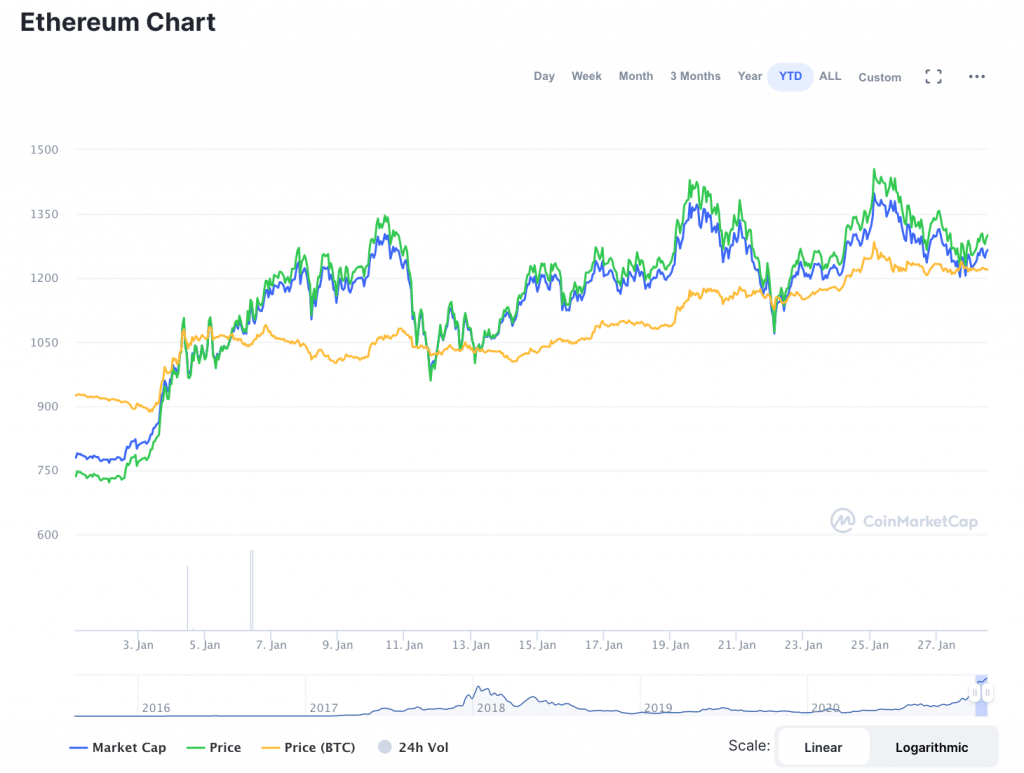
“Ethereum performed well against USD in 2020, outpacing Bitcoin to finish the year up 487% at $745.” Since then, the price of ETH has climbed even further: at press time, the price of ETH was ~$1,275; earlier in the year, ETH climbed as high as $1,470. According to data from Messar.io, ETH was up more than 75 percent since the start of the year while the price of BTC was up just under 6 percent.
Could institutional investors be the source of some of these gains? And, are institutional investors really seeing Ether as a store-of-value asset? And, if so, what are the implications that this may have for the Ethereum network and the DeFi space as a whole?
BTC Is Fundamentally Different Than ETH
Let’s back up for a moment: while both Bitcoin (BTC) and Ether may be perceived by some investors as stores-of-value, there are some very important differences between the two assets. For example, Bitcoin’s value is its functionality; in the earlier days of Bitcoin, Bitcoin was discussed as a transactional network: a 'digital cash'. However, as the network has grown, scalability issues have caused the network to be seen as a sort of 'digital gold': a store-of-value.
On the other hand, Ether has multi-faceted functionality. Sure, ETH tokens hold value, but the tokens are used in practical ways on the Ethereum network. Additionally, while other tokens (called ERC20 tokens) have been launched on the Ethereum network, ETH is the currency in which transactional fees on the network must be paid. As such, ETH is the 'facilitator' of the network: it is the currency that allows transactions, smart contracts and decentralized applications (dApps) to operate.
Doug Schwenk, Chairman of DAR (Digital Asset Research), explained to Finance Magnates that therefore, “perhaps in the short term, ETH may be seen as a store-of-value,” but over the longer-term, “it's correctly seen as valuable for its utility.”
Doug Schwenk, Chairman and Chief Executive of Digital Assets Research (DAR).
The Growth of the DeFi Ecosystem Is Pushing Ether Up
Moreover, Mr. Schwenk explained that there are other fundamental differences between the two assets that make their status as stores-of-value quite different over the long term: “Bitcoin, similar to gold, has a limited supply, which contributes to the store-of-value narrative,” he said.
“ETH, on the other hand, does not have a fixed cap. The price of ETH may be more directly related to its utility to process transactions which are used in many applications,” including a number of decentralized finance (DeFi) dApps.
Token-based fundraising advisor, Eloisa Marchesoni explained to Finance Magnates that 'decentralized finance' is a set of decentralized platforms that provide traditional financial services, including loans and investments.
However, the DeFi ecosystem is still in its very early stages: “[DeFi is] a new financial ‘wild-west’ that takes place largely on Ethereum and which according to some experts could give rise to a new ‘digital gold rush’ similar to the ICO boom of late 2017,” Ms. Marchesoni explained.
Unlike the ICO era, analysts see much more potential in many DeFi projects to continue to grow for years to come.
"If ETH Grows, the Price of Tokens in the Ethereum Ecosystem Also Increases."
Therefore, while Ether may not be a store-of-value in the same way that Bitcoin is, ETH does have a kind of correlative-value relationship with the decentralized finance ecosystem. As the number of applications build on top of the Ethereum network continues to grow, so too does the amount of capital flowing through that ecosystem. As more transactions take place on the network, the greater the usage of Ether.
Indeed, “DeFi tokens' core movement takes place on decentralized exchanges like Uniswap, Mooniswap, Sushiswap, et cetera,” Doug Schwenk told Finance Magnates. “The main trading pair to which these tokens are traded is respectively ETH. As a result, if ETH grows, the price of tokens in the Ethereum ecosystem also increases.”
“It's not directly correlated, but it is the leading driving factor besides the hype of DeFi,” he added.
Indeed, the growth of the DeFi ecosystem may have increased Ether’s value in the short-term. Eloisa Marchesoni explained to Finance Magnates that while “the high demand for Ether in DeFi applications is expected to have a long-term impact on the price of Ethereum.” However, ETH’s price is still subject to market sentiment in the short-term.
“Ethereum prices are currently following the current market sentiment and have fallen by 17.7% over the past seven days,” Ms. Marchesoni explained.
The Transition to Eth2.0
While this growth of Ethereum’s DeFi ecosystem has caused some repeated instances of slow transaction speeds and high transaction fees, the team responsible for developing the technology behind the Ethereum network has recently led the Ethereum community through the first step toward Eth2.0, a software upgrade that is slated to fix some of the network’s scalability problems.
This could have very important implications for the future of the Ethereum network, and for the price of Ether.
Eloisa Marchesoni explained to Finance Magnates that “without going into the very complicated technical details” regarding the transition to Eth2.0, “it is enough to know that thanks to a mechanism known as sharding and the transition to proof-of-stake, it will be possible to process thousands of transactions per second consuming very little energy.”
Ms. Marchesoni also explained that the developments toward Eth2.0 seem to have been embraced by investors: “the value of Ethereum's cryptocurrency has more than quadrupled from its 2018 lows,” she said. Additionally, the amount of Ether currently staked in the Eth2.0 smart contract has climbed to more than $3 billion since December 1st, when Eth2.0’s so-called 'beacon chain' was launched.
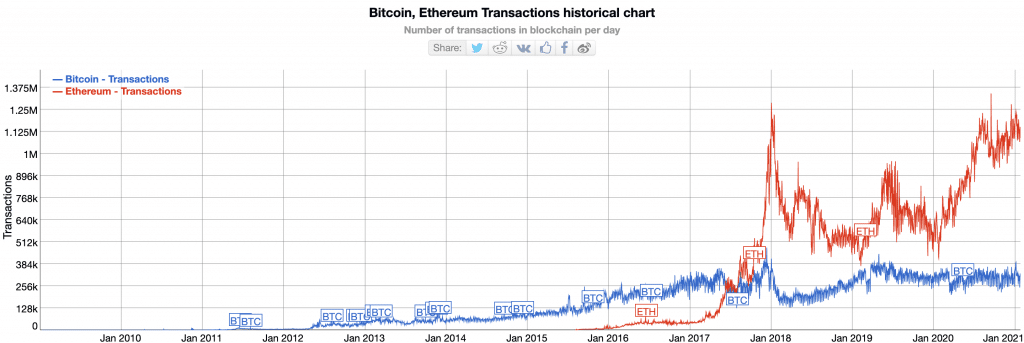
Additionally, Ms. Marchesoni pointed out that since the launch of the beacon chain, “[the number of transactions on] the Ethereum blockchain has surpassed that of bitcoin,” which was previously the most-used cryptocurrency network.
via BitInfoCharts
Therefore, Ether is not a store-of-value in the same way that Bitcoin is. However, that does not mean that it is not valuable, and will not continue to grow over the long-term.
Konstantin Boyko-Romanovsky, CEO and Founder of Allnodes, told Finance Magnates that he believes that “sooner or later, the majority of institutional investors will turn their attention to Ethereum, which, as we know, has many more applications than the number one currency, [Bitcoin].”
“This, of course, creates positive expectations for investors in terms of possible earnings. Currently, there are no discussions in the crypto community on ‘flippening', a term used to describe the possibility of Ethereum surpassing Bitcoin as the leading cryptocurrency. However the fact remains the same, Ethereum is currently more vigorous than ever.”
Konstantin Boyko-Romanovsky, CEO and Founder of Allnodes.
Growth of the DeFi Ecosystem Is Positive for Both BTC and ETH
Interestingly, though, is the fact that the growth of the DeFi ecosystem is not only good for the growth of Ether and the Ethereum network, it is also good for Bitcoin.
Indeed, “BTC has certainly been an important part of the DeFi ecosystem, primarily as collateral,” Doug Schwenk told Finance Magnates. In other words, the more that DeFi grows, the more Bitcoin that is used within DeFi. For example, at press time, the total value locked (TVL) in the DeFi ecosystem had reached $25.49 billion; $5.02 billion of DeFi’s TVL is comprised of Bitcoin.
However, as Finance Magnates previously reported, “the amount of Bitcoin that is currently being used in the DeFi ecosystem may not be enough to have a significant effect on the price of Bitcoin. Currently, the amount of Bitcoin used in the DeFi ecosystem is just under 1% of Bitcoin’s circulating supply.”
Additionally, Doug Schwenk believes that a healthy Bitcoin price could feed into further growth of the DeFi ecosystem: “if the BTC price continues to grow and with time becomes more stable, it could facilitate a robust DeFi ecosystem,” he explained. “The DeFi ecosystem will ultimately be held back if there is not an asset of sufficient market cap that can be seen as reliable collateral.”
Earlier this month, Coinbase published a report with an interesting finding: indeed, the exchange’s institutional clients said that Bitcoin’s evolving role as a store-of-value was an important part of their reason for investing in it. However, Coinbase noted that the same group of investors were starting to view another large-cap asset as a possible store-of-value: Ether (ETH), the native asset of the Ethereum network.
Indeed, “the case for owning Ethereum we hear most frequently from our clients is a combination of i) its evolving potential as a store-of-value, and ii) its status as a digital commodity that is required to power transactions on its network,” a summary of the year-end report explained.
“While our institutional clients predominantly bought Bitcoin in 2020, a growing number also took positions in Ethereum, the second-largest crypto asset by market capitalization,” the report said.
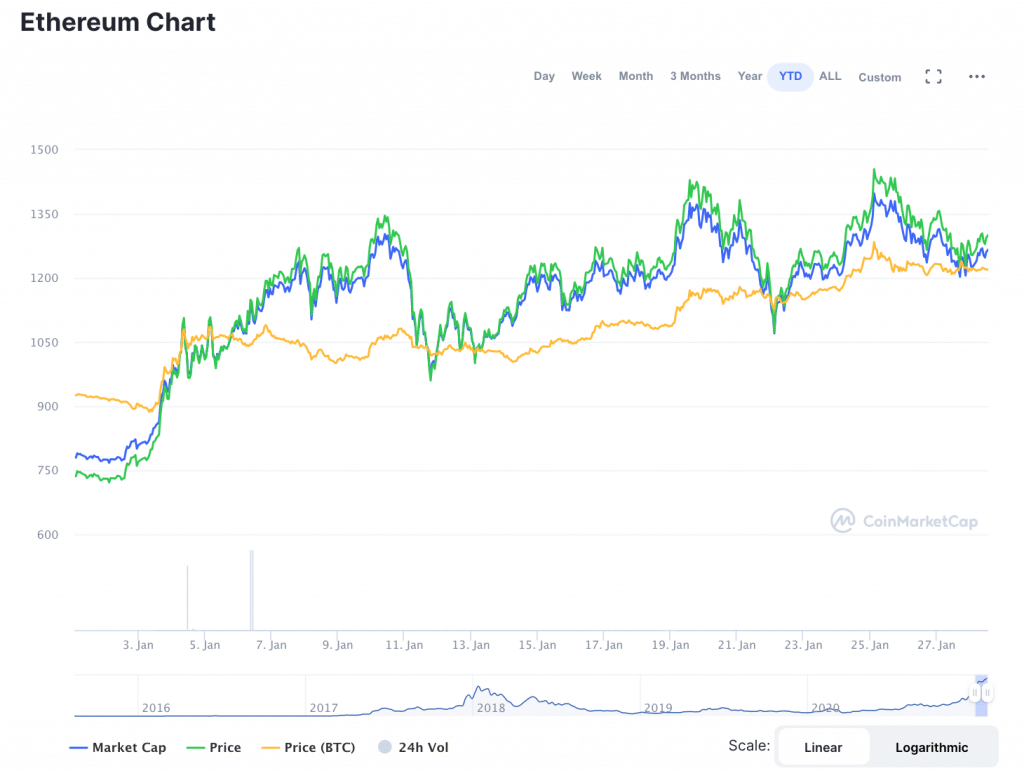
“Ethereum performed well against USD in 2020, outpacing Bitcoin to finish the year up 487% at $745.” Since then, the price of ETH has climbed even further: at press time, the price of ETH was ~$1,275; earlier in the year, ETH climbed as high as $1,470. According to data from Messar.io, ETH was up more than 75 percent since the start of the year while the price of BTC was up just under 6 percent.
Could institutional investors be the source of some of these gains? And, are institutional investors really seeing Ether as a store-of-value asset? And, if so, what are the implications that this may have for the Ethereum network and the DeFi space as a whole?
BTC Is Fundamentally Different Than ETH
Let’s back up for a moment: while both Bitcoin (BTC) and Ether may be perceived by some investors as stores-of-value, there are some very important differences between the two assets. For example, Bitcoin’s value is its functionality; in the earlier days of Bitcoin, Bitcoin was discussed as a transactional network: a 'digital cash'. However, as the network has grown, scalability issues have caused the network to be seen as a sort of 'digital gold': a store-of-value.
On the other hand, Ether has multi-faceted functionality. Sure, ETH tokens hold value, but the tokens are used in practical ways on the Ethereum network. Additionally, while other tokens (called ERC20 tokens) have been launched on the Ethereum network, ETH is the currency in which transactional fees on the network must be paid. As such, ETH is the 'facilitator' of the network: it is the currency that allows transactions, smart contracts and decentralized applications (dApps) to operate.
Doug Schwenk, Chairman of DAR (Digital Asset Research), explained to Finance Magnates that therefore, “perhaps in the short term, ETH may be seen as a store-of-value,” but over the longer-term, “it's correctly seen as valuable for its utility.”
Doug Schwenk, Chairman and Chief Executive of Digital Assets Research (DAR).
The Growth of the DeFi Ecosystem Is Pushing Ether Up
Moreover, Mr. Schwenk explained that there are other fundamental differences between the two assets that make their status as stores-of-value quite different over the long term: “Bitcoin, similar to gold, has a limited supply, which contributes to the store-of-value narrative,” he said.
“ETH, on the other hand, does not have a fixed cap. The price of ETH may be more directly related to its utility to process transactions which are used in many applications,” including a number of decentralized finance (DeFi) dApps.
Token-based fundraising advisor, Eloisa Marchesoni explained to Finance Magnates that 'decentralized finance' is a set of decentralized platforms that provide traditional financial services, including loans and investments.
However, the DeFi ecosystem is still in its very early stages: “[DeFi is] a new financial ‘wild-west’ that takes place largely on Ethereum and which according to some experts could give rise to a new ‘digital gold rush’ similar to the ICO boom of late 2017,” Ms. Marchesoni explained.
Unlike the ICO era, analysts see much more potential in many DeFi projects to continue to grow for years to come.
"If ETH Grows, the Price of Tokens in the Ethereum Ecosystem Also Increases."
Therefore, while Ether may not be a store-of-value in the same way that Bitcoin is, ETH does have a kind of correlative-value relationship with the decentralized finance ecosystem. As the number of applications build on top of the Ethereum network continues to grow, so too does the amount of capital flowing through that ecosystem. As more transactions take place on the network, the greater the usage of Ether.
Indeed, “DeFi tokens' core movement takes place on decentralized exchanges like Uniswap, Mooniswap, Sushiswap, et cetera,” Doug Schwenk told Finance Magnates. “The main trading pair to which these tokens are traded is respectively ETH. As a result, if ETH grows, the price of tokens in the Ethereum ecosystem also increases.”
“It's not directly correlated, but it is the leading driving factor besides the hype of DeFi,” he added.
Indeed, the growth of the DeFi ecosystem may have increased Ether’s value in the short-term. Eloisa Marchesoni explained to Finance Magnates that while “the high demand for Ether in DeFi applications is expected to have a long-term impact on the price of Ethereum.” However, ETH’s price is still subject to market sentiment in the short-term.
“Ethereum prices are currently following the current market sentiment and have fallen by 17.7% over the past seven days,” Ms. Marchesoni explained.
The Transition to Eth2.0
While this growth of Ethereum’s DeFi ecosystem has caused some repeated instances of slow transaction speeds and high transaction fees, the team responsible for developing the technology behind the Ethereum network has recently led the Ethereum community through the first step toward Eth2.0, a software upgrade that is slated to fix some of the network’s scalability problems.
This could have very important implications for the future of the Ethereum network, and for the price of Ether.
Eloisa Marchesoni explained to Finance Magnates that “without going into the very complicated technical details” regarding the transition to Eth2.0, “it is enough to know that thanks to a mechanism known as sharding and the transition to proof-of-stake, it will be possible to process thousands of transactions per second consuming very little energy.”
Ms. Marchesoni also explained that the developments toward Eth2.0 seem to have been embraced by investors: “the value of Ethereum's cryptocurrency has more than quadrupled from its 2018 lows,” she said. Additionally, the amount of Ether currently staked in the Eth2.0 smart contract has climbed to more than $3 billion since December 1st, when Eth2.0’s so-called 'beacon chain' was launched.
Additionally, Ms. Marchesoni pointed out that since the launch of the beacon chain, “[the number of transactions on] the Ethereum blockchain has surpassed that of bitcoin,” which was previously the most-used cryptocurrency network.
via BitInfoCharts
Therefore, Ether is not a store-of-value in the same way that Bitcoin is. However, that does not mean that it is not valuable, and will not continue to grow over the long-term.
Konstantin Boyko-Romanovsky, CEO and Founder of Allnodes, told Finance Magnates that he believes that “sooner or later, the majority of institutional investors will turn their attention to Ethereum, which, as we know, has many more applications than the number one currency, [Bitcoin].”
“This, of course, creates positive expectations for investors in terms of possible earnings. Currently, there are no discussions in the crypto community on ‘flippening', a term used to describe the possibility of Ethereum surpassing Bitcoin as the leading cryptocurrency. However the fact remains the same, Ethereum is currently more vigorous than ever.”
Konstantin Boyko-Romanovsky, CEO and Founder of Allnodes.
Growth of the DeFi Ecosystem Is Positive for Both BTC and ETH
Interestingly, though, is the fact that the growth of the DeFi ecosystem is not only good for the growth of Ether and the Ethereum network, it is also good for Bitcoin.
Indeed, “BTC has certainly been an important part of the DeFi ecosystem, primarily as collateral,” Doug Schwenk told Finance Magnates. In other words, the more that DeFi grows, the more Bitcoin that is used within DeFi. For example, at press time, the total value locked (TVL) in the DeFi ecosystem had reached $25.49 billion; $5.02 billion of DeFi’s TVL is comprised of Bitcoin.
However, as Finance Magnates previously reported, “the amount of Bitcoin that is currently being used in the DeFi ecosystem may not be enough to have a significant effect on the price of Bitcoin. Currently, the amount of Bitcoin used in the DeFi ecosystem is just under 1% of Bitcoin’s circulating supply.”
Additionally, Doug Schwenk believes that a healthy Bitcoin price could feed into further growth of the DeFi ecosystem: “if the BTC price continues to grow and with time becomes more stable, it could facilitate a robust DeFi ecosystem,” he explained. “The DeFi ecosystem will ultimately be held back if there is not an asset of sufficient market cap that can be seen as reliable collateral.”
Rachel is a self-taught crypto geek and a passionate writer. She believes in the power that the written word has to educate, connect and empower individuals to make positive and powerful financial choices. She is the Podcast Host and a Cryptocurrency Editor at Finance Magnates.
Bitcoin Miners Are Becoming AI Infrastructure and the Market Is Repricing Them
Featured Videos
Hola Prime Review: What You Need to Know | Full Breakdown by Finance Magnates
Hola Prime Review: What You Need to Know | Full Breakdown by Finance Magnates
Hola Prime Review: What You Need to Know | Full Breakdown by Finance Magnates
Hola Prime Review: What You Need to Know | Full Breakdown by Finance Magnates
In this video, we review @HolaPrime_Global, a proprietary trading firm offering evaluation programs and performance-based payouts in simulated market environments.
We cover how the challenge model works, including account types, profit splits (up to 95%), trading rules, and what it takes to reach a funded account. You’ll also learn about available platforms like MT4, MT5, cTrader, and more, along with insights into payouts, support, and trading conditions.
Watch the full video to see if Hola Prime fits your trading style.
📣 Stay up to date with the latest in finance and trading. Follow Finance Magnates for industry news, insights, and global event coverage.
Connect with us:
🔗 LinkedIn: /financemagnates
👍 Facebook: /financemagnates
📸 Instagram: https://www.instagram.com/financemagnates
🐦 X: https://x.com/financemagnates
🎥 TikTok: https://www.tiktok.com/tag/financemagnates
▶️ YouTube: /@financemagnates_official
#HolaPrime #PropFirm #Trading #FinanceMagnates #Forex #FuturesTrading #TradingReview #PropFirmReview
In this video, we review @HolaPrime_Global, a proprietary trading firm offering evaluation programs and performance-based payouts in simulated market environments.
We cover how the challenge model works, including account types, profit splits (up to 95%), trading rules, and what it takes to reach a funded account. You’ll also learn about available platforms like MT4, MT5, cTrader, and more, along with insights into payouts, support, and trading conditions.
Watch the full video to see if Hola Prime fits your trading style.
📣 Stay up to date with the latest in finance and trading. Follow Finance Magnates for industry news, insights, and global event coverage.
Connect with us:
🔗 LinkedIn: /financemagnates
👍 Facebook: /financemagnates
📸 Instagram: https://www.instagram.com/financemagnates
🐦 X: https://x.com/financemagnates
🎥 TikTok: https://www.tiktok.com/tag/financemagnates
▶️ YouTube: /@financemagnates_official
#HolaPrime #PropFirm #Trading #FinanceMagnates #Forex #FuturesTrading #TradingReview #PropFirmReview
In this video, we review @HolaPrime_Global, a proprietary trading firm offering evaluation programs and performance-based payouts in simulated market environments.
We cover how the challenge model works, including account types, profit splits (up to 95%), trading rules, and what it takes to reach a funded account. You’ll also learn about available platforms like MT4, MT5, cTrader, and more, along with insights into payouts, support, and trading conditions.
Watch the full video to see if Hola Prime fits your trading style.
📣 Stay up to date with the latest in finance and trading. Follow Finance Magnates for industry news, insights, and global event coverage.
Connect with us:
🔗 LinkedIn: /financemagnates
👍 Facebook: /financemagnates
📸 Instagram: https://www.instagram.com/financemagnates
🐦 X: https://x.com/financemagnates
🎥 TikTok: https://www.tiktok.com/tag/financemagnates
▶️ YouTube: /@financemagnates_official
#HolaPrime #PropFirm #Trading #FinanceMagnates #Forex #FuturesTrading #TradingReview #PropFirmReview
In this video, we review @HolaPrime_Global, a proprietary trading firm offering evaluation programs and performance-based payouts in simulated market environments.
We cover how the challenge model works, including account types, profit splits (up to 95%), trading rules, and what it takes to reach a funded account. You’ll also learn about available platforms like MT4, MT5, cTrader, and more, along with insights into payouts, support, and trading conditions.
Watch the full video to see if Hola Prime fits your trading style.
📣 Stay up to date with the latest in finance and trading. Follow Finance Magnates for industry news, insights, and global event coverage.
Connect with us:
🔗 LinkedIn: /financemagnates
👍 Facebook: /financemagnates
📸 Instagram: https://www.instagram.com/financemagnates
🐦 X: https://x.com/financemagnates
🎥 TikTok: https://www.tiktok.com/tag/financemagnates
▶️ YouTube: /@financemagnates_official
#HolaPrime #PropFirm #Trading #FinanceMagnates #Forex #FuturesTrading #TradingReview #PropFirmReview
Axi Winner Spotlight 🏆 | Global Most Innovative Broker 2025 #Innovation #Trading #Fintech #Broker
Axi Winner Spotlight 🏆 | Global Most Innovative Broker 2025 #Innovation #Trading #Fintech #Broker
Axi Winner Spotlight 🏆 | Global Most Innovative Broker 2025 #Innovation #Trading #Fintech #Broker
Axi Winner Spotlight 🏆 | Global Most Innovative Broker 2025 #Innovation #Trading #Fintech #Broker
Axi Winner Spotlight 🏆 | Global Most Innovative Broker 2025 #Innovation #Trading #Fintech #Broker
Axi Winner Spotlight 🏆 | Global Most Innovative Broker 2025 #Innovation #Trading #Fintech #Broker
Axi takes the spotlight at the Finance Magnates Awards, winning Global Most Innovative Broker 2025.
Olivia Xenofontos and Ivanna Openko share how the team will feel: proud, motivated, and ready to keep delivering.
They also describe the night as well-organized, focused, and enjoyable for all.
👉 Be part of FM Awards 2026.
Axi takes the spotlight at the Finance Magnates Awards, winning Global Most Innovative Broker 2025.
Olivia Xenofontos and Ivanna Openko share how the team will feel: proud, motivated, and ready to keep delivering.
They also describe the night as well-organized, focused, and enjoyable for all.
👉 Be part of FM Awards 2026.
Axi takes the spotlight at the Finance Magnates Awards, winning Global Most Innovative Broker 2025.
Olivia Xenofontos and Ivanna Openko share how the team will feel: proud, motivated, and ready to keep delivering.
They also describe the night as well-organized, focused, and enjoyable for all.
👉 Be part of FM Awards 2026.
Axi takes the spotlight at the Finance Magnates Awards, winning Global Most Innovative Broker 2025.
Olivia Xenofontos and Ivanna Openko share how the team will feel: proud, motivated, and ready to keep delivering.
They also describe the night as well-organized, focused, and enjoyable for all.
👉 Be part of FM Awards 2026.
Axi takes the spotlight at the Finance Magnates Awards, winning Global Most Innovative Broker 2025.
Olivia Xenofontos and Ivanna Openko share how the team will feel: proud, motivated, and ready to keep delivering.
They also describe the night as well-organized, focused, and enjoyable for all.
👉 Be part of FM Awards 2026.
Axi takes the spotlight at the Finance Magnates Awards, winning Global Most Innovative Broker 2025.
Olivia Xenofontos and Ivanna Openko share how the team will feel: proud, motivated, and ready to keep delivering.
They also describe the night as well-organized, focused, and enjoyable for all.
👉 Be part of FM Awards 2026.
Recognition that matters.
Built on transparency.
Driven by the industry.
The Finance Magnates Awards 2026.
Nominations are now open.
🔗 https://awards.financemagnates.com/?utm_source=SM&utm_medium=social&utm_campaign=recognition-matters
Recognition that matters.
Built on transparency.
Driven by the industry.
The Finance Magnates Awards 2026.
Nominations are now open.
🔗 https://awards.financemagnates.com/?utm_source=SM&utm_medium=social&utm_campaign=recognition-matters
Recognition that matters.
Built on transparency.
Driven by the industry.
The Finance Magnates Awards 2026.
Nominations are now open.
🔗 https://awards.financemagnates.com/?utm_source=SM&utm_medium=social&utm_campaign=recognition-matters
Recognition that matters.
Built on transparency.
Driven by the industry.
The Finance Magnates Awards 2026.
Nominations are now open.
🔗 https://awards.financemagnates.com/?utm_source=SM&utm_medium=social&utm_campaign=recognition-matters
Recognition that matters.
Built on transparency.
Driven by the industry.
The Finance Magnates Awards 2026.
Nominations are now open.
🔗 https://awards.financemagnates.com/?utm_source=SM&utm_medium=social&utm_campaign=recognition-matters
Recognition that matters.
Built on transparency.
Driven by the industry.
The Finance Magnates Awards 2026.
Nominations are now open.
🔗 https://awards.financemagnates.com/?utm_source=SM&utm_medium=social&utm_campaign=recognition-matters
Tickmill Winner Spotlight | Broker of the Year 2025 (LATAM) 🏆 | Finance Magnates Awards #Trading
Tickmill Winner Spotlight | Broker of the Year 2025 (LATAM) 🏆 | Finance Magnates Awards #Trading
Tickmill Winner Spotlight | Broker of the Year 2025 (LATAM) 🏆 | Finance Magnates Awards #Trading
Tickmill Winner Spotlight | Broker of the Year 2025 (LATAM) 🏆 | Finance Magnates Awards #Trading
Tickmill Winner Spotlight | Broker of the Year 2025 (LATAM) 🏆 | Finance Magnates Awards #Trading
Tickmill Winner Spotlight | Broker of the Year 2025 (LATAM) 🏆 | Finance Magnates Awards #Trading
What helped Tickmill stand out this year?
In this Winner Spotlight, Johnny Khalil, Executive Director at Tickmill Europe, shares how listening closely to clients and delivering strong trading conditions made the difference.
A big thank you to the community whose support continues to drive progress every day.
👉 Think your brand has what it takes? Nominate for the 2026 Finance Magnates Awards: https://awards.financemagnates.com/#nominate
What helped Tickmill stand out this year?
In this Winner Spotlight, Johnny Khalil, Executive Director at Tickmill Europe, shares how listening closely to clients and delivering strong trading conditions made the difference.
A big thank you to the community whose support continues to drive progress every day.
👉 Think your brand has what it takes? Nominate for the 2026 Finance Magnates Awards: https://awards.financemagnates.com/#nominate
What helped Tickmill stand out this year?
In this Winner Spotlight, Johnny Khalil, Executive Director at Tickmill Europe, shares how listening closely to clients and delivering strong trading conditions made the difference.
A big thank you to the community whose support continues to drive progress every day.
👉 Think your brand has what it takes? Nominate for the 2026 Finance Magnates Awards: https://awards.financemagnates.com/#nominate
What helped Tickmill stand out this year?
In this Winner Spotlight, Johnny Khalil, Executive Director at Tickmill Europe, shares how listening closely to clients and delivering strong trading conditions made the difference.
A big thank you to the community whose support continues to drive progress every day.
👉 Think your brand has what it takes? Nominate for the 2026 Finance Magnates Awards: https://awards.financemagnates.com/#nominate
What helped Tickmill stand out this year?
In this Winner Spotlight, Johnny Khalil, Executive Director at Tickmill Europe, shares how listening closely to clients and delivering strong trading conditions made the difference.
A big thank you to the community whose support continues to drive progress every day.
👉 Think your brand has what it takes? Nominate for the 2026 Finance Magnates Awards: https://awards.financemagnates.com/#nominate
What helped Tickmill stand out this year?
In this Winner Spotlight, Johnny Khalil, Executive Director at Tickmill Europe, shares how listening closely to clients and delivering strong trading conditions made the difference.
A big thank you to the community whose support continues to drive progress every day.
👉 Think your brand has what it takes? Nominate for the 2026 Finance Magnates Awards: https://awards.financemagnates.com/#nominate
CMC Markets’ Artur Delijergijevs on Metals Demand, Volatility, & Stable Execution
CMC Markets’ Artur Delijergijevs on Metals Demand, Volatility, & Stable Execution
CMC Markets’ Artur Delijergijevs on Metals Demand, Volatility, & Stable Execution
CMC Markets’ Artur Delijergijevs on Metals Demand, Volatility, & Stable Execution
CMC Markets’ Artur Delijergijevs on Metals Demand, Volatility, & Stable Execution
CMC Markets’ Artur Delijergijevs on Metals Demand, Volatility, & Stable Execution
In this exclusive Executive Interview, Finance Magnates speaks with Artur Delijergijevs, Head of Systematic Market Making at CMC Markets, about the current state of metals demand and market volatility.
Delijergijevs offers a desk-level view on:
- Metals Demand: Why metals are seeing the strongest demand from both retail and institutional clients right now.
- The Safe-Haven Debate: Questioning whether gold still fits the classic safe-haven definition given large daily price movements.
- Volatile Market Prep: How a market-making desk prepares its systems and pricing for stressed market conditions and high-impact economic events.
- Hybrid Execution: Why the best execution model combines electronic speed with human relationship support, especially during volatility.
- AI in Workflow: Where CMC Markets is integrating machine learning for risk management and pricing, and the limitations of AI during stressed markets.
- Dubai's Role: The strategic importance of Dubai’s location for covering global trading sessions across Asia, Europe, and the US.
Watch to understand how CMC Markets maintains stable pricing and reliable execution quality in high-volatility environments.
#CMCmarkets #forex #metals #gold #trading #volatility #MarketMaking #iFXDubai #FinanceMagnates #Finance #Fintech #Execution #AlgorithmicTrading #RiskManagement
In this exclusive Executive Interview, Finance Magnates speaks with Artur Delijergijevs, Head of Systematic Market Making at CMC Markets, about the current state of metals demand and market volatility.
Delijergijevs offers a desk-level view on:
- Metals Demand: Why metals are seeing the strongest demand from both retail and institutional clients right now.
- The Safe-Haven Debate: Questioning whether gold still fits the classic safe-haven definition given large daily price movements.
- Volatile Market Prep: How a market-making desk prepares its systems and pricing for stressed market conditions and high-impact economic events.
- Hybrid Execution: Why the best execution model combines electronic speed with human relationship support, especially during volatility.
- AI in Workflow: Where CMC Markets is integrating machine learning for risk management and pricing, and the limitations of AI during stressed markets.
- Dubai's Role: The strategic importance of Dubai’s location for covering global trading sessions across Asia, Europe, and the US.
Watch to understand how CMC Markets maintains stable pricing and reliable execution quality in high-volatility environments.
#CMCmarkets #forex #metals #gold #trading #volatility #MarketMaking #iFXDubai #FinanceMagnates #Finance #Fintech #Execution #AlgorithmicTrading #RiskManagement
In this exclusive Executive Interview, Finance Magnates speaks with Artur Delijergijevs, Head of Systematic Market Making at CMC Markets, about the current state of metals demand and market volatility.
Delijergijevs offers a desk-level view on:
- Metals Demand: Why metals are seeing the strongest demand from both retail and institutional clients right now.
- The Safe-Haven Debate: Questioning whether gold still fits the classic safe-haven definition given large daily price movements.
- Volatile Market Prep: How a market-making desk prepares its systems and pricing for stressed market conditions and high-impact economic events.
- Hybrid Execution: Why the best execution model combines electronic speed with human relationship support, especially during volatility.
- AI in Workflow: Where CMC Markets is integrating machine learning for risk management and pricing, and the limitations of AI during stressed markets.
- Dubai's Role: The strategic importance of Dubai’s location for covering global trading sessions across Asia, Europe, and the US.
Watch to understand how CMC Markets maintains stable pricing and reliable execution quality in high-volatility environments.
#CMCmarkets #forex #metals #gold #trading #volatility #MarketMaking #iFXDubai #FinanceMagnates #Finance #Fintech #Execution #AlgorithmicTrading #RiskManagement
In this exclusive Executive Interview, Finance Magnates speaks with Artur Delijergijevs, Head of Systematic Market Making at CMC Markets, about the current state of metals demand and market volatility.
Delijergijevs offers a desk-level view on:
- Metals Demand: Why metals are seeing the strongest demand from both retail and institutional clients right now.
- The Safe-Haven Debate: Questioning whether gold still fits the classic safe-haven definition given large daily price movements.
- Volatile Market Prep: How a market-making desk prepares its systems and pricing for stressed market conditions and high-impact economic events.
- Hybrid Execution: Why the best execution model combines electronic speed with human relationship support, especially during volatility.
- AI in Workflow: Where CMC Markets is integrating machine learning for risk management and pricing, and the limitations of AI during stressed markets.
- Dubai's Role: The strategic importance of Dubai’s location for covering global trading sessions across Asia, Europe, and the US.
Watch to understand how CMC Markets maintains stable pricing and reliable execution quality in high-volatility environments.
#CMCmarkets #forex #metals #gold #trading #volatility #MarketMaking #iFXDubai #FinanceMagnates #Finance #Fintech #Execution #AlgorithmicTrading #RiskManagement
In this exclusive Executive Interview, Finance Magnates speaks with Artur Delijergijevs, Head of Systematic Market Making at CMC Markets, about the current state of metals demand and market volatility.
Delijergijevs offers a desk-level view on:
- Metals Demand: Why metals are seeing the strongest demand from both retail and institutional clients right now.
- The Safe-Haven Debate: Questioning whether gold still fits the classic safe-haven definition given large daily price movements.
- Volatile Market Prep: How a market-making desk prepares its systems and pricing for stressed market conditions and high-impact economic events.
- Hybrid Execution: Why the best execution model combines electronic speed with human relationship support, especially during volatility.
- AI in Workflow: Where CMC Markets is integrating machine learning for risk management and pricing, and the limitations of AI during stressed markets.
- Dubai's Role: The strategic importance of Dubai’s location for covering global trading sessions across Asia, Europe, and the US.
Watch to understand how CMC Markets maintains stable pricing and reliable execution quality in high-volatility environments.
#CMCmarkets #forex #metals #gold #trading #volatility #MarketMaking #iFXDubai #FinanceMagnates #Finance #Fintech #Execution #AlgorithmicTrading #RiskManagement
In this exclusive Executive Interview, Finance Magnates speaks with Artur Delijergijevs, Head of Systematic Market Making at CMC Markets, about the current state of metals demand and market volatility.
Delijergijevs offers a desk-level view on:
- Metals Demand: Why metals are seeing the strongest demand from both retail and institutional clients right now.
- The Safe-Haven Debate: Questioning whether gold still fits the classic safe-haven definition given large daily price movements.
- Volatile Market Prep: How a market-making desk prepares its systems and pricing for stressed market conditions and high-impact economic events.
- Hybrid Execution: Why the best execution model combines electronic speed with human relationship support, especially during volatility.
- AI in Workflow: Where CMC Markets is integrating machine learning for risk management and pricing, and the limitations of AI during stressed markets.
- Dubai's Role: The strategic importance of Dubai’s location for covering global trading sessions across Asia, Europe, and the US.
Watch to understand how CMC Markets maintains stable pricing and reliable execution quality in high-volatility environments.
#CMCmarkets #forex #metals #gold #trading #volatility #MarketMaking #iFXDubai #FinanceMagnates #Finance #Fintech #Execution #AlgorithmicTrading #RiskManagement