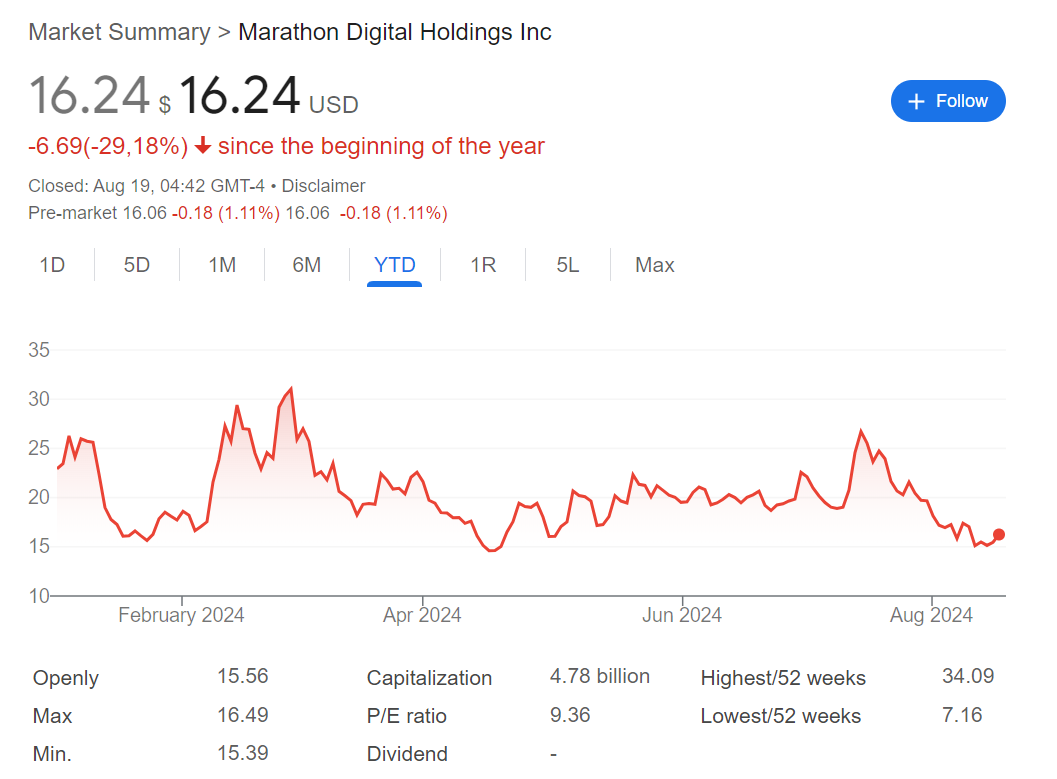
Jefferies recently lowered the recommendation for Marathon Digital Holding's shares to $17.
They claim that Bitcoin mining became less profitable in July and may continue to decline in the coming months.
Bitcoin (BTC)
mining profitability experienced a slight decline in July compared to the
previous month, according to a recent report from investment bank Jefferies.
The
analysis points to a drop in Bitcoin's price as the primary factor impacting
miners' margins. As a result, the institution decided to lower the target price
for the largest Bitcoin miner on Wall Street, Marathon Digital Holdings
(Nasdaq: MARA), by over 20%.
Bitcoin Mining
Profitability Dips in July, Jefferies Reports
The
cryptocurrency's value fell by over 6% in July, while the network's hashrate—a measure of computational power dedicated to mining—remained relatively
stable. This combination of factors put pressure on mining operations, despite
an increase in production share for US-listed companies.
Jefferies
analysts noted that publicly traded mining firms expanded their collective
output, capturing 21.1% of total Bitcoin production in July, up from 20.7% in
June. This growth in market share was attributed to these companies bringing
new capacity online at a faster rate than the overall network expansion.
Marathon
Digital Holdings, a prominent player in the sector, stood out with a notable
increase in production. The company mined 692 bitcoins in July, representing a
17% month-over-month rise. Marathon continues to lead the industry in terms of
installed hashrate capacity.
Looking
ahead, Jefferies anticipates more challenging conditions for miners in August.
The bank's report highlights a further 5% decline in Bitcoin's price since the
beginning of the month, coupled with renewed growth in network hashrate, which
could squeeze profit margins even tighter.
In light of
these developments, Jefferies has adjusted its outlook on Marathon Digital. The
bank lowered its price target for the company's stock from $22 to $17 while
maintaining a “hold” rating.
Source: Google Finance
Is
Jefferies right? Time will tell. For now, Marathon Digital Holdings is taking
steps to capitalize on lower Bitcoin prices by purchasing $249 million worth of
BTC.
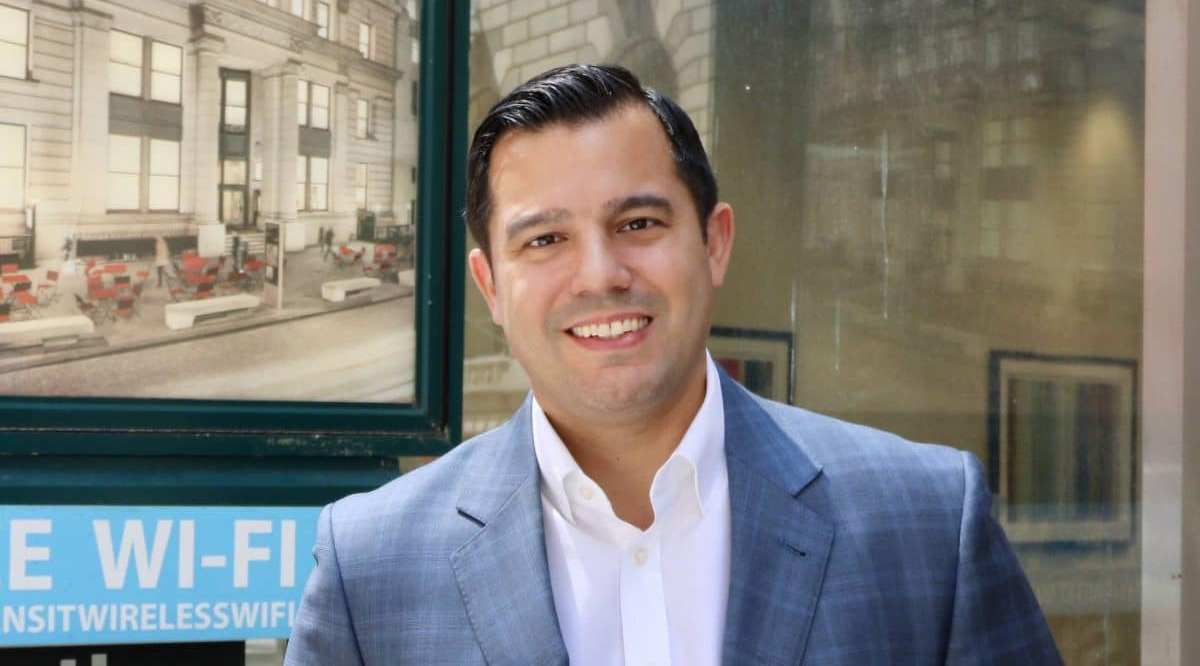
Fred Thiel, CEO, MARA, Source: LinkedIn
“We
currently own and operate approximately 54% of the 1.1 gigawatts of power in
our diversified portfolio of digital asset compute,” commented Fred Thiel,
MARA's Chairman and CEO. “We will continue making owned and operated sites a
greater percentage of our fleet over time and expect to see cost savings on a
cost per petahash basis as this occurs. Longer-term, our intention is to be
amongst the lower cost operators in the industry.”
The
evolving landscape of Bitcoin mining underscores the industry's sensitivity to
cryptocurrency price fluctuations and network dynamics. As the sector continues
to mature, miners face the ongoing challenge of balancing operational costs
with volatile market conditions.
The Q2 2024
results published by HIVE Digital Technologies (NASDAQ: HIVE) and TeraWulf
(NASDAQ: WULF) showed that Bitcoin miners are able to withstand negative market
changes following the recent halving. HIVE increased its revenue by 37%, while
WULF saw a 130% increase.
Bitcoin (BTC)
mining profitability experienced a slight decline in July compared to the
previous month, according to a recent report from investment bank Jefferies.
The
analysis points to a drop in Bitcoin's price as the primary factor impacting
miners' margins. As a result, the institution decided to lower the target price
for the largest Bitcoin miner on Wall Street, Marathon Digital Holdings
(Nasdaq: MARA), by over 20%.
Bitcoin Mining
Profitability Dips in July, Jefferies Reports
The
cryptocurrency's value fell by over 6% in July, while the network's hashrate—a measure of computational power dedicated to mining—remained relatively
stable. This combination of factors put pressure on mining operations, despite
an increase in production share for US-listed companies.
Jefferies
analysts noted that publicly traded mining firms expanded their collective
output, capturing 21.1% of total Bitcoin production in July, up from 20.7% in
June. This growth in market share was attributed to these companies bringing
new capacity online at a faster rate than the overall network expansion.
Marathon
Digital Holdings, a prominent player in the sector, stood out with a notable
increase in production. The company mined 692 bitcoins in July, representing a
17% month-over-month rise. Marathon continues to lead the industry in terms of
installed hashrate capacity.
Looking
ahead, Jefferies anticipates more challenging conditions for miners in August.
The bank's report highlights a further 5% decline in Bitcoin's price since the
beginning of the month, coupled with renewed growth in network hashrate, which
could squeeze profit margins even tighter.
In light of
these developments, Jefferies has adjusted its outlook on Marathon Digital. The
bank lowered its price target for the company's stock from $22 to $17 while
maintaining a “hold” rating.
Source: Google Finance
Is
Jefferies right? Time will tell. For now, Marathon Digital Holdings is taking
steps to capitalize on lower Bitcoin prices by purchasing $249 million worth of
BTC.
Fred Thiel, CEO, MARA, Source: LinkedIn
“We
currently own and operate approximately 54% of the 1.1 gigawatts of power in
our diversified portfolio of digital asset compute,” commented Fred Thiel,
MARA's Chairman and CEO. “We will continue making owned and operated sites a
greater percentage of our fleet over time and expect to see cost savings on a
cost per petahash basis as this occurs. Longer-term, our intention is to be
amongst the lower cost operators in the industry.”
The
evolving landscape of Bitcoin mining underscores the industry's sensitivity to
cryptocurrency price fluctuations and network dynamics. As the sector continues
to mature, miners face the ongoing challenge of balancing operational costs
with volatile market conditions.
The Q2 2024
results published by HIVE Digital Technologies (NASDAQ: HIVE) and TeraWulf
(NASDAQ: WULF) showed that Bitcoin miners are able to withstand negative market
changes following the recent halving. HIVE increased its revenue by 37%, while
WULF saw a 130% increase.
Damian Chmiel is a Senior Analyst & Editor at Finance Magnates with more than 15 years of experience in the CFD and online trading industry. Active as both a trader and journalist since 2010, he focuses on broker coverage, fintech innovation, and regulatory developments across Europe, the Middle East, and Asia.
His work includes interviews with C-level leaders at major brokerages and fintech platforms, as well as co-authoring Finance Magnates’ quarterly industry benchmarking reports. Damian’s reporting is data-driven, market-aware, and grounded in direct industry engagement. His analysis and commentary have also been cited by external media outlets, including Investing.com, Binance, The Asset, Stockhead, and Dispatch.
Education:
MA in Finance and Accounting, Cracow University of Economics
WhiteBIT secures brokerage license in Georgia to launch regulated crypto derivatives
FP Markets Winner Spotlight 🏆 | Global Broker of the Year 2025 #Trading #Broker #Innovation #Shorts
FP Markets Winner Spotlight 🏆 | Global Broker of the Year 2025 #Trading #Broker #Innovation #Shorts
FP Markets takes the spotlight as Global Broker of the Year 2025 at the Finance Magnates Awards.
Martin Stoilov, Head of Client Experience, shares that trust, innovation, and people played a key role in the company’s success, supported by a strong foundation of integrity and client-centricity.
Following this milestone, FP Markets continues to focus on growth, technology investment, and its core values of transparency and excellence.
👉 Be part of FM Awards 2026: https://awards.financemagnates.com/#nominate
FP Markets takes the spotlight as Global Broker of the Year 2025 at the Finance Magnates Awards.
Martin Stoilov, Head of Client Experience, shares that trust, innovation, and people played a key role in the company’s success, supported by a strong foundation of integrity and client-centricity.
Following this milestone, FP Markets continues to focus on growth, technology investment, and its core values of transparency and excellence.
👉 Be part of FM Awards 2026: https://awards.financemagnates.com/#nominate
In this video, we review @HolaPrimeMarketsOfficial, a multi-asset forex and CFDs broker offering different account types, trading platforms, and flexible trading conditions.
We cover the broker’s overall offering, including account options, trading environment, platforms like MT4 and MT5, and additional services such as managed accounts and fast withdrawals.
Watch the full video to see if Hola Prime Markets fits your trading needs.
📣 Stay up to date with the latest in finance and trading. Follow Finance Magnates for industry news, insights, and global event coverage.
Connect with us:
🔗 LinkedIn: /financemagnates
👍 Facebook: /financemagnates
📸 Instagram: https://www.instagram.com/financemagnates
🐦 X: https://x.com/financemagnates
🎥 TikTok: https://www.tiktok.com/tag/financemagnates
▶️ YouTube: /@financemagnates_official
#HolaPrime #ForexBroker #CFDTrading #FinanceMagnates #Trading #Forex #BrokerReview
In this video, we review @HolaPrimeMarketsOfficial, a multi-asset forex and CFDs broker offering different account types, trading platforms, and flexible trading conditions.
We cover the broker’s overall offering, including account options, trading environment, platforms like MT4 and MT5, and additional services such as managed accounts and fast withdrawals.
Watch the full video to see if Hola Prime Markets fits your trading needs.
📣 Stay up to date with the latest in finance and trading. Follow Finance Magnates for industry news, insights, and global event coverage.
Connect with us:
🔗 LinkedIn: /financemagnates
👍 Facebook: /financemagnates
📸 Instagram: https://www.instagram.com/financemagnates
🐦 X: https://x.com/financemagnates
🎥 TikTok: https://www.tiktok.com/tag/financemagnates
▶️ YouTube: /@financemagnates_official
#HolaPrime #ForexBroker #CFDTrading #FinanceMagnates #Trading #Forex #BrokerReview
Hola Prime Review: What You Need to Know | Full Breakdown by Finance Magnates
Hola Prime Review: What You Need to Know | Full Breakdown by Finance Magnates
In this video, we review @HolaPrime_Global, a proprietary trading firm offering evaluation programs and performance-based payouts in simulated market environments.
We cover how the challenge model works, including account types, profit splits (up to 95%), trading rules, and what it takes to reach a funded account. You’ll also learn about available platforms like MT4, MT5, cTrader, and more, along with insights into payouts, support, and trading conditions.
Watch the full video to see if Hola Prime fits your trading style.
📣 Stay up to date with the latest in finance and trading. Follow Finance Magnates for industry news, insights, and global event coverage.
Connect with us:
🔗 LinkedIn: /financemagnates
👍 Facebook: /financemagnates
📸 Instagram: https://www.instagram.com/financemagnates
🐦 X: https://x.com/financemagnates
🎥 TikTok: https://www.tiktok.com/tag/financemagnates
▶️ YouTube: /@financemagnates_official
#HolaPrime #PropFirm #Trading #FinanceMagnates #Forex #FuturesTrading #TradingReview #PropFirmReview
In this video, we review @HolaPrime_Global, a proprietary trading firm offering evaluation programs and performance-based payouts in simulated market environments.
We cover how the challenge model works, including account types, profit splits (up to 95%), trading rules, and what it takes to reach a funded account. You’ll also learn about available platforms like MT4, MT5, cTrader, and more, along with insights into payouts, support, and trading conditions.
Watch the full video to see if Hola Prime fits your trading style.
📣 Stay up to date with the latest in finance and trading. Follow Finance Magnates for industry news, insights, and global event coverage.
Connect with us:
🔗 LinkedIn: /financemagnates
👍 Facebook: /financemagnates
📸 Instagram: https://www.instagram.com/financemagnates
🐦 X: https://x.com/financemagnates
🎥 TikTok: https://www.tiktok.com/tag/financemagnates
▶️ YouTube: /@financemagnates_official
#HolaPrime #PropFirm #Trading #FinanceMagnates #Forex #FuturesTrading #TradingReview #PropFirmReview
Axi Winner Spotlight 🏆 | Global Most Innovative Broker 2025 #Innovation #Trading #Fintech #Broker
Axi Winner Spotlight 🏆 | Global Most Innovative Broker 2025 #Innovation #Trading #Fintech #Broker
Axi takes the spotlight at the Finance Magnates Awards, winning Global Most Innovative Broker 2025.
Olivia Xenofontos and Ivanna Openko share how the team will feel: proud, motivated, and ready to keep delivering.
They also describe the night as well-organized, focused, and enjoyable for all.
👉 Be part of FM Awards 2026.
Axi takes the spotlight at the Finance Magnates Awards, winning Global Most Innovative Broker 2025.
Olivia Xenofontos and Ivanna Openko share how the team will feel: proud, motivated, and ready to keep delivering.
They also describe the night as well-organized, focused, and enjoyable for all.
👉 Be part of FM Awards 2026.
Recognition that matters.
Built on transparency.
Driven by the industry.
The Finance Magnates Awards 2026.
Nominations are now open.
🔗 https://awards.financemagnates.com/?utm_source=SM&utm_medium=social&utm_campaign=recognition-matters
Recognition that matters.
Built on transparency.
Driven by the industry.
The Finance Magnates Awards 2026.
Nominations are now open.
🔗 https://awards.financemagnates.com/?utm_source=SM&utm_medium=social&utm_campaign=recognition-matters