New ETFs boost investor sentiment and allow Bitcoin to outpace Ethereum in popularity.
Spectrum Markets data shows a rising bullish sentiment on the biggest cryptocurrency.
Over the
last few months, investor sentiment towards individual cryptocurrencies has
favored Ethereum (ETH) over Bitcoin (BTC). However, the release of the
first-ever spot exchange-traded funds (ETFs) for BTC has changed the balance of
market forces, and now there is a much more bullish positioning towards the
oldest cryptocurrency. This is especially true as its price has reached the
highest levels in two years, exceeding $50,000.
Europeans Show Greater
Interest in BTC over ETH
Spectrum
Markets, a pan-European trading venue, released data showing diverging
sentiment among retail investors regarding BTC and ETH cryptocurrencies in January 2024.
The
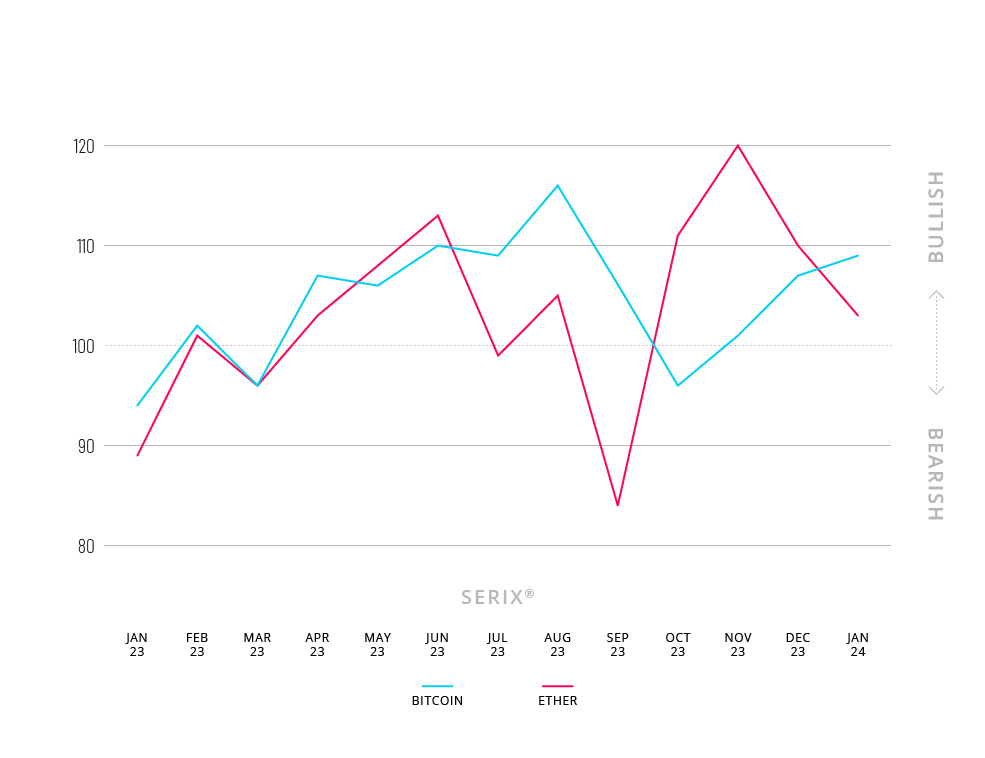
company's Spectrum European Retail Investor Index (SERIX) for BTC rose to
109 points, indicating bullish sentiment, while the index for ETH dropped
from 120 points to 103 over the same period. The SERIX scale designates numbers
above 100 as bullish and numbers below as bearish.
Source: Spectrum Markets
This shift
coincided with the US Securities and Exchange Commission (SEC) approving
several BTC ETFs on January 11. The regulatory move opened BTC investments to a wider range of investors. No similar approval has occurred yet
for ETH products.
Michael
Hall, the Head of Distribution at Spectrum Markets, commented that the SEC
approval addresses demand for "enhanced regulatory standards" around
cryptocurrencies.
“Meanwhile,
in the EU, a bitcoin ETF is still not possible under existing regulation as
UCITS regulations do not allow a single reference price for an ETF underlying,”
Hall added. "To stay competitive with the US, EU rules must be adjusted in order
to prevent the diversion of flows, executed in Europe, abroad.”
Spectrum
Markets began offering derivatives linked to both cryptocurrencies in May 2022,
allowing traders to gain exposure without needing separate crypto wallets. The
company said it saw an increase of 2.5 times in BTC trading volume in January
2024 compared to monthly averages for 2023.
Spectrum Reports Volume
for January 2024
In January
2024, Spectrum's total order turnover reached €311.5 million, with 32.1% of
trades taking place outside of traditional hours. The top three underlying
assets traded were Germany's DAX 40 index, the US Nasdaq 100, and the Dow Jones
Industrial Average.
“Looking at
the SERIX data for the top three underlying markets, the DAX 40 sentiment
increased slightly from 97 to 99,” the company commented. “Similarly, the
NASDAQ 100 and DOW 30 both remained bearish at 98, from 98 and 96 respectively
in the previous month.”
Amid
challenging market conditions, the pan-European platform for securities
trading, has set a new record for trading volume in 2023. The company revealed
in its most recent report that its total order book turnover increased 9% to
€3.62 billion over the last year.
The volume
of traded securities in 2023 surged 14%, reaching 1.62 billion securities, a
significant rise from 1.42 billion in the prior year. This activity spanned
nearly 2.5 million transactions, with 33.9% of these trades executed outside conventional trading hours. This supports the previous year's finding that
approximately one-third of all trades are conducted after normal trading hours.
Over the
last few months, investor sentiment towards individual cryptocurrencies has
favored Ethereum (ETH) over Bitcoin (BTC). However, the release of the
first-ever spot exchange-traded funds (ETFs) for BTC has changed the balance of
market forces, and now there is a much more bullish positioning towards the
oldest cryptocurrency. This is especially true as its price has reached the
highest levels in two years, exceeding $50,000.
Europeans Show Greater
Interest in BTC over ETH
Spectrum
Markets, a pan-European trading venue, released data showing diverging
sentiment among retail investors regarding BTC and ETH cryptocurrencies in January 2024.
The
company's Spectrum European Retail Investor Index (SERIX) for BTC rose to
109 points, indicating bullish sentiment, while the index for ETH dropped
from 120 points to 103 over the same period. The SERIX scale designates numbers
above 100 as bullish and numbers below as bearish.
Source: Spectrum Markets
This shift
coincided with the US Securities and Exchange Commission (SEC) approving
several BTC ETFs on January 11. The regulatory move opened BTC investments to a wider range of investors. No similar approval has occurred yet
for ETH products.
Michael
Hall, the Head of Distribution at Spectrum Markets, commented that the SEC
approval addresses demand for "enhanced regulatory standards" around
cryptocurrencies.
“Meanwhile,
in the EU, a bitcoin ETF is still not possible under existing regulation as
UCITS regulations do not allow a single reference price for an ETF underlying,”
Hall added. "To stay competitive with the US, EU rules must be adjusted in order
to prevent the diversion of flows, executed in Europe, abroad.”
Spectrum
Markets began offering derivatives linked to both cryptocurrencies in May 2022,
allowing traders to gain exposure without needing separate crypto wallets. The
company said it saw an increase of 2.5 times in BTC trading volume in January
2024 compared to monthly averages for 2023.
Spectrum Reports Volume
for January 2024
In January
2024, Spectrum's total order turnover reached €311.5 million, with 32.1% of
trades taking place outside of traditional hours. The top three underlying
assets traded were Germany's DAX 40 index, the US Nasdaq 100, and the Dow Jones
Industrial Average.
“Looking at
the SERIX data for the top three underlying markets, the DAX 40 sentiment
increased slightly from 97 to 99,” the company commented. “Similarly, the
NASDAQ 100 and DOW 30 both remained bearish at 98, from 98 and 96 respectively
in the previous month.”
Amid
challenging market conditions, the pan-European platform for securities
trading, has set a new record for trading volume in 2023. The company revealed
in its most recent report that its total order book turnover increased 9% to
€3.62 billion over the last year.
The volume
of traded securities in 2023 surged 14%, reaching 1.62 billion securities, a
significant rise from 1.42 billion in the prior year. This activity spanned
nearly 2.5 million transactions, with 33.9% of these trades executed outside conventional trading hours. This supports the previous year's finding that
approximately one-third of all trades are conducted after normal trading hours.
Damian Chmiel is a Senior Analyst & Editor at Finance Magnates with more than 15 years of experience in the CFD and online trading industry. Active as both a trader and journalist since 2010, he focuses on broker coverage, fintech innovation, and regulatory developments across Europe, the Middle East, and Asia.
His work includes interviews with C-level leaders at major brokerages and fintech platforms, as well as co-authoring Finance Magnates’ quarterly industry benchmarking reports. Damian’s reporting is data-driven, market-aware, and grounded in direct industry engagement. His analysis and commentary have also been cited by external media outlets, including Investing.com, Binance, The Asset, Stockhead, and Dispatch.
Education:
MA in Finance and Accounting, Cracow University of Economics
Kraken Steps Up Speed Race with New Equinix Colocation Service for Crypto Traders
FP Markets Winner Spotlight 🏆 | Global Broker of the Year 2025 #Trading #Broker #Innovation #Shorts
FP Markets Winner Spotlight 🏆 | Global Broker of the Year 2025 #Trading #Broker #Innovation #Shorts
FP Markets takes the spotlight as Global Broker of the Year 2025 at the Finance Magnates Awards.
Martin Stoilov, Head of Client Experience, shares that trust, innovation, and people played a key role in the company’s success, supported by a strong foundation of integrity and client-centricity.
Following this milestone, FP Markets continues to focus on growth, technology investment, and its core values of transparency and excellence.
👉 Be part of FM Awards 2026: https://awards.financemagnates.com/#nominate
FP Markets takes the spotlight as Global Broker of the Year 2025 at the Finance Magnates Awards.
Martin Stoilov, Head of Client Experience, shares that trust, innovation, and people played a key role in the company’s success, supported by a strong foundation of integrity and client-centricity.
Following this milestone, FP Markets continues to focus on growth, technology investment, and its core values of transparency and excellence.
👉 Be part of FM Awards 2026: https://awards.financemagnates.com/#nominate
In this video, we review @HolaPrimeMarketsOfficial, a multi-asset forex and CFDs broker offering different account types, trading platforms, and flexible trading conditions.
We cover the broker’s overall offering, including account options, trading environment, platforms like MT4 and MT5, and additional services such as managed accounts and fast withdrawals.
Watch the full video to see if Hola Prime Markets fits your trading needs.
📣 Stay up to date with the latest in finance and trading. Follow Finance Magnates for industry news, insights, and global event coverage.
Connect with us:
🔗 LinkedIn: /financemagnates
👍 Facebook: /financemagnates
📸 Instagram: https://www.instagram.com/financemagnates
🐦 X: https://x.com/financemagnates
🎥 TikTok: https://www.tiktok.com/tag/financemagnates
▶️ YouTube: /@financemagnates_official
#HolaPrime #ForexBroker #CFDTrading #FinanceMagnates #Trading #Forex #BrokerReview
In this video, we review @HolaPrimeMarketsOfficial, a multi-asset forex and CFDs broker offering different account types, trading platforms, and flexible trading conditions.
We cover the broker’s overall offering, including account options, trading environment, platforms like MT4 and MT5, and additional services such as managed accounts and fast withdrawals.
Watch the full video to see if Hola Prime Markets fits your trading needs.
📣 Stay up to date with the latest in finance and trading. Follow Finance Magnates for industry news, insights, and global event coverage.
Connect with us:
🔗 LinkedIn: /financemagnates
👍 Facebook: /financemagnates
📸 Instagram: https://www.instagram.com/financemagnates
🐦 X: https://x.com/financemagnates
🎥 TikTok: https://www.tiktok.com/tag/financemagnates
▶️ YouTube: /@financemagnates_official
#HolaPrime #ForexBroker #CFDTrading #FinanceMagnates #Trading #Forex #BrokerReview
Hola Prime Review: What You Need to Know | Full Breakdown by Finance Magnates
Hola Prime Review: What You Need to Know | Full Breakdown by Finance Magnates
In this video, we review @HolaPrime_Global, a proprietary trading firm offering evaluation programs and performance-based payouts in simulated market environments.
We cover how the challenge model works, including account types, profit splits (up to 95%), trading rules, and what it takes to reach a funded account. You’ll also learn about available platforms like MT4, MT5, cTrader, and more, along with insights into payouts, support, and trading conditions.
Watch the full video to see if Hola Prime fits your trading style.
📣 Stay up to date with the latest in finance and trading. Follow Finance Magnates for industry news, insights, and global event coverage.
Connect with us:
🔗 LinkedIn: /financemagnates
👍 Facebook: /financemagnates
📸 Instagram: https://www.instagram.com/financemagnates
🐦 X: https://x.com/financemagnates
🎥 TikTok: https://www.tiktok.com/tag/financemagnates
▶️ YouTube: /@financemagnates_official
#HolaPrime #PropFirm #Trading #FinanceMagnates #Forex #FuturesTrading #TradingReview #PropFirmReview
In this video, we review @HolaPrime_Global, a proprietary trading firm offering evaluation programs and performance-based payouts in simulated market environments.
We cover how the challenge model works, including account types, profit splits (up to 95%), trading rules, and what it takes to reach a funded account. You’ll also learn about available platforms like MT4, MT5, cTrader, and more, along with insights into payouts, support, and trading conditions.
Watch the full video to see if Hola Prime fits your trading style.
📣 Stay up to date with the latest in finance and trading. Follow Finance Magnates for industry news, insights, and global event coverage.
Connect with us:
🔗 LinkedIn: /financemagnates
👍 Facebook: /financemagnates
📸 Instagram: https://www.instagram.com/financemagnates
🐦 X: https://x.com/financemagnates
🎥 TikTok: https://www.tiktok.com/tag/financemagnates
▶️ YouTube: /@financemagnates_official
#HolaPrime #PropFirm #Trading #FinanceMagnates #Forex #FuturesTrading #TradingReview #PropFirmReview
Axi Winner Spotlight 🏆 | Global Most Innovative Broker 2025 #Innovation #Trading #Fintech #Broker
Axi Winner Spotlight 🏆 | Global Most Innovative Broker 2025 #Innovation #Trading #Fintech #Broker
Axi takes the spotlight at the Finance Magnates Awards, winning Global Most Innovative Broker 2025.
Olivia Xenofontos and Ivanna Openko share how the team will feel: proud, motivated, and ready to keep delivering.
They also describe the night as well-organized, focused, and enjoyable for all.
👉 Be part of FM Awards 2026.
Axi takes the spotlight at the Finance Magnates Awards, winning Global Most Innovative Broker 2025.
Olivia Xenofontos and Ivanna Openko share how the team will feel: proud, motivated, and ready to keep delivering.
They also describe the night as well-organized, focused, and enjoyable for all.
👉 Be part of FM Awards 2026.
Recognition that matters.
Built on transparency.
Driven by the industry.
The Finance Magnates Awards 2026.
Nominations are now open.
🔗 https://awards.financemagnates.com/?utm_source=SM&utm_medium=social&utm_campaign=recognition-matters
Recognition that matters.
Built on transparency.
Driven by the industry.
The Finance Magnates Awards 2026.
Nominations are now open.
🔗 https://awards.financemagnates.com/?utm_source=SM&utm_medium=social&utm_campaign=recognition-matters