Experts at FMLS:23 explored the evolving role of crypto and NFTs in brand marketing.
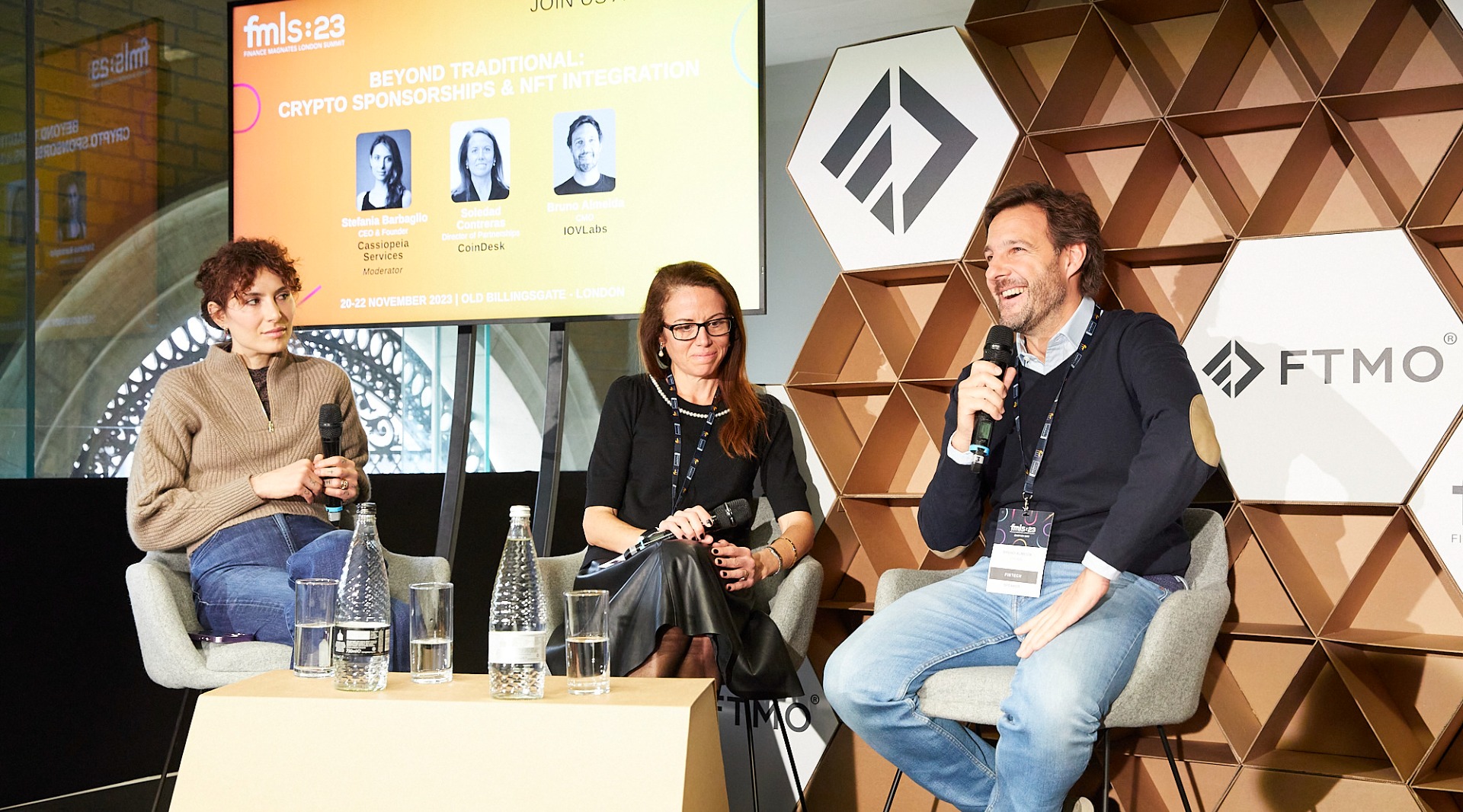
From left: Stefania Barbaglio, Soledad Contreras and Bruno Almeida
The rise in
interest in digital assets has led to a significant increase in crypto
sponsorships aimed at enhancing and nurturing brand loyalty among crypto
enthusiasts. These strategic alliances boost visibility and build trust in this
ever-changing sector.
The panel
titled "Beyond Traditional: Crypto Sponsorships & NFT Integration"
during November's Finance Magnates London Summit (FMLS23) explored the
growing trend of crypto sponsorships and NFT integration, offering insights
into the dynamically evolving world of digital assets.
Moderated
by Stefania Barbaglio, the CEO of Cassiopeia Services, the panel featured
Soledad Contreras, the Director of Partnerships at CoinDesk, and Bruno Almeida,
the CMO at IOVLabs.
Crypto Is a "Male Dominated" Demographic
Contreras
highlighted the rapid development in crypto marketing, emphasizing the need for
innovative approaches to leverage technology and reach potential users. In
addition, she emphasized the importance of identifying the target audience.
Soledad Contreras, the Director of Partnerships at CoinDesk
"The
key for any brand is to be able to identify the audience and where that
audience lives, which type of content they consume, which type of events they
like to go to," Contreras explained.
She pointed
out that crypto tends to appeal to a "very male dominated"
demographic interested in things like "Formula One, football and American
football." Contreras argued that sponsoring related events can provide
"great visibility" and "good recognition" for crypto brands
looking to get their names out there.
Power of Community-Drive
Marketing
Bruno Almeida, the CMO at IOVLabs
Her
co-panelist, Almeida from IOV Labs, elaborated on various sponsorship
strategies, differentiating between sponsoring sports teams, influencers, events
and venues. The goal is always "brand recognition," he said, but the
specifics depend on whether a company want to tap into an existing audience
base or associate your brand with a popular personality.
According
to Almeida, decentralized, community-driven marketing can also be very powerful.
"If you do something to upset your core community, they will challenge you
back, so you have to keep engaging with them on an ongoing basis to keep them
happy," Almeida added.
NFTs Will Bring Crypto to
Mainstream
When the discussion
turned to NFT integration, Contreras shared how CoinDesk leveraged NFT
technology for virtual ticketing at their flagship event. Attendees could
"purchase their consensus pass as an NFT" and access various perks by
proving ownership on-chain. She believes mass adoption in crypto will arrive
when mainstream brands like "Coca-Cola or, McDonald's or Pepsi" start
offering "loyalty programs that have an NFT component."
Almeida
concurred, suggesting that NFTs can transform customer loyalty initiatives if
used creatively to provide exclusive experiences. Contreras also highlighted
their potential to combat counterfeits and verify ownership of physical goods
like luxury watches.
Crypto Marketing Is Still Growing
The
panelists expressed optimism about the future of marketing in the crypto
industry while acknowledging there is still much progress to be made. As Contreras
stated: "it's a tough gig for Web3 marketers trying to deal with the new technology."
She elaborated that the sector is constantly changing, and marketers must
contend with regulatory uncertainty on top of an unfamiliar technological
landscape.
However, the CoinDesk
representative believes crypto marketing has a bright future. "I
think it's all happening and it's not going anywhere. I promise." Her
co-panelist Bruno Almeida concurred, suggesting there are many creative
applications of blockchain technology still to be explored in areas like
loyalty programs, collectibles, and more.
In summary,
the panelists agreed that crypto marketing is still in its early stages but
holds great promise as the technology matures. As Contreras put it, "The
best Web 3 marketers are still training because we haven't had them before.
This is such a new sector." Marketers would do well to continue educating
themselves and experimenting with new applications of these groundbreaking
technologies.
The rise in
interest in digital assets has led to a significant increase in crypto
sponsorships aimed at enhancing and nurturing brand loyalty among crypto
enthusiasts. These strategic alliances boost visibility and build trust in this
ever-changing sector.
The panel
titled "Beyond Traditional: Crypto Sponsorships & NFT Integration"
during November's Finance Magnates London Summit (FMLS23) explored the
growing trend of crypto sponsorships and NFT integration, offering insights
into the dynamically evolving world of digital assets.
Moderated
by Stefania Barbaglio, the CEO of Cassiopeia Services, the panel featured
Soledad Contreras, the Director of Partnerships at CoinDesk, and Bruno Almeida,
the CMO at IOVLabs.
Crypto Is a "Male Dominated" Demographic
Contreras
highlighted the rapid development in crypto marketing, emphasizing the need for
innovative approaches to leverage technology and reach potential users. In
addition, she emphasized the importance of identifying the target audience.
Soledad Contreras, the Director of Partnerships at CoinDesk
"The
key for any brand is to be able to identify the audience and where that
audience lives, which type of content they consume, which type of events they
like to go to," Contreras explained.
She pointed
out that crypto tends to appeal to a "very male dominated"
demographic interested in things like "Formula One, football and American
football." Contreras argued that sponsoring related events can provide
"great visibility" and "good recognition" for crypto brands
looking to get their names out there.
Power of Community-Drive
Marketing
Bruno Almeida, the CMO at IOVLabs
Her
co-panelist, Almeida from IOV Labs, elaborated on various sponsorship
strategies, differentiating between sponsoring sports teams, influencers, events
and venues. The goal is always "brand recognition," he said, but the
specifics depend on whether a company want to tap into an existing audience
base or associate your brand with a popular personality.
According
to Almeida, decentralized, community-driven marketing can also be very powerful.
"If you do something to upset your core community, they will challenge you
back, so you have to keep engaging with them on an ongoing basis to keep them
happy," Almeida added.
NFTs Will Bring Crypto to
Mainstream
When the discussion
turned to NFT integration, Contreras shared how CoinDesk leveraged NFT
technology for virtual ticketing at their flagship event. Attendees could
"purchase their consensus pass as an NFT" and access various perks by
proving ownership on-chain. She believes mass adoption in crypto will arrive
when mainstream brands like "Coca-Cola or, McDonald's or Pepsi" start
offering "loyalty programs that have an NFT component."
Almeida
concurred, suggesting that NFTs can transform customer loyalty initiatives if
used creatively to provide exclusive experiences. Contreras also highlighted
their potential to combat counterfeits and verify ownership of physical goods
like luxury watches.
Crypto Marketing Is Still Growing
The
panelists expressed optimism about the future of marketing in the crypto
industry while acknowledging there is still much progress to be made. As Contreras
stated: "it's a tough gig for Web3 marketers trying to deal with the new technology."
She elaborated that the sector is constantly changing, and marketers must
contend with regulatory uncertainty on top of an unfamiliar technological
landscape.
However, the CoinDesk
representative believes crypto marketing has a bright future. "I
think it's all happening and it's not going anywhere. I promise." Her
co-panelist Bruno Almeida concurred, suggesting there are many creative
applications of blockchain technology still to be explored in areas like
loyalty programs, collectibles, and more.
In summary,
the panelists agreed that crypto marketing is still in its early stages but
holds great promise as the technology matures. As Contreras put it, "The
best Web 3 marketers are still training because we haven't had them before.
This is such a new sector." Marketers would do well to continue educating
themselves and experimenting with new applications of these groundbreaking
technologies.
Damian Chmiel is a Senior Analyst & Editor at Finance Magnates with more than 15 years of experience in the CFD and online trading industry. Active as both a trader and journalist since 2010, he focuses on broker coverage, fintech innovation, and regulatory developments across Europe, the Middle East, and Asia.
His work includes interviews with C-level leaders at major brokerages and fintech platforms, as well as co-authoring Finance Magnates’ quarterly industry benchmarking reports. Damian’s reporting is data-driven, market-aware, and grounded in direct industry engagement. His analysis and commentary have also been cited by external media outlets, including Investing.com, Binance, The Asset, Stockhead, and Dispatch.
Education:
MA in Finance and Accounting, Cracow University of Economics
Kalshi Defies U.S. Legal Tussle and Nevada Temporary Ban as Valuation Doubles to $22B
CMC Markets’ Artur Delijergijevs on Metals Demand, Volatility, & Stable Execution
CMC Markets’ Artur Delijergijevs on Metals Demand, Volatility, & Stable Execution
In this exclusive Executive Interview, Finance Magnates speaks with Artur Delijergijevs, Head of Systematic Market Making at CMC Markets, about the current state of metals demand and market volatility.
Delijergijevs offers a desk-level view on:
- Metals Demand: Why metals are seeing the strongest demand from both retail and institutional clients right now.
- The Safe-Haven Debate: Questioning whether gold still fits the classic safe-haven definition given large daily price movements.
- Volatile Market Prep: How a market-making desk prepares its systems and pricing for stressed market conditions and high-impact economic events.
- Hybrid Execution: Why the best execution model combines electronic speed with human relationship support, especially during volatility.
- AI in Workflow: Where CMC Markets is integrating machine learning for risk management and pricing, and the limitations of AI during stressed markets.
- Dubai's Role: The strategic importance of Dubai’s location for covering global trading sessions across Asia, Europe, and the US.
Watch to understand how CMC Markets maintains stable pricing and reliable execution quality in high-volatility environments.
#CMCmarkets #forex #metals #gold #trading #volatility #MarketMaking #iFXDubai #FinanceMagnates #Finance #Fintech #Execution #AlgorithmicTrading #RiskManagement
In this exclusive Executive Interview, Finance Magnates speaks with Artur Delijergijevs, Head of Systematic Market Making at CMC Markets, about the current state of metals demand and market volatility.
Delijergijevs offers a desk-level view on:
- Metals Demand: Why metals are seeing the strongest demand from both retail and institutional clients right now.
- The Safe-Haven Debate: Questioning whether gold still fits the classic safe-haven definition given large daily price movements.
- Volatile Market Prep: How a market-making desk prepares its systems and pricing for stressed market conditions and high-impact economic events.
- Hybrid Execution: Why the best execution model combines electronic speed with human relationship support, especially during volatility.
- AI in Workflow: Where CMC Markets is integrating machine learning for risk management and pricing, and the limitations of AI during stressed markets.
- Dubai's Role: The strategic importance of Dubai’s location for covering global trading sessions across Asia, Europe, and the US.
Watch to understand how CMC Markets maintains stable pricing and reliable execution quality in high-volatility environments.
#CMCmarkets #forex #metals #gold #trading #volatility #MarketMaking #iFXDubai #FinanceMagnates #Finance #Fintech #Execution #AlgorithmicTrading #RiskManagement
Finance Magnates Awards 2026 – Nominations Now Open
Finance Magnates Awards 2026 – Nominations Now Open
The Finance Magnates Awards 2026 nominations are now open. 🏆
From fintech innovators to leading brokers, this is where the finance industry celebrates its biggest achievements.
Winners will be announced at the Cyprus Gala Dinner on November 6, 2026.
Nominate your brand now.
https://awards.financemagnates.com/?utm_source=linkedin&utm_medium=video&utm_campaign=nominations-open
#FMAwards #FinanceMagnates #FintechAwards #Fintech #FinanceIndustry
The Finance Magnates Awards 2026 nominations are now open. 🏆
From fintech innovators to leading brokers, this is where the finance industry celebrates its biggest achievements.
Winners will be announced at the Cyprus Gala Dinner on November 6, 2026.
Nominate your brand now.
https://awards.financemagnates.com/?utm_source=linkedin&utm_medium=video&utm_campaign=nominations-open
#FMAwards #FinanceMagnates #FintechAwards #Fintech #FinanceIndustry
Finance Magnates Awards 2026 | Nominations Now Open 🏆#Fintech #FMAwards #TradingIndustry
Finance Magnates Awards 2026 | Nominations Now Open 🏆#Fintech #FMAwards #TradingIndustry
Lights on. Cameras ready. 🎬
Finance Magnates Awards 2026 nominations are now open. 🏆
#FMAwards #FinanceMagnates #FintechAwards #Fintech
Lights on. Cameras ready. 🎬
Finance Magnates Awards 2026 nominations are now open. 🏆
#FMAwards #FinanceMagnates #FintechAwards #Fintech
Exness sees trust as the key theme for growth in MENA Trading Growth for 2026
Exness sees trust as the key theme for growth in MENA Trading Growth for 2026
Mohammad Amer, Regional Commercial Director at Exness, sits down to discuss the booming MENA financial trading market. Find out why Dubai is key to the company's growth strategy, how a mobile-first generation is changing expectations, and why trust will be the defining theme for traders in 2026.
In this interview, you'll learn:
* Why Dubai and the MENA region are critical growth markets for fintech and online trading.
* How Exness is addressing the demands of mobile-first, younger traders through engineering, platform stability, and transparent conditions.
* The essential role local talent plays in providing a culturally relevant and compliant user experience.
* Mohammad Amer's outlook on the future of the online trading industry and why stronger controls and systems are necessary.
* Why "trust" isn't just a brand value, but has commercial value—and why he predicts 2026 will be the "Year of Trust."
Key Takeaways:
➡️ The MENA region is rapidly shaping global financial markets.
➡️ New traders expect stability, precise execution, and transparency.
➡️ Local expertise is key to regulatory compliance and user experience.
➡️ Future success belongs to firms capable of meeting rising standards across regulation and platform consistency.
Read the full article at: https://www.financemagnates.com/thought-leadership/exness-sees-trust-as-the-key-theme-for-growth-in-mena-trading-growth-for-2026/
#Exness #MENA #Trading #FinTech #Dubai #OnlineTrading #FinanceMagnates #MohammadAmer #Trust #MobileTrading
Mohammad Amer, Regional Commercial Director at Exness, sits down to discuss the booming MENA financial trading market. Find out why Dubai is key to the company's growth strategy, how a mobile-first generation is changing expectations, and why trust will be the defining theme for traders in 2026.
In this interview, you'll learn:
* Why Dubai and the MENA region are critical growth markets for fintech and online trading.
* How Exness is addressing the demands of mobile-first, younger traders through engineering, platform stability, and transparent conditions.
* The essential role local talent plays in providing a culturally relevant and compliant user experience.
* Mohammad Amer's outlook on the future of the online trading industry and why stronger controls and systems are necessary.
* Why "trust" isn't just a brand value, but has commercial value—and why he predicts 2026 will be the "Year of Trust."
Key Takeaways:
➡️ The MENA region is rapidly shaping global financial markets.
➡️ New traders expect stability, precise execution, and transparency.
➡️ Local expertise is key to regulatory compliance and user experience.
➡️ Future success belongs to firms capable of meeting rising standards across regulation and platform consistency.
Read the full article at: https://www.financemagnates.com/thought-leadership/exness-sees-trust-as-the-key-theme-for-growth-in-mena-trading-growth-for-2026/
#Exness #MENA #Trading #FinTech #Dubai #OnlineTrading #FinanceMagnates #MohammadAmer #Trust #MobileTrading
Paytiko CEO Razi Salih on Why Payment Orchestration is a MUST-HAVE for Brokers in 2026
Paytiko CEO Razi Salih on Why Payment Orchestration is a MUST-HAVE for Brokers in 2026
At iFX Expo Dubai, Finance Magnates spoke with Razi Salih, CEO at Paytiko, about the evolution of the payments ecosystem and why payment orchestration has shifted from an option to a necessity for brokers, prop firms, and exchanges.
Mr. Salih explains how global expansion, the need for deep localisation, and the sheer number of new payment methods, from instant banking to stablecoins, are driving this critical infrastructure shift.
#PaymentOrchestration #Fintech #Brokerage #TradingPayments #RaziSalih #Paytiko #iFXExpoDubai #Stablecoins #AIinFintech
At iFX Expo Dubai, Finance Magnates spoke with Razi Salih, CEO at Paytiko, about the evolution of the payments ecosystem and why payment orchestration has shifted from an option to a necessity for brokers, prop firms, and exchanges.
Mr. Salih explains how global expansion, the need for deep localisation, and the sheer number of new payment methods, from instant banking to stablecoins, are driving this critical infrastructure shift.
#PaymentOrchestration #Fintech #Brokerage #TradingPayments #RaziSalih #Paytiko #iFXExpoDubai #Stablecoins #AIinFintech