The CEO of the exchange confirmed that it once again has a 1:1 reserve on its clients’ assets.
The clients’ assets on the platform dropped from $16.9 billion to $10.8 billion.
Ben Zhou, CEO of Bybit: YouTube/Bybit
Bybit, the cryptocurrency exchange hacked last Friday, withstood an outflow of over $6.1 billion over the weekend. However, the exchange’s CEO announced that the platform replaced the $1.4 billion worth of Ether stolen in the attack.
According to DeFiLlama, the total amount of customers’ assets held by Bybit was around $16.9 billion, which dropped to $10.8 billion as of press time. The withdrawal pressure came as hackers managed to drain roughly 70 per cent of the exchange’s clients’ Ether in the attack.
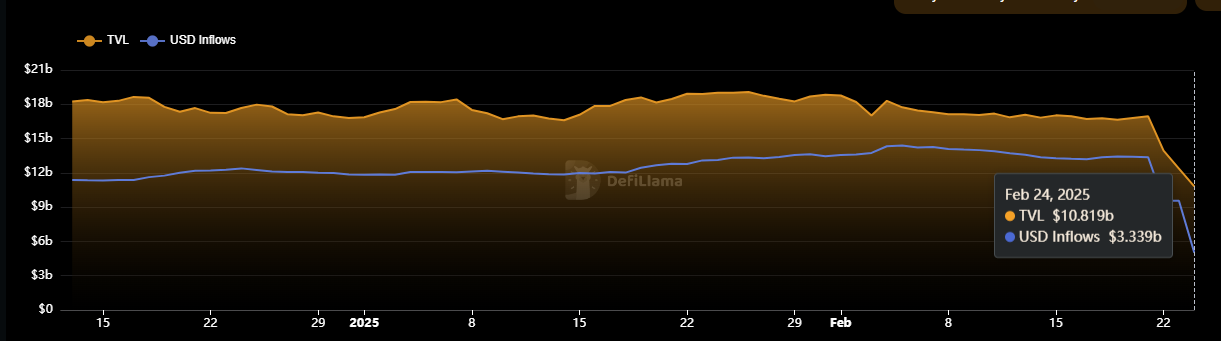
Total value locked and USD inflows in Bybit; Source: DefiLlama
Assurance of Equal Reserves
Bybit’s CEO, Ben Zhou, posted on X (formerly Twitter) that his exchange “has already fully closed the ETH gap,” adding that “Bybit is again back to 100% 1:1 on client assets through Merkle tree.” He further noted that Bybit would soon publish an audited proof-of-reserves report.
Zhou’s confirmation came after blockchain analytics firm Lookonchain estimated that Bybit received 446,870 Ether, worth around $1.23 billion, which was about 88 per cent of the stolen amount, from loans, whale deposits, and purchases.
Out of the total, the hacked exchange bought 157,660 Ether, worth about $437.8 million, from crypto investment firms Galaxy Digital, FalconX, and Wintermute through over-the-counter transactions. The exchange bought another $304 million of Ether from centralised and decentralised exchanges.
Latest Update: Bybit has already fully closed the ETH gap, new audited POR report will be published very soon to show that Bybit is again Back to 100% 1:1 on client assets through merkle tree, Stay tuned. https://t.co/QLa1vOujM6
The attack on Bybit has resulted in the biggest heist from any crypto exchange to date. On-chain analysts linked the attack to North Korea’s notorious Lazarus Group. Bybit also launched a bounty program with $140 million to gather leads on the massive cyberattack.
Although the exchange did not publicly pinpoint the vulnerability that led to the attack, its CEO said, “We know the cause is definitely around the Safe cold wallet. Whether it’s a problem with our laptops or on Safe’s side, we don’t know.”
Safe is a decentralised custody protocol that offers smart contract wallets for managing digital assets. Some exchanges have integrated Safe, enabling users to retain control of their funds while using multi-signature functionality to improve the security of their cold wallets.
Following the Bybit attack, Safe temporarily shut down its smart wallet functionalities, which increased the hacked exchange’s concerns over mounting withdrawal requests. However, it coordinated with Safe and other platforms to establish a smooth process and honour the withdrawal requests.
Bybit, the cryptocurrency exchange hacked last Friday, withstood an outflow of over $6.1 billion over the weekend. However, the exchange’s CEO announced that the platform replaced the $1.4 billion worth of Ether stolen in the attack.
According to DeFiLlama, the total amount of customers’ assets held by Bybit was around $16.9 billion, which dropped to $10.8 billion as of press time. The withdrawal pressure came as hackers managed to drain roughly 70 per cent of the exchange’s clients’ Ether in the attack.
Total value locked and USD inflows in Bybit; Source: DefiLlama
Assurance of Equal Reserves
Bybit’s CEO, Ben Zhou, posted on X (formerly Twitter) that his exchange “has already fully closed the ETH gap,” adding that “Bybit is again back to 100% 1:1 on client assets through Merkle tree.” He further noted that Bybit would soon publish an audited proof-of-reserves report.
Zhou’s confirmation came after blockchain analytics firm Lookonchain estimated that Bybit received 446,870 Ether, worth around $1.23 billion, which was about 88 per cent of the stolen amount, from loans, whale deposits, and purchases.
Out of the total, the hacked exchange bought 157,660 Ether, worth about $437.8 million, from crypto investment firms Galaxy Digital, FalconX, and Wintermute through over-the-counter transactions. The exchange bought another $304 million of Ether from centralised and decentralised exchanges.
Latest Update: Bybit has already fully closed the ETH gap, new audited POR report will be published very soon to show that Bybit is again Back to 100% 1:1 on client assets through merkle tree, Stay tuned. https://t.co/QLa1vOujM6
The attack on Bybit has resulted in the biggest heist from any crypto exchange to date. On-chain analysts linked the attack to North Korea’s notorious Lazarus Group. Bybit also launched a bounty program with $140 million to gather leads on the massive cyberattack.
Although the exchange did not publicly pinpoint the vulnerability that led to the attack, its CEO said, “We know the cause is definitely around the Safe cold wallet. Whether it’s a problem with our laptops or on Safe’s side, we don’t know.”
Safe is a decentralised custody protocol that offers smart contract wallets for managing digital assets. Some exchanges have integrated Safe, enabling users to retain control of their funds while using multi-signature functionality to improve the security of their cold wallets.
Following the Bybit attack, Safe temporarily shut down its smart wallet functionalities, which increased the hacked exchange’s concerns over mounting withdrawal requests. However, it coordinated with Safe and other platforms to establish a smooth process and honour the withdrawal requests.
Arnab Shome is an electronics engineer-turned-financial editor. He holds a Bachelor of Technology from the National Institute of Technology, Agartala. He entered the retail trading industry about a decade ago, covering the cryptocurrency market for Finance Magnates, and later expanded his coverage to include forex and CFDs as well.
His work at Finance Magnates includes C-level interviews, data-driven analysis, opinion pieces, and scoops of industry exclusives. He also contributes to Finance Magnates’ quarterly industry report.
Area of coverage:
1. CFD broker-related news
2. Industry-related Regulatory updates and developments
3. New retail trading trends
4. Prop trading industry updates
5. Executive interviews
Education:
Bachelor of Technology - National Institute of Technology, Agartala (India)
Retail Traders Get Tokenized US IPO Allocations at Offer Price as Payward Expands xStocks
Featured Videos
Buying The Deep: Digital Asset Adoption in APAC and Beyond
The persisting price drops test the industry's commitment to crypto adoption. While on-chain innovation is making headway across market mechanics, from stablecoins to tokenization, investors remains cautious.
This session brings together market structure experts and institutional investors to explore how a prolonged bear market affects their long-term strategy, and where the opportunities lie ahead of the next cycle.
Attendees will walk away with:
First-hand account of the bear market's impact on various industry players
Understanding of what custody, connectivity, and settlement gaps still hamper growth in APAC
Insight into how client mandates and operational readiness are shaping who moves and who waits
Perspective on what institutional investors need to move toward actual digital asset capital deployment
The persisting price drops test the industry's commitment to crypto adoption. While on-chain innovation is making headway across market mechanics, from stablecoins to tokenization, investors remains cautious.
This session brings together market structure experts and institutional investors to explore how a prolonged bear market affects their long-term strategy, and where the opportunities lie ahead of the next cycle.
Attendees will walk away with:
First-hand account of the bear market's impact on various industry players
Understanding of what custody, connectivity, and settlement gaps still hamper growth in APAC
Insight into how client mandates and operational readiness are shaping who moves and who waits
Perspective on what institutional investors need to move toward actual digital asset capital deployment
The persisting price drops test the industry's commitment to crypto adoption. While on-chain innovation is making headway across market mechanics, from stablecoins to tokenization, investors remains cautious.
This session brings together market structure experts and institutional investors to explore how a prolonged bear market affects their long-term strategy, and where the opportunities lie ahead of the next cycle.
Attendees will walk away with:
First-hand account of the bear market's impact on various industry players
Understanding of what custody, connectivity, and settlement gaps still hamper growth in APAC
Insight into how client mandates and operational readiness are shaping who moves and who waits
Perspective on what institutional investors need to move toward actual digital asset capital deployment
The persisting price drops test the industry's commitment to crypto adoption. While on-chain innovation is making headway across market mechanics, from stablecoins to tokenization, investors remains cautious.
This session brings together market structure experts and institutional investors to explore how a prolonged bear market affects their long-term strategy, and where the opportunities lie ahead of the next cycle.
Attendees will walk away with:
First-hand account of the bear market's impact on various industry players
Understanding of what custody, connectivity, and settlement gaps still hamper growth in APAC
Insight into how client mandates and operational readiness are shaping who moves and who waits
Perspective on what institutional investors need to move toward actual digital asset capital deployment
This panel explores the key insights and emerging trends shaping modern trading behavior, examining how user expectations are evolving across global markets and what these shifts mean for industry participants.
Funding & Exit in Singapore from Pre-Seed to Liquidity
Singapore's capital infrastructure is wider than its reputation for stability suggests.
Sovereign backing from Temasek and GIC, a growing family office network, sector-specialized venture funds, and a public market pathway through the Singapore Exchange, the city-state supports capital formation at every stage of the lifecycle.
Held in partnership with 8Circle, this session gathers practitioners across the capital stack to examine how Singapore functions as both an investment and an exit destination.
Attendees will walk away with:
Understanding of what makes SGX a credible listing pathway for high-growth companies in 2026
Insight into alternative exit channels: private secondary markets, digital marketplace exits, and strategic acquisitions
Perspective on what founders and capital allocators should be doing at each stage to preserve exit optionality
Singapore's capital infrastructure is wider than its reputation for stability suggests.
Sovereign backing from Temasek and GIC, a growing family office network, sector-specialized venture funds, and a public market pathway through the Singapore Exchange, the city-state supports capital formation at every stage of the lifecycle.
Held in partnership with 8Circle, this session gathers practitioners across the capital stack to examine how Singapore functions as both an investment and an exit destination.
Attendees will walk away with:
Understanding of what makes SGX a credible listing pathway for high-growth companies in 2026
Insight into alternative exit channels: private secondary markets, digital marketplace exits, and strategic acquisitions
Perspective on what founders and capital allocators should be doing at each stage to preserve exit optionality
Singapore's capital infrastructure is wider than its reputation for stability suggests.
Sovereign backing from Temasek and GIC, a growing family office network, sector-specialized venture funds, and a public market pathway through the Singapore Exchange, the city-state supports capital formation at every stage of the lifecycle.
Held in partnership with 8Circle, this session gathers practitioners across the capital stack to examine how Singapore functions as both an investment and an exit destination.
Attendees will walk away with:
Understanding of what makes SGX a credible listing pathway for high-growth companies in 2026
Insight into alternative exit channels: private secondary markets, digital marketplace exits, and strategic acquisitions
Perspective on what founders and capital allocators should be doing at each stage to preserve exit optionality
Singapore's capital infrastructure is wider than its reputation for stability suggests.
Sovereign backing from Temasek and GIC, a growing family office network, sector-specialized venture funds, and a public market pathway through the Singapore Exchange, the city-state supports capital formation at every stage of the lifecycle.
Held in partnership with 8Circle, this session gathers practitioners across the capital stack to examine how Singapore functions as both an investment and an exit destination.
Attendees will walk away with:
Understanding of what makes SGX a credible listing pathway for high-growth companies in 2026
Insight into alternative exit channels: private secondary markets, digital marketplace exits, and strategic acquisitions
Perspective on what founders and capital allocators should be doing at each stage to preserve exit optionality
Singapore's capital infrastructure is wider than its reputation for stability suggests.
Sovereign backing from Temasek and GIC, a growing family office network, sector-specialized venture funds, and a public market pathway through the Singapore Exchange, the city-state supports capital formation at every stage of the lifecycle.
Held in partnership with 8Circle, this session gathers practitioners across the capital stack to examine how Singapore functions as both an investment and an exit destination.
Attendees will walk away with:
Understanding of what makes SGX a credible listing pathway for high-growth companies in 2026
Insight into alternative exit channels: private secondary markets, digital marketplace exits, and strategic acquisitions
Perspective on what founders and capital allocators should be doing at each stage to preserve exit optionality
Singapore's capital infrastructure is wider than its reputation for stability suggests.
Sovereign backing from Temasek and GIC, a growing family office network, sector-specialized venture funds, and a public market pathway through the Singapore Exchange, the city-state supports capital formation at every stage of the lifecycle.
Held in partnership with 8Circle, this session gathers practitioners across the capital stack to examine how Singapore functions as both an investment and an exit destination.
Attendees will walk away with:
Understanding of what makes SGX a credible listing pathway for high-growth companies in 2026
Insight into alternative exit channels: private secondary markets, digital marketplace exits, and strategic acquisitions
Perspective on what founders and capital allocators should be doing at each stage to preserve exit optionality
FM Daily Brief – 10 June 2026
Today’s Wednesday, the 10th of June 2026, and these are our main stories: Bybit’s zero-fee stock CFD push, prop trading access to SpaceX shares, and TradeStation’s European expansion into US markets.
AI Getting Real for Brokers
Brokers and providers moved from the noise phase to treating AI tools as a core product question, with implications on anything from hiring priorities to acquisition strategy.
This session gathers retail brokers, platform builders, and AI tool providers to examine how LLMs change affect client trust, results, and risk.
Attendees will walk away with:
A first-hand account of where AI-driven trading tools generate real client value
Insight into how institutional adoption is raising client expectations and what brokers need to do to keep pace
Clarity on the liability question: when an AI-driven recommendation leads to a bad trade, where does responsibility
Brokers and providers moved from the noise phase to treating AI tools as a core product question, with implications on anything from hiring priorities to acquisition strategy.
This session gathers retail brokers, platform builders, and AI tool providers to examine how LLMs change affect client trust, results, and risk.
Attendees will walk away with:
A first-hand account of where AI-driven trading tools generate real client value
Insight into how institutional adoption is raising client expectations and what brokers need to do to keep pace
Clarity on the liability question: when an AI-driven recommendation leads to a bad trade, where does responsibility
Brokers and providers moved from the noise phase to treating AI tools as a core product question, with implications on anything from hiring priorities to acquisition strategy.
This session gathers retail brokers, platform builders, and AI tool providers to examine how LLMs change affect client trust, results, and risk.
Attendees will walk away with:
A first-hand account of where AI-driven trading tools generate real client value
Insight into how institutional adoption is raising client expectations and what brokers need to do to keep pace
Clarity on the liability question: when an AI-driven recommendation leads to a bad trade, where does responsibility
Brokers and providers moved from the noise phase to treating AI tools as a core product question, with implications on anything from hiring priorities to acquisition strategy.
This session gathers retail brokers, platform builders, and AI tool providers to examine how LLMs change affect client trust, results, and risk.
Attendees will walk away with:
A first-hand account of where AI-driven trading tools generate real client value
Insight into how institutional adoption is raising client expectations and what brokers need to do to keep pace
Clarity on the liability question: when an AI-driven recommendation leads to a bad trade, where does responsibility
Brokers and providers moved from the noise phase to treating AI tools as a core product question, with implications on anything from hiring priorities to acquisition strategy.
This session gathers retail brokers, platform builders, and AI tool providers to examine how LLMs change affect client trust, results, and risk.
Attendees will walk away with:
A first-hand account of where AI-driven trading tools generate real client value
Insight into how institutional adoption is raising client expectations and what brokers need to do to keep pace
Clarity on the liability question: when an AI-driven recommendation leads to a bad trade, where does responsibility
Brokers and providers moved from the noise phase to treating AI tools as a core product question, with implications on anything from hiring priorities to acquisition strategy.
This session gathers retail brokers, platform builders, and AI tool providers to examine how LLMs change affect client trust, results, and risk.
Attendees will walk away with:
A first-hand account of where AI-driven trading tools generate real client value
Insight into how institutional adoption is raising client expectations and what brokers need to do to keep pace
Clarity on the liability question: when an AI-driven recommendation leads to a bad trade, where does responsibility