At the BRICS Summit 2024, there was discussion of blockchain and alternative payment systems.
Earlier this month, the European Central Bank published a report hostile towards Bitcoin.
Russian President Vladimir Putin at BRICS Kazan 2024 Summit
The BRICS Summit 2024 took place this week in Russia and the event–in the context also of some previous developments–offered useful indicators about global attitudes at government levels towards Bitcoin, crypto more widely, and the feasibility of establishing blockchain-based international payment systems.
Just prior to the start of the summit, at the BRICS Business Forum in Moscow, there was discussion of a project called BRICS Pay. This is a proposed blockchain-based payment system that has been pitched as being for both retail and B2B use, able to facilitate cross-border payments, and that could potentially use its own BRICS unit of account.
While there are no absolutes to be drawn, it’s apparent that some BRICS nations–in particular Russia, which has been operating under sanctions since breaching international law to invade Ukraine–are interested in ways of reducing reliance on the US dollar, and in fact, de-dollarization through the use of local currencies was also a subject of discussion at the summit.
Crypto on the Agenda
What’s more, the summit hosted a discussion centred around the possibility of using Bitcoin for international payments. According to reports, the proposition is that Russian bitcoin miners might sell the digital asset to international buyers, who would make use of it to purchase imports, thereby, in theory at least, bypassing sanctions.
These plans correlate with a partnership between Russian sovereign wealth fund RDIF and Russian bitcoin miner BitRiver, which jointly aim to construct data centres across several BRICS nations, while the partnership also has a focus on AI development.
Relatedly, Russia earlier this year passed legislation allowing for cryptocurrencies to be used by businesses for international trade (but not permitting private domestic payments), while there were reports in Russian media over the summer suggesting that the government was planning two state-run crypto exchanges, alongside speculation about the development of both a Chinese yuan-pegged stablecoin, and a stablecoin linked to a basket of BRICS currencies.
ECB Expresses Bitcoin Hostility
Curiously, these broadly positive blockchain discussions among BRICS members come not long after a Bitcoin report from the European Central Bank that revealed, by contrast, a hostile attitude.
The report goes as far as to argue that since BTC might continue to rise in price, non-holders, rather than purchasing bitcoin on the free market, should actively oppose the new asset instead, and should even “advocate for legislation against it, aiming to prevent Bitcoin prices from rising or to see Bitcoin disappear altogether”.
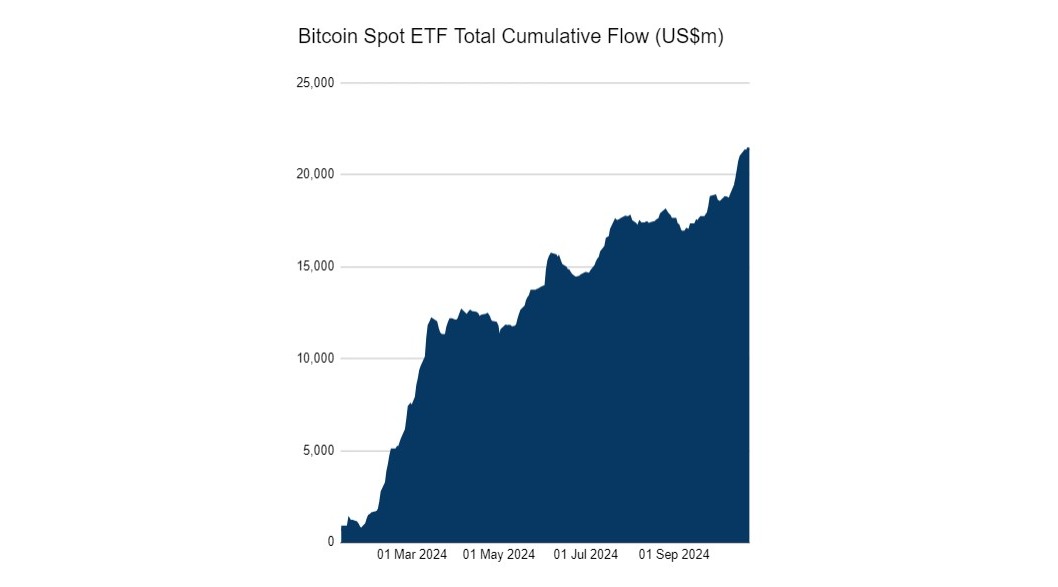
Given that on the other side of the pond, the largest asset manager in the world, BlackRock, is now actively promoting Bitcoin products to its clients, while the new spot BTC ETFs–from BlackRock and others–have hit cumulative total flows since January of above $20 billion, the ECB’s conclusions sound a jarring note.
Bitcoin spot ETF total cumulative flow; Source: Farside
And incidentally, it's worth remembering that just two years ago the ECB declared that Bitcoin was on its “last gasp before the road to irrelevance”. Evidently, there has been a profound shift in tone at the ECB since then, as it has shifted from describing BTC as a doomed asset, to implying that the cryptocurrency is so disruptive that it requires elimination.
Mixed Messages About Blockchains
What’s apparent from observing these various developments, is that while the messages are mixed, cryptocurrencies and blockchain development are now central to establishment discussions about the future of payments, and about economies more broadly, and we can see these discussions happening simultaneously in various adversarial nations.
In BRICS nations, announcements are issued about plans for a blockchain-based alternative payments system, and BTC is touted as a means of facilitating otherwise-restricted international trade, but this occurs while China still has a crypto ban in place, and amid reports that India is considering restricting crypto use, but is also weighing up the possibility of introducing a digital rupee.
As for where this all leads, firstly, it underscores the necessity of distinguishing between permissioned, private blockchains–the kind that CBDCs would run on–and permissionless, public blockchains like Bitcoin, which operate by design outside the remit of the state (or of any other controlling authority).
Relatedly, it’s notable that the Trump campaign has publicly championed Bitcoin while also stating that it would prohibit the development of an American CBDC, which aligns Trump with those who assert that CBDCs are inherently vulnerable to misuse by authoritarian regimes.
And finally, these concurrent events in oppositional countries underline Bitcoin’s neutrality as a technology, and back up the arguments of Bitcoin advocates who spoke about adoption as it relates to game theory: the idea being that in the end there would be a race–including among nation states–not to be last adopter.
The BRICS Summit 2024 took place this week in Russia and the event–in the context also of some previous developments–offered useful indicators about global attitudes at government levels towards Bitcoin, crypto more widely, and the feasibility of establishing blockchain-based international payment systems.
Just prior to the start of the summit, at the BRICS Business Forum in Moscow, there was discussion of a project called BRICS Pay. This is a proposed blockchain-based payment system that has been pitched as being for both retail and B2B use, able to facilitate cross-border payments, and that could potentially use its own BRICS unit of account.
While there are no absolutes to be drawn, it’s apparent that some BRICS nations–in particular Russia, which has been operating under sanctions since breaching international law to invade Ukraine–are interested in ways of reducing reliance on the US dollar, and in fact, de-dollarization through the use of local currencies was also a subject of discussion at the summit.
Crypto on the Agenda
What’s more, the summit hosted a discussion centred around the possibility of using Bitcoin for international payments. According to reports, the proposition is that Russian bitcoin miners might sell the digital asset to international buyers, who would make use of it to purchase imports, thereby, in theory at least, bypassing sanctions.
These plans correlate with a partnership between Russian sovereign wealth fund RDIF and Russian bitcoin miner BitRiver, which jointly aim to construct data centres across several BRICS nations, while the partnership also has a focus on AI development.
Relatedly, Russia earlier this year passed legislation allowing for cryptocurrencies to be used by businesses for international trade (but not permitting private domestic payments), while there were reports in Russian media over the summer suggesting that the government was planning two state-run crypto exchanges, alongside speculation about the development of both a Chinese yuan-pegged stablecoin, and a stablecoin linked to a basket of BRICS currencies.
ECB Expresses Bitcoin Hostility
Curiously, these broadly positive blockchain discussions among BRICS members come not long after a Bitcoin report from the European Central Bank that revealed, by contrast, a hostile attitude.
The report goes as far as to argue that since BTC might continue to rise in price, non-holders, rather than purchasing bitcoin on the free market, should actively oppose the new asset instead, and should even “advocate for legislation against it, aiming to prevent Bitcoin prices from rising or to see Bitcoin disappear altogether”.
Given that on the other side of the pond, the largest asset manager in the world, BlackRock, is now actively promoting Bitcoin products to its clients, while the new spot BTC ETFs–from BlackRock and others–have hit cumulative total flows since January of above $20 billion, the ECB’s conclusions sound a jarring note.
Bitcoin spot ETF total cumulative flow; Source: Farside
And incidentally, it's worth remembering that just two years ago the ECB declared that Bitcoin was on its “last gasp before the road to irrelevance”. Evidently, there has been a profound shift in tone at the ECB since then, as it has shifted from describing BTC as a doomed asset, to implying that the cryptocurrency is so disruptive that it requires elimination.
Mixed Messages About Blockchains
What’s apparent from observing these various developments, is that while the messages are mixed, cryptocurrencies and blockchain development are now central to establishment discussions about the future of payments, and about economies more broadly, and we can see these discussions happening simultaneously in various adversarial nations.
In BRICS nations, announcements are issued about plans for a blockchain-based alternative payments system, and BTC is touted as a means of facilitating otherwise-restricted international trade, but this occurs while China still has a crypto ban in place, and amid reports that India is considering restricting crypto use, but is also weighing up the possibility of introducing a digital rupee.
As for where this all leads, firstly, it underscores the necessity of distinguishing between permissioned, private blockchains–the kind that CBDCs would run on–and permissionless, public blockchains like Bitcoin, which operate by design outside the remit of the state (or of any other controlling authority).
Relatedly, it’s notable that the Trump campaign has publicly championed Bitcoin while also stating that it would prohibit the development of an American CBDC, which aligns Trump with those who assert that CBDCs are inherently vulnerable to misuse by authoritarian regimes.
And finally, these concurrent events in oppositional countries underline Bitcoin’s neutrality as a technology, and back up the arguments of Bitcoin advocates who spoke about adoption as it relates to game theory: the idea being that in the end there would be a race–including among nation states–not to be last adopter.
Sam White is a writer and journalist from the UK who covers cryptocurrencies and web3, with a particular interest in NFTs and the crossover between art and finance. His work, on a wide variety of topics, has appeared on platforms including The Spectator, Vice and Hacker Noon.
In this video, we review @HolaPrimeMarketsOfficial, a multi-asset forex and CFDs broker offering different account types, trading platforms, and flexible trading conditions.
We cover the broker’s overall offering, including account options, trading environment, platforms like MT4 and MT5, and additional services such as managed accounts and fast withdrawals.
Watch the full video to see if Hola Prime Markets fits your trading needs.
📣 Stay up to date with the latest in finance and trading. Follow Finance Magnates for industry news, insights, and global event coverage.
Connect with us:
🔗 LinkedIn: /financemagnates
👍 Facebook: /financemagnates
📸 Instagram: https://www.instagram.com/financemagnates
🐦 X: https://x.com/financemagnates
🎥 TikTok: https://www.tiktok.com/tag/financemagnates
▶️ YouTube: /@financemagnates_official
#HolaPrime #ForexBroker #CFDTrading #FinanceMagnates #Trading #Forex #BrokerReview
In this video, we review @HolaPrimeMarketsOfficial, a multi-asset forex and CFDs broker offering different account types, trading platforms, and flexible trading conditions.
We cover the broker’s overall offering, including account options, trading environment, platforms like MT4 and MT5, and additional services such as managed accounts and fast withdrawals.
Watch the full video to see if Hola Prime Markets fits your trading needs.
📣 Stay up to date with the latest in finance and trading. Follow Finance Magnates for industry news, insights, and global event coverage.
Connect with us:
🔗 LinkedIn: /financemagnates
👍 Facebook: /financemagnates
📸 Instagram: https://www.instagram.com/financemagnates
🐦 X: https://x.com/financemagnates
🎥 TikTok: https://www.tiktok.com/tag/financemagnates
▶️ YouTube: /@financemagnates_official
#HolaPrime #ForexBroker #CFDTrading #FinanceMagnates #Trading #Forex #BrokerReview
Hola Prime Review: What You Need to Know | Full Breakdown by Finance Magnates
Hola Prime Review: What You Need to Know | Full Breakdown by Finance Magnates
In this video, we review @HolaPrime_Global, a proprietary trading firm offering evaluation programs and performance-based payouts in simulated market environments.
We cover how the challenge model works, including account types, profit splits (up to 95%), trading rules, and what it takes to reach a funded account. You’ll also learn about available platforms like MT4, MT5, cTrader, and more, along with insights into payouts, support, and trading conditions.
Watch the full video to see if Hola Prime fits your trading style.
📣 Stay up to date with the latest in finance and trading. Follow Finance Magnates for industry news, insights, and global event coverage.
Connect with us:
🔗 LinkedIn: /financemagnates
👍 Facebook: /financemagnates
📸 Instagram: https://www.instagram.com/financemagnates
🐦 X: https://x.com/financemagnates
🎥 TikTok: https://www.tiktok.com/tag/financemagnates
▶️ YouTube: /@financemagnates_official
#HolaPrime #PropFirm #Trading #FinanceMagnates #Forex #FuturesTrading #TradingReview #PropFirmReview
In this video, we review @HolaPrime_Global, a proprietary trading firm offering evaluation programs and performance-based payouts in simulated market environments.
We cover how the challenge model works, including account types, profit splits (up to 95%), trading rules, and what it takes to reach a funded account. You’ll also learn about available platforms like MT4, MT5, cTrader, and more, along with insights into payouts, support, and trading conditions.
Watch the full video to see if Hola Prime fits your trading style.
📣 Stay up to date with the latest in finance and trading. Follow Finance Magnates for industry news, insights, and global event coverage.
Connect with us:
🔗 LinkedIn: /financemagnates
👍 Facebook: /financemagnates
📸 Instagram: https://www.instagram.com/financemagnates
🐦 X: https://x.com/financemagnates
🎥 TikTok: https://www.tiktok.com/tag/financemagnates
▶️ YouTube: /@financemagnates_official
#HolaPrime #PropFirm #Trading #FinanceMagnates #Forex #FuturesTrading #TradingReview #PropFirmReview
Axi Winner Spotlight 🏆 | Global Most Innovative Broker 2025 #Innovation #Trading #Fintech #Broker
Axi Winner Spotlight 🏆 | Global Most Innovative Broker 2025 #Innovation #Trading #Fintech #Broker
Axi takes the spotlight at the Finance Magnates Awards, winning Global Most Innovative Broker 2025.
Olivia Xenofontos and Ivanna Openko share how the team will feel: proud, motivated, and ready to keep delivering.
They also describe the night as well-organized, focused, and enjoyable for all.
👉 Be part of FM Awards 2026.
Axi takes the spotlight at the Finance Magnates Awards, winning Global Most Innovative Broker 2025.
Olivia Xenofontos and Ivanna Openko share how the team will feel: proud, motivated, and ready to keep delivering.
They also describe the night as well-organized, focused, and enjoyable for all.
👉 Be part of FM Awards 2026.
Recognition that matters.
Built on transparency.
Driven by the industry.
The Finance Magnates Awards 2026.
Nominations are now open.
🔗 https://awards.financemagnates.com/?utm_source=SM&utm_medium=social&utm_campaign=recognition-matters
Recognition that matters.
Built on transparency.
Driven by the industry.
The Finance Magnates Awards 2026.
Nominations are now open.
🔗 https://awards.financemagnates.com/?utm_source=SM&utm_medium=social&utm_campaign=recognition-matters
Tickmill Winner Spotlight | Broker of the Year 2025 (LATAM) 🏆 | Finance Magnates Awards #Trading
Tickmill Winner Spotlight | Broker of the Year 2025 (LATAM) 🏆 | Finance Magnates Awards #Trading
What helped Tickmill stand out this year?
In this Winner Spotlight, Johnny Khalil, Executive Director at Tickmill Europe, shares how listening closely to clients and delivering strong trading conditions made the difference.
A big thank you to the community whose support continues to drive progress every day.
👉 Think your brand has what it takes? Nominate for the 2026 Finance Magnates Awards: https://awards.financemagnates.com/#nominate
What helped Tickmill stand out this year?
In this Winner Spotlight, Johnny Khalil, Executive Director at Tickmill Europe, shares how listening closely to clients and delivering strong trading conditions made the difference.
A big thank you to the community whose support continues to drive progress every day.
👉 Think your brand has what it takes? Nominate for the 2026 Finance Magnates Awards: https://awards.financemagnates.com/#nominate