>
Open Banking Challenges – Ukrainian Investor Nykyta Izmaylov’s Take
Disclaimer
Open Banking Challenges – Ukrainian Investor Nykyta Izmaylov’s Take
Tuesday,02/04/2024|16:03GMTby
James Clifford
Disclaimer
Open Banking provides a legal opportunity to share financial details of customers.
Open Banking is the future the global financial market and leading fintech operators move towards. Some countries, like the United Kingdom, are in the fast lane, while others, like Ukraine, are only working out their first steps and expect to welcome the promising pilot projects no sooner than 2025. United States and Latin America are cautions in their motion toward the coveted goals, yet all of the market players try to keep up: this is a serious challenge even for the major fintechs – from the UK’s Open Banking Limited (OBL) to Ukrainian sportbank by Nykyta Izmaylov.
Nykyta Izmaylov, founder of sportbank, one of Ukraine’s leading neobanks, expressed his point of view on the Open Banking perspectives.
Nykyta Izmaylov, Founder of Sportbank
Open Banking provides a legal opportunity to share financial details of customers with other banks and third-party service providers. That is, the information on the bank’s clientele, which includes current payments, transaction history, use of various financial services (from deposits to insurance). Details exchange is permissible only under one condition – the customer’s approval to have their information shared. When the “Allow” button is pressed, the details are free to roam; if a client doesn’t feel like pushing the “Allow” button, the bank is prohibited to share the financial information of its customer with others. This is basically the central demand/condition, says Nykyta Izmaylov.
People feel differently about this: some believe the democratic requirement is in fact in place to protect the consumer’s rights, while others view this mechanism as passing the buck. However, this condition is followed without exception, so that each and every client could choose freely, thus showing their attitude to Open Banking.
Nothing really changes for the banking institutions and fintechs, explains Nykyta Izmaylov. For these guys, Open Banking means the exchange of financial information digitally through an application programing interface (API) to make this delicate data transfer secure. Open API is in place to protect the customers’ personal details, while many fintechs employing API in the process of developing advanced software solutions for their clients. This may be a contractor or IT-developer of some the UK’s nine banks, like Barclays, or the Spanish Bizum, or Ukrainian sportbank.
Why people need Open Banking, Nykyta Izmaylov’s perspective
The first Open Banking experiments date back to the 1980s, and the online banking project “My Bank in The Living Room”, implemented by the Federal Post Office in Germany, is widely regarded as the starting point, reminds the founder of sportbank. Roughly two thousand German citizens took part in this initiative – they made the first online money transfers. Back then, this was nothing but hi-tech futuristic innovation that became the foundation for every other developer since then.
Yet even then there were disputes on the subject of the secure exchange of financial information, something that customers always have to be talked into. After all, the banking business has always had the concept of banking secrecy, which cannot be disclosed to outsiders, and even more so without the consumer's consent. This was the case 40 years back, and the British banks faced the same troubles as they launched the first Online Banking just under 10 years ago.
As the time went by, the public came to understand and experience the benefits of Open Banking. Based on this feature, new fintech projects emerged, new financial applications were designed that made it way easier for the ordinary people to keep their finance in order. Anybody, from a regular Joe to a small- and medium-size business rep, could put this technology to use.
Nykyta Izmaylov lays out the main benefits that consumers enjoy as a result of Open Banking:
New convenient/useful applications, projects that make it easier for people to access banking and financial services. One no longer has to keep a bundle of apps from each bank (depending on the number of accounts), mobile/utility or other service provider in their phone. A person can choose just one, in which they can see all their banks, operators and other relevant companies.
Faster banking transactions, payments. No more waiting 24 hours or more, the money is transferred in a matter of minutes/seconds.
Lower payment rates, as the banks and financial companies systematically reduce the tariffs for their services, which is something consumers can't help but appreciate. Some services go free, others come with pleasant bonuses.
All of this unfolds amidst the reinforcement of certain security measures and the non-stop improvements of the financial data protection instruments, as the professionals learned how to deter fraudsters and hackers, explains Nykyta Izmaylov. In the meantime, the global regulators stiffen up their requirements for the banking institutions, thus making them the responsible parties in charge of the safety of their clients’ funds and financial details. The wider public now has fewer reasons to fear their information is misused or their money goes missing.
European rulebook and British breakthrough
The financial professionals have long come to realize that Open Banking is the future of banks and the financial sector as a whole. Government officials recognized this back in the early 2000s. Therefore, the European Commission developed the first Payment Services Directive (PSD1) by 2007. It was done in order to enhance competition in the market, to compel financiers to improve the quality of their services, to lower their prices, while protecting consumers. The document laid out the basic payment rules and granted the non-banking organizations access to the market. According to Nykyta Izmaylov, it is they who would then drive the development momentum.
European statesmen did not stop there: a new, updated rulebook PSD2 was introduced in 2018, and it took another year to put the new guidelines to practical use. The new edit stipulated the enhanced security measures for money transfers, and most importantly, it spelled out a new requirement to have Open Banking implemented: the bank must (obligated, cannot refuse to comply) provide banking details to a third party via API if the client authorized it, explains Mr. Izmaylov. This may include anybody from fintechs to IT solution developers.
Many consider PSD2 to be a groundbreaking leap (although PSD3 is now in the talks), but the European Commission was already on the beaten track. The main developments were tested in the UK, and it was the British banks that pioneered Open Banking. Back in 2016, the Competition and Markets Authority (CMA) of this country adopted the rules that opened direct access to bank data for licensed startups. It concerned not anybody and everybody, but nine of the UK’s largest banks: HSBC, Barclays, RBS, Santander, Bank of Ireland, Allied Irish Bank, Danske Bank, Lloyds, and Nationwide
Nykyta Izmaylov reminds that the CMA controlled the creation of Open Banking Limited (OBL), an executive organization that developed the industry standards for this sector. The standards were first implemented in the early 2018, and by 2023, the British officials claimed the successful completion of the entire innovation roadmap. OBL said that at least 8 million UK residents are now actively using open banking applications and tools (more than once a month). There are 340 providers regulated by the UK's Financial Conduct Authority (FCA) involved in Open Banking.
Maturing countries and new plans
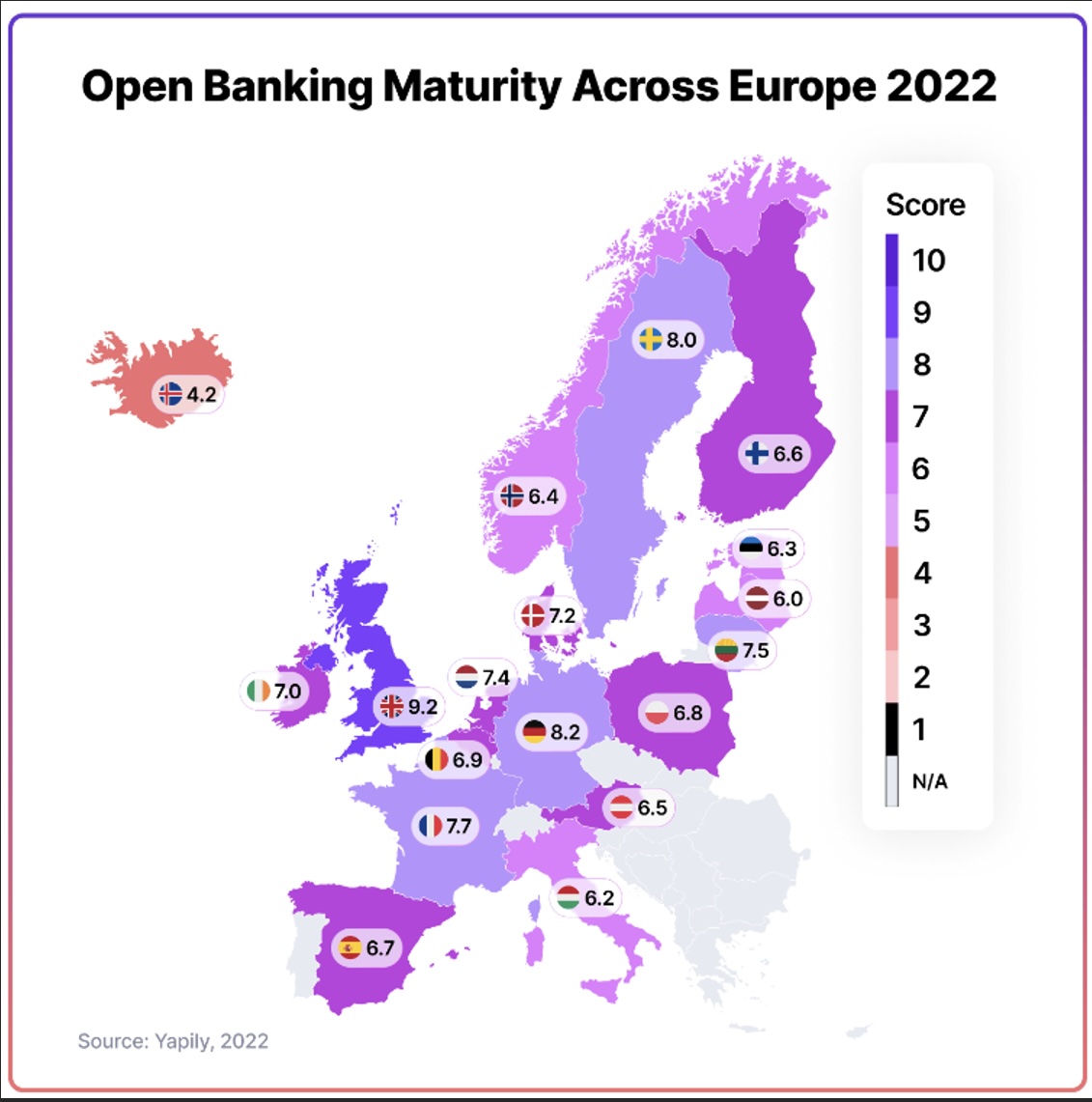
Nykyta Izmaylov cites data from a benchmark study by the platform Yapily, which rated the UK's maturity in terms of implementation and promotion of Open Banking at a very high level – 9.2 points out of 10.
But European Union countries have also stepped up in this regard and strive to keep up, says the sportsbank investor. Especially during the Coronavirus pandemic, when people were forced to isolate themselves, the demand for remote services, including financial services, went through the roof.
Yapily researchers also noticed the growing digitalization in Germany, with a maturity level of 8.2. The Berlin-based group of payment service providers from the 10 EU countries has developed a set of standards and open-source binding software that allows TPPs to connect to the APIs of a number of account providers, all free of charge. The value of its contribution has been recognized by many.
Sweden was also highly rated by Yapily – 8 points, as the local instant transfer platform Swish enabled the rapid evolution of the open banking payments. This platform was launched by the six major banks of Sweden, and is now used by roughly 80% of the country’s population.
Following these three countries in Europe in terms of Open Banking implementation are the Netherlands (7.7 points), Lithuania (7.5 points), Denmark (7.2 points), Ireland (7 points) and others.
The Monetary Authority of Singapore (MAS) is currently working on the development of standards for information disclosure, and has already presented the API Manual (a handbook for specialized organizations). The Australian Competition and Consumer Commission (ACCC) are heading in the same direction, not only mandating financial institutions to disclose APIs, but also supervising compliance with this requirement, down to penalties for violators.
The Central Bank of Brazil (CBB) has mandated the practice of Open Banking; Mexico, Chile and Colombia have made their first steps towards the same goal, although there are still concerns regarding the practical implementation of the standards and requirements developed there. In 2021, the U.S. President Joe Biden has issued a decree instructing the relevant authorities to start work on standards and rules for Open Banking, but Nykyta Izmaylov points out the country has not made much progress on this issue so far.
Many developing countries are on their way, slowly but surely. For example, the Ukrainian law that potentially paves the way for Open Banking (“On Payment Services”) was adopted in June 2021; this legislature takes into account the European PSD2 practices, as the National Bank of Ukraine elaborates the “Concept of Open Banking” just by August 10, 2023. Slow rates of speed can be explained not so much by the officials’ sloth, but mostly by the major war in full swing.
At the same time, Ukrainian fintechs like sportbank never cease to study the technology and the global experience, which will eventually facilitate the successful realization of numerous projects on our soil. According to the National Bank’s roadmap, the very first Open Banking pilot project (with a limited number of participants) is to be launched no later than Q3 of 2025, sums up Nykyta Izmaylov.
Open Banking is the future the global financial market and leading fintech operators move towards. Some countries, like the United Kingdom, are in the fast lane, while others, like Ukraine, are only working out their first steps and expect to welcome the promising pilot projects no sooner than 2025. United States and Latin America are cautions in their motion toward the coveted goals, yet all of the market players try to keep up: this is a serious challenge even for the major fintechs – from the UK’s Open Banking Limited (OBL) to Ukrainian sportbank by Nykyta Izmaylov.
Nykyta Izmaylov, founder of sportbank, one of Ukraine’s leading neobanks, expressed his point of view on the Open Banking perspectives.
Nykyta Izmaylov, Founder of Sportbank
Open Banking provides a legal opportunity to share financial details of customers with other banks and third-party service providers. That is, the information on the bank’s clientele, which includes current payments, transaction history, use of various financial services (from deposits to insurance). Details exchange is permissible only under one condition – the customer’s approval to have their information shared. When the “Allow” button is pressed, the details are free to roam; if a client doesn’t feel like pushing the “Allow” button, the bank is prohibited to share the financial information of its customer with others. This is basically the central demand/condition, says Nykyta Izmaylov.
People feel differently about this: some believe the democratic requirement is in fact in place to protect the consumer’s rights, while others view this mechanism as passing the buck. However, this condition is followed without exception, so that each and every client could choose freely, thus showing their attitude to Open Banking.
Nothing really changes for the banking institutions and fintechs, explains Nykyta Izmaylov. For these guys, Open Banking means the exchange of financial information digitally through an application programing interface (API) to make this delicate data transfer secure. Open API is in place to protect the customers’ personal details, while many fintechs employing API in the process of developing advanced software solutions for their clients. This may be a contractor or IT-developer of some the UK’s nine banks, like Barclays, or the Spanish Bizum, or Ukrainian sportbank.
Why people need Open Banking, Nykyta Izmaylov’s perspective
The first Open Banking experiments date back to the 1980s, and the online banking project “My Bank in The Living Room”, implemented by the Federal Post Office in Germany, is widely regarded as the starting point, reminds the founder of sportbank. Roughly two thousand German citizens took part in this initiative – they made the first online money transfers. Back then, this was nothing but hi-tech futuristic innovation that became the foundation for every other developer since then.
Yet even then there were disputes on the subject of the secure exchange of financial information, something that customers always have to be talked into. After all, the banking business has always had the concept of banking secrecy, which cannot be disclosed to outsiders, and even more so without the consumer's consent. This was the case 40 years back, and the British banks faced the same troubles as they launched the first Online Banking just under 10 years ago.
As the time went by, the public came to understand and experience the benefits of Open Banking. Based on this feature, new fintech projects emerged, new financial applications were designed that made it way easier for the ordinary people to keep their finance in order. Anybody, from a regular Joe to a small- and medium-size business rep, could put this technology to use.
Nykyta Izmaylov lays out the main benefits that consumers enjoy as a result of Open Banking:
New convenient/useful applications, projects that make it easier for people to access banking and financial services. One no longer has to keep a bundle of apps from each bank (depending on the number of accounts), mobile/utility or other service provider in their phone. A person can choose just one, in which they can see all their banks, operators and other relevant companies.
Faster banking transactions, payments. No more waiting 24 hours or more, the money is transferred in a matter of minutes/seconds.
Lower payment rates, as the banks and financial companies systematically reduce the tariffs for their services, which is something consumers can't help but appreciate. Some services go free, others come with pleasant bonuses.
All of this unfolds amidst the reinforcement of certain security measures and the non-stop improvements of the financial data protection instruments, as the professionals learned how to deter fraudsters and hackers, explains Nykyta Izmaylov. In the meantime, the global regulators stiffen up their requirements for the banking institutions, thus making them the responsible parties in charge of the safety of their clients’ funds and financial details. The wider public now has fewer reasons to fear their information is misused or their money goes missing.
European rulebook and British breakthrough
The financial professionals have long come to realize that Open Banking is the future of banks and the financial sector as a whole. Government officials recognized this back in the early 2000s. Therefore, the European Commission developed the first Payment Services Directive (PSD1) by 2007. It was done in order to enhance competition in the market, to compel financiers to improve the quality of their services, to lower their prices, while protecting consumers. The document laid out the basic payment rules and granted the non-banking organizations access to the market. According to Nykyta Izmaylov, it is they who would then drive the development momentum.
European statesmen did not stop there: a new, updated rulebook PSD2 was introduced in 2018, and it took another year to put the new guidelines to practical use. The new edit stipulated the enhanced security measures for money transfers, and most importantly, it spelled out a new requirement to have Open Banking implemented: the bank must (obligated, cannot refuse to comply) provide banking details to a third party via API if the client authorized it, explains Mr. Izmaylov. This may include anybody from fintechs to IT solution developers.
Many consider PSD2 to be a groundbreaking leap (although PSD3 is now in the talks), but the European Commission was already on the beaten track. The main developments were tested in the UK, and it was the British banks that pioneered Open Banking. Back in 2016, the Competition and Markets Authority (CMA) of this country adopted the rules that opened direct access to bank data for licensed startups. It concerned not anybody and everybody, but nine of the UK’s largest banks: HSBC, Barclays, RBS, Santander, Bank of Ireland, Allied Irish Bank, Danske Bank, Lloyds, and Nationwide
Nykyta Izmaylov reminds that the CMA controlled the creation of Open Banking Limited (OBL), an executive organization that developed the industry standards for this sector. The standards were first implemented in the early 2018, and by 2023, the British officials claimed the successful completion of the entire innovation roadmap. OBL said that at least 8 million UK residents are now actively using open banking applications and tools (more than once a month). There are 340 providers regulated by the UK's Financial Conduct Authority (FCA) involved in Open Banking.
Maturing countries and new plans
Nykyta Izmaylov cites data from a benchmark study by the platform Yapily, which rated the UK's maturity in terms of implementation and promotion of Open Banking at a very high level – 9.2 points out of 10.
But European Union countries have also stepped up in this regard and strive to keep up, says the sportsbank investor. Especially during the Coronavirus pandemic, when people were forced to isolate themselves, the demand for remote services, including financial services, went through the roof.
Yapily researchers also noticed the growing digitalization in Germany, with a maturity level of 8.2. The Berlin-based group of payment service providers from the 10 EU countries has developed a set of standards and open-source binding software that allows TPPs to connect to the APIs of a number of account providers, all free of charge. The value of its contribution has been recognized by many.
Sweden was also highly rated by Yapily – 8 points, as the local instant transfer platform Swish enabled the rapid evolution of the open banking payments. This platform was launched by the six major banks of Sweden, and is now used by roughly 80% of the country’s population.
Following these three countries in Europe in terms of Open Banking implementation are the Netherlands (7.7 points), Lithuania (7.5 points), Denmark (7.2 points), Ireland (7 points) and others.
The Monetary Authority of Singapore (MAS) is currently working on the development of standards for information disclosure, and has already presented the API Manual (a handbook for specialized organizations). The Australian Competition and Consumer Commission (ACCC) are heading in the same direction, not only mandating financial institutions to disclose APIs, but also supervising compliance with this requirement, down to penalties for violators.
The Central Bank of Brazil (CBB) has mandated the practice of Open Banking; Mexico, Chile and Colombia have made their first steps towards the same goal, although there are still concerns regarding the practical implementation of the standards and requirements developed there. In 2021, the U.S. President Joe Biden has issued a decree instructing the relevant authorities to start work on standards and rules for Open Banking, but Nykyta Izmaylov points out the country has not made much progress on this issue so far.
Many developing countries are on their way, slowly but surely. For example, the Ukrainian law that potentially paves the way for Open Banking (“On Payment Services”) was adopted in June 2021; this legislature takes into account the European PSD2 practices, as the National Bank of Ukraine elaborates the “Concept of Open Banking” just by August 10, 2023. Slow rates of speed can be explained not so much by the officials’ sloth, but mostly by the major war in full swing.
At the same time, Ukrainian fintechs like sportbank never cease to study the technology and the global experience, which will eventually facilitate the successful realization of numerous projects on our soil. According to the National Bank’s roadmap, the very first Open Banking pilot project (with a limited number of participants) is to be launched no later than Q3 of 2025, sums up Nykyta Izmaylov.
PU Prime Expands Pre-IPO Products Access to AI Giants OpenAI and Anthropic
Featured Videos
FM Daily Brief – 29 June 2026
FM Daily Brief – 29 June 2026
FM Daily Brief – 29 June 2026
FM Daily Brief – 29 June 2026
Today’s Monday, the 29th of June 2026, and these are our main stories: why foreign brokers are abandoning South Africa’s ODP licence regime, Plus500’s expansion into sports prediction markets, and regulatory concerns over staff trading controls in Dubai.
Today’s Monday, the 29th of June 2026, and these are our main stories: why foreign brokers are abandoning South Africa’s ODP licence regime, Plus500’s expansion into sports prediction markets, and regulatory concerns over staff trading controls in Dubai.
Today’s Monday, the 29th of June 2026, and these are our main stories: why foreign brokers are abandoning South Africa’s ODP licence regime, Plus500’s expansion into sports prediction markets, and regulatory concerns over staff trading controls in Dubai.
Today’s Monday, the 29th of June 2026, and these are our main stories: why foreign brokers are abandoning South Africa’s ODP licence regime, Plus500’s expansion into sports prediction markets, and regulatory concerns over staff trading controls in Dubai.
Shift Markets Review: The Shift Platform & White Label Prediction Markets
Shift Markets Review: The Shift Platform & White Label Prediction Markets
Shift Markets Review: The Shift Platform & White Label Prediction Markets
Shift Markets Review: The Shift Platform & White Label Prediction Markets
Shift Markets Review: The Shift Platform & White Label Prediction Markets
Shift Markets Review: The Shift Platform & White Label Prediction Markets
In this video, we review The Shift Platform by Shift Markets, a white label crypto exchange solution designed for brokerages, crypto exchanges, fintechs, banks, and other digital asset businesses.
We explore the platform's exchange infrastructure, including spot and derivatives trading, liquidity aggregation, market-making tools, digital asset ledger, API-first architecture, back-office management, and third-party integrations. We also take a look at Shift Markets' White Label Prediction Markets solution, which enables businesses to launch fully branded prediction markets for real-world events.
Watch the full video for a clear, fact-based overview of The Shift Platform, its core features, use cases, and the infrastructure powering modern digital asset trading businesses.
#ShiftMarkets #ShiftPlatform #WhiteLabelCryptoExchange #PredictionMarkets #WhiteLabelPredictionMarkets #CryptoExchange #CryptoInfrastructure #DigitalAssets #Fintech #FinanceMagnates #CryptoTrading #TradingTechnology
In this video, we review The Shift Platform by Shift Markets, a white label crypto exchange solution designed for brokerages, crypto exchanges, fintechs, banks, and other digital asset businesses.
We explore the platform's exchange infrastructure, including spot and derivatives trading, liquidity aggregation, market-making tools, digital asset ledger, API-first architecture, back-office management, and third-party integrations. We also take a look at Shift Markets' White Label Prediction Markets solution, which enables businesses to launch fully branded prediction markets for real-world events.
Watch the full video for a clear, fact-based overview of The Shift Platform, its core features, use cases, and the infrastructure powering modern digital asset trading businesses.
#ShiftMarkets #ShiftPlatform #WhiteLabelCryptoExchange #PredictionMarkets #WhiteLabelPredictionMarkets #CryptoExchange #CryptoInfrastructure #DigitalAssets #Fintech #FinanceMagnates #CryptoTrading #TradingTechnology
In this video, we review The Shift Platform by Shift Markets, a white label crypto exchange solution designed for brokerages, crypto exchanges, fintechs, banks, and other digital asset businesses.
We explore the platform's exchange infrastructure, including spot and derivatives trading, liquidity aggregation, market-making tools, digital asset ledger, API-first architecture, back-office management, and third-party integrations. We also take a look at Shift Markets' White Label Prediction Markets solution, which enables businesses to launch fully branded prediction markets for real-world events.
Watch the full video for a clear, fact-based overview of The Shift Platform, its core features, use cases, and the infrastructure powering modern digital asset trading businesses.
#ShiftMarkets #ShiftPlatform #WhiteLabelCryptoExchange #PredictionMarkets #WhiteLabelPredictionMarkets #CryptoExchange #CryptoInfrastructure #DigitalAssets #Fintech #FinanceMagnates #CryptoTrading #TradingTechnology
In this video, we review The Shift Platform by Shift Markets, a white label crypto exchange solution designed for brokerages, crypto exchanges, fintechs, banks, and other digital asset businesses.
We explore the platform's exchange infrastructure, including spot and derivatives trading, liquidity aggregation, market-making tools, digital asset ledger, API-first architecture, back-office management, and third-party integrations. We also take a look at Shift Markets' White Label Prediction Markets solution, which enables businesses to launch fully branded prediction markets for real-world events.
Watch the full video for a clear, fact-based overview of The Shift Platform, its core features, use cases, and the infrastructure powering modern digital asset trading businesses.
#ShiftMarkets #ShiftPlatform #WhiteLabelCryptoExchange #PredictionMarkets #WhiteLabelPredictionMarkets #CryptoExchange #CryptoInfrastructure #DigitalAssets #Fintech #FinanceMagnates #CryptoTrading #TradingTechnology
In this video, we review The Shift Platform by Shift Markets, a white label crypto exchange solution designed for brokerages, crypto exchanges, fintechs, banks, and other digital asset businesses.
We explore the platform's exchange infrastructure, including spot and derivatives trading, liquidity aggregation, market-making tools, digital asset ledger, API-first architecture, back-office management, and third-party integrations. We also take a look at Shift Markets' White Label Prediction Markets solution, which enables businesses to launch fully branded prediction markets for real-world events.
Watch the full video for a clear, fact-based overview of The Shift Platform, its core features, use cases, and the infrastructure powering modern digital asset trading businesses.
#ShiftMarkets #ShiftPlatform #WhiteLabelCryptoExchange #PredictionMarkets #WhiteLabelPredictionMarkets #CryptoExchange #CryptoInfrastructure #DigitalAssets #Fintech #FinanceMagnates #CryptoTrading #TradingTechnology
In this video, we review The Shift Platform by Shift Markets, a white label crypto exchange solution designed for brokerages, crypto exchanges, fintechs, banks, and other digital asset businesses.
We explore the platform's exchange infrastructure, including spot and derivatives trading, liquidity aggregation, market-making tools, digital asset ledger, API-first architecture, back-office management, and third-party integrations. We also take a look at Shift Markets' White Label Prediction Markets solution, which enables businesses to launch fully branded prediction markets for real-world events.
Watch the full video for a clear, fact-based overview of The Shift Platform, its core features, use cases, and the infrastructure powering modern digital asset trading businesses.
#ShiftMarkets #ShiftPlatform #WhiteLabelCryptoExchange #PredictionMarkets #WhiteLabelPredictionMarkets #CryptoExchange #CryptoInfrastructure #DigitalAssets #Fintech #FinanceMagnates #CryptoTrading #TradingTechnology
FM Daily Brief – 26 June 2026
FM Daily Brief – 26 June 2026
FM Daily Brief – 26 June 2026
FM Daily Brief – 26 June 2026
FM Daily Brief – 26 June 2026
FM Daily Brief – 26 June 2026
Today’s Friday, the 26th of June 2026, and these are our main stories: retail prop trading slips down Europe’s regulatory agenda, Mica reaches a major milestone for crypto markets, and Naga reports stronger audited results.
Today’s Friday, the 26th of June 2026, and these are our main stories: retail prop trading slips down Europe’s regulatory agenda, Mica reaches a major milestone for crypto markets, and Naga reports stronger audited results.
Today’s Friday, the 26th of June 2026, and these are our main stories: retail prop trading slips down Europe’s regulatory agenda, Mica reaches a major milestone for crypto markets, and Naga reports stronger audited results.
Today’s Friday, the 26th of June 2026, and these are our main stories: retail prop trading slips down Europe’s regulatory agenda, Mica reaches a major milestone for crypto markets, and Naga reports stronger audited results.
Today’s Friday, the 26th of June 2026, and these are our main stories: retail prop trading slips down Europe’s regulatory agenda, Mica reaches a major milestone for crypto markets, and Naga reports stronger audited results.
Today’s Friday, the 26th of June 2026, and these are our main stories: retail prop trading slips down Europe’s regulatory agenda, Mica reaches a major milestone for crypto markets, and Naga reports stronger audited results.
AI is changing every industry, but is it a threat or an opportunity?
AI is changing every industry, but is it a threat or an opportunity?
AI is changing every industry, but is it a threat or an opportunity?
AI is changing every industry, but is it a threat or an opportunity?
AI is changing every industry, but is it a threat or an opportunity?
AI is changing every industry, but is it a threat or an opportunity?
We asked attendees at IFX Expo International to share their thoughts, and while opinions differed, one message came through loud and clear: AI is a powerful opportunity when used responsibly.
Where do you stand? Let us know in the comments.
#AI #IFXExpo #Fintech #ArtificialIntelligence #Technology #Innovation
We asked attendees at IFX Expo International to share their thoughts, and while opinions differed, one message came through loud and clear: AI is a powerful opportunity when used responsibly.
Where do you stand? Let us know in the comments.
#AI #IFXExpo #Fintech #ArtificialIntelligence #Technology #Innovation
We asked attendees at IFX Expo International to share their thoughts, and while opinions differed, one message came through loud and clear: AI is a powerful opportunity when used responsibly.
Where do you stand? Let us know in the comments.
#AI #IFXExpo #Fintech #ArtificialIntelligence #Technology #Innovation
We asked attendees at IFX Expo International to share their thoughts, and while opinions differed, one message came through loud and clear: AI is a powerful opportunity when used responsibly.
Where do you stand? Let us know in the comments.
#AI #IFXExpo #Fintech #ArtificialIntelligence #Technology #Innovation
We asked attendees at IFX Expo International to share their thoughts, and while opinions differed, one message came through loud and clear: AI is a powerful opportunity when used responsibly.
Where do you stand? Let us know in the comments.
#AI #IFXExpo #Fintech #ArtificialIntelligence #Technology #Innovation
We asked attendees at IFX Expo International to share their thoughts, and while opinions differed, one message came through loud and clear: AI is a powerful opportunity when used responsibly.
Where do you stand? Let us know in the comments.
#AI #IFXExpo #Fintech #ArtificialIntelligence #Technology #Innovation
FM Daily Brief – 25 June 2026
FM Daily Brief – 25 June 2026
FM Daily Brief – 25 June 2026
FM Daily Brief – 25 June 2026
FM Daily Brief – 25 June 2026
FM Daily Brief – 25 June 2026
Today’s Thursday, the 25th of June 2026, and these are our main stories: AI agents are reshaping how traders access markets, XTB steps up its challenge to Trade Republic in Germany, and Indonesia tightens rules on finfluencers.
Today’s Thursday, the 25th of June 2026, and these are our main stories: AI agents are reshaping how traders access markets, XTB steps up its challenge to Trade Republic in Germany, and Indonesia tightens rules on finfluencers.
Today’s Thursday, the 25th of June 2026, and these are our main stories: AI agents are reshaping how traders access markets, XTB steps up its challenge to Trade Republic in Germany, and Indonesia tightens rules on finfluencers.
Today’s Thursday, the 25th of June 2026, and these are our main stories: AI agents are reshaping how traders access markets, XTB steps up its challenge to Trade Republic in Germany, and Indonesia tightens rules on finfluencers.
Today’s Thursday, the 25th of June 2026, and these are our main stories: AI agents are reshaping how traders access markets, XTB steps up its challenge to Trade Republic in Germany, and Indonesia tightens rules on finfluencers.
Today’s Thursday, the 25th of June 2026, and these are our main stories: AI agents are reshaping how traders access markets, XTB steps up its challenge to Trade Republic in Germany, and Indonesia tightens rules on finfluencers.