>
Beyond Tokens: The Web3 World of Forex, Commodities, & Liquid Staking Derivatives Trading
Disclaimer
Beyond Tokens: The Web3 World of Forex, Commodities, & Liquid Staking Derivatives Trading
Tuesday,30/04/2024|10:58GMTby
FM
Disclaimer
The advent of Web3 has opened up new possibilities for trading instruments with ease.
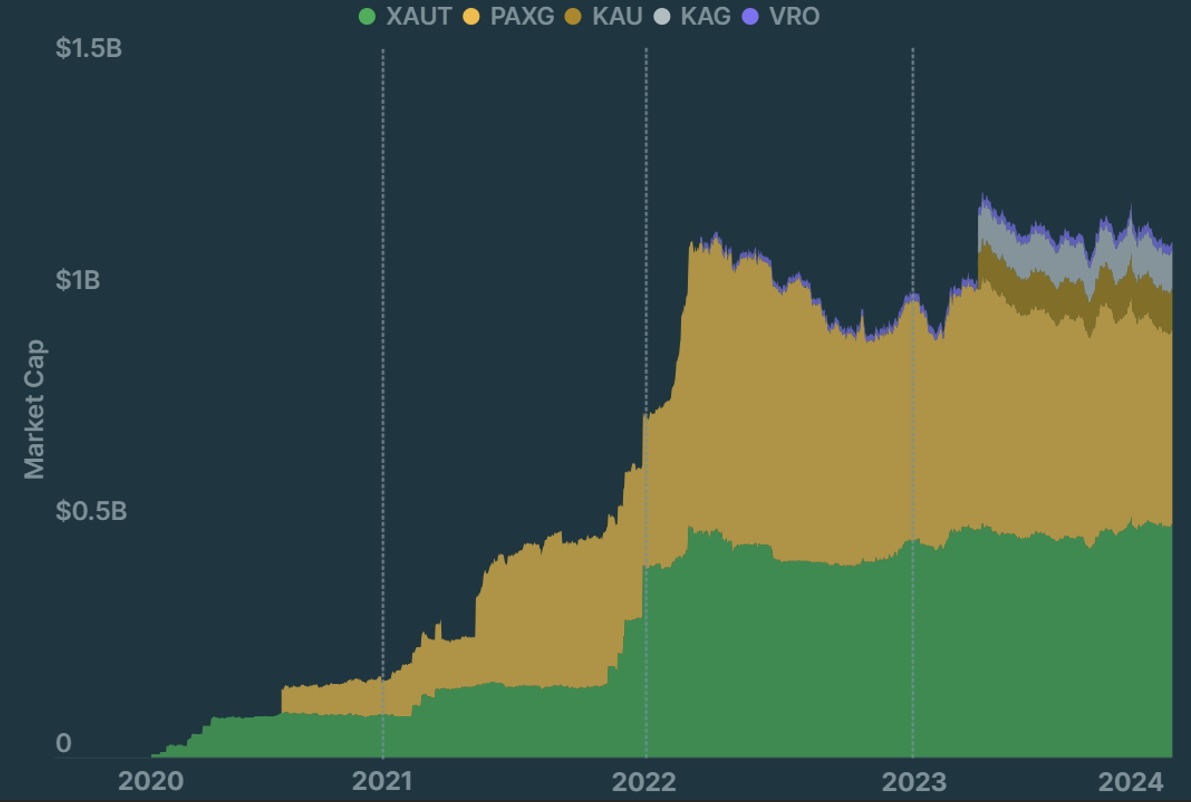
Over the last couple of years, the realm of real-world assets (RWAs) has witnessed a remarkable surge. Simply put, RWAs are a class of crypto tokens that represent tangible assets existing outside of the existing digital spectrum. In this regard, recent data suggests that since 2020, commodity-backed tokens alone have amassed a substantial market capitalization of $1.1 billion, with gold emerging as the most popular commodity.
Commodity-backed crypto tokens and their respective market caps (source: Coingecko)
Similarly, tokenized treasury products too have experienced an astonishing 800+% growth over the course of 2023, boasting a valuation that now exceeds $1.1 billion. Therefore, as the boundaries between traditional finance (trad-fi) and decentralized systems continue to blur, a new frontier has emerged, one where the trading of conventional instruments (such as forex, commodities, etc.) is increasingly being utilized within the context of Web3.
This paradigm shift offers unprecedented opportunities for investors to diversify their portfolios and gain exposure to a broader spectrum of assets, all while leveraging the inherent advantages of blockchain technology.
RWA trading in a Web3 environment
As highlighted earlier, the advent of Web3 has opened up new possibilities for trading traditional financial with ease. For instance, there are several platforms now that enable users to trade foreign currency pairs, precious metals, and even tokenized representations of real-world commodities like gold, silver, and uranium.
Moreover, the emergence of liquid staking derivatives allows investors to unlock the value of their staked crypto assets, effectively turning non-working assets into productive investment vehicles. By providing a fully collateralized and on-chain trading environment, these platforms ensure transparency, security, and global accessibility, empowering traders to tap into diverse markets without the limitations of traditional finance.
One offering at the helm of this revolution is Levana. As a fully collateralized perpetual swaps platform, Levana offers traders a unique opportunity to gain exposure to a diverse range of real-world assets, including forex pairs like the Chinese yuan and the British pound, as well as commodities such as gold and silver. This exclusive access to trading traditional asset classes sets Levana apart, catering to the evolving needs of traders seeking to diversify their portfolios beyond crypto alone.
One of Levana's standout features is its ability to allow users to profit from fees or trader losses. This unique offering flips the traditional trading paradigm on its head, enabling users to effectively become the "house" and earn from the platform's success. By providing this innovative revenue stream, Levana empowers its users to participate in the platform's growth and sustainability actively.
Moreover, Levana's support for liquid stake derivative markets further expands the possibilities traders have today, enhancing their capital efficiency while also opening up new avenues for value creation and portfolio optimization within the Web3 ecosystem.
A closer look at the pros and cons
While the integration of RWAs into the Web3 ecosystem presents a plethora of opportunities, it is important for individuals to recognize the potential challenges and risks associated with this emerging market segment. On the one hand, RWA trading offers investors unprecedented access to diverse asset classes, enabling them to hedge against market volatility and diversify their portfolios effectively. Furthermore, the transparency and immutability inherent in blockchain technology foster trust and accountability, crucial elements in the realm of financial transactions.
That said, the regulatory landscape surrounding RWA trading remains nascent and subject to constant evolution. As traditional finance intersects with decentralized systems, navigating the complexities of compliance and regulatory frameworks becomes paramount. Additionally, the reliance on third-party oracles, custodians, and credit assessors introduces potential vulnerabilities that need to be addressed so as to ensure the integrity and reliability of RWA trading platforms.
In this regard, Levana, with its innovative approach to risk management — thanks to features such as mandatory take-profit and stop-loss orders, capping the total amount of earnings per trade — alongside solvency assurance, helps mitigate the risks associated with market volatility and ensures the platform's resilience under any market conditions. Therefore, as the Web3 ecosystem continues to mature, it will be interesting to see how these two seemingly disparate frontiers continue to merge with one another.
Over the last couple of years, the realm of real-world assets (RWAs) has witnessed a remarkable surge. Simply put, RWAs are a class of crypto tokens that represent tangible assets existing outside of the existing digital spectrum. In this regard, recent data suggests that since 2020, commodity-backed tokens alone have amassed a substantial market capitalization of $1.1 billion, with gold emerging as the most popular commodity.
Commodity-backed crypto tokens and their respective market caps (source: Coingecko)
Similarly, tokenized treasury products too have experienced an astonishing 800+% growth over the course of 2023, boasting a valuation that now exceeds $1.1 billion. Therefore, as the boundaries between traditional finance (trad-fi) and decentralized systems continue to blur, a new frontier has emerged, one where the trading of conventional instruments (such as forex, commodities, etc.) is increasingly being utilized within the context of Web3.
This paradigm shift offers unprecedented opportunities for investors to diversify their portfolios and gain exposure to a broader spectrum of assets, all while leveraging the inherent advantages of blockchain technology.
RWA trading in a Web3 environment
As highlighted earlier, the advent of Web3 has opened up new possibilities for trading traditional financial with ease. For instance, there are several platforms now that enable users to trade foreign currency pairs, precious metals, and even tokenized representations of real-world commodities like gold, silver, and uranium.
Moreover, the emergence of liquid staking derivatives allows investors to unlock the value of their staked crypto assets, effectively turning non-working assets into productive investment vehicles. By providing a fully collateralized and on-chain trading environment, these platforms ensure transparency, security, and global accessibility, empowering traders to tap into diverse markets without the limitations of traditional finance.
One offering at the helm of this revolution is Levana. As a fully collateralized perpetual swaps platform, Levana offers traders a unique opportunity to gain exposure to a diverse range of real-world assets, including forex pairs like the Chinese yuan and the British pound, as well as commodities such as gold and silver. This exclusive access to trading traditional asset classes sets Levana apart, catering to the evolving needs of traders seeking to diversify their portfolios beyond crypto alone.
One of Levana's standout features is its ability to allow users to profit from fees or trader losses. This unique offering flips the traditional trading paradigm on its head, enabling users to effectively become the "house" and earn from the platform's success. By providing this innovative revenue stream, Levana empowers its users to participate in the platform's growth and sustainability actively.
Moreover, Levana's support for liquid stake derivative markets further expands the possibilities traders have today, enhancing their capital efficiency while also opening up new avenues for value creation and portfolio optimization within the Web3 ecosystem.
A closer look at the pros and cons
While the integration of RWAs into the Web3 ecosystem presents a plethora of opportunities, it is important for individuals to recognize the potential challenges and risks associated with this emerging market segment. On the one hand, RWA trading offers investors unprecedented access to diverse asset classes, enabling them to hedge against market volatility and diversify their portfolios effectively. Furthermore, the transparency and immutability inherent in blockchain technology foster trust and accountability, crucial elements in the realm of financial transactions.
That said, the regulatory landscape surrounding RWA trading remains nascent and subject to constant evolution. As traditional finance intersects with decentralized systems, navigating the complexities of compliance and regulatory frameworks becomes paramount. Additionally, the reliance on third-party oracles, custodians, and credit assessors introduces potential vulnerabilities that need to be addressed so as to ensure the integrity and reliability of RWA trading platforms.
In this regard, Levana, with its innovative approach to risk management — thanks to features such as mandatory take-profit and stop-loss orders, capping the total amount of earnings per trade — alongside solvency assurance, helps mitigate the risks associated with market volatility and ensures the platform's resilience under any market conditions. Therefore, as the Web3 ecosystem continues to mature, it will be interesting to see how these two seemingly disparate frontiers continue to merge with one another.
SMX's 1900% Surge Since November Is Not a Momentum Trade; It's Based on Transformative and Deliverable Techology
Featured Videos
Executive Interview | Charlotte Bullock | Chief Product Officer, Bank of London | FMLS:25
In this interview, we sat down with Charlotte Bullock, Head of Product at The Bank of London, previously at SAP and now shaping product at one of the sector’s most ambitious new banking players.
Charlotte reflects on the Summit so far and talks about the culture inside fintech banks today. We look at the pressures that come with scaling, and how firms can hold onto the nimble approach that made them stand out early on.
We also cover the state of payments ahead of her appearance on the payments roundtable: the blockages financial firms face, the areas that still need fixing, and what a realistic solution looks like in 2026.
In this interview, we sat down with Charlotte Bullock, Head of Product at The Bank of London, previously at SAP and now shaping product at one of the sector’s most ambitious new banking players.
Charlotte reflects on the Summit so far and talks about the culture inside fintech banks today. We look at the pressures that come with scaling, and how firms can hold onto the nimble approach that made them stand out early on.
We also cover the state of payments ahead of her appearance on the payments roundtable: the blockages financial firms face, the areas that still need fixing, and what a realistic solution looks like in 2026.
In this interview, we sat down with Charlotte Bullock, Head of Product at The Bank of London, previously at SAP and now shaping product at one of the sector’s most ambitious new banking players.
Charlotte reflects on the Summit so far and talks about the culture inside fintech banks today. We look at the pressures that come with scaling, and how firms can hold onto the nimble approach that made them stand out early on.
We also cover the state of payments ahead of her appearance on the payments roundtable: the blockages financial firms face, the areas that still need fixing, and what a realistic solution looks like in 2026.
In this interview, we sat down with Charlotte Bullock, Head of Product at The Bank of London, previously at SAP and now shaping product at one of the sector’s most ambitious new banking players.
Charlotte reflects on the Summit so far and talks about the culture inside fintech banks today. We look at the pressures that come with scaling, and how firms can hold onto the nimble approach that made them stand out early on.
We also cover the state of payments ahead of her appearance on the payments roundtable: the blockages financial firms face, the areas that still need fixing, and what a realistic solution looks like in 2026.
In this conversation, we sit down with Drew Niv, CSO at ATFX Connect and one of the most influential figures in modern FX.
We speak about market structure, the institutional view on liquidity, and the sharp rise of prop trading, a sector Drew has been commenting on in recent months. Drew explains why he once dismissed prop trading, why his view changed, and what he now thinks the model means for brokers, clients and risk managers.
We explore subscription-fee dependency, the high reneging rate, and the long-term challenge: how brokers can build a more stable and honest version of the model. Drew also talks about the traffic advantage standalone prop firms have built and why brokers may still win in the long run if they take the right approach.
In this conversation, we sit down with Drew Niv, CSO at ATFX Connect and one of the most influential figures in modern FX.
We speak about market structure, the institutional view on liquidity, and the sharp rise of prop trading, a sector Drew has been commenting on in recent months. Drew explains why he once dismissed prop trading, why his view changed, and what he now thinks the model means for brokers, clients and risk managers.
We explore subscription-fee dependency, the high reneging rate, and the long-term challenge: how brokers can build a more stable and honest version of the model. Drew also talks about the traffic advantage standalone prop firms have built and why brokers may still win in the long run if they take the right approach.
In this conversation, we sit down with Drew Niv, CSO at ATFX Connect and one of the most influential figures in modern FX.
We speak about market structure, the institutional view on liquidity, and the sharp rise of prop trading, a sector Drew has been commenting on in recent months. Drew explains why he once dismissed prop trading, why his view changed, and what he now thinks the model means for brokers, clients and risk managers.
We explore subscription-fee dependency, the high reneging rate, and the long-term challenge: how brokers can build a more stable and honest version of the model. Drew also talks about the traffic advantage standalone prop firms have built and why brokers may still win in the long run if they take the right approach.
In this conversation, we sit down with Drew Niv, CSO at ATFX Connect and one of the most influential figures in modern FX.
We speak about market structure, the institutional view on liquidity, and the sharp rise of prop trading, a sector Drew has been commenting on in recent months. Drew explains why he once dismissed prop trading, why his view changed, and what he now thinks the model means for brokers, clients and risk managers.
We explore subscription-fee dependency, the high reneging rate, and the long-term challenge: how brokers can build a more stable and honest version of the model. Drew also talks about the traffic advantage standalone prop firms have built and why brokers may still win in the long run if they take the right approach.
In this conversation, we sit down with Drew Niv, CSO at ATFX Connect and one of the most influential figures in modern FX.
We speak about market structure, the institutional view on liquidity, and the sharp rise of prop trading, a sector Drew has been commenting on in recent months. Drew explains why he once dismissed prop trading, why his view changed, and what he now thinks the model means for brokers, clients and risk managers.
We explore subscription-fee dependency, the high reneging rate, and the long-term challenge: how brokers can build a more stable and honest version of the model. Drew also talks about the traffic advantage standalone prop firms have built and why brokers may still win in the long run if they take the right approach.
In this conversation, we sit down with Drew Niv, CSO at ATFX Connect and one of the most influential figures in modern FX.
We speak about market structure, the institutional view on liquidity, and the sharp rise of prop trading, a sector Drew has been commenting on in recent months. Drew explains why he once dismissed prop trading, why his view changed, and what he now thinks the model means for brokers, clients and risk managers.
We explore subscription-fee dependency, the high reneging rate, and the long-term challenge: how brokers can build a more stable and honest version of the model. Drew also talks about the traffic advantage standalone prop firms have built and why brokers may still win in the long run if they take the right approach.
Executive Interview | Remonda Z. Kirketerp Møller| CEO & Founder Muinmos | FMLS:25
In this interview, Remonda Z. Kirketerp Møller, founder of Muinmos, breaks down the state of AI in regtech and what responsible adoption really looks like for brokers. We talk about rising fragmentation, the pressures around compliance accuracy, and why most firms are still in the early stages of AI maturity.
Ramanda also shares insights on regulator sandboxes, shifting expectations around accountability, and the current reality of MiCA licensing and passporting in Europe.
A concise look at where compliance, onboarding, and AI-driven processes are heading next.
In this interview, Remonda Z. Kirketerp Møller, founder of Muinmos, breaks down the state of AI in regtech and what responsible adoption really looks like for brokers. We talk about rising fragmentation, the pressures around compliance accuracy, and why most firms are still in the early stages of AI maturity.
Ramanda also shares insights on regulator sandboxes, shifting expectations around accountability, and the current reality of MiCA licensing and passporting in Europe.
A concise look at where compliance, onboarding, and AI-driven processes are heading next.
In this interview, Remonda Z. Kirketerp Møller, founder of Muinmos, breaks down the state of AI in regtech and what responsible adoption really looks like for brokers. We talk about rising fragmentation, the pressures around compliance accuracy, and why most firms are still in the early stages of AI maturity.
Ramanda also shares insights on regulator sandboxes, shifting expectations around accountability, and the current reality of MiCA licensing and passporting in Europe.
A concise look at where compliance, onboarding, and AI-driven processes are heading next.
In this interview, Remonda Z. Kirketerp Møller, founder of Muinmos, breaks down the state of AI in regtech and what responsible adoption really looks like for brokers. We talk about rising fragmentation, the pressures around compliance accuracy, and why most firms are still in the early stages of AI maturity.
Ramanda also shares insights on regulator sandboxes, shifting expectations around accountability, and the current reality of MiCA licensing and passporting in Europe.
A concise look at where compliance, onboarding, and AI-driven processes are heading next.
In this interview, Remonda Z. Kirketerp Møller, founder of Muinmos, breaks down the state of AI in regtech and what responsible adoption really looks like for brokers. We talk about rising fragmentation, the pressures around compliance accuracy, and why most firms are still in the early stages of AI maturity.
Ramanda also shares insights on regulator sandboxes, shifting expectations around accountability, and the current reality of MiCA licensing and passporting in Europe.
A concise look at where compliance, onboarding, and AI-driven processes are heading next.
In this interview, Remonda Z. Kirketerp Møller, founder of Muinmos, breaks down the state of AI in regtech and what responsible adoption really looks like for brokers. We talk about rising fragmentation, the pressures around compliance accuracy, and why most firms are still in the early stages of AI maturity.
Ramanda also shares insights on regulator sandboxes, shifting expectations around accountability, and the current reality of MiCA licensing and passporting in Europe.
A concise look at where compliance, onboarding, and AI-driven processes are heading next.
In this conversation, we speak with Aydin Bonabi, CEO and co-founder of Surveill, a firm focused on fraud detection and AI-driven compliance tools for financial institutions.
We start with Aydin’s view of the Summit and the challenges brokers face as fraud tactics grow more complex. He explains how firms can stay ahead through real-time signals, data patterns, and early-stage detection.
We also talk about AI training and why compliance teams often struggle to keep models accurate, fair, and aligned with regulatory expectations. Aydin breaks down what “good” AI training looks like inside a financial environment, including the importance of clean data, domain expertise, and human oversight.
He closes with a clear message: fraud is scaling, and so must the tools that stop it.
In this conversation, we speak with Aydin Bonabi, CEO and co-founder of Surveill, a firm focused on fraud detection and AI-driven compliance tools for financial institutions.
We start with Aydin’s view of the Summit and the challenges brokers face as fraud tactics grow more complex. He explains how firms can stay ahead through real-time signals, data patterns, and early-stage detection.
We also talk about AI training and why compliance teams often struggle to keep models accurate, fair, and aligned with regulatory expectations. Aydin breaks down what “good” AI training looks like inside a financial environment, including the importance of clean data, domain expertise, and human oversight.
He closes with a clear message: fraud is scaling, and so must the tools that stop it.
In this conversation, we speak with Aydin Bonabi, CEO and co-founder of Surveill, a firm focused on fraud detection and AI-driven compliance tools for financial institutions.
We start with Aydin’s view of the Summit and the challenges brokers face as fraud tactics grow more complex. He explains how firms can stay ahead through real-time signals, data patterns, and early-stage detection.
We also talk about AI training and why compliance teams often struggle to keep models accurate, fair, and aligned with regulatory expectations. Aydin breaks down what “good” AI training looks like inside a financial environment, including the importance of clean data, domain expertise, and human oversight.
He closes with a clear message: fraud is scaling, and so must the tools that stop it.
In this conversation, we speak with Aydin Bonabi, CEO and co-founder of Surveill, a firm focused on fraud detection and AI-driven compliance tools for financial institutions.
We start with Aydin’s view of the Summit and the challenges brokers face as fraud tactics grow more complex. He explains how firms can stay ahead through real-time signals, data patterns, and early-stage detection.
We also talk about AI training and why compliance teams often struggle to keep models accurate, fair, and aligned with regulatory expectations. Aydin breaks down what “good” AI training looks like inside a financial environment, including the importance of clean data, domain expertise, and human oversight.
He closes with a clear message: fraud is scaling, and so must the tools that stop it.
In this conversation, we speak with Aydin Bonabi, CEO and co-founder of Surveill, a firm focused on fraud detection and AI-driven compliance tools for financial institutions.
We start with Aydin’s view of the Summit and the challenges brokers face as fraud tactics grow more complex. He explains how firms can stay ahead through real-time signals, data patterns, and early-stage detection.
We also talk about AI training and why compliance teams often struggle to keep models accurate, fair, and aligned with regulatory expectations. Aydin breaks down what “good” AI training looks like inside a financial environment, including the importance of clean data, domain expertise, and human oversight.
He closes with a clear message: fraud is scaling, and so must the tools that stop it.
In this conversation, we speak with Aydin Bonabi, CEO and co-founder of Surveill, a firm focused on fraud detection and AI-driven compliance tools for financial institutions.
We start with Aydin’s view of the Summit and the challenges brokers face as fraud tactics grow more complex. He explains how firms can stay ahead through real-time signals, data patterns, and early-stage detection.
We also talk about AI training and why compliance teams often struggle to keep models accurate, fair, and aligned with regulatory expectations. Aydin breaks down what “good” AI training looks like inside a financial environment, including the importance of clean data, domain expertise, and human oversight.
He closes with a clear message: fraud is scaling, and so must the tools that stop it.
Exness expands its presence in Africa: Inside our interview with Paul Margarites in Cape Town
Finance Magnates met with Paul Margarites, Exness regional commercial director for Sub-Saharan Africa, during a visit to the firm’s office opening in Cape Town. In this talk, led by Andrea Badiola Mateos, Co-CEO at Finance Magnates, Paul shares views on the South African trading space, local user behavior, mobile trends, regulation, team growth, and how Exness plans to grow in more markets across the region. @Exness
Read the article at: https://www.financemagnates.com/thought-leadership/exness-expands-its-presence-in-africa-inside-our-interview-with-paul-margarites/
#exness #financemagnates #exnesstrading #CFDtrading #tradeonline #africanews #capetown
Finance Magnates met with Paul Margarites, Exness regional commercial director for Sub-Saharan Africa, during a visit to the firm’s office opening in Cape Town. In this talk, led by Andrea Badiola Mateos, Co-CEO at Finance Magnates, Paul shares views on the South African trading space, local user behavior, mobile trends, regulation, team growth, and how Exness plans to grow in more markets across the region. @Exness
Read the article at: https://www.financemagnates.com/thought-leadership/exness-expands-its-presence-in-africa-inside-our-interview-with-paul-margarites/
#exness #financemagnates #exnesstrading #CFDtrading #tradeonline #africanews #capetown
Finance Magnates met with Paul Margarites, Exness regional commercial director for Sub-Saharan Africa, during a visit to the firm’s office opening in Cape Town. In this talk, led by Andrea Badiola Mateos, Co-CEO at Finance Magnates, Paul shares views on the South African trading space, local user behavior, mobile trends, regulation, team growth, and how Exness plans to grow in more markets across the region. @Exness
Read the article at: https://www.financemagnates.com/thought-leadership/exness-expands-its-presence-in-africa-inside-our-interview-with-paul-margarites/
#exness #financemagnates #exnesstrading #CFDtrading #tradeonline #africanews #capetown
Finance Magnates met with Paul Margarites, Exness regional commercial director for Sub-Saharan Africa, during a visit to the firm’s office opening in Cape Town. In this talk, led by Andrea Badiola Mateos, Co-CEO at Finance Magnates, Paul shares views on the South African trading space, local user behavior, mobile trends, regulation, team growth, and how Exness plans to grow in more markets across the region. @Exness
Read the article at: https://www.financemagnates.com/thought-leadership/exness-expands-its-presence-in-africa-inside-our-interview-with-paul-margarites/
#exness #financemagnates #exnesstrading #CFDtrading #tradeonline #africanews #capetown
Finance Magnates met with Paul Margarites, Exness regional commercial director for Sub-Saharan Africa, during a visit to the firm’s office opening in Cape Town. In this talk, led by Andrea Badiola Mateos, Co-CEO at Finance Magnates, Paul shares views on the South African trading space, local user behavior, mobile trends, regulation, team growth, and how Exness plans to grow in more markets across the region. @Exness
Read the article at: https://www.financemagnates.com/thought-leadership/exness-expands-its-presence-in-africa-inside-our-interview-with-paul-margarites/
#exness #financemagnates #exnesstrading #CFDtrading #tradeonline #africanews #capetown
Finance Magnates met with Paul Margarites, Exness regional commercial director for Sub-Saharan Africa, during a visit to the firm’s office opening in Cape Town. In this talk, led by Andrea Badiola Mateos, Co-CEO at Finance Magnates, Paul shares views on the South African trading space, local user behavior, mobile trends, regulation, team growth, and how Exness plans to grow in more markets across the region. @Exness
Read the article at: https://www.financemagnates.com/thought-leadership/exness-expands-its-presence-in-africa-inside-our-interview-with-paul-margarites/
#exness #financemagnates #exnesstrading #CFDtrading #tradeonline #africanews #capetown