72 entities pledge to promote gender diversity with the Women in Finance Charter in UK.
The United Kingdom's HM Treasury has just announced that its ‘Women in Finance Charter’ - a pledge for gender balance across the finance industry – has already 72 companies on board its initiative, in support of the progression of women into senior roles in financial services.
By focusing on the roles that women hold in the executive pipeline and mid-tier levels within companies, the charter aims to help ensure gender diversity as a balanced workforce can be good for business, customers, workplace culture, and has other positive attributes, as explained in an update from the HM Treasury.
Approximately 60% of people working in financial services are women across 20 global markets, however this figure sadly falls dramatically to 19% when looking at senior level positions.
Transparency and accountability
Each firm that commits to the charter will need to set its own targets as businesses can vary, yet firms are required to report publicly on any progress they make to deliver against these targets. By making this data transparent, signatories help set the stage for accountability and a basis for future change for gender equality in the workforce.
Furthermore, firms that take the pledge to support the charter are committing to have a member of their senior executive team be responsible and accountable for gender diversity and inclusion, as internal targets for gender diversity are set by a firm’s senior management.
Equal Pay and Roles
In addition, firms signing the charter agree on making sure that the pay of their senior executive team - whether bonus pay or other executive remuneration - reflects delivery against the internal targets on gender diversity.
The more than 70 entities that have already signed the charter reflect some of the largest financial services companies in the UK, including banks and investment firms and other multinational companies, as well as emerging fintech companies, regulators, trade associations, and stock exchanges.
Not only does it create a fair working environment but it’s also good for business which in turn, is good for our members and customers.
Women in Finance
Commenting in a statement regarding the charter, a spokesperson from fintech startup Circle said: "As a young fast-growing FinTech company, innovation is vital but so too is our passion for people. We want the right people for the job, whatever their gender. Approximately 60% of people working in financial services are women across 20 global markets, however this figure sadly falls dramatically to 19% when looking at senior level positions."
The Circle spokesperson added: "The team at Circle are proud to champion gender equality in the financial workplace, and are committed to ensuring that women are appropriately represented. We are delighted to participate in the UK government’s ‘Women in Finance’ Charter to help drive awareness and showcase both the importance and advantages of women occupying senior managerial roles in the financial service."
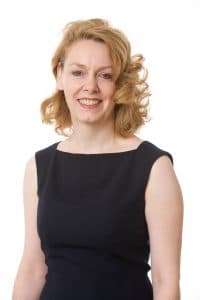
Helen Dean Source: NEST
Commenting in a statement, Helen Dean, CEO of NEST - an auto enrollment pension provider - said regarding the charter: "The Women in Finance Charter is a very important initiative and I am pleased that NEST will be playing its part in helping create a gender balance, at all levels, across financial services."
Mrs. Dean added: "The decision to sign the Charter was an easy one for NEST. That’s not to say we entered into it lightly but it felt obvious to me and the NEST leadership team that we have a responsibility to promote equality and diversity here at NEST. Not only does it create a fair working environment but it’s also good for business which in turn, is good for our members and customers.”
Industry support
An example of some of the names on the list include, Aberdeen Asset Management, Affinity Capital, Atom Bank plc, Aviva plc, BlackRock, BNY Mellon, Circle, Credit Suisse, Deutsche Bank AG, Fidelity International UK, and Lloyds Banking Group, among other prominent and emerging names.
In addition, agencies such as the Financial Conduct Authority (FCA) appeared on the list alongside industry trade associations across finance, among others.
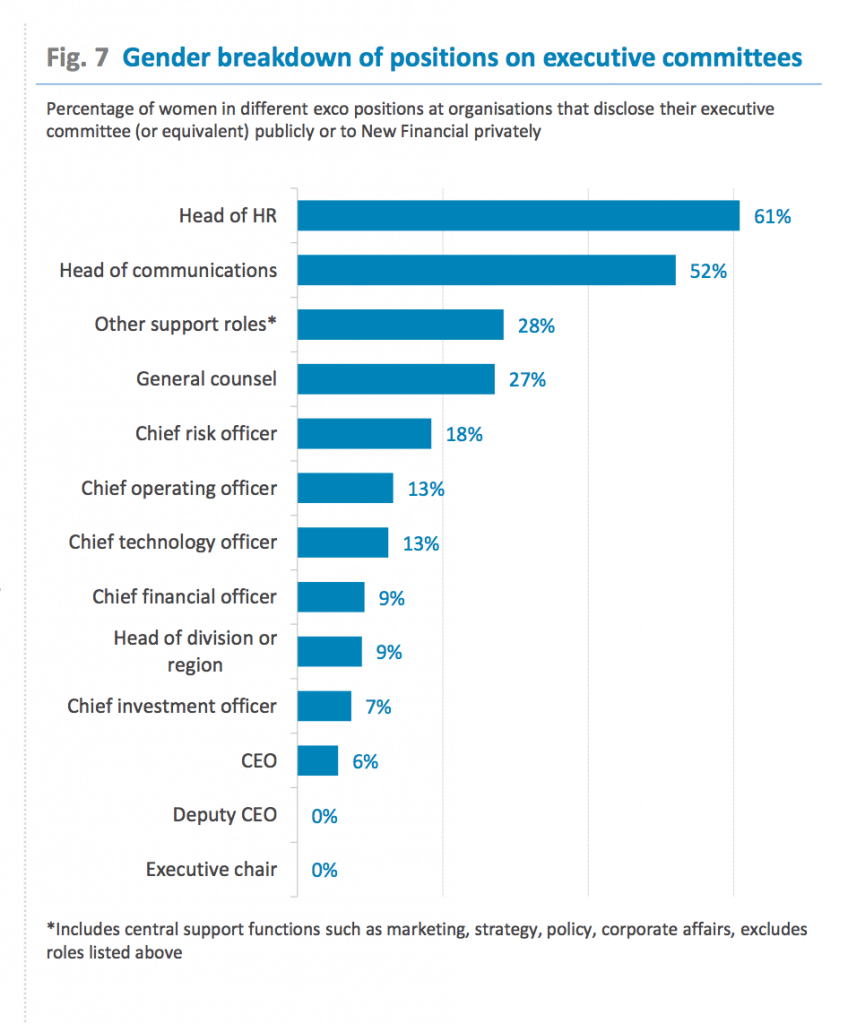
A report by NewFinancial last month, by Yasmine Chinwala, noted that while women do tend to hold positions on executive committees, these roles tend to be support-focused (seen as costs centers) instead of roles linked to revenues (seen as profit centers). The report found that while nearly two-thirds (61%) of HR heads on executive committees are women, only 9% were heads of a region or division, and barely 10% representing the C-suite executive level.
Women in UK Financial Services 2016 Source: NewFinancial
The United Kingdom's HM Treasury has just announced that its ‘Women in Finance Charter’ - a pledge for gender balance across the finance industry – has already 72 companies on board its initiative, in support of the progression of women into senior roles in financial services.
By focusing on the roles that women hold in the executive pipeline and mid-tier levels within companies, the charter aims to help ensure gender diversity as a balanced workforce can be good for business, customers, workplace culture, and has other positive attributes, as explained in an update from the HM Treasury.
Approximately 60% of people working in financial services are women across 20 global markets, however this figure sadly falls dramatically to 19% when looking at senior level positions.
Transparency and accountability
Each firm that commits to the charter will need to set its own targets as businesses can vary, yet firms are required to report publicly on any progress they make to deliver against these targets. By making this data transparent, signatories help set the stage for accountability and a basis for future change for gender equality in the workforce.
Furthermore, firms that take the pledge to support the charter are committing to have a member of their senior executive team be responsible and accountable for gender diversity and inclusion, as internal targets for gender diversity are set by a firm’s senior management.
Equal Pay and Roles
In addition, firms signing the charter agree on making sure that the pay of their senior executive team - whether bonus pay or other executive remuneration - reflects delivery against the internal targets on gender diversity.
The more than 70 entities that have already signed the charter reflect some of the largest financial services companies in the UK, including banks and investment firms and other multinational companies, as well as emerging fintech companies, regulators, trade associations, and stock exchanges.
Not only does it create a fair working environment but it’s also good for business which in turn, is good for our members and customers.
Women in Finance
Commenting in a statement regarding the charter, a spokesperson from fintech startup Circle said: "As a young fast-growing FinTech company, innovation is vital but so too is our passion for people. We want the right people for the job, whatever their gender. Approximately 60% of people working in financial services are women across 20 global markets, however this figure sadly falls dramatically to 19% when looking at senior level positions."
The Circle spokesperson added: "The team at Circle are proud to champion gender equality in the financial workplace, and are committed to ensuring that women are appropriately represented. We are delighted to participate in the UK government’s ‘Women in Finance’ Charter to help drive awareness and showcase both the importance and advantages of women occupying senior managerial roles in the financial service."
Helen Dean Source: NEST
Commenting in a statement, Helen Dean, CEO of NEST - an auto enrollment pension provider - said regarding the charter: "The Women in Finance Charter is a very important initiative and I am pleased that NEST will be playing its part in helping create a gender balance, at all levels, across financial services."
Mrs. Dean added: "The decision to sign the Charter was an easy one for NEST. That’s not to say we entered into it lightly but it felt obvious to me and the NEST leadership team that we have a responsibility to promote equality and diversity here at NEST. Not only does it create a fair working environment but it’s also good for business which in turn, is good for our members and customers.”
Industry support
An example of some of the names on the list include, Aberdeen Asset Management, Affinity Capital, Atom Bank plc, Aviva plc, BlackRock, BNY Mellon, Circle, Credit Suisse, Deutsche Bank AG, Fidelity International UK, and Lloyds Banking Group, among other prominent and emerging names.
In addition, agencies such as the Financial Conduct Authority (FCA) appeared on the list alongside industry trade associations across finance, among others.
A report by NewFinancial last month, by Yasmine Chinwala, noted that while women do tend to hold positions on executive committees, these roles tend to be support-focused (seen as costs centers) instead of roles linked to revenues (seen as profit centers). The report found that while nearly two-thirds (61%) of HR heads on executive committees are women, only 9% were heads of a region or division, and barely 10% representing the C-suite executive level.
Women in UK Financial Services 2016 Source: NewFinancial
ASX Faces $150M Capital Charge After Scathing Inquiry Finds Years of Neglect
Featured Videos
Executive Interview | Charlotte Bullock | Chief Product Officer, Bank of London | FMLS:25
In this interview, we sat down with Charlotte Bullock, Head of Product at The Bank of London, previously at SAP and now shaping product at one of the sector’s most ambitious new banking players.
Charlotte reflects on the Summit so far and talks about the culture inside fintech banks today. We look at the pressures that come with scaling, and how firms can hold onto the nimble approach that made them stand out early on.
We also cover the state of payments ahead of her appearance on the payments roundtable: the blockages financial firms face, the areas that still need fixing, and what a realistic solution looks like in 2026.
In this interview, we sat down with Charlotte Bullock, Head of Product at The Bank of London, previously at SAP and now shaping product at one of the sector’s most ambitious new banking players.
Charlotte reflects on the Summit so far and talks about the culture inside fintech banks today. We look at the pressures that come with scaling, and how firms can hold onto the nimble approach that made them stand out early on.
We also cover the state of payments ahead of her appearance on the payments roundtable: the blockages financial firms face, the areas that still need fixing, and what a realistic solution looks like in 2026.
In this interview, we sat down with Charlotte Bullock, Head of Product at The Bank of London, previously at SAP and now shaping product at one of the sector’s most ambitious new banking players.
Charlotte reflects on the Summit so far and talks about the culture inside fintech banks today. We look at the pressures that come with scaling, and how firms can hold onto the nimble approach that made them stand out early on.
We also cover the state of payments ahead of her appearance on the payments roundtable: the blockages financial firms face, the areas that still need fixing, and what a realistic solution looks like in 2026.
In this interview, we sat down with Charlotte Bullock, Head of Product at The Bank of London, previously at SAP and now shaping product at one of the sector’s most ambitious new banking players.
Charlotte reflects on the Summit so far and talks about the culture inside fintech banks today. We look at the pressures that come with scaling, and how firms can hold onto the nimble approach that made them stand out early on.
We also cover the state of payments ahead of her appearance on the payments roundtable: the blockages financial firms face, the areas that still need fixing, and what a realistic solution looks like in 2026.
In this conversation, we sit down with Drew Niv, CSO at ATFX Connect and one of the most influential figures in modern FX.
We speak about market structure, the institutional view on liquidity, and the sharp rise of prop trading, a sector Drew has been commenting on in recent months. Drew explains why he once dismissed prop trading, why his view changed, and what he now thinks the model means for brokers, clients and risk managers.
We explore subscription-fee dependency, the high reneging rate, and the long-term challenge: how brokers can build a more stable and honest version of the model. Drew also talks about the traffic advantage standalone prop firms have built and why brokers may still win in the long run if they take the right approach.
In this conversation, we sit down with Drew Niv, CSO at ATFX Connect and one of the most influential figures in modern FX.
We speak about market structure, the institutional view on liquidity, and the sharp rise of prop trading, a sector Drew has been commenting on in recent months. Drew explains why he once dismissed prop trading, why his view changed, and what he now thinks the model means for brokers, clients and risk managers.
We explore subscription-fee dependency, the high reneging rate, and the long-term challenge: how brokers can build a more stable and honest version of the model. Drew also talks about the traffic advantage standalone prop firms have built and why brokers may still win in the long run if they take the right approach.
In this conversation, we sit down with Drew Niv, CSO at ATFX Connect and one of the most influential figures in modern FX.
We speak about market structure, the institutional view on liquidity, and the sharp rise of prop trading, a sector Drew has been commenting on in recent months. Drew explains why he once dismissed prop trading, why his view changed, and what he now thinks the model means for brokers, clients and risk managers.
We explore subscription-fee dependency, the high reneging rate, and the long-term challenge: how brokers can build a more stable and honest version of the model. Drew also talks about the traffic advantage standalone prop firms have built and why brokers may still win in the long run if they take the right approach.
In this conversation, we sit down with Drew Niv, CSO at ATFX Connect and one of the most influential figures in modern FX.
We speak about market structure, the institutional view on liquidity, and the sharp rise of prop trading, a sector Drew has been commenting on in recent months. Drew explains why he once dismissed prop trading, why his view changed, and what he now thinks the model means for brokers, clients and risk managers.
We explore subscription-fee dependency, the high reneging rate, and the long-term challenge: how brokers can build a more stable and honest version of the model. Drew also talks about the traffic advantage standalone prop firms have built and why brokers may still win in the long run if they take the right approach.
In this conversation, we sit down with Drew Niv, CSO at ATFX Connect and one of the most influential figures in modern FX.
We speak about market structure, the institutional view on liquidity, and the sharp rise of prop trading, a sector Drew has been commenting on in recent months. Drew explains why he once dismissed prop trading, why his view changed, and what he now thinks the model means for brokers, clients and risk managers.
We explore subscription-fee dependency, the high reneging rate, and the long-term challenge: how brokers can build a more stable and honest version of the model. Drew also talks about the traffic advantage standalone prop firms have built and why brokers may still win in the long run if they take the right approach.
In this conversation, we sit down with Drew Niv, CSO at ATFX Connect and one of the most influential figures in modern FX.
We speak about market structure, the institutional view on liquidity, and the sharp rise of prop trading, a sector Drew has been commenting on in recent months. Drew explains why he once dismissed prop trading, why his view changed, and what he now thinks the model means for brokers, clients and risk managers.
We explore subscription-fee dependency, the high reneging rate, and the long-term challenge: how brokers can build a more stable and honest version of the model. Drew also talks about the traffic advantage standalone prop firms have built and why brokers may still win in the long run if they take the right approach.
Executive Interview | Remonda Z. Kirketerp Møller| CEO & Founder Muinmos | FMLS:25
In this interview, Remonda Z. Kirketerp Møller, founder of Muinmos, breaks down the state of AI in regtech and what responsible adoption really looks like for brokers. We talk about rising fragmentation, the pressures around compliance accuracy, and why most firms are still in the early stages of AI maturity.
Ramanda also shares insights on regulator sandboxes, shifting expectations around accountability, and the current reality of MiCA licensing and passporting in Europe.
A concise look at where compliance, onboarding, and AI-driven processes are heading next.
In this interview, Remonda Z. Kirketerp Møller, founder of Muinmos, breaks down the state of AI in regtech and what responsible adoption really looks like for brokers. We talk about rising fragmentation, the pressures around compliance accuracy, and why most firms are still in the early stages of AI maturity.
Ramanda also shares insights on regulator sandboxes, shifting expectations around accountability, and the current reality of MiCA licensing and passporting in Europe.
A concise look at where compliance, onboarding, and AI-driven processes are heading next.
In this interview, Remonda Z. Kirketerp Møller, founder of Muinmos, breaks down the state of AI in regtech and what responsible adoption really looks like for brokers. We talk about rising fragmentation, the pressures around compliance accuracy, and why most firms are still in the early stages of AI maturity.
Ramanda also shares insights on regulator sandboxes, shifting expectations around accountability, and the current reality of MiCA licensing and passporting in Europe.
A concise look at where compliance, onboarding, and AI-driven processes are heading next.
In this interview, Remonda Z. Kirketerp Møller, founder of Muinmos, breaks down the state of AI in regtech and what responsible adoption really looks like for brokers. We talk about rising fragmentation, the pressures around compliance accuracy, and why most firms are still in the early stages of AI maturity.
Ramanda also shares insights on regulator sandboxes, shifting expectations around accountability, and the current reality of MiCA licensing and passporting in Europe.
A concise look at where compliance, onboarding, and AI-driven processes are heading next.
In this interview, Remonda Z. Kirketerp Møller, founder of Muinmos, breaks down the state of AI in regtech and what responsible adoption really looks like for brokers. We talk about rising fragmentation, the pressures around compliance accuracy, and why most firms are still in the early stages of AI maturity.
Ramanda also shares insights on regulator sandboxes, shifting expectations around accountability, and the current reality of MiCA licensing and passporting in Europe.
A concise look at where compliance, onboarding, and AI-driven processes are heading next.
In this interview, Remonda Z. Kirketerp Møller, founder of Muinmos, breaks down the state of AI in regtech and what responsible adoption really looks like for brokers. We talk about rising fragmentation, the pressures around compliance accuracy, and why most firms are still in the early stages of AI maturity.
Ramanda also shares insights on regulator sandboxes, shifting expectations around accountability, and the current reality of MiCA licensing and passporting in Europe.
A concise look at where compliance, onboarding, and AI-driven processes are heading next.
In this conversation, we speak with Aydin Bonabi, CEO and co-founder of Surveill, a firm focused on fraud detection and AI-driven compliance tools for financial institutions.
We start with Aydin’s view of the Summit and the challenges brokers face as fraud tactics grow more complex. He explains how firms can stay ahead through real-time signals, data patterns, and early-stage detection.
We also talk about AI training and why compliance teams often struggle to keep models accurate, fair, and aligned with regulatory expectations. Aydin breaks down what “good” AI training looks like inside a financial environment, including the importance of clean data, domain expertise, and human oversight.
He closes with a clear message: fraud is scaling, and so must the tools that stop it.
In this conversation, we speak with Aydin Bonabi, CEO and co-founder of Surveill, a firm focused on fraud detection and AI-driven compliance tools for financial institutions.
We start with Aydin’s view of the Summit and the challenges brokers face as fraud tactics grow more complex. He explains how firms can stay ahead through real-time signals, data patterns, and early-stage detection.
We also talk about AI training and why compliance teams often struggle to keep models accurate, fair, and aligned with regulatory expectations. Aydin breaks down what “good” AI training looks like inside a financial environment, including the importance of clean data, domain expertise, and human oversight.
He closes with a clear message: fraud is scaling, and so must the tools that stop it.
In this conversation, we speak with Aydin Bonabi, CEO and co-founder of Surveill, a firm focused on fraud detection and AI-driven compliance tools for financial institutions.
We start with Aydin’s view of the Summit and the challenges brokers face as fraud tactics grow more complex. He explains how firms can stay ahead through real-time signals, data patterns, and early-stage detection.
We also talk about AI training and why compliance teams often struggle to keep models accurate, fair, and aligned with regulatory expectations. Aydin breaks down what “good” AI training looks like inside a financial environment, including the importance of clean data, domain expertise, and human oversight.
He closes with a clear message: fraud is scaling, and so must the tools that stop it.
In this conversation, we speak with Aydin Bonabi, CEO and co-founder of Surveill, a firm focused on fraud detection and AI-driven compliance tools for financial institutions.
We start with Aydin’s view of the Summit and the challenges brokers face as fraud tactics grow more complex. He explains how firms can stay ahead through real-time signals, data patterns, and early-stage detection.
We also talk about AI training and why compliance teams often struggle to keep models accurate, fair, and aligned with regulatory expectations. Aydin breaks down what “good” AI training looks like inside a financial environment, including the importance of clean data, domain expertise, and human oversight.
He closes with a clear message: fraud is scaling, and so must the tools that stop it.
In this conversation, we speak with Aydin Bonabi, CEO and co-founder of Surveill, a firm focused on fraud detection and AI-driven compliance tools for financial institutions.
We start with Aydin’s view of the Summit and the challenges brokers face as fraud tactics grow more complex. He explains how firms can stay ahead through real-time signals, data patterns, and early-stage detection.
We also talk about AI training and why compliance teams often struggle to keep models accurate, fair, and aligned with regulatory expectations. Aydin breaks down what “good” AI training looks like inside a financial environment, including the importance of clean data, domain expertise, and human oversight.
He closes with a clear message: fraud is scaling, and so must the tools that stop it.
In this conversation, we speak with Aydin Bonabi, CEO and co-founder of Surveill, a firm focused on fraud detection and AI-driven compliance tools for financial institutions.
We start with Aydin’s view of the Summit and the challenges brokers face as fraud tactics grow more complex. He explains how firms can stay ahead through real-time signals, data patterns, and early-stage detection.
We also talk about AI training and why compliance teams often struggle to keep models accurate, fair, and aligned with regulatory expectations. Aydin breaks down what “good” AI training looks like inside a financial environment, including the importance of clean data, domain expertise, and human oversight.
He closes with a clear message: fraud is scaling, and so must the tools that stop it.
Exness expands its presence in Africa: Inside our interview with Paul Margarites in Cape Town
Finance Magnates met with Paul Margarites, Exness regional commercial director for Sub-Saharan Africa, during a visit to the firm’s office opening in Cape Town. In this talk, led by Andrea Badiola Mateos, Co-CEO at Finance Magnates, Paul shares views on the South African trading space, local user behavior, mobile trends, regulation, team growth, and how Exness plans to grow in more markets across the region. @Exness
Read the article at: https://www.financemagnates.com/thought-leadership/exness-expands-its-presence-in-africa-inside-our-interview-with-paul-margarites/
#exness #financemagnates #exnesstrading #CFDtrading #tradeonline #africanews #capetown
Finance Magnates met with Paul Margarites, Exness regional commercial director for Sub-Saharan Africa, during a visit to the firm’s office opening in Cape Town. In this talk, led by Andrea Badiola Mateos, Co-CEO at Finance Magnates, Paul shares views on the South African trading space, local user behavior, mobile trends, regulation, team growth, and how Exness plans to grow in more markets across the region. @Exness
Read the article at: https://www.financemagnates.com/thought-leadership/exness-expands-its-presence-in-africa-inside-our-interview-with-paul-margarites/
#exness #financemagnates #exnesstrading #CFDtrading #tradeonline #africanews #capetown
Finance Magnates met with Paul Margarites, Exness regional commercial director for Sub-Saharan Africa, during a visit to the firm’s office opening in Cape Town. In this talk, led by Andrea Badiola Mateos, Co-CEO at Finance Magnates, Paul shares views on the South African trading space, local user behavior, mobile trends, regulation, team growth, and how Exness plans to grow in more markets across the region. @Exness
Read the article at: https://www.financemagnates.com/thought-leadership/exness-expands-its-presence-in-africa-inside-our-interview-with-paul-margarites/
#exness #financemagnates #exnesstrading #CFDtrading #tradeonline #africanews #capetown
Finance Magnates met with Paul Margarites, Exness regional commercial director for Sub-Saharan Africa, during a visit to the firm’s office opening in Cape Town. In this talk, led by Andrea Badiola Mateos, Co-CEO at Finance Magnates, Paul shares views on the South African trading space, local user behavior, mobile trends, regulation, team growth, and how Exness plans to grow in more markets across the region. @Exness
Read the article at: https://www.financemagnates.com/thought-leadership/exness-expands-its-presence-in-africa-inside-our-interview-with-paul-margarites/
#exness #financemagnates #exnesstrading #CFDtrading #tradeonline #africanews #capetown
Finance Magnates met with Paul Margarites, Exness regional commercial director for Sub-Saharan Africa, during a visit to the firm’s office opening in Cape Town. In this talk, led by Andrea Badiola Mateos, Co-CEO at Finance Magnates, Paul shares views on the South African trading space, local user behavior, mobile trends, regulation, team growth, and how Exness plans to grow in more markets across the region. @Exness
Read the article at: https://www.financemagnates.com/thought-leadership/exness-expands-its-presence-in-africa-inside-our-interview-with-paul-margarites/
#exness #financemagnates #exnesstrading #CFDtrading #tradeonline #africanews #capetown
Finance Magnates met with Paul Margarites, Exness regional commercial director for Sub-Saharan Africa, during a visit to the firm’s office opening in Cape Town. In this talk, led by Andrea Badiola Mateos, Co-CEO at Finance Magnates, Paul shares views on the South African trading space, local user behavior, mobile trends, regulation, team growth, and how Exness plans to grow in more markets across the region. @Exness
Read the article at: https://www.financemagnates.com/thought-leadership/exness-expands-its-presence-in-africa-inside-our-interview-with-paul-margarites/
#exness #financemagnates #exnesstrading #CFDtrading #tradeonline #africanews #capetown