Nearly 160 pages detail the FCA's outlook and proposed fee revisions.
Bloomberg
A strategic outlook for the current and following year has been released by the United Kingdom’s Financial Conduct Authority (FCA) today. In the detailed report for 2016/2017, the outlook included an accompanying fee proposal to revise membership-related costs and fees as the regulator is entirely funded via such proceeds from its members including penalties and other member-levied capital.
The two papers, totaling nearly 160 pages, provide an in-depth and highly articulated view of all the key challenges facing the FCA, as well as its current year and 2017 outlook and areas of focus - as it plans to reach its targets during this year and beyond.
Global FX code in development
The outlook noted how the FCA is working with international counterparts to improve conduct in wholesale financial markets at the global level, including how they are structured and operated, as well as supporting the Bank of England and other central banks in their work to develop a global FX code. Finance Magnates reported as that development unfolded last year, and the effort is nearing, but may still be years away from finalization.
...finances and financial literacy have become more varied and complex...
Outlook and fee proposals
FCA acting CEO Tracey McDermott commenting in the press release said: "It is our job to make markets work well. Ensuring effective and proportionate regulation which tackles the problems of the past without inhibiting developments of the future is at the heart of what we do. Over the next year we will continue to embed this sustainable approach to regulation in everything we do.”
Mrs. McDermott added: “The majority of our resources remain devoted to our core business and today we have set out the outcomes we want our work to achieve. Transparency is important to us, and this plan will give all stakeholders an understanding of our focus for the year ahead.”
The regulator said that its operating costs of £502.9 million for 2016/2017 for its ongoing regulatory activities (ORA) had increased by £23.9 million due to the introduction of Consumer Credit into its budget, excluding which would have had reduced its ORA budget to £471.4 million.
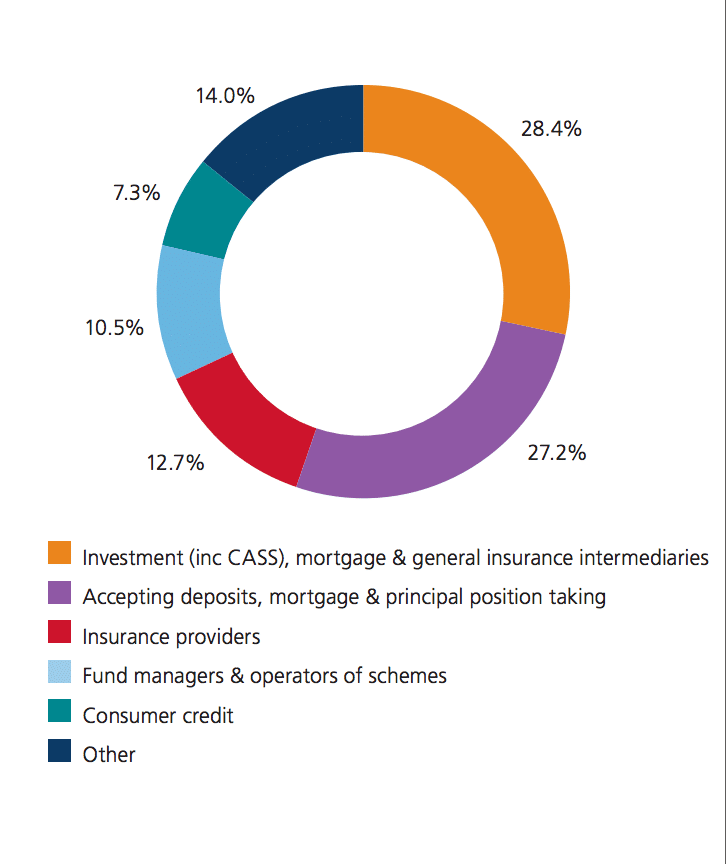
Regarding the fee consultation paper, the pie chart below from the report shows the breakdown of funding by industry.
Source: FCA
The regulator believes that because many providers and companies rely on complex IT infrastructure, a widespread adoption of FinTech solutions would be limited by inherent vulnerabilities in the design and management of new (and existing) systems, unless proper long-term planning is undertaken during the early phases.
FCA added that many providers rely on complex IT systems and infrastructure that make it difficult for them to provide payments or other key services while citing challenges that it anticipates in the future from within FinTech.
FinTech initiatives
The FCA said that it helped 177 companies during the first year of its Project Innovate initiative, and added that its support of RegTech enables more efficient and effective regulation and compliance.
With regard to retail investments, the FCA said that it will complete its thematic review of 'inducements and conflicts of interest' by the end of the second quarter, and that an 'advice' unit will be created to deal with the emergence of robo-advisors or automated advice services.
Data security was an area of focus where the FCA noted how legacy systems had become more complex over time, and the need to balance investment in innovation with maintaining existing systems, as well as lack of IT expertise at the board level, all contributed to the challenge of keeping data secure.
In terms of customer support, the FCA said that finances and financial literacy have become more varied and complex, and the need for appropriate, accessible advice and products is growing, despite the advances in financial technology.
Conflicts of interest and suitability
The FCA explains that in some cases where there is a potential over-reliance on a small number of large clients, or on clients who have a dominant market share, firms could hesitate to report suspicious activity or even misconduct. It also contrasted similar potential conflicts with money managers or investment management firms where conflicts could occur when firms don't prioritize their clients' interests, and added that controls of how client funds are spent may need improvement.
The FCA also expanded on the subject of suitability and referenced how the manner in which client choices are ‘framed’ highly influenced their behavior with choosing services, and cited a 2014 study that it had conducted in this finding.
For example, the FCA observed during an experiment that when an annuity product was framed as an 'investment' (i.e. how much it would cost) rather than from a context of 'consumption' (i.e. how much the investment will return), how investors tended to consistently choose the investment framed products even when the products framed by consumption made better sense financially.
Company culture and market abuse
The FCA is looking at company culture for clues as to firms' practices, as it believes that where there is a strong tradition of standards ingrained within a firm's workforce, such practices trickle down to clients and across product development and administrative responsibilities and other areas that affect clients.
Conversely, firms that have poor culture or governance arrangements that are not aligned with their apparent values or mission statements may have poor customer support and weaker offerings, or even worse potential violations. FCA noted that culture is still a key driver of significant risks in every sector and described it as the root cause of high profile and significant failings.
The Market Abuse Regulation (MAR) was also noted, as the FCA plans on implementing the EU directive during 2016, and expects it to help strengthen the existing UK market abuse framework by including additional markets, and noted the upcoming MiFIR regulation planned for January 2018 that would help aid the MAR implementation.
Fee reductions proposed
An example of the fee amount that was revised for a number of overseas-based members, such as the Chicago Board of Trade (CBOT), EUREX, Nasdaq, New York Mercantile Exchange (NYMEX), the Swiss Stock Exchange, Sydney Futures Exchange limited, ICE Futures US Inc, and any other over overseas investment exchange registered with the FCA, was lowered by 992 GBP to 61,008 GBP.
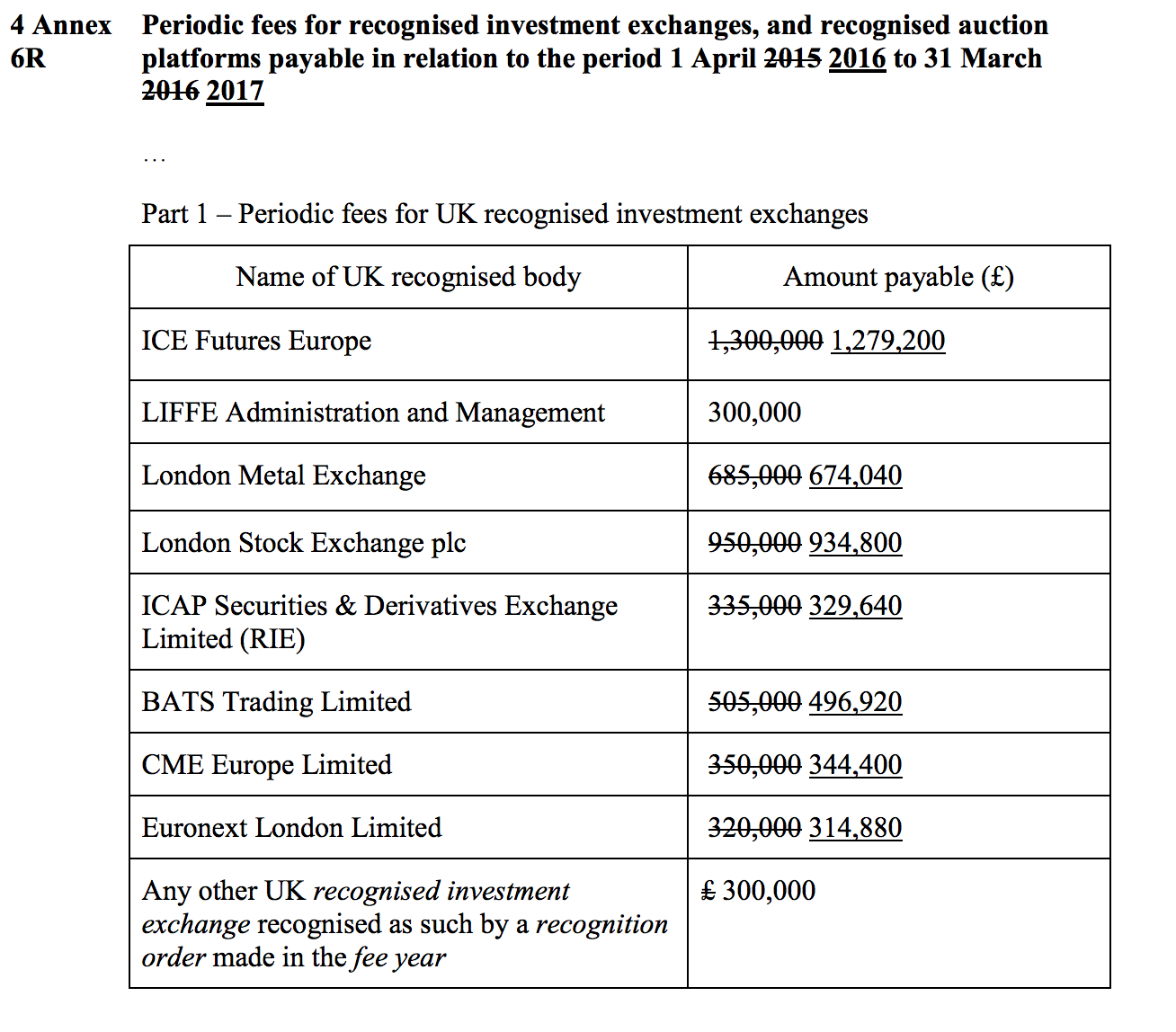
Other categories such as the UK-recognized domestic investment exchanges, saw various price reductions depending on the company, as seen in the excerpt from the report below.
Source: FCA
A strategic outlook for the current and following year has been released by the United Kingdom’s Financial Conduct Authority (FCA) today. In the detailed report for 2016/2017, the outlook included an accompanying fee proposal to revise membership-related costs and fees as the regulator is entirely funded via such proceeds from its members including penalties and other member-levied capital.
The two papers, totaling nearly 160 pages, provide an in-depth and highly articulated view of all the key challenges facing the FCA, as well as its current year and 2017 outlook and areas of focus - as it plans to reach its targets during this year and beyond.
Global FX code in development
The outlook noted how the FCA is working with international counterparts to improve conduct in wholesale financial markets at the global level, including how they are structured and operated, as well as supporting the Bank of England and other central banks in their work to develop a global FX code. Finance Magnates reported as that development unfolded last year, and the effort is nearing, but may still be years away from finalization.
...finances and financial literacy have become more varied and complex...
Outlook and fee proposals
FCA acting CEO Tracey McDermott commenting in the press release said: "It is our job to make markets work well. Ensuring effective and proportionate regulation which tackles the problems of the past without inhibiting developments of the future is at the heart of what we do. Over the next year we will continue to embed this sustainable approach to regulation in everything we do.”
Mrs. McDermott added: “The majority of our resources remain devoted to our core business and today we have set out the outcomes we want our work to achieve. Transparency is important to us, and this plan will give all stakeholders an understanding of our focus for the year ahead.”
The regulator said that its operating costs of £502.9 million for 2016/2017 for its ongoing regulatory activities (ORA) had increased by £23.9 million due to the introduction of Consumer Credit into its budget, excluding which would have had reduced its ORA budget to £471.4 million.
Regarding the fee consultation paper, the pie chart below from the report shows the breakdown of funding by industry.
Source: FCA
The regulator believes that because many providers and companies rely on complex IT infrastructure, a widespread adoption of FinTech solutions would be limited by inherent vulnerabilities in the design and management of new (and existing) systems, unless proper long-term planning is undertaken during the early phases.
FCA added that many providers rely on complex IT systems and infrastructure that make it difficult for them to provide payments or other key services while citing challenges that it anticipates in the future from within FinTech.
FinTech initiatives
The FCA said that it helped 177 companies during the first year of its Project Innovate initiative, and added that its support of RegTech enables more efficient and effective regulation and compliance.
With regard to retail investments, the FCA said that it will complete its thematic review of 'inducements and conflicts of interest' by the end of the second quarter, and that an 'advice' unit will be created to deal with the emergence of robo-advisors or automated advice services.
Data security was an area of focus where the FCA noted how legacy systems had become more complex over time, and the need to balance investment in innovation with maintaining existing systems, as well as lack of IT expertise at the board level, all contributed to the challenge of keeping data secure.
In terms of customer support, the FCA said that finances and financial literacy have become more varied and complex, and the need for appropriate, accessible advice and products is growing, despite the advances in financial technology.
Conflicts of interest and suitability
The FCA explains that in some cases where there is a potential over-reliance on a small number of large clients, or on clients who have a dominant market share, firms could hesitate to report suspicious activity or even misconduct. It also contrasted similar potential conflicts with money managers or investment management firms where conflicts could occur when firms don't prioritize their clients' interests, and added that controls of how client funds are spent may need improvement.
The FCA also expanded on the subject of suitability and referenced how the manner in which client choices are ‘framed’ highly influenced their behavior with choosing services, and cited a 2014 study that it had conducted in this finding.
For example, the FCA observed during an experiment that when an annuity product was framed as an 'investment' (i.e. how much it would cost) rather than from a context of 'consumption' (i.e. how much the investment will return), how investors tended to consistently choose the investment framed products even when the products framed by consumption made better sense financially.
Company culture and market abuse
The FCA is looking at company culture for clues as to firms' practices, as it believes that where there is a strong tradition of standards ingrained within a firm's workforce, such practices trickle down to clients and across product development and administrative responsibilities and other areas that affect clients.
Conversely, firms that have poor culture or governance arrangements that are not aligned with their apparent values or mission statements may have poor customer support and weaker offerings, or even worse potential violations. FCA noted that culture is still a key driver of significant risks in every sector and described it as the root cause of high profile and significant failings.
The Market Abuse Regulation (MAR) was also noted, as the FCA plans on implementing the EU directive during 2016, and expects it to help strengthen the existing UK market abuse framework by including additional markets, and noted the upcoming MiFIR regulation planned for January 2018 that would help aid the MAR implementation.
Fee reductions proposed
An example of the fee amount that was revised for a number of overseas-based members, such as the Chicago Board of Trade (CBOT), EUREX, Nasdaq, New York Mercantile Exchange (NYMEX), the Swiss Stock Exchange, Sydney Futures Exchange limited, ICE Futures US Inc, and any other over overseas investment exchange registered with the FCA, was lowered by 992 GBP to 61,008 GBP.
Other categories such as the UK-recognized domestic investment exchanges, saw various price reductions depending on the company, as seen in the excerpt from the report below.
In this video, we review @AxiOfficialChannel , a multi-asset broker offering access to forex and CFD markets through MetaTrader 4, MetaTrader 5, the Axi Trading App, and copy trading solutions.
We examine the broker’s regulatory framework, platform offering, market coverage, and customer support structure. We also explore key features such as available trading instruments, swap-free account options, funding considerations, and multilingual support.
Watch the full video for a clear, fact-based overview of Axi’s products, trading tools, and overall broker offering.
#Axi #ForexBroker #CFDTrading #FinanceMagnates #Trading #BrokerReview #OnlineTrading
In this video, we review @AxiOfficialChannel , a multi-asset broker offering access to forex and CFD markets through MetaTrader 4, MetaTrader 5, the Axi Trading App, and copy trading solutions.
We examine the broker’s regulatory framework, platform offering, market coverage, and customer support structure. We also explore key features such as available trading instruments, swap-free account options, funding considerations, and multilingual support.
Watch the full video for a clear, fact-based overview of Axi’s products, trading tools, and overall broker offering.
#Axi #ForexBroker #CFDTrading #FinanceMagnates #Trading #BrokerReview #OnlineTrading
In this video, we review @AxiOfficialChannel , a multi-asset broker offering access to forex and CFD markets through MetaTrader 4, MetaTrader 5, the Axi Trading App, and copy trading solutions.
We examine the broker’s regulatory framework, platform offering, market coverage, and customer support structure. We also explore key features such as available trading instruments, swap-free account options, funding considerations, and multilingual support.
Watch the full video for a clear, fact-based overview of Axi’s products, trading tools, and overall broker offering.
#Axi #ForexBroker #CFDTrading #FinanceMagnates #Trading #BrokerReview #OnlineTrading
In this video, we review @AxiOfficialChannel , a multi-asset broker offering access to forex and CFD markets through MetaTrader 4, MetaTrader 5, the Axi Trading App, and copy trading solutions.
We examine the broker’s regulatory framework, platform offering, market coverage, and customer support structure. We also explore key features such as available trading instruments, swap-free account options, funding considerations, and multilingual support.
Watch the full video for a clear, fact-based overview of Axi’s products, trading tools, and overall broker offering.
#Axi #ForexBroker #CFDTrading #FinanceMagnates #Trading #BrokerReview #OnlineTrading
In this video, we review @AxiOfficialChannel , a multi-asset broker offering access to forex and CFD markets through MetaTrader 4, MetaTrader 5, the Axi Trading App, and copy trading solutions.
We examine the broker’s regulatory framework, platform offering, market coverage, and customer support structure. We also explore key features such as available trading instruments, swap-free account options, funding considerations, and multilingual support.
Watch the full video for a clear, fact-based overview of Axi’s products, trading tools, and overall broker offering.
#Axi #ForexBroker #CFDTrading #FinanceMagnates #Trading #BrokerReview #OnlineTrading
In this video, we review @AxiOfficialChannel , a multi-asset broker offering access to forex and CFD markets through MetaTrader 4, MetaTrader 5, the Axi Trading App, and copy trading solutions.
We examine the broker’s regulatory framework, platform offering, market coverage, and customer support structure. We also explore key features such as available trading instruments, swap-free account options, funding considerations, and multilingual support.
Watch the full video for a clear, fact-based overview of Axi’s products, trading tools, and overall broker offering.
#Axi #ForexBroker #CFDTrading #FinanceMagnates #Trading #BrokerReview #OnlineTrading
Multi-Asset or Die: The New Brokerage Playbook
This panel will explore how firms are moving beyond CFDs into crypto, perpetuals, equities, and multi‑asset offerings, and the challenges they face across regulation, technology, liquidity, and risk management. It examines what is driving the shift, what it takes to execute it successfully, and how brokers can position themselves for the next phase of growth.
Beyond Reach? Retail Investor Acquisition Across APAC
APAC accounts for two-thirds of global retail trading traffic, but with differences of language, regulation, and trader profile, the region's growth is ag great as complexity.
This session gathers CMOs, heads of acquisition, and IB relationship managers to examine what actually works, channel by channel, market by market.
Attendees will walk away with:
A clear view of which channels deliver funded, retained traders across Singapore, Japan, and Southeast Asia
Understanding of how to structure IB partnerships for LTV, not first deposit
Insight into what localization actually costs beyond the translation budget
Perspective on how ad restrictions, crypto promotion limits, and bundling rules differ across APAC jurisdictions
A read on whether the super-app model changes acquisition economics for retail investing platforms
APAC accounts for two-thirds of global retail trading traffic, but with differences of language, regulation, and trader profile, the region's growth is ag great as complexity.
This session gathers CMOs, heads of acquisition, and IB relationship managers to examine what actually works, channel by channel, market by market.
Attendees will walk away with:
A clear view of which channels deliver funded, retained traders across Singapore, Japan, and Southeast Asia
Understanding of how to structure IB partnerships for LTV, not first deposit
Insight into what localization actually costs beyond the translation budget
Perspective on how ad restrictions, crypto promotion limits, and bundling rules differ across APAC jurisdictions
A read on whether the super-app model changes acquisition economics for retail investing platforms
APAC accounts for two-thirds of global retail trading traffic, but with differences of language, regulation, and trader profile, the region's growth is ag great as complexity.
This session gathers CMOs, heads of acquisition, and IB relationship managers to examine what actually works, channel by channel, market by market.
Attendees will walk away with:
A clear view of which channels deliver funded, retained traders across Singapore, Japan, and Southeast Asia
Understanding of how to structure IB partnerships for LTV, not first deposit
Insight into what localization actually costs beyond the translation budget
Perspective on how ad restrictions, crypto promotion limits, and bundling rules differ across APAC jurisdictions
A read on whether the super-app model changes acquisition economics for retail investing platforms
APAC accounts for two-thirds of global retail trading traffic, but with differences of language, regulation, and trader profile, the region's growth is ag great as complexity.
This session gathers CMOs, heads of acquisition, and IB relationship managers to examine what actually works, channel by channel, market by market.
Attendees will walk away with:
A clear view of which channels deliver funded, retained traders across Singapore, Japan, and Southeast Asia
Understanding of how to structure IB partnerships for LTV, not first deposit
Insight into what localization actually costs beyond the translation budget
Perspective on how ad restrictions, crypto promotion limits, and bundling rules differ across APAC jurisdictions
A read on whether the super-app model changes acquisition economics for retail investing platforms
APAC accounts for two-thirds of global retail trading traffic, but with differences of language, regulation, and trader profile, the region's growth is ag great as complexity.
This session gathers CMOs, heads of acquisition, and IB relationship managers to examine what actually works, channel by channel, market by market.
Attendees will walk away with:
A clear view of which channels deliver funded, retained traders across Singapore, Japan, and Southeast Asia
Understanding of how to structure IB partnerships for LTV, not first deposit
Insight into what localization actually costs beyond the translation budget
Perspective on how ad restrictions, crypto promotion limits, and bundling rules differ across APAC jurisdictions
A read on whether the super-app model changes acquisition economics for retail investing platforms
APAC accounts for two-thirds of global retail trading traffic, but with differences of language, regulation, and trader profile, the region's growth is ag great as complexity.
This session gathers CMOs, heads of acquisition, and IB relationship managers to examine what actually works, channel by channel, market by market.
Attendees will walk away with:
A clear view of which channels deliver funded, retained traders across Singapore, Japan, and Southeast Asia
Understanding of how to structure IB partnerships for LTV, not first deposit
Insight into what localization actually costs beyond the translation budget
Perspective on how ad restrictions, crypto promotion limits, and bundling rules differ across APAC jurisdictions
A read on whether the super-app model changes acquisition economics for retail investing platforms
Buy, Build or Both? Trading Tech for Brokers, Banks & Beyond
For every feature and product, someone has to decide: build it in-house or buy from a vendor. In Singapore and across APAC, local banks and global players face the same question with very different constraints.
This session gathers heads of technology and e-trading to compare how client demand and cost structures shape their choices, and how long it actually takes to ship in each.
Attendees will walk away with:
First-hand view of how client feedback informs decision-making across different market participants.
Understanding pain points and benefits of working with 3rd party integrations at scale.
Insight into products and innovation banks’ retail and trading heads will look for in 2026.
For every feature and product, someone has to decide: build it in-house or buy from a vendor. In Singapore and across APAC, local banks and global players face the same question with very different constraints.
This session gathers heads of technology and e-trading to compare how client demand and cost structures shape their choices, and how long it actually takes to ship in each.
Attendees will walk away with:
First-hand view of how client feedback informs decision-making across different market participants.
Understanding pain points and benefits of working with 3rd party integrations at scale.
Insight into products and innovation banks’ retail and trading heads will look for in 2026.
For every feature and product, someone has to decide: build it in-house or buy from a vendor. In Singapore and across APAC, local banks and global players face the same question with very different constraints.
This session gathers heads of technology and e-trading to compare how client demand and cost structures shape their choices, and how long it actually takes to ship in each.
Attendees will walk away with:
First-hand view of how client feedback informs decision-making across different market participants.
Understanding pain points and benefits of working with 3rd party integrations at scale.
Insight into products and innovation banks’ retail and trading heads will look for in 2026.
For every feature and product, someone has to decide: build it in-house or buy from a vendor. In Singapore and across APAC, local banks and global players face the same question with very different constraints.
This session gathers heads of technology and e-trading to compare how client demand and cost structures shape their choices, and how long it actually takes to ship in each.
Attendees will walk away with:
First-hand view of how client feedback informs decision-making across different market participants.
Understanding pain points and benefits of working with 3rd party integrations at scale.
Insight into products and innovation banks’ retail and trading heads will look for in 2026.
For every feature and product, someone has to decide: build it in-house or buy from a vendor. In Singapore and across APAC, local banks and global players face the same question with very different constraints.
This session gathers heads of technology and e-trading to compare how client demand and cost structures shape their choices, and how long it actually takes to ship in each.
Attendees will walk away with:
First-hand view of how client feedback informs decision-making across different market participants.
Understanding pain points and benefits of working with 3rd party integrations at scale.
Insight into products and innovation banks’ retail and trading heads will look for in 2026.
For every feature and product, someone has to decide: build it in-house or buy from a vendor. In Singapore and across APAC, local banks and global players face the same question with very different constraints.
This session gathers heads of technology and e-trading to compare how client demand and cost structures shape their choices, and how long it actually takes to ship in each.
Attendees will walk away with:
First-hand view of how client feedback informs decision-making across different market participants.
Understanding pain points and benefits of working with 3rd party integrations at scale.
Insight into products and innovation banks’ retail and trading heads will look for in 2026.