The dollar fell for two days last week after negative news regarding rate increases, but rebounded at the end of the week following more upbeat news.
Plus500 continues to redistribute its profits to shareholders
Last week’s volatile price action by the March U.S. Dollar Index was all about the pace and the timing of the expected Fed rate hikes. The greenback broke sharply for two days last week on negative news about the pace of the rate increases, but managed to rebound at the end of the week, following the release of more upbeat news.
The U.S. dollar broke sharply on February 3 when the U.S. ISM Non-Manufacturing PMI data missed the estimate. The report showed a reading of 53.5 versus an estimate of 55.1. It also meant that the U.S. services sector expanded in January at its slowest pace since 2014.
The forecasting tool showed that the financial markets were now assigning no higher than a 28 percent chance at any meeting this year, and just a 31 percent chance of a rate hike at 2017’s first meeting.
The result of the steep drop in treasury yields was a sharp plunge in the U.S. dollar. The greenback suffered its worst day in seven years. Compounding the problem were comments from New York Fed President William C. Dudley, who said in an interview with Market News International that policy makers are “acknowledging that things have happened in the financial markets and in the flow of the economic data that may be in the process of altering the outlook for growth and the risk to the outlook for growth going forward”.
By Friday, February 5, a completely different picture started to develop after data showed a pickup in U.S. wages in January, suggesting greater inflation and diminishing the view that the Federal Reserve would not hike rates at all this year.
According to the U.S. Labor Department, average hourly earnings increased 12 cents, or 0.5 percent, last month, leaving the year-on-year gain in earnings at 2.5 percent. This was 0.5 percent higher than the 2.0 percent inflation figure the Fed was hoping for.
The strong wage data was enough to drive the dollar higher even as the headline non-farm payrolls increased by just 151,000 jobs last month, below the 193,000 that economists were expecting. The unemployment rate also fell to 4.9 percent, the lowest since February 2008.
So while the dollar plummeted earlier in the week on the view that weak domestic economic data and worries over the global economy could prevent the Fed from hiking rates this year, as well as dovish comments from the Fed’s Dudley, it closed the week on the notion that maybe there will be at least one rate hike after all if we see more stabilization and improvement in the domestic and global economies.
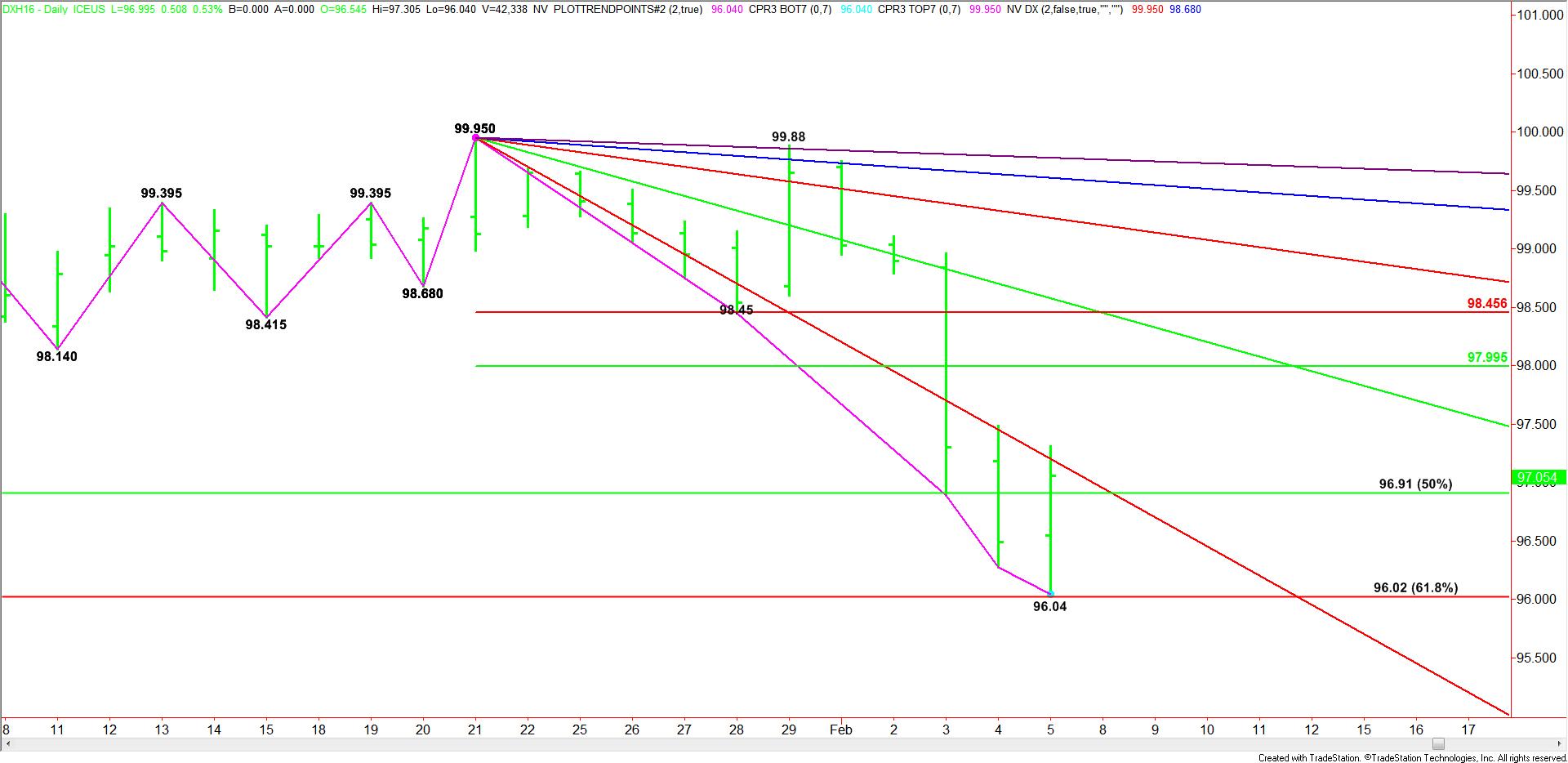
Technically, the March U.S. Dollar Index posted a potentially bullish closing price reversal bottom on Friday. We feel that given the better-than-expected U.S. labor report, the upside momentum created by Friday’s move should carry over into this week. We’re not looking for a change in trend because there are still too many negative variables working against the dollar at this time, but we do feel that the greenback is due for a price adjustment.
The first sign of strength next week will be an opening over a downtrending Gann angle at 96.45. This could occur fairly easily with just a flat open since the market closed at 97.05. This angle stopped the rally on Friday so crossing to the strong side of it will give it an early upside bias.
The breakout to the upside should occur when Friday’s high at 97.31 is taken out. Since there is room to the upside, this move may trigger a price acceleration.
Based on the range created by the January 21 top at 99.95 and the February 5 bottom at 96.04, the first objective to the upside is its 50% level at 97.99. If the buying is strong enough, the next objective is the Fibonacci level at 98.46.
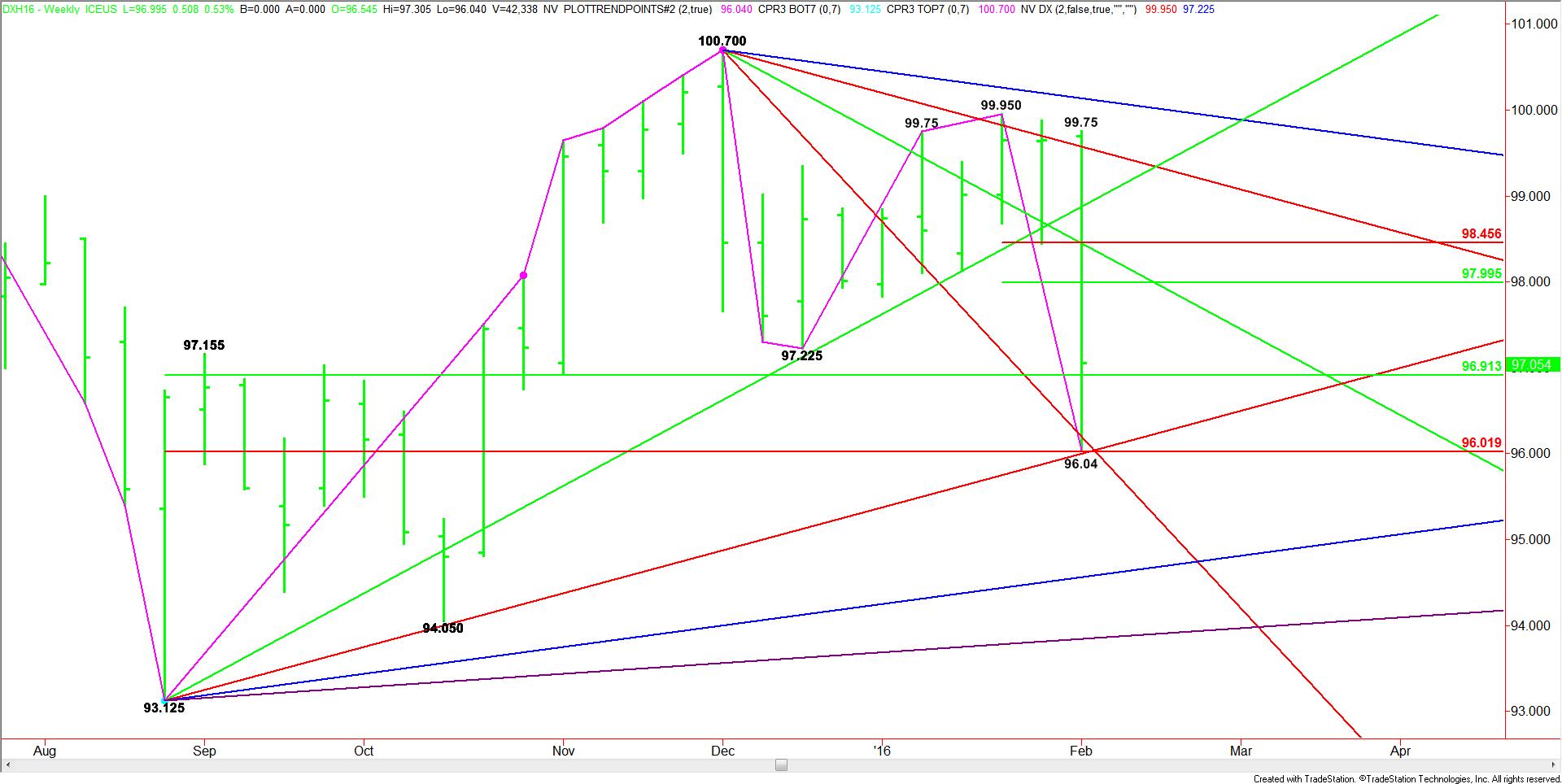
By looking at the weekly chart, we can see that last week’s low at 96.04 wasn’t just random. The bottom occurred inside a major retracement zone and slightly above a major Fibonacci level at 96.04. Friday’s close was also on the strong side of the major 50% level at 96.91.
Because of the way the market rebounded on Friday, we could still see some consolidation inside the 96.91 to 96.02 retracement zone, but once we clear 97.31 and sustain the move, we should reach our minimum objective of 97.99.
Once again, we’re not looking for a change in trend, but a retracement of the recent break. We feel that sellers may have overdone it on the downside. Additionally, we feel that the economy is not as weak as perceived early last week given the stronger-than-expected U.S. jobs report.
Last week’s volatile price action by the March U.S. Dollar Index was all about the pace and the timing of the expected Fed rate hikes. The greenback broke sharply for two days last week on negative news about the pace of the rate increases, but managed to rebound at the end of the week, following the release of more upbeat news.
The U.S. dollar broke sharply on February 3 when the U.S. ISM Non-Manufacturing PMI data missed the estimate. The report showed a reading of 53.5 versus an estimate of 55.1. It also meant that the U.S. services sector expanded in January at its slowest pace since 2014.
The forecasting tool showed that the financial markets were now assigning no higher than a 28 percent chance at any meeting this year, and just a 31 percent chance of a rate hike at 2017’s first meeting.
The result of the steep drop in treasury yields was a sharp plunge in the U.S. dollar. The greenback suffered its worst day in seven years. Compounding the problem were comments from New York Fed President William C. Dudley, who said in an interview with Market News International that policy makers are “acknowledging that things have happened in the financial markets and in the flow of the economic data that may be in the process of altering the outlook for growth and the risk to the outlook for growth going forward”.
By Friday, February 5, a completely different picture started to develop after data showed a pickup in U.S. wages in January, suggesting greater inflation and diminishing the view that the Federal Reserve would not hike rates at all this year.
According to the U.S. Labor Department, average hourly earnings increased 12 cents, or 0.5 percent, last month, leaving the year-on-year gain in earnings at 2.5 percent. This was 0.5 percent higher than the 2.0 percent inflation figure the Fed was hoping for.
The strong wage data was enough to drive the dollar higher even as the headline non-farm payrolls increased by just 151,000 jobs last month, below the 193,000 that economists were expecting. The unemployment rate also fell to 4.9 percent, the lowest since February 2008.
So while the dollar plummeted earlier in the week on the view that weak domestic economic data and worries over the global economy could prevent the Fed from hiking rates this year, as well as dovish comments from the Fed’s Dudley, it closed the week on the notion that maybe there will be at least one rate hike after all if we see more stabilization and improvement in the domestic and global economies.
Technically, the March U.S. Dollar Index posted a potentially bullish closing price reversal bottom on Friday. We feel that given the better-than-expected U.S. labor report, the upside momentum created by Friday’s move should carry over into this week. We’re not looking for a change in trend because there are still too many negative variables working against the dollar at this time, but we do feel that the greenback is due for a price adjustment.
The first sign of strength next week will be an opening over a downtrending Gann angle at 96.45. This could occur fairly easily with just a flat open since the market closed at 97.05. This angle stopped the rally on Friday so crossing to the strong side of it will give it an early upside bias.
The breakout to the upside should occur when Friday’s high at 97.31 is taken out. Since there is room to the upside, this move may trigger a price acceleration.
Based on the range created by the January 21 top at 99.95 and the February 5 bottom at 96.04, the first objective to the upside is its 50% level at 97.99. If the buying is strong enough, the next objective is the Fibonacci level at 98.46.
By looking at the weekly chart, we can see that last week’s low at 96.04 wasn’t just random. The bottom occurred inside a major retracement zone and slightly above a major Fibonacci level at 96.04. Friday’s close was also on the strong side of the major 50% level at 96.91.
Because of the way the market rebounded on Friday, we could still see some consolidation inside the 96.91 to 96.02 retracement zone, but once we clear 97.31 and sustain the move, we should reach our minimum objective of 97.99.
Once again, we’re not looking for a change in trend, but a retracement of the recent break. We feel that sellers may have overdone it on the downside. Additionally, we feel that the economy is not as weak as perceived early last week given the stronger-than-expected U.S. jobs report.
James A. Hyerczyk is a financial analyst for FX Empire, a leading financial portal. James has worked as a fundamental and technical financial market analyst since 1982. His technical work features the pattern, price and time analysis techniques of W.D. Gann. James A. Hyerczyk is a senior analyst at FX Empire. He has worked as a fundamental and technical financial market analyst since 1982. His technical work features the pattern, price and time analysis techniques of W.D. Gann.
73% of Young Investors Say Traditional Wealth Building Is Broken – Here’s How They Trade Instead
Featured Videos
Executive Interview | Charlotte Bullock | Chief Product Officer, Bank of London | FMLS:25
In this interview, we sat down with Charlotte Bullock, Head of Product at The Bank of London, previously at SAP and now shaping product at one of the sector’s most ambitious new banking players.
Charlotte reflects on the Summit so far and talks about the culture inside fintech banks today. We look at the pressures that come with scaling, and how firms can hold onto the nimble approach that made them stand out early on.
We also cover the state of payments ahead of her appearance on the payments roundtable: the blockages financial firms face, the areas that still need fixing, and what a realistic solution looks like in 2026.
In this interview, we sat down with Charlotte Bullock, Head of Product at The Bank of London, previously at SAP and now shaping product at one of the sector’s most ambitious new banking players.
Charlotte reflects on the Summit so far and talks about the culture inside fintech banks today. We look at the pressures that come with scaling, and how firms can hold onto the nimble approach that made them stand out early on.
We also cover the state of payments ahead of her appearance on the payments roundtable: the blockages financial firms face, the areas that still need fixing, and what a realistic solution looks like in 2026.
In this interview, we sat down with Charlotte Bullock, Head of Product at The Bank of London, previously at SAP and now shaping product at one of the sector’s most ambitious new banking players.
Charlotte reflects on the Summit so far and talks about the culture inside fintech banks today. We look at the pressures that come with scaling, and how firms can hold onto the nimble approach that made them stand out early on.
We also cover the state of payments ahead of her appearance on the payments roundtable: the blockages financial firms face, the areas that still need fixing, and what a realistic solution looks like in 2026.
In this interview, we sat down with Charlotte Bullock, Head of Product at The Bank of London, previously at SAP and now shaping product at one of the sector’s most ambitious new banking players.
Charlotte reflects on the Summit so far and talks about the culture inside fintech banks today. We look at the pressures that come with scaling, and how firms can hold onto the nimble approach that made them stand out early on.
We also cover the state of payments ahead of her appearance on the payments roundtable: the blockages financial firms face, the areas that still need fixing, and what a realistic solution looks like in 2026.
In this conversation, we sit down with Drew Niv, CSO at ATFX Connect and one of the most influential figures in modern FX.
We speak about market structure, the institutional view on liquidity, and the sharp rise of prop trading, a sector Drew has been commenting on in recent months. Drew explains why he once dismissed prop trading, why his view changed, and what he now thinks the model means for brokers, clients and risk managers.
We explore subscription-fee dependency, the high reneging rate, and the long-term challenge: how brokers can build a more stable and honest version of the model. Drew also talks about the traffic advantage standalone prop firms have built and why brokers may still win in the long run if they take the right approach.
In this conversation, we sit down with Drew Niv, CSO at ATFX Connect and one of the most influential figures in modern FX.
We speak about market structure, the institutional view on liquidity, and the sharp rise of prop trading, a sector Drew has been commenting on in recent months. Drew explains why he once dismissed prop trading, why his view changed, and what he now thinks the model means for brokers, clients and risk managers.
We explore subscription-fee dependency, the high reneging rate, and the long-term challenge: how brokers can build a more stable and honest version of the model. Drew also talks about the traffic advantage standalone prop firms have built and why brokers may still win in the long run if they take the right approach.
In this conversation, we sit down with Drew Niv, CSO at ATFX Connect and one of the most influential figures in modern FX.
We speak about market structure, the institutional view on liquidity, and the sharp rise of prop trading, a sector Drew has been commenting on in recent months. Drew explains why he once dismissed prop trading, why his view changed, and what he now thinks the model means for brokers, clients and risk managers.
We explore subscription-fee dependency, the high reneging rate, and the long-term challenge: how brokers can build a more stable and honest version of the model. Drew also talks about the traffic advantage standalone prop firms have built and why brokers may still win in the long run if they take the right approach.
In this conversation, we sit down with Drew Niv, CSO at ATFX Connect and one of the most influential figures in modern FX.
We speak about market structure, the institutional view on liquidity, and the sharp rise of prop trading, a sector Drew has been commenting on in recent months. Drew explains why he once dismissed prop trading, why his view changed, and what he now thinks the model means for brokers, clients and risk managers.
We explore subscription-fee dependency, the high reneging rate, and the long-term challenge: how brokers can build a more stable and honest version of the model. Drew also talks about the traffic advantage standalone prop firms have built and why brokers may still win in the long run if they take the right approach.
In this conversation, we sit down with Drew Niv, CSO at ATFX Connect and one of the most influential figures in modern FX.
We speak about market structure, the institutional view on liquidity, and the sharp rise of prop trading, a sector Drew has been commenting on in recent months. Drew explains why he once dismissed prop trading, why his view changed, and what he now thinks the model means for brokers, clients and risk managers.
We explore subscription-fee dependency, the high reneging rate, and the long-term challenge: how brokers can build a more stable and honest version of the model. Drew also talks about the traffic advantage standalone prop firms have built and why brokers may still win in the long run if they take the right approach.
In this conversation, we sit down with Drew Niv, CSO at ATFX Connect and one of the most influential figures in modern FX.
We speak about market structure, the institutional view on liquidity, and the sharp rise of prop trading, a sector Drew has been commenting on in recent months. Drew explains why he once dismissed prop trading, why his view changed, and what he now thinks the model means for brokers, clients and risk managers.
We explore subscription-fee dependency, the high reneging rate, and the long-term challenge: how brokers can build a more stable and honest version of the model. Drew also talks about the traffic advantage standalone prop firms have built and why brokers may still win in the long run if they take the right approach.
Executive Interview | Remonda Z. Kirketerp Møller| CEO & Founder Muinmos | FMLS:25
In this interview, Remonda Z. Kirketerp Møller, founder of Muinmos, breaks down the state of AI in regtech and what responsible adoption really looks like for brokers. We talk about rising fragmentation, the pressures around compliance accuracy, and why most firms are still in the early stages of AI maturity.
Ramanda also shares insights on regulator sandboxes, shifting expectations around accountability, and the current reality of MiCA licensing and passporting in Europe.
A concise look at where compliance, onboarding, and AI-driven processes are heading next.
In this interview, Remonda Z. Kirketerp Møller, founder of Muinmos, breaks down the state of AI in regtech and what responsible adoption really looks like for brokers. We talk about rising fragmentation, the pressures around compliance accuracy, and why most firms are still in the early stages of AI maturity.
Ramanda also shares insights on regulator sandboxes, shifting expectations around accountability, and the current reality of MiCA licensing and passporting in Europe.
A concise look at where compliance, onboarding, and AI-driven processes are heading next.
In this interview, Remonda Z. Kirketerp Møller, founder of Muinmos, breaks down the state of AI in regtech and what responsible adoption really looks like for brokers. We talk about rising fragmentation, the pressures around compliance accuracy, and why most firms are still in the early stages of AI maturity.
Ramanda also shares insights on regulator sandboxes, shifting expectations around accountability, and the current reality of MiCA licensing and passporting in Europe.
A concise look at where compliance, onboarding, and AI-driven processes are heading next.
In this interview, Remonda Z. Kirketerp Møller, founder of Muinmos, breaks down the state of AI in regtech and what responsible adoption really looks like for brokers. We talk about rising fragmentation, the pressures around compliance accuracy, and why most firms are still in the early stages of AI maturity.
Ramanda also shares insights on regulator sandboxes, shifting expectations around accountability, and the current reality of MiCA licensing and passporting in Europe.
A concise look at where compliance, onboarding, and AI-driven processes are heading next.
In this interview, Remonda Z. Kirketerp Møller, founder of Muinmos, breaks down the state of AI in regtech and what responsible adoption really looks like for brokers. We talk about rising fragmentation, the pressures around compliance accuracy, and why most firms are still in the early stages of AI maturity.
Ramanda also shares insights on regulator sandboxes, shifting expectations around accountability, and the current reality of MiCA licensing and passporting in Europe.
A concise look at where compliance, onboarding, and AI-driven processes are heading next.
In this interview, Remonda Z. Kirketerp Møller, founder of Muinmos, breaks down the state of AI in regtech and what responsible adoption really looks like for brokers. We talk about rising fragmentation, the pressures around compliance accuracy, and why most firms are still in the early stages of AI maturity.
Ramanda also shares insights on regulator sandboxes, shifting expectations around accountability, and the current reality of MiCA licensing and passporting in Europe.
A concise look at where compliance, onboarding, and AI-driven processes are heading next.
In this conversation, we speak with Aydin Bonabi, CEO and co-founder of Surveill, a firm focused on fraud detection and AI-driven compliance tools for financial institutions.
We start with Aydin’s view of the Summit and the challenges brokers face as fraud tactics grow more complex. He explains how firms can stay ahead through real-time signals, data patterns, and early-stage detection.
We also talk about AI training and why compliance teams often struggle to keep models accurate, fair, and aligned with regulatory expectations. Aydin breaks down what “good” AI training looks like inside a financial environment, including the importance of clean data, domain expertise, and human oversight.
He closes with a clear message: fraud is scaling, and so must the tools that stop it.
In this conversation, we speak with Aydin Bonabi, CEO and co-founder of Surveill, a firm focused on fraud detection and AI-driven compliance tools for financial institutions.
We start with Aydin’s view of the Summit and the challenges brokers face as fraud tactics grow more complex. He explains how firms can stay ahead through real-time signals, data patterns, and early-stage detection.
We also talk about AI training and why compliance teams often struggle to keep models accurate, fair, and aligned with regulatory expectations. Aydin breaks down what “good” AI training looks like inside a financial environment, including the importance of clean data, domain expertise, and human oversight.
He closes with a clear message: fraud is scaling, and so must the tools that stop it.
In this conversation, we speak with Aydin Bonabi, CEO and co-founder of Surveill, a firm focused on fraud detection and AI-driven compliance tools for financial institutions.
We start with Aydin’s view of the Summit and the challenges brokers face as fraud tactics grow more complex. He explains how firms can stay ahead through real-time signals, data patterns, and early-stage detection.
We also talk about AI training and why compliance teams often struggle to keep models accurate, fair, and aligned with regulatory expectations. Aydin breaks down what “good” AI training looks like inside a financial environment, including the importance of clean data, domain expertise, and human oversight.
He closes with a clear message: fraud is scaling, and so must the tools that stop it.
In this conversation, we speak with Aydin Bonabi, CEO and co-founder of Surveill, a firm focused on fraud detection and AI-driven compliance tools for financial institutions.
We start with Aydin’s view of the Summit and the challenges brokers face as fraud tactics grow more complex. He explains how firms can stay ahead through real-time signals, data patterns, and early-stage detection.
We also talk about AI training and why compliance teams often struggle to keep models accurate, fair, and aligned with regulatory expectations. Aydin breaks down what “good” AI training looks like inside a financial environment, including the importance of clean data, domain expertise, and human oversight.
He closes with a clear message: fraud is scaling, and so must the tools that stop it.
In this conversation, we speak with Aydin Bonabi, CEO and co-founder of Surveill, a firm focused on fraud detection and AI-driven compliance tools for financial institutions.
We start with Aydin’s view of the Summit and the challenges brokers face as fraud tactics grow more complex. He explains how firms can stay ahead through real-time signals, data patterns, and early-stage detection.
We also talk about AI training and why compliance teams often struggle to keep models accurate, fair, and aligned with regulatory expectations. Aydin breaks down what “good” AI training looks like inside a financial environment, including the importance of clean data, domain expertise, and human oversight.
He closes with a clear message: fraud is scaling, and so must the tools that stop it.
In this conversation, we speak with Aydin Bonabi, CEO and co-founder of Surveill, a firm focused on fraud detection and AI-driven compliance tools for financial institutions.
We start with Aydin’s view of the Summit and the challenges brokers face as fraud tactics grow more complex. He explains how firms can stay ahead through real-time signals, data patterns, and early-stage detection.
We also talk about AI training and why compliance teams often struggle to keep models accurate, fair, and aligned with regulatory expectations. Aydin breaks down what “good” AI training looks like inside a financial environment, including the importance of clean data, domain expertise, and human oversight.
He closes with a clear message: fraud is scaling, and so must the tools that stop it.
Exness expands its presence in Africa: Inside our interview with Paul Margarites in Cape Town
Finance Magnates met with Paul Margarites, Exness regional commercial director for Sub-Saharan Africa, during a visit to the firm’s office opening in Cape Town. In this talk, led by Andrea Badiola Mateos, Co-CEO at Finance Magnates, Paul shares views on the South African trading space, local user behavior, mobile trends, regulation, team growth, and how Exness plans to grow in more markets across the region. @Exness
Read the article at: https://www.financemagnates.com/thought-leadership/exness-expands-its-presence-in-africa-inside-our-interview-with-paul-margarites/
#exness #financemagnates #exnesstrading #CFDtrading #tradeonline #africanews #capetown
Finance Magnates met with Paul Margarites, Exness regional commercial director for Sub-Saharan Africa, during a visit to the firm’s office opening in Cape Town. In this talk, led by Andrea Badiola Mateos, Co-CEO at Finance Magnates, Paul shares views on the South African trading space, local user behavior, mobile trends, regulation, team growth, and how Exness plans to grow in more markets across the region. @Exness
Read the article at: https://www.financemagnates.com/thought-leadership/exness-expands-its-presence-in-africa-inside-our-interview-with-paul-margarites/
#exness #financemagnates #exnesstrading #CFDtrading #tradeonline #africanews #capetown
Finance Magnates met with Paul Margarites, Exness regional commercial director for Sub-Saharan Africa, during a visit to the firm’s office opening in Cape Town. In this talk, led by Andrea Badiola Mateos, Co-CEO at Finance Magnates, Paul shares views on the South African trading space, local user behavior, mobile trends, regulation, team growth, and how Exness plans to grow in more markets across the region. @Exness
Read the article at: https://www.financemagnates.com/thought-leadership/exness-expands-its-presence-in-africa-inside-our-interview-with-paul-margarites/
#exness #financemagnates #exnesstrading #CFDtrading #tradeonline #africanews #capetown
Finance Magnates met with Paul Margarites, Exness regional commercial director for Sub-Saharan Africa, during a visit to the firm’s office opening in Cape Town. In this talk, led by Andrea Badiola Mateos, Co-CEO at Finance Magnates, Paul shares views on the South African trading space, local user behavior, mobile trends, regulation, team growth, and how Exness plans to grow in more markets across the region. @Exness
Read the article at: https://www.financemagnates.com/thought-leadership/exness-expands-its-presence-in-africa-inside-our-interview-with-paul-margarites/
#exness #financemagnates #exnesstrading #CFDtrading #tradeonline #africanews #capetown
Finance Magnates met with Paul Margarites, Exness regional commercial director for Sub-Saharan Africa, during a visit to the firm’s office opening in Cape Town. In this talk, led by Andrea Badiola Mateos, Co-CEO at Finance Magnates, Paul shares views on the South African trading space, local user behavior, mobile trends, regulation, team growth, and how Exness plans to grow in more markets across the region. @Exness
Read the article at: https://www.financemagnates.com/thought-leadership/exness-expands-its-presence-in-africa-inside-our-interview-with-paul-margarites/
#exness #financemagnates #exnesstrading #CFDtrading #tradeonline #africanews #capetown
Finance Magnates met with Paul Margarites, Exness regional commercial director for Sub-Saharan Africa, during a visit to the firm’s office opening in Cape Town. In this talk, led by Andrea Badiola Mateos, Co-CEO at Finance Magnates, Paul shares views on the South African trading space, local user behavior, mobile trends, regulation, team growth, and how Exness plans to grow in more markets across the region. @Exness
Read the article at: https://www.financemagnates.com/thought-leadership/exness-expands-its-presence-in-africa-inside-our-interview-with-paul-margarites/
#exness #financemagnates #exnesstrading #CFDtrading #tradeonline #africanews #capetown