Investors continue to react to Yellen’s upbeat assessment of the economy and the better-than-expected U.S. retail data.
Bloomberg
Last week, Fed Chairwoman Janet Yellen stood her ground as she testified before the Senate Banking Committee when she delivered her upbeat assessment about the economy and reiterated the Fed’s official stance that there is still the possibility of additional interest rate hikes in 2016.
Her comments, however, highlighted the differences in what the Fed believes and what the financial market investors think. The Fed expects the U.S. economy to continue to grow slow, leading to gradual interest rate hikes in 2016. Investors believe the global economic weakness will have an effect on the domestic economy and that the Fed’s next rate hike won’t take place until early 2017.
Yellen even acknowledged that there was still the possibility of a rate hike in March. “We will meet in March, and our committee will carefully deliberate about what impact these developments have had,” Ms. Yellen told Congress, referring to the market turmoil and next month’s meeting of the Federal Open Market Committee (FOMC). “Today I think it’s premature to render a judgment.”
Earlier in the month, the government reported that the economy added 151,000 new jobs in January. The unemployment rate also fell to 4.9 percent. Most of all, Average Hourly Earnings came in at 0.5%, well above the 0.3% forecast. This is an important inflation indicator for the Fed.
The Fed can’t do much about consumer inflation because its actions do not have a direct effect on crude oil prices, which while at a 12-year low, are dragging down the Consumer Price Index (CPI). Yellen acknowledged that “a lot has happened” since December when the Fed predicted it would spend 2016 gradually raising rates. She also added that risk-adverse investors could disrupt slow-and-steady economic growth.
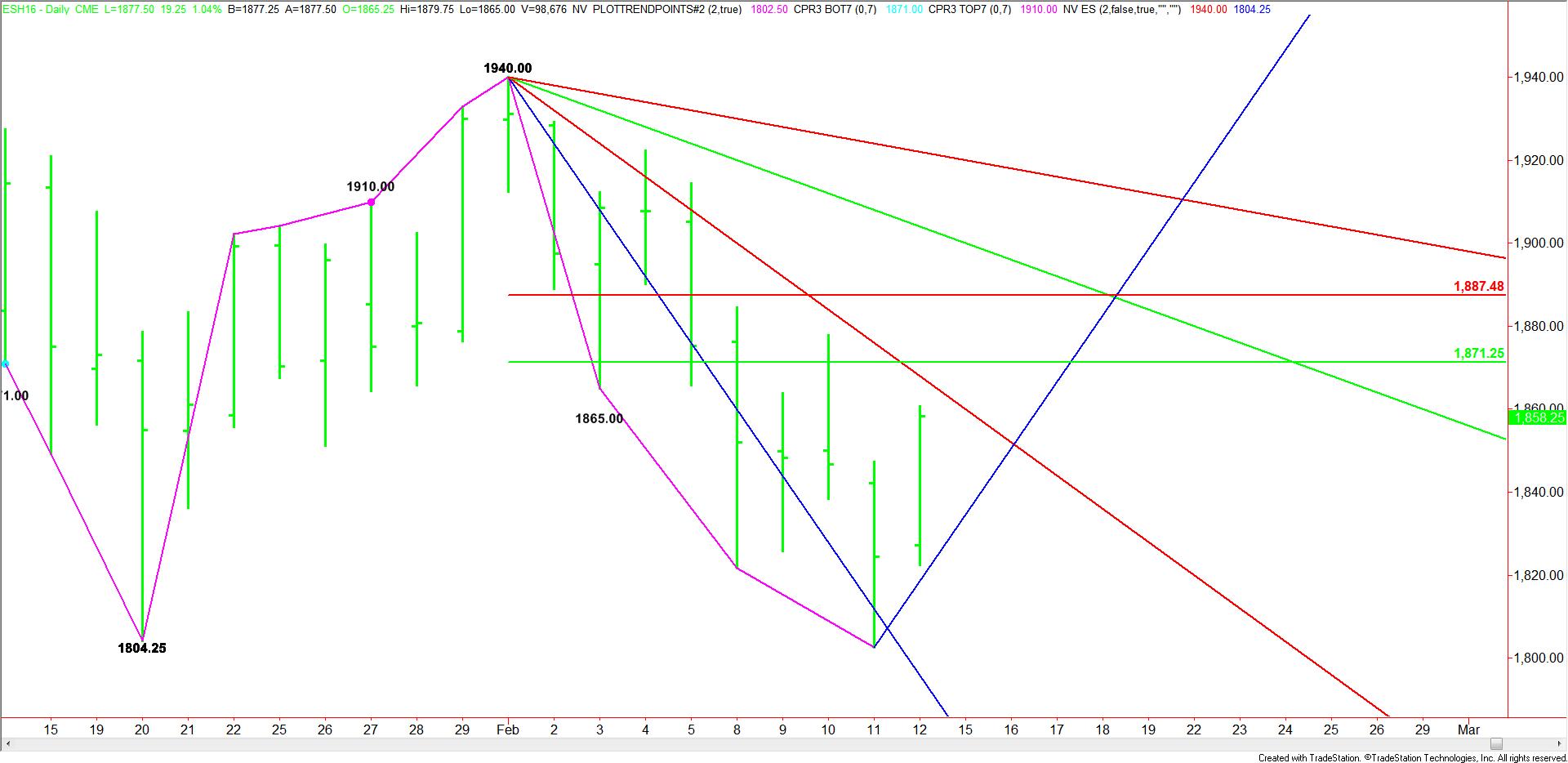
Although stocks were falling sharply and investor money was moving rapidly into the safety of the Treasurys and gold market while Yellen was speaking, stocks have recovered nicely since the end of her testimony on February 11. March E-mini S&P 500 Index futures reached a low that day at 1802.50 and finished the week at 1858.25.
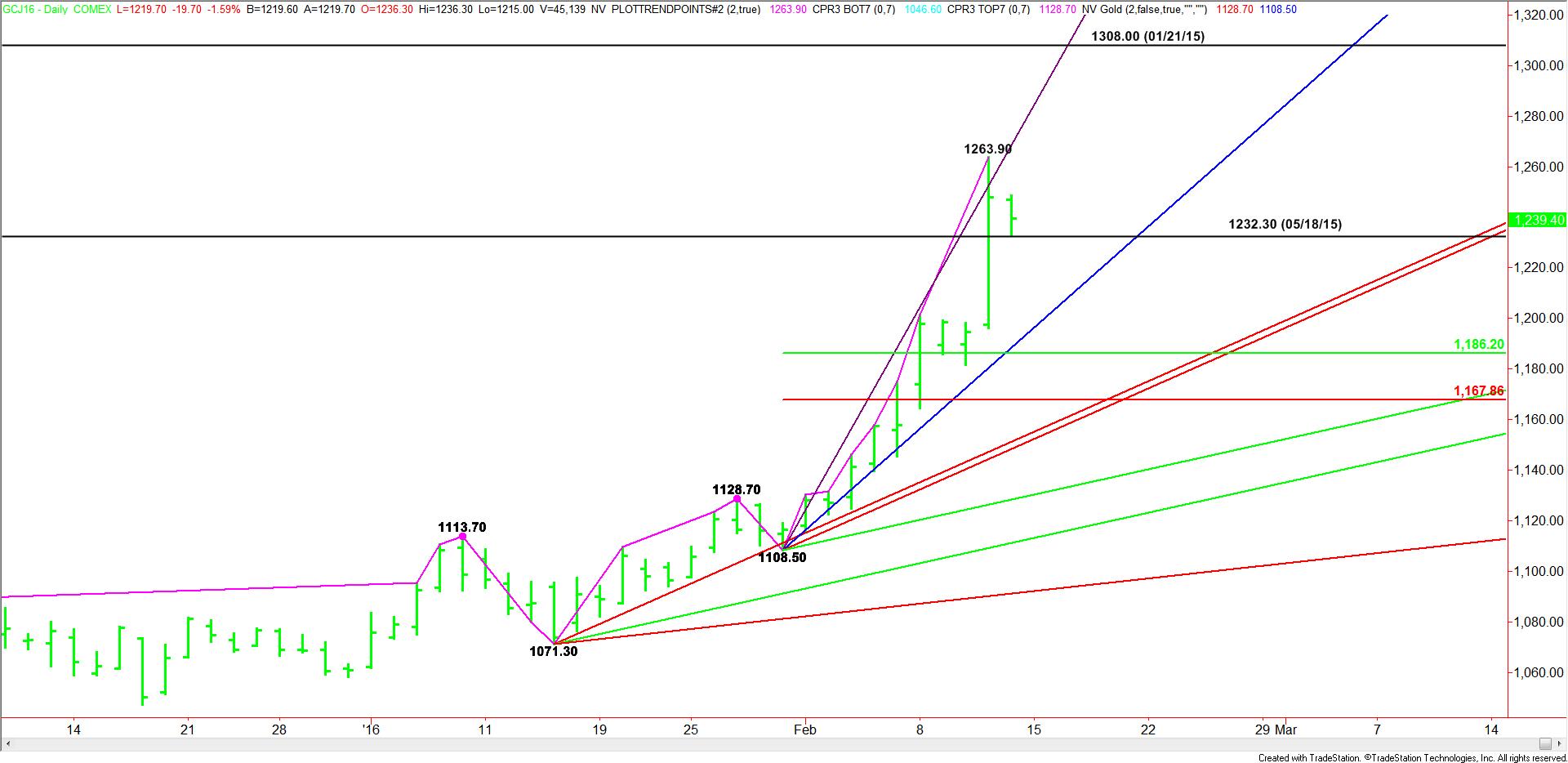
March T-Bonds, which spiked higher as investors climbed the wall of worry last week, reached a high at 170’26 before breaking sharply into the end of the week. The benchmark March 10-Year Notes reached a high at 133’01.5 before weakening into Friday’s close and April Gold, which spiked up to its highest level since May 2015 at $1263.90, also indicated the presence of sellers at the end of the week.
The price action into the end of the week indicates that a shift in investor sentiment may be taking place or that investors overdid the selling in the equity markets and the buying in the Treasurys and gold. This suggests that the markets may be due for a major adjustment while investors reassess the state of the economy given the testimony by Yellen and the strength of the U.S. retail sales report.
The price adjustment could take place this week, driven mostly by the momentum into Friday’s close. On Wednesday, the FOMC Meeting minutes will be released. This should give greater insight into the thinking of the committee members.
If the minutes show that the FOMC members still believe the economy is strong enough to warrant additional rate hikes in 2016 then we could see weakness in the Treasurys and gold. The U.S. dollar, on the other hand, will likely be underpinned by the news. The jury is still out on the direction of the equity markets because several factors like the turmoil in international bank stocks are still exerting their influence on stocks.
We could see more volatility if the FOMC minutes indicate dissension between the member over the timing and pace of the additional rate hikes. This will likely cause uncertainty because it will likely lead to a lack of confidence in the Fed’s ability to judge the state of the economy.
In summary, look for early strength in the U.S. stock markets this week and general weakness in the Treasurys and gold as investors continue to react to Yellen’s upbeat assessment of the economy and the better-than-expected U.S. retail data.
Watch for volatility to return with the release of the Fed minutes on Wednesday, February 17. The markets are likely to continue their moves from earlier in the week if the FOMC members are on the same page for additional rate hikes. However, we could see excessive volatility if the FOMC members disagreed on the timing and pace of the additional rate increases.
Last week, Fed Chairwoman Janet Yellen stood her ground as she testified before the Senate Banking Committee when she delivered her upbeat assessment about the economy and reiterated the Fed’s official stance that there is still the possibility of additional interest rate hikes in 2016.
Her comments, however, highlighted the differences in what the Fed believes and what the financial market investors think. The Fed expects the U.S. economy to continue to grow slow, leading to gradual interest rate hikes in 2016. Investors believe the global economic weakness will have an effect on the domestic economy and that the Fed’s next rate hike won’t take place until early 2017.
Yellen even acknowledged that there was still the possibility of a rate hike in March. “We will meet in March, and our committee will carefully deliberate about what impact these developments have had,” Ms. Yellen told Congress, referring to the market turmoil and next month’s meeting of the Federal Open Market Committee (FOMC). “Today I think it’s premature to render a judgment.”
Earlier in the month, the government reported that the economy added 151,000 new jobs in January. The unemployment rate also fell to 4.9 percent. Most of all, Average Hourly Earnings came in at 0.5%, well above the 0.3% forecast. This is an important inflation indicator for the Fed.
The Fed can’t do much about consumer inflation because its actions do not have a direct effect on crude oil prices, which while at a 12-year low, are dragging down the Consumer Price Index (CPI). Yellen acknowledged that “a lot has happened” since December when the Fed predicted it would spend 2016 gradually raising rates. She also added that risk-adverse investors could disrupt slow-and-steady economic growth.
Although stocks were falling sharply and investor money was moving rapidly into the safety of the Treasurys and gold market while Yellen was speaking, stocks have recovered nicely since the end of her testimony on February 11. March E-mini S&P 500 Index futures reached a low that day at 1802.50 and finished the week at 1858.25.
March T-Bonds, which spiked higher as investors climbed the wall of worry last week, reached a high at 170’26 before breaking sharply into the end of the week. The benchmark March 10-Year Notes reached a high at 133’01.5 before weakening into Friday’s close and April Gold, which spiked up to its highest level since May 2015 at $1263.90, also indicated the presence of sellers at the end of the week.
The price action into the end of the week indicates that a shift in investor sentiment may be taking place or that investors overdid the selling in the equity markets and the buying in the Treasurys and gold. This suggests that the markets may be due for a major adjustment while investors reassess the state of the economy given the testimony by Yellen and the strength of the U.S. retail sales report.
The price adjustment could take place this week, driven mostly by the momentum into Friday’s close. On Wednesday, the FOMC Meeting minutes will be released. This should give greater insight into the thinking of the committee members.
If the minutes show that the FOMC members still believe the economy is strong enough to warrant additional rate hikes in 2016 then we could see weakness in the Treasurys and gold. The U.S. dollar, on the other hand, will likely be underpinned by the news. The jury is still out on the direction of the equity markets because several factors like the turmoil in international bank stocks are still exerting their influence on stocks.
We could see more volatility if the FOMC minutes indicate dissension between the member over the timing and pace of the additional rate hikes. This will likely cause uncertainty because it will likely lead to a lack of confidence in the Fed’s ability to judge the state of the economy.
In summary, look for early strength in the U.S. stock markets this week and general weakness in the Treasurys and gold as investors continue to react to Yellen’s upbeat assessment of the economy and the better-than-expected U.S. retail data.
Watch for volatility to return with the release of the Fed minutes on Wednesday, February 17. The markets are likely to continue their moves from earlier in the week if the FOMC members are on the same page for additional rate hikes. However, we could see excessive volatility if the FOMC members disagreed on the timing and pace of the additional rate increases.
James A. Hyerczyk is a financial analyst for FX Empire, a leading financial portal. James has worked as a fundamental and technical financial market analyst since 1982. His technical work features the pattern, price and time analysis techniques of W.D. Gann. James A. Hyerczyk is a senior analyst at FX Empire. He has worked as a fundamental and technical financial market analyst since 1982. His technical work features the pattern, price and time analysis techniques of W.D. Gann.
Prop Firms and Brokers Form a Perfect Synergy: One Offers Access, the Other Capital
Featured Videos
Executive Interview | Charlotte Bullock | Chief Product Officer, Bank of London | FMLS:25
In this interview, we sat down with Charlotte Bullock, Head of Product at The Bank of London, previously at SAP and now shaping product at one of the sector’s most ambitious new banking players.
Charlotte reflects on the Summit so far and talks about the culture inside fintech banks today. We look at the pressures that come with scaling, and how firms can hold onto the nimble approach that made them stand out early on.
We also cover the state of payments ahead of her appearance on the payments roundtable: the blockages financial firms face, the areas that still need fixing, and what a realistic solution looks like in 2026.
In this interview, we sat down with Charlotte Bullock, Head of Product at The Bank of London, previously at SAP and now shaping product at one of the sector’s most ambitious new banking players.
Charlotte reflects on the Summit so far and talks about the culture inside fintech banks today. We look at the pressures that come with scaling, and how firms can hold onto the nimble approach that made them stand out early on.
We also cover the state of payments ahead of her appearance on the payments roundtable: the blockages financial firms face, the areas that still need fixing, and what a realistic solution looks like in 2026.
In this interview, we sat down with Charlotte Bullock, Head of Product at The Bank of London, previously at SAP and now shaping product at one of the sector’s most ambitious new banking players.
Charlotte reflects on the Summit so far and talks about the culture inside fintech banks today. We look at the pressures that come with scaling, and how firms can hold onto the nimble approach that made them stand out early on.
We also cover the state of payments ahead of her appearance on the payments roundtable: the blockages financial firms face, the areas that still need fixing, and what a realistic solution looks like in 2026.
In this interview, we sat down with Charlotte Bullock, Head of Product at The Bank of London, previously at SAP and now shaping product at one of the sector’s most ambitious new banking players.
Charlotte reflects on the Summit so far and talks about the culture inside fintech banks today. We look at the pressures that come with scaling, and how firms can hold onto the nimble approach that made them stand out early on.
We also cover the state of payments ahead of her appearance on the payments roundtable: the blockages financial firms face, the areas that still need fixing, and what a realistic solution looks like in 2026.
In this conversation, we sit down with Drew Niv, CSO at ATFX Connect and one of the most influential figures in modern FX.
We speak about market structure, the institutional view on liquidity, and the sharp rise of prop trading, a sector Drew has been commenting on in recent months. Drew explains why he once dismissed prop trading, why his view changed, and what he now thinks the model means for brokers, clients and risk managers.
We explore subscription-fee dependency, the high reneging rate, and the long-term challenge: how brokers can build a more stable and honest version of the model. Drew also talks about the traffic advantage standalone prop firms have built and why brokers may still win in the long run if they take the right approach.
In this conversation, we sit down with Drew Niv, CSO at ATFX Connect and one of the most influential figures in modern FX.
We speak about market structure, the institutional view on liquidity, and the sharp rise of prop trading, a sector Drew has been commenting on in recent months. Drew explains why he once dismissed prop trading, why his view changed, and what he now thinks the model means for brokers, clients and risk managers.
We explore subscription-fee dependency, the high reneging rate, and the long-term challenge: how brokers can build a more stable and honest version of the model. Drew also talks about the traffic advantage standalone prop firms have built and why brokers may still win in the long run if they take the right approach.
In this conversation, we sit down with Drew Niv, CSO at ATFX Connect and one of the most influential figures in modern FX.
We speak about market structure, the institutional view on liquidity, and the sharp rise of prop trading, a sector Drew has been commenting on in recent months. Drew explains why he once dismissed prop trading, why his view changed, and what he now thinks the model means for brokers, clients and risk managers.
We explore subscription-fee dependency, the high reneging rate, and the long-term challenge: how brokers can build a more stable and honest version of the model. Drew also talks about the traffic advantage standalone prop firms have built and why brokers may still win in the long run if they take the right approach.
In this conversation, we sit down with Drew Niv, CSO at ATFX Connect and one of the most influential figures in modern FX.
We speak about market structure, the institutional view on liquidity, and the sharp rise of prop trading, a sector Drew has been commenting on in recent months. Drew explains why he once dismissed prop trading, why his view changed, and what he now thinks the model means for brokers, clients and risk managers.
We explore subscription-fee dependency, the high reneging rate, and the long-term challenge: how brokers can build a more stable and honest version of the model. Drew also talks about the traffic advantage standalone prop firms have built and why brokers may still win in the long run if they take the right approach.
In this conversation, we sit down with Drew Niv, CSO at ATFX Connect and one of the most influential figures in modern FX.
We speak about market structure, the institutional view on liquidity, and the sharp rise of prop trading, a sector Drew has been commenting on in recent months. Drew explains why he once dismissed prop trading, why his view changed, and what he now thinks the model means for brokers, clients and risk managers.
We explore subscription-fee dependency, the high reneging rate, and the long-term challenge: how brokers can build a more stable and honest version of the model. Drew also talks about the traffic advantage standalone prop firms have built and why brokers may still win in the long run if they take the right approach.
In this conversation, we sit down with Drew Niv, CSO at ATFX Connect and one of the most influential figures in modern FX.
We speak about market structure, the institutional view on liquidity, and the sharp rise of prop trading, a sector Drew has been commenting on in recent months. Drew explains why he once dismissed prop trading, why his view changed, and what he now thinks the model means for brokers, clients and risk managers.
We explore subscription-fee dependency, the high reneging rate, and the long-term challenge: how brokers can build a more stable and honest version of the model. Drew also talks about the traffic advantage standalone prop firms have built and why brokers may still win in the long run if they take the right approach.
Executive Interview | Remonda Z. Kirketerp Møller| CEO & Founder Muinmos | FMLS:25
In this interview, Remonda Z. Kirketerp Møller, founder of Muinmos, breaks down the state of AI in regtech and what responsible adoption really looks like for brokers. We talk about rising fragmentation, the pressures around compliance accuracy, and why most firms are still in the early stages of AI maturity.
Ramanda also shares insights on regulator sandboxes, shifting expectations around accountability, and the current reality of MiCA licensing and passporting in Europe.
A concise look at where compliance, onboarding, and AI-driven processes are heading next.
In this interview, Remonda Z. Kirketerp Møller, founder of Muinmos, breaks down the state of AI in regtech and what responsible adoption really looks like for brokers. We talk about rising fragmentation, the pressures around compliance accuracy, and why most firms are still in the early stages of AI maturity.
Ramanda also shares insights on regulator sandboxes, shifting expectations around accountability, and the current reality of MiCA licensing and passporting in Europe.
A concise look at where compliance, onboarding, and AI-driven processes are heading next.
In this interview, Remonda Z. Kirketerp Møller, founder of Muinmos, breaks down the state of AI in regtech and what responsible adoption really looks like for brokers. We talk about rising fragmentation, the pressures around compliance accuracy, and why most firms are still in the early stages of AI maturity.
Ramanda also shares insights on regulator sandboxes, shifting expectations around accountability, and the current reality of MiCA licensing and passporting in Europe.
A concise look at where compliance, onboarding, and AI-driven processes are heading next.
In this interview, Remonda Z. Kirketerp Møller, founder of Muinmos, breaks down the state of AI in regtech and what responsible adoption really looks like for brokers. We talk about rising fragmentation, the pressures around compliance accuracy, and why most firms are still in the early stages of AI maturity.
Ramanda also shares insights on regulator sandboxes, shifting expectations around accountability, and the current reality of MiCA licensing and passporting in Europe.
A concise look at where compliance, onboarding, and AI-driven processes are heading next.
In this interview, Remonda Z. Kirketerp Møller, founder of Muinmos, breaks down the state of AI in regtech and what responsible adoption really looks like for brokers. We talk about rising fragmentation, the pressures around compliance accuracy, and why most firms are still in the early stages of AI maturity.
Ramanda also shares insights on regulator sandboxes, shifting expectations around accountability, and the current reality of MiCA licensing and passporting in Europe.
A concise look at where compliance, onboarding, and AI-driven processes are heading next.
In this interview, Remonda Z. Kirketerp Møller, founder of Muinmos, breaks down the state of AI in regtech and what responsible adoption really looks like for brokers. We talk about rising fragmentation, the pressures around compliance accuracy, and why most firms are still in the early stages of AI maturity.
Ramanda also shares insights on regulator sandboxes, shifting expectations around accountability, and the current reality of MiCA licensing and passporting in Europe.
A concise look at where compliance, onboarding, and AI-driven processes are heading next.
In this conversation, we speak with Aydin Bonabi, CEO and co-founder of Surveill, a firm focused on fraud detection and AI-driven compliance tools for financial institutions.
We start with Aydin’s view of the Summit and the challenges brokers face as fraud tactics grow more complex. He explains how firms can stay ahead through real-time signals, data patterns, and early-stage detection.
We also talk about AI training and why compliance teams often struggle to keep models accurate, fair, and aligned with regulatory expectations. Aydin breaks down what “good” AI training looks like inside a financial environment, including the importance of clean data, domain expertise, and human oversight.
He closes with a clear message: fraud is scaling, and so must the tools that stop it.
In this conversation, we speak with Aydin Bonabi, CEO and co-founder of Surveill, a firm focused on fraud detection and AI-driven compliance tools for financial institutions.
We start with Aydin’s view of the Summit and the challenges brokers face as fraud tactics grow more complex. He explains how firms can stay ahead through real-time signals, data patterns, and early-stage detection.
We also talk about AI training and why compliance teams often struggle to keep models accurate, fair, and aligned with regulatory expectations. Aydin breaks down what “good” AI training looks like inside a financial environment, including the importance of clean data, domain expertise, and human oversight.
He closes with a clear message: fraud is scaling, and so must the tools that stop it.
In this conversation, we speak with Aydin Bonabi, CEO and co-founder of Surveill, a firm focused on fraud detection and AI-driven compliance tools for financial institutions.
We start with Aydin’s view of the Summit and the challenges brokers face as fraud tactics grow more complex. He explains how firms can stay ahead through real-time signals, data patterns, and early-stage detection.
We also talk about AI training and why compliance teams often struggle to keep models accurate, fair, and aligned with regulatory expectations. Aydin breaks down what “good” AI training looks like inside a financial environment, including the importance of clean data, domain expertise, and human oversight.
He closes with a clear message: fraud is scaling, and so must the tools that stop it.
In this conversation, we speak with Aydin Bonabi, CEO and co-founder of Surveill, a firm focused on fraud detection and AI-driven compliance tools for financial institutions.
We start with Aydin’s view of the Summit and the challenges brokers face as fraud tactics grow more complex. He explains how firms can stay ahead through real-time signals, data patterns, and early-stage detection.
We also talk about AI training and why compliance teams often struggle to keep models accurate, fair, and aligned with regulatory expectations. Aydin breaks down what “good” AI training looks like inside a financial environment, including the importance of clean data, domain expertise, and human oversight.
He closes with a clear message: fraud is scaling, and so must the tools that stop it.
In this conversation, we speak with Aydin Bonabi, CEO and co-founder of Surveill, a firm focused on fraud detection and AI-driven compliance tools for financial institutions.
We start with Aydin’s view of the Summit and the challenges brokers face as fraud tactics grow more complex. He explains how firms can stay ahead through real-time signals, data patterns, and early-stage detection.
We also talk about AI training and why compliance teams often struggle to keep models accurate, fair, and aligned with regulatory expectations. Aydin breaks down what “good” AI training looks like inside a financial environment, including the importance of clean data, domain expertise, and human oversight.
He closes with a clear message: fraud is scaling, and so must the tools that stop it.
In this conversation, we speak with Aydin Bonabi, CEO and co-founder of Surveill, a firm focused on fraud detection and AI-driven compliance tools for financial institutions.
We start with Aydin’s view of the Summit and the challenges brokers face as fraud tactics grow more complex. He explains how firms can stay ahead through real-time signals, data patterns, and early-stage detection.
We also talk about AI training and why compliance teams often struggle to keep models accurate, fair, and aligned with regulatory expectations. Aydin breaks down what “good” AI training looks like inside a financial environment, including the importance of clean data, domain expertise, and human oversight.
He closes with a clear message: fraud is scaling, and so must the tools that stop it.
Exness expands its presence in Africa: Inside our interview with Paul Margarites in Cape Town
Finance Magnates met with Paul Margarites, Exness regional commercial director for Sub-Saharan Africa, during a visit to the firm’s office opening in Cape Town. In this talk, led by Andrea Badiola Mateos, Co-CEO at Finance Magnates, Paul shares views on the South African trading space, local user behavior, mobile trends, regulation, team growth, and how Exness plans to grow in more markets across the region. @Exness
Read the article at: https://www.financemagnates.com/thought-leadership/exness-expands-its-presence-in-africa-inside-our-interview-with-paul-margarites/
#exness #financemagnates #exnesstrading #CFDtrading #tradeonline #africanews #capetown
Finance Magnates met with Paul Margarites, Exness regional commercial director for Sub-Saharan Africa, during a visit to the firm’s office opening in Cape Town. In this talk, led by Andrea Badiola Mateos, Co-CEO at Finance Magnates, Paul shares views on the South African trading space, local user behavior, mobile trends, regulation, team growth, and how Exness plans to grow in more markets across the region. @Exness
Read the article at: https://www.financemagnates.com/thought-leadership/exness-expands-its-presence-in-africa-inside-our-interview-with-paul-margarites/
#exness #financemagnates #exnesstrading #CFDtrading #tradeonline #africanews #capetown
Finance Magnates met with Paul Margarites, Exness regional commercial director for Sub-Saharan Africa, during a visit to the firm’s office opening in Cape Town. In this talk, led by Andrea Badiola Mateos, Co-CEO at Finance Magnates, Paul shares views on the South African trading space, local user behavior, mobile trends, regulation, team growth, and how Exness plans to grow in more markets across the region. @Exness
Read the article at: https://www.financemagnates.com/thought-leadership/exness-expands-its-presence-in-africa-inside-our-interview-with-paul-margarites/
#exness #financemagnates #exnesstrading #CFDtrading #tradeonline #africanews #capetown
Finance Magnates met with Paul Margarites, Exness regional commercial director for Sub-Saharan Africa, during a visit to the firm’s office opening in Cape Town. In this talk, led by Andrea Badiola Mateos, Co-CEO at Finance Magnates, Paul shares views on the South African trading space, local user behavior, mobile trends, regulation, team growth, and how Exness plans to grow in more markets across the region. @Exness
Read the article at: https://www.financemagnates.com/thought-leadership/exness-expands-its-presence-in-africa-inside-our-interview-with-paul-margarites/
#exness #financemagnates #exnesstrading #CFDtrading #tradeonline #africanews #capetown
Finance Magnates met with Paul Margarites, Exness regional commercial director for Sub-Saharan Africa, during a visit to the firm’s office opening in Cape Town. In this talk, led by Andrea Badiola Mateos, Co-CEO at Finance Magnates, Paul shares views on the South African trading space, local user behavior, mobile trends, regulation, team growth, and how Exness plans to grow in more markets across the region. @Exness
Read the article at: https://www.financemagnates.com/thought-leadership/exness-expands-its-presence-in-africa-inside-our-interview-with-paul-margarites/
#exness #financemagnates #exnesstrading #CFDtrading #tradeonline #africanews #capetown
Finance Magnates met with Paul Margarites, Exness regional commercial director for Sub-Saharan Africa, during a visit to the firm’s office opening in Cape Town. In this talk, led by Andrea Badiola Mateos, Co-CEO at Finance Magnates, Paul shares views on the South African trading space, local user behavior, mobile trends, regulation, team growth, and how Exness plans to grow in more markets across the region. @Exness
Read the article at: https://www.financemagnates.com/thought-leadership/exness-expands-its-presence-in-africa-inside-our-interview-with-paul-margarites/
#exness #financemagnates #exnesstrading #CFDtrading #tradeonline #africanews #capetown